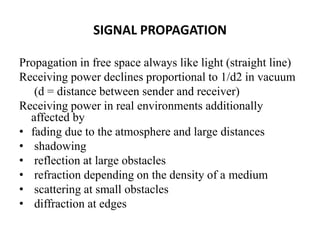
SIGNAL PROPAGATION
Propagation in free space always like light (straight line)
Receiving power declines proportional to 1/d2 in vacuum
(d = distance between sender and receiver)
Receiving power in real environments additionally
affected by
• fading due to the atmosphere and large distances
• shadowing
• reflection at large obstacles
• refraction depending on the density of a medium
• scattering at small obstacles
• diffraction at edges
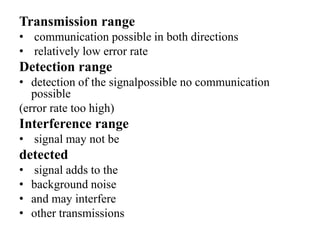
Transmission range
• communication possible in both directions
• relatively low error rate
Detection range
• detection of the signalpossible no communication
possible
(error rate too high)
Interference range
• signal may not be
detected
• signal adds to the
• background noise
• and may interfere
• other transmissions
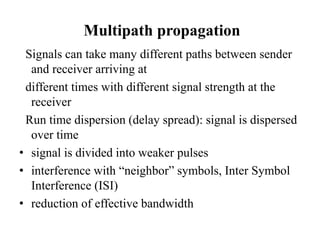
Multipath propagation
Signals can take many different paths between sender
and receiver arriving at
different times with different signal strength at the
receiver
Run time dispersion (delay spread): signal is dispersed
over time
• signal is divided into weaker pulses
• interference with “neighbor” symbols, Inter Symbol
Interference (ISI)
• reduction of effective bandwidth
MULTIPLEXING
Goal:
multiple use of a shared medium realized
on the physical layer (or on the MAC layer as in the
wired case)
Multiplexing can be done regarding
4 dimensions (parameters):
• space (si)
• time (t)
• frequency (f)
• code (c)
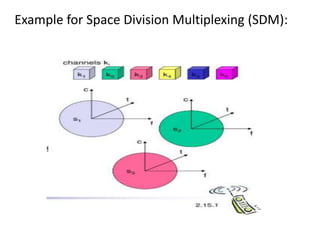
Example for Space Division Multiplexing (SDM):
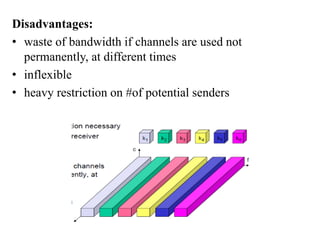
Frequency Division Multiplexing (FDM):
Separation of the whole available spectrum into smaller
frequency bands
A channel gets a certain band of the spectrum exclusively
for the whole time
Advantages:
• no complex coordination necessary between sender and
receiver
Disadvantages:
• waste of bandwidth if channels are used not
permanently, at different times
• inflexible
• heavy restriction on #of potential senders
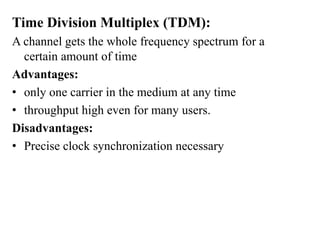
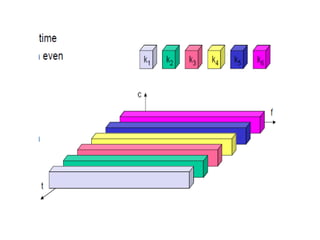
Time Division Multiplex (TDM):
A channel gets the whole frequency spectrum for a
certain amount of time
Advantages:
• only one carrier in the medium at any time
• throughput high even for many users.
Disadvantages:
• Precise clock synchronization necessary
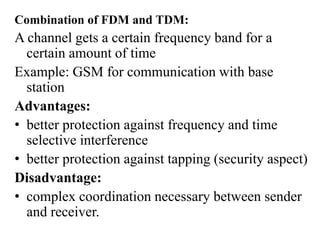
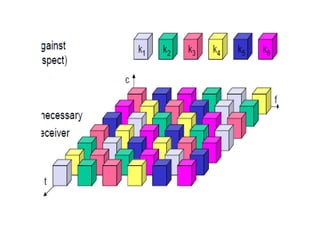
Combination of FDM and TDM:
A channel gets a certain frequency band for a
certain amount of time
Example: GSM for communication with base
station
Advantages:
• better protection against frequency and time
selective interference
• better protection against tapping (security aspect)
Disadvantage:
• complex coordination necessary between sender
and receiver.
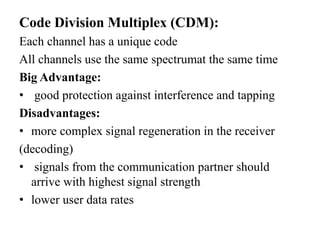
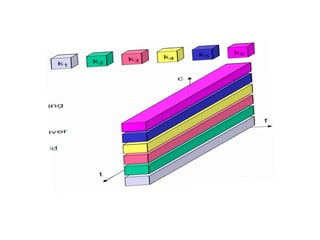
Code Division Multiplex (CDM):
Each channel has a unique code
All channels use the same spectrumat the same time
Big Advantage:
• good protection against interference and tapping
Disadvantages:
• more complex signal regeneration in the receiver
(decoding)
• signals from the communication partner should
arrive with highest signal strength
• lower user data rates
mobile computing

mobile computing

  • 2.
    SIGNAL PROPAGATION Propagation infree space always like light (straight line) Receiving power declines proportional to 1/d2 in vacuum (d = distance between sender and receiver) Receiving power in real environments additionally affected by • fading due to the atmosphere and large distances • shadowing • reflection at large obstacles • refraction depending on the density of a medium • scattering at small obstacles • diffraction at edges
  • 3.
    Transmission range • communicationpossible in both directions • relatively low error rate Detection range • detection of the signalpossible no communication possible (error rate too high) Interference range • signal may not be detected • signal adds to the • background noise • and may interfere • other transmissions
  • 4.
    Multipath propagation Signals cantake many different paths between sender and receiver arriving at different times with different signal strength at the receiver Run time dispersion (delay spread): signal is dispersed over time • signal is divided into weaker pulses • interference with “neighbor” symbols, Inter Symbol Interference (ISI) • reduction of effective bandwidth
  • 5.
    MULTIPLEXING Goal: multiple use ofa shared medium realized on the physical layer (or on the MAC layer as in the wired case) Multiplexing can be done regarding 4 dimensions (parameters): • space (si) • time (t) • frequency (f) • code (c)
  • 6.
    Example for SpaceDivision Multiplexing (SDM):
  • 7.
    Frequency Division Multiplexing(FDM): Separation of the whole available spectrum into smaller frequency bands A channel gets a certain band of the spectrum exclusively for the whole time Advantages: • no complex coordination necessary between sender and receiver
  • 8.
    Disadvantages: • waste ofbandwidth if channels are used not permanently, at different times • inflexible • heavy restriction on #of potential senders
  • 9.
    Time Division Multiplex(TDM): A channel gets the whole frequency spectrum for a certain amount of time Advantages: • only one carrier in the medium at any time • throughput high even for many users. Disadvantages: • Precise clock synchronization necessary
  • 11.
    Combination of FDMand TDM: A channel gets a certain frequency band for a certain amount of time Example: GSM for communication with base station Advantages: • better protection against frequency and time selective interference • better protection against tapping (security aspect) Disadvantage: • complex coordination necessary between sender and receiver.
  • 13.
    Code Division Multiplex(CDM): Each channel has a unique code All channels use the same spectrumat the same time Big Advantage: • good protection against interference and tapping Disadvantages: • more complex signal regeneration in the receiver (decoding) • signals from the communication partner should arrive with highest signal strength • lower user data rates