Geometrical Properties of Light
Md Anisur Rahman (Anjum)
Professor & Head
(Ophthalmology)
Dhaka Medical College, Dhaka
Geometric Optics
 Geometric Optics deals with the formation of images by using
such optical devices as lenses, prisms and mirrors and with the
laws governing the characteristics of these images, such as
their size, shape, position and clarity.
 Rays of light
 Pencil of light
 Beam of light
• (M.A MATIN P=19)
5 June 2020 2anjumk38dmc@gmail.com
Before discussion of reflection we have to clear some
basic idea:
Luminous versus Illuminated Objects
Opaque. Transparent & Mirror surface
Specular reflection & diffuse reflection
Aug 28, 20198/28/2019 anjumk38dmc@gmail.com 3
Luminous versus Illuminated Objects
Luminous objects are objects that generate their own
light
Illuminated objects are objects that are capable of
reflecting light to our eyes.
The sun is an example of a luminous object, while the
moon is an illuminated object.
Aug 28, 20198/28/2019 anjumk38dmc@gmail.com 4
Opaque. Transparent & Mirror surface
1) Some substances absorb light which fall on them.
These are called Opaque substances.
2) Some substances allows the light to pass through
them. These are called Transparent substances,
such as glass.
3) Some others such as mirror surfaces reflect the light
backward.
Aug 28, 20198/28/2019 5anjumk38dmc@gmail.com
Q. What happened to the light when it
strikes a surface?
Ans) 3 things may happen. It may be:
 Absorbed
 Reflected
 Or Refracted
Two Kinds of Reflection
• Diffuse reflection: When rays are
reflected from a rough surface, they are
reflected in many directions and no clear
image is formed. None of the normal drawn
to the surface (at the point at which the
incident light ray strikes the surface) are
parallel.
Two Kinds of Reflection
Regular reflection or specular reflection:
When rays are reflected from a smooth
surface, they are reflected so that a clear
image is formed. The reflected rays are
nearly parallel. The normal drawn to the
surface (at the point at which the incident
ray strikes the surface) are nearly parallel.
specular reflection & diffuse reflection
Reflection of smooth surfaces such as mirrors or a
calm body of water leads to a type of reflection
known as specular reflection.
Reflection of rough surfaces such as clothing, paper,
and the asphalt roadway leads to a type of reflection
known as diffuse reflection.
• Whether the surface is microscopically rough or
smooth has a tremendous impact upon the subsequent
reflection of a beam of light.
specular reflection & diffuse reflection
The diagram depicts two beams of light incident upon
a rough and a smooth surface.
Applications of Specular and Diffuse
Reflection
There are several interesting applications of this
distinction between specular and diffuse reflection.
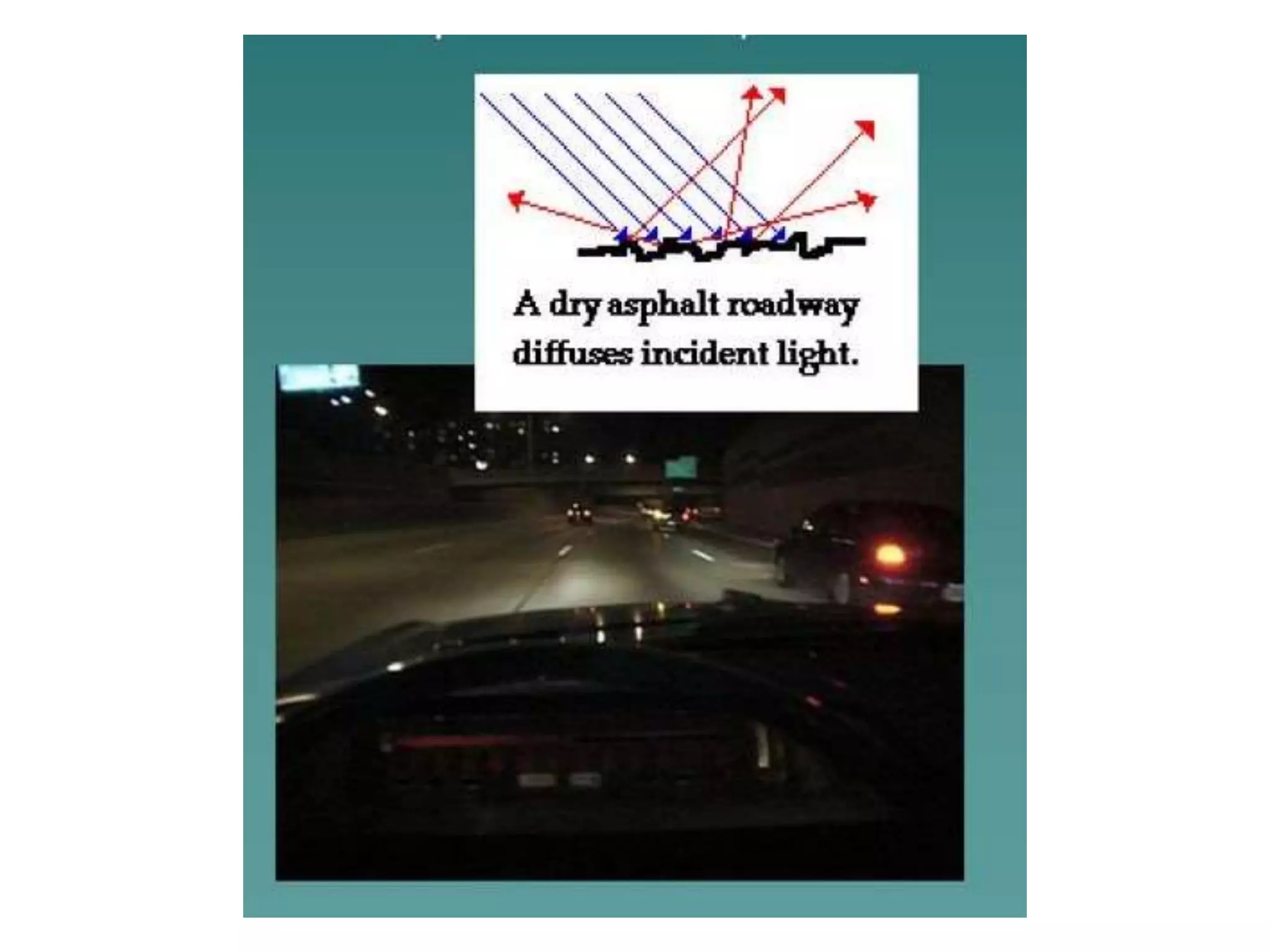
One application pertains to the relative difficulty of
night driving on a wet asphalt roadway compared to a
dry asphalt roadway. Most drivers are aware of the
fact that driving at night on a wet roadway results in
an annoying glare from oncoming headlights.
Applications of Specular and Diffuse
Reflection
The glare is the result of the specular reflection of the
beam of light from an oncoming car. Normally a
roadway would cause diffuse reflection due to its
rough surface. But if the surface is wet, water can fill
in the crevices and smooth out the surface.
Applications of Specular and Diffuse
Reflection
• Rays of light from the beam of an oncoming car hit
this smooth surface, undergo specular reflection and
remain concentrated in a beam. The driver perceives
an annoying glare caused by this concentrated beam
of reflected light.
Example of specular reflection
Applications of Specular and Diffuse
Reflection
A second application of the distinction between
diffuse and specular reflection pertains to the field of
photography. Many people have witnessed in person
or have seen a photograph of a beautiful nature scene
captured by a photographer who set up the shot with a
calm body of water in the foreground.
Applications of Specular and Diffuse
Reflection
The water (if calm) provides for the specular
reflection of light from the subject of the photograph.
Applications of Specular and Diffuse
Reflection
Light from the subject can reach the camera lens
directly or it can take a longer path in which it reflects
off the water before traveling to the lens.
• Since the light reflecting off the water undergoes
specular reflection, the incident rays remain
concentrated (instead of diffusing).
Applications of Specular and Diffuse
Reflection
The light is thus able
to travel together to the
lens of the camera and
produce an image (an
exact replica) of the
subject which is strong
enough to perceive in
the photograph. An
example of such a
photograph is shown.
Question
If a bundle of parallel incident rays undergoing
diffuse reflection follow the law of reflection, then
why do they scatter in many different directions after
reflecting off a surface?
Each individual ray strikes a surface which has a
different orientation. Since the normal is different for
each ray of light, the direction of the reflected ray will
also be different.
Perhaps you have observed magazines which have
glossy pages. The usual microscopically rough
surface of paper has been filled in with a glossy
substance to give the pages of the magazine a smooth
surface. Do you suppose that it would be easier to
read from rough pages or glossy pages? Explain your
answer.
It is much easier to read from rough pages which provide
for diffuse reflection. Glossy pages result in specular
reflection and cause a glare. The reader typically sees an
image of the light bulb which illuminates the page. If you
think about, most magazines which use glossy pages are
usually the type which people spend more time viewing
pictures than they do reading articles.
Whether the surface is microscopically rough or
smooth has a tremendous impact upon the
subsequent reflection of a beam of light.
Aug 28, 20198/28/2019 anjumk38dmc@gmail.com 27
Reflection
 The law of reflection, evidently first stated by Euclid
around 300 BC, states that when light encounters a
flat reflecting surface the angle of incidence of a ray
is equal to the angle of reflection
Reflection of light
• When light meets an interface between two media, its
behavior depends on the nature of the two media
involved. Light may be absorbed by the new medium
or transmitted onward through it or it may bounch
back into first medium. This bouncing of light at an
interface is called Reflection.
 (M.A MATIN = 21)
5 June 2020 29anjumk38dmc@gmail.com
Defination of Reflection
 Reflection is defined as the change of path of light
without any change in the medium.
 All the reflections end up in producing images of the
object kept in front of the reflecting surface.
1) The incidence ray and
the reflected ray lie in
the same plane which
is perpendicular to
the mirror surface at
the point of incidence.
2) When light is
reflected off any
surface, the angle of
incidence is always
equal to the angle of
reflection,
Laws of Reflection
Optical density
In space light maintains a constant speed of about
184,000 miles/second but as it travels through the
substance of a transparent body it will encounter
resistance and its speed will be lowered. This
property of offering resistance to light is known as
Optical density.
Aug 28, 20198/28/2019 32anjumk38dmc@gmail.com
Direction of light
1) Divergence (minus vergence)
2) Zero vergence (straight)
3) Convergence (plus vergence)
 (M.A MATIN = 20)
Aug 28, 20198/28/2019 anjumk38dmc@gmail.com 33
Aug 28, 20198/28/2019 anjumk38dmc@gmail.com 34
Laws of Reflection
1) The incidence ray and the reflected ray lie in the
same plane which is perpendicular to the mirror
surface at the point of incidence.
2) When light is reflected off any surface, the angle of
incidence is always equal to the angle of reflection,
Aug 28, 20198/28/2019 anjumk38dmc@gmail.com 35
Aug 28, 20198/28/2019 anjumk38dmc@gmail.com 36
Refraction
Q) What is refraction?
Ans) Refraction of light is a phenomenon of change in
the path of light when it passes from one medium to
another due to change in velocity.
Terms used in refraction
1) NORMAL: This is a line right angles to the interface
2) INCIDENCE RAY: The ray that strikes the interface
at the base of the normal in an angular fashion.
3) REFRACTED RAY: This is the deviated ray in the
second medium.
4) ANGLE OF INCIDENCE: Angle between the
normal and the incident ray
5) ANGLE OF REFRACTION: The angle between the
refracted ray & the normal is called ANGLE OF
REFRACTION
6) The two angles are never equal.
Snell’s Law
Total Internal Reflection (TIR)
• The complete reflection of a light ray reaching an
interface with a less dense medium when the angle of
incidence exceeds the critical angle.
Total Internal Reflection (TIR)
Different uses of TIR
1) Gonioscopy employs total internal reflection to view
the anatomical angle formed between the
eye's cornea and iris.
2) Total internal reflection is the operating principle
of optical fibers, which are used in endoscopes and
telecommunications.
Different uses of TIR
3) Total internal reflection is the operating principle of
automotive rain sensors, which control
automatic windscreen/windshield wipers
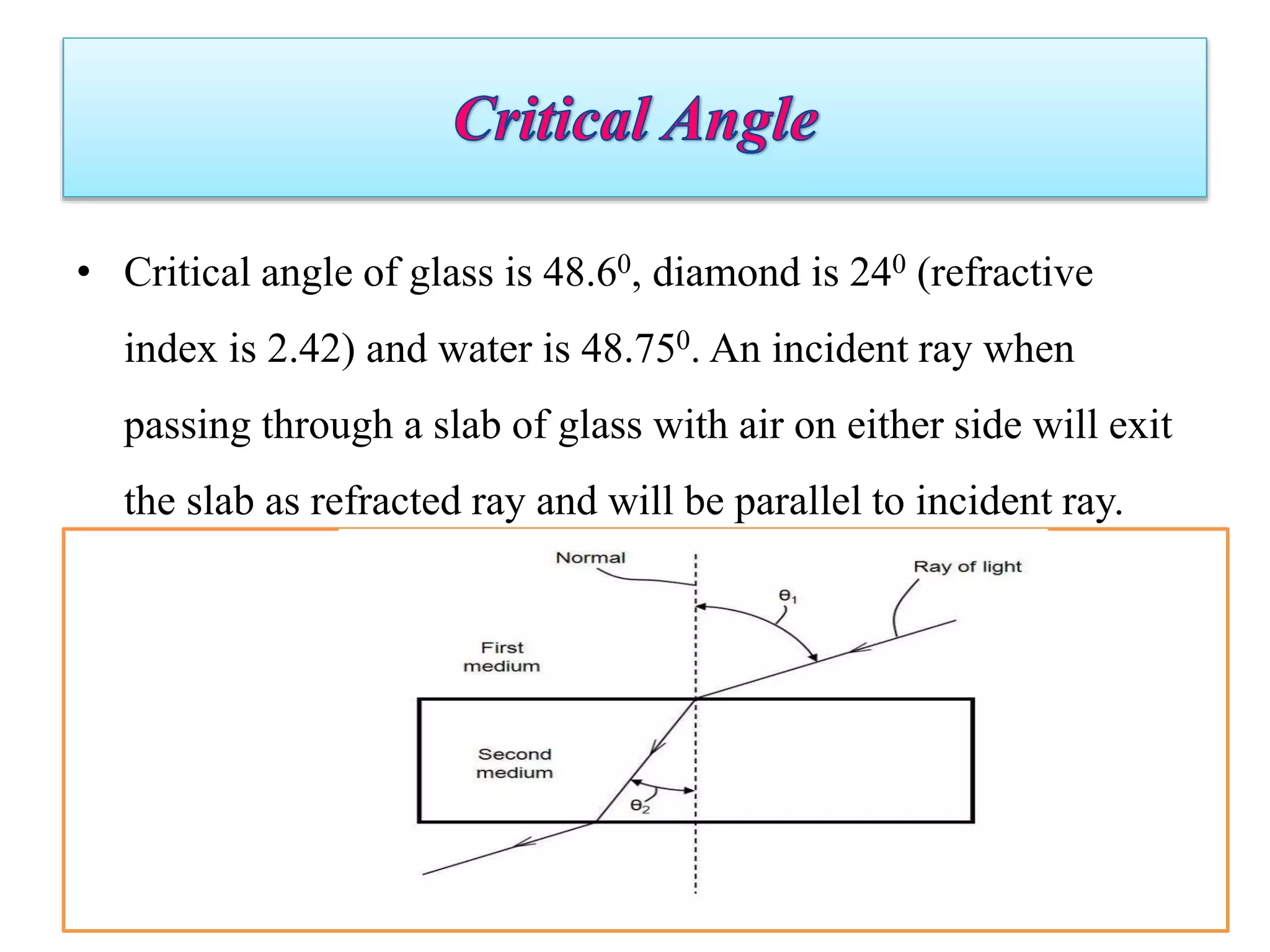
Critical Angle
Critical angle is the angle of incidence above which total internal
reflection occurs.
It is defined as the angle when the incidence ray is of such an
angle that the refracted ray is at right angles to the normal
• Critical angle of glass is 48.60, diamond is 240 (refractive
index is 2.42) and water is 48.750. An incident ray when
passing through a slab of glass with air on either side will exit
the slab as refracted ray and will be parallel to incident ray.

02 properties of light

  • 1.
    Geometrical Properties ofLight Md Anisur Rahman (Anjum) Professor & Head (Ophthalmology) Dhaka Medical College, Dhaka
  • 2.
    Geometric Optics  GeometricOptics deals with the formation of images by using such optical devices as lenses, prisms and mirrors and with the laws governing the characteristics of these images, such as their size, shape, position and clarity.  Rays of light  Pencil of light  Beam of light • (M.A MATIN P=19) 5 June 2020 2anjumk38dmc@gmail.com
  • 3.
    Before discussion ofreflection we have to clear some basic idea: Luminous versus Illuminated Objects Opaque. Transparent & Mirror surface Specular reflection & diffuse reflection Aug 28, 20198/28/2019 anjumk38dmc@gmail.com 3
  • 4.
    Luminous versus IlluminatedObjects Luminous objects are objects that generate their own light Illuminated objects are objects that are capable of reflecting light to our eyes. The sun is an example of a luminous object, while the moon is an illuminated object. Aug 28, 20198/28/2019 anjumk38dmc@gmail.com 4
  • 5.
    Opaque. Transparent &Mirror surface 1) Some substances absorb light which fall on them. These are called Opaque substances. 2) Some substances allows the light to pass through them. These are called Transparent substances, such as glass. 3) Some others such as mirror surfaces reflect the light backward. Aug 28, 20198/28/2019 5anjumk38dmc@gmail.com
  • 6.
    Q. What happenedto the light when it strikes a surface? Ans) 3 things may happen. It may be:  Absorbed  Reflected  Or Refracted
  • 8.
    Two Kinds ofReflection • Diffuse reflection: When rays are reflected from a rough surface, they are reflected in many directions and no clear image is formed. None of the normal drawn to the surface (at the point at which the incident light ray strikes the surface) are parallel.
  • 9.
    Two Kinds ofReflection Regular reflection or specular reflection: When rays are reflected from a smooth surface, they are reflected so that a clear image is formed. The reflected rays are nearly parallel. The normal drawn to the surface (at the point at which the incident ray strikes the surface) are nearly parallel.
  • 10.
    specular reflection &diffuse reflection Reflection of smooth surfaces such as mirrors or a calm body of water leads to a type of reflection known as specular reflection. Reflection of rough surfaces such as clothing, paper, and the asphalt roadway leads to a type of reflection known as diffuse reflection.
  • 11.
    • Whether thesurface is microscopically rough or smooth has a tremendous impact upon the subsequent reflection of a beam of light.
  • 12.
    specular reflection &diffuse reflection The diagram depicts two beams of light incident upon a rough and a smooth surface.
  • 13.
    Applications of Specularand Diffuse Reflection There are several interesting applications of this distinction between specular and diffuse reflection. One application pertains to the relative difficulty of night driving on a wet asphalt roadway compared to a dry asphalt roadway. Most drivers are aware of the fact that driving at night on a wet roadway results in an annoying glare from oncoming headlights.
  • 14.
    Applications of Specularand Diffuse Reflection The glare is the result of the specular reflection of the beam of light from an oncoming car. Normally a roadway would cause diffuse reflection due to its rough surface. But if the surface is wet, water can fill in the crevices and smooth out the surface.
  • 15.
    Applications of Specularand Diffuse Reflection • Rays of light from the beam of an oncoming car hit this smooth surface, undergo specular reflection and remain concentrated in a beam. The driver perceives an annoying glare caused by this concentrated beam of reflected light.
  • 17.
  • 19.
    Applications of Specularand Diffuse Reflection A second application of the distinction between diffuse and specular reflection pertains to the field of photography. Many people have witnessed in person or have seen a photograph of a beautiful nature scene captured by a photographer who set up the shot with a calm body of water in the foreground.
  • 20.
    Applications of Specularand Diffuse Reflection The water (if calm) provides for the specular reflection of light from the subject of the photograph.
  • 21.
    Applications of Specularand Diffuse Reflection Light from the subject can reach the camera lens directly or it can take a longer path in which it reflects off the water before traveling to the lens. • Since the light reflecting off the water undergoes specular reflection, the incident rays remain concentrated (instead of diffusing).
  • 22.
    Applications of Specularand Diffuse Reflection The light is thus able to travel together to the lens of the camera and produce an image (an exact replica) of the subject which is strong enough to perceive in the photograph. An example of such a photograph is shown.
  • 23.
    Question If a bundleof parallel incident rays undergoing diffuse reflection follow the law of reflection, then why do they scatter in many different directions after reflecting off a surface?
  • 24.
    Each individual raystrikes a surface which has a different orientation. Since the normal is different for each ray of light, the direction of the reflected ray will also be different.
  • 25.
    Perhaps you haveobserved magazines which have glossy pages. The usual microscopically rough surface of paper has been filled in with a glossy substance to give the pages of the magazine a smooth surface. Do you suppose that it would be easier to read from rough pages or glossy pages? Explain your answer.
  • 26.
    It is mucheasier to read from rough pages which provide for diffuse reflection. Glossy pages result in specular reflection and cause a glare. The reader typically sees an image of the light bulb which illuminates the page. If you think about, most magazines which use glossy pages are usually the type which people spend more time viewing pictures than they do reading articles.
  • 27.
    Whether the surfaceis microscopically rough or smooth has a tremendous impact upon the subsequent reflection of a beam of light. Aug 28, 20198/28/2019 anjumk38dmc@gmail.com 27
  • 28.
    Reflection  The lawof reflection, evidently first stated by Euclid around 300 BC, states that when light encounters a flat reflecting surface the angle of incidence of a ray is equal to the angle of reflection
  • 29.
    Reflection of light •When light meets an interface between two media, its behavior depends on the nature of the two media involved. Light may be absorbed by the new medium or transmitted onward through it or it may bounch back into first medium. This bouncing of light at an interface is called Reflection.  (M.A MATIN = 21) 5 June 2020 29anjumk38dmc@gmail.com
  • 30.
    Defination of Reflection Reflection is defined as the change of path of light without any change in the medium.  All the reflections end up in producing images of the object kept in front of the reflecting surface.
  • 31.
    1) The incidenceray and the reflected ray lie in the same plane which is perpendicular to the mirror surface at the point of incidence. 2) When light is reflected off any surface, the angle of incidence is always equal to the angle of reflection, Laws of Reflection
  • 32.
    Optical density In spacelight maintains a constant speed of about 184,000 miles/second but as it travels through the substance of a transparent body it will encounter resistance and its speed will be lowered. This property of offering resistance to light is known as Optical density. Aug 28, 20198/28/2019 32anjumk38dmc@gmail.com
  • 33.
    Direction of light 1)Divergence (minus vergence) 2) Zero vergence (straight) 3) Convergence (plus vergence)  (M.A MATIN = 20) Aug 28, 20198/28/2019 anjumk38dmc@gmail.com 33
  • 34.
    Aug 28, 20198/28/2019anjumk38dmc@gmail.com 34
  • 35.
    Laws of Reflection 1)The incidence ray and the reflected ray lie in the same plane which is perpendicular to the mirror surface at the point of incidence. 2) When light is reflected off any surface, the angle of incidence is always equal to the angle of reflection, Aug 28, 20198/28/2019 anjumk38dmc@gmail.com 35
  • 36.
    Aug 28, 20198/28/2019anjumk38dmc@gmail.com 36
  • 37.
    Refraction Q) What isrefraction? Ans) Refraction of light is a phenomenon of change in the path of light when it passes from one medium to another due to change in velocity.
  • 38.
    Terms used inrefraction 1) NORMAL: This is a line right angles to the interface 2) INCIDENCE RAY: The ray that strikes the interface at the base of the normal in an angular fashion. 3) REFRACTED RAY: This is the deviated ray in the second medium.
  • 39.
    4) ANGLE OFINCIDENCE: Angle between the normal and the incident ray 5) ANGLE OF REFRACTION: The angle between the refracted ray & the normal is called ANGLE OF REFRACTION 6) The two angles are never equal.
  • 40.
  • 41.
    Total Internal Reflection(TIR) • The complete reflection of a light ray reaching an interface with a less dense medium when the angle of incidence exceeds the critical angle.
  • 42.
  • 43.
    Different uses ofTIR 1) Gonioscopy employs total internal reflection to view the anatomical angle formed between the eye's cornea and iris. 2) Total internal reflection is the operating principle of optical fibers, which are used in endoscopes and telecommunications.
  • 44.
    Different uses ofTIR 3) Total internal reflection is the operating principle of automotive rain sensors, which control automatic windscreen/windshield wipers
  • 45.
    Critical Angle Critical angleis the angle of incidence above which total internal reflection occurs. It is defined as the angle when the incidence ray is of such an angle that the refracted ray is at right angles to the normal
  • 46.
    • Critical angleof glass is 48.60, diamond is 240 (refractive index is 2.42) and water is 48.750. An incident ray when passing through a slab of glass with air on either side will exit the slab as refracted ray and will be parallel to incident ray.

Editor's Notes

  • #41 Snell’s Law: state that the incidence ray, refracted ray and the normal all lie in the same plane and that the angles of incidence, I, and refraction, r, are related to the refractive index, n, of the media concerned by the equation sin i/sin r