Reflection of Light
• Luminous objects – generate their own 
light (the sun) 
• Illuminated objects – reflect light (the 
moon) 
• Line of Sight – a line from an object or 
image to your eyes (light from the object 
travels along this line to your eyes) 
Slide 2 
Definitions
Slide 3 
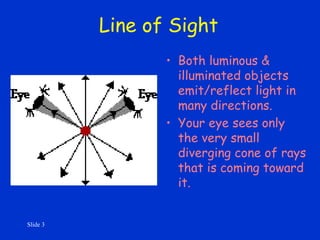
Line of Sight 
• Both luminous & 
illuminated objects 
emit/reflect light in 
many directions. 
• Your eye sees only 
the very small 
diverging cone of rays 
that is coming toward 
it.
Slide 4 
Rays of Light 
• Incident Ray – leaves 
the object and strikes 
the mirror 
• Reflected Ray – leaves 
mirror and strikes your 
eye 
• The reflected ray is on 
the line of sight from 
the image to your eye.
Slide 5 
Law of Reflection 
• Angle of incidence equals angle 
of reflection.
Slide 6 
Law of Reflection 
• Normal – line 
perpendicular to the 
mirror surface 
• Angle of incidence – 
angle between 
incident ray and 
normal 
• Angle of reflection – 
angle between 
reflected ray and 
normal
Law of Reflection Animation 
 qi = qr 
Slide 7
Slide 8 
Diffuse Reflection
Slide 9 
Diffuse Reflection
Slide 10 
Wet Road Glare 
• Driving at night on a wet roadway results in 
an annoying glare from oncoming 
headlights.
Slide 11 
Observing an Image 
• An image is a position in 
space from which all 
reflected light appears 
to diverge. 
• Image formed by a plane 
mirror is called a virtual 
image. 
• Virtual images are 
formed in regions where 
there is actually no light
Slide 12 
Image Location
Image Formed By Plane Mirror 
Slide 13 
• Image is virtual. 
• Image is located 
as far behind the 
mirror as the 
object is in front 
of the mirror.
How Big Must the Mirror Be? 
Slide 14
Slide 15 
Distance from Mirror 
Irrelevant
Slide 16 
Right Angle Mirror
Slide 17 
Right Angle Mirror 
• Formation of primary 
and secondary images
Slide 18 
Kaleidoscope 
• Angles smaller than 
90o produce more 
than 3 images
Slide 19 
Kaleidoscope Applets 
• Hinged Mirror Applet 
• Image Formation Applet
Reflection Applets 
• Plane Mirror Image Applets 
• Double Mirror Images 
• Hinged Mirror Applet 
• Rainbow Applets
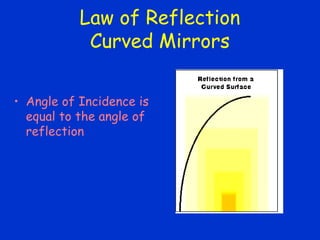
Law of Reflection 
Curved Mirrors 
• Angle of Incidence is 
equal to the angle of 
reflection
Converging Mirror 
• A series of flat mirrors 
can be arranged to 
reflect parallel light 
through a single point. 
• Increasing the number 
of flat mirrors causes 
the shape to more 
closely approximate a 
parabola and causes the 
reflected light to 
converge in a smaller 
area.
Parabolic vs Spherical 
• Close to the axis of 
the mirror, the 
parabola and the 
circle are almost 
the same shape. 
• Farther from axis 
the parabola 
flattens out. 
• It is easier and 
less expensive to 
make spherical 
mirrors.
Types of Curved Mirrors 
• A concave mirror is 
silvered on the inside of 
the sphere. 
• A concave mirror is also 
called a converging mirror 
because it converges 
parallel light. 
• A convex mirror is 
silvered on the outside of 
the bowl. 
• A convex mirror is also 
called a diverging mirror 
because it diverges 
parallel light.
Concave Mirror Terms 
• Axis 
• Center of Curvature 
• Radius of Curvature 
• Focus 
• Focal Length
Three Useful Rays 
• Ray parallel to the 
axis reflects through 
the focus. 
• Ray through the 
focus reflects 
parallel to the axis. 
• Ray through the 
center of curvature 
reflects back on 
itself.

Reflection

  • 1.
  • 2.
    • Luminous objects– generate their own light (the sun) • Illuminated objects – reflect light (the moon) • Line of Sight – a line from an object or image to your eyes (light from the object travels along this line to your eyes) Slide 2 Definitions
  • 3.
    Slide 3 Lineof Sight • Both luminous & illuminated objects emit/reflect light in many directions. • Your eye sees only the very small diverging cone of rays that is coming toward it.
  • 4.
    Slide 4 Raysof Light • Incident Ray – leaves the object and strikes the mirror • Reflected Ray – leaves mirror and strikes your eye • The reflected ray is on the line of sight from the image to your eye.
  • 5.
    Slide 5 Lawof Reflection • Angle of incidence equals angle of reflection.
  • 6.
    Slide 6 Lawof Reflection • Normal – line perpendicular to the mirror surface • Angle of incidence – angle between incident ray and normal • Angle of reflection – angle between reflected ray and normal
  • 7.
    Law of ReflectionAnimation qi = qr Slide 7
  • 8.
    Slide 8 DiffuseReflection
  • 9.
    Slide 9 DiffuseReflection
  • 10.
    Slide 10 WetRoad Glare • Driving at night on a wet roadway results in an annoying glare from oncoming headlights.
  • 11.
    Slide 11 Observingan Image • An image is a position in space from which all reflected light appears to diverge. • Image formed by a plane mirror is called a virtual image. • Virtual images are formed in regions where there is actually no light
  • 12.
  • 13.
    Image Formed ByPlane Mirror Slide 13 • Image is virtual. • Image is located as far behind the mirror as the object is in front of the mirror.
  • 14.
    How Big Mustthe Mirror Be? Slide 14
  • 15.
    Slide 15 Distancefrom Mirror Irrelevant
  • 16.
    Slide 16 RightAngle Mirror
  • 17.
    Slide 17 RightAngle Mirror • Formation of primary and secondary images
  • 18.
    Slide 18 Kaleidoscope • Angles smaller than 90o produce more than 3 images
  • 19.
    Slide 19 KaleidoscopeApplets • Hinged Mirror Applet • Image Formation Applet
  • 20.
    Reflection Applets •Plane Mirror Image Applets • Double Mirror Images • Hinged Mirror Applet • Rainbow Applets
  • 21.
    Law of Reflection Curved Mirrors • Angle of Incidence is equal to the angle of reflection
  • 22.
    Converging Mirror •A series of flat mirrors can be arranged to reflect parallel light through a single point. • Increasing the number of flat mirrors causes the shape to more closely approximate a parabola and causes the reflected light to converge in a smaller area.
  • 23.
    Parabolic vs Spherical • Close to the axis of the mirror, the parabola and the circle are almost the same shape. • Farther from axis the parabola flattens out. • It is easier and less expensive to make spherical mirrors.
  • 24.
    Types of CurvedMirrors • A concave mirror is silvered on the inside of the sphere. • A concave mirror is also called a converging mirror because it converges parallel light. • A convex mirror is silvered on the outside of the bowl. • A convex mirror is also called a diverging mirror because it diverges parallel light.
  • 25.
    Concave Mirror Terms • Axis • Center of Curvature • Radius of Curvature • Focus • Focal Length
  • 26.
    Three Useful Rays • Ray parallel to the axis reflects through the focus. • Ray through the focus reflects parallel to the axis. • Ray through the center of curvature reflects back on itself.