

PIN HOLE IMAGING
&
INTRACTION OF LIGHT WITH
PLANE AND CURVED SURFACES
RABIA AMMER
OPTOMETRIST &
ORTHOPTIST
PIN HOLE IMAGING
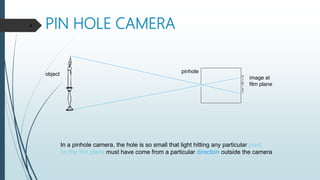
 The simplest imaging device
 Formation of an image without use of a lens.
 Light travels in straight lines, the hole permits rays from each
point of an object to fall only within a small circle on the
opposite wall, effectively forming an image.
 Virtually infinite depth of focus and a very wide angular field
 The pinhole produces the one-to-one relationship between the
object and the image because of its small size
 The image is dim because most rays from the object can’t
contribute to the image
 The image is inverted (both with respect to up/down and
right/left)
EXPERIMENT
 Make a pinhole in the center of a large sheet of aluminum foil
 Light a candle
 Turn off room lights
 Place a sheet of plain paper 2 feet from candle
 Place pinhole midway between candle and paper
 Observe an inverted image of candle flame on paper
 The image is faint, but the image features are fully duplicated
 Moving the pinhole closer to the candle while keeping the paper
stationary yields a larger image.
PIN HOLE CAMERA4
In a pinhole camera, the hole is so small that light hitting any particular point
on the film plane must have come from a particular direction outside the camera
pinhole
image at
film plane
object
WHAT IS
REFLECTION…???
REFLECTION
Reflection of light is a phenomenon of
change in the path of light rays
without any change in the medium
REFLECTION
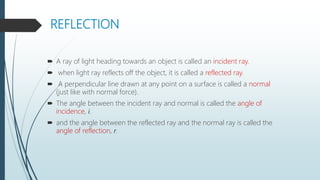
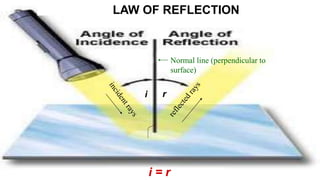
 A ray of light heading towards an object is called an incident ray.
 when light ray reflects off the object, it is called a reflected ray.
 A perpendicular line drawn at any point on a surface is called a normal
(just like with normal force).
 The angle between the incident ray and normal is called the angle of
incidence, i.
 and the angle between the reflected ray and the normal ray is called the
angle of reflection, r.
LAW OF REFLECTION
i r
i = r
Normal line (perpendicular to
surface)
LAW OF REFLECTION
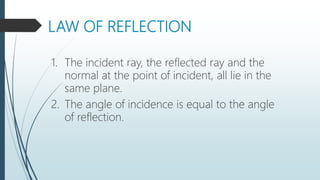
1. The incident ray, the reflected ray and the
normal at the point of incident, all lie in the
same plane.
2. The angle of incidence is equal to the angle
of reflection.
DIFFUSE REFLECTION
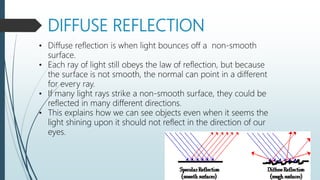
• Diffuse reflection is when light bounces off a non-smooth
surface.
• Each ray of light still obeys the law of reflection, but because
the surface is not smooth, the normal can point in a different
for every ray.
• If many light rays strike a non-smooth surface, they could be
reflected in many different directions.
• This explains how we can see objects even when it seems the
light shining upon it should not reflect in the direction of our
eyes.
REFLECTION
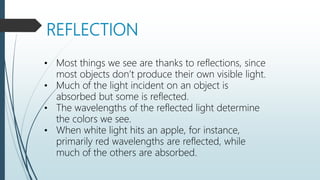
• Most things we see are thanks to reflections, since
most objects don’t produce their own visible light.
• Much of the light incident on an object is
absorbed but some is reflected.
• The wavelengths of the reflected light determine
the colors we see.
• When white light hits an apple, for instance,
primarily red wavelengths are reflected, while
much of the others are absorbed.
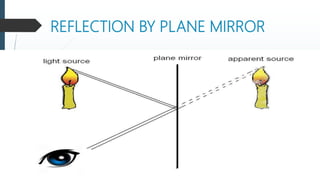
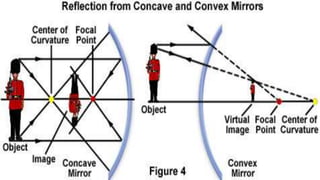
REFLECTION BY PLANE MIRROR
WHAT IS
REFRACTION…???
REFRACTION OF LIGHT
Refraction of light is the phenomenon of change in
the path of light, when it goes from one medium to
another. The basic cause of refraction is change in
the velocity of light in going from one medium to the
other.
LAWS OF REFRACTION
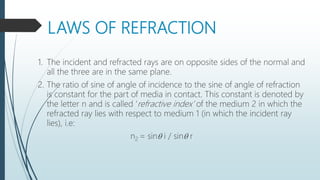
1. The incident and refracted rays are on opposite sides of the normal and
all the three are in the same plane.
2. The ratio of sine of angle of incidence to the sine of angle of refraction
is constant for the part of media in contact. This constant is denoted by
the letter n and is called ‘refractive index’ of the medium 2 in which the
refracted ray lies with respect to medium 1 (in which the incident ray
lies), i.e:
n2 = sin i / sin r
INDEX OF REFRACTION, n
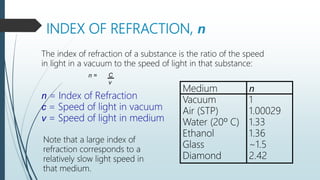
The index of refraction of a substance is the ratio of the speed
in light in a vacuum to the speed of light in that substance:
n = Index of Refraction
c = Speed of light in vacuum
v = Speed of light in medium
n = C
v
Note that a large index of
refraction corresponds to a
relatively slow light speed in
that medium.
Medium
Vacuum
Air (STP)
Water (20º C)
Ethanol
Glass
Diamond
n
1
1.00029
1.33
1.36
~1.5
2.42
REFRACTION AT A PLANE SURFACE
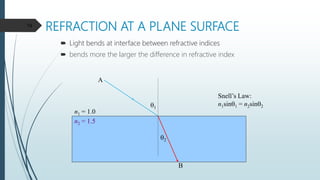
 Light bends at interface between refractive indices
 bends more the larger the difference in refractive index
19
n2 = 1.5
n1 = 1.0
A
B
1
2
Snell’s Law:
n1sin1 = n2sin2
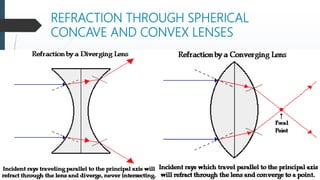
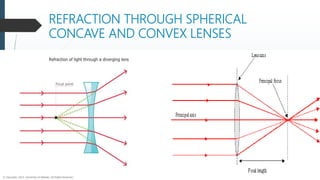
REFRACTION THROUGH SPHERICAL
CONCAVE AND CONVEX LENSES
REFRACTION THROUGH SPHERICAL
CONCAVE AND CONVEX LENSES
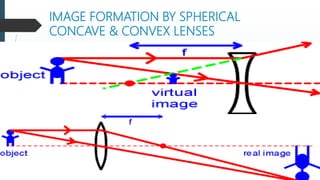
IMAGE FORMATION BY SPHERICAL
CONCAVE & CONVEX LENSES
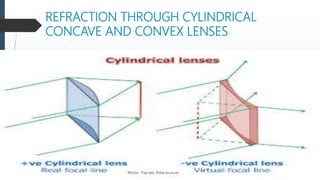
REFRACTION THROUGH CYLINDRICAL
CONCAVE AND CONVEX LENSES
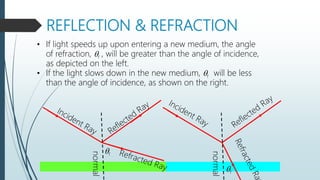
REFLECTION & REFRACTION
r
• If light speeds up upon entering a new medium, the angle
of refraction, r , will be greater than the angle of incidence,
as depicted on the left.
• If the light slows down in the new medium, r will be less
than the angle of incidence, as shown on the right.
normal
r
normal
REFLECTION & REFRACTION
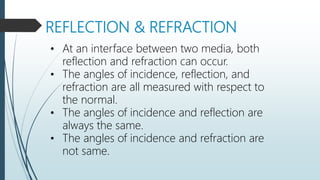
• At an interface between two media, both
reflection and refraction can occur.
• The angles of incidence, reflection, and
refraction are all measured with respect to
the normal.
• The angles of incidence and reflection are
always the same.
• The angles of incidence and refraction are
not same.
WHAT IS TOTAL
INTERNAL
REFLECTION…???
TOTAL INTERNAL REFLECTION
 When a ray of light travelling from an optically- denser
medium to an optically-rarer medium is incident at an
angle greater than the critical angle of the pair of media in
contact, the ray is totally reflected back into the denser
medium. This phenomenon is called
total internal reflection.
TOTAL INTERNAL
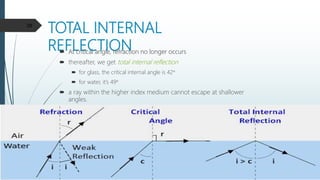
REFLECTION At critical angle, refraction no longer occurs
 thereafter, we get total internal reflection
 for glass, the critical internal angle is 42°
 for water, it’s 49°
 a ray within the higher index medium cannot escape at shallower
angles.
28
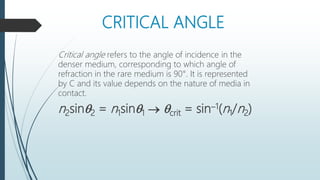
CRITICAL ANGLE
Critical angle refers to the angle of incidence in the
denser medium, corresponding to which angle of
refraction in the rare medium is 90°. It is represented
by C and its value depends on the nature of media in
contact.
n2sin2 = n1sin1  crit = sin1(n1/n2)
THANK YOU

Pin Hole Imaging, Reflection & Refraction

  • 1.
    PIN HOLE IMAGING & INTRACTIONOF LIGHT WITH PLANE AND CURVED SURFACES RABIA AMMER OPTOMETRIST & ORTHOPTIST
  • 2.
    PIN HOLE IMAGING The simplest imaging device  Formation of an image without use of a lens.  Light travels in straight lines, the hole permits rays from each point of an object to fall only within a small circle on the opposite wall, effectively forming an image.  Virtually infinite depth of focus and a very wide angular field  The pinhole produces the one-to-one relationship between the object and the image because of its small size  The image is dim because most rays from the object can’t contribute to the image  The image is inverted (both with respect to up/down and right/left)
  • 3.
    EXPERIMENT  Make apinhole in the center of a large sheet of aluminum foil  Light a candle  Turn off room lights  Place a sheet of plain paper 2 feet from candle  Place pinhole midway between candle and paper  Observe an inverted image of candle flame on paper  The image is faint, but the image features are fully duplicated  Moving the pinhole closer to the candle while keeping the paper stationary yields a larger image.
  • 4.
    PIN HOLE CAMERA4 Ina pinhole camera, the hole is so small that light hitting any particular point on the film plane must have come from a particular direction outside the camera pinhole image at film plane object
  • 5.
  • 6.
    REFLECTION Reflection of lightis a phenomenon of change in the path of light rays without any change in the medium
  • 7.
    REFLECTION  A rayof light heading towards an object is called an incident ray.  when light ray reflects off the object, it is called a reflected ray.  A perpendicular line drawn at any point on a surface is called a normal (just like with normal force).  The angle between the incident ray and normal is called the angle of incidence, i.  and the angle between the reflected ray and the normal ray is called the angle of reflection, r.
  • 8.
    LAW OF REFLECTION ir i = r Normal line (perpendicular to surface)
  • 9.
    LAW OF REFLECTION 1.The incident ray, the reflected ray and the normal at the point of incident, all lie in the same plane. 2. The angle of incidence is equal to the angle of reflection.
  • 10.
    DIFFUSE REFLECTION • Diffusereflection is when light bounces off a non-smooth surface. • Each ray of light still obeys the law of reflection, but because the surface is not smooth, the normal can point in a different for every ray. • If many light rays strike a non-smooth surface, they could be reflected in many different directions. • This explains how we can see objects even when it seems the light shining upon it should not reflect in the direction of our eyes.
  • 11.
    REFLECTION • Most thingswe see are thanks to reflections, since most objects don’t produce their own visible light. • Much of the light incident on an object is absorbed but some is reflected. • The wavelengths of the reflected light determine the colors we see. • When white light hits an apple, for instance, primarily red wavelengths are reflected, while much of the others are absorbed.
  • 12.
  • 15.
  • 16.
    REFRACTION OF LIGHT Refractionof light is the phenomenon of change in the path of light, when it goes from one medium to another. The basic cause of refraction is change in the velocity of light in going from one medium to the other.
  • 17.
    LAWS OF REFRACTION 1.The incident and refracted rays are on opposite sides of the normal and all the three are in the same plane. 2. The ratio of sine of angle of incidence to the sine of angle of refraction is constant for the part of media in contact. This constant is denoted by the letter n and is called ‘refractive index’ of the medium 2 in which the refracted ray lies with respect to medium 1 (in which the incident ray lies), i.e: n2 = sin i / sin r
  • 18.
    INDEX OF REFRACTION,n The index of refraction of a substance is the ratio of the speed in light in a vacuum to the speed of light in that substance: n = Index of Refraction c = Speed of light in vacuum v = Speed of light in medium n = C v Note that a large index of refraction corresponds to a relatively slow light speed in that medium. Medium Vacuum Air (STP) Water (20º C) Ethanol Glass Diamond n 1 1.00029 1.33 1.36 ~1.5 2.42
  • 19.
    REFRACTION AT APLANE SURFACE  Light bends at interface between refractive indices  bends more the larger the difference in refractive index 19 n2 = 1.5 n1 = 1.0 A B 1 2 Snell’s Law: n1sin1 = n2sin2
  • 20.
  • 21.
  • 22.
    IMAGE FORMATION BYSPHERICAL CONCAVE & CONVEX LENSES
  • 23.
  • 24.
    REFLECTION & REFRACTION r •If light speeds up upon entering a new medium, the angle of refraction, r , will be greater than the angle of incidence, as depicted on the left. • If the light slows down in the new medium, r will be less than the angle of incidence, as shown on the right. normal r normal
  • 25.
    REFLECTION & REFRACTION •At an interface between two media, both reflection and refraction can occur. • The angles of incidence, reflection, and refraction are all measured with respect to the normal. • The angles of incidence and reflection are always the same. • The angles of incidence and refraction are not same.
  • 26.
  • 27.
    TOTAL INTERNAL REFLECTION When a ray of light travelling from an optically- denser medium to an optically-rarer medium is incident at an angle greater than the critical angle of the pair of media in contact, the ray is totally reflected back into the denser medium. This phenomenon is called total internal reflection.
  • 28.
    TOTAL INTERNAL REFLECTION Atcritical angle, refraction no longer occurs  thereafter, we get total internal reflection  for glass, the critical internal angle is 42°  for water, it’s 49°  a ray within the higher index medium cannot escape at shallower angles. 28
  • 29.
    CRITICAL ANGLE Critical anglerefers to the angle of incidence in the denser medium, corresponding to which angle of refraction in the rare medium is 90°. It is represented by C and its value depends on the nature of media in contact. n2sin2 = n1sin1  crit = sin1(n1/n2)
  • 30.

Editor's Notes