Telescopes
1
2
Telescope
 A telescope is an optical system designed
to increase the angle subtended at the
eye by distant objects.
 It is called a focal because pencils oflight
entering with zero vergence comeout with
zero vergence. OR
 It is an optical system that provides angular magnification
without bringing about a change in vergence.
3
Objective Lens:
 It is a convex (positive) lens.
 It is towards the object.
Eyepiece Lens:
 It can be either a convex (positive) or concave (negative)
lens.
 It is towards the eye.
 It is of higher power than the objective lens.
Pakistan institute of community
ophthalmology M.Phil VS 4
TYPES OF TELESCOPES:
Telescopes are mainly of two types.
 Galilean (Terrestrial)
 Kaplerian (Astronomical)
VS 5
Galilean Telescope:
 The objective lens is positive, and the eyepiece lens is
negative.
 The two lenses are separated by the difference of their
focal lengths.
 The objective lens forms an optically real image of the
object, which acts as a virtual object for the eyepiece lens.
 It produces an upright, magnified virtual image.
6
7
Optics of Galilean Telescope:
Keplerian Telescope:
8
It has a positive powered objective lens and
a stronger positive powered eye piece
lens.
The two lenses are separated such that the
secondary focal point of the objective lens
coincide with the primary focal point of the
eye piece lens.
Parallel light enters a plus objective.
The light is focused towards the focal point
of the objective.
Because the focal point of the objective and
the focal point of the eyepiece coincide,
light leaves parallel
9
Optics of Keplerian Telescope:
Characteristics Galilean Kaplerian
Power <4X >4X
Exit Pupil Virtual I Real I
Image Erect Inverted
Field of View Smaller Larger
Magnification Low (upto 4X) High (upto 10X)
Image Quality Brighter Much brighter
Design Simple Complicated
Weight Light Heavy
Path length Short Long
10
Comparison of Galilean & Kaplerian Telescopes
The telescopes can be prescribed as
 Monocular
 Binocular
These can be
 Hand-held
 Spectacle mounted
11
Monocular Telescopes:
 These are easy to carry and use.
 Their use in LV is small but important.
Binocular Telescopes:
 Give binocular vision.
 Allow for good grip, but cumbersome to carry.
If one eye is worse than the other, then a binocular
telescope offers no improvement in viewing quality.
12
Indications:
 Telescopic spectacles are used for sedentary distance
viewing and when magnification can not be obtained by
moving closer.
 Hand-held telescopes are suitable for distance spotting,
e.g., street and bus signs, blackboards etc.
13
Limitations:
The problems encountered in using telescopic systems are
 Reduction in field of view.
 Ring scotomas.
 Decrease in depth of focus.
 Reduced light transmission.
14
Telescopes:
15
Bioptic Telescope:
 Spectacle mounted; it is drilled into the lens.
 Called bioptic because it has two optical systems: a carrier
lens and a telescope.
 Not mounted centrally because the patient would have a
hard time getting around, unless special occupational
needs.
 Mounted superiorly – tilt head down to see through it.
16
Bioptic Telescopes:
17
Telemicroscope:
 Telemicroscope is a telescope with a microscope
(or plus lens) attached, which allows you to see at
a certain distance.
 Telemicroscope allows you to see things closer; so it is like
a telescope with a reading cap.
 Working distance is based on reading cap.
 It provides high magnification at a large working
distance.
18
Magnification of telescope
 M=-Fe/Fo or -focal length of eyepiece
lens/focal length of objective lens
 -ve sign show image is inverted and +ve
sign show that image is erect.
 Calculate magnification for Galilean and
Kaplariean telescope .
19
20
Entrance and Exit Puil of telescope
 Entrance pupil
◦ Opening in the optical system which effectively limits the
amount of light entering the system E.G pupil
 Exit pupil
◦ The image of the objective lens formed by the eyepiece is
called exit pupil
 In any optical system, when the entrance and
exit pupil coincide ,Field of view increase.
 That’s why Galilean telescope have smaller
field of view as compared to kaplariean.
21
Image brightness
 The relationship b/w the size of the objective
and eyepiece determine the image brightness
of a given telescope.
 Best situition is where the diameter are in the
following ratio.
 Magnification of the unit=Dia of objective/Dia
of eyepiece
 Provided the ratio is more than 1,larger the
dia of lenes,greater will be the amount of
light transmitted and hence greater will be
the brightness.
22
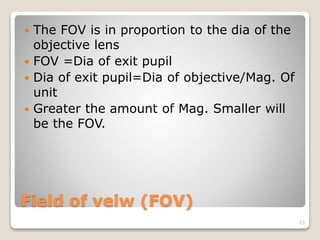
Field of veiw (FOV)
 The FOV is in proportion to the dia of the
objective lens
 FOV =Dia of exit pupil
 Dia of exit pupil=Dia of objective/Mag. Of
unit
 Greater the amount of Mag. Smaller will
be the FOV.
23
24
 Common distance tasks include driving,
watching television, reading a blackboard
at schooL and reading bus signs to
commute to work.
25
 Telescopes are typically labeled in terms of the
magnification that they provide. Those focused
at a distance are afocaL which means that
parallel light rays both enter and exit the device.
Therefore, no dioptric equivalent exits.
Oftentimes there will be a second number on a
telescope; for example, one may be labeled as 4
x 12,which means that it is a 4x telescope with a
12-mm objective. This information is important,
because it determines the size of the exit pupil
for the telescope, which in turn affects retinal
illuminance:
26
Compensating for refractive error
 Adding the full refractive correction to
the eyepiece (or alternatively encouraging
the patient to view through their glasses)
– the enlargement of the telescope
 remains unchanged as it is still afocal,
and astigmatism can be
Pakistan institute of community
ophthalmology M.Phil VS 27

Telescopes

  • 1.
  • 2.
  • 3.
    Telescope  A telescopeis an optical system designed to increase the angle subtended at the eye by distant objects.  It is called a focal because pencils oflight entering with zero vergence comeout with zero vergence. OR  It is an optical system that provides angular magnification without bringing about a change in vergence. 3
  • 4.
    Objective Lens:  Itis a convex (positive) lens.  It is towards the object. Eyepiece Lens:  It can be either a convex (positive) or concave (negative) lens.  It is towards the eye.  It is of higher power than the objective lens. Pakistan institute of community ophthalmology M.Phil VS 4
  • 5.
    TYPES OF TELESCOPES: Telescopesare mainly of two types.  Galilean (Terrestrial)  Kaplerian (Astronomical) VS 5
  • 6.
    Galilean Telescope:  Theobjective lens is positive, and the eyepiece lens is negative.  The two lenses are separated by the difference of their focal lengths.  The objective lens forms an optically real image of the object, which acts as a virtual object for the eyepiece lens.  It produces an upright, magnified virtual image. 6
  • 7.
  • 8.
    Keplerian Telescope: 8 It hasa positive powered objective lens and a stronger positive powered eye piece lens. The two lenses are separated such that the secondary focal point of the objective lens coincide with the primary focal point of the eye piece lens. Parallel light enters a plus objective. The light is focused towards the focal point of the objective. Because the focal point of the objective and the focal point of the eyepiece coincide, light leaves parallel
  • 9.
  • 10.
    Characteristics Galilean Kaplerian Power<4X >4X Exit Pupil Virtual I Real I Image Erect Inverted Field of View Smaller Larger Magnification Low (upto 4X) High (upto 10X) Image Quality Brighter Much brighter Design Simple Complicated Weight Light Heavy Path length Short Long 10 Comparison of Galilean & Kaplerian Telescopes
  • 11.
    The telescopes canbe prescribed as  Monocular  Binocular These can be  Hand-held  Spectacle mounted 11
  • 12.
    Monocular Telescopes:  Theseare easy to carry and use.  Their use in LV is small but important. Binocular Telescopes:  Give binocular vision.  Allow for good grip, but cumbersome to carry. If one eye is worse than the other, then a binocular telescope offers no improvement in viewing quality. 12
  • 13.
    Indications:  Telescopic spectaclesare used for sedentary distance viewing and when magnification can not be obtained by moving closer.  Hand-held telescopes are suitable for distance spotting, e.g., street and bus signs, blackboards etc. 13
  • 14.
    Limitations: The problems encounteredin using telescopic systems are  Reduction in field of view.  Ring scotomas.  Decrease in depth of focus.  Reduced light transmission. 14
  • 15.
  • 16.
    Bioptic Telescope:  Spectaclemounted; it is drilled into the lens.  Called bioptic because it has two optical systems: a carrier lens and a telescope.  Not mounted centrally because the patient would have a hard time getting around, unless special occupational needs.  Mounted superiorly – tilt head down to see through it. 16
  • 17.
  • 18.
    Telemicroscope:  Telemicroscope isa telescope with a microscope (or plus lens) attached, which allows you to see at a certain distance.  Telemicroscope allows you to see things closer; so it is like a telescope with a reading cap.  Working distance is based on reading cap.  It provides high magnification at a large working distance. 18
  • 19.
    Magnification of telescope M=-Fe/Fo or -focal length of eyepiece lens/focal length of objective lens  -ve sign show image is inverted and +ve sign show that image is erect.  Calculate magnification for Galilean and Kaplariean telescope . 19
  • 20.
  • 21.
    Entrance and ExitPuil of telescope  Entrance pupil ◦ Opening in the optical system which effectively limits the amount of light entering the system E.G pupil  Exit pupil ◦ The image of the objective lens formed by the eyepiece is called exit pupil  In any optical system, when the entrance and exit pupil coincide ,Field of view increase.  That’s why Galilean telescope have smaller field of view as compared to kaplariean. 21
  • 22.
    Image brightness  Therelationship b/w the size of the objective and eyepiece determine the image brightness of a given telescope.  Best situition is where the diameter are in the following ratio.  Magnification of the unit=Dia of objective/Dia of eyepiece  Provided the ratio is more than 1,larger the dia of lenes,greater will be the amount of light transmitted and hence greater will be the brightness. 22
  • 23.
    Field of veiw(FOV)  The FOV is in proportion to the dia of the objective lens  FOV =Dia of exit pupil  Dia of exit pupil=Dia of objective/Mag. Of unit  Greater the amount of Mag. Smaller will be the FOV. 23
  • 24.
  • 25.
     Common distancetasks include driving, watching television, reading a blackboard at schooL and reading bus signs to commute to work. 25
  • 26.
     Telescopes aretypically labeled in terms of the magnification that they provide. Those focused at a distance are afocaL which means that parallel light rays both enter and exit the device. Therefore, no dioptric equivalent exits. Oftentimes there will be a second number on a telescope; for example, one may be labeled as 4 x 12,which means that it is a 4x telescope with a 12-mm objective. This information is important, because it determines the size of the exit pupil for the telescope, which in turn affects retinal illuminance: 26
  • 27.
    Compensating for refractiveerror  Adding the full refractive correction to the eyepiece (or alternatively encouraging the patient to view through their glasses) – the enlargement of the telescope  remains unchanged as it is still afocal, and astigmatism can be Pakistan institute of community ophthalmology M.Phil VS 27