


                         Pipe Networks
                              Pipeline systems
                                 Transmission lines
        You are here             Pipe networks
                                 Measurements
                                 Manifolds and diffusers
                                 Pumps
                                 Transients
                                   School of Civil and
      Monroe L. Weber-Shirk   Environmental Engineering
Pipeline systems:
              Pipe networks
 Water distribution systems for municipalities
 Multiple sources and multiple sinks connected
  with an interconnected network of pipes.
 Computer solutions!
    KYpipes
    WaterCAD
    CyberNET
    EPANET http://www.epa.gov/ORD/NRMRL/wswrd/epanet.html
Water Distribution System
              Assumption
 Each point in the                          a
  system can only
  have one pressure
            _______          1                            2
 The pressure change
  from 1 to 2 by path a
  must equal the                            b
  pressure change
  from 1 to 2 by path b

p1 V12        p2 V22
  +    + z1 =   +    + z 2 + hL
γ 2g          γ 2g
          2
 p 2 p1 V1         V22
    − =     + z1 −
            a         a
                       − z2 − hL       Same for path b!
 γ   γ  2g         2g              a
Water Distribution System
                Assumption
 V12            V22                 V12            V22
   a
       + z1 −     a
                      − z2 − hL =     b
                                          + z1 −     b
                                                         − z 2 − hL
 2g             2g            a
                                    2g             2g                 b

                                                                          a
                                                                  1           2
Pressure change by path a

                                                          b
 hL = hL
   a       b
                                                          zero
                      Or sum of head loss around loop is _____.
                                              (Need a sign convention)
  Pipe diameters are constant or K.E. is small
  Model withdrawals as occurring at nodes so
   V is constant between nodes
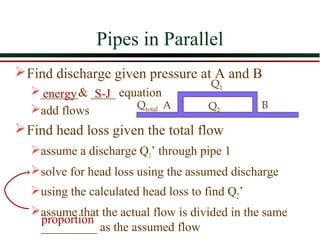
Pipes in Parallel
 Find discharge given pressure at A and B
                                      Q1
  ______& ____ equation
   energy S-J
  add flows       Qtotal A          Q2         B

 Find head loss given the total flow
  assume a discharge Q1’ through pipe 1
  solve for head loss using the assumed discharge
  using the calculated head loss to find Q2’
  assume that the actual flow is divided in the same
   proportion
   _________ as the assumed flow
Networks of Pipes
Mass __________ at all nodes
  ____ conservation               0.32 m /s
                                        3
                                              A
                                                  0.28 m3/s

 The relationship between head               ?
  loss and discharge must be
  maintained for each pipe
  Darcy-Weisbach equation
     Swamee-Jain
    _____________
  Exponential friction formula               a
     _____________
      Hazen-Williams               1                   2


                                              b
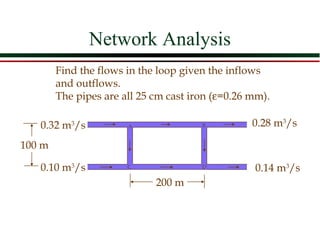
Network Analysis
        Find the flows in the loop given the inflows
        and outflows.
        The pipes are all 25 cm cast iron (ε=0.26 mm).

   0.32 m3/s           A               B          0.28 m3/s

100 m

   0.10 m3/s           C               D
                                                  0.14 m3/s
                             200 m
Network Analysis
 Assign a flow to each pipe link
 Flow into each junction must equal flow out
  of the junction
              arbitrary

0.32 m3/s      A                  B          0.28 m3/s
                           0.32
                   0.00               0.04
0.10 m3/s      C                  D
                                             0.14 m3/s
                          0.10
Network Analysis
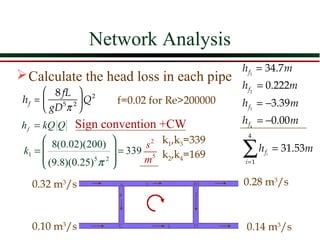
                                                  h f = 34.7m
 Calculate the head loss in each pipe             1


                                                  h f = 0.222m
       8 fL  2                                   2

 hf =       
          5 2 Q         f=0.02 for Re>200000      h f = −3.39m
       gD π                                      3


h f = kQ Q Sign convention +CW                    h f = −0.00m
                                                   4

                                                   4
       8(0.02)(200)             s 2 k1,k3=339
k1 =                      = 339
       (9.8)(0.25) 5 π 2        m5 k2,k4=169
                                                  ∑h    fi   = 31.53m
                                                i=1


  0.32 m3/s              A     1            B     0.28 m3/s
                        4                   2


  0.10 m3/s             C            3      D
                                                  0.14 m3/s
Network Analysis
 The head loss around the loop isn’t zero
 Need to change the flow around the loop
           clockwise
    the ___________ flow is too great (head loss is
     positive)
    reduce the clockwise flow to reduce the head loss
 Solution techniques
                                    optimizes correction
    Hardy Cross loop-balancing (___________ _________)
    Use a numeric solver (Solver in Excel) to find a change
     in flow that will give zero head loss around the loop
    Use Network Analysis software (EPANET)
Numeric Solver
 Set up a spreadsheet as shown below.
 the numbers in bold were entered, the other cells are
  calculations
 initially ∆Q is 0
 use “solver” to set the sum of the head loss to 0 by changing ∆Q
 the column Q0+ ∆Q contains the correct flows
 ∆Q       0.000
  pipe      f      L      D       k    Q0 Q0+∆Q          hf
   P1      0.02    200    0.25    339 0.32 0.320         34.69
   P2      0.02    100    0.25    169 0.04 0.040          0.27
   P3      0.02    200    0.25    339 -0.1 -0.100        -3.39
   P4      0.02    100    0.25    169     0 0.000         0.00
                                     Sum Head Loss      31.575
Solution to Loop Problem

   Q0+ ∆Q
     0.218
     −0.062
     −0.202
     −0.102


     0.32 m3/s         A           1               B           0.28 m3/s
                       4               0.218       2

                           0.102                       0.062

                                   0.202
     0.10 m /s3        C                       3   D
                                                               0.14 m3/s

Better solution is software with a GUI showing the pipe network.
Network Elements
 Controls
    Check valve (CV)
    Pressure relief valve
    Pressure reducing valve (PRV)
    Pressure sustaining valve (PSV)
    Flow control valve (FCV)
 Pumps: need a relationship between flow and head
 Reservoirs: infinite source, elevation is not
  affected by demand
 Tanks: specific geometry, mass conservation
  applies
Check Valve
 Valve only allows flow in one direction
 The valve automatically closes when flow
  begins to reverse

           open           closed
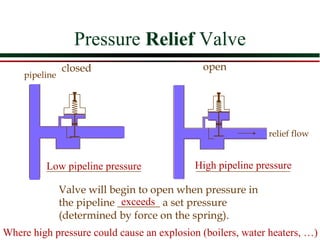
Pressure Relief Valve
               closed                        open
    pipeline


                                                            relief flow


         Low pipeline pressure             High pipeline pressure

               Valve will begin to open when pressure in
                             exceeds
               the pipeline ________ a set pressure
               (determined by force on the spring).
Where high pressure could cause an explosion (boilers, water heaters, …)
Pressure Regulating Valve
           sets maximum pressure downstream
      closed                      open


High downstream pressure      Low downstream pressure

 Valve will begin to open when the pressure
 ___________ less
 downstream is _________ than the setpoint
 pressure (determined by the force of the spring).
Similar function to pressure break tank
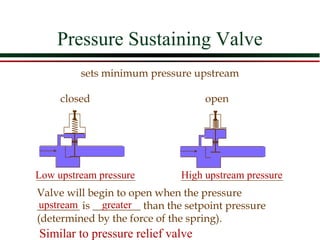
Pressure Sustaining Valve
         sets minimum pressure upstream

     closed                        open


Low upstream pressure         High upstream pressure
Valve will begin to open when the pressure
upstream      greater
________ is _________ than the setpoint pressure
(determined by the force of the spring).
Similar to pressure relief valve
Flow control valve (FCV)
 Limits the flow rate
             ____ ___
  through the valve to a
  specified value, in a
  specified direction
 Commonly used to limit
  the maximum flow to a
  value that will not
  adversely affect the
  provider’s system
Pressure Break Tanks

 In the developing world small water supplies in
  mountainous regions can develop too much
  pressure for the PVC pipe.
 They don’t want to use PRVs because they are too
  expensive and are prone to failure.
 Pressure break tanks have an inlet, an outlet, and
  an overflow.
 Is there a better solution?
Network Analysis Extended

 The previous approach works for a simple
  loop, but it doesn’t easily extend to a whole
  network of loops
 Need a matrix method
  Initial guess for flows
  Adjust all flows to reduce the error in pressures
   __________________________
    Simultaneous equations
   _______________________________
     Appendix D of EPANET manual
Pressure Network Analysis
           Software: EPANET
reservoir
                            pipe                junction


    0.32 m3/s   A           1               B              0.28 m3/s
                4               0.218       2

                    0.102                       0.062

                             0.202
    0.10 m /s
            3   C                       3   D
                                                           0.14 m3/s
EPANET network solution

      8 fL  2       H i − H j = hij = rQij + mQij
                                           n      2

hf =       
         5 2 Q
      gD π 
                              ∑Qj
                                    ij    − Di = 0
     8 fL 
 r =
     gD 5π 2 ÷
              
                               AH = F
                               Aii = ∑ pij
  n=2                                      j
                               Aij = − pij
            1
pij =                                  1
        8 fL        pij =              n −1
      2        Q
           5 2 ÷ ij           nr Qij            + 2m Qij
        gD π 
            
Fi =  ∑ Qij − Di ÷+ ∑ yij + ∑ pif H f
      j           j        f


         (       n
yij = pij r Qij + m Qij
                             2
                                 ) sgn ( Q )
                                         ij


  Qij = Qij −  yij − pij ( H i − H j ) 
                                       
02 pipe networks

02 pipe networks

  • 1.
     Pipe Networks Pipeline systems Transmission lines You are here Pipe networks Measurements Manifolds and diffusers Pumps Transients School of Civil and Monroe L. Weber-Shirk Environmental Engineering
  • 2.
    Pipeline systems: Pipe networks  Water distribution systems for municipalities  Multiple sources and multiple sinks connected with an interconnected network of pipes.  Computer solutions!  KYpipes  WaterCAD  CyberNET  EPANET http://www.epa.gov/ORD/NRMRL/wswrd/epanet.html
  • 3.
    Water Distribution System Assumption  Each point in the a system can only have one pressure _______ 1 2  The pressure change from 1 to 2 by path a must equal the b pressure change from 1 to 2 by path b p1 V12 p2 V22 + + z1 = + + z 2 + hL γ 2g γ 2g 2 p 2 p1 V1 V22 − = + z1 − a a − z2 − hL Same for path b! γ γ 2g 2g a
  • 4.
    Water Distribution System Assumption V12 V22 V12 V22 a + z1 − a − z2 − hL = b + z1 − b − z 2 − hL 2g 2g a 2g 2g b a 1 2 Pressure change by path a b hL = hL a b zero Or sum of head loss around loop is _____. (Need a sign convention)  Pipe diameters are constant or K.E. is small  Model withdrawals as occurring at nodes so V is constant between nodes
  • 5.
    Pipes in Parallel Find discharge given pressure at A and B Q1 ______& ____ equation energy S-J add flows Qtotal A Q2 B  Find head loss given the total flow assume a discharge Q1’ through pipe 1 solve for head loss using the assumed discharge using the calculated head loss to find Q2’ assume that the actual flow is divided in the same proportion _________ as the assumed flow
  • 6.
    Networks of Pipes Mass__________ at all nodes ____ conservation 0.32 m /s 3 A 0.28 m3/s  The relationship between head ? loss and discharge must be maintained for each pipe Darcy-Weisbach equation Swamee-Jain _____________ Exponential friction formula a _____________ Hazen-Williams 1 2 b
  • 7.
    Network Analysis Find the flows in the loop given the inflows and outflows. The pipes are all 25 cm cast iron (ε=0.26 mm). 0.32 m3/s A B 0.28 m3/s 100 m 0.10 m3/s C D 0.14 m3/s 200 m
  • 8.
    Network Analysis  Assigna flow to each pipe link  Flow into each junction must equal flow out of the junction arbitrary 0.32 m3/s A B 0.28 m3/s 0.32 0.00 0.04 0.10 m3/s C D 0.14 m3/s 0.10
  • 9.
    Network Analysis h f = 34.7m  Calculate the head loss in each pipe 1 h f = 0.222m  8 fL  2 2 hf =   5 2 Q f=0.02 for Re>200000 h f = −3.39m  gD π  3 h f = kQ Q Sign convention +CW h f = −0.00m 4 4  8(0.02)(200)  s 2 k1,k3=339 k1 =   = 339  (9.8)(0.25) 5 π 2  m5 k2,k4=169 ∑h fi = 31.53m   i=1 0.32 m3/s A 1 B 0.28 m3/s 4 2 0.10 m3/s C 3 D 0.14 m3/s
  • 10.
    Network Analysis  Thehead loss around the loop isn’t zero  Need to change the flow around the loop clockwise  the ___________ flow is too great (head loss is positive)  reduce the clockwise flow to reduce the head loss  Solution techniques optimizes correction  Hardy Cross loop-balancing (___________ _________)  Use a numeric solver (Solver in Excel) to find a change in flow that will give zero head loss around the loop  Use Network Analysis software (EPANET)
  • 11.
    Numeric Solver  Setup a spreadsheet as shown below.  the numbers in bold were entered, the other cells are calculations  initially ∆Q is 0  use “solver” to set the sum of the head loss to 0 by changing ∆Q  the column Q0+ ∆Q contains the correct flows ∆Q 0.000 pipe f L D k Q0 Q0+∆Q hf P1 0.02 200 0.25 339 0.32 0.320 34.69 P2 0.02 100 0.25 169 0.04 0.040 0.27 P3 0.02 200 0.25 339 -0.1 -0.100 -3.39 P4 0.02 100 0.25 169 0 0.000 0.00 Sum Head Loss 31.575
  • 12.
    Solution to LoopProblem Q0+ ∆Q 0.218 −0.062 −0.202 −0.102 0.32 m3/s A 1 B 0.28 m3/s 4 0.218 2 0.102 0.062 0.202 0.10 m /s3 C 3 D 0.14 m3/s Better solution is software with a GUI showing the pipe network.
  • 13.
    Network Elements  Controls  Check valve (CV)  Pressure relief valve  Pressure reducing valve (PRV)  Pressure sustaining valve (PSV)  Flow control valve (FCV)  Pumps: need a relationship between flow and head  Reservoirs: infinite source, elevation is not affected by demand  Tanks: specific geometry, mass conservation applies
  • 14.
    Check Valve  Valveonly allows flow in one direction  The valve automatically closes when flow begins to reverse open closed
  • 15.
    Pressure Relief Valve closed open pipeline relief flow Low pipeline pressure High pipeline pressure Valve will begin to open when pressure in exceeds the pipeline ________ a set pressure (determined by force on the spring). Where high pressure could cause an explosion (boilers, water heaters, …)
  • 16.
    Pressure Regulating Valve sets maximum pressure downstream closed open High downstream pressure Low downstream pressure Valve will begin to open when the pressure ___________ less downstream is _________ than the setpoint pressure (determined by the force of the spring). Similar function to pressure break tank
  • 17.
    Pressure Sustaining Valve sets minimum pressure upstream closed open Low upstream pressure High upstream pressure Valve will begin to open when the pressure upstream greater ________ is _________ than the setpoint pressure (determined by the force of the spring). Similar to pressure relief valve
  • 18.
    Flow control valve(FCV)  Limits the flow rate ____ ___ through the valve to a specified value, in a specified direction  Commonly used to limit the maximum flow to a value that will not adversely affect the provider’s system
  • 19.
    Pressure Break Tanks In the developing world small water supplies in mountainous regions can develop too much pressure for the PVC pipe.  They don’t want to use PRVs because they are too expensive and are prone to failure.  Pressure break tanks have an inlet, an outlet, and an overflow.  Is there a better solution?
  • 20.
    Network Analysis Extended The previous approach works for a simple loop, but it doesn’t easily extend to a whole network of loops  Need a matrix method Initial guess for flows Adjust all flows to reduce the error in pressures  __________________________ Simultaneous equations  _______________________________ Appendix D of EPANET manual
  • 21.
    Pressure Network Analysis Software: EPANET reservoir pipe junction 0.32 m3/s A 1 B 0.28 m3/s 4 0.218 2 0.102 0.062 0.202 0.10 m /s 3 C 3 D 0.14 m3/s
  • 22.
    EPANET network solution  8 fL  2 H i − H j = hij = rQij + mQij n 2 hf =   5 2 Q  gD π  ∑Qj ij − Di = 0  8 fL  r =  gD 5π 2 ÷  AH = F Aii = ∑ pij n=2 j Aij = − pij 1 pij = 1  8 fL  pij = n −1 2 Q 5 2 ÷ ij nr Qij + 2m Qij  gD π 
  • 23.
     Fi =  ∑ Qij − Di ÷+ ∑ yij + ∑ pif H f  j  j f ( n yij = pij r Qij + m Qij 2 ) sgn ( Q ) ij Qij = Qij −  yij − pij ( H i − H j )   