Hardycross Method 
Muhammad Nouman 
UET,Peshawar,Pakistan
Hardy Cross Method:- 
• To analyze a given distribution system to determine the pressure and flow available in any section of the 
system and to suggest improvement if needed a number of methods are used like Equivalent pipe, Circle 
method, method of section and Hardy-cross method. Hardy-cross method is a popular method. According 
to this method the sum of the loss of head for a closed network / loop is equal to zero. Also the sum of 
inflow at a node / joint is equal to the out flow i.e. Σinflow = Σoutflow or total head loss = 0 
Assumption:- 
Sum of the inflow at a node/point is equal to outflow. Σinflow = Σoutflow; Σtotal flow = 0 
Algebraic sum of the head losses in a closed loop is equal to zero. Σhead losses = 0 
Clockwise flows are positive. Counter clockwise flows are negative. 
• Derivation:- 
According to Hazen William Equation H= 10.68 (Q/C) 1.85 (L / d)4.87 
H= KQ1.85 where K = (10.68L)/(C1.85*d4.87) 
For any pipe in a closed loop 
Q = Q+ Δ where Q = actual flow; Q= assumed flow and Δ = required flow correction 
1 1 H= KQx (i) x is an exponent whose value is generally 1.85 
From (i) H = K(Q+ Δ)x By Binomial theorm = K[Qx + (xQx-1Δ)/1! + {x(x-1)Qx-2Δ2}/2! + ……..] 
1 1 
1 
As Δ is very small as compared to Q, we can neglect Δ2 etc. Therefore, H = KQ1 
x + KxQ1 
x-1Δ (ii) 
For a closed loop Σ H = 0 => Σ Qx = 0 => Σ k Q1 
x = - ΔΣ x Q1 
x-1) => Δ = - Σ k Q1 
x / (Σ x Q1 
x-1)
As H = K*Q x 
Σ KQ1 
x/ Q1 = H/Q 1 
Therefore, Δ = - Σ H/ [x* Σ (H)/ Q1] 
Above equation is used in Hardy Cross Method 
Procedure : (i) Assume the diameter of each pipe in the loop. 
(ii) Assume the flow in the pipe such that sum of the inflow = sum of the outflow at any junction or node 
( V = V1 + V2 or Q = Q1 + Q2 ) 
(iii) Compute the head losses in each pipe by Hazen William Equation H = 10.68 * (Q/C)1.85 * L/D4.87 
(iv) Taking clock wise flow as positive and anti clock wise as negative. 
(v) Find sum of the ratio of head loss and discharge in each pipe without regard of sign Σ ( H/Q1 ) 
(vi) Find the correction for each loop from Δ = - Σ H/ [x* Σ (H)/ Q1] and apply it to all pipes. 
(vii) Repeat the procedure with corrected values of flow and continue till the correction become very small
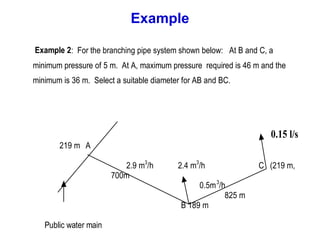
Example 2: For the branching pipe system shown below: At B and C, a 
minimum pressure of 5 m. At A, maximum pressure required is 46 m and the 
minimum is 36 m. Select a suitable diameter for AB and BC. 
0.15 l/s 
219 m A 
2.9 m3/h 2.4 m3/h C (219 m, 
700m 
0.5m3/h 
825 m 
B 189 m 
Public water main 
Example
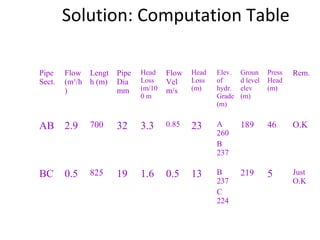
Solution: Computation Table 
Pipe 
Sect. 
Flow 
(m3/h 
) 
Lengt 
h (m) 
Pipe 
Dia 
mm 
Head 
Loss 
(m/10 
0 m 
Flow 
Vel 
m/s 
Head 
Loss 
(m) 
Elev. 
of 
hydr. 
Grade 
(m) 
Groun 
d level 
elev 
(m) 
Press 
Head 
(m) 
Rem. 
AB 2.9 700 32 3.3 0.85 23 A 
260 
B 
237 
189 46 O.K 
BC 0.5 825 19 1.6 0.5 13 B 
237 
C 
224 
219 5 Just 
O.K
Example 
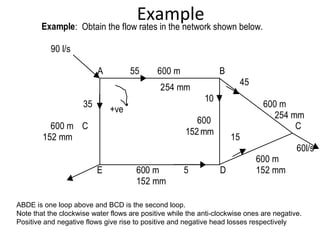
Example: Obtain the flow rates in the network shown below. 
90 l/s 
A 55 600 m B 
45 
254 mm 
35 600 m 
254 mm 
600 m C C 
152 mm 15 
15 60l/s 
66600 600 m 
E 600 m 5 D 152 mm 
152 mm 
10 
+ve 
600 
152 mm 
ABDE is one loop above and BCD is the second loop. 
Note that the clockwise water flows are positive while the anti-clockwise ones are negative. 
Positive and negative flows give rise to positive and negative head losses respectively
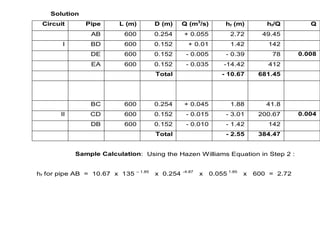
Solution 
Circuit Pipe L (m) D (m) Q (m3/s) hf (m) hf/Q Q 
AB 600 0.254 + 0.055 2.72 49.45 
I BD 600 0.152 + 0.01 1.42 142 
DE 600 0.152 - 0.005 - 0.39 78 0.008 
EA 600 0.152 - 0.035 -14.42 412 
Total - 10.67 681.45 
BC 600 0.254 + 0.045 1.88 41.8 
II CD 600 0.152 - 0.015 - 3.01 200.67 0.004 
DB 600 0.152 - 0.010 - 1.42 142 
Total - 2.55 384.47 
Sample Calculation: Using the Hazen Williams Equation in Step 2 : 
hf for pipe AB = 10.67 x 135 – 1.85 x 0.254 -4.87 x 0.055 1.85 x 600 = 2.72

Hardycross method

  • 1.
    Hardycross Method MuhammadNouman UET,Peshawar,Pakistan
  • 2.
    Hardy Cross Method:- • To analyze a given distribution system to determine the pressure and flow available in any section of the system and to suggest improvement if needed a number of methods are used like Equivalent pipe, Circle method, method of section and Hardy-cross method. Hardy-cross method is a popular method. According to this method the sum of the loss of head for a closed network / loop is equal to zero. Also the sum of inflow at a node / joint is equal to the out flow i.e. Σinflow = Σoutflow or total head loss = 0 Assumption:- Sum of the inflow at a node/point is equal to outflow. Σinflow = Σoutflow; Σtotal flow = 0 Algebraic sum of the head losses in a closed loop is equal to zero. Σhead losses = 0 Clockwise flows are positive. Counter clockwise flows are negative. • Derivation:- According to Hazen William Equation H= 10.68 (Q/C) 1.85 (L / d)4.87 H= KQ1.85 where K = (10.68L)/(C1.85*d4.87) For any pipe in a closed loop Q = Q+ Δ where Q = actual flow; Q= assumed flow and Δ = required flow correction 1 1 H= KQx (i) x is an exponent whose value is generally 1.85 From (i) H = K(Q+ Δ)x By Binomial theorm = K[Qx + (xQx-1Δ)/1! + {x(x-1)Qx-2Δ2}/2! + ……..] 1 1 1 As Δ is very small as compared to Q, we can neglect Δ2 etc. Therefore, H = KQ1 x + KxQ1 x-1Δ (ii) For a closed loop Σ H = 0 => Σ Qx = 0 => Σ k Q1 x = - ΔΣ x Q1 x-1) => Δ = - Σ k Q1 x / (Σ x Q1 x-1)
  • 3.
    As H =K*Q x Σ KQ1 x/ Q1 = H/Q 1 Therefore, Δ = - Σ H/ [x* Σ (H)/ Q1] Above equation is used in Hardy Cross Method Procedure : (i) Assume the diameter of each pipe in the loop. (ii) Assume the flow in the pipe such that sum of the inflow = sum of the outflow at any junction or node ( V = V1 + V2 or Q = Q1 + Q2 ) (iii) Compute the head losses in each pipe by Hazen William Equation H = 10.68 * (Q/C)1.85 * L/D4.87 (iv) Taking clock wise flow as positive and anti clock wise as negative. (v) Find sum of the ratio of head loss and discharge in each pipe without regard of sign Σ ( H/Q1 ) (vi) Find the correction for each loop from Δ = - Σ H/ [x* Σ (H)/ Q1] and apply it to all pipes. (vii) Repeat the procedure with corrected values of flow and continue till the correction become very small
  • 4.
    Example 2: Forthe branching pipe system shown below: At B and C, a minimum pressure of 5 m. At A, maximum pressure required is 46 m and the minimum is 36 m. Select a suitable diameter for AB and BC. 0.15 l/s 219 m A 2.9 m3/h 2.4 m3/h C (219 m, 700m 0.5m3/h 825 m B 189 m Public water main Example
  • 5.
    Solution: Computation Table Pipe Sect. Flow (m3/h ) Lengt h (m) Pipe Dia mm Head Loss (m/10 0 m Flow Vel m/s Head Loss (m) Elev. of hydr. Grade (m) Groun d level elev (m) Press Head (m) Rem. AB 2.9 700 32 3.3 0.85 23 A 260 B 237 189 46 O.K BC 0.5 825 19 1.6 0.5 13 B 237 C 224 219 5 Just O.K
  • 6.
    Example Example: Obtainthe flow rates in the network shown below. 90 l/s A 55 600 m B 45 254 mm 35 600 m 254 mm 600 m C C 152 mm 15 15 60l/s 66600 600 m E 600 m 5 D 152 mm 152 mm 10 +ve 600 152 mm ABDE is one loop above and BCD is the second loop. Note that the clockwise water flows are positive while the anti-clockwise ones are negative. Positive and negative flows give rise to positive and negative head losses respectively
  • 7.
    Solution Circuit PipeL (m) D (m) Q (m3/s) hf (m) hf/Q Q AB 600 0.254 + 0.055 2.72 49.45 I BD 600 0.152 + 0.01 1.42 142 DE 600 0.152 - 0.005 - 0.39 78 0.008 EA 600 0.152 - 0.035 -14.42 412 Total - 10.67 681.45 BC 600 0.254 + 0.045 1.88 41.8 II CD 600 0.152 - 0.015 - 3.01 200.67 0.004 DB 600 0.152 - 0.010 - 1.42 142 Total - 2.55 384.47 Sample Calculation: Using the Hazen Williams Equation in Step 2 : hf for pipe AB = 10.67 x 135 – 1.85 x 0.254 -4.87 x 0.055 1.85 x 600 = 2.72