Dr Jaffar Raza Syed
Gingival Diseases
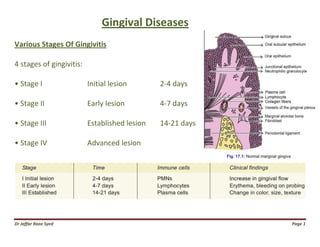
Various Stages Of Gingivitis
4 stages of gingivitis:
• Stage I Initial lesion
• Stage II Early lesion
• Stage III Established lesion
• Stage IV Advanced lesion
Gingival Diseases
Initial lesion 2-4 days
Early lesion 4-7 days
Established lesion 14-21 days
dvanced lesion
Page 1
Dr Jaffar Raza Syed Page 2
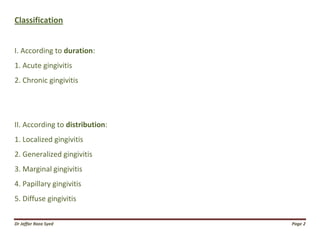
Classification
I. According to duration:
1. Acute gingivitis
2. Chronic gingivitis
II. According to distribution:
1. Localized gingivitis
2. Generalized gingivitis
3. Marginal gingivitis
4. Papillary gingivitis
5. Diffuse gingivitis
Dr Jaffar Raza Syed
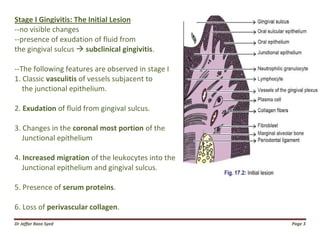
Stage I Gingivitis: The Initial Lesion
--no visible changes
--presence of exudation of fluid from
the gingival sulcus  subclinical gingivitis
--The following features are observed
1. Classic vasculitis of vessels subjacent to
the junctional epithelium.
2. Exudation of fluid from gingival sulcus.
3. Changes in the coronal most portion
Junctional epithelium
4. Increased migration of the leukocytes into t
Junctional epithelium and gingival sulcus.
5. Presence of serum proteins.
6. Loss of perivascular collagen.
tage I Gingivitis: The Initial Lesion
exudation of fluid from
subclinical gingivitis.
The following features are observed in stage I
of vessels subjacent to
of fluid from gingival sulcus.
coronal most portion of the
of the leukocytes into the
epithelium and gingival sulcus.
Page 3
Dr Jaffar Raza Syed
Stage II Gingivitis: The Early Lesion
Clinically, erythematous gingiva and
on probing may be evident.
Microscopic features of the early lesion
1. All the changes seen in the initial lesion
continue to intensify.
2. The junctional epithelium may begin to show
the development of rete pegs or ridges
3. Accumulation of lymphocytes
beneath the junctional epithelium.
4. Further loss of collagen fiber network
supporting the marginal gingiva.
5. Fibroblasts show cytotoxic alteration with a decreased
capacity for collagen production.
Stage II Gingivitis: The Early Lesion
Clinically, erythematous gingiva and bleeding
the early lesion include:
1. All the changes seen in the initial lesion
2. The junctional epithelium may begin to show
development of rete pegs or ridges.
lymphocytes
epithelium.
fiber network
marginal gingiva.
show cytotoxic alteration with a decreased
capacity for collagen production.
Page 4
Dr Jaffar Raza Syed Page 5
Stage III Gingivitis: The Established Lesion
--Same as early lesion, with blood stasis
--Changes are seen in color consistency and surface texture.
--Bluish hue around the reddened gingiva
--Proliferation, apical migration and lateral extension of junctional epithelium
--Atropic areas
--Plasma cells are predominant
--Further loss of collagen.
--Increased enzyme levels like acid and alkaline phosphatase, β glucuronidase
and others.
Dr Jaffar Raza Syed Page 6
Stage IV Gingivitis: The Advanced Lesion
The advanced lesion is also known as phase of advanced periodontal breakdown.
The following clinical and microscopic features are seen:
1. Persistence of features described in the established lesion.
2. Extension of the lesion into the alveolar bone and PDL leading
to significant amount of bone loss.
3. Continued loss of collagen.
4. Formation of periodontal pockets.
5. Conversion of bone marrow into fibrous tissue.
6. Presence of almost all the types of inflammatory cells.
Dr Jaffar Raza Syed Page 7
Clinical Findings
Changes in
color,
contour,
consistency,
size,
position,
severity of bleeding,
surface texture
Dr Jaffar Raza Syed Page 8
Dr Jaffar Raza Syed Page 9
Dr Jaffar Raza Syed Page 10
Dr Jaffar Raza Syed Page 11
Dr Jaffar Raza Syed
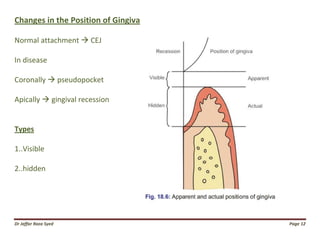
Changes in the Position of Gingiva
Normal attachment  CEJ
In disease
Coronally  pseudopocket
Apically  gingival recession
Types
1..Visible
2..hidden
Changes in the Position of Gingiva
Page 12
Dr Jaffar Raza Syed Page 13
PD Miller’s Classification of Gingival Recession
Dr Jaffar Raza Syed Page 14
Etiology of Gingival Recession
Plaque-induced gingival inflammation
Faulty tooth brushing
Tooth malpositions
Presence of dehiscence and fenestrations
Smoking
Primary trauma from occlusion
Iatrogenic factors
Dr Jaffar Raza Syed Page 15
Clinical Significance of Gingival Recession
1. The exposed root surface may be extremely sensitive.
2. Hyperemia of the pulp may result due to gingival recession.
3. Interproximal recession creates oral hygiene problems
thereby resulting in plaque accumulation.
4. Finally, it is aesthetically unacceptable.

019.gingival diseases

  • 1.
    Dr Jaffar RazaSyed Gingival Diseases Various Stages Of Gingivitis 4 stages of gingivitis: • Stage I Initial lesion • Stage II Early lesion • Stage III Established lesion • Stage IV Advanced lesion Gingival Diseases Initial lesion 2-4 days Early lesion 4-7 days Established lesion 14-21 days dvanced lesion Page 1
  • 2.
    Dr Jaffar RazaSyed Page 2 Classification I. According to duration: 1. Acute gingivitis 2. Chronic gingivitis II. According to distribution: 1. Localized gingivitis 2. Generalized gingivitis 3. Marginal gingivitis 4. Papillary gingivitis 5. Diffuse gingivitis
  • 3.
    Dr Jaffar RazaSyed Stage I Gingivitis: The Initial Lesion --no visible changes --presence of exudation of fluid from the gingival sulcus  subclinical gingivitis --The following features are observed 1. Classic vasculitis of vessels subjacent to the junctional epithelium. 2. Exudation of fluid from gingival sulcus. 3. Changes in the coronal most portion Junctional epithelium 4. Increased migration of the leukocytes into t Junctional epithelium and gingival sulcus. 5. Presence of serum proteins. 6. Loss of perivascular collagen. tage I Gingivitis: The Initial Lesion exudation of fluid from subclinical gingivitis. The following features are observed in stage I of vessels subjacent to of fluid from gingival sulcus. coronal most portion of the of the leukocytes into the epithelium and gingival sulcus. Page 3
  • 4.
    Dr Jaffar RazaSyed Stage II Gingivitis: The Early Lesion Clinically, erythematous gingiva and on probing may be evident. Microscopic features of the early lesion 1. All the changes seen in the initial lesion continue to intensify. 2. The junctional epithelium may begin to show the development of rete pegs or ridges 3. Accumulation of lymphocytes beneath the junctional epithelium. 4. Further loss of collagen fiber network supporting the marginal gingiva. 5. Fibroblasts show cytotoxic alteration with a decreased capacity for collagen production. Stage II Gingivitis: The Early Lesion Clinically, erythematous gingiva and bleeding the early lesion include: 1. All the changes seen in the initial lesion 2. The junctional epithelium may begin to show development of rete pegs or ridges. lymphocytes epithelium. fiber network marginal gingiva. show cytotoxic alteration with a decreased capacity for collagen production. Page 4
  • 5.
    Dr Jaffar RazaSyed Page 5 Stage III Gingivitis: The Established Lesion --Same as early lesion, with blood stasis --Changes are seen in color consistency and surface texture. --Bluish hue around the reddened gingiva --Proliferation, apical migration and lateral extension of junctional epithelium --Atropic areas --Plasma cells are predominant --Further loss of collagen. --Increased enzyme levels like acid and alkaline phosphatase, β glucuronidase and others.
  • 6.
    Dr Jaffar RazaSyed Page 6 Stage IV Gingivitis: The Advanced Lesion The advanced lesion is also known as phase of advanced periodontal breakdown. The following clinical and microscopic features are seen: 1. Persistence of features described in the established lesion. 2. Extension of the lesion into the alveolar bone and PDL leading to significant amount of bone loss. 3. Continued loss of collagen. 4. Formation of periodontal pockets. 5. Conversion of bone marrow into fibrous tissue. 6. Presence of almost all the types of inflammatory cells.
  • 7.
    Dr Jaffar RazaSyed Page 7 Clinical Findings Changes in color, contour, consistency, size, position, severity of bleeding, surface texture
  • 8.
    Dr Jaffar RazaSyed Page 8
  • 9.
    Dr Jaffar RazaSyed Page 9
  • 10.
    Dr Jaffar RazaSyed Page 10
  • 11.
    Dr Jaffar RazaSyed Page 11
  • 12.
    Dr Jaffar RazaSyed Changes in the Position of Gingiva Normal attachment  CEJ In disease Coronally  pseudopocket Apically  gingival recession Types 1..Visible 2..hidden Changes in the Position of Gingiva Page 12
  • 13.
    Dr Jaffar RazaSyed Page 13 PD Miller’s Classification of Gingival Recession
  • 14.
    Dr Jaffar RazaSyed Page 14 Etiology of Gingival Recession Plaque-induced gingival inflammation Faulty tooth brushing Tooth malpositions Presence of dehiscence and fenestrations Smoking Primary trauma from occlusion Iatrogenic factors
  • 15.
    Dr Jaffar RazaSyed Page 15 Clinical Significance of Gingival Recession 1. The exposed root surface may be extremely sensitive. 2. Hyperemia of the pulp may result due to gingival recession. 3. Interproximal recession creates oral hygiene problems thereby resulting in plaque accumulation. 4. Finally, it is aesthetically unacceptable.