Dr Jaffar Raza Syed
Desquamative Gingivitis
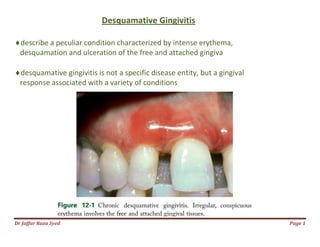
describe a peculiar condition characterized by intense erythema,
desquamation and ulceration of the free and attached gingiva
desquamative gingivitis is not a specific disease entity, but a gingival
response associated with a variety of conditions
Desquamative Gingivitis
describe a peculiar condition characterized by intense erythema,
desquamation and ulceration of the free and attached gingiva
desquamative gingivitis is not a specific disease entity, but a gingival
response associated with a variety of conditions
Page 1
desquamative gingivitis is not a specific disease entity, but a gingival
Dr Jaffar Raza Syed Page 2
CLASSIFICATION
A. Dermatoses
• Oral lichen planus
• Mucous membrane pemphigoid
• Pemphigus vulgaris
• Bullous pemphigoid
• Erythema multiforme
• Linear IgA disease
• Lupus erythematosus
• Epidermolysis bullosa aquisita
• Dermatitis herpetiformis
Dr Jaffar Raza Syed Page 3
B. Local hypersensitivity reactions to
Toothpastes,
mouthwashes,
dental materials,
drugs,
cosmetics,
chewing gum
cinnamon, etc
C. Miscellaneous
Chronic ulcerative stomatitis
Orofacial granulomatosis
Plasma cell gingivitis
Dr Jaffar Raza Syed Page 4
Clinical Features
• Females are more frequently affected.
• Buccal aspect of anterior gingiva most commonly affected.
• The gingiva is fiery red, friable and desquamates easily
• Patients complain of soreness, especially when eating spicy or acidic food,
and of bleeding and discomfort with toothbrushing.
• Lesions get aggravated by local plaque accumulation.
• A positive Nikolsky’s sign where the surface epithelium “floats away” when
lateral pressure is applied to the mucosa, may indicate vesiculobullous disorders
• The presence of white plaques or white striae indicate lichen planus
Dr Jaffar Raza Syed Page 5
Etiology
• The etiology is unclear
• Mainly affects women at middle and advanced age
Symptoms
• Warmth, tenseness, tingling, itchiness, burning, and pain.
• Erythema and edema of the marginal and attached gingiva are clinically
Observed predominantly in the frontal areas.
Signs
• Desquamation of the epitelium with painfull erosive lesions and sometimes
formation of hemorrhagic bullae by pressing.
Dr Jaffar Raza Syed Page 6
Diagnosis
• Detailed clinical examination of the oral and perioral lesions
• Biopsy (perilesional)
• Biopsy for direct immunofluorescence and with indirect immunofluorescence of
the serum
Dr Jaffar Raza Syed Page 7
Summary of diagnostic procedure
CLINICAL HISTORY
(data regarding the symptoms & historical aspect is collected & information
about previous therapy is also collected )
CLINICAL EXAMINATION
(recognition of the pattern of distribution of lesion & performing Nikolsky’s
sign)
BIOPSY
[ Either incisional or perilesional]
MICROSCOPIC EXAMINATION IMMUNOFLORESENCE
Dr Jaffar Raza Syed Page 8
Management
• Plaque control: Oral Hygiene, education
• Avoid stimulants, e.g spicy foods…
• Identify and manage the cause
• Topical corticosteroids are the mainstay of treatment for lichen planus and MMP
And should be applied directly onto the affected gingiva.
• Systemic corticosteroids are needed for pemphigus
• Treat
• Collaborate with other clinicians
• Refer
Dr Jaffar Raza Syed
Diseases Clinically Presenting As Desquamative Gingivitis
Lichen Planus
Lichen planus is an inflmmatory mucocutaneous disorder
mucosal surfaces (e.g., oral cavity, genital tract, and
skin (including the scalp and the
occurs as a bilateral disease
presence of cutaneous violaceous
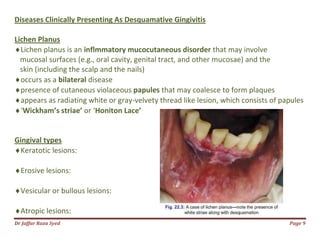
appears as radiating white or gray
‘Wickham’s striae’ or ‘Honiton Lace’
Gingival types
Keratotic lesions:
Erosive lesions:
Vesicular or bullous lesions:
Atropic lesions:
lly Presenting As Desquamative Gingivitis
inflmmatory mucocutaneous disorder that may involve
mucosal surfaces (e.g., oral cavity, genital tract, and other mucosae) and the
skin (including the scalp and the nails)
presence of cutaneous violaceous papules that may coalesce to form plaques
appears as radiating white or gray-velvety thread like lesion, which consists of papules
Honiton Lace’
Page 9
may involve
other mucosae) and the
that may coalesce to form plaques
velvety thread like lesion, which consists of papules
Dr Jaffar Raza Syed Page 10
HISTOPATHOLOGY
 hyperkeratosis.
hydropic degeneration of basal cell layer.
saw toothed rete pegs.
colloid bodies present.
lamina propria exhibit band like infiltration of T- lymphocytes.
Dr Jaffar Raza Syed
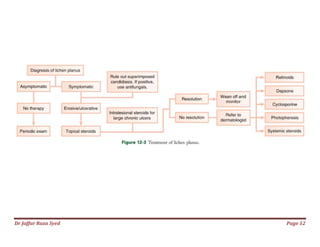
Treatment
Corticosteroids  Topical application and local injection of steroids
topical steroid such as 0.05 percent Fluocinolone acetonide
triamcinolone acetonide (10 to 20 mg)
Other treatment modalities are
retinoids,
hydroxychloroquine,
cyclosporine and
free gingival grafts.
Addition of antifungal therapy
Topical application and local injection of steroids
topical steroid such as 0.05 percent Fluocinolone acetonide
triamcinolone acetonide (10 to 20 mg)
Addition of antifungal therapy  additional benefits>>>
Page 11
Topical application and local injection of steroids
Dr Jaffar Raza Syed Page 12
Dr Jaffar Raza Syed Page 13
Cicatricial Pemphigoid (Mucous Membrane Pemphigoid MMP)
chronic autoimmune subepithelial disease primarily affecting the
mucous membranes of patients over the age of 50
multiple painful ulcers preceded by bullae.
characterized by mucosal blister formation with subsequent scarring
affect women more than men
oral mucosal presentation
erosion or desquamation of attached gingival tissues or large areas of
vesiculobullous eruptions
healing with scarring
+ve Nikolsky’s sign
Dr Jaffar Raza Syed
Histopathology
Sub epithelial clefting with epithelial separation
basal layer
Sub epithelial clefting with epithelial separation from lamina propria leaving an intact
Page 14
from lamina propria leaving an intact
Dr Jaffar Raza Syed Page 15
Bullous Pemphigoid
skin disease with infrequent oral lesion.
ulcers preceded by bullae.
no scarring.
seen in elderly persons.
Histopathology
Sub epithelial clefting with epithelial sepration from lamina propria leaving an intact
basal layer.
Dr Jaffar Raza Syed Page 16
Pemphigus Vulgaris
multiple painful ulcers preceded by bullae.
middle aged patients commonly effected.
positive Nikolsky’s sign.
it is a progressive disease.
Histopathology
 intra epithelial clefting above the basal layer.
“Tombstone” appearance of basal cell layer.
acantholysis present.
Dr Jaffar Raza Syed
pemphis vulgaris of the gingiva. oral lesions
confined to the gingiva consistent with
desquamative gingivitis
Page 17
pemphis vulgaris of the gingiva. oral lesions
confined to the gingiva consistent with
Dr Jaffar Raza Syed Page 18
Dr Jaffar Raza Syed Page 19
Dermatitis Herpetiformis:
Skin diseases with rare oral involvement.
vesicles and pustules.
exacerbation and remission seen.
young and middle aged patients are
commonly effected.
Histopathology:
Collection of esoniophils, neutrophils and fibrin in connective tissue papillae.
Dr Jaffar Raza Syed Page 20
Linear IgA disease:
manifested as vesicles.
painful ulcers are seen.
erosive gingivitis.
Histopathology:
Separation of the basement membrane.
Dr Jaffar Raza Syed Page 21

022.desquamative gingivitis

  • 1.
    Dr Jaffar RazaSyed Desquamative Gingivitis describe a peculiar condition characterized by intense erythema, desquamation and ulceration of the free and attached gingiva desquamative gingivitis is not a specific disease entity, but a gingival response associated with a variety of conditions Desquamative Gingivitis describe a peculiar condition characterized by intense erythema, desquamation and ulceration of the free and attached gingiva desquamative gingivitis is not a specific disease entity, but a gingival response associated with a variety of conditions Page 1 desquamative gingivitis is not a specific disease entity, but a gingival
  • 2.
    Dr Jaffar RazaSyed Page 2 CLASSIFICATION A. Dermatoses • Oral lichen planus • Mucous membrane pemphigoid • Pemphigus vulgaris • Bullous pemphigoid • Erythema multiforme • Linear IgA disease • Lupus erythematosus • Epidermolysis bullosa aquisita • Dermatitis herpetiformis
  • 3.
    Dr Jaffar RazaSyed Page 3 B. Local hypersensitivity reactions to Toothpastes, mouthwashes, dental materials, drugs, cosmetics, chewing gum cinnamon, etc C. Miscellaneous Chronic ulcerative stomatitis Orofacial granulomatosis Plasma cell gingivitis
  • 4.
    Dr Jaffar RazaSyed Page 4 Clinical Features • Females are more frequently affected. • Buccal aspect of anterior gingiva most commonly affected. • The gingiva is fiery red, friable and desquamates easily • Patients complain of soreness, especially when eating spicy or acidic food, and of bleeding and discomfort with toothbrushing. • Lesions get aggravated by local plaque accumulation. • A positive Nikolsky’s sign where the surface epithelium “floats away” when lateral pressure is applied to the mucosa, may indicate vesiculobullous disorders • The presence of white plaques or white striae indicate lichen planus
  • 5.
    Dr Jaffar RazaSyed Page 5 Etiology • The etiology is unclear • Mainly affects women at middle and advanced age Symptoms • Warmth, tenseness, tingling, itchiness, burning, and pain. • Erythema and edema of the marginal and attached gingiva are clinically Observed predominantly in the frontal areas. Signs • Desquamation of the epitelium with painfull erosive lesions and sometimes formation of hemorrhagic bullae by pressing.
  • 6.
    Dr Jaffar RazaSyed Page 6 Diagnosis • Detailed clinical examination of the oral and perioral lesions • Biopsy (perilesional) • Biopsy for direct immunofluorescence and with indirect immunofluorescence of the serum
  • 7.
    Dr Jaffar RazaSyed Page 7 Summary of diagnostic procedure CLINICAL HISTORY (data regarding the symptoms & historical aspect is collected & information about previous therapy is also collected ) CLINICAL EXAMINATION (recognition of the pattern of distribution of lesion & performing Nikolsky’s sign) BIOPSY [ Either incisional or perilesional] MICROSCOPIC EXAMINATION IMMUNOFLORESENCE
  • 8.
    Dr Jaffar RazaSyed Page 8 Management • Plaque control: Oral Hygiene, education • Avoid stimulants, e.g spicy foods… • Identify and manage the cause • Topical corticosteroids are the mainstay of treatment for lichen planus and MMP And should be applied directly onto the affected gingiva. • Systemic corticosteroids are needed for pemphigus • Treat • Collaborate with other clinicians • Refer
  • 9.
    Dr Jaffar RazaSyed Diseases Clinically Presenting As Desquamative Gingivitis Lichen Planus Lichen planus is an inflmmatory mucocutaneous disorder mucosal surfaces (e.g., oral cavity, genital tract, and skin (including the scalp and the occurs as a bilateral disease presence of cutaneous violaceous appears as radiating white or gray ‘Wickham’s striae’ or ‘Honiton Lace’ Gingival types Keratotic lesions: Erosive lesions: Vesicular or bullous lesions: Atropic lesions: lly Presenting As Desquamative Gingivitis inflmmatory mucocutaneous disorder that may involve mucosal surfaces (e.g., oral cavity, genital tract, and other mucosae) and the skin (including the scalp and the nails) presence of cutaneous violaceous papules that may coalesce to form plaques appears as radiating white or gray-velvety thread like lesion, which consists of papules Honiton Lace’ Page 9 may involve other mucosae) and the that may coalesce to form plaques velvety thread like lesion, which consists of papules
  • 10.
    Dr Jaffar RazaSyed Page 10 HISTOPATHOLOGY  hyperkeratosis. hydropic degeneration of basal cell layer. saw toothed rete pegs. colloid bodies present. lamina propria exhibit band like infiltration of T- lymphocytes.
  • 11.
    Dr Jaffar RazaSyed Treatment Corticosteroids  Topical application and local injection of steroids topical steroid such as 0.05 percent Fluocinolone acetonide triamcinolone acetonide (10 to 20 mg) Other treatment modalities are retinoids, hydroxychloroquine, cyclosporine and free gingival grafts. Addition of antifungal therapy Topical application and local injection of steroids topical steroid such as 0.05 percent Fluocinolone acetonide triamcinolone acetonide (10 to 20 mg) Addition of antifungal therapy  additional benefits>>> Page 11 Topical application and local injection of steroids
  • 12.
    Dr Jaffar RazaSyed Page 12
  • 13.
    Dr Jaffar RazaSyed Page 13 Cicatricial Pemphigoid (Mucous Membrane Pemphigoid MMP) chronic autoimmune subepithelial disease primarily affecting the mucous membranes of patients over the age of 50 multiple painful ulcers preceded by bullae. characterized by mucosal blister formation with subsequent scarring affect women more than men oral mucosal presentation erosion or desquamation of attached gingival tissues or large areas of vesiculobullous eruptions healing with scarring +ve Nikolsky’s sign
  • 14.
    Dr Jaffar RazaSyed Histopathology Sub epithelial clefting with epithelial separation basal layer Sub epithelial clefting with epithelial separation from lamina propria leaving an intact Page 14 from lamina propria leaving an intact
  • 15.
    Dr Jaffar RazaSyed Page 15 Bullous Pemphigoid skin disease with infrequent oral lesion. ulcers preceded by bullae. no scarring. seen in elderly persons. Histopathology Sub epithelial clefting with epithelial sepration from lamina propria leaving an intact basal layer.
  • 16.
    Dr Jaffar RazaSyed Page 16 Pemphigus Vulgaris multiple painful ulcers preceded by bullae. middle aged patients commonly effected. positive Nikolsky’s sign. it is a progressive disease. Histopathology  intra epithelial clefting above the basal layer. “Tombstone” appearance of basal cell layer. acantholysis present.
  • 17.
    Dr Jaffar RazaSyed pemphis vulgaris of the gingiva. oral lesions confined to the gingiva consistent with desquamative gingivitis Page 17 pemphis vulgaris of the gingiva. oral lesions confined to the gingiva consistent with
  • 18.
    Dr Jaffar RazaSyed Page 18
  • 19.
    Dr Jaffar RazaSyed Page 19 Dermatitis Herpetiformis: Skin diseases with rare oral involvement. vesicles and pustules. exacerbation and remission seen. young and middle aged patients are commonly effected. Histopathology: Collection of esoniophils, neutrophils and fibrin in connective tissue papillae.
  • 20.
    Dr Jaffar RazaSyed Page 20 Linear IgA disease: manifested as vesicles. painful ulcers are seen. erosive gingivitis. Histopathology: Separation of the basement membrane.
  • 21.
    Dr Jaffar RazaSyed Page 21