ACUTE GINGIVAL INFECTIONS
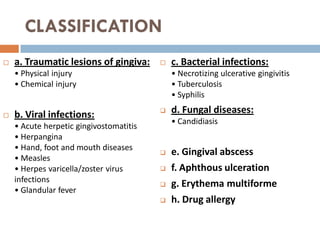
CLASSIFICATION
 a. Traumatic lesions of gingiva:
• Physical injury
• Chemical injury
 b. Viral infections:
• Acute herpetic gingivostomatitis
• Herpangina
• Hand, foot and mouth diseases
• Measles
• Herpes varicella/zoster virus
infections
• Glandular fever
 c. Bacterial infections:
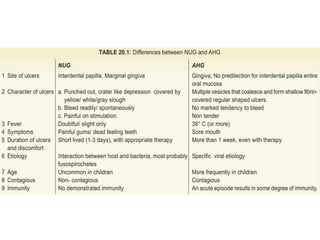
• Necrotizing ulcerative gingivitis
• Tuberculosis
• Syphilis
 d. Fungal diseases:
• Candidiasis
 e. Gingival abscess
 f. Aphthous ulceration
 g. Erythema multiforme
 h. Drug allergy
CLASSIFICATION
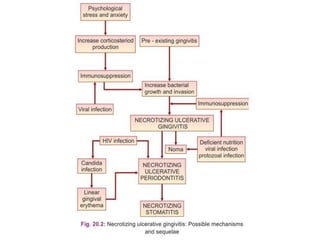
Also known as
►Vincent’s infection
► Trench mouth
► Acute ulceromembranous gingivitis
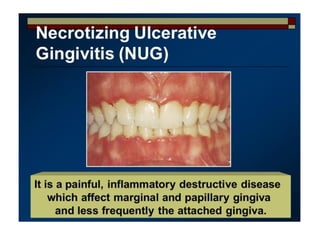
It is an inflammatory,destructive disease of the gingiva,
which presents characteristic signs and symptoms
►Sudden onset,
►may be followed by an episode of debilitating
diseases or ARTI.
►Long hours of working without adequate rest,
►psychologic stress.
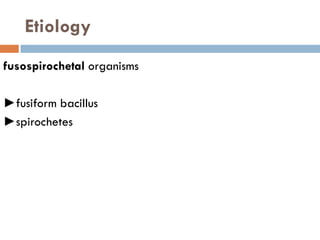
Signs and Symptoms
 Punched out, crater-like depressions at the crest of the interdental papillae,
subsequently involving marginal gingiva and rarely attached gingiva
 grayish pseudomembranous slough
 gingival hemorrhage or pronounced bleeding on the slightest stimulation.
 Fetid odor and increased salivation.
 extremely sensitive to touch
 constant radiating, gnawing pain that is intensified by eating spicy or hot foods and
chewing
 metallic foul taste
 pasty saliva
 local lymphadenopathy
 elevation in temperature
Etiology
fusospirochetal organisms
►fusiform bacillus
►spirochetes
Clinical Course
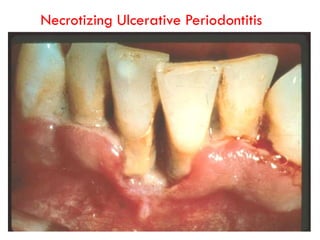
 if left untreated, it may lead to destruction of the periodontium, and
denudation of roots (NUP), combined with severe toxic systemic
complications.
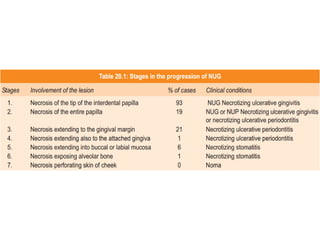
Stages of oral necrotizing disease
by Horning & Cohen
 Stage 1- necrosis of the top of the interdental papilla.
 Stage 2- necrosis of entire papilla
 Stage 3- necrosis extending to the gingival margin.
 Stage 4- necrosis extending to the attached gingiva.
 Stage 5– necrosis extending to labial & buccal mucosa.
 Stage 6- necrosis exposing alveolar bone.
 Stage 7– necrosis perforating skin of cheek.
Necrotizing Ulcerative Periodontitis
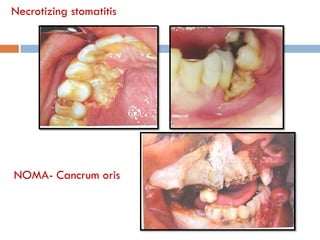
Necrotizing stomatitis
NOMA- Cancrum oris
Predisposing Factors
predisposing factors are:
 Pre-existing gingivitis
 Injury to the gingiva
 Smoking
Systemic Predisposing Factors
 Nutritional deficiency
 Debilitating diseases
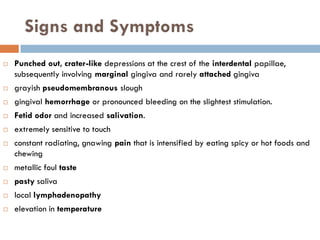
 Psychosomatic factors  activation of the hypothalamic
pituitary adrenal axis  ↑ cortisol levels  ↓ lymphocyte
and polymorphonuclear leukocytes function
Relationship of Bacteria to the Characteristic Lesions
1. Zone I—Bacterial zone:
It is the most superficial zone, consists of varied bacteria, including a few
Spirochetes of the small, medium-sized and large types.
2. Zone II—Neutrophil-rich zone:
Contains numerous leukocytes predominantly neutrophils with bacteria
including spirochetes of various types.
3. Zone III—Necrotic zone:
Consists of a dead tissue cells, remnants of connective tissue fragments, and
numerous spirochetes.
4. Zone IV—Zone of spirochetal infiltration:
Consists of a well preserved tissue infiltrated with spirochetes of
intermediate and large-sized without other organisms.
Treatment
Non-ambulatory Patients
Day 1:
 gently removing the necrotic pseudomembrane with a
pellet of cotton saturated with hydrogen peroxide
(H2O2).
 Advised bed rest and rinse the mouth every 2 hours
with a diluted 3 percent hydrogen peroxide (H2O2).
 Systemic antibiotics like penicillin or metronidazole can
be prescribed.
Treatment
Non-ambulatory Patients
Day 2:
 After 24 hours, a bedside visit should be made. The treatment
again includes gently swab the area with hydrogen peroxide,
instructions of the previous day are repeated.
Day 3:
 Most cases, the condition will be improved, start the treatment for
ambulatory patients.
Treatment
Ambulatory Patients
First visit:
 topical anesthetic
 gently swabbed with a cotton pellet to remove pseudomembrane
and non-attached surface debris.
 area is cleansed with warm water
 superficial calculus is removed with ultrasonic scalers.
 Antibiotics prescription
 Subgingival scaling and curettage are contraindicated
Instructions to the patient
1. Avoid smoking and alcohol.
2. Rinse with 3 percent hydrogen peroxide and warm water for every two hours.
3. Confine toothbrushing to the removal of surface debris with a bland dentifrice,
use of interdental aids and chlorhexidine mouth rinse are recommended.
Treatment
Ambulatory Patients
Second visit:
►Scalers and curettes are added to the instrumentarium.
►Shrinkage of the gingiva may expose previously covered calculus which is gently removed.
►Same instructions are reinforced.
Third visit:
►Scaling and root planing are repeated,
►Plaque control instructions are given.
►Hydrogen peroxide rinses are discontinued.
Fourth visit:
►Oral hygiene instructions are reinforced
►thorough scaling and root planing are performed.
Fifth visit:
►Appointments are fixed for treatment of chronic gingivitis, periodontal pockets
and pericoronal flaps, and for the elimination of all local irritants.
►Patient is placed on maintenance program.
Further Treatment Considerations
1. Gingivoplasty.
2. Systemic antibiotics—only in patients with toxic systemic
complications.
3. Supportive systemic treatment—copious fluid consumption and
administration of analgesics and adequate bed rest.
4. Nutritional supplements—vitamin B/C supplements
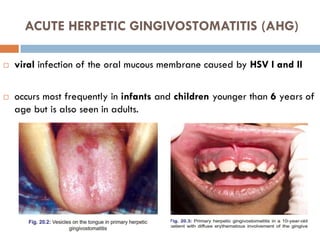
ACUTE HERPETIC GINGIVOSTOMATITIS (AHG)
 viral infection of the oral mucous membrane caused by HSV I and II
 occurs most frequently in infants and children younger than 6 years of
age but is also seen in adults.
Clinical Features
1. appears as a diffuse, shiny erythematous, involvement of the gingiva and
the adjacent oral mucosa with varying degrees of edema and gingival
bleeding.
2. In its initial stage it may appear as discrete, spherical, clusters of vesicles
dispersed in different areas, e.g. labial and buccal mucosa, hard palate,
pharynx and tongue. After approximately 24 hours the vesicles rupture and
form painful shallow ulcers with scalloped borders and surrounding
erythema.
3. Diffuse, edematous, erythematous enlargement of the gingiva with a tendency
towards bleeding is seen.
4. The course of the disease is 7 to 10 days.
Oral Symptoms
1. Generalized soreness of the oral cavity which interferes with eating and drinking.
2. The ruptured vesicles are sensitive to touch, thermal changes and food.
Extraoral and Systemic Signs and Symptoms
►fever
►loss of appetite
►myalgia
►Cervical lymphadenopathy
►After the primary infection the virus remains latent in the nerve tissue. If reactivation occurs it
causes Herpes labialis (cold sore).
►It is associated with prodrome of tingling and itching on the corners of lip followed by vesicle
formation and ulceration
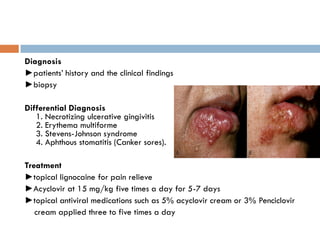
Diagnosis
►patients’ history and the clinical findings
►biopsy
Differential Diagnosis
1. Necrotizing ulcerative gingivitis
2. Erythema multiforme
3. Stevens-Johnson syndrome
4. Aphthous stomatitis (Canker sores).
Treatment
►topical lignocaine for pain relieve
►Acyclovir at 15 mg/kg five times a day for 5-7 days
►topical antiviral medications such as 5% acyclovir cream or 3% Penciclovir
cream applied three to five times a day
Recurrent Aphthous Stomatitis (RAS)
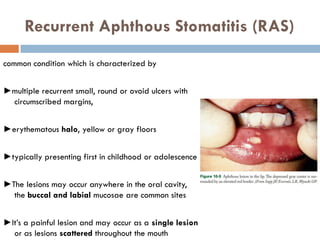
common condition which is characterized by
►multiple recurrent small, round or ovoid ulcers with
circumscribed margins,
►erythematous halo, yellow or gray floors
►typically presenting first in childhood or adolescence
►The lesions may occur anywhere in the oral cavity,
the buccal and labial mucosae are common sites
►It’s a painful lesion and may occur as a single lesion
or as lesions scattered throughout the mouth
Types
Minor aphthae:
►Is the most common affecting about 80% of patients with RAS
►ulcers are round or oval usually <5 mm in diameter with a
gray-white pseudomembrane and an erythematous halo.
►The ulcers heal within 10-14 days without scarring.
Major aphthae:
►Is a rare severe form of Aphthous ulcer.
►Ulcers are oval and may exceed 1 cm in diameter.
►Ulcers persist for up to 6 weeks and often heal with scarring.
Herpetiform aphthae:
►least common variety
►characterized by multiple recurrent crops of widespread small,
painful ulcers.
►As many as 100 ulcers may be present at a given time
►each measuring 2-3 mm in diameter
Etiology
►Unknown
►linked to RAS are genetic predisposition,
►Hematinic deficiencies,
►Immunologic abnormalities,
►stress,
►food allergy
►gastrointestinal disorders
►Predisposing factors include hormonal disturbances, trauma, cessation of
smoking and menstruation
Treatment
►topical lignocaine
►Topical steroids like Triamcinolone and Clobetasol
►systemic steroids and Thalidomide to reduce the number of ulcers and
recurrences.
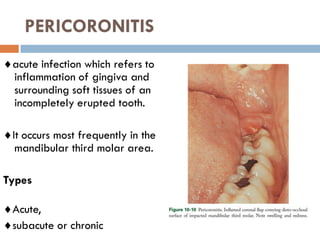
PERICORONITIS
acute infection which refers to
inflammation of gingiva and
surrounding soft tissues of an
incompletely erupted tooth.
It occurs most frequently in the
mandibular third molar area.
Types
Acute,
subacute or chronic
Signs and Symptoms
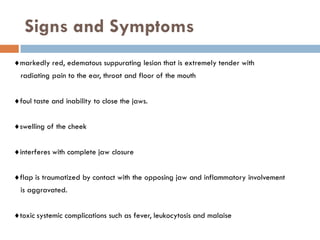
markedly red, edematous suppurating lesion that is extremely tender with
radiating pain to the ear, throat and floor of the mouth
foul taste and inability to close the jaws.
swelling of the cheek
interferes with complete jaw closure
flap is traumatized by contact with the opposing jaw and inflammatory involvement
is aggravated.
toxic systemic complications such as fever, leukocytosis and malaise
Complications
Localized  pericoronal abscess or cyst formation
may spread posteriorly into the oropharyngeal area and medially into
the base of the tongue, making it difficult for the patient to swallow
Peritonsillar abscess formation, cellulitis and Ludwig’s angina are the
potential complications
Treatment
The treatment of pericoronitis depends on
 Severity of the inflammation.
 The systemic complications, and
 The advisability of retaining the involved tooth
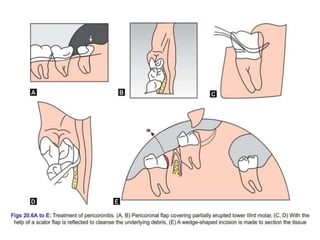
First Visit
warm water flush + topical anesthetic agent
flap is reflected with a scaler and the underlying debris is also removed
hourly rinses instructions
copious fluid intake
systemic antibiotics
If the gingival flap is swollen and fluctuant an antero-posterior incision to
establish drainage is made with a No. 15 bard parker blade
followed by insertion of 1/4th inch gauze wick
In the next visit, determination is made as to whether the tooth is to be retained
or extracted
04.acute gingival infections

04.acute gingival infections

  • 1.
  • 2.
    CLASSIFICATION  a. Traumaticlesions of gingiva: • Physical injury • Chemical injury  b. Viral infections: • Acute herpetic gingivostomatitis • Herpangina • Hand, foot and mouth diseases • Measles • Herpes varicella/zoster virus infections • Glandular fever  c. Bacterial infections: • Necrotizing ulcerative gingivitis • Tuberculosis • Syphilis  d. Fungal diseases: • Candidiasis  e. Gingival abscess  f. Aphthous ulceration  g. Erythema multiforme  h. Drug allergy
  • 3.
  • 4.
    Also known as ►Vincent’sinfection ► Trench mouth ► Acute ulceromembranous gingivitis It is an inflammatory,destructive disease of the gingiva, which presents characteristic signs and symptoms ►Sudden onset, ►may be followed by an episode of debilitating diseases or ARTI. ►Long hours of working without adequate rest, ►psychologic stress.
  • 6.
    Signs and Symptoms Punched out, crater-like depressions at the crest of the interdental papillae, subsequently involving marginal gingiva and rarely attached gingiva  grayish pseudomembranous slough  gingival hemorrhage or pronounced bleeding on the slightest stimulation.  Fetid odor and increased salivation.  extremely sensitive to touch  constant radiating, gnawing pain that is intensified by eating spicy or hot foods and chewing  metallic foul taste  pasty saliva  local lymphadenopathy  elevation in temperature
  • 7.
  • 8.
    Clinical Course  ifleft untreated, it may lead to destruction of the periodontium, and denudation of roots (NUP), combined with severe toxic systemic complications.
  • 9.
    Stages of oralnecrotizing disease by Horning & Cohen  Stage 1- necrosis of the top of the interdental papilla.  Stage 2- necrosis of entire papilla  Stage 3- necrosis extending to the gingival margin.  Stage 4- necrosis extending to the attached gingiva.  Stage 5– necrosis extending to labial & buccal mucosa.  Stage 6- necrosis exposing alveolar bone.  Stage 7– necrosis perforating skin of cheek.
  • 10.
  • 11.
  • 13.
    Predisposing Factors predisposing factorsare:  Pre-existing gingivitis  Injury to the gingiva  Smoking Systemic Predisposing Factors  Nutritional deficiency  Debilitating diseases  Psychosomatic factors  activation of the hypothalamic pituitary adrenal axis  ↑ cortisol levels  ↓ lymphocyte and polymorphonuclear leukocytes function
  • 14.
    Relationship of Bacteriato the Characteristic Lesions 1. Zone I—Bacterial zone: It is the most superficial zone, consists of varied bacteria, including a few Spirochetes of the small, medium-sized and large types. 2. Zone II—Neutrophil-rich zone: Contains numerous leukocytes predominantly neutrophils with bacteria including spirochetes of various types. 3. Zone III—Necrotic zone: Consists of a dead tissue cells, remnants of connective tissue fragments, and numerous spirochetes. 4. Zone IV—Zone of spirochetal infiltration: Consists of a well preserved tissue infiltrated with spirochetes of intermediate and large-sized without other organisms.
  • 15.
    Treatment Non-ambulatory Patients Day 1: gently removing the necrotic pseudomembrane with a pellet of cotton saturated with hydrogen peroxide (H2O2).  Advised bed rest and rinse the mouth every 2 hours with a diluted 3 percent hydrogen peroxide (H2O2).  Systemic antibiotics like penicillin or metronidazole can be prescribed.
  • 16.
    Treatment Non-ambulatory Patients Day 2: After 24 hours, a bedside visit should be made. The treatment again includes gently swab the area with hydrogen peroxide, instructions of the previous day are repeated. Day 3:  Most cases, the condition will be improved, start the treatment for ambulatory patients.
  • 17.
    Treatment Ambulatory Patients First visit: topical anesthetic  gently swabbed with a cotton pellet to remove pseudomembrane and non-attached surface debris.  area is cleansed with warm water  superficial calculus is removed with ultrasonic scalers.  Antibiotics prescription  Subgingival scaling and curettage are contraindicated Instructions to the patient 1. Avoid smoking and alcohol. 2. Rinse with 3 percent hydrogen peroxide and warm water for every two hours. 3. Confine toothbrushing to the removal of surface debris with a bland dentifrice, use of interdental aids and chlorhexidine mouth rinse are recommended.
  • 18.
    Treatment Ambulatory Patients Second visit: ►Scalersand curettes are added to the instrumentarium. ►Shrinkage of the gingiva may expose previously covered calculus which is gently removed. ►Same instructions are reinforced. Third visit: ►Scaling and root planing are repeated, ►Plaque control instructions are given. ►Hydrogen peroxide rinses are discontinued. Fourth visit: ►Oral hygiene instructions are reinforced ►thorough scaling and root planing are performed. Fifth visit: ►Appointments are fixed for treatment of chronic gingivitis, periodontal pockets and pericoronal flaps, and for the elimination of all local irritants. ►Patient is placed on maintenance program.
  • 19.
    Further Treatment Considerations 1.Gingivoplasty. 2. Systemic antibiotics—only in patients with toxic systemic complications. 3. Supportive systemic treatment—copious fluid consumption and administration of analgesics and adequate bed rest. 4. Nutritional supplements—vitamin B/C supplements
  • 20.
    ACUTE HERPETIC GINGIVOSTOMATITIS(AHG)  viral infection of the oral mucous membrane caused by HSV I and II  occurs most frequently in infants and children younger than 6 years of age but is also seen in adults.
  • 21.
    Clinical Features 1. appearsas a diffuse, shiny erythematous, involvement of the gingiva and the adjacent oral mucosa with varying degrees of edema and gingival bleeding. 2. In its initial stage it may appear as discrete, spherical, clusters of vesicles dispersed in different areas, e.g. labial and buccal mucosa, hard palate, pharynx and tongue. After approximately 24 hours the vesicles rupture and form painful shallow ulcers with scalloped borders and surrounding erythema. 3. Diffuse, edematous, erythematous enlargement of the gingiva with a tendency towards bleeding is seen. 4. The course of the disease is 7 to 10 days.
  • 22.
    Oral Symptoms 1. Generalizedsoreness of the oral cavity which interferes with eating and drinking. 2. The ruptured vesicles are sensitive to touch, thermal changes and food. Extraoral and Systemic Signs and Symptoms ►fever ►loss of appetite ►myalgia ►Cervical lymphadenopathy ►After the primary infection the virus remains latent in the nerve tissue. If reactivation occurs it causes Herpes labialis (cold sore). ►It is associated with prodrome of tingling and itching on the corners of lip followed by vesicle formation and ulceration
  • 23.
    Diagnosis ►patients’ history andthe clinical findings ►biopsy Differential Diagnosis 1. Necrotizing ulcerative gingivitis 2. Erythema multiforme 3. Stevens-Johnson syndrome 4. Aphthous stomatitis (Canker sores). Treatment ►topical lignocaine for pain relieve ►Acyclovir at 15 mg/kg five times a day for 5-7 days ►topical antiviral medications such as 5% acyclovir cream or 3% Penciclovir cream applied three to five times a day
  • 24.
    Recurrent Aphthous Stomatitis(RAS) common condition which is characterized by ►multiple recurrent small, round or ovoid ulcers with circumscribed margins, ►erythematous halo, yellow or gray floors ►typically presenting first in childhood or adolescence ►The lesions may occur anywhere in the oral cavity, the buccal and labial mucosae are common sites ►It’s a painful lesion and may occur as a single lesion or as lesions scattered throughout the mouth
  • 25.
    Types Minor aphthae: ►Is themost common affecting about 80% of patients with RAS ►ulcers are round or oval usually <5 mm in diameter with a gray-white pseudomembrane and an erythematous halo. ►The ulcers heal within 10-14 days without scarring. Major aphthae: ►Is a rare severe form of Aphthous ulcer. ►Ulcers are oval and may exceed 1 cm in diameter. ►Ulcers persist for up to 6 weeks and often heal with scarring.
  • 26.
    Herpetiform aphthae: ►least commonvariety ►characterized by multiple recurrent crops of widespread small, painful ulcers. ►As many as 100 ulcers may be present at a given time ►each measuring 2-3 mm in diameter
  • 27.
    Etiology ►Unknown ►linked to RASare genetic predisposition, ►Hematinic deficiencies, ►Immunologic abnormalities, ►stress, ►food allergy ►gastrointestinal disorders ►Predisposing factors include hormonal disturbances, trauma, cessation of smoking and menstruation
  • 28.
    Treatment ►topical lignocaine ►Topical steroidslike Triamcinolone and Clobetasol ►systemic steroids and Thalidomide to reduce the number of ulcers and recurrences.
  • 30.
    PERICORONITIS acute infection whichrefers to inflammation of gingiva and surrounding soft tissues of an incompletely erupted tooth. It occurs most frequently in the mandibular third molar area. Types Acute, subacute or chronic
  • 31.
    Signs and Symptoms markedlyred, edematous suppurating lesion that is extremely tender with radiating pain to the ear, throat and floor of the mouth foul taste and inability to close the jaws. swelling of the cheek interferes with complete jaw closure flap is traumatized by contact with the opposing jaw and inflammatory involvement is aggravated. toxic systemic complications such as fever, leukocytosis and malaise
  • 32.
    Complications Localized  pericoronalabscess or cyst formation may spread posteriorly into the oropharyngeal area and medially into the base of the tongue, making it difficult for the patient to swallow Peritonsillar abscess formation, cellulitis and Ludwig’s angina are the potential complications
  • 33.
    Treatment The treatment ofpericoronitis depends on  Severity of the inflammation.  The systemic complications, and  The advisability of retaining the involved tooth
  • 34.
    First Visit warm waterflush + topical anesthetic agent flap is reflected with a scaler and the underlying debris is also removed hourly rinses instructions copious fluid intake systemic antibiotics If the gingival flap is swollen and fluctuant an antero-posterior incision to establish drainage is made with a No. 15 bard parker blade followed by insertion of 1/4th inch gauze wick In the next visit, determination is made as to whether the tooth is to be retained or extracted