Click to edit Master title style
1
Click to edit Master title style
2
Faculty of Dental Medicine, Al-Azhar University Assiut
Oral Medicine, Periodontology, Oral Diagnosis, and Dental Radiology
Branch
Click to edit Master title style
3 3
Types Stages
Pathology
Causes
Definition
Clinical
findings and
diagnosis
Management Prevention Prognosis
Click to edit Master title style
4 4
Inflammation is an observable alteration
in tissues associated with changes in
vascular permeability and dilation,
often with the infiltration of leukocytes
into affected tissues.
These changes result in erythema,
edema, heat, pain, and loss of function.
These are the cardinal signs of
inflammation.
Click to edit Master title style
5 5
Gingivitis is a non-destructive disease that causes inflammation of the
gums. Unlike periodontitis, there is no attachment loss and therefore no
migration of the junctional epithelium.
It happens when plaque and bacteria build up on your teeth
and cause infection. Common symptoms include red, swollen,
and bleeding gingiva.
Click to edit Master title style
6 6
Click to edit Master title style
7 7
Click to edit Master title style
8 8
It is the complex microbial community that develops on the tooth surface. Plaque has
a large diversity of species and consists of densely packed bacteria embedded in a
matrix of organic polymers of bacterial and salivary origin.
Plaque is composed of organic and inorganic materials derived
from saliva, gingival crevicular fluid, and bacterial products.
• Polysaccharides
• Proteins
• Glycoproteins
• Lipid materials
Organic
material
• Calcium
• Phosphorus
• Traces of sodium
• Potassium
Inorganic
material
Click to edit Master title style
9 9
Supragingival
Plaque
Found at or above the
gingival margin
Contains 50%
matrix
Mostly gram (+)
bacteria
Aerobic
unless thick
Few motile
bacteria
Predominately
metabolize
carbohydrates
Sub gingival
Plaque
Found below the gingival
margin
Has little or no
matrix
Mostly gram (-)
bacteria
Highly
anaerobic
Motile
bacteria are
common
Predominately
metabolize
Proteins
Click to edit Master title style
10
10
In systemic disorders, gingival hemorrhage occurs spontaneously or after irritation
and is excessive and difficult to control. This is due to the failure of hemostatic
mechanism of the body.
Vascular
abnormalities
Vitamin c
deficiency
Vitamin c allergy
Platelet disorders
Thrombocytopenic
purpura
Hypoprothrombinemia
Vitamin k
deficiency
Other coagulation
defects
Hemophilia
Leukemia
Christmas disease
Deficient platelet
thromboplastic factor
resulting from uremia
Multiple
myeloma
Click to edit Master title style
11
11
In addition, in women, long-term depression-related stress exposure may increase
concentrations of interleukin-6 in gingival crevicular fluid and may worsen periodontal conditions
with elevated gingival inflammation and increased pocket depths.
Click to edit Master title style
12
12
Among pathologic endocrine conditions, diabetes is an
endocrine disease that has a well-characterized effect
on the gingiva showing marked inflammation affecting
both epithelial and connective tissues, which leads to
degeneration of the dermal papilla, increase in the
number of inflammatory cells, destruction of reticular
fibers, and accumulation of dense collagen fibers that
cause fibrosis.
Click to edit Master title style
13
13
Anticonvulsants
• Phenytoin
• Carbamazepine
Calcium channel blockers
• Nifedipine
• Verapamil
Immunosuppressant
drugs
• Cyclosporine
• Prednisone
Aspirin
Oral contraceptives
• Estrogen
• Progestin
Click to edit Master title style
14
14
Microorganisms attach to tooth surface or gingival
sulcus.
These organisms synthesize collagenase,
hyaluronidase, protease, chondroitin, sulfatase, and
endotoxins.
This causes damage to epithelial cells, connective
tissue cells, and intercellular constituents. Widening of
spaces between junctional epithelial cells also occur.
Injurious agents derived from bacteria and bacteria
themselves gain access to the connective tissue.
Microbial products activate monocytes and
macrophages to produce vasoactive substances such
as prostaglandin E2, interferon, tumor necrosis factors,
and interleukin-1
Click to edit Master title style
15
15
The microorganisms more strongly associated with the etiology of gingivitis include species of Streptococcus,
Fusobacterium, Actinomyces, Veillonella, and Treponema. Bacteroides and Eikenella are also potentially linked to
the etiology of the disease.
1%
10%
6%
22%
45-60%
Gram positive cocci and short
rods
Gram negative cocci and short
rods
Gram positive filaments
Fusobacteria
Spirochetes
Vibrios
10%
Click to edit Master title style
16
16
Plaque-forming bacteria found on the surface of
a tooth. Bacteria attaches to the tooth, and goes
on to form plaque
Gingivitis. Coloured scanning electron micrograph
(SEM) of a large number of bacteria (round) in the
gingiva (gums) of a human mouth.
Click to edit Master title style
17
17
Initial stage
Early stage Established stage
Advanced stage
Click to edit Master title style
18
18
After just 2-4 days of biofilm accumulation, an initial lesion begins to form. The tiny
blood vessels next to the junctional epithelium become inflamed and start to leak fluid
into the surrounding tissues.
Polymorphonuclear (PMN) cells, the first line of defense against infection, migrate into
the gingival sulcus by traveling through the junctional epithelium. Perivascular
collagen starts to degrade and is lost.
At this stage, the lesion is considered clinically benign and will show no observable
symptoms. However, the mechanisms of periodontal disease have been put into
motion
Click to edit Master title style
19
19
At 4-10 days, the injury can progress to an early lesion. As the fibroblast cells undergo
pathological alteration and destruction, T lymphocytes and PMN cells flood the area.
In the process, they cause further collagen breakdown, creating space for further
inflammatory infiltration.
The marginal gingival connective tissue matrix is
also degraded. At this stage, the patient may see
the early signs of gingivitis, such as redness,
inflammation and swelling.
Click to edit Master title style
20
20
An established lesion can develop within 2-3 weeks. With an influx of leukocytes and
activated B cells (plasma cells), the marginal gingival connective matrix deteriorates
further. Migration of PMN cells through the junctional epithelium is ongoing, and
pockets begin to form between the gingiva and tooth.
At this stage, the gingiva may bleed when probed, or when the patient brushes or
flosses.
Click to edit Master title style
21
21
The final stage marks the transition from gingivitis to periodontitis. The gingival
pockets are now well-established, attracting biofilm and allowing bacteria to thrive.
Plasma cells and other inflammatory infiltrates become even denser, dominating the
area. The gingival tissue is now visibly affected, the periodontal ligament is degrading
and detaching from the root surface, and the alveolar bone is undergoing resorption,
all of which are irreversible.
At this stage, the receding gingiva may give the impression of “long” teeth. The
patient may be experiencing significant gingival swelling, inflammation, soreness, and
bleeding, as well as pain when chewing. Due to bacterial accumulation in the pockets,
the patient may display halitosis and be at risk of both oral and systemic infections. If
periodontitis continues to advance, progressive loss of the supporting tissues occurs,
and mobility of the teeth may be felt, with tooth loss as the end result.
Click to edit Master title style
22
Acute gingivitis Sub-acute gingivitis Recurrent gingivitis Chronic gingivitis
Painful Less painful
Reappears and
disappears
spontaneously
Painless unless complicated by
acute or sub-acute gingivitis
exasperations
Sudden onset
Short duration
22
Click to edit Master title style
23
23
Click to edit Master title style
24
Localized Gingivitis
Generalized
Gingivitis
Marginal
Gingivitis
Papillary
Gingivitis
Diffuse Gingivitis
Confined to gingiva
Involves the entire
mouth
Involves gingival
margin
Involves the entire
papilla
Affects the
marginal gingiva,
the attached
gingiva, and the
interdental papilla
In relation to single tooth
or group of teeth
May include a
portion of the
attached gingiva
May include a
portion of the
marginal gingiva
24
Marginal and diffuse gingivitis can occur as localized or generalized conditions
Click to edit Master title style
25
25
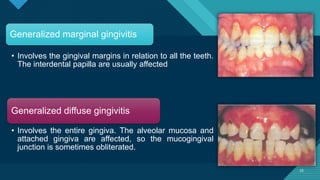
Generalized marginal gingivitis
• Involves the gingival margins in relation to all the teeth.
The interdental papilla are usually affected
Generalized diffuse gingivitis
• Involves the entire gingiva. The alveolar mucosa and
attached gingiva are affected, so the mucogingival
junction is sometimes obliterated.
Click to edit Master title style
26
26
Localized marginal gingivitis
• Is confined to one or more of the marginal gingiva.
Localized diffuse gingivitis
• Extends from the margin to the mucobuccal fold in a
limited area.
Localized papillary gingivitis
• Is confined to one or more interdental space in a
limited area
Click to edit Master title style
27
27
Plasma cell gingivitis a rare condition, appearing as generalized erythema and
edema of the attached gingiva, occasionally accompanied by cheilitis or glossitis.
Click to edit Master title style
28
Hypersensitivity reactions to some antigen.
Possible sources of antigens include ingredients
in toothpastes, chewing gum, mints, pepper, or
foods.
Specifically, cinnamonaldehyde and cinnamon
flavoring are often to blame. However, the exact
cause in most is unknown.
28
Click to edit Master title style
29
A biopsy is usually taken, and allergy testing
may also be used. The histopathologic
appearance is characterized by diffuse, sub-
epithelial plasma cell inflammatory infiltration
into the connective tissue. The epithelium
shows spongiosis
29
Histologically plasma cell gingivitis shows
mainly plasma cells. The differential diagnosis
is with acute leukemia and multiple myeloma.
Hence, blood tests are often involved in ruling
out other conditions.
Click to edit Master title style
30
These methods include:
• Corticosteroid therapy by topical corticosteroid application or intralesional injection
of recommended corticosteroid by the maxillofacial surgeon.
• Systemic antibiotic therapies
• Electrocoagulation
• Liquid nitrogen therapy
• Use of CO2 laser
30
Click to edit Master title style
31
31
ANUG, also known as Vincent disease or trench
mouth, has a sudden onset with gingiva showing
punched-out crater-like ulcerations, covered with a
whitish pseudo-membrane, surrounded by a
demarcated zone of erythema. Any area of the mouth
can be affected. There is spontaneous bleeding and
breath has fetid odor. The patient's chief complaint is
pain.
There is no loss of periodontal attachment but if left
untreated it becomes Necrotizing Ulcerative
Periodontitis (NUP).
Click to edit Master title style
32
Contributing factors include the fusospirochetal oral flora, reduced host resistance, malnutrition, poor
oral hygiene, smoking, and psychologic stress. ANUG occurs with increased frequency in HIV-infected
patients, in whom it may evolve rapidly to stomatitis, periodontitis, and osteitis if not adequately treated.
ANUG (and oral hairy leukoplakia) are significantly correlated with helper T-cell depletion.
32
Click to edit Master title style
33
Treatment of ANUG includes:
• Debridement
• Oral mouthwashes (such as hydrogen
peroxide and chlorhexidine)
• Improved oral hygiene
• Sometimes oral antibiotics (such as
metronidazole).
33
Click to edit Master title style
34
34
Click to edit Master title style
35
35
Click to edit Master title style
36
36
The changes in gingiva during inflammation can be seen under the following
headings:
Color
Mucogingival
junction
Position
Surface texture
Consistency
Shape
Size
Bleeding Exudate
Click to edit Master title style
37
37
Click to edit Master title style
38
38
Click to edit Master title style
39
The prime objective of treating gingivitis is to reduce inflammation. This is achieved by the
use of different instruments to remove dental plaque deposits.
Gingivitis, in its initial stages, can be easily managed if the patient starts following oral
hygiene protocol, which includes regular tooth brushing with an appropriate technique and
interproximal hygiene, such as dental flossing, or the use of interproximal brushes. The
removal of plaque and calculus is also professionally achieved by scaling and root planning
according to the severity of the condition.
39
Click to edit Master title style
40
If it is a drug-induced gingival overgrowth >>>>> change the medication.
If it is due to nutritional deficiency >>>>>>>supplements can be prescribed.
Medications in the form of antiseptic mouthwash that contains chlorhexidine can also be
prescribed in conjunction with the mechanical removal of plaque.
It has been suggested that the use of chlorhexidine mouthwashes in addition to the usual
tooth-brushing and interproximal cleaning leads to a significant decrease in the build-up of
dental biofilm. The concentration of the chlorhexidine rinse does not affect its
effectiveness.
40
Click to edit Master title style
41
41
There are studies on the effect of medicinal or herbal plants on the management of
gingivitis. The mechanism of action of these plants on gingivitis is due to their anti-
inflammatory property. Such medicinal plants include pomegranate, tea, and
chamomile. The flavonoids and tannins present in these plants are potent anti-
inflammatory and astringent phytochemicals.
Therefore, they can resolve both gingival bleeding and inflammation. Some studies
proved that there is a synergistic effect when the herbal plants are prescribed along
with conventional mechanical procedures of plaque removal, such as scaling .
Click to edit Master title style
42
42
Brush teeth thoroughly twice daily with a fluoride toothpaste
Use dental floss daily to remove plaque from between the
teeth and under the gums
Use of an antibacterial mouth rinse can reduce bacteria
that cause plaque and gum disease, according to the
ADA.
Visit your dentist regularly for professional cleanings and
dental examinations
Check teeth with plaque disclosing tablets to ensure
removing tooth plaque
Diet control and limiting sugary or starchy foods,
especially sticky snacks
Click to edit Master title style
43
43
You can rely on your dentist to tell you if you have dental plaque, but you can
also take the do-it-yourself route. Disclosing tablets, swabs and solution are
plaque-revealing products that can be used at home. These products
temporarily stain dental plaque so that you can see where it is and how much
there is on your teeth.
Click to edit Master title style
44
44
Disclosing tablets
Chew a disclosing tablet and allow it to mix with your saliva. Swish the mixture
around in your mouth with your tongue for about 30 seconds and then spit it out.
Click to edit Master title style
45
45
Disclosing solution
Put some disclosing solution in your mouth, swish it around for about 30 seconds,
and then spit the solution out.
Click to edit Master title style
46
Disclosing swabs
Apply the swab to all tooth surfaces in your mouth. Use these products regularly until
you find no more areas of stained plaque after you brush and floss. You may want to
test for plaque once a month to be sure you are getting rid of the plaque.
46
Click to edit Master title style
47
47
Prognosis of gingival disease induced by plaque only:
Good with the control of local factors, ex: plaque control, removal of calculus,
and overhanging restorations.
Prognosis of gingival disease associated with systemic modifiers:
Depends heavily on the control of the systemic condition or disease, for
example: DM, pregnancy, medication, and malnutrition.
Click to edit Master title style
48
“
48
Click to edit Master title style
49

Gingivitis.pptx

  • 1.
    Click to editMaster title style 1
  • 2.
    Click to editMaster title style 2 Faculty of Dental Medicine, Al-Azhar University Assiut Oral Medicine, Periodontology, Oral Diagnosis, and Dental Radiology Branch
  • 3.
    Click to editMaster title style 3 3 Types Stages Pathology Causes Definition Clinical findings and diagnosis Management Prevention Prognosis
  • 4.
    Click to editMaster title style 4 4 Inflammation is an observable alteration in tissues associated with changes in vascular permeability and dilation, often with the infiltration of leukocytes into affected tissues. These changes result in erythema, edema, heat, pain, and loss of function. These are the cardinal signs of inflammation.
  • 5.
    Click to editMaster title style 5 5 Gingivitis is a non-destructive disease that causes inflammation of the gums. Unlike periodontitis, there is no attachment loss and therefore no migration of the junctional epithelium. It happens when plaque and bacteria build up on your teeth and cause infection. Common symptoms include red, swollen, and bleeding gingiva.
  • 6.
    Click to editMaster title style 6 6
  • 7.
    Click to editMaster title style 7 7
  • 8.
    Click to editMaster title style 8 8 It is the complex microbial community that develops on the tooth surface. Plaque has a large diversity of species and consists of densely packed bacteria embedded in a matrix of organic polymers of bacterial and salivary origin. Plaque is composed of organic and inorganic materials derived from saliva, gingival crevicular fluid, and bacterial products. • Polysaccharides • Proteins • Glycoproteins • Lipid materials Organic material • Calcium • Phosphorus • Traces of sodium • Potassium Inorganic material
  • 9.
    Click to editMaster title style 9 9 Supragingival Plaque Found at or above the gingival margin Contains 50% matrix Mostly gram (+) bacteria Aerobic unless thick Few motile bacteria Predominately metabolize carbohydrates Sub gingival Plaque Found below the gingival margin Has little or no matrix Mostly gram (-) bacteria Highly anaerobic Motile bacteria are common Predominately metabolize Proteins
  • 10.
    Click to editMaster title style 10 10 In systemic disorders, gingival hemorrhage occurs spontaneously or after irritation and is excessive and difficult to control. This is due to the failure of hemostatic mechanism of the body. Vascular abnormalities Vitamin c deficiency Vitamin c allergy Platelet disorders Thrombocytopenic purpura Hypoprothrombinemia Vitamin k deficiency Other coagulation defects Hemophilia Leukemia Christmas disease Deficient platelet thromboplastic factor resulting from uremia Multiple myeloma
  • 11.
    Click to editMaster title style 11 11 In addition, in women, long-term depression-related stress exposure may increase concentrations of interleukin-6 in gingival crevicular fluid and may worsen periodontal conditions with elevated gingival inflammation and increased pocket depths.
  • 12.
    Click to editMaster title style 12 12 Among pathologic endocrine conditions, diabetes is an endocrine disease that has a well-characterized effect on the gingiva showing marked inflammation affecting both epithelial and connective tissues, which leads to degeneration of the dermal papilla, increase in the number of inflammatory cells, destruction of reticular fibers, and accumulation of dense collagen fibers that cause fibrosis.
  • 13.
    Click to editMaster title style 13 13 Anticonvulsants • Phenytoin • Carbamazepine Calcium channel blockers • Nifedipine • Verapamil Immunosuppressant drugs • Cyclosporine • Prednisone Aspirin Oral contraceptives • Estrogen • Progestin
  • 14.
    Click to editMaster title style 14 14 Microorganisms attach to tooth surface or gingival sulcus. These organisms synthesize collagenase, hyaluronidase, protease, chondroitin, sulfatase, and endotoxins. This causes damage to epithelial cells, connective tissue cells, and intercellular constituents. Widening of spaces between junctional epithelial cells also occur. Injurious agents derived from bacteria and bacteria themselves gain access to the connective tissue. Microbial products activate monocytes and macrophages to produce vasoactive substances such as prostaglandin E2, interferon, tumor necrosis factors, and interleukin-1
  • 15.
    Click to editMaster title style 15 15 The microorganisms more strongly associated with the etiology of gingivitis include species of Streptococcus, Fusobacterium, Actinomyces, Veillonella, and Treponema. Bacteroides and Eikenella are also potentially linked to the etiology of the disease. 1% 10% 6% 22% 45-60% Gram positive cocci and short rods Gram negative cocci and short rods Gram positive filaments Fusobacteria Spirochetes Vibrios 10%
  • 16.
    Click to editMaster title style 16 16 Plaque-forming bacteria found on the surface of a tooth. Bacteria attaches to the tooth, and goes on to form plaque Gingivitis. Coloured scanning electron micrograph (SEM) of a large number of bacteria (round) in the gingiva (gums) of a human mouth.
  • 17.
    Click to editMaster title style 17 17 Initial stage Early stage Established stage Advanced stage
  • 18.
    Click to editMaster title style 18 18 After just 2-4 days of biofilm accumulation, an initial lesion begins to form. The tiny blood vessels next to the junctional epithelium become inflamed and start to leak fluid into the surrounding tissues. Polymorphonuclear (PMN) cells, the first line of defense against infection, migrate into the gingival sulcus by traveling through the junctional epithelium. Perivascular collagen starts to degrade and is lost. At this stage, the lesion is considered clinically benign and will show no observable symptoms. However, the mechanisms of periodontal disease have been put into motion
  • 19.
    Click to editMaster title style 19 19 At 4-10 days, the injury can progress to an early lesion. As the fibroblast cells undergo pathological alteration and destruction, T lymphocytes and PMN cells flood the area. In the process, they cause further collagen breakdown, creating space for further inflammatory infiltration. The marginal gingival connective tissue matrix is also degraded. At this stage, the patient may see the early signs of gingivitis, such as redness, inflammation and swelling.
  • 20.
    Click to editMaster title style 20 20 An established lesion can develop within 2-3 weeks. With an influx of leukocytes and activated B cells (plasma cells), the marginal gingival connective matrix deteriorates further. Migration of PMN cells through the junctional epithelium is ongoing, and pockets begin to form between the gingiva and tooth. At this stage, the gingiva may bleed when probed, or when the patient brushes or flosses.
  • 21.
    Click to editMaster title style 21 21 The final stage marks the transition from gingivitis to periodontitis. The gingival pockets are now well-established, attracting biofilm and allowing bacteria to thrive. Plasma cells and other inflammatory infiltrates become even denser, dominating the area. The gingival tissue is now visibly affected, the periodontal ligament is degrading and detaching from the root surface, and the alveolar bone is undergoing resorption, all of which are irreversible. At this stage, the receding gingiva may give the impression of “long” teeth. The patient may be experiencing significant gingival swelling, inflammation, soreness, and bleeding, as well as pain when chewing. Due to bacterial accumulation in the pockets, the patient may display halitosis and be at risk of both oral and systemic infections. If periodontitis continues to advance, progressive loss of the supporting tissues occurs, and mobility of the teeth may be felt, with tooth loss as the end result.
  • 22.
    Click to editMaster title style 22 Acute gingivitis Sub-acute gingivitis Recurrent gingivitis Chronic gingivitis Painful Less painful Reappears and disappears spontaneously Painless unless complicated by acute or sub-acute gingivitis exasperations Sudden onset Short duration 22
  • 23.
    Click to editMaster title style 23 23
  • 24.
    Click to editMaster title style 24 Localized Gingivitis Generalized Gingivitis Marginal Gingivitis Papillary Gingivitis Diffuse Gingivitis Confined to gingiva Involves the entire mouth Involves gingival margin Involves the entire papilla Affects the marginal gingiva, the attached gingiva, and the interdental papilla In relation to single tooth or group of teeth May include a portion of the attached gingiva May include a portion of the marginal gingiva 24 Marginal and diffuse gingivitis can occur as localized or generalized conditions
  • 25.
    Click to editMaster title style 25 25 Generalized marginal gingivitis • Involves the gingival margins in relation to all the teeth. The interdental papilla are usually affected Generalized diffuse gingivitis • Involves the entire gingiva. The alveolar mucosa and attached gingiva are affected, so the mucogingival junction is sometimes obliterated.
  • 26.
    Click to editMaster title style 26 26 Localized marginal gingivitis • Is confined to one or more of the marginal gingiva. Localized diffuse gingivitis • Extends from the margin to the mucobuccal fold in a limited area. Localized papillary gingivitis • Is confined to one or more interdental space in a limited area
  • 27.
    Click to editMaster title style 27 27 Plasma cell gingivitis a rare condition, appearing as generalized erythema and edema of the attached gingiva, occasionally accompanied by cheilitis or glossitis.
  • 28.
    Click to editMaster title style 28 Hypersensitivity reactions to some antigen. Possible sources of antigens include ingredients in toothpastes, chewing gum, mints, pepper, or foods. Specifically, cinnamonaldehyde and cinnamon flavoring are often to blame. However, the exact cause in most is unknown. 28
  • 29.
    Click to editMaster title style 29 A biopsy is usually taken, and allergy testing may also be used. The histopathologic appearance is characterized by diffuse, sub- epithelial plasma cell inflammatory infiltration into the connective tissue. The epithelium shows spongiosis 29 Histologically plasma cell gingivitis shows mainly plasma cells. The differential diagnosis is with acute leukemia and multiple myeloma. Hence, blood tests are often involved in ruling out other conditions.
  • 30.
    Click to editMaster title style 30 These methods include: • Corticosteroid therapy by topical corticosteroid application or intralesional injection of recommended corticosteroid by the maxillofacial surgeon. • Systemic antibiotic therapies • Electrocoagulation • Liquid nitrogen therapy • Use of CO2 laser 30
  • 31.
    Click to editMaster title style 31 31 ANUG, also known as Vincent disease or trench mouth, has a sudden onset with gingiva showing punched-out crater-like ulcerations, covered with a whitish pseudo-membrane, surrounded by a demarcated zone of erythema. Any area of the mouth can be affected. There is spontaneous bleeding and breath has fetid odor. The patient's chief complaint is pain. There is no loss of periodontal attachment but if left untreated it becomes Necrotizing Ulcerative Periodontitis (NUP).
  • 32.
    Click to editMaster title style 32 Contributing factors include the fusospirochetal oral flora, reduced host resistance, malnutrition, poor oral hygiene, smoking, and psychologic stress. ANUG occurs with increased frequency in HIV-infected patients, in whom it may evolve rapidly to stomatitis, periodontitis, and osteitis if not adequately treated. ANUG (and oral hairy leukoplakia) are significantly correlated with helper T-cell depletion. 32
  • 33.
    Click to editMaster title style 33 Treatment of ANUG includes: • Debridement • Oral mouthwashes (such as hydrogen peroxide and chlorhexidine) • Improved oral hygiene • Sometimes oral antibiotics (such as metronidazole). 33
  • 34.
    Click to editMaster title style 34 34
  • 35.
    Click to editMaster title style 35 35
  • 36.
    Click to editMaster title style 36 36 The changes in gingiva during inflammation can be seen under the following headings: Color Mucogingival junction Position Surface texture Consistency Shape Size Bleeding Exudate
  • 37.
    Click to editMaster title style 37 37
  • 38.
    Click to editMaster title style 38 38
  • 39.
    Click to editMaster title style 39 The prime objective of treating gingivitis is to reduce inflammation. This is achieved by the use of different instruments to remove dental plaque deposits. Gingivitis, in its initial stages, can be easily managed if the patient starts following oral hygiene protocol, which includes regular tooth brushing with an appropriate technique and interproximal hygiene, such as dental flossing, or the use of interproximal brushes. The removal of plaque and calculus is also professionally achieved by scaling and root planning according to the severity of the condition. 39
  • 40.
    Click to editMaster title style 40 If it is a drug-induced gingival overgrowth >>>>> change the medication. If it is due to nutritional deficiency >>>>>>>supplements can be prescribed. Medications in the form of antiseptic mouthwash that contains chlorhexidine can also be prescribed in conjunction with the mechanical removal of plaque. It has been suggested that the use of chlorhexidine mouthwashes in addition to the usual tooth-brushing and interproximal cleaning leads to a significant decrease in the build-up of dental biofilm. The concentration of the chlorhexidine rinse does not affect its effectiveness. 40
  • 41.
    Click to editMaster title style 41 41 There are studies on the effect of medicinal or herbal plants on the management of gingivitis. The mechanism of action of these plants on gingivitis is due to their anti- inflammatory property. Such medicinal plants include pomegranate, tea, and chamomile. The flavonoids and tannins present in these plants are potent anti- inflammatory and astringent phytochemicals. Therefore, they can resolve both gingival bleeding and inflammation. Some studies proved that there is a synergistic effect when the herbal plants are prescribed along with conventional mechanical procedures of plaque removal, such as scaling .
  • 42.
    Click to editMaster title style 42 42 Brush teeth thoroughly twice daily with a fluoride toothpaste Use dental floss daily to remove plaque from between the teeth and under the gums Use of an antibacterial mouth rinse can reduce bacteria that cause plaque and gum disease, according to the ADA. Visit your dentist regularly for professional cleanings and dental examinations Check teeth with plaque disclosing tablets to ensure removing tooth plaque Diet control and limiting sugary or starchy foods, especially sticky snacks
  • 43.
    Click to editMaster title style 43 43 You can rely on your dentist to tell you if you have dental plaque, but you can also take the do-it-yourself route. Disclosing tablets, swabs and solution are plaque-revealing products that can be used at home. These products temporarily stain dental plaque so that you can see where it is and how much there is on your teeth.
  • 44.
    Click to editMaster title style 44 44 Disclosing tablets Chew a disclosing tablet and allow it to mix with your saliva. Swish the mixture around in your mouth with your tongue for about 30 seconds and then spit it out.
  • 45.
    Click to editMaster title style 45 45 Disclosing solution Put some disclosing solution in your mouth, swish it around for about 30 seconds, and then spit the solution out.
  • 46.
    Click to editMaster title style 46 Disclosing swabs Apply the swab to all tooth surfaces in your mouth. Use these products regularly until you find no more areas of stained plaque after you brush and floss. You may want to test for plaque once a month to be sure you are getting rid of the plaque. 46
  • 47.
    Click to editMaster title style 47 47 Prognosis of gingival disease induced by plaque only: Good with the control of local factors, ex: plaque control, removal of calculus, and overhanging restorations. Prognosis of gingival disease associated with systemic modifiers: Depends heavily on the control of the systemic condition or disease, for example: DM, pregnancy, medication, and malnutrition.
  • 48.
    Click to editMaster title style 48 “ 48
  • 49.
    Click to editMaster title style 49