Jаffaя яaza Syзd Page 1
PLAQUE CONTROL
It is the removal of microbial plaque and the prevention of its accumulation on the teeth
and adjacent gingival surfaces
BASIC APPROACHES FOR PLAQUE CONTROL
There are two basic approaches for plaque control:
1. Mechanical:
• Individual
• Professional—for subgingival plaque control, e.g. scaling and root planing.
2. Chemical:
• Individual
• Professional.
Jаffaя яaza Syзd Page 2
MECHANICAL PLAQUE CONTROL
Individual mechanical plaque control is achieved by:
I. Toothbrush:
Manual or powered
II. Interdental aids:
• Dental floss:
• Triangular toothpicks:
• Brushes:
III. Others:
• Rubber tip stimulator
• Water irrigators
Jаffaя яaza Syзd Page 3
Toothbrushes
• 1- handle:The part grasped in the hand during tooth brushing.
• 2- head : it is the working end of tooth brush that hold bristles.
• 3- tufts: clusters of bristles secured into head
4- 80-86 bristles per tuft
Toothbrush bristles
• Natural: hog
• Artificial filaments: nylon which are uniform in size & elasticity, resistant to
fracture & doesn’t get contaminated.
Jаffaя яaza Syзd Page 4
Bristle hardness
• Soft brush: 0.007 inch(0.2 mm)
• Medium brush: 0.012 inch(0.3 mm)
• Hard brush: 0.014 inch(0.4 mm)
American Dental Association (ADA)
i. 1 inch to 1¼ inches long.
ii. 2-4 rows of bristles.
iii. 5/16 inch to 3/8 inches wide.
iv. 5-12 tufts per row.
v. 80-86 bristles per tuft.
Jаffaя яaza Syзd Page 5
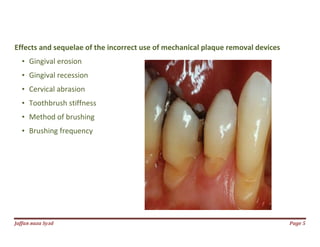
Effects and sequelae of the incorrect use of mechanical plaque removal devices
• Gingival erosion
• Gingival recession
• Cervical abrasion
• Toothbrush stiffness
• Method of brushing
• Brushing frequency
Jаffaя яaza Syзd Page 6
Brushing technique
• Horizontal brushing (scrub)
• Leonard method (vertical)
• Bass method
• Modified Bass method
• Stillman method
• Modified Stillman method
• Charters method (Vibratory)
• Methods of cleaning with powered toothbrushes
Jаffaя яaza Syзd Page 7
Dentifrices
• These are the aids for cleaning and polishing of teeth surfaces.
• They are used in the form of powders, pastes and gels
Composition of toothpaste:
1. Abrasives 20 to 40 percent CaCO3, Ca3 (PO4)2, silicon oxides, Al2O3,
polyvinylchloride are used.
2. Humectants: 20 to 40 percent; maintains moisture, e.g. glycerine, sorbitol, mannitol,
propylene glycol.
3. Preservatives: Such as benzoic acid.
4. Thickening agents: Synthetic sodium carboxy-methyl cellulose is used.
5. Water: 20 to 40 percent.
Jаffaя яaza Syзd Page 8
6. Foaming agents: 1 to 2 percent soap/detergent, e.g. sodium lauryl sulphate.
7. Flavoring and sweetening agents:
• Two percent essential oils and synthetic flavors, e.g. mint and others.
• Sweetening agents such as saccharine, sorbitol, mannitol.
8. Desensitizing agents: Up to 2 percent strontium salts, sodium fluoride, formalin,
potassium nitrate and others.
9. Coloring and preservatives: Less than 1 percent.
10. Anticaries agents: Like sodium monofluorophosphate, sodium fluoride, formalin.
Dentifrices containing pyrophosphates or zinc compounds have reportedly
shown 10 to 50 percent reduction in calculus. They are thought to produce this effect by
the fact that they are absorbed on to hydroxyapatite crystals thus inhibiting the growth
of larger organized crystals
Jаffaя яaza Syзd Page 9
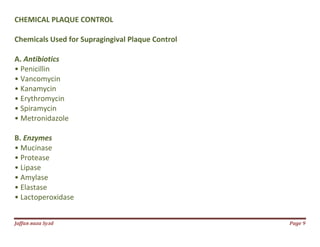
CHEMICAL PLAQUE CONTROL
Chemicals Used for Supragingival Plaque Control
A. Antibiotics
• Penicillin
• Vancomycin
• Kanamycin
• Erythromycin
• Spiramycin
• Metronidazole
B. Enzymes
• Mucinase
• Protease
• Lipase
• Amylase
• Elastase
• Lactoperoxidase
Jаffaя яaza Syзd Page 10
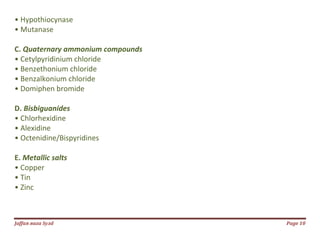
• Hypothiocynase
• Mutanase
C. Quaternary ammonium compounds
• Cetylpyridinium chloride
• Benzethonium chloride
• Benzalkonium chloride
• Domiphen bromide
D. Bisbiguanides
• Chlorhexidine
• Alexidine
• Octenidine/Bispyridines
E. Metallic salts
• Copper
• Tin
• Zinc
Jаffaя яaza Syзd Page 11
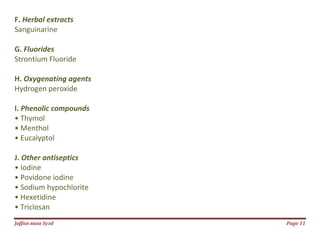
F. Herbal extracts
Sanguinarine
G. Fluorides
Strontium Fluoride
H. Oxygenating agents
Hydrogen peroxide
I. Phenolic compounds
• Thymol
• Menthol
• Eucalyptol
J. Other antiseptics
• Iodine
• Povidone iodine
• Sodium hypochlorite
• Hexetidine
• Triclosan

031. plaque control

  • 1.
    Jаffaя яaza SyзdPage 1 PLAQUE CONTROL It is the removal of microbial plaque and the prevention of its accumulation on the teeth and adjacent gingival surfaces BASIC APPROACHES FOR PLAQUE CONTROL There are two basic approaches for plaque control: 1. Mechanical: • Individual • Professional—for subgingival plaque control, e.g. scaling and root planing. 2. Chemical: • Individual • Professional.
  • 2.
    Jаffaя яaza SyзdPage 2 MECHANICAL PLAQUE CONTROL Individual mechanical plaque control is achieved by: I. Toothbrush: Manual or powered II. Interdental aids: • Dental floss: • Triangular toothpicks: • Brushes: III. Others: • Rubber tip stimulator • Water irrigators
  • 3.
    Jаffaя яaza SyзdPage 3 Toothbrushes • 1- handle:The part grasped in the hand during tooth brushing. • 2- head : it is the working end of tooth brush that hold bristles. • 3- tufts: clusters of bristles secured into head 4- 80-86 bristles per tuft Toothbrush bristles • Natural: hog • Artificial filaments: nylon which are uniform in size & elasticity, resistant to fracture & doesn’t get contaminated.
  • 4.
    Jаffaя яaza SyзdPage 4 Bristle hardness • Soft brush: 0.007 inch(0.2 mm) • Medium brush: 0.012 inch(0.3 mm) • Hard brush: 0.014 inch(0.4 mm) American Dental Association (ADA) i. 1 inch to 1¼ inches long. ii. 2-4 rows of bristles. iii. 5/16 inch to 3/8 inches wide. iv. 5-12 tufts per row. v. 80-86 bristles per tuft.
  • 5.
    Jаffaя яaza SyзdPage 5 Effects and sequelae of the incorrect use of mechanical plaque removal devices • Gingival erosion • Gingival recession • Cervical abrasion • Toothbrush stiffness • Method of brushing • Brushing frequency
  • 6.
    Jаffaя яaza SyзdPage 6 Brushing technique • Horizontal brushing (scrub) • Leonard method (vertical) • Bass method • Modified Bass method • Stillman method • Modified Stillman method • Charters method (Vibratory) • Methods of cleaning with powered toothbrushes
  • 7.
    Jаffaя яaza SyзdPage 7 Dentifrices • These are the aids for cleaning and polishing of teeth surfaces. • They are used in the form of powders, pastes and gels Composition of toothpaste: 1. Abrasives 20 to 40 percent CaCO3, Ca3 (PO4)2, silicon oxides, Al2O3, polyvinylchloride are used. 2. Humectants: 20 to 40 percent; maintains moisture, e.g. glycerine, sorbitol, mannitol, propylene glycol. 3. Preservatives: Such as benzoic acid. 4. Thickening agents: Synthetic sodium carboxy-methyl cellulose is used. 5. Water: 20 to 40 percent.
  • 8.
    Jаffaя яaza SyзdPage 8 6. Foaming agents: 1 to 2 percent soap/detergent, e.g. sodium lauryl sulphate. 7. Flavoring and sweetening agents: • Two percent essential oils and synthetic flavors, e.g. mint and others. • Sweetening agents such as saccharine, sorbitol, mannitol. 8. Desensitizing agents: Up to 2 percent strontium salts, sodium fluoride, formalin, potassium nitrate and others. 9. Coloring and preservatives: Less than 1 percent. 10. Anticaries agents: Like sodium monofluorophosphate, sodium fluoride, formalin. Dentifrices containing pyrophosphates or zinc compounds have reportedly shown 10 to 50 percent reduction in calculus. They are thought to produce this effect by the fact that they are absorbed on to hydroxyapatite crystals thus inhibiting the growth of larger organized crystals
  • 9.
    Jаffaя яaza SyзdPage 9 CHEMICAL PLAQUE CONTROL Chemicals Used for Supragingival Plaque Control A. Antibiotics • Penicillin • Vancomycin • Kanamycin • Erythromycin • Spiramycin • Metronidazole B. Enzymes • Mucinase • Protease • Lipase • Amylase • Elastase • Lactoperoxidase
  • 10.
    Jаffaя яaza SyзdPage 10 • Hypothiocynase • Mutanase C. Quaternary ammonium compounds • Cetylpyridinium chloride • Benzethonium chloride • Benzalkonium chloride • Domiphen bromide D. Bisbiguanides • Chlorhexidine • Alexidine • Octenidine/Bispyridines E. Metallic salts • Copper • Tin • Zinc
  • 11.
    Jаffaя яaza SyзdPage 11 F. Herbal extracts Sanguinarine G. Fluorides Strontium Fluoride H. Oxygenating agents Hydrogen peroxide I. Phenolic compounds • Thymol • Menthol • Eucalyptol J. Other antiseptics • Iodine • Povidone iodine • Sodium hypochlorite • Hexetidine • Triclosan