4
o Healing/ Repair.
o Pulp’s vitality and function.
o Normal responsiveness to
electrical and thermal pulp tests.
o Preventing breakdown of the
peri-radicular supporting tissue.
oFormation of secondary dentine.
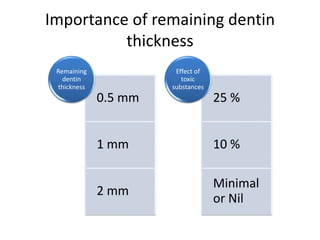
Importance of remaining dentin
thickness
0.5 mm
1 mm
2 mm
Remaining
dentin
thickness
25 %
10 %
Minimal
or Nil
Effect of
toxic
substances
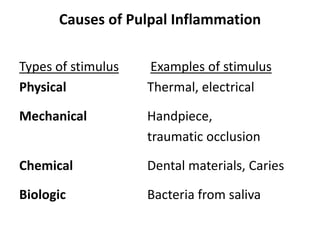
Causes of Pulpal Inflammation
Types of stimulus Examples of stimulus
Physical Thermal, electrical
Mechanical Handpiece,
traumatic occlusion
Chemical Dental materials, Caries
Biologic Bacteria from saliva
6
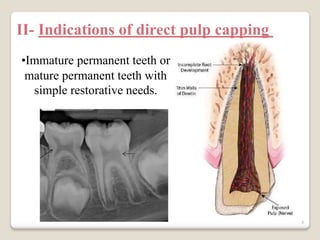
•Immature permanent teeth or
mature permanent teeth with
simple restorative needs.
II- Indications of direct pulp capping
7
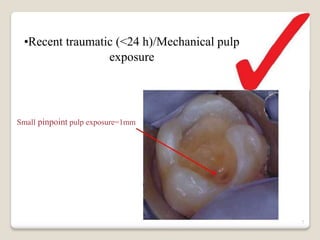
Small pinpoint pulp exposure=1mm
•Recent traumatic (<24 h)/Mechanical pulp
exposure
8
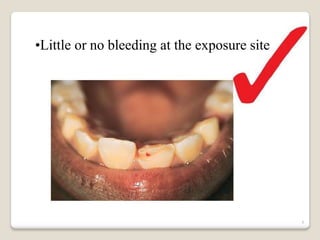
•Little or no bleeding at the exposure site
9
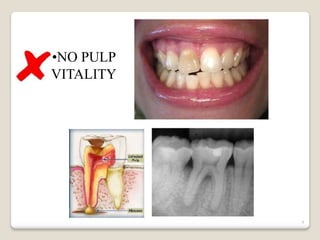
•NO PULP
VITALITY
10
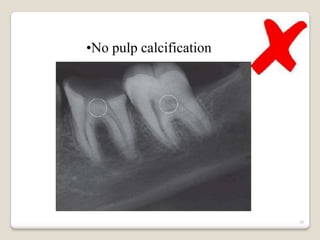
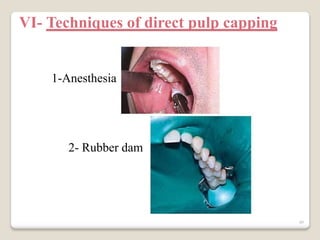
•No pulp calcification
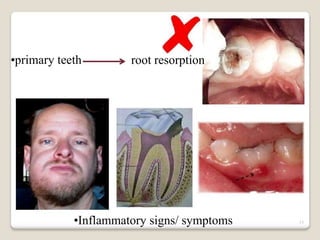
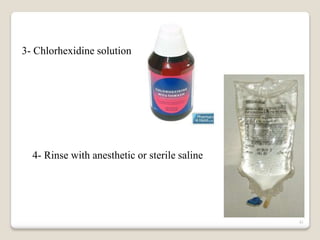
•Inflammatory signs/ symptoms 13
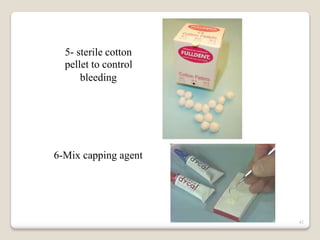
•primary teeth root resorption
14
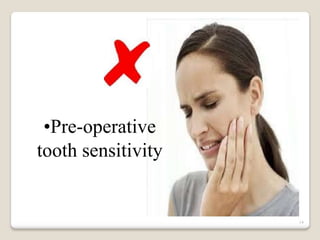
•Pre-operative
tooth sensitivity
15
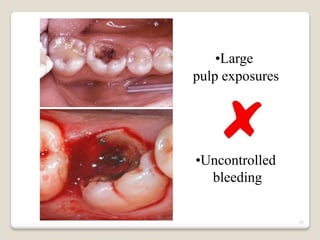
•Large
pulp exposures
•Uncontrolled
bleeding
16
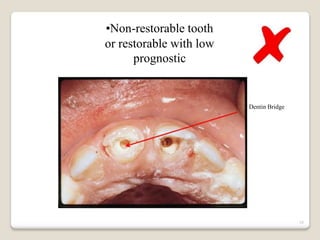
•Non-restorable tooth
or restorable with low
prognostic
Dentin Bridge
Classification and types
• CAVITY SEALERS: Varnish, Adhesive sealers
• CAVITY LINERS: Glass ionomer, Calcium hydroxide
• Bases: - 1. Zinc phosphate cement.
2. Reinforced zinc oxide / eugenol cement.
3. Zinc polycarboxylate cement.
4. Glass ionomer cement.
Cavity sealers
• Varnish
• Adhesive sealers
• Provide protective coating and barrier to leakage
• Coat all walls of the cavity
• Provide various degrees of seal
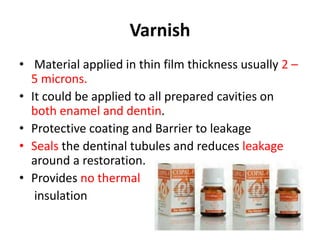
Varnish
• Material applied in thin film thickness usually 2 –
5 microns.
• It could be applied to all prepared cavities on
both enamel and dentin.
• Protective coating and Barrier to leakage
• Seals the dentinal tubules and reduces leakage
around a restoration.
• Provides no thermal
insulation
 
Varnish
Composition:
• Organic resin or synthetic gum dissolved in
solution of ether, chloroform or acetone.
• This solution evaporates rapidly after
placement on the tooth leaving a thin layer of
semi-permeable membrane.
• The thickness of this layer is 5 – 25 microns
depending on the type of the solvent and the
number of applications.
• Application process
– Applied with either a small disposable
applicator or a cotton pellet.
– Thin coating of the varnish on the walls, floor,
and margin of the cavity preparation.
– Apply a second coat.
Contraindication:
- Composite – free monomer layer dissolves the varnish
- Ca(OH)2/ ZOE beneficial affects are lost
- Polycarboxylate – interferes with adhesion
- GIC – blocks fluoride penetration.
Adhesive sealers
• Provide sealing as well as bonding at the
interface between restoration and cavity
preparation walls.
Concerns about use of adhesive sealers
under amalgam
• Barrier to corrosion products
• More technique sensitive than varnishes
• Expensive and time consuming
• Pooling of resin
• Incorporation into amalgam
Liners:
Definition: It is liquid in which CaOH and zinc oxide
(occasionally) are suspended in a solution of natural
or synthetic resins.
Composition:
1. Ca(OH) / ZnO – Therapeutic agent
2. Ethyl alcohol – Solvent
3. Ethyl cellulose – Thickening agent
4. Barium sulfate – Radiopacifier
5. Fluorides – Anticariogenic
Manipulation:
Trade names: Dycal and Life
It is available as 2 paste systems both of which contain
Ca(OH) and one consists of accelerator
Equal amounts of material from each tube is collected over a
glass slab or mixing pad with help of probe (Applicator) both
are mixed till homogeneous colour is achieved and with
same instrument it is carried.
- to deepest portion of the cavity and since it is fluid in
consistency it readily flows or gets painted over the cavity
over which the thermal insulating base or temporary
restoration is provided.
Properties:
1. Acts as a thin barrier between the restoration and the
remaining dentine and protects the pulpal tissue from
irritation caused by physical, mechanical, biological, or
chemical agents .
2. Like cavity varnish it neither possesses mechanical properties
nor provides thermal insulation.
3. Should not be applied on cavity margins.
Uses:
1. As pulp capping agent due to its sealing ability.
2. As anticariogenic cement because it stimulates the
production of secondary or reparative dentin.
3. Prevents post operative sensitivity or pain.
4. It is compatible with all types of restorative materials.
17
IV- Pulp capping materials
•Calcium Hydroxide Ca(OH)2
•Mineral TrioxideAggregate MTA
•Tri-calcium phosphate
•Bioaggregate
•Biodentine
•Bonding Systems
18
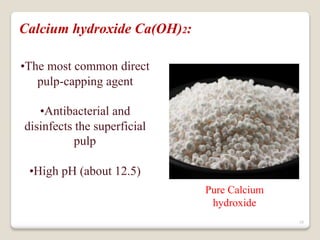
•The most common direct
pulp-capping agent
•Antibacterial and
disinfects the superficial
pulp
•High pH (about 12.5)
Pure Calcium
hydroxide
Calcium hydroxide Ca(OH)2:
19
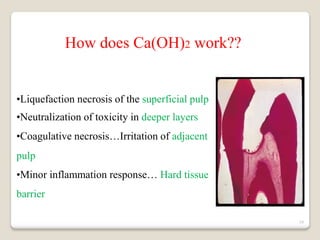
How does Ca(OH)2 work??
•Liquefaction necrosis of the superficial pulp
•Neutralization of toxicity in deeper layers
•Coagulative necrosis…Irritation of adjacent
pulp
•Minor inflammation response… Hard tissue
barrier
20
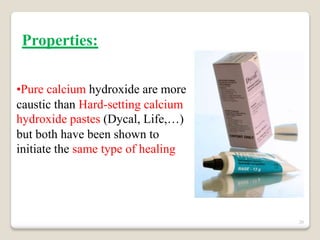
•Pure calcium hydroxide are more
caustic than Hard-setting calcium
hydroxide pastes (Dycal, Life,…)
but both have been shown to
initiate the same type of healing
Properties:
21
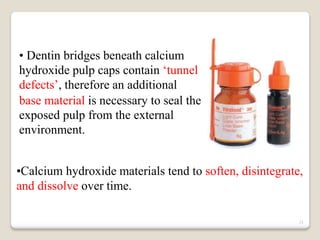
• Dentin bridges beneath calcium
hydroxide pulp caps contain ‘tunnel
defects’, therefore an additional
base material is necessary to seal the
exposed pulp from the external
environment.
•Calcium hydroxide materials tend to soften, disintegrate,
and dissolve over time.
22
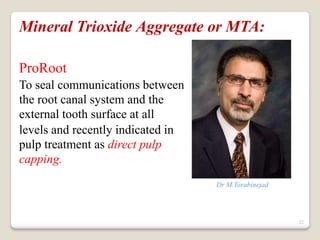
Mineral Trioxide Aggregate or MTA:
ProRoot
To seal communications between
the root canal system and the
external tooth surface at all
levels and recently indicated in
pulp treatment as direct pulp
capping.
Dr M.Torabinejad
23
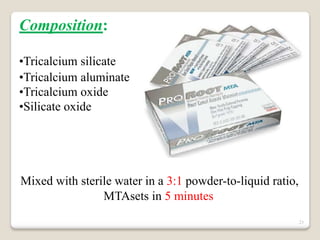
Composition:
•Tricalcium silicate
•Tricalcium aluminate
•Tricalcium oxide
•Silicate oxide
Mixed with sterile water in a 3:1 powder-to-liquid ratio,
MTAsets in 5 minutes
24
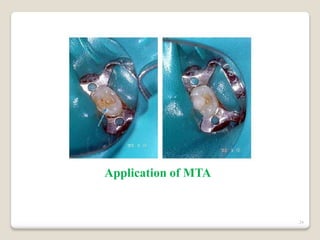
Application of MTA
25
Properties:
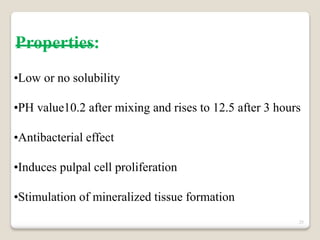
•Low or no solubility
•PH value10.2 after mixing and rises to 12.5 after 3 hours
•Antibacterial effect
•Induces pulpal cell proliferation
•Stimulation of mineralized tissue formation
26
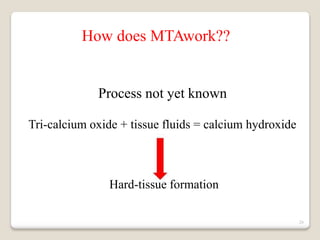
Process not yet known
Tri-calcium oxide + tissue fluids = calcium hydroxide
Hard-tissue formation
How does MTAwork??
28
Tri-calcium phosphate:
- Bone regeneration procedures (promotes effects on
hard tissue formation by osteoblasts)
- Studies showed that dentinal bridge
formation does take place, by direct apposition, on the
pulpal wall
The bridge:
•Contiguous
•Thick
•Minimal pulpal inflammation
•Odontoblasts directly under and in contact with the
bridge
29
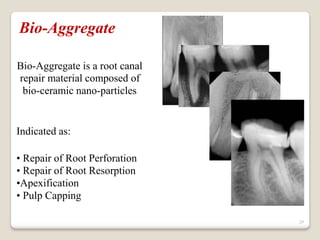
Bio-Aggregate
Indicated as:
• Repair of Root Perforation
• Repair of Root Resorption
•Apexification
• Pulp Capping
Bio-Aggregate is a root canal
repair material composed of
bio-ceramic nano-particles
30
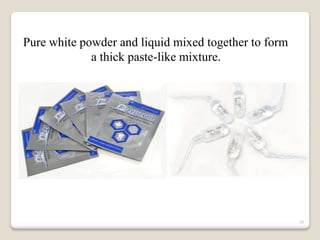
Pure white powder and liquid mixed together to form
a thick paste-like mixture.
32
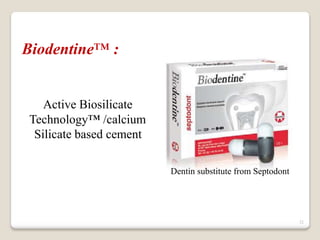
Biodentine™ :
Active Biosilicate
Technology™ /calcium
Silicate based cement
Dentin substitute from Septodont
33
Indications:
•Endodontic indications (repair of perforations or
resorptions, apexification, root-end filling)
•Permanent dentine substitute and temporary enamel
substitute
•Restoration of deep or large crown carious lesions
•Direct pulp capping in adults presenting healthy pulp
34
Formulation:
Powder
Tri-calcium Silicate (C3S) Main core material
Di-calcium Silicate (C2S) Second core material
Calcium Carbonate and Oxide Filler
Iron Oxide Shade
Zirconium Oxide Radiopacifier
Liquid
Calcium chlorideAccelerator
Hydrosoluble polymer Water reducing agent
40
1-Anesthesia
2- Rubber dam
VI- Techniques of direct pulp capping
41
3- Chlorhexidine solution
4- Rinse with anesthetic or sterile saline
42
5- sterile cotton
pellet to control
bleeding
6-Mix capping agent
43
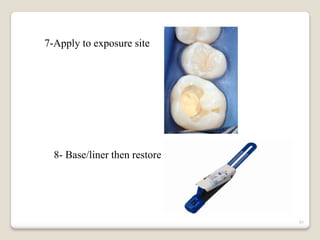
7-Apply to exposure site
8- Base/liner then restore
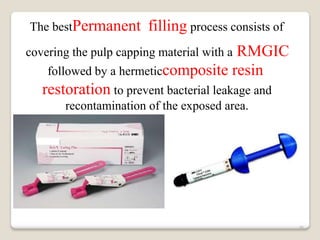
The bestPermanent filling process consists of
covering the pulp capping material with a RMGIC
followed by a hermeticcomposite resin
restoration to prevent bacterial leakage and
recontamination of the exposed area.
46
Bases
• Insulation
• Bulk build up
• Blocking of undercuts
• Resin composite exhibits low thermal
diffusivity that a thermal insulating base
should be unnecessary
• Insulating base for thermal protection should
be used under metallic restorations
• Thickness 0.5-0.75 mm

06.liners and bases

  • 2.
    4 o Healing/ Repair. oPulp’s vitality and function. o Normal responsiveness to electrical and thermal pulp tests. o Preventing breakdown of the peri-radicular supporting tissue. oFormation of secondary dentine.
  • 3.
    Importance of remainingdentin thickness 0.5 mm 1 mm 2 mm Remaining dentin thickness 25 % 10 % Minimal or Nil Effect of toxic substances
  • 4.
    Causes of PulpalInflammation Types of stimulus Examples of stimulus Physical Thermal, electrical Mechanical Handpiece, traumatic occlusion Chemical Dental materials, Caries Biologic Bacteria from saliva
  • 5.
    6 •Immature permanent teethor mature permanent teeth with simple restorative needs. II- Indications of direct pulp capping
  • 6.
    7 Small pinpoint pulpexposure=1mm •Recent traumatic (<24 h)/Mechanical pulp exposure
  • 7.
    8 •Little or nobleeding at the exposure site
  • 8.
  • 9.
  • 10.
    •Inflammatory signs/ symptoms13 •primary teeth root resorption
  • 11.
  • 12.
  • 13.
    16 •Non-restorable tooth or restorablewith low prognostic Dentin Bridge
  • 14.
    Classification and types •CAVITY SEALERS: Varnish, Adhesive sealers • CAVITY LINERS: Glass ionomer, Calcium hydroxide • Bases: - 1. Zinc phosphate cement. 2. Reinforced zinc oxide / eugenol cement. 3. Zinc polycarboxylate cement. 4. Glass ionomer cement.
  • 15.
    Cavity sealers • Varnish •Adhesive sealers • Provide protective coating and barrier to leakage • Coat all walls of the cavity • Provide various degrees of seal
  • 16.
    Varnish • Material appliedin thin film thickness usually 2 – 5 microns. • It could be applied to all prepared cavities on both enamel and dentin. • Protective coating and Barrier to leakage • Seals the dentinal tubules and reduces leakage around a restoration. • Provides no thermal insulation  
  • 17.
    Varnish Composition: • Organic resinor synthetic gum dissolved in solution of ether, chloroform or acetone. • This solution evaporates rapidly after placement on the tooth leaving a thin layer of semi-permeable membrane. • The thickness of this layer is 5 – 25 microns depending on the type of the solvent and the number of applications.
  • 18.
    • Application process –Applied with either a small disposable applicator or a cotton pellet. – Thin coating of the varnish on the walls, floor, and margin of the cavity preparation. – Apply a second coat.
  • 19.
    Contraindication: - Composite –free monomer layer dissolves the varnish - Ca(OH)2/ ZOE beneficial affects are lost - Polycarboxylate – interferes with adhesion - GIC – blocks fluoride penetration.
  • 20.
    Adhesive sealers • Providesealing as well as bonding at the interface between restoration and cavity preparation walls.
  • 21.
    Concerns about useof adhesive sealers under amalgam • Barrier to corrosion products • More technique sensitive than varnishes • Expensive and time consuming • Pooling of resin • Incorporation into amalgam
  • 22.
    Liners: Definition: It isliquid in which CaOH and zinc oxide (occasionally) are suspended in a solution of natural or synthetic resins.
  • 23.
    Composition: 1. Ca(OH) /ZnO – Therapeutic agent 2. Ethyl alcohol – Solvent 3. Ethyl cellulose – Thickening agent 4. Barium sulfate – Radiopacifier 5. Fluorides – Anticariogenic
  • 24.
    Manipulation: Trade names: Dycaland Life It is available as 2 paste systems both of which contain Ca(OH) and one consists of accelerator
  • 25.
    Equal amounts ofmaterial from each tube is collected over a glass slab or mixing pad with help of probe (Applicator) both are mixed till homogeneous colour is achieved and with same instrument it is carried.
  • 26.
    - to deepestportion of the cavity and since it is fluid in consistency it readily flows or gets painted over the cavity over which the thermal insulating base or temporary restoration is provided.
  • 27.
    Properties: 1. Acts asa thin barrier between the restoration and the remaining dentine and protects the pulpal tissue from irritation caused by physical, mechanical, biological, or chemical agents . 2. Like cavity varnish it neither possesses mechanical properties nor provides thermal insulation. 3. Should not be applied on cavity margins.
  • 28.
    Uses: 1. As pulpcapping agent due to its sealing ability. 2. As anticariogenic cement because it stimulates the production of secondary or reparative dentin. 3. Prevents post operative sensitivity or pain. 4. It is compatible with all types of restorative materials.
  • 29.
    17 IV- Pulp cappingmaterials •Calcium Hydroxide Ca(OH)2 •Mineral TrioxideAggregate MTA •Tri-calcium phosphate •Bioaggregate •Biodentine •Bonding Systems
  • 30.
    18 •The most commondirect pulp-capping agent •Antibacterial and disinfects the superficial pulp •High pH (about 12.5) Pure Calcium hydroxide Calcium hydroxide Ca(OH)2:
  • 31.
    19 How does Ca(OH)2work?? •Liquefaction necrosis of the superficial pulp •Neutralization of toxicity in deeper layers •Coagulative necrosis…Irritation of adjacent pulp •Minor inflammation response… Hard tissue barrier
  • 32.
    20 •Pure calcium hydroxideare more caustic than Hard-setting calcium hydroxide pastes (Dycal, Life,…) but both have been shown to initiate the same type of healing Properties:
  • 33.
    21 • Dentin bridgesbeneath calcium hydroxide pulp caps contain ‘tunnel defects’, therefore an additional base material is necessary to seal the exposed pulp from the external environment. •Calcium hydroxide materials tend to soften, disintegrate, and dissolve over time.
  • 34.
    22 Mineral Trioxide Aggregateor MTA: ProRoot To seal communications between the root canal system and the external tooth surface at all levels and recently indicated in pulp treatment as direct pulp capping. Dr M.Torabinejad
  • 35.
    23 Composition: •Tricalcium silicate •Tricalcium aluminate •Tricalciumoxide •Silicate oxide Mixed with sterile water in a 3:1 powder-to-liquid ratio, MTAsets in 5 minutes
  • 36.
  • 37.
    25 Properties: •Low or nosolubility •PH value10.2 after mixing and rises to 12.5 after 3 hours •Antibacterial effect •Induces pulpal cell proliferation •Stimulation of mineralized tissue formation
  • 38.
    26 Process not yetknown Tri-calcium oxide + tissue fluids = calcium hydroxide Hard-tissue formation How does MTAwork??
  • 39.
    28 Tri-calcium phosphate: - Boneregeneration procedures (promotes effects on hard tissue formation by osteoblasts) - Studies showed that dentinal bridge formation does take place, by direct apposition, on the pulpal wall The bridge: •Contiguous •Thick •Minimal pulpal inflammation •Odontoblasts directly under and in contact with the bridge
  • 40.
    29 Bio-Aggregate Indicated as: • Repairof Root Perforation • Repair of Root Resorption •Apexification • Pulp Capping Bio-Aggregate is a root canal repair material composed of bio-ceramic nano-particles
  • 41.
    30 Pure white powderand liquid mixed together to form a thick paste-like mixture.
  • 42.
    32 Biodentine™ : Active Biosilicate Technology™/calcium Silicate based cement Dentin substitute from Septodont
  • 43.
    33 Indications: •Endodontic indications (repairof perforations or resorptions, apexification, root-end filling) •Permanent dentine substitute and temporary enamel substitute •Restoration of deep or large crown carious lesions •Direct pulp capping in adults presenting healthy pulp
  • 44.
    34 Formulation: Powder Tri-calcium Silicate (C3S)Main core material Di-calcium Silicate (C2S) Second core material Calcium Carbonate and Oxide Filler Iron Oxide Shade Zirconium Oxide Radiopacifier Liquid Calcium chlorideAccelerator Hydrosoluble polymer Water reducing agent
  • 45.
    40 1-Anesthesia 2- Rubber dam VI-Techniques of direct pulp capping
  • 46.
    41 3- Chlorhexidine solution 4-Rinse with anesthetic or sterile saline
  • 47.
    42 5- sterile cotton pelletto control bleeding 6-Mix capping agent
  • 48.
    43 7-Apply to exposuresite 8- Base/liner then restore
  • 49.
    The bestPermanent fillingprocess consists of covering the pulp capping material with a RMGIC followed by a hermeticcomposite resin restoration to prevent bacterial leakage and recontamination of the exposed area. 46
  • 50.
    Bases • Insulation • Bulkbuild up • Blocking of undercuts
  • 51.
    • Resin compositeexhibits low thermal diffusivity that a thermal insulating base should be unnecessary • Insulating base for thermal protection should be used under metallic restorations • Thickness 0.5-0.75 mm