
Working Length
Determination
By: Dr. Jaffar Raza
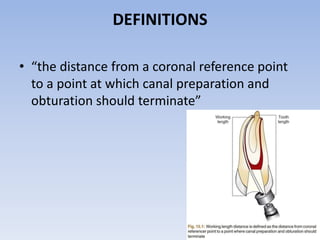
DEFINITIONS
• “the distance from a coronal reference point
to a point at which canal preparation and
obturation should terminate”
• Anatomic apex is “tip or end of root determined morphologically”.
• Radiographic apex is “tip or end of root determined
radiographically”.
• Apical foramen is main apical opening of the root canal which
may be located away from anatomic or radiographic apex.
• Apical constriction (minor apical diameter) is apical portion
of root canal having narrowest diameter. It is usually 0.5 -1 mm
short of apical foramen. The minor diameter widens
apically to foramen, i.e. major diameter.
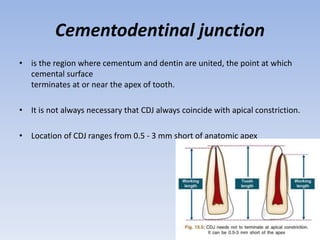
Cementodentinal junction
• is the region where cementum and dentin are united, the point at which
cemental surface
terminates at or near the apex of tooth.
• It is not always necessary that CDJ always coincide with apical constriction.
• Location of CDJ ranges from 0.5 - 3 mm short of anatomic apex
DIFFERENT METHODS OF
WORKING LENGTH DETERMINATION
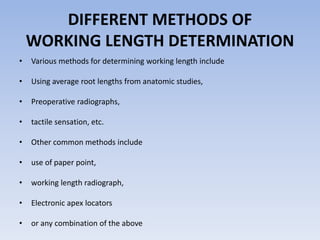
• Various methods for determining working length include
• Using average root lengths from anatomic studies,
• Preoperative radiographs,
• tactile sensation, etc.
• Other common methods include
• use of paper point,
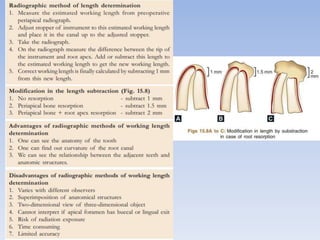
• working length radiograph,
• Electronic apex locators
• or any combination of the above
ELECTRONIC APEX LOCATORS
• Electronic apex locators (EAL) are used for
determining working length as an adjunct to
radiography.
• They are basically used to locate the apical
constriction or cementodentinal junction or
the apical foramen, and not the radiographic
apex.
Components of Electronic Apex
Locators
• • Lip clip
• File clip
• Electronic device
• Cord which connects above three parts.
• Advantages of Apex Locators
• Provide objective information with high degree of accuracy.
• Accurate in reading (90-98% accuracy)
• Some apex locators are also available in combination with pulp
tester, so can be used to test pulp vitality.
• Disadvantages
• a. Can provide inaccurate readings in following cases:-
i. Presence of pulp tissue in canal
ii. Too wet or too dry canal
iii. Use of narrow file
iv. Blockage of canal
v. Incomplete circuit
vi. Low battery
• b. Chances of over estimation
• c. May pose problem in teeth with immature apex.
Uses of Apex Locators
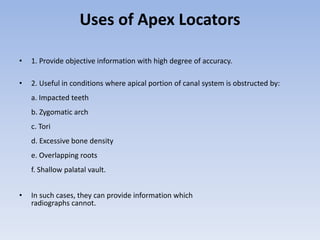
• 1. Provide objective information with high degree of accuracy.
• 2. Useful in conditions where apical portion of canal system is obstructed by:
a. Impacted teeth
b. Zygomatic arch
c. Tori
d. Excessive bone density
e. Overlapping roots
f. Shallow palatal vault.
• In such cases, they can provide information which
radiographs cannot.
• 3. Useful in patient who cannot tolerate X-ray film placement because of gag
reflex.
• 4. In case of pregnant patients, to reduce the radiation
exposure, they can be valuable tool.
• 5. Useful in children who may not tolerate taking radiographs,
disabled patients and patients who are heavily sedated.
• 6. Valuable tool for:
a. Detecting site of root perforations
b. Diagnosis of external and internal resorption which have penetrated root
surface
c. Detection of horizontal and vertical root fracture
d. Determination of perforations caused during post preparation
e. Testing pulp vitality
• 7. Helpful in root canal treatment of teeth with incomplete root formation,
requiring apexification and to determine working length in primary teeth.
Contraindications to the Use of Apex
Locator
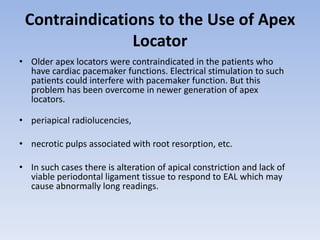
• Older apex locators were contraindicated in the patients who
have cardiac pacemaker functions. Electrical stimulation to such
patients could interfere with pacemaker function. But this
problem has been overcome in newer generation of apex
locators.
• periapical radiolucencies,
• necrotic pulps associated with root resorption, etc.
• In such cases there is alteration of apical constriction and lack of
viable periodontal ligament tissue to respond to EAL which may
cause abnormally long readings.
Basic Conditions for Accuracy of EALs
• • Canal should be free from debris
• • Canal should be relatively dry
• • No cervical leakage
• • Proper contact of file with canal walls and periapex
• • No blockages or calcifications in canal

013.working length determination

  • 1.
  • 2.
    DEFINITIONS • “the distancefrom a coronal reference point to a point at which canal preparation and obturation should terminate”
  • 3.
    • Anatomic apexis “tip or end of root determined morphologically”. • Radiographic apex is “tip or end of root determined radiographically”. • Apical foramen is main apical opening of the root canal which may be located away from anatomic or radiographic apex. • Apical constriction (minor apical diameter) is apical portion of root canal having narrowest diameter. It is usually 0.5 -1 mm short of apical foramen. The minor diameter widens apically to foramen, i.e. major diameter.
  • 5.
    Cementodentinal junction • isthe region where cementum and dentin are united, the point at which cemental surface terminates at or near the apex of tooth. • It is not always necessary that CDJ always coincide with apical constriction. • Location of CDJ ranges from 0.5 - 3 mm short of anatomic apex
  • 7.
    DIFFERENT METHODS OF WORKINGLENGTH DETERMINATION • Various methods for determining working length include • Using average root lengths from anatomic studies, • Preoperative radiographs, • tactile sensation, etc. • Other common methods include • use of paper point, • working length radiograph, • Electronic apex locators • or any combination of the above
  • 9.
    ELECTRONIC APEX LOCATORS •Electronic apex locators (EAL) are used for determining working length as an adjunct to radiography. • They are basically used to locate the apical constriction or cementodentinal junction or the apical foramen, and not the radiographic apex.
  • 10.
    Components of ElectronicApex Locators • • Lip clip • File clip • Electronic device • Cord which connects above three parts.
  • 11.
    • Advantages ofApex Locators • Provide objective information with high degree of accuracy. • Accurate in reading (90-98% accuracy) • Some apex locators are also available in combination with pulp tester, so can be used to test pulp vitality. • Disadvantages • a. Can provide inaccurate readings in following cases:- i. Presence of pulp tissue in canal ii. Too wet or too dry canal iii. Use of narrow file iv. Blockage of canal v. Incomplete circuit vi. Low battery • b. Chances of over estimation • c. May pose problem in teeth with immature apex.
  • 12.
    Uses of ApexLocators • 1. Provide objective information with high degree of accuracy. • 2. Useful in conditions where apical portion of canal system is obstructed by: a. Impacted teeth b. Zygomatic arch c. Tori d. Excessive bone density e. Overlapping roots f. Shallow palatal vault. • In such cases, they can provide information which radiographs cannot.
  • 13.
    • 3. Usefulin patient who cannot tolerate X-ray film placement because of gag reflex. • 4. In case of pregnant patients, to reduce the radiation exposure, they can be valuable tool. • 5. Useful in children who may not tolerate taking radiographs, disabled patients and patients who are heavily sedated. • 6. Valuable tool for: a. Detecting site of root perforations b. Diagnosis of external and internal resorption which have penetrated root surface c. Detection of horizontal and vertical root fracture d. Determination of perforations caused during post preparation e. Testing pulp vitality • 7. Helpful in root canal treatment of teeth with incomplete root formation, requiring apexification and to determine working length in primary teeth.
  • 14.
    Contraindications to theUse of Apex Locator • Older apex locators were contraindicated in the patients who have cardiac pacemaker functions. Electrical stimulation to such patients could interfere with pacemaker function. But this problem has been overcome in newer generation of apex locators. • periapical radiolucencies, • necrotic pulps associated with root resorption, etc. • In such cases there is alteration of apical constriction and lack of viable periodontal ligament tissue to respond to EAL which may cause abnormally long readings.
  • 15.
    Basic Conditions forAccuracy of EALs • • Canal should be free from debris • • Canal should be relatively dry • • No cervical leakage • • Proper contact of file with canal walls and periapex • • No blockages or calcifications in canal