Mathematics for Artificial Intelligence
Square Matrices and Related Matters
Andres Mendez-Vazquez
March 2, 2020
1 / 42
Outline
1 Square Matrices
Introduction
The Inverse
Solution to Ax = y
Algorithm for the Inverse of a Matrix
2 Determinants
Introduction
Complexity Increases
Reducing the Complexity
Some Consequences of the definition
Special Determinants
2 / 42
Outline
1 Square Matrices
Introduction
The Inverse
Solution to Ax = y
Algorithm for the Inverse of a Matrix
2 Determinants
Introduction
Complexity Increases
Reducing the Complexity
Some Consequences of the definition
Special Determinants
3 / 42
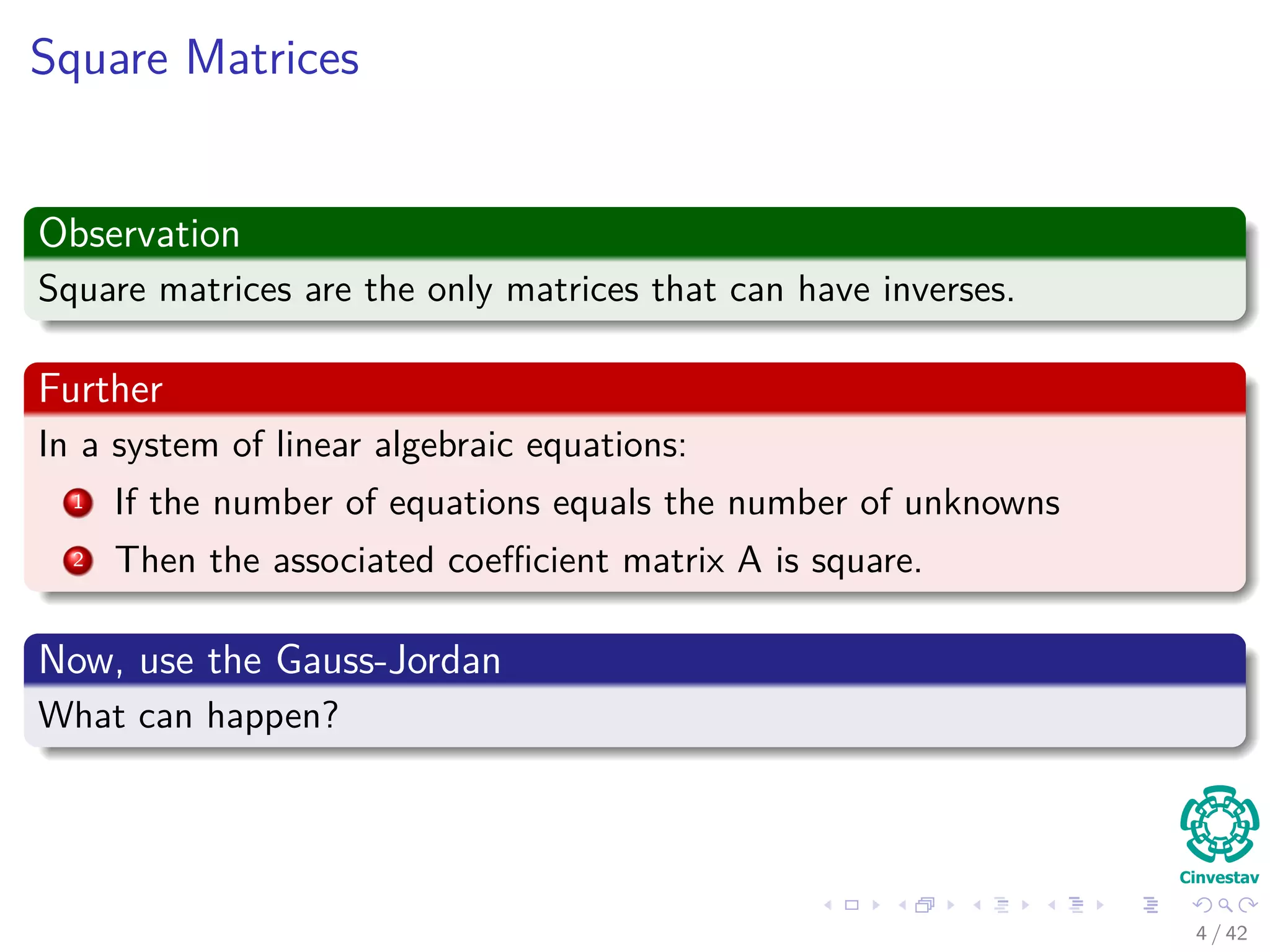
Square Matrices
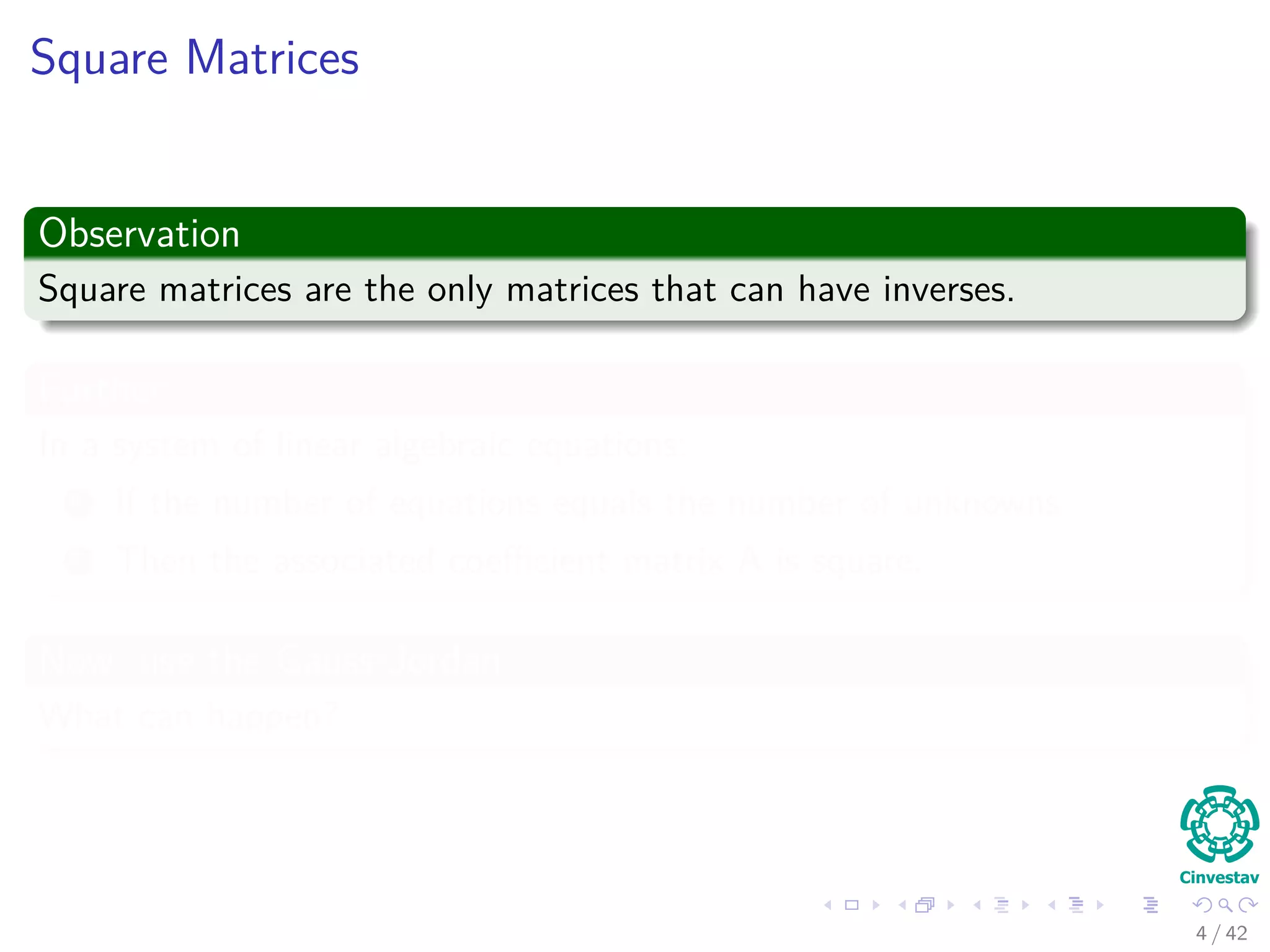
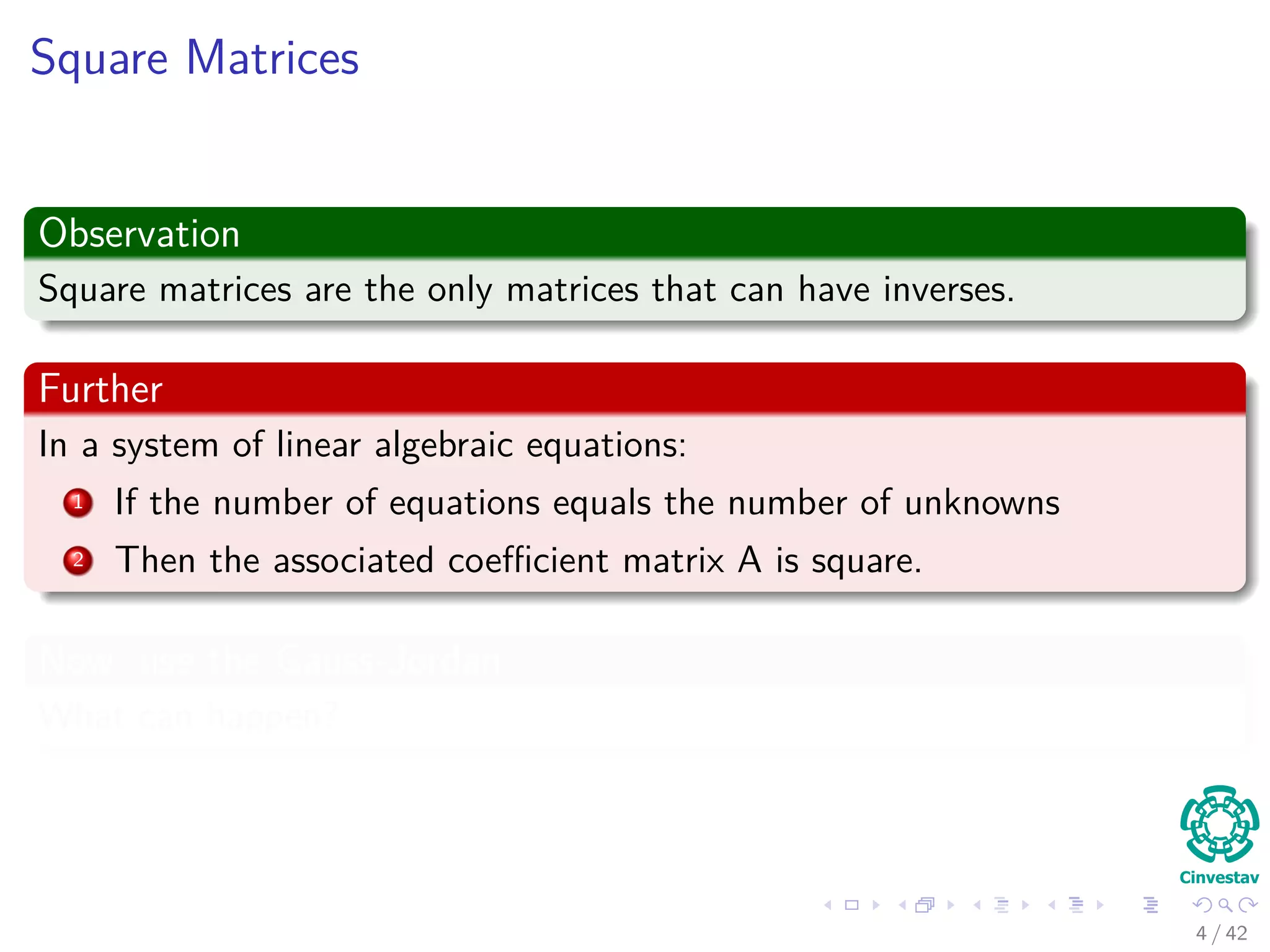
Observation
Square matrices are the only matrices that can have inverses.
Further
In a system of linear algebraic equations:
1 If the number of equations equals the number of unknowns
2 Then the associated coefficient matrix A is square.
Now, use the Gauss-Jordan
What can happen?
4 / 42
Square Matrices
Observation
Square matrices are the only matrices that can have inverses.
Further
In a system of linear algebraic equations:
1 If the number of equations equals the number of unknowns
2 Then the associated coefficient matrix A is square.
Now, use the Gauss-Jordan
What can happen?
4 / 42
Square Matrices
Observation
Square matrices are the only matrices that can have inverses.
Further
In a system of linear algebraic equations:
1 If the number of equations equals the number of unknowns
2 Then the associated coefficient matrix A is square.
Now, use the Gauss-Jordan
What can happen?
4 / 42
Outline
1 Square Matrices
Introduction
The Inverse
Solution to Ax = y
Algorithm for the Inverse of a Matrix
2 Determinants
Introduction
Complexity Increases
Reducing the Complexity
Some Consequences of the definition
Special Determinants
5 / 42
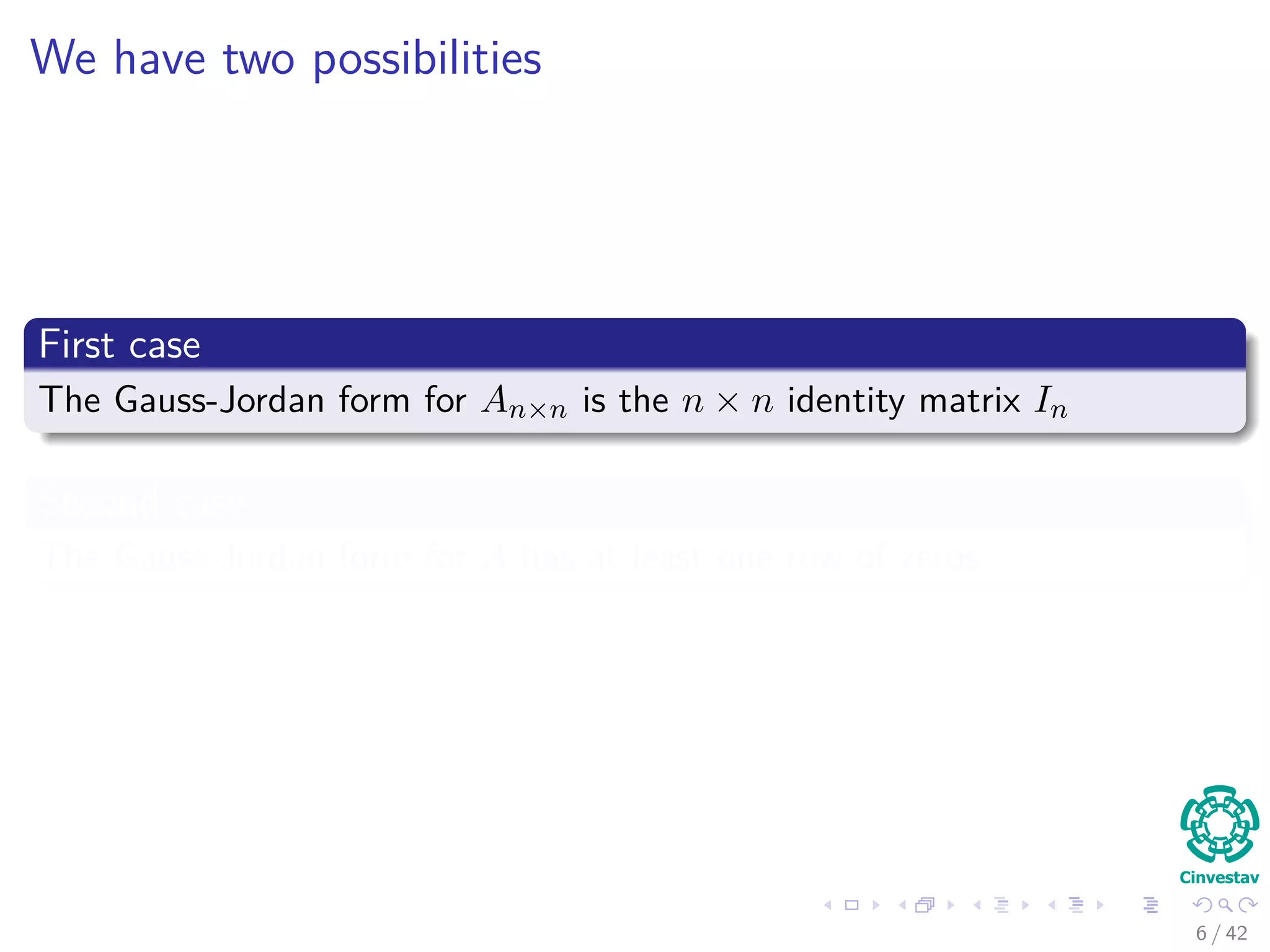
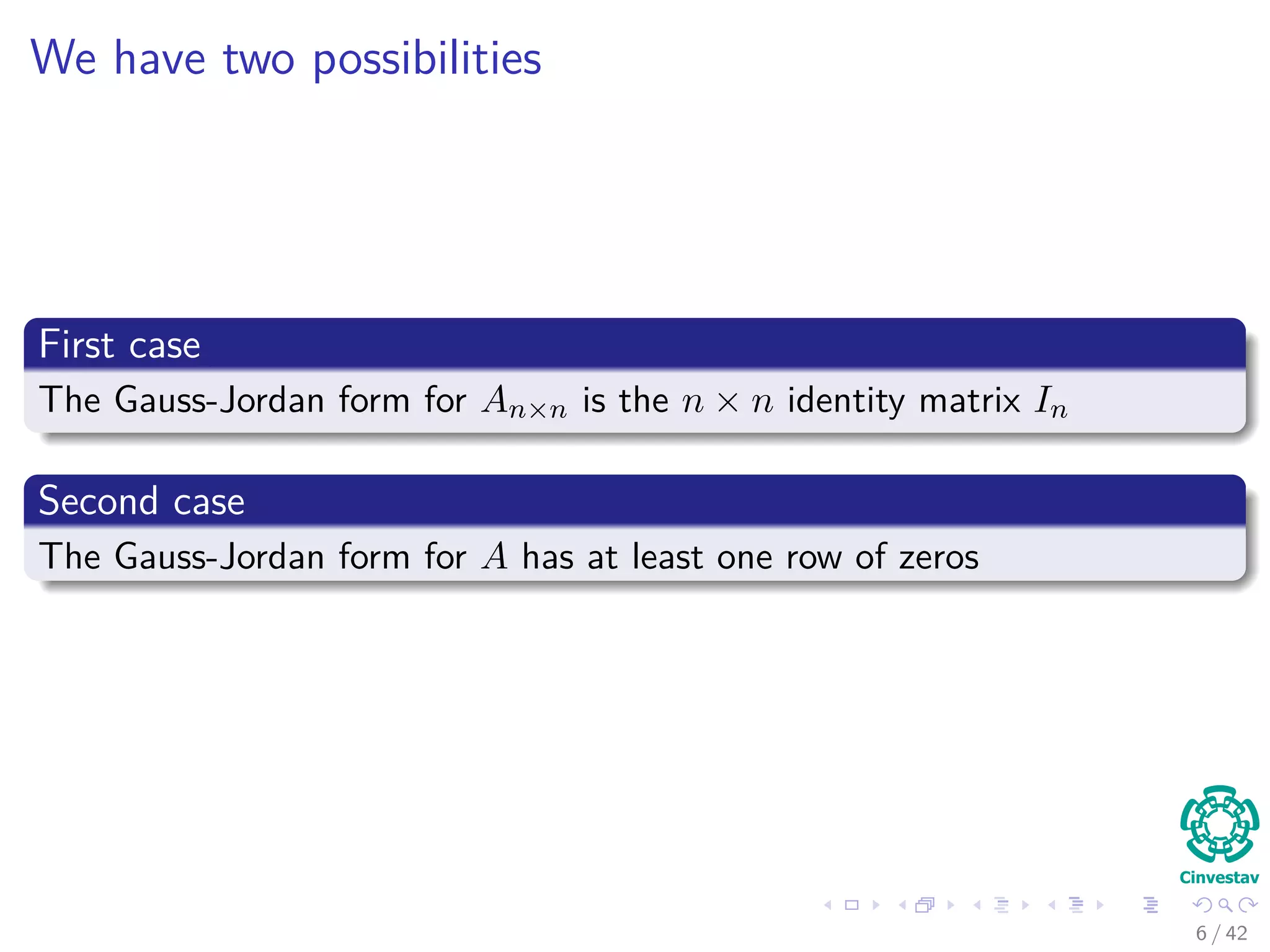
We have two possibilities
First case
The Gauss-Jordan form for An×n is the n × n identity matrix In
Second case
The Gauss-Jordan form for A has at least one row of zeros
6 / 42
We have two possibilities
First case
The Gauss-Jordan form for An×n is the n × n identity matrix In
Second case
The Gauss-Jordan form for A has at least one row of zeros
6 / 42
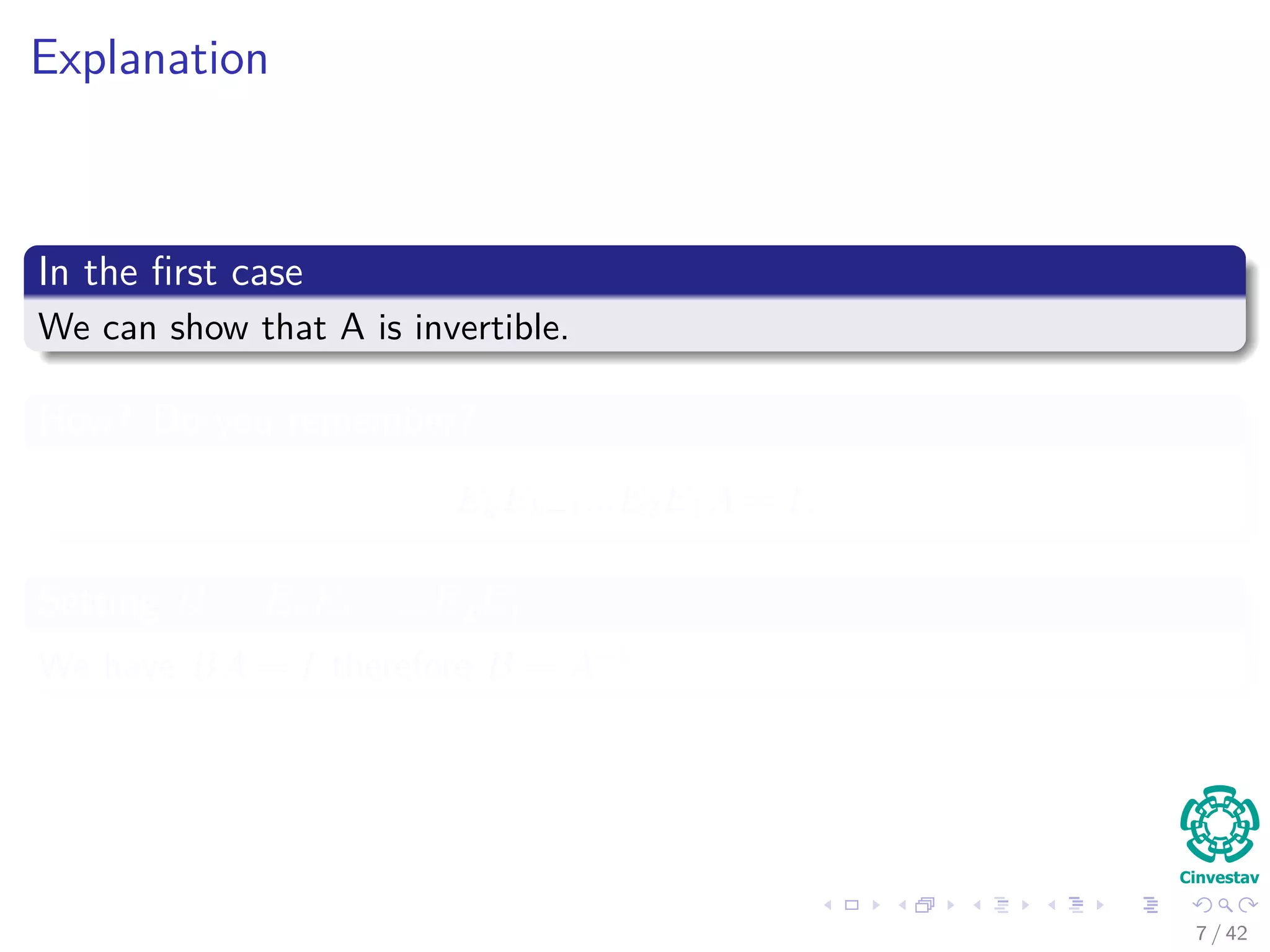
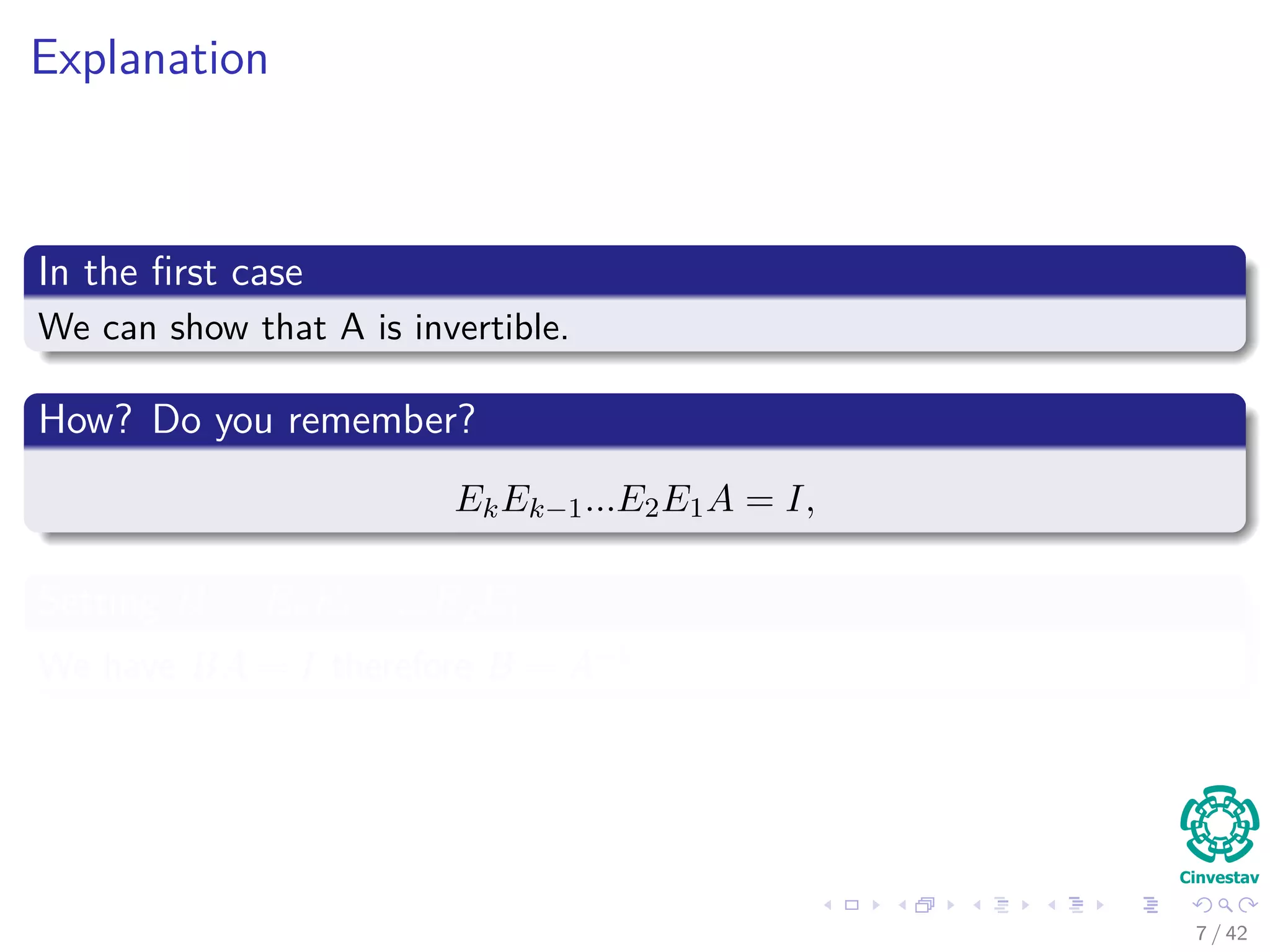
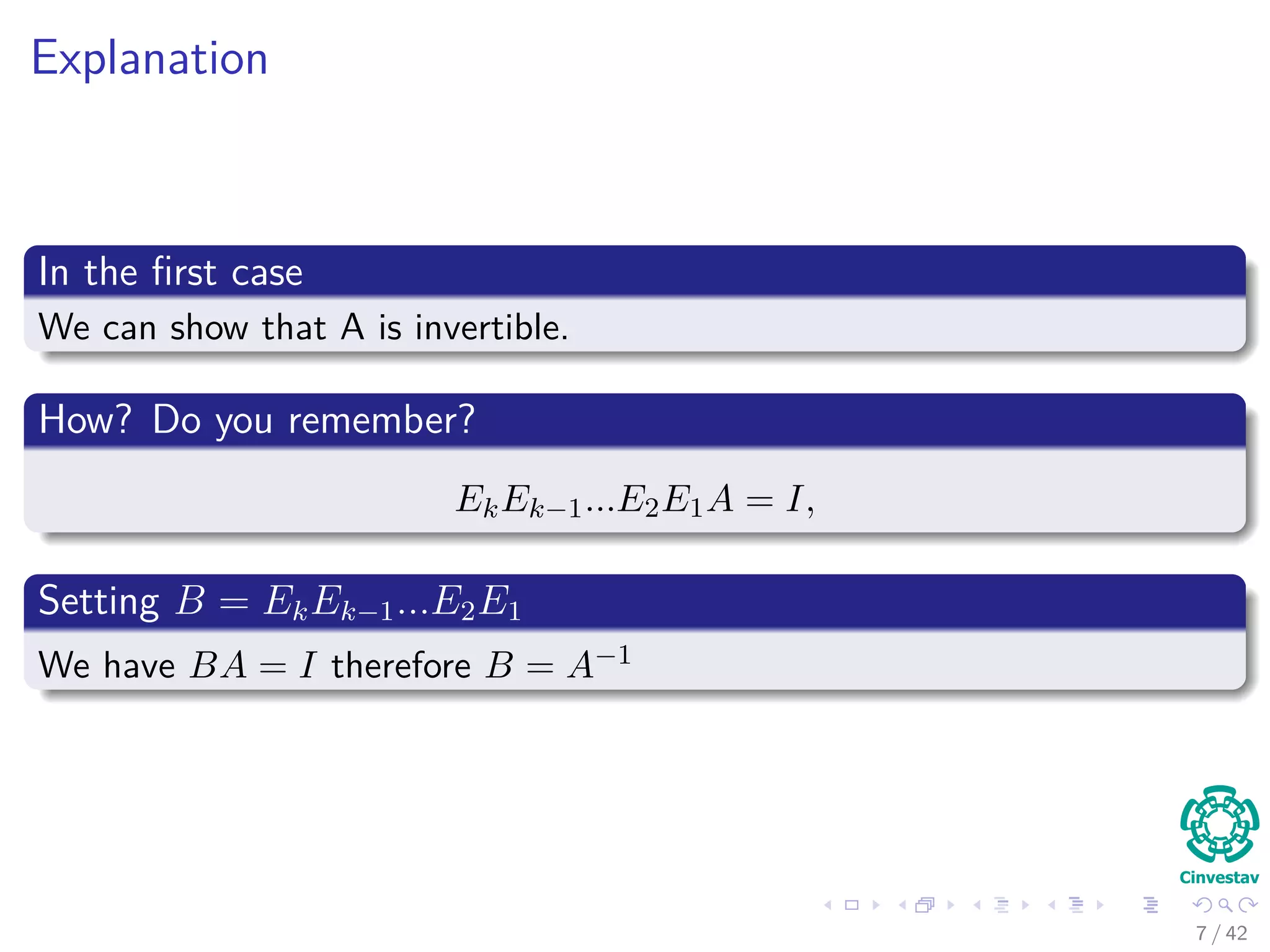
Explanation
In the first case
We can show that A is invertible.
How? Do you remember?
EkEk−1...E2E1A = I,
Setting B = EkEk−1...E2E1
We have BA = I therefore B = A−1
7 / 42
Explanation
In the first case
We can show that A is invertible.
How? Do you remember?
EkEk−1...E2E1A = I,
Setting B = EkEk−1...E2E1
We have BA = I therefore B = A−1
7 / 42
Explanation
In the first case
We can show that A is invertible.
How? Do you remember?
EkEk−1...E2E1A = I,
Setting B = EkEk−1...E2E1
We have BA = I therefore B = A−1
7 / 42
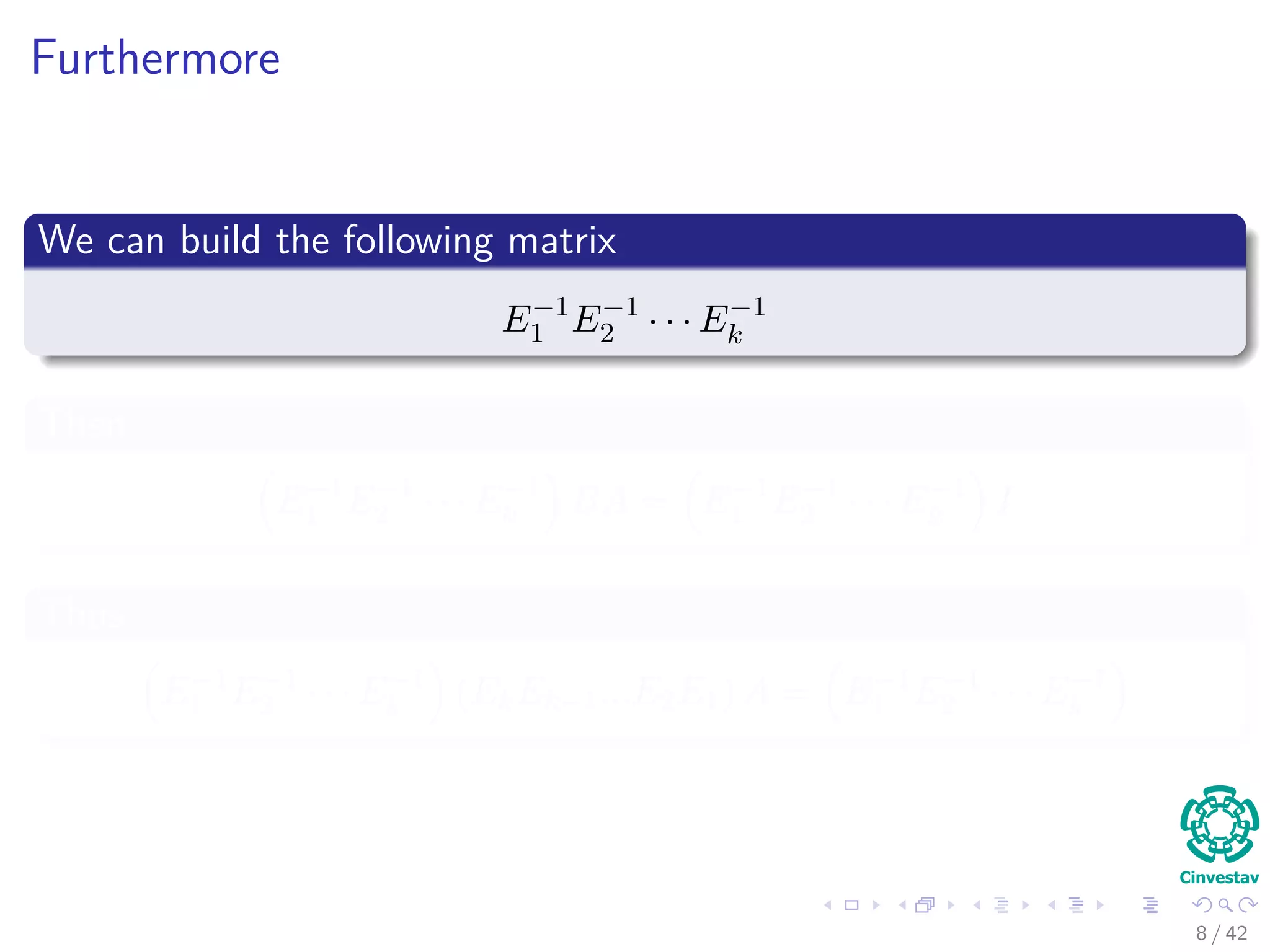
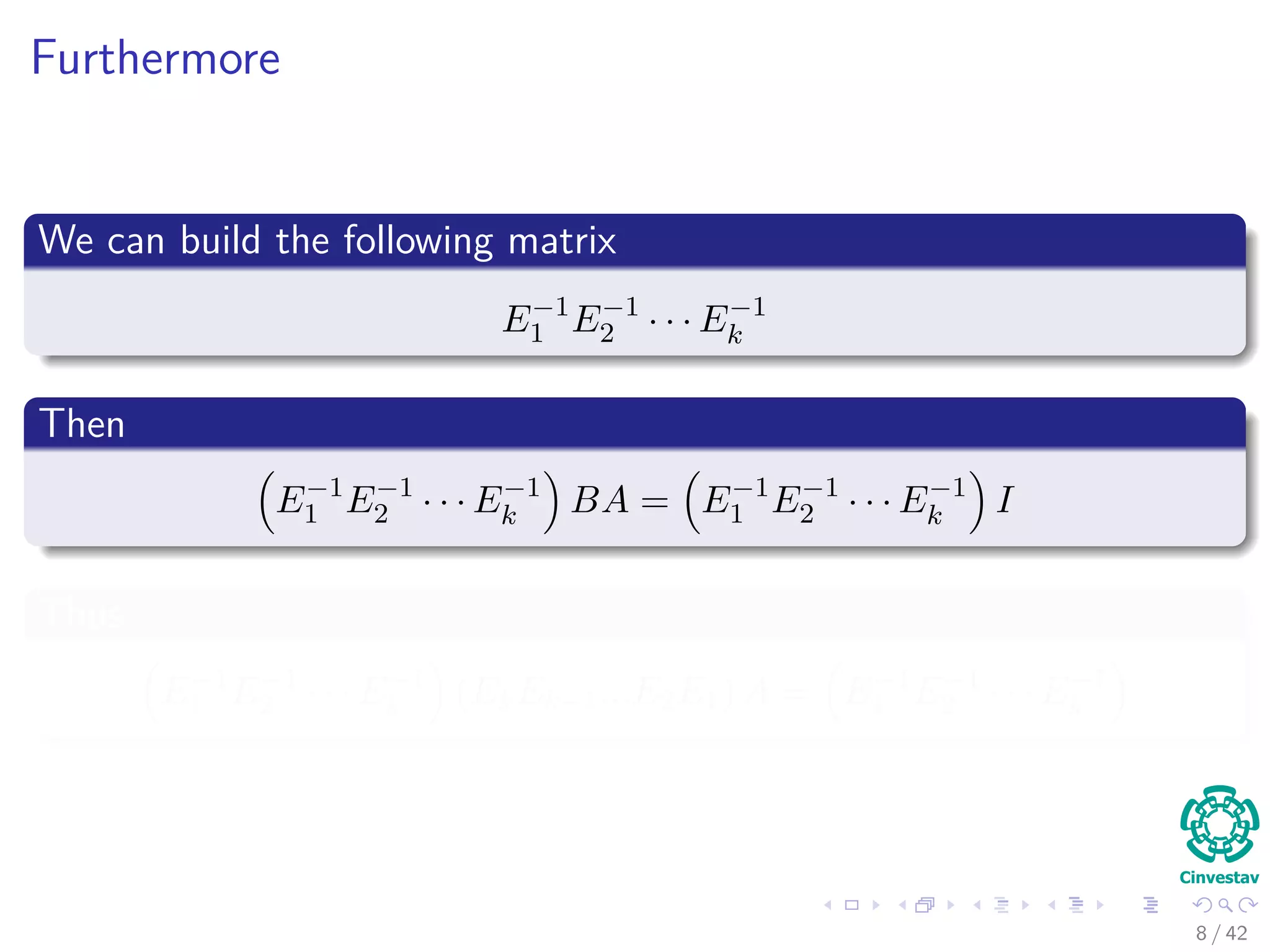
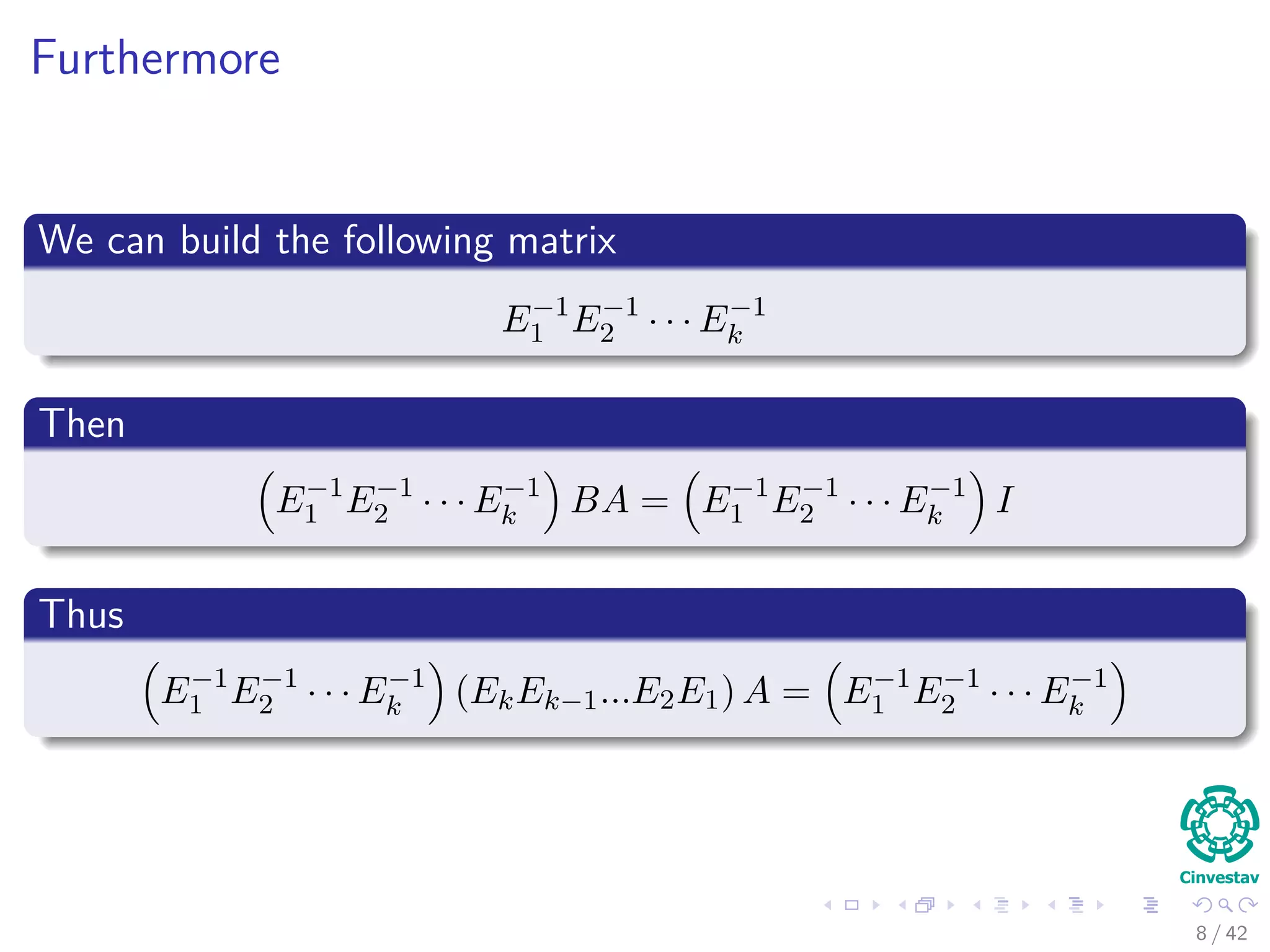
Furthermore
We can build the following matrix
E−1
1 E−1
2 · · · E−1
k
Then
E−1
1 E−1
2 · · · E−1
k BA = E−1
1 E−1
2 · · · E−1
k I
Thus
E−1
1 E−1
2 · · · E−1
k (EkEk−1...E2E1) A = E−1
1 E−1
2 · · · E−1
k
8 / 42
Furthermore
We can build the following matrix
E−1
1 E−1
2 · · · E−1
k
Then
E−1
1 E−1
2 · · · E−1
k BA = E−1
1 E−1
2 · · · E−1
k I
Thus
E−1
1 E−1
2 · · · E−1
k (EkEk−1...E2E1) A = E−1
1 E−1
2 · · · E−1
k
8 / 42
Furthermore
We can build the following matrix
E−1
1 E−1
2 · · · E−1
k
Then
E−1
1 E−1
2 · · · E−1
k BA = E−1
1 E−1
2 · · · E−1
k I
Thus
E−1
1 E−1
2 · · · E−1
k (EkEk−1...E2E1) A = E−1
1 E−1
2 · · · E−1
k
8 / 42
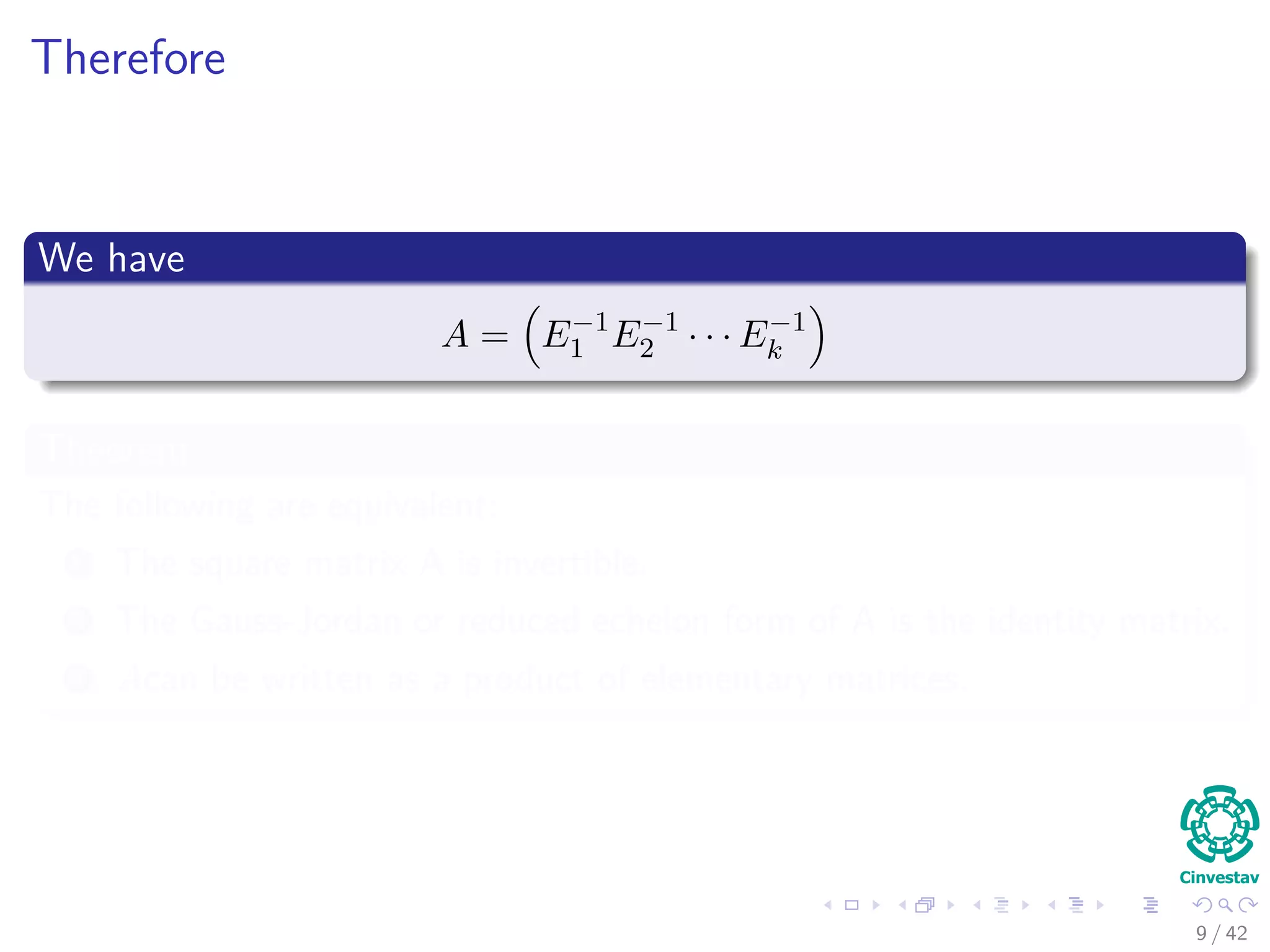
Therefore
We have
A = E−1
1 E−1
2 · · · E−1
k
Theorem
The following are equivalent:
1 The square matrix A is invertible.
2 The Gauss-Jordan or reduced echelon form of A is the identity matrix.
3 Acan be written as a product of elementary matrices.
9 / 42
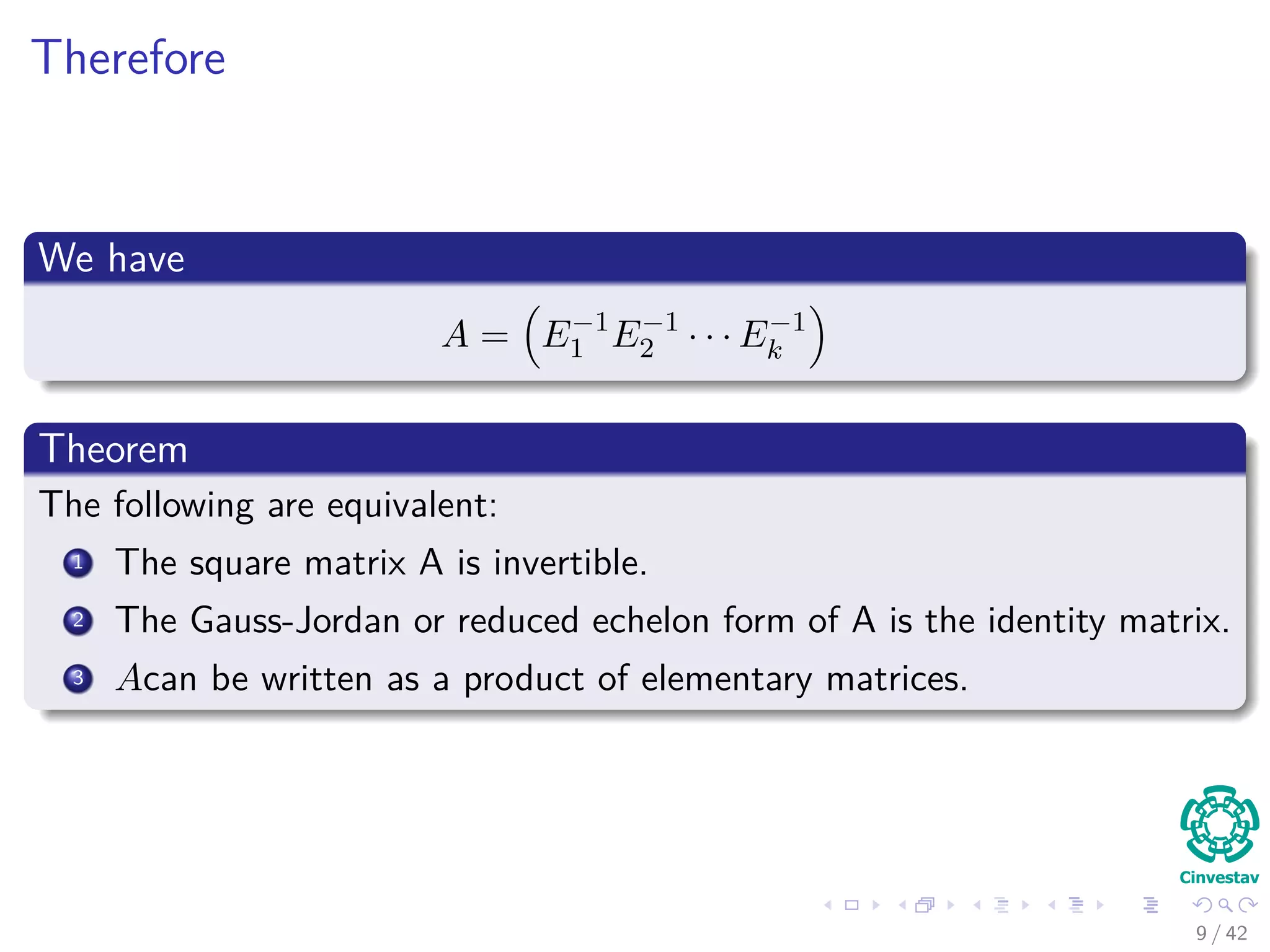
Therefore
We have
A = E−1
1 E−1
2 · · · E−1
k
Theorem
The following are equivalent:
1 The square matrix A is invertible.
2 The Gauss-Jordan or reduced echelon form of A is the identity matrix.
3 Acan be written as a product of elementary matrices.
9 / 42
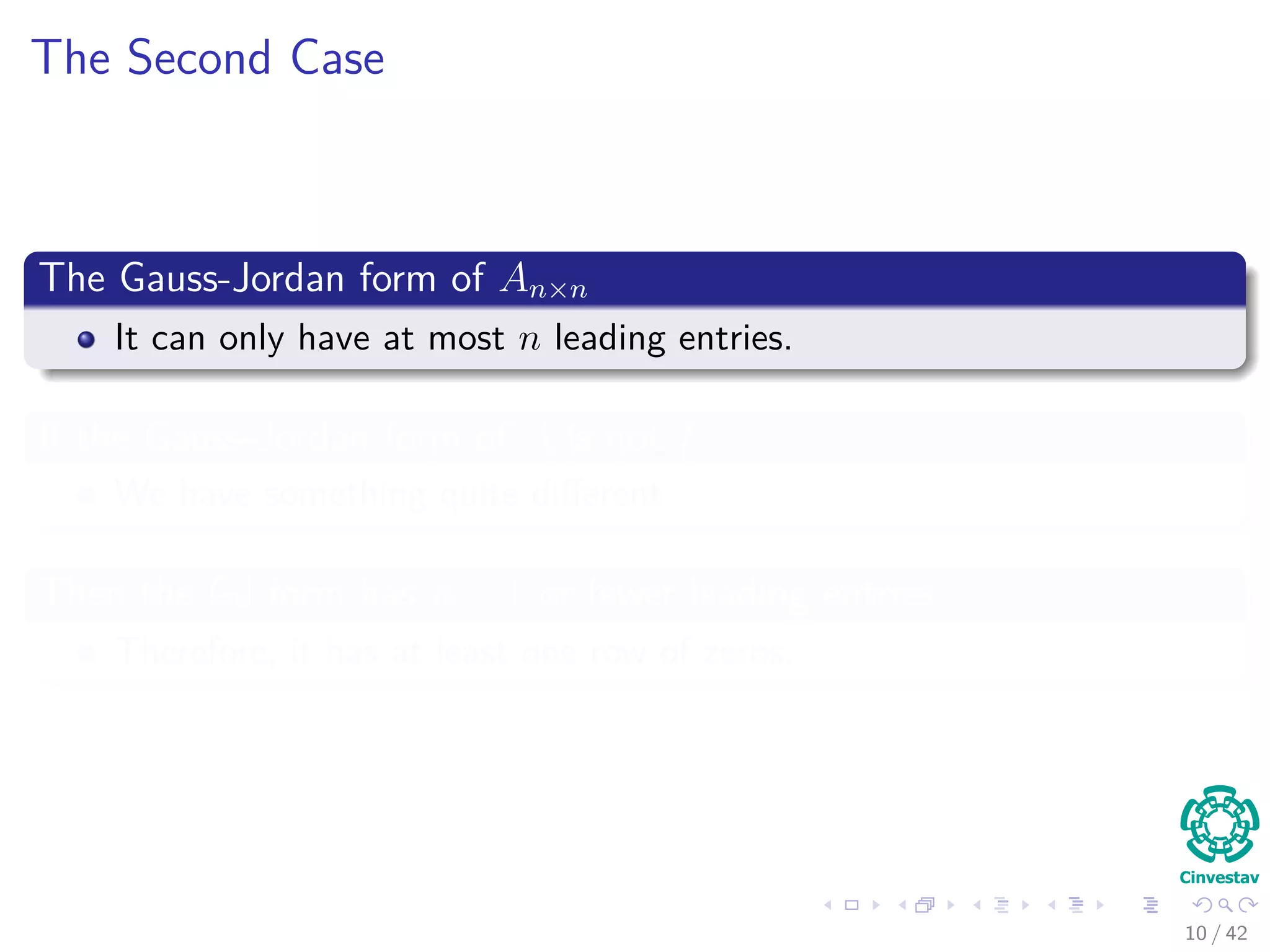
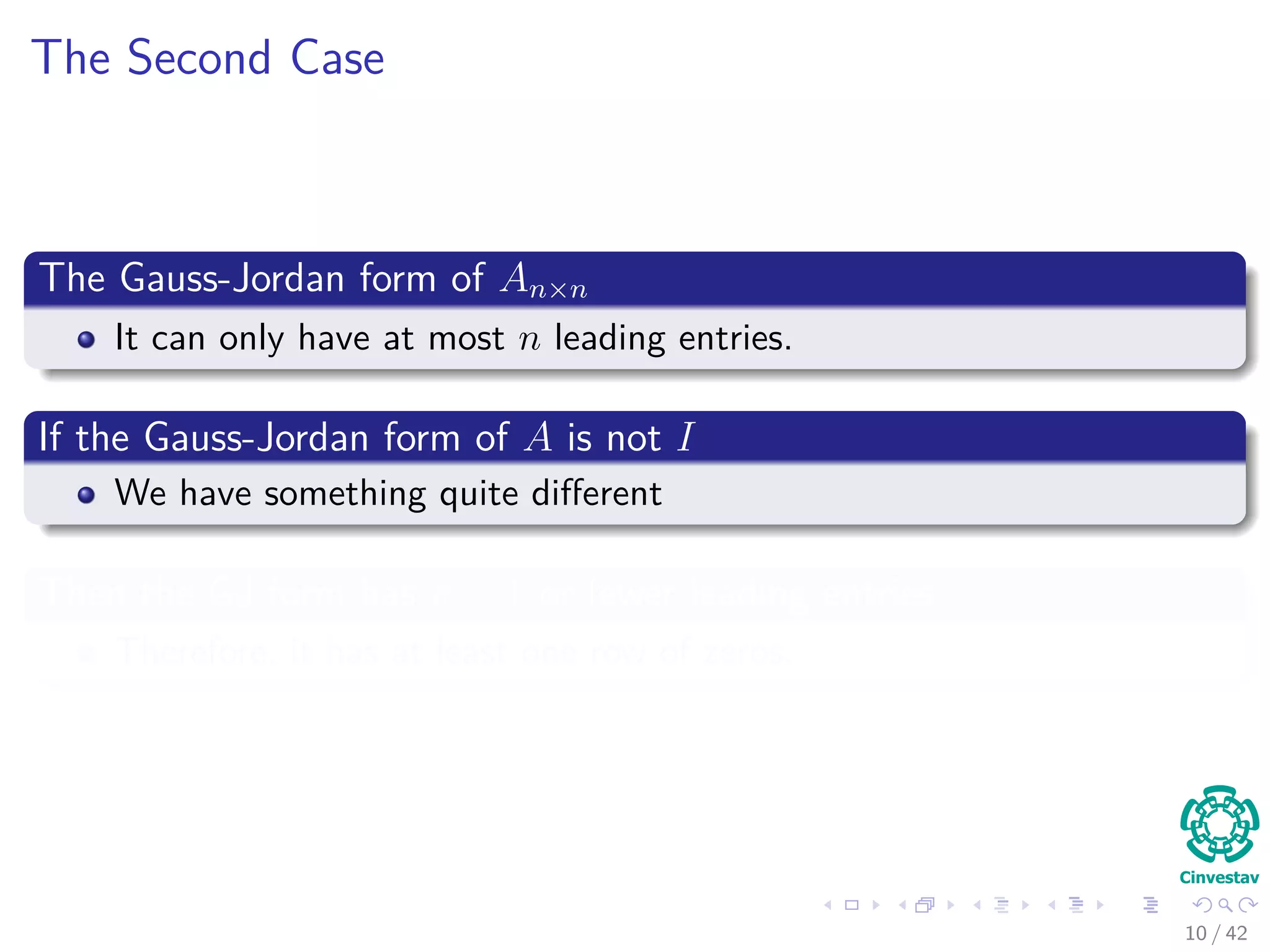
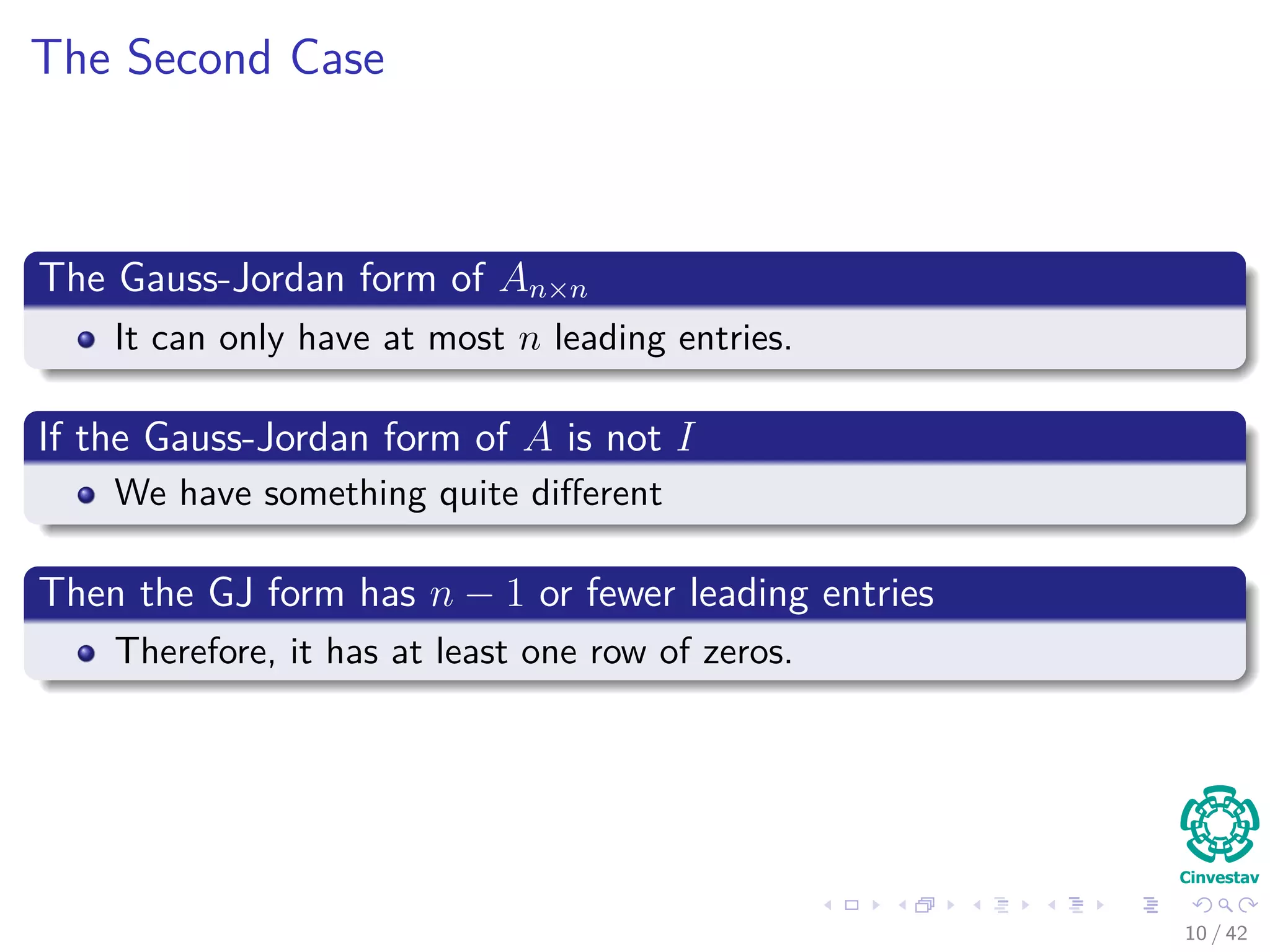
The Second Case
The Gauss-Jordan form of An×n
It can only have at most n leading entries.
If the Gauss-Jordan form of A is not I
We have something quite different
Then the GJ form has n − 1 or fewer leading entries
Therefore, it has at least one row of zeros.
10 / 42
The Second Case
The Gauss-Jordan form of An×n
It can only have at most n leading entries.
If the Gauss-Jordan form of A is not I
We have something quite different
Then the GJ form has n − 1 or fewer leading entries
Therefore, it has at least one row of zeros.
10 / 42
The Second Case
The Gauss-Jordan form of An×n
It can only have at most n leading entries.
If the Gauss-Jordan form of A is not I
We have something quite different
Then the GJ form has n − 1 or fewer leading entries
Therefore, it has at least one row of zeros.
10 / 42
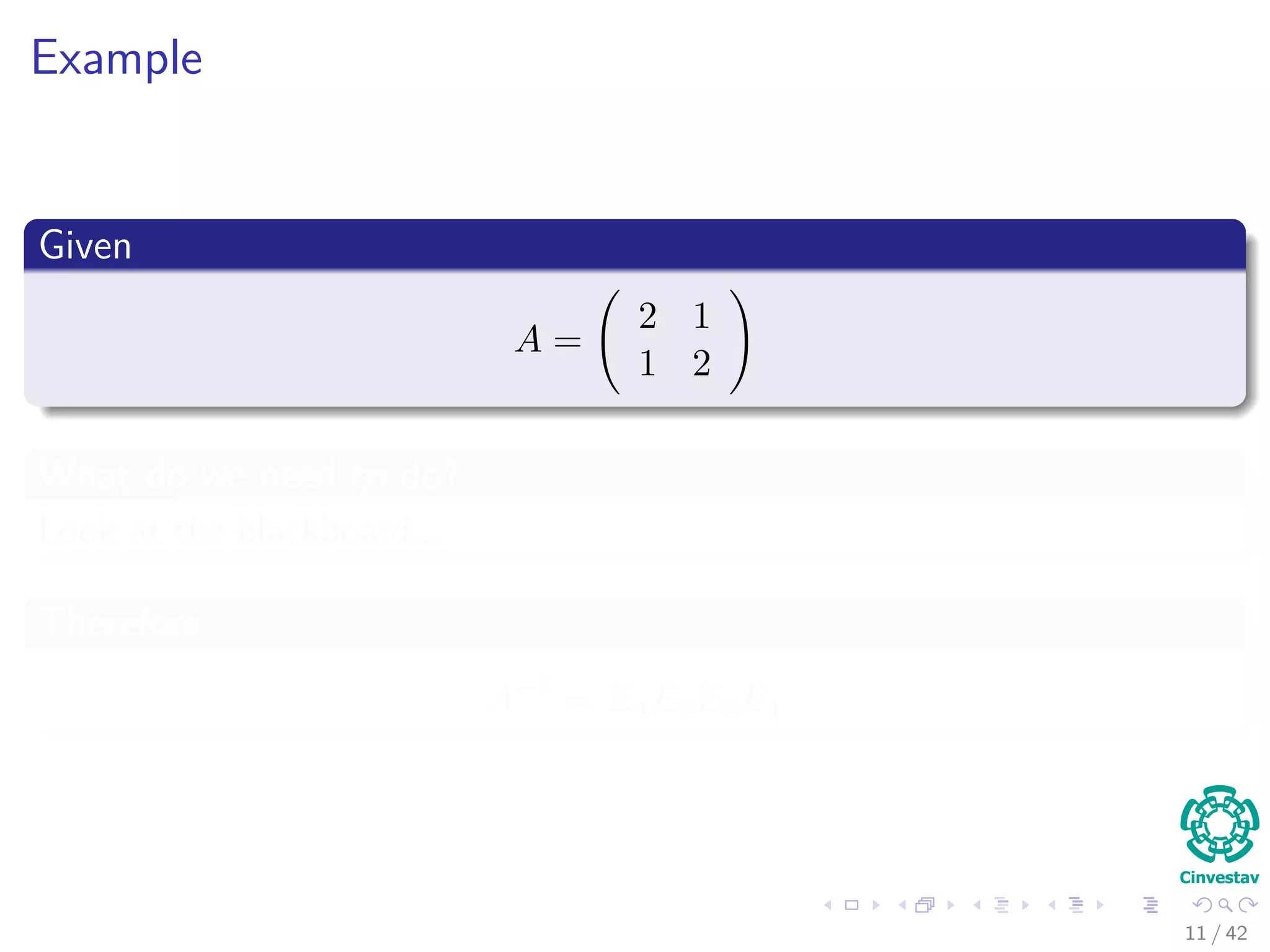
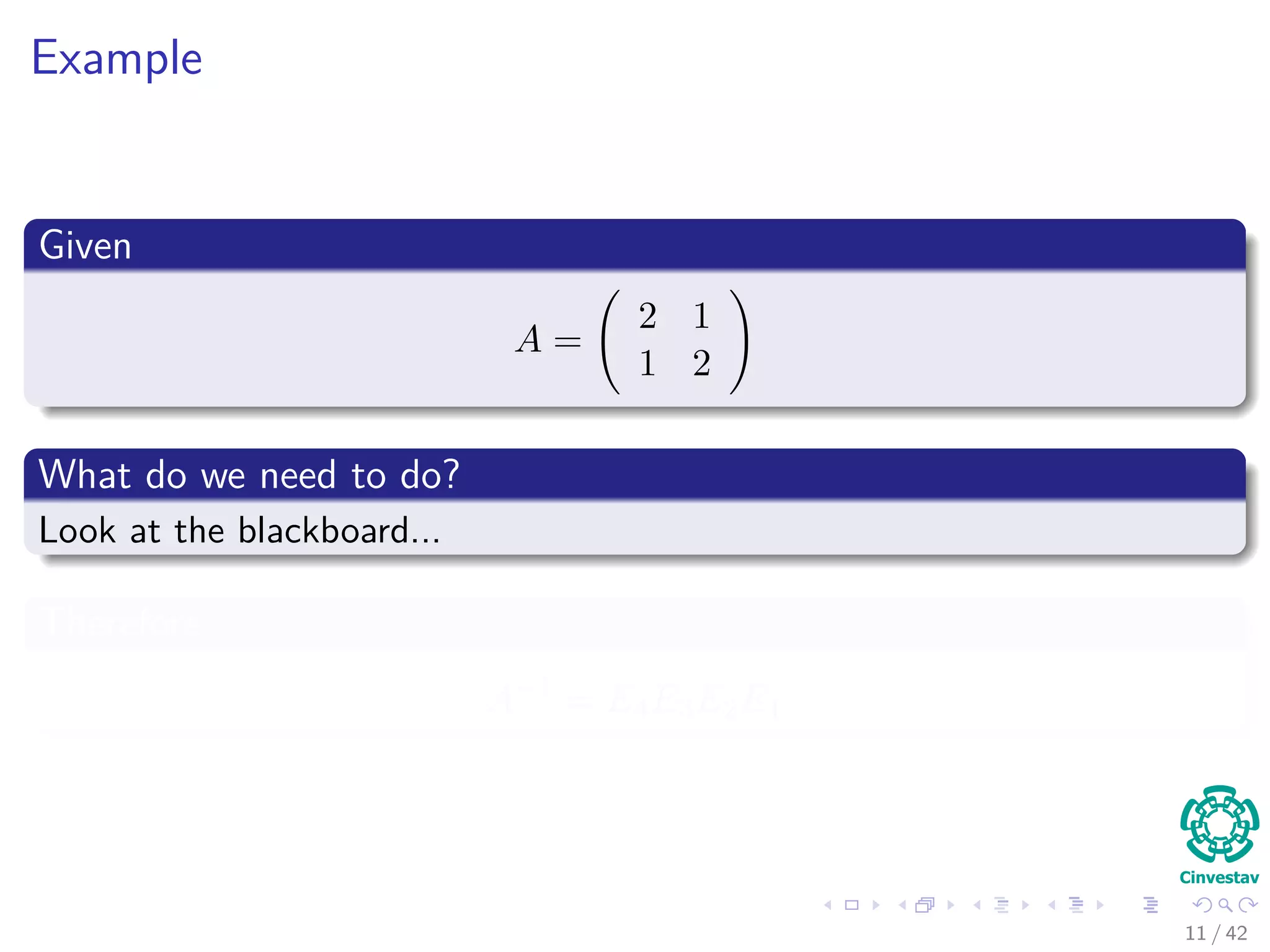
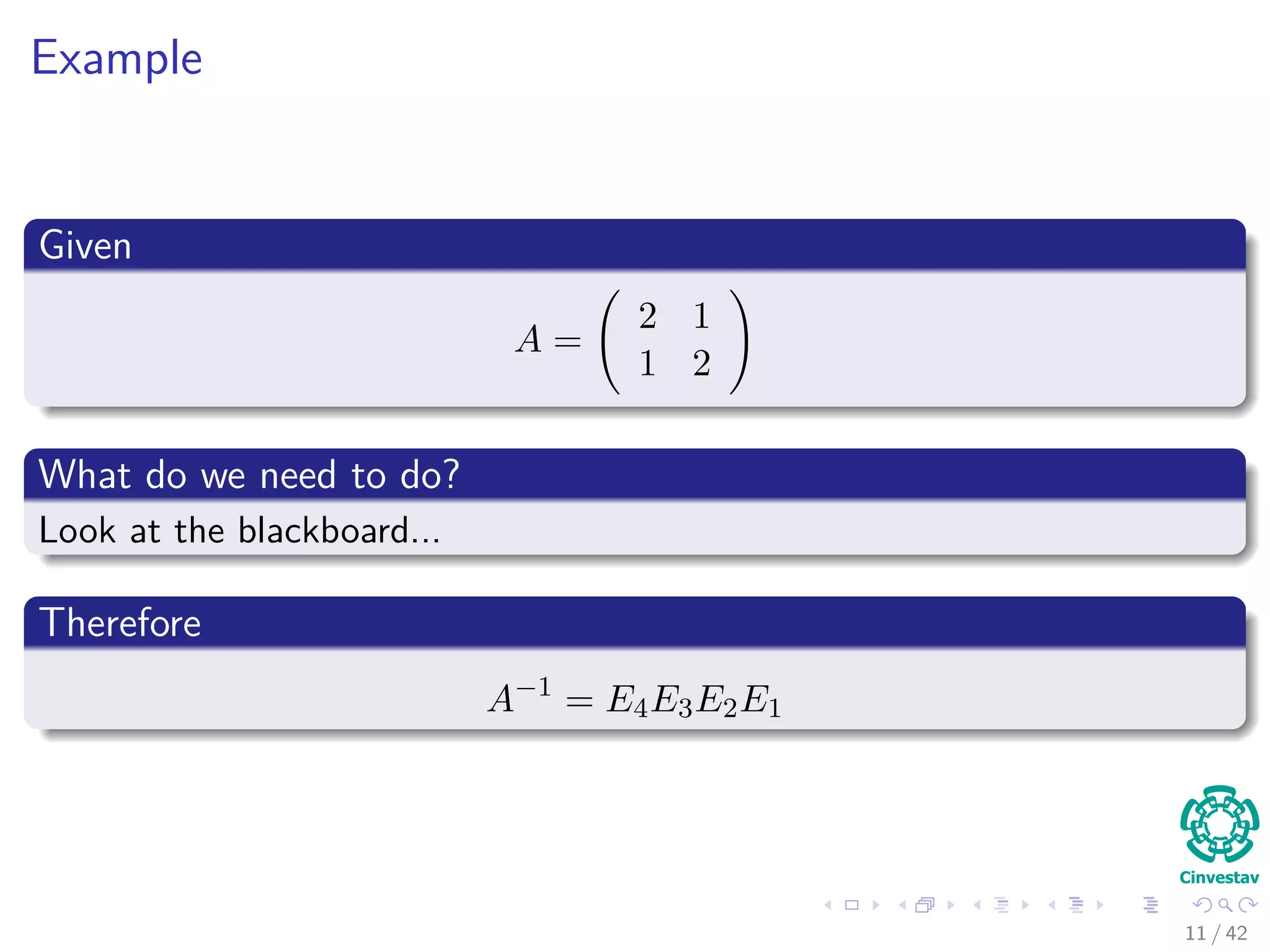
Example
Given
A =
2 1
1 2
What do we need to do?
Look at the blackboard...
Therefore
A−1
= E4E3E2E1
11 / 42
Example
Given
A =
2 1
1 2
What do we need to do?
Look at the blackboard...
Therefore
A−1
= E4E3E2E1
11 / 42
Example
Given
A =
2 1
1 2
What do we need to do?
Look at the blackboard...
Therefore
A−1
= E4E3E2E1
11 / 42
Outline
1 Square Matrices
Introduction
The Inverse
Solution to Ax = y
Algorithm for the Inverse of a Matrix
2 Determinants
Introduction
Complexity Increases
Reducing the Complexity
Some Consequences of the definition
Special Determinants
12 / 42
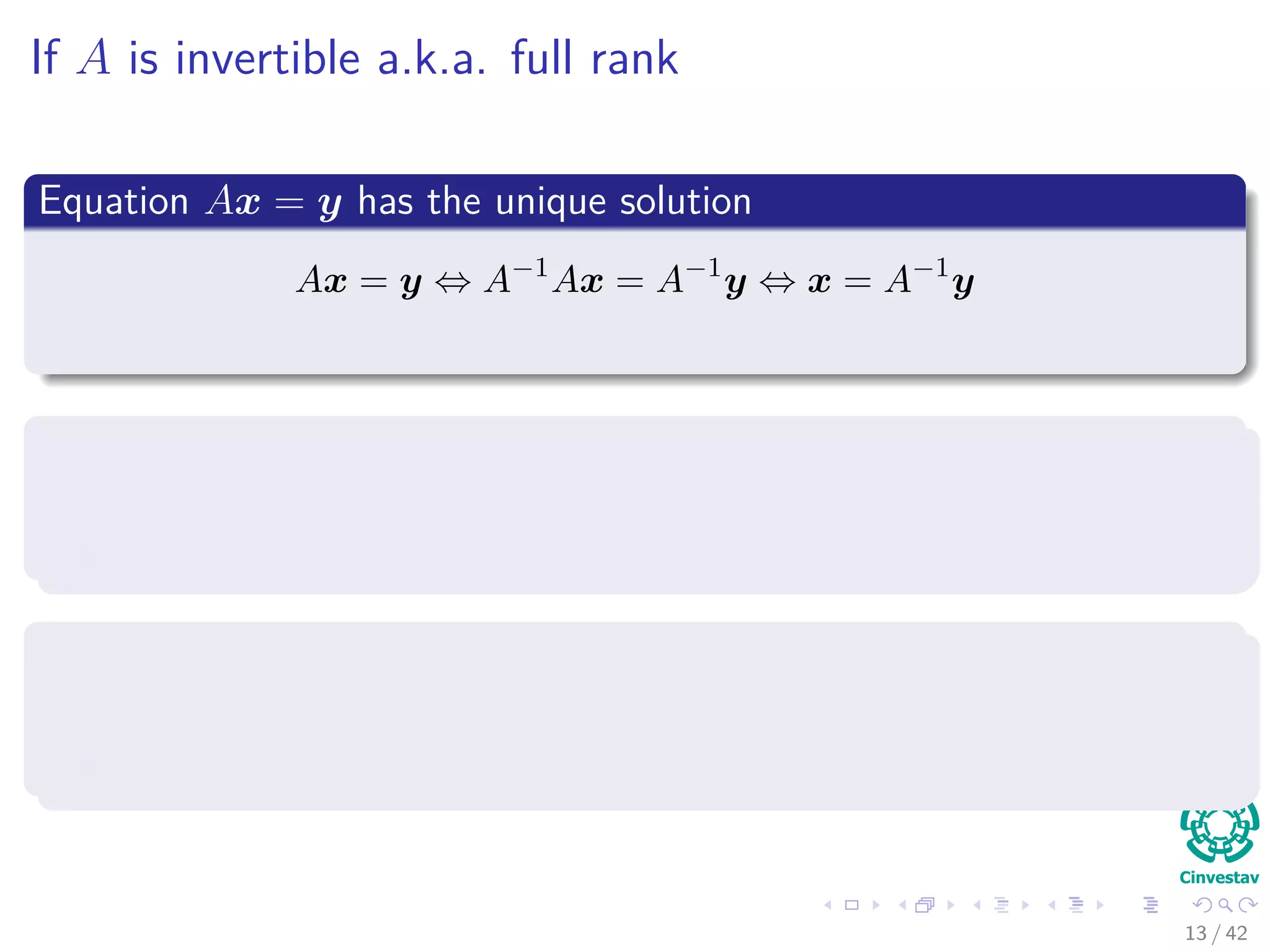
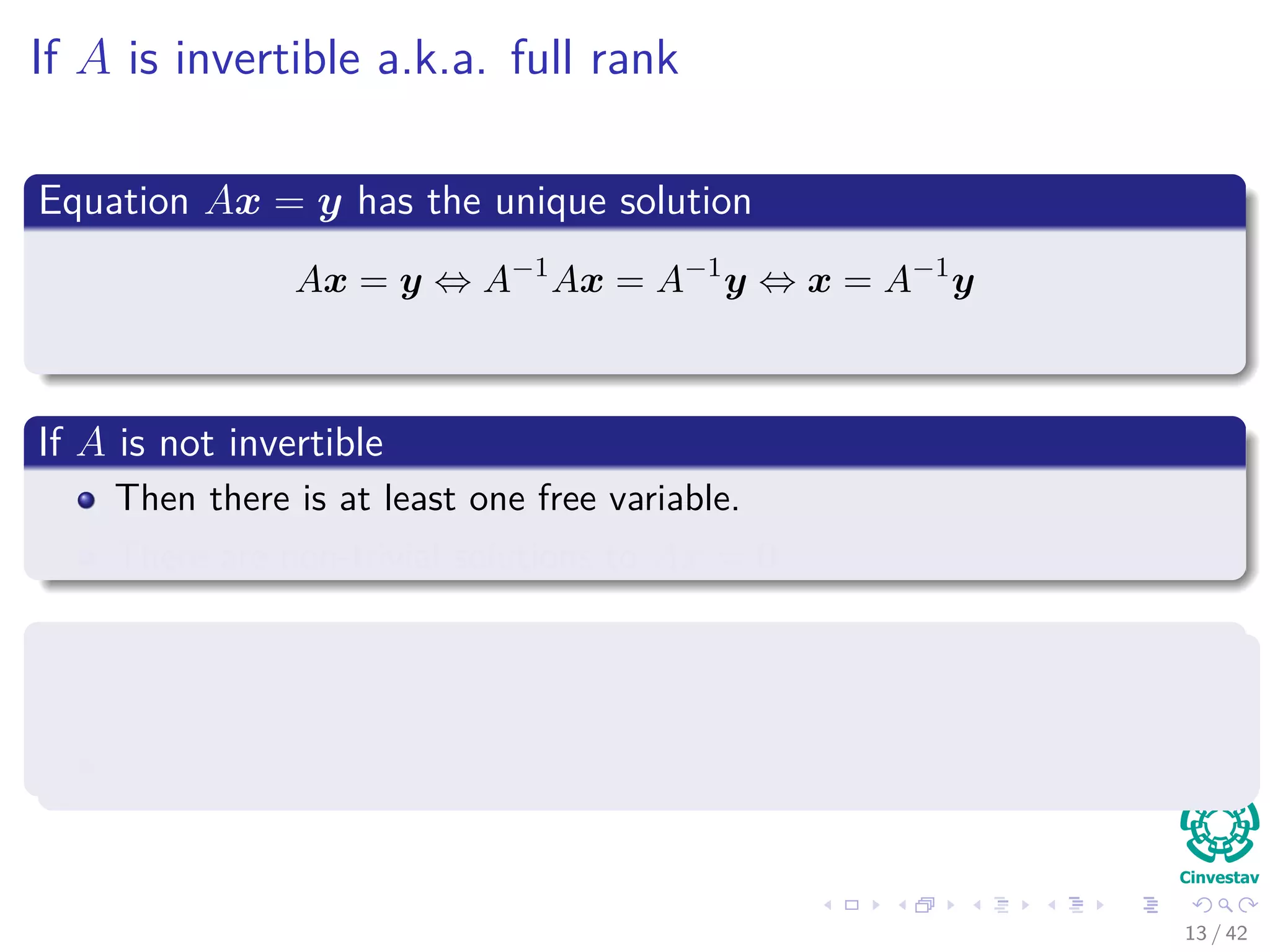
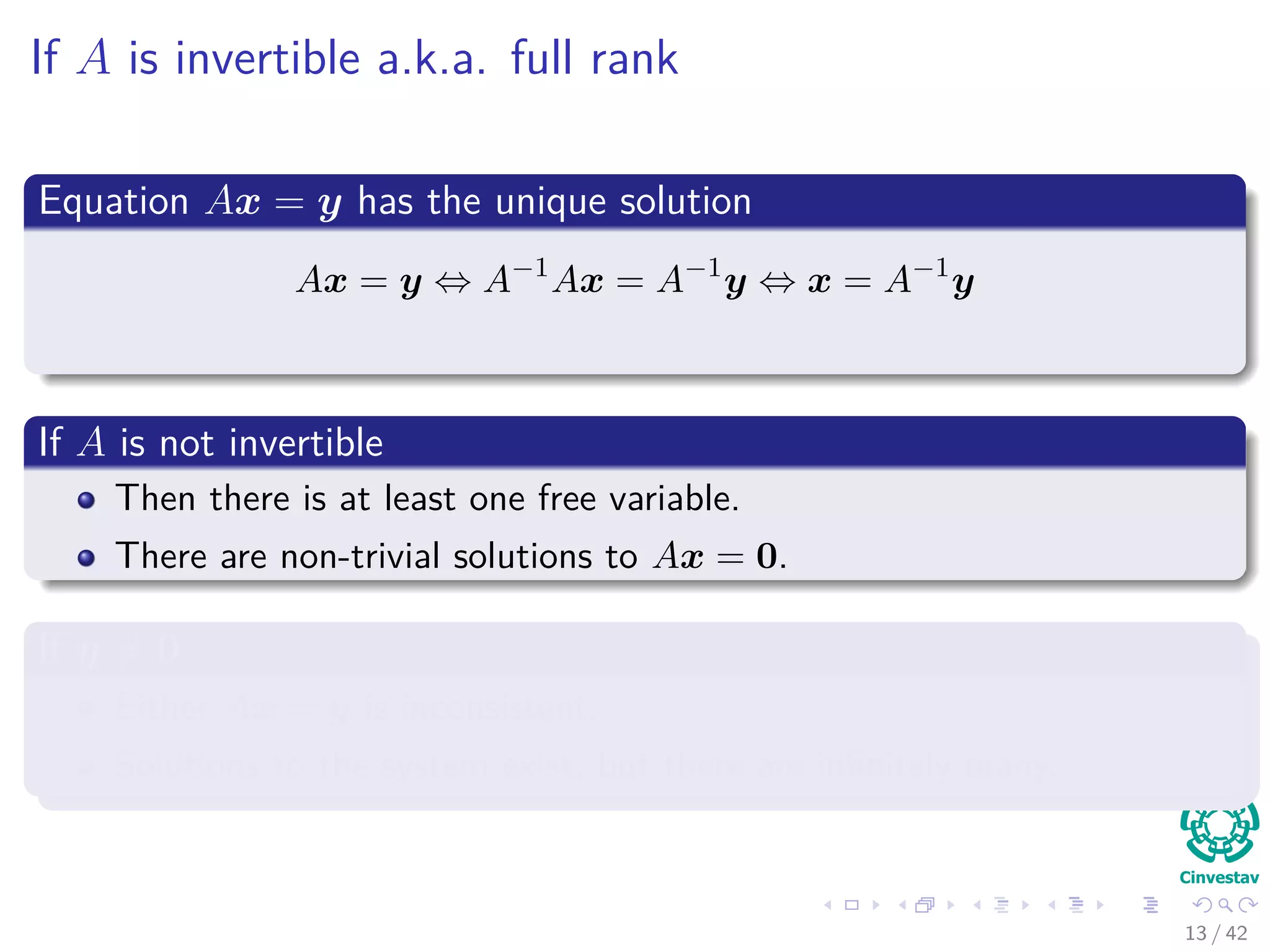
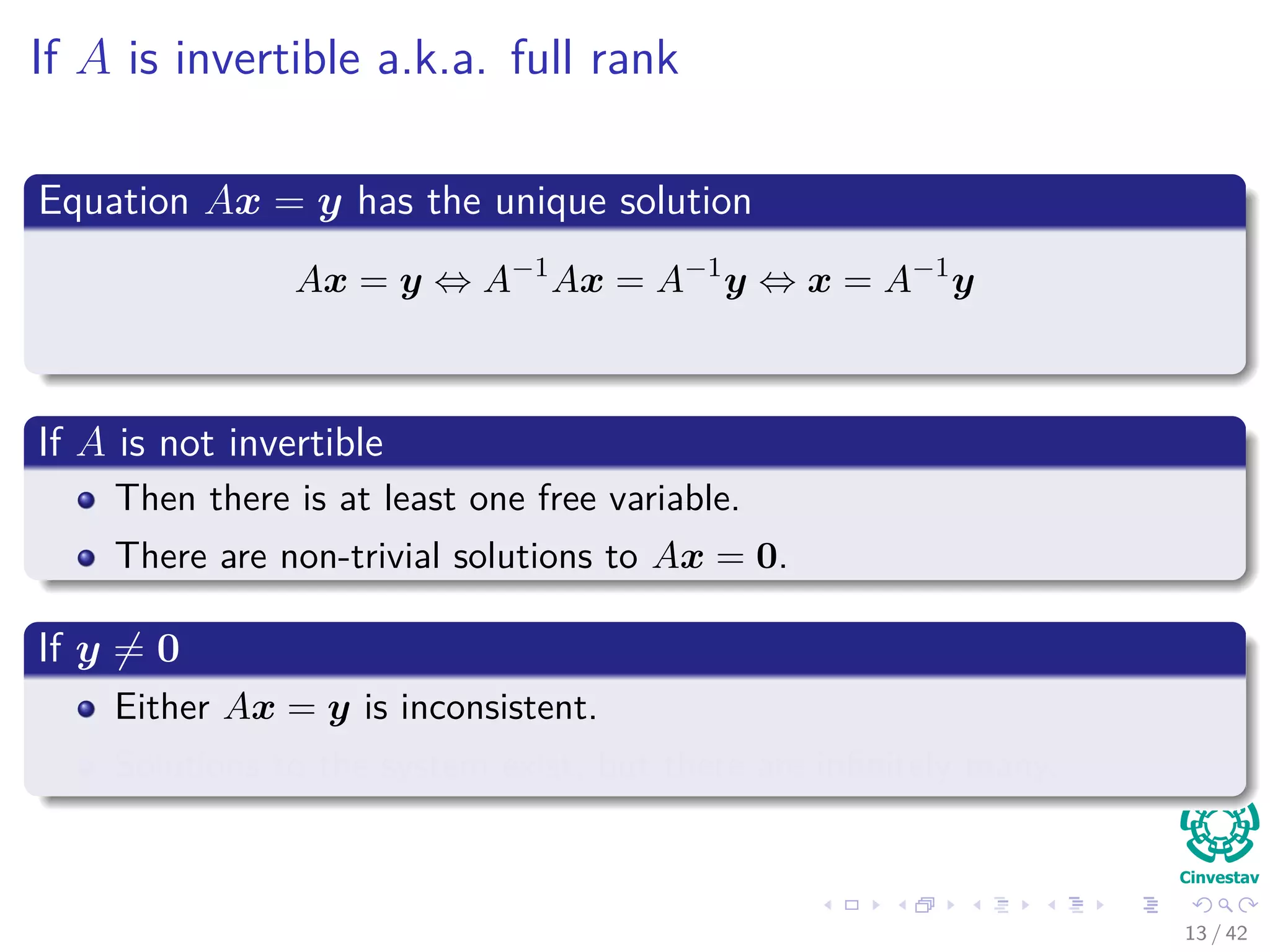
If A is invertible a.k.a. full rank
Equation Ax = y has the unique solution
Ax = y ⇔ A−1
Ax = A−1
y ⇔ x = A−1
y
If A is not invertible
Then there is at least one free variable.
There are non-trivial solutions to Ax = 0.
If y = 0
Either Ax = y is inconsistent.
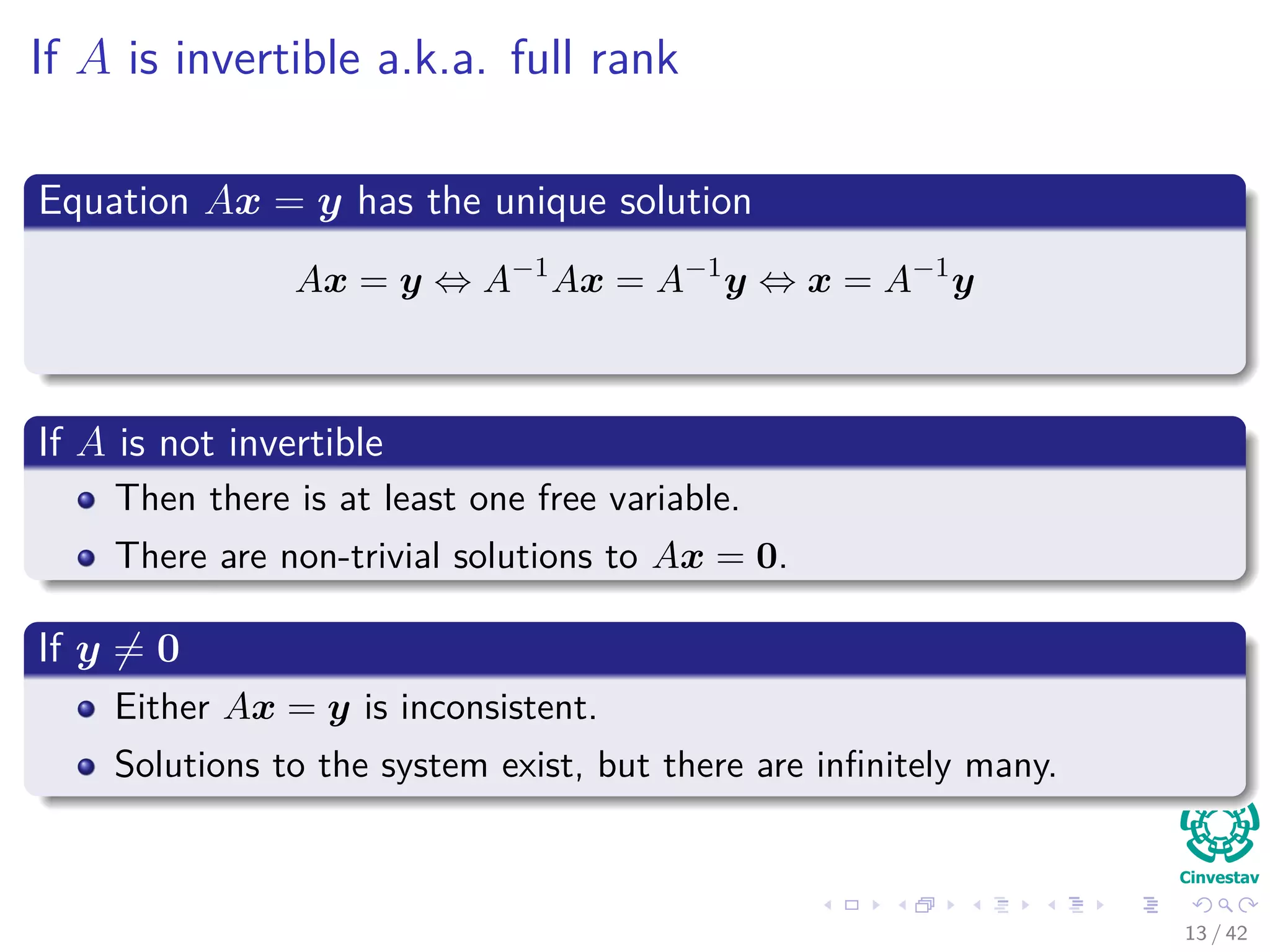
Solutions to the system exist, but there are infinitely many.
13 / 42
If A is invertible a.k.a. full rank
Equation Ax = y has the unique solution
Ax = y ⇔ A−1
Ax = A−1
y ⇔ x = A−1
y
If A is not invertible
Then there is at least one free variable.
There are non-trivial solutions to Ax = 0.
If y = 0
Either Ax = y is inconsistent.
Solutions to the system exist, but there are infinitely many.
13 / 42
If A is invertible a.k.a. full rank
Equation Ax = y has the unique solution
Ax = y ⇔ A−1
Ax = A−1
y ⇔ x = A−1
y
If A is not invertible
Then there is at least one free variable.
There are non-trivial solutions to Ax = 0.
If y = 0
Either Ax = y is inconsistent.
Solutions to the system exist, but there are infinitely many.
13 / 42
If A is invertible a.k.a. full rank
Equation Ax = y has the unique solution
Ax = y ⇔ A−1
Ax = A−1
y ⇔ x = A−1
y
If A is not invertible
Then there is at least one free variable.
There are non-trivial solutions to Ax = 0.
If y = 0
Either Ax = y is inconsistent.
Solutions to the system exist, but there are infinitely many.
13 / 42
If A is invertible a.k.a. full rank
Equation Ax = y has the unique solution
Ax = y ⇔ A−1
Ax = A−1
y ⇔ x = A−1
y
If A is not invertible
Then there is at least one free variable.
There are non-trivial solutions to Ax = 0.
If y = 0
Either Ax = y is inconsistent.
Solutions to the system exist, but there are infinitely many.
13 / 42
Outline
1 Square Matrices
Introduction
The Inverse
Solution to Ax = y
Algorithm for the Inverse of a Matrix
2 Determinants
Introduction
Complexity Increases
Reducing the Complexity
Some Consequences of the definition
Special Determinants
14 / 42
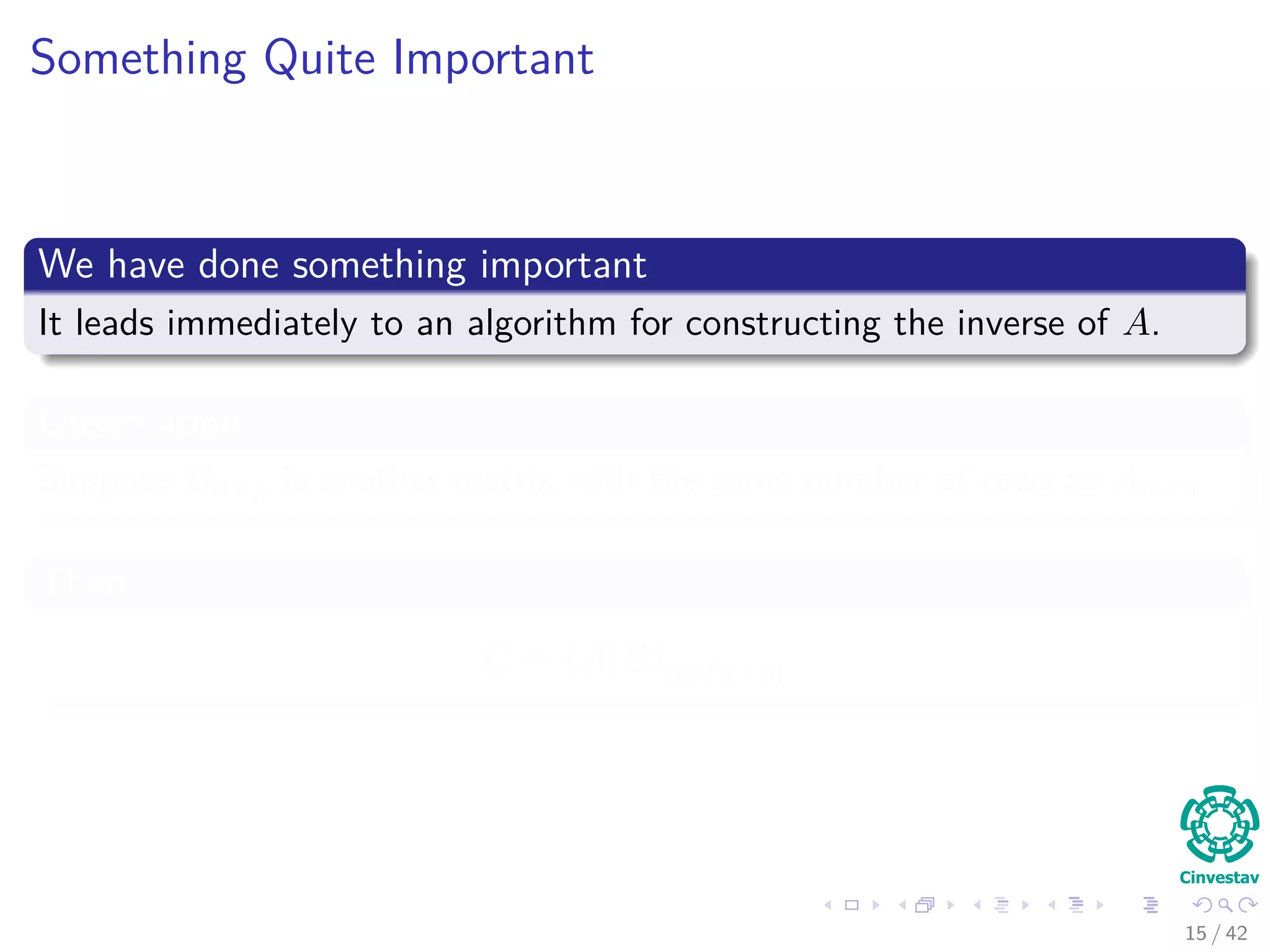
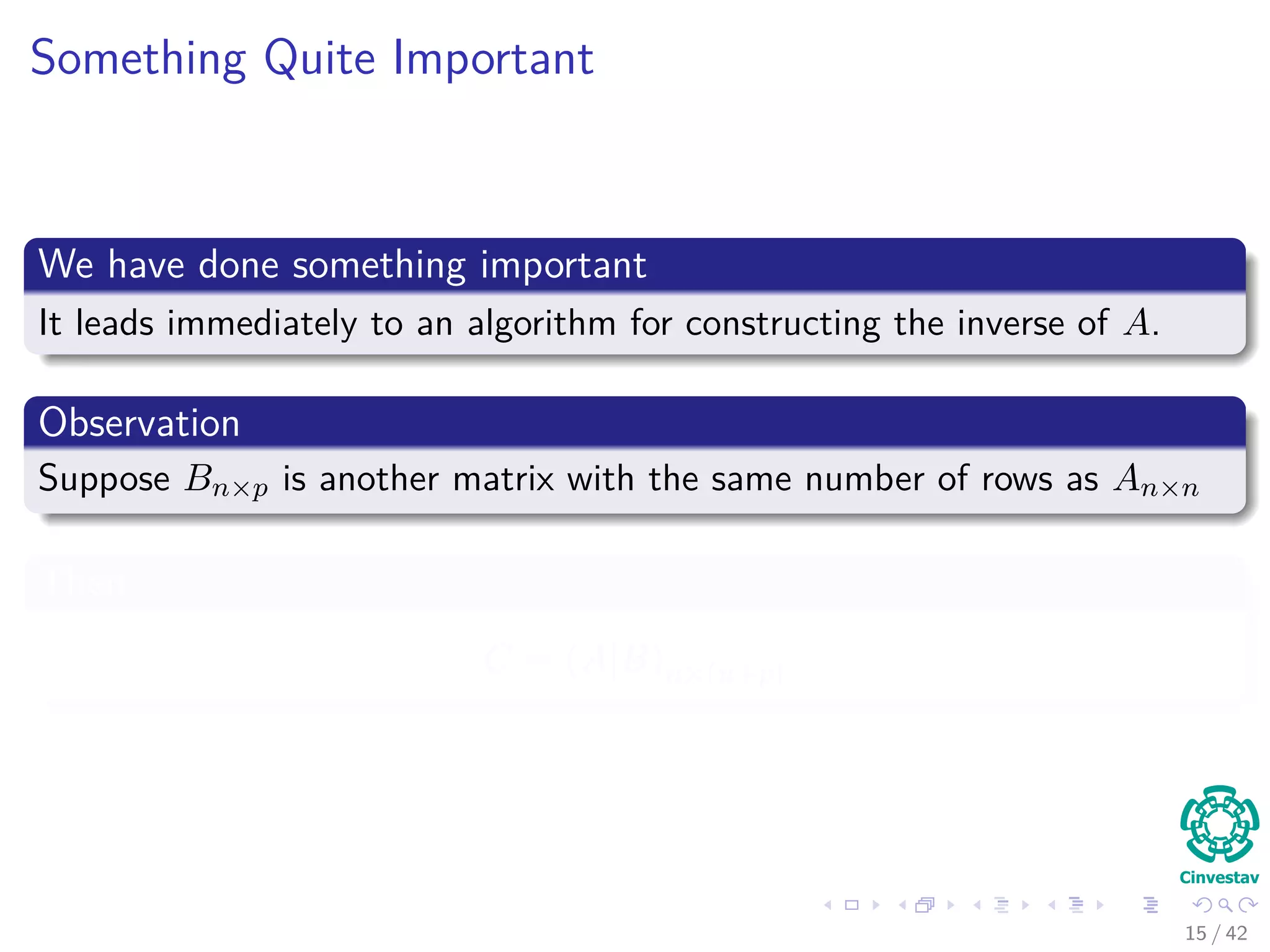
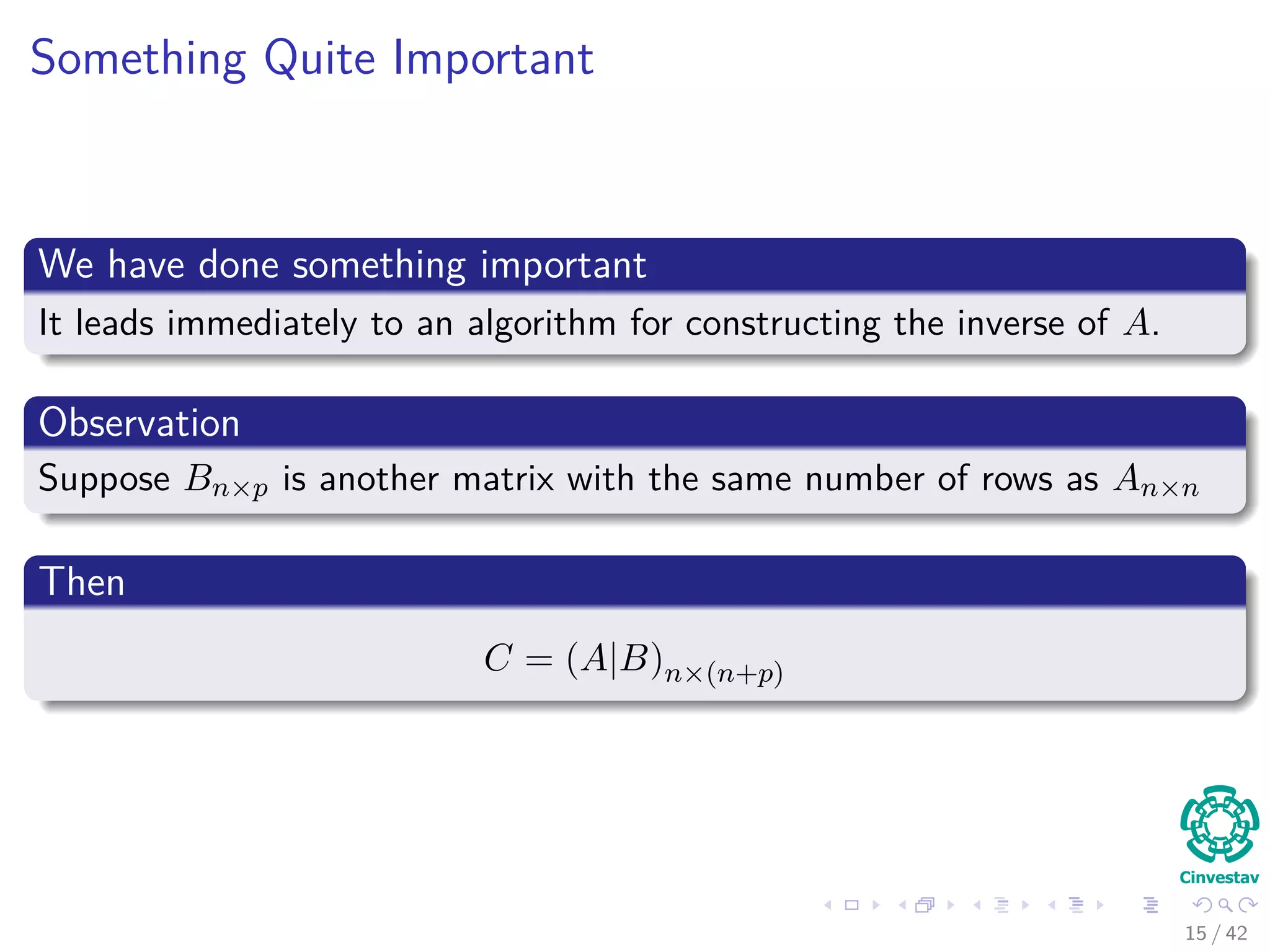
Something Quite Important
We have done something important
It leads immediately to an algorithm for constructing the inverse of A.
Observation
Suppose Bn×p is another matrix with the same number of rows as An×n
Then
C = (A|B)n×(n+p)
15 / 42
Something Quite Important
We have done something important
It leads immediately to an algorithm for constructing the inverse of A.
Observation
Suppose Bn×p is another matrix with the same number of rows as An×n
Then
C = (A|B)n×(n+p)
15 / 42
Something Quite Important
We have done something important
It leads immediately to an algorithm for constructing the inverse of A.
Observation
Suppose Bn×p is another matrix with the same number of rows as An×n
Then
C = (A|B)n×(n+p)
15 / 42
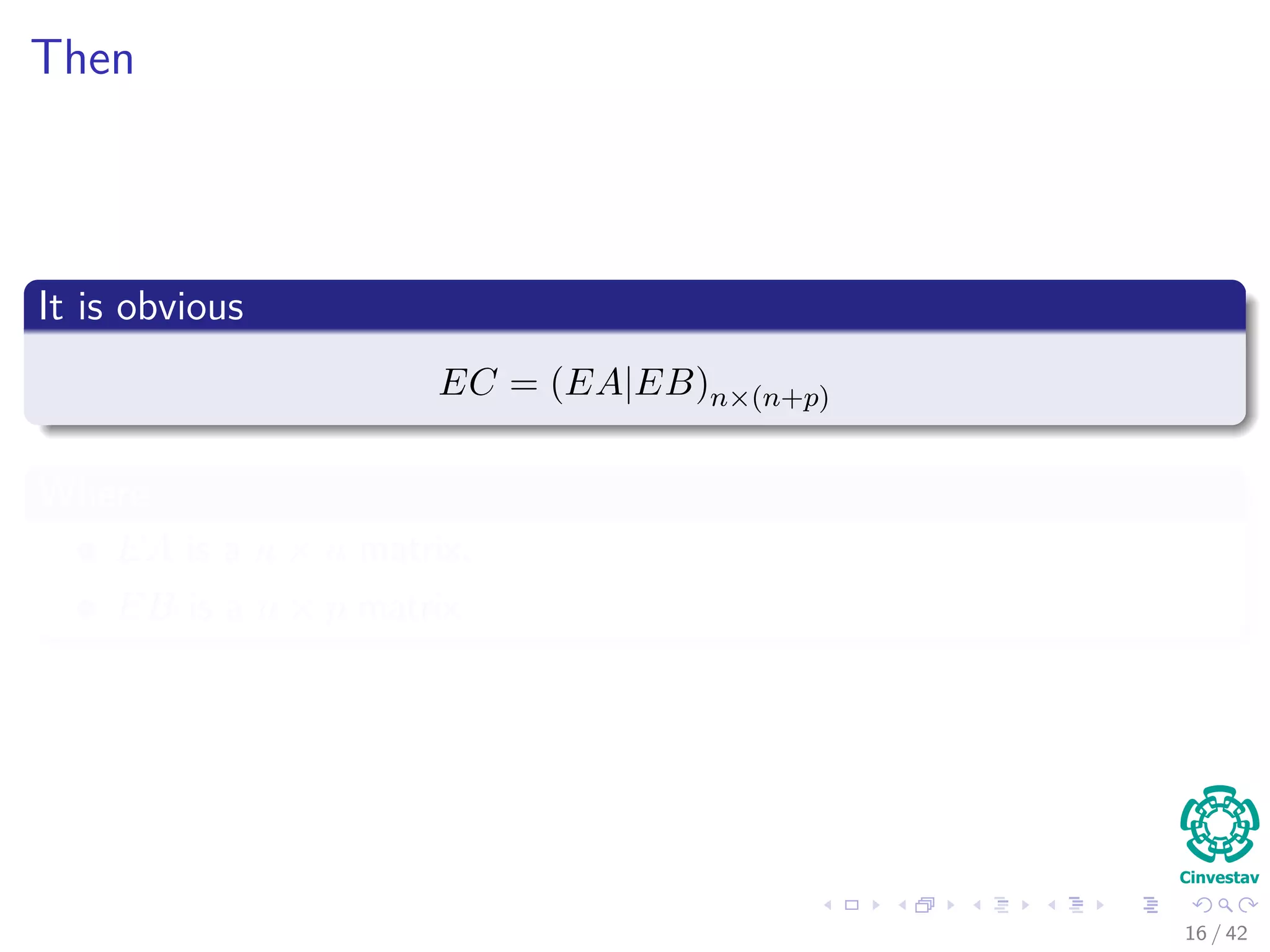
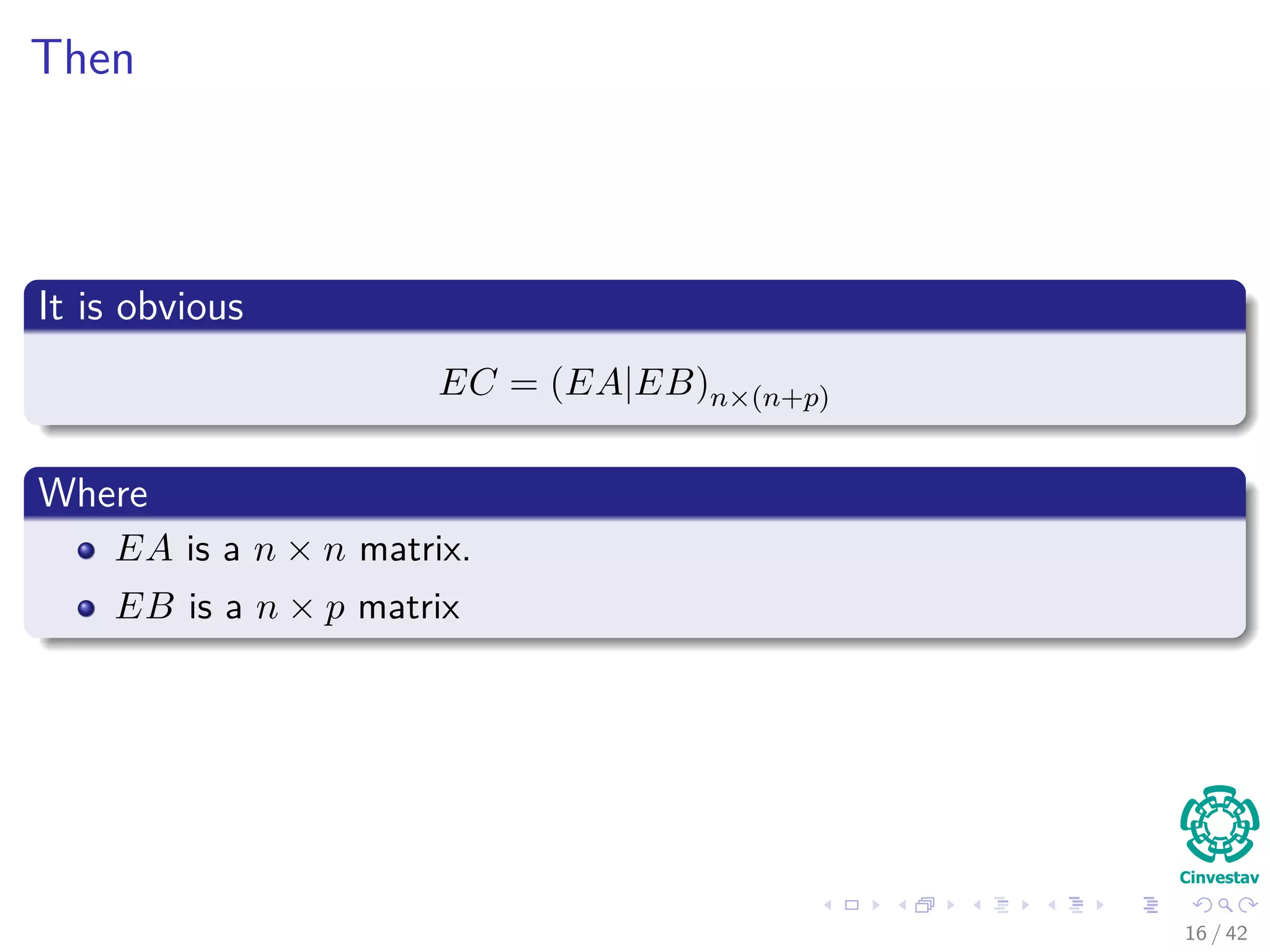
Then
It is obvious
EC = (EA|EB)n×(n+p)
Where
EA is a n × n matrix.
EB is a n × p matrix
16 / 42
Then
It is obvious
EC = (EA|EB)n×(n+p)
Where
EA is a n × n matrix.
EB is a n × p matrix
16 / 42
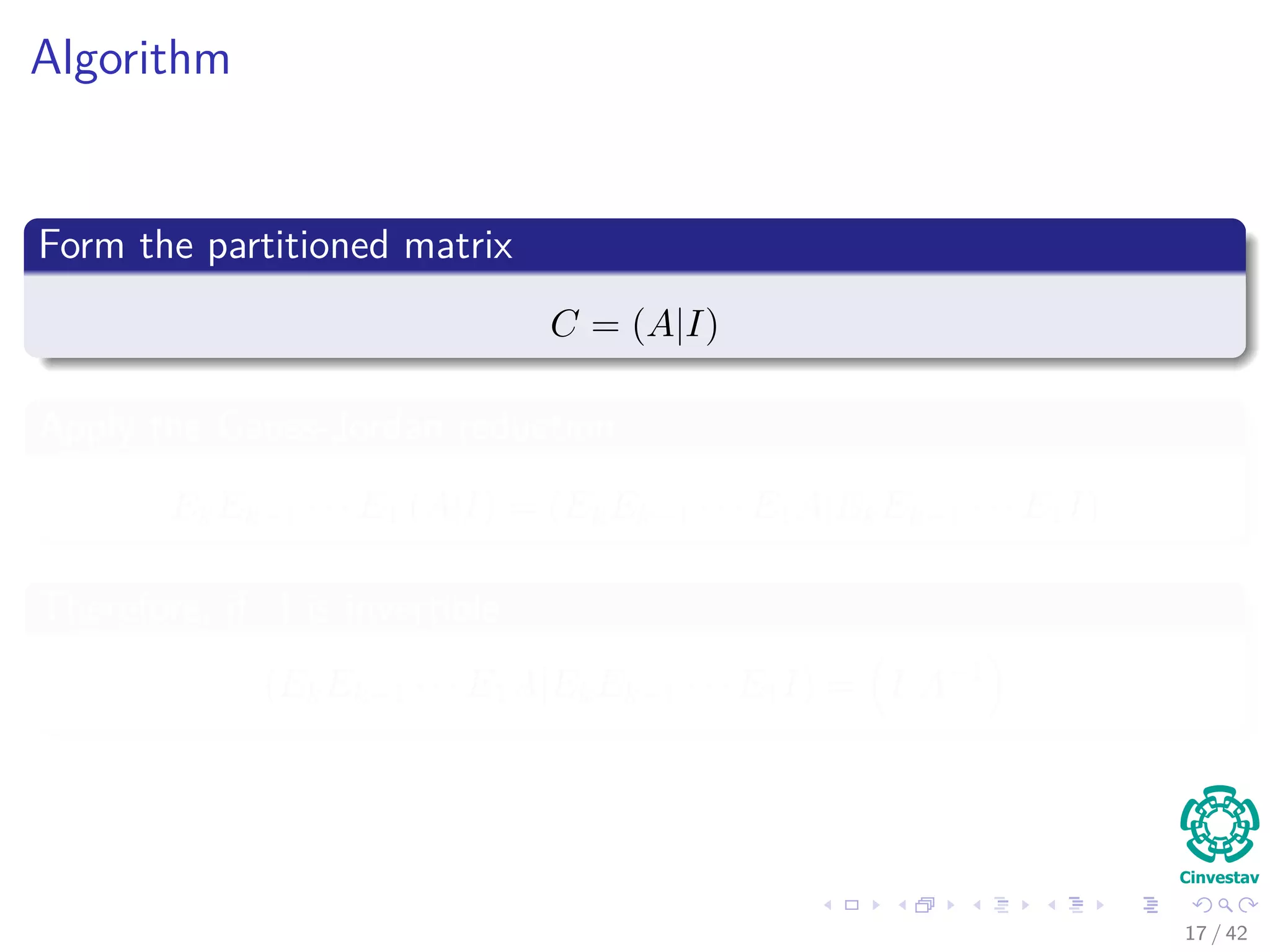
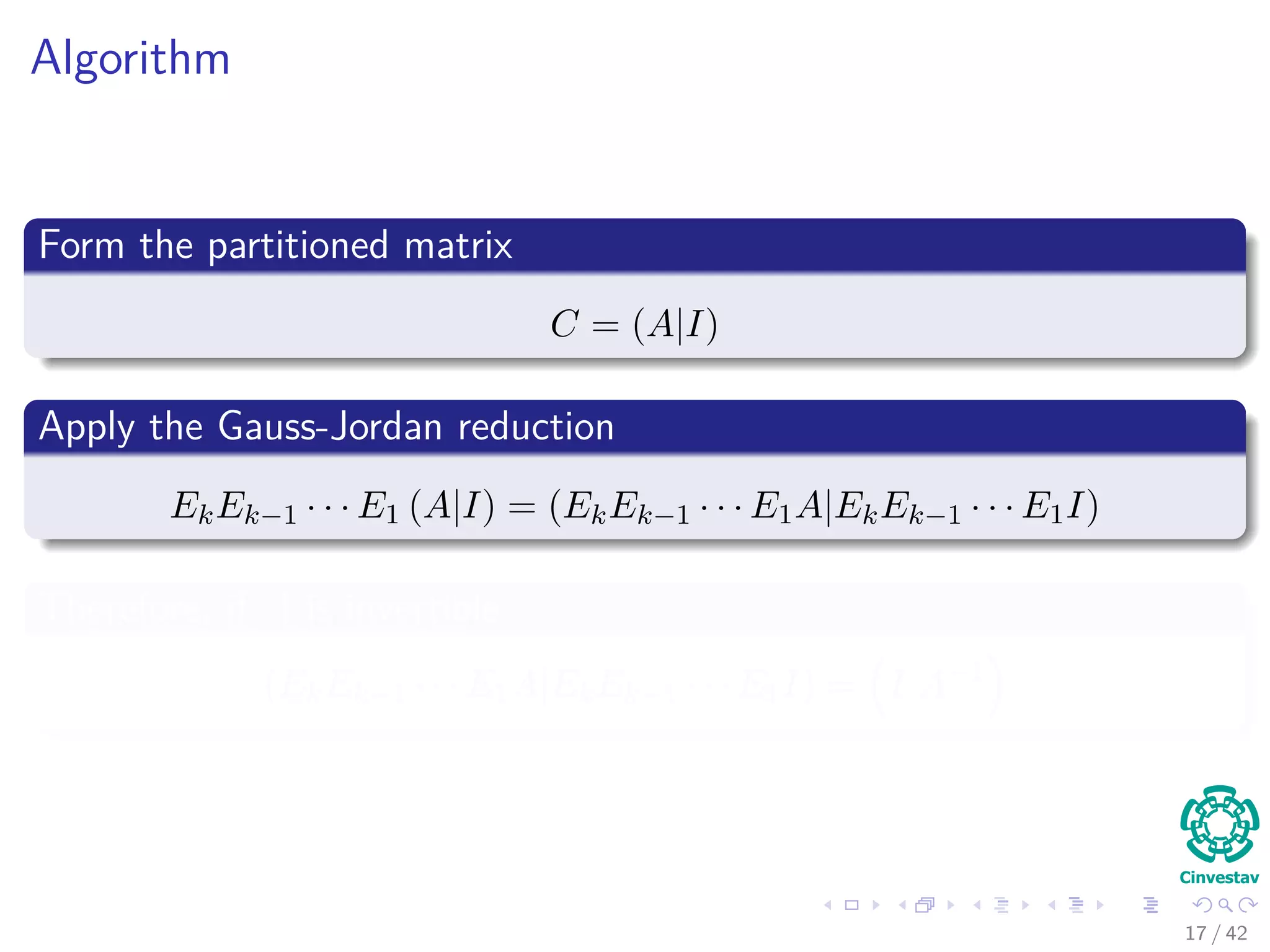
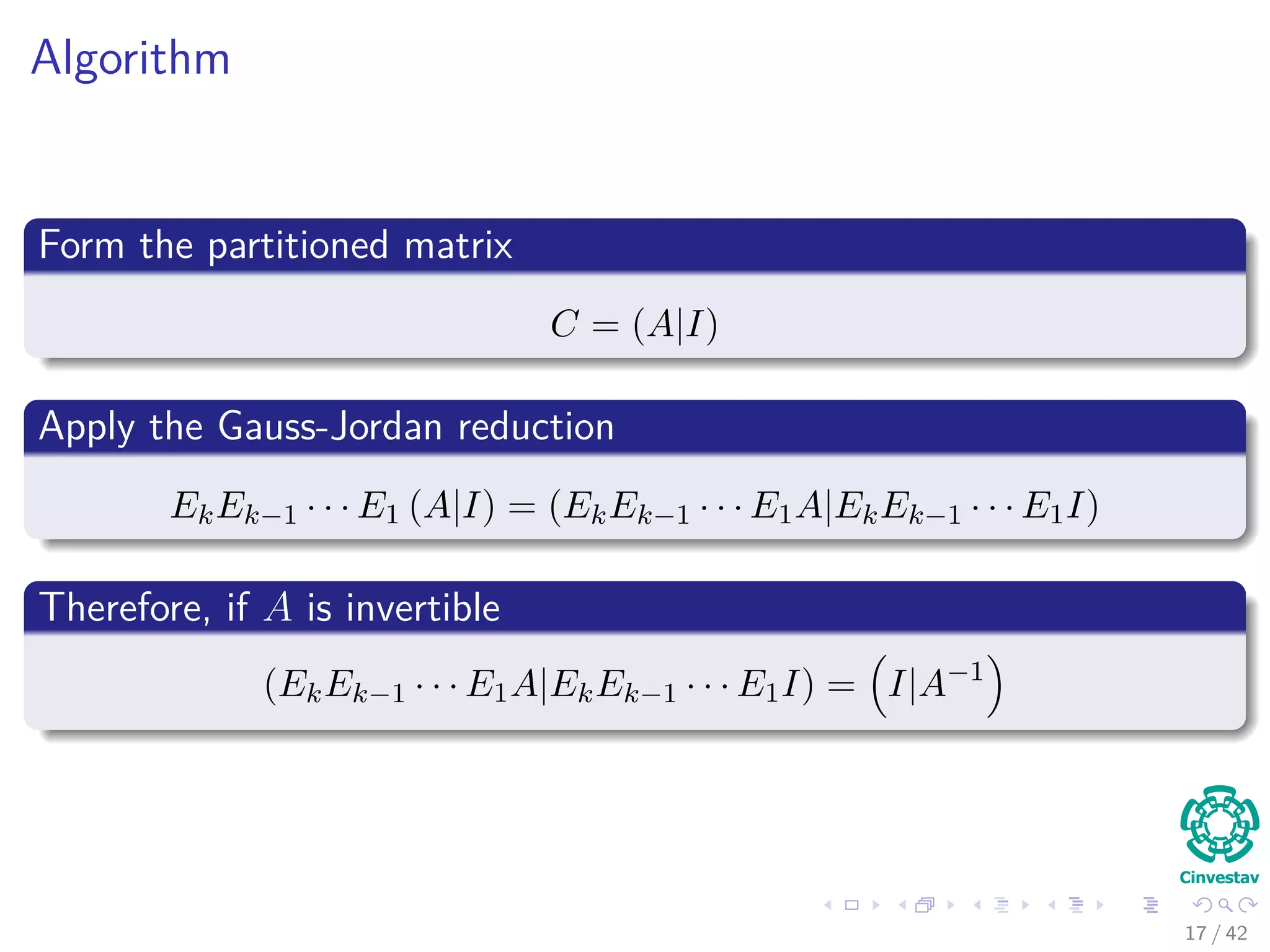
Algorithm
Form the partitioned matrix
C = (A|I)
Apply the Gauss-Jordan reduction
EkEk−1 · · · E1 (A|I) = (EkEk−1 · · · E1A|EkEk−1 · · · E1I)
Therefore, if A is invertible
(EkEk−1 · · · E1A|EkEk−1 · · · E1I) = I|A−1
17 / 42
Algorithm
Form the partitioned matrix
C = (A|I)
Apply the Gauss-Jordan reduction
EkEk−1 · · · E1 (A|I) = (EkEk−1 · · · E1A|EkEk−1 · · · E1I)
Therefore, if A is invertible
(EkEk−1 · · · E1A|EkEk−1 · · · E1I) = I|A−1
17 / 42
Algorithm
Form the partitioned matrix
C = (A|I)
Apply the Gauss-Jordan reduction
EkEk−1 · · · E1 (A|I) = (EkEk−1 · · · E1A|EkEk−1 · · · E1I)
Therefore, if A is invertible
(EkEk−1 · · · E1A|EkEk−1 · · · E1I) = I|A−1
17 / 42
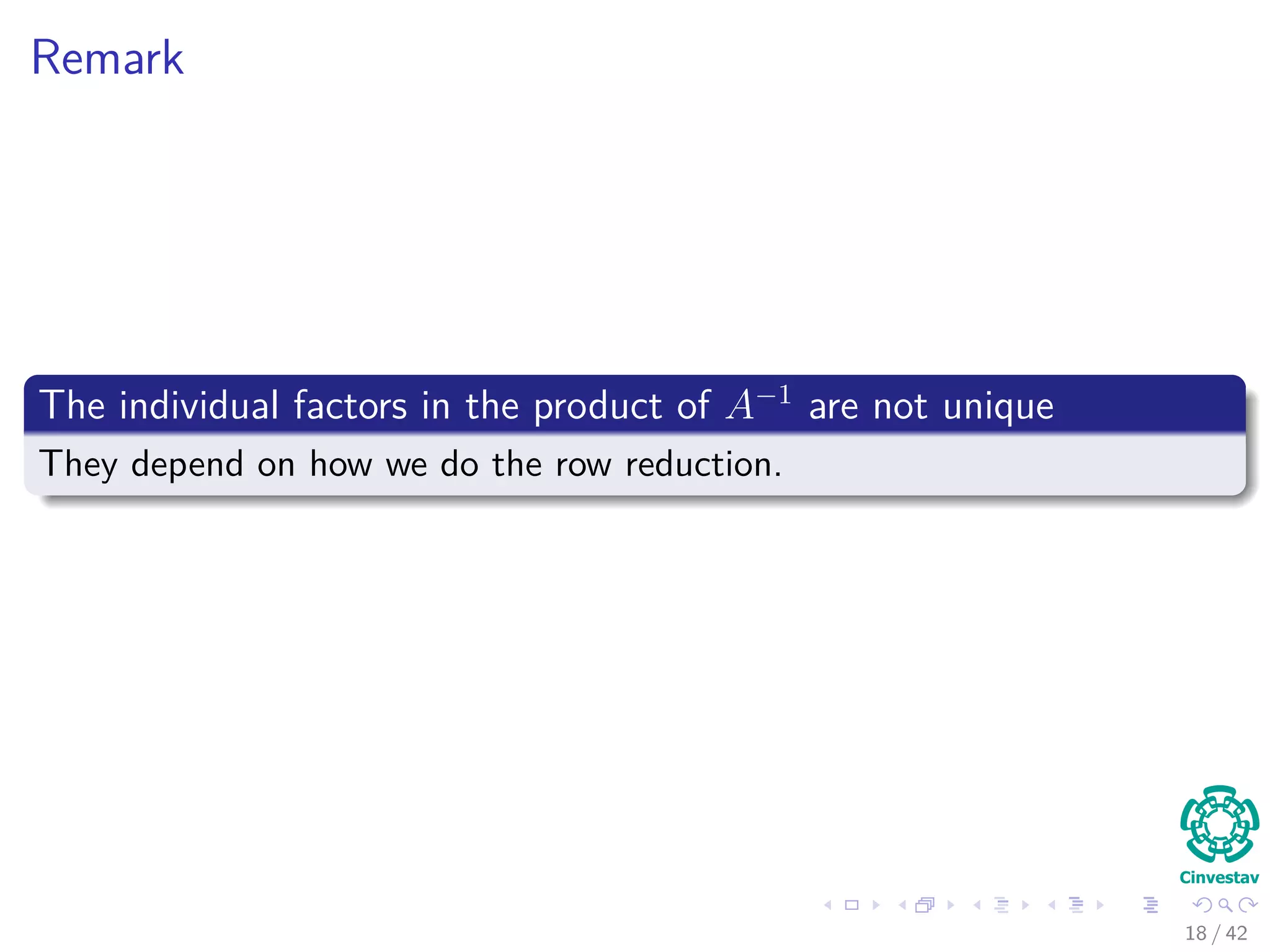
Remark
The individual factors in the product of A−1
are not unique
They depend on how we do the row reduction.
18 / 42
Outline
1 Square Matrices
Introduction
The Inverse
Solution to Ax = y
Algorithm for the Inverse of a Matrix
2 Determinants
Introduction
Complexity Increases
Reducing the Complexity
Some Consequences of the definition
Special Determinants
19 / 42
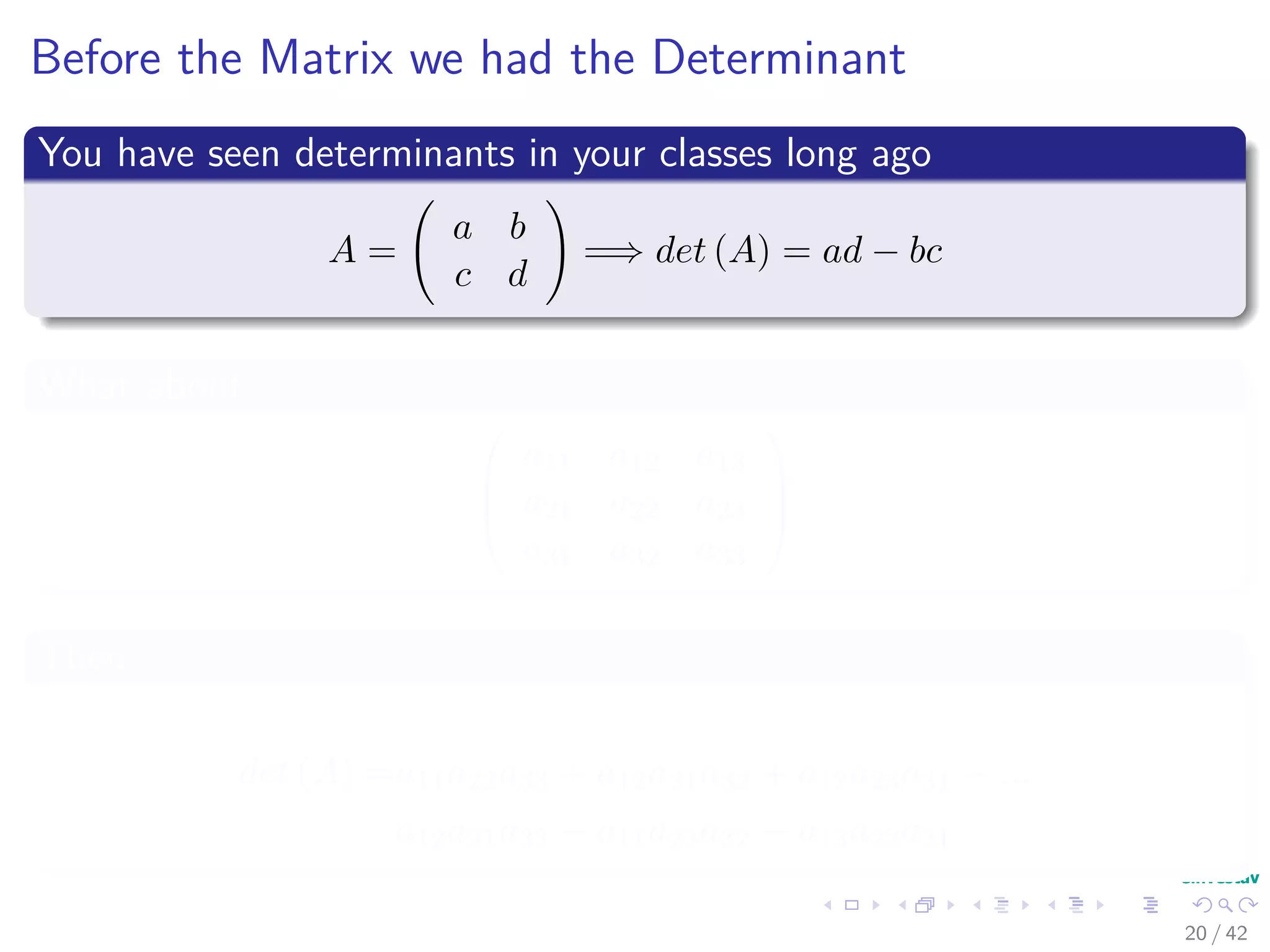
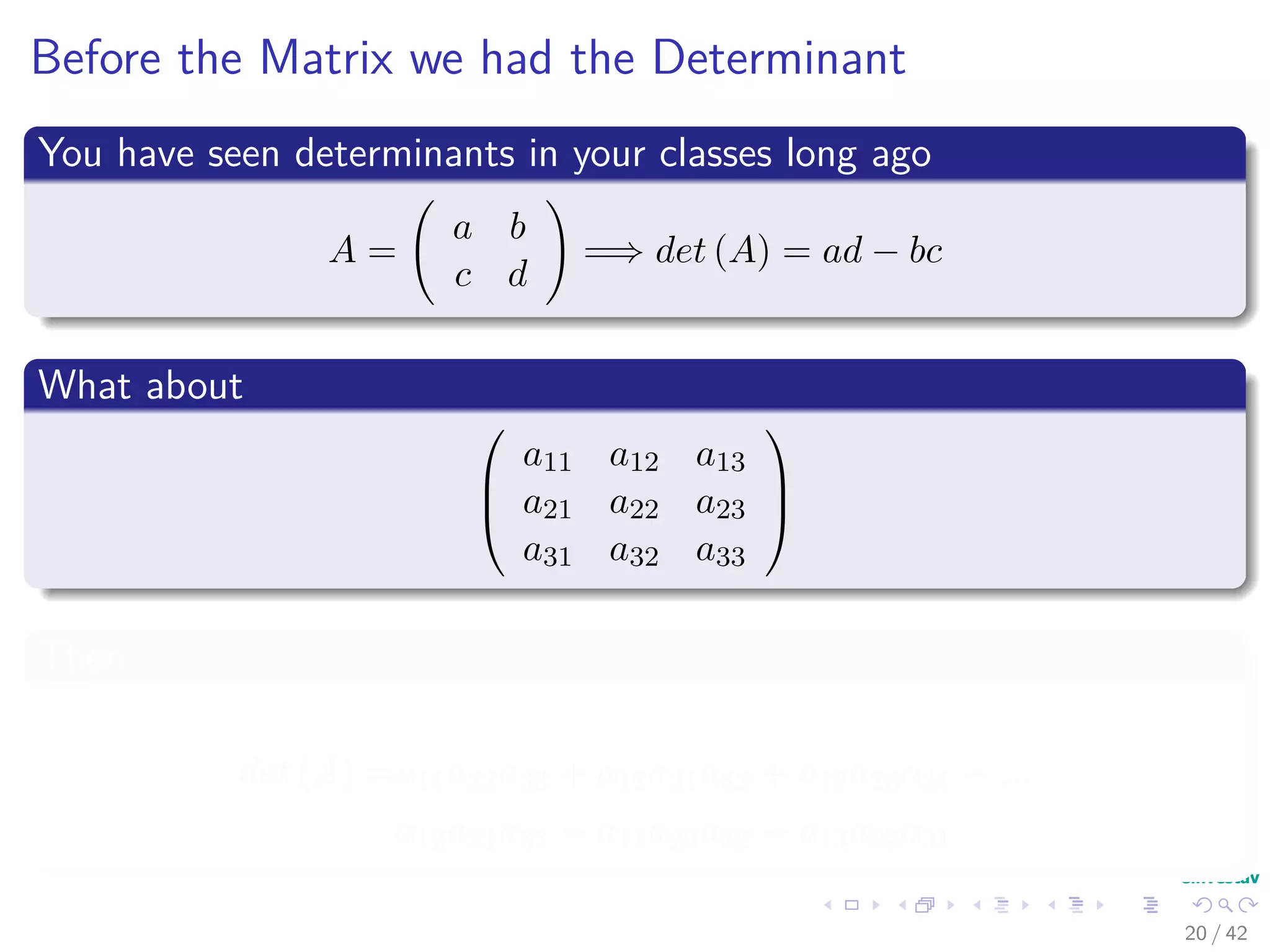
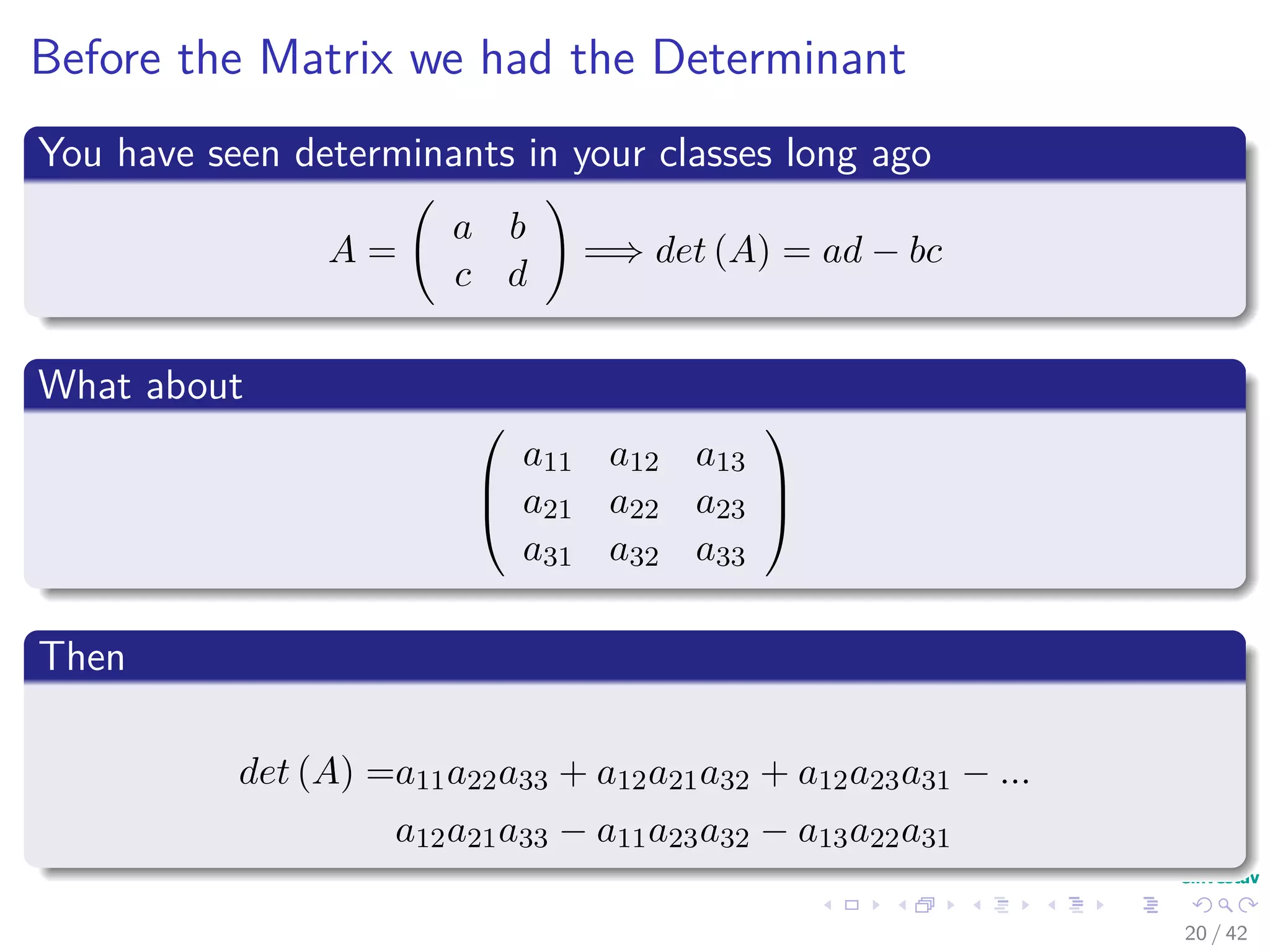
Before the Matrix we had the Determinant
You have seen determinants in your classes long ago
A =
a b
c d
=⇒ det (A) = ad − bc
What about



a11 a12 a13
a21 a22 a23
a31 a32 a33



Then
det (A) =a11a22a33 + a12a21a32 + a12a23a31 − ...
a12a21a33 − a11a23a32 − a13a22a31
20 / 42
Before the Matrix we had the Determinant
You have seen determinants in your classes long ago
A =
a b
c d
=⇒ det (A) = ad − bc
What about



a11 a12 a13
a21 a22 a23
a31 a32 a33



Then
det (A) =a11a22a33 + a12a21a32 + a12a23a31 − ...
a12a21a33 − a11a23a32 − a13a22a31
20 / 42
Before the Matrix we had the Determinant
You have seen determinants in your classes long ago
A =
a b
c d
=⇒ det (A) = ad − bc
What about



a11 a12 a13
a21 a22 a23
a31 a32 a33



Then
det (A) =a11a22a33 + a12a21a32 + a12a23a31 − ...
a12a21a33 − a11a23a32 − a13a22a31
20 / 42
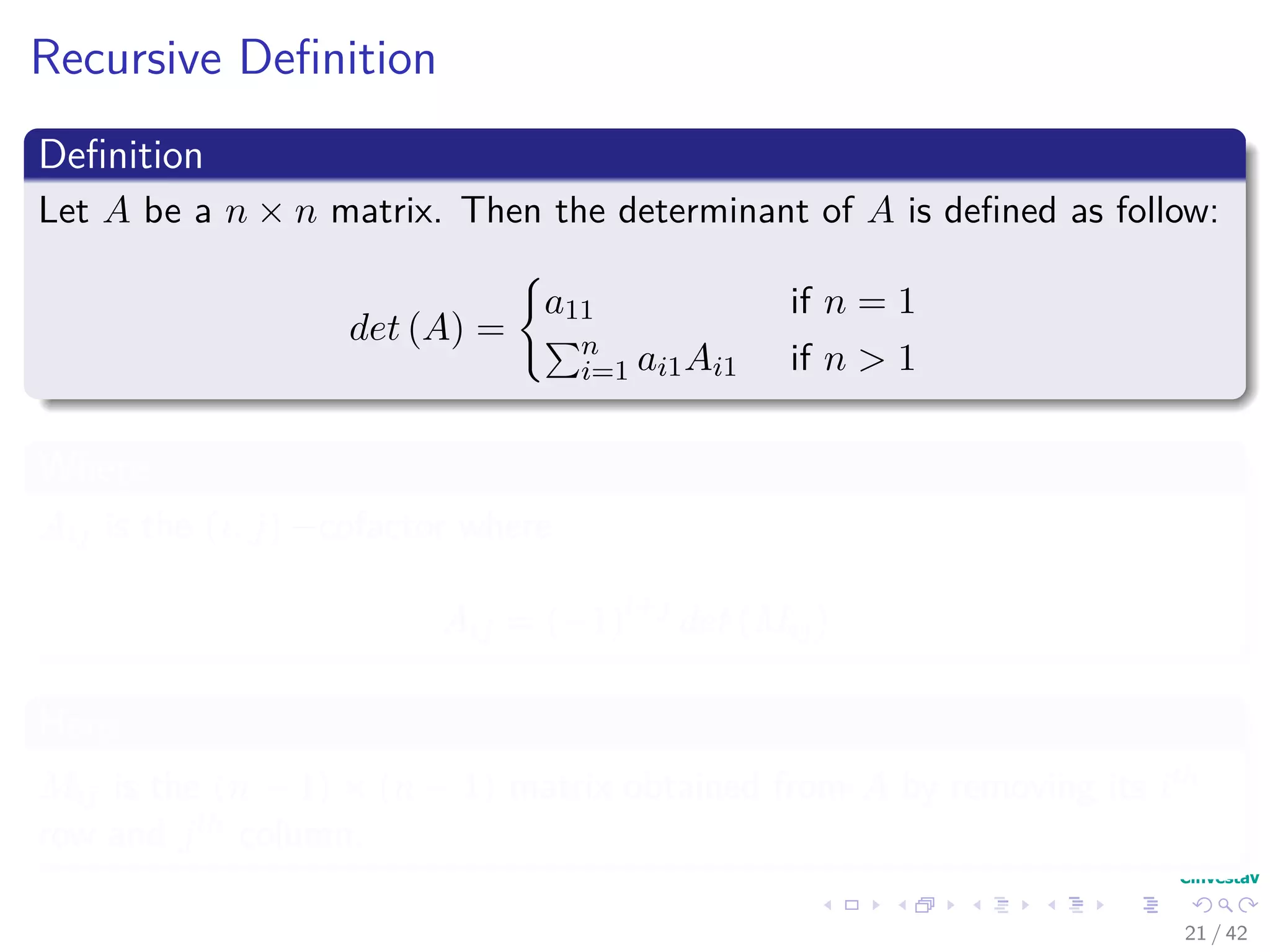
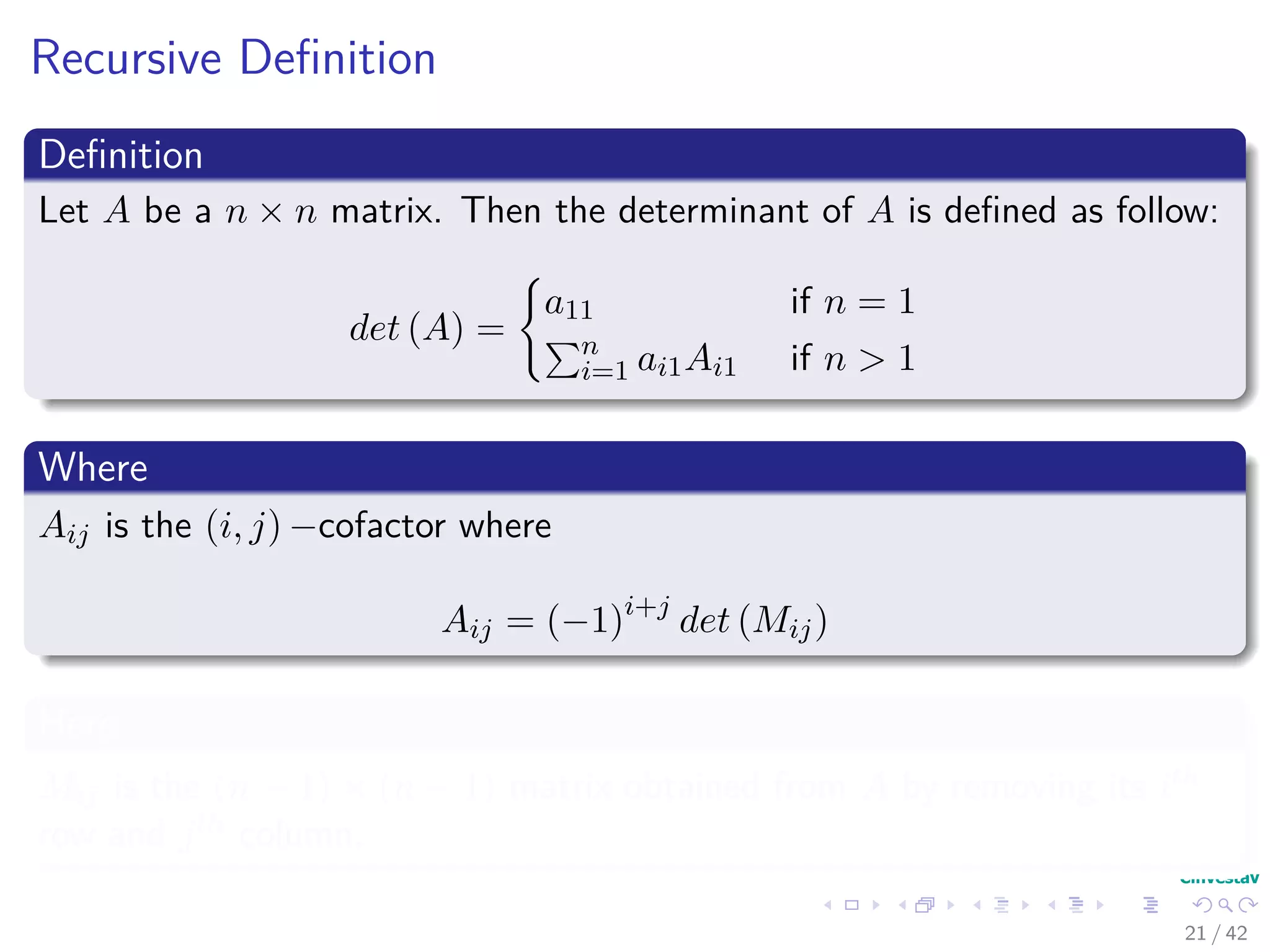
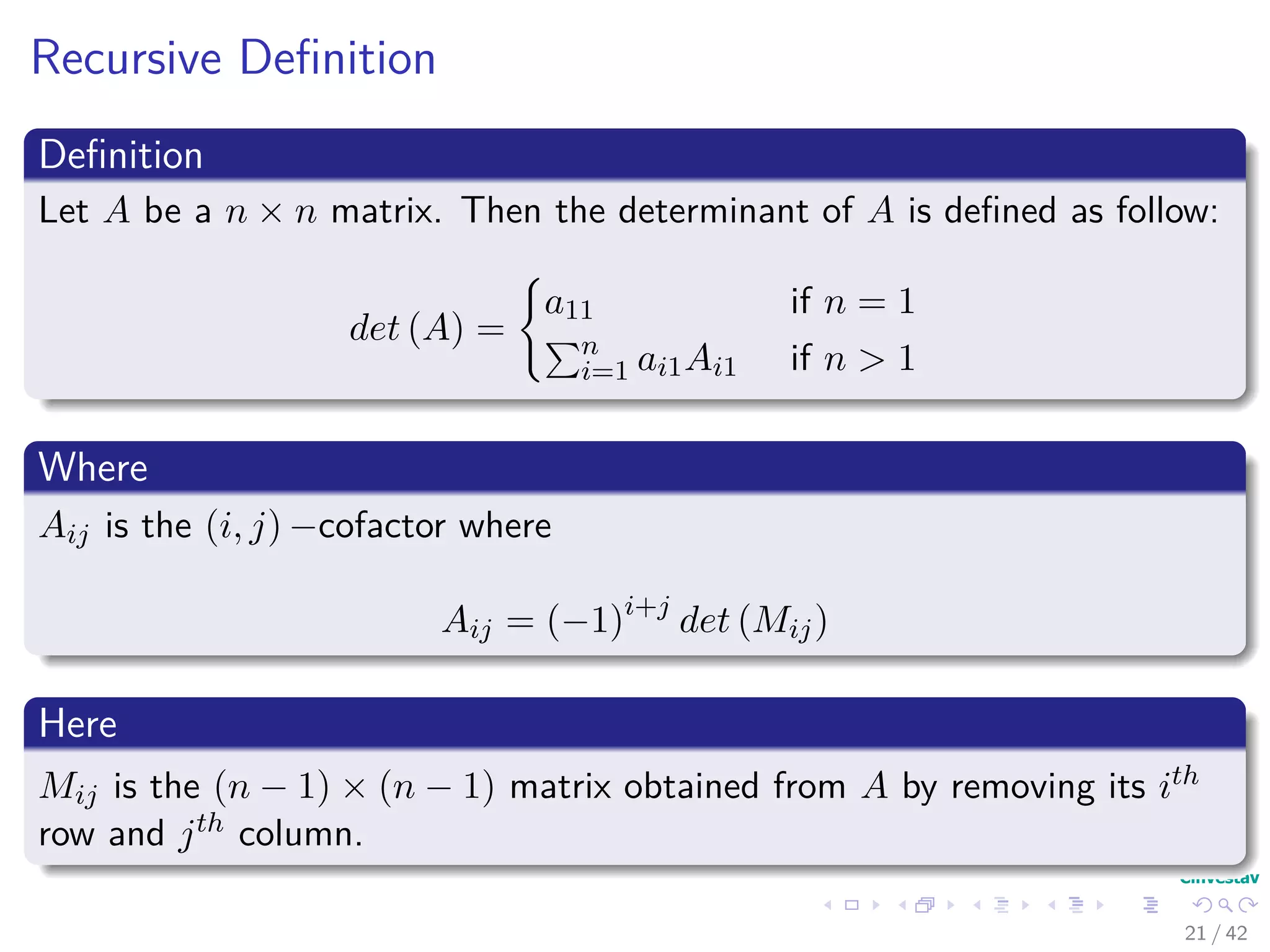
Recursive Definition
Definition
Let A be a n × n matrix. Then the determinant of A is defined as follow:
det (A) =
a11 if n = 1
n
i=1 ai1Ai1 if n > 1
Where
Aij is the (i, j) −cofactor where
Aij = (−1)i+j
det (Mij)
Here
Mij is the (n − 1) × (n − 1) matrix obtained from A by removing its ith
row and jth column.
21 / 42
Recursive Definition
Definition
Let A be a n × n matrix. Then the determinant of A is defined as follow:
det (A) =
a11 if n = 1
n
i=1 ai1Ai1 if n > 1
Where
Aij is the (i, j) −cofactor where
Aij = (−1)i+j
det (Mij)
Here
Mij is the (n − 1) × (n − 1) matrix obtained from A by removing its ith
row and jth column.
21 / 42
Recursive Definition
Definition
Let A be a n × n matrix. Then the determinant of A is defined as follow:
det (A) =
a11 if n = 1
n
i=1 ai1Ai1 if n > 1
Where
Aij is the (i, j) −cofactor where
Aij = (−1)i+j
det (Mij)
Here
Mij is the (n − 1) × (n − 1) matrix obtained from A by removing its ith
row and jth column.
21 / 42
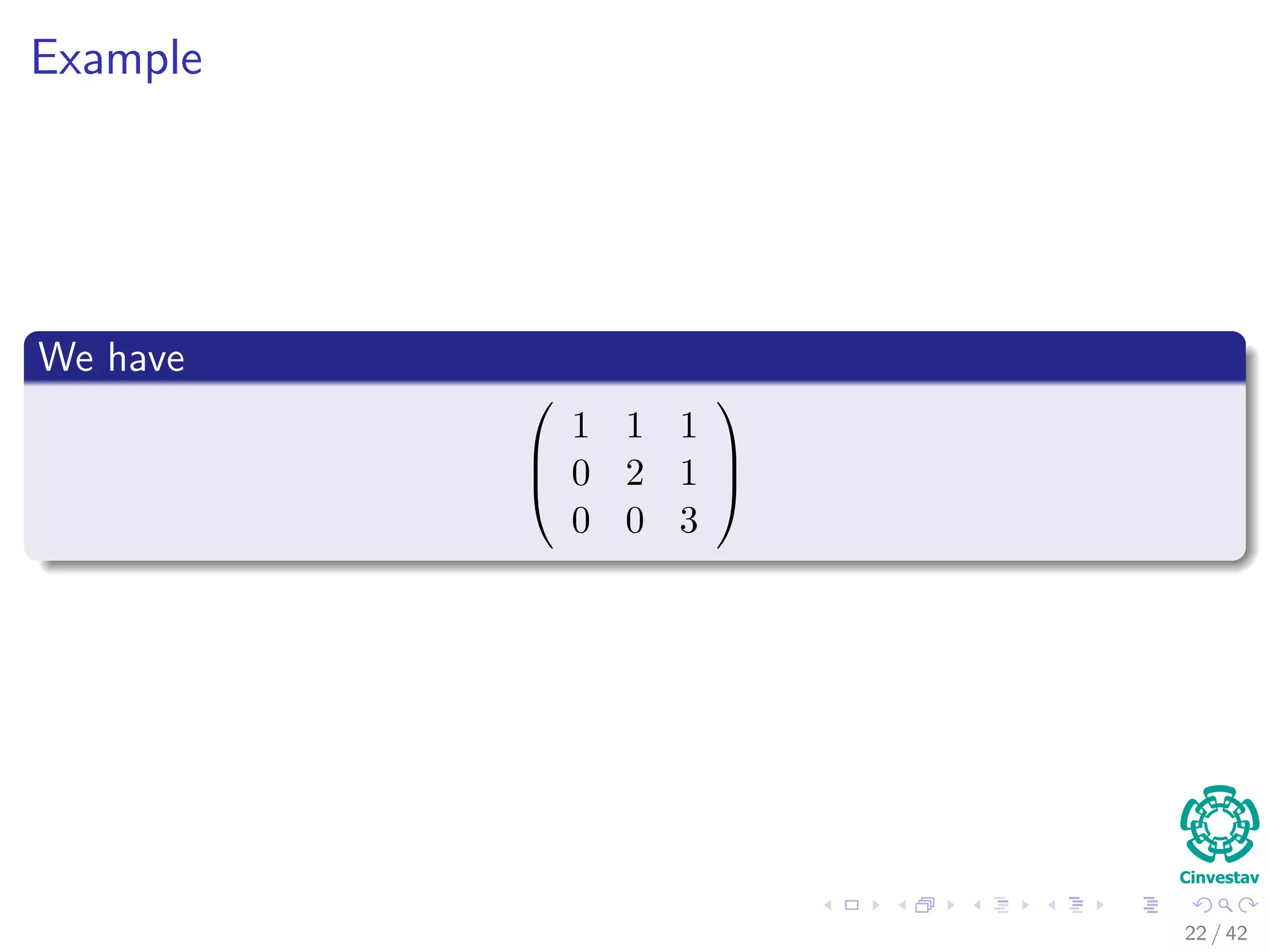
Example
We have



1 1 1
0 2 1
0 0 3



22 / 42
Outline
1 Square Matrices
Introduction
The Inverse
Solution to Ax = y
Algorithm for the Inverse of a Matrix
2 Determinants
Introduction
Complexity Increases
Reducing the Complexity
Some Consequences of the definition
Special Determinants
23 / 42
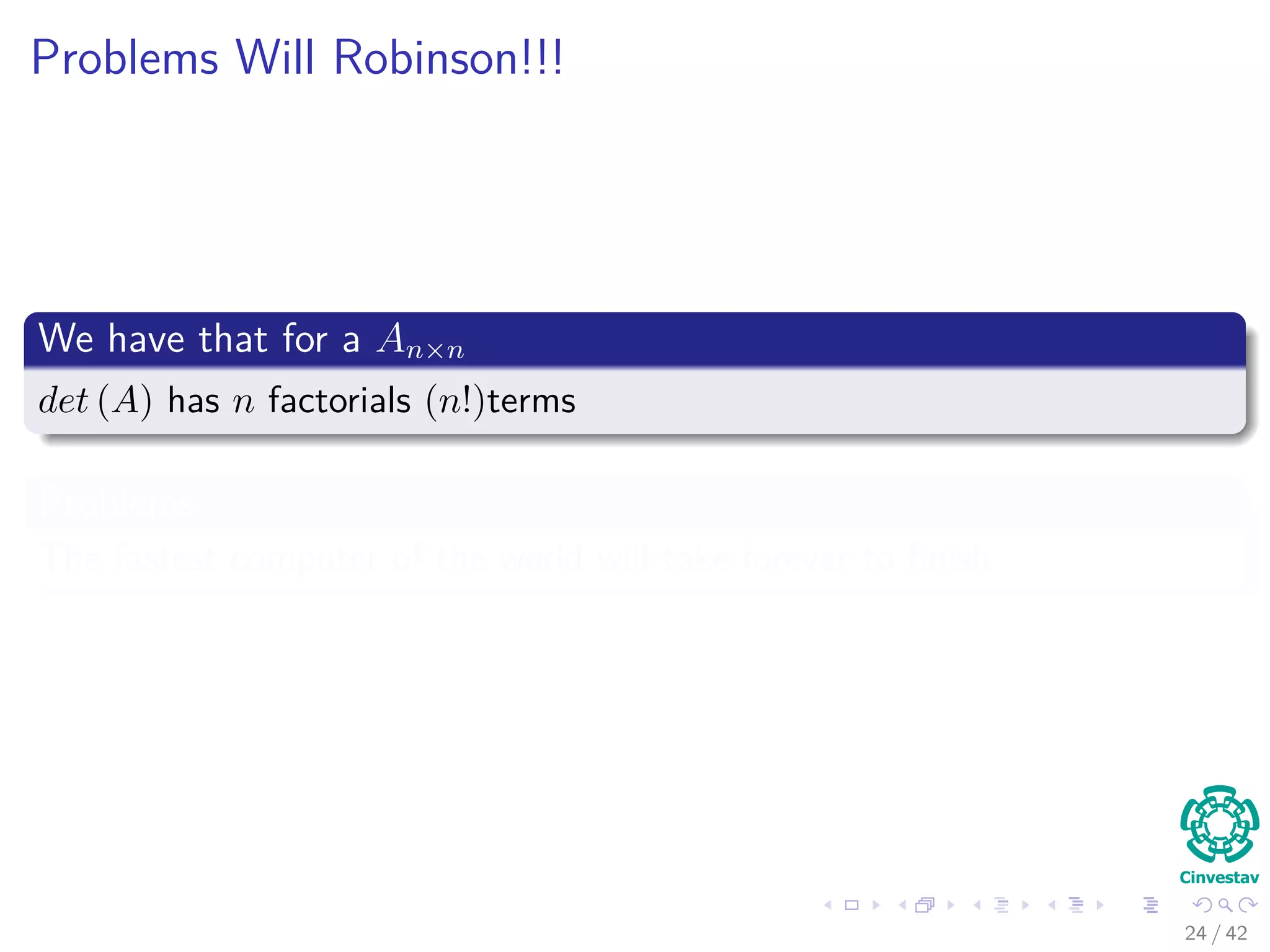
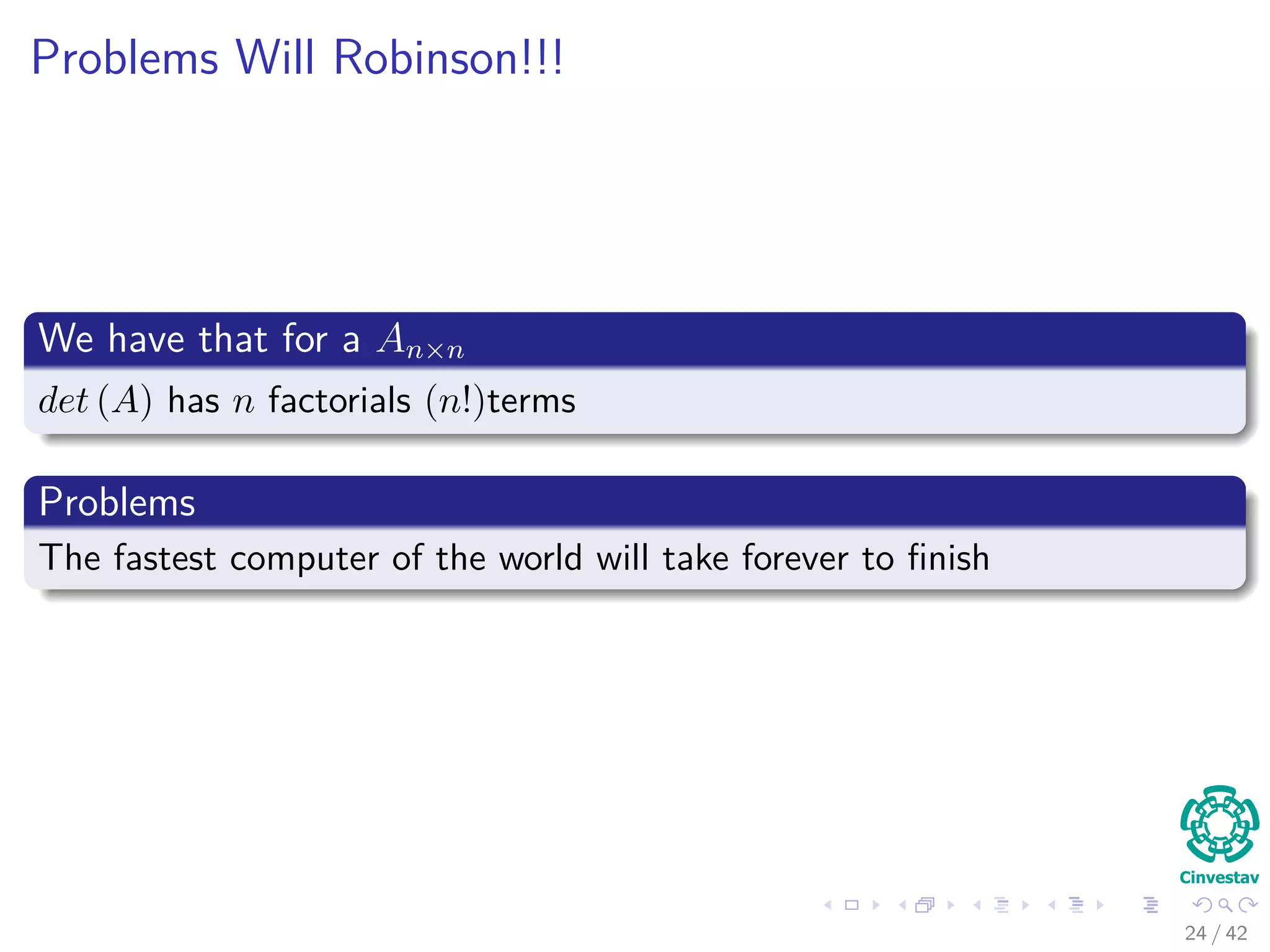
Problems Will Robinson!!!
We have that for a An×n
det (A) has n factorials (n!)terms
Problems
The fastest computer of the world will take forever to finish
24 / 42
Problems Will Robinson!!!
We have that for a An×n
det (A) has n factorials (n!)terms
Problems
The fastest computer of the world will take forever to finish
24 / 42
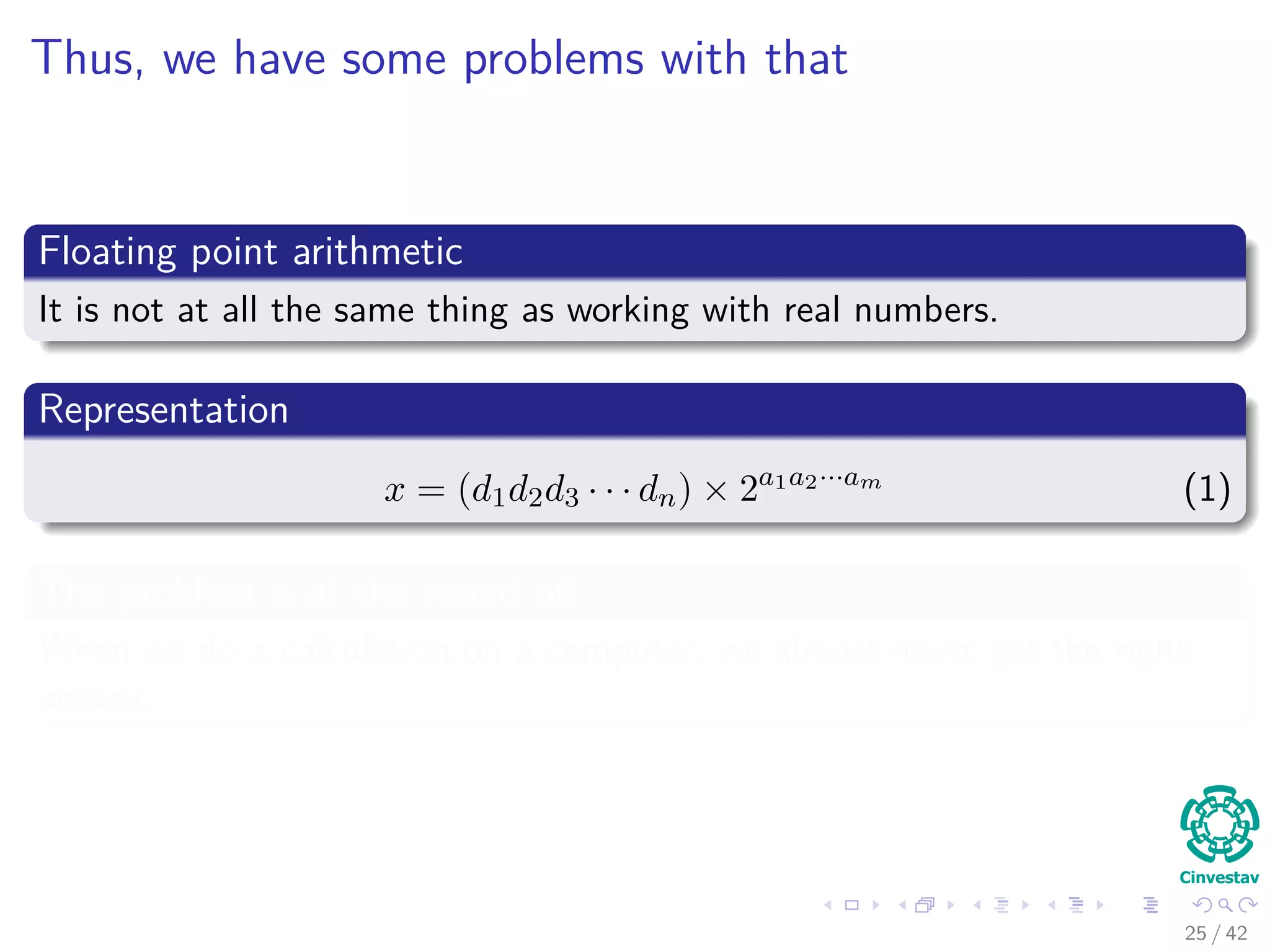
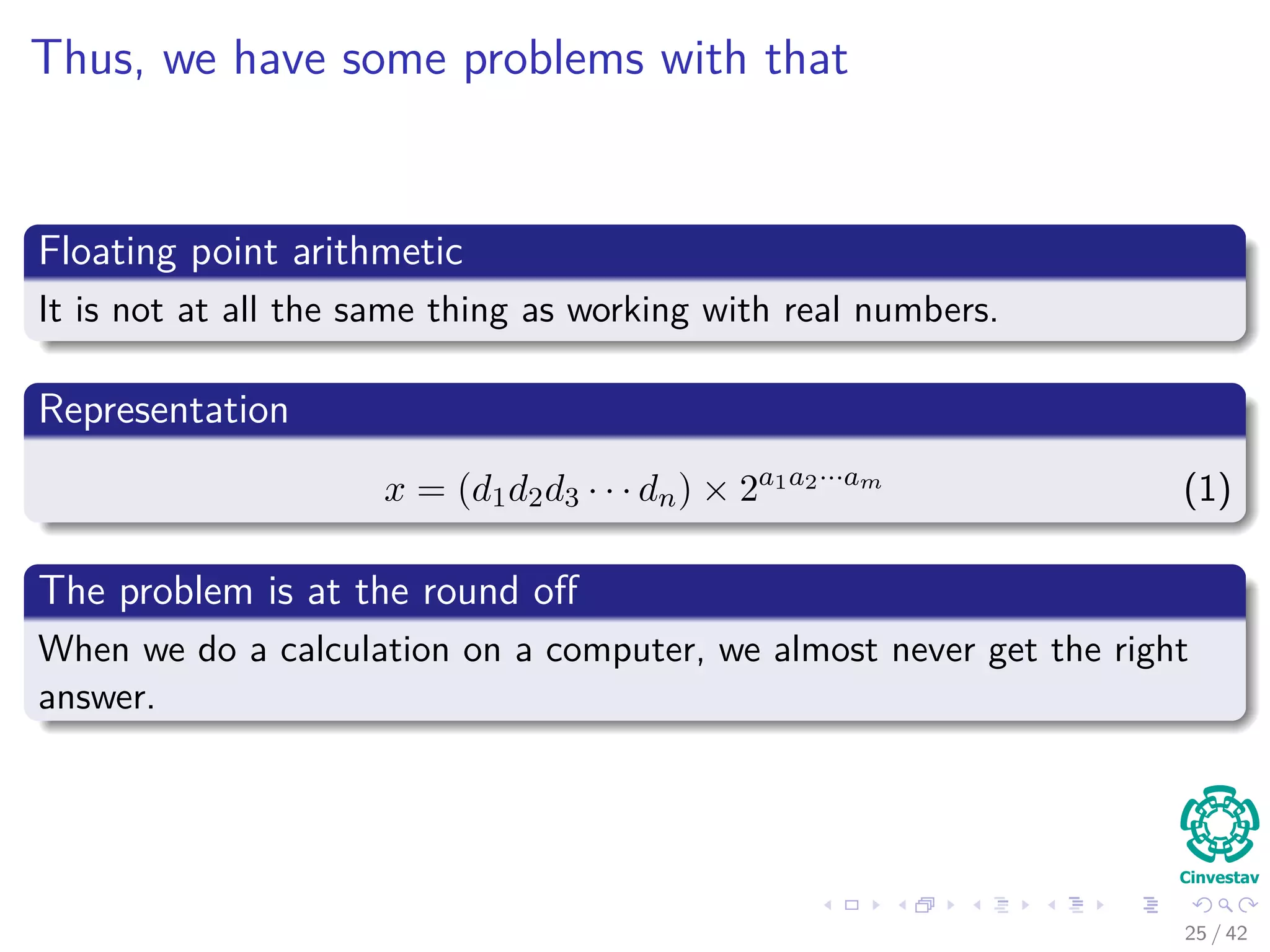
Thus, we have some problems with that
Floating point arithmetic
It is not at all the same thing as working with real numbers.
Representation
x = (d1d2d3 · · · dn) × 2a1a2···am
(1)
The problem is at the round off
When we do a calculation on a computer, we almost never get the right
answer.
25 / 42
Thus, we have some problems with that
Floating point arithmetic
It is not at all the same thing as working with real numbers.
Representation
x = (d1d2d3 · · · dn) × 2a1a2···am
(1)
The problem is at the round off
When we do a calculation on a computer, we almost never get the right
answer.
25 / 42
Thus, we have some problems with that
Floating point arithmetic
It is not at all the same thing as working with real numbers.
Representation
x = (d1d2d3 · · · dn) × 2a1a2···am
(1)
The problem is at the round off
When we do a calculation on a computer, we almost never get the right
answer.
25 / 42
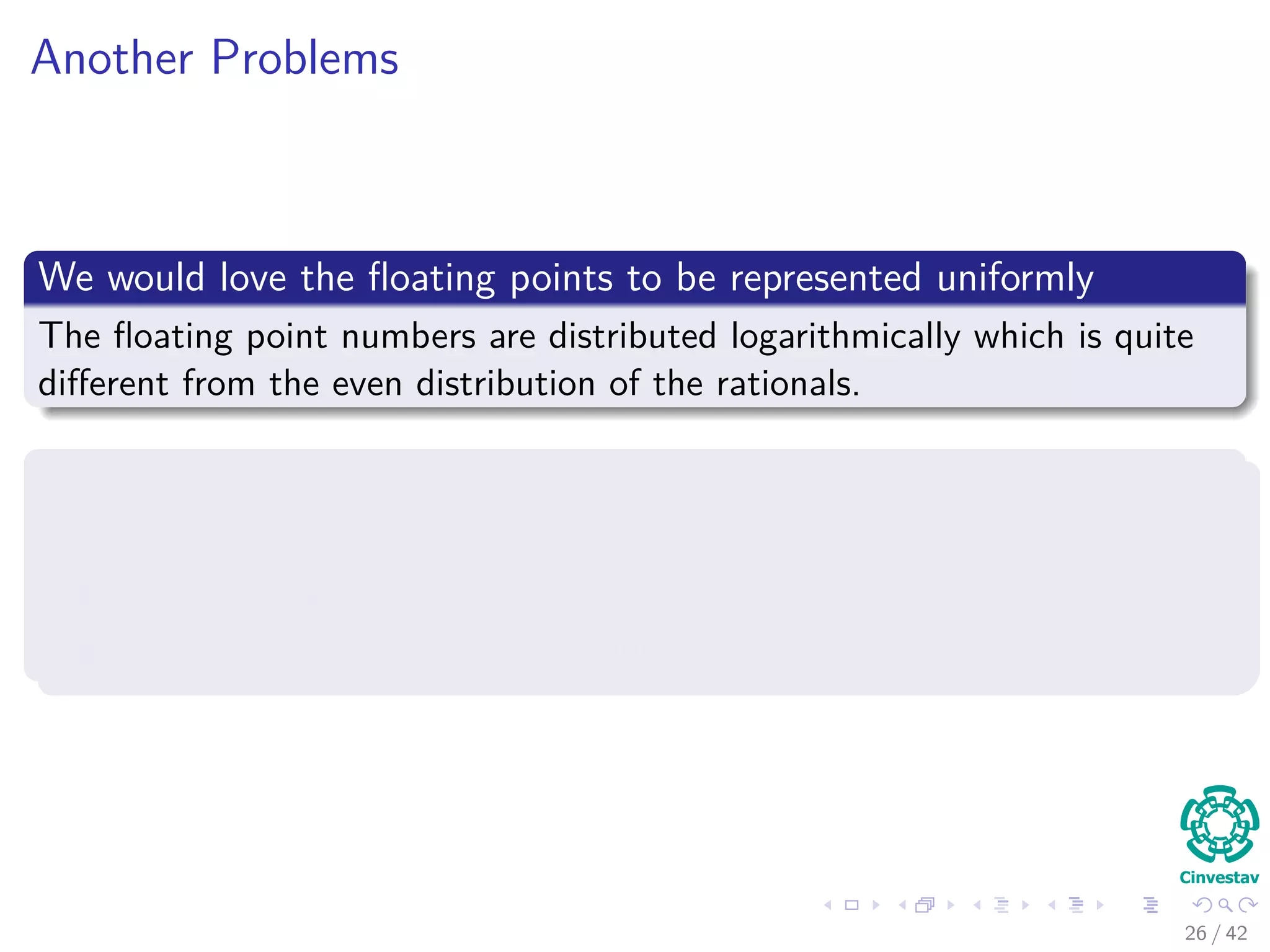
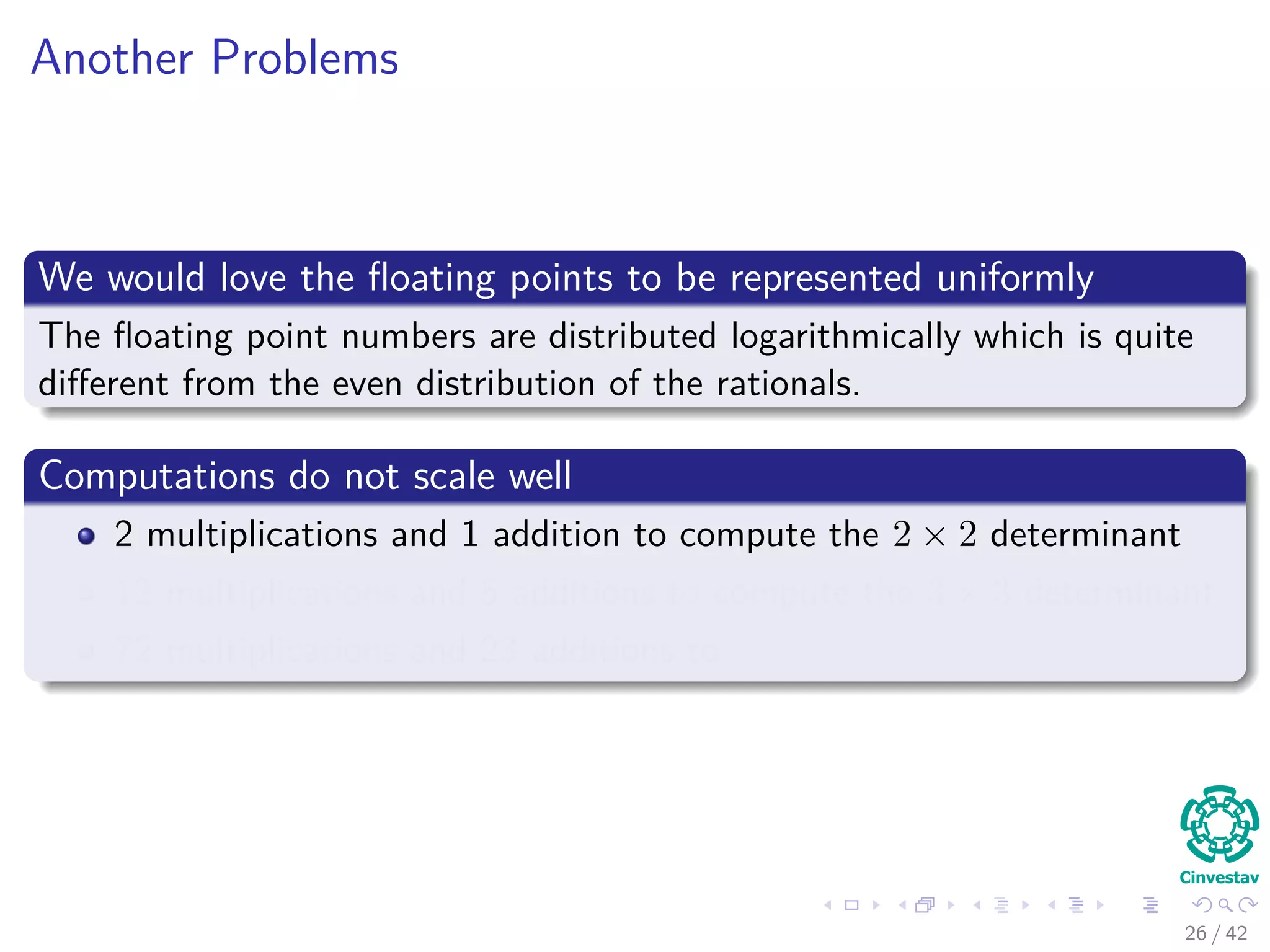
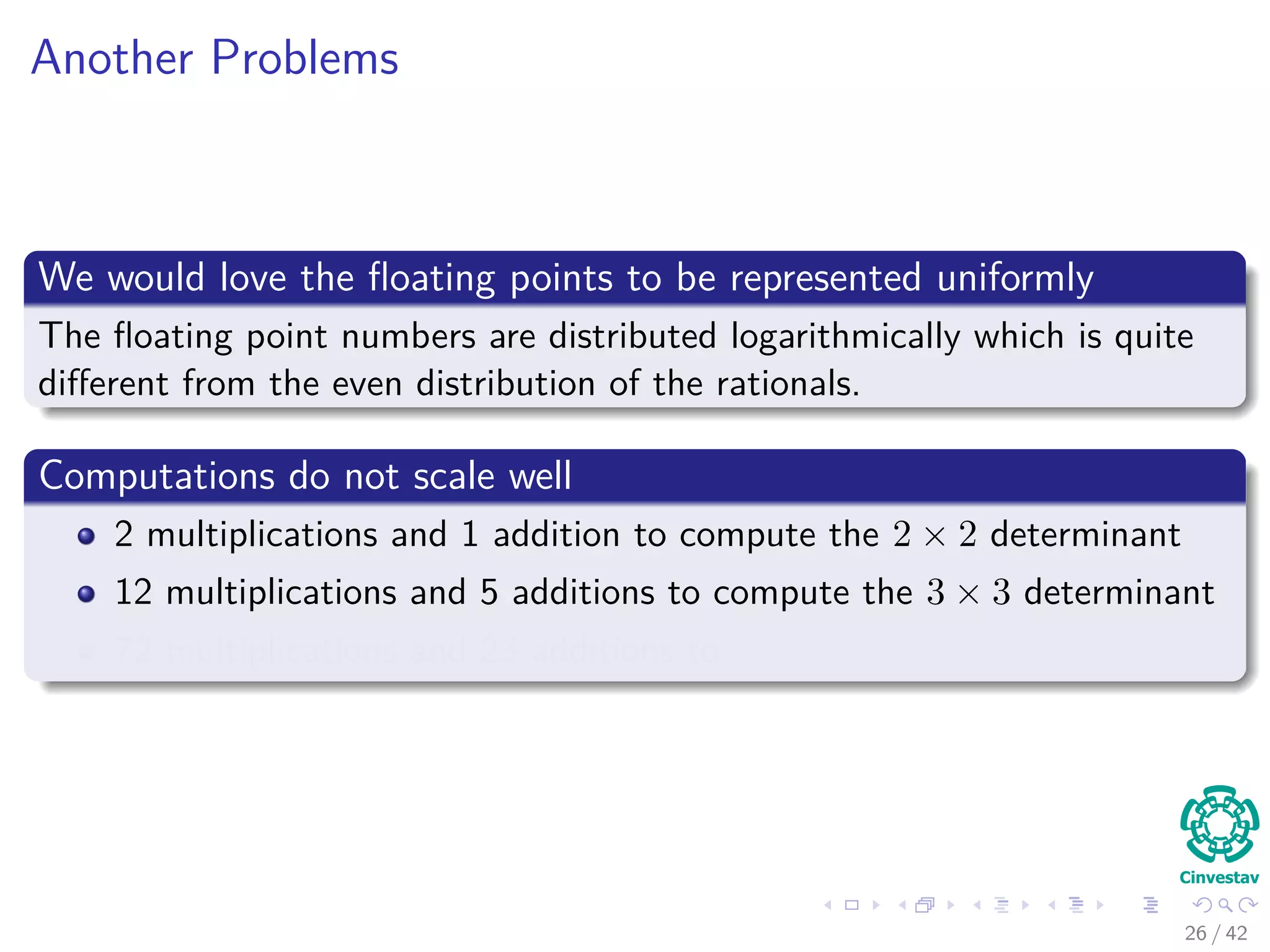
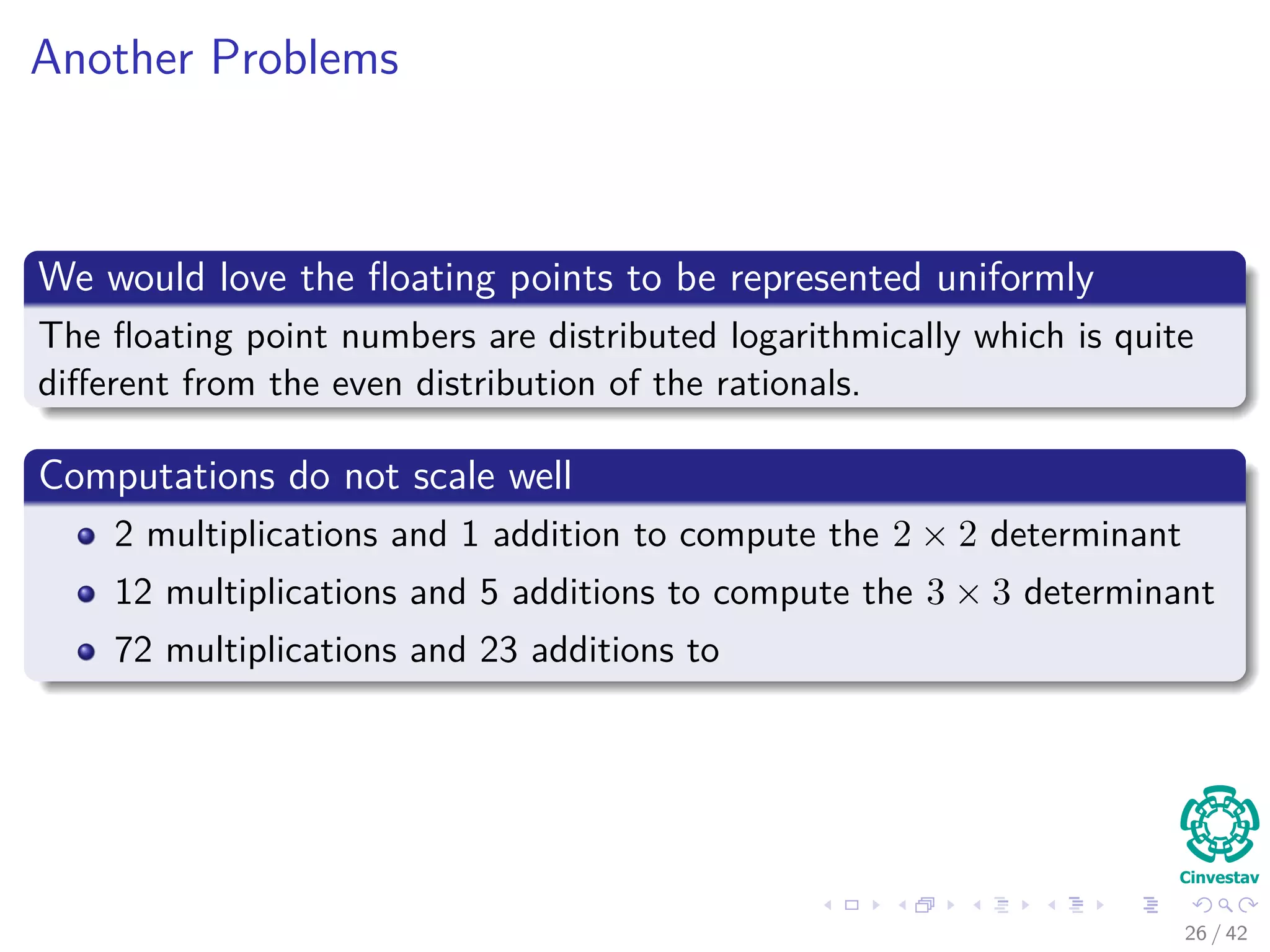
Another Problems
We would love the floating points to be represented uniformly
The floating point numbers are distributed logarithmically which is quite
different from the even distribution of the rationals.
Computations do not scale well
2 multiplications and 1 addition to compute the 2 × 2 determinant
12 multiplications and 5 additions to compute the 3 × 3 determinant
72 multiplications and 23 additions to
26 / 42
Another Problems
We would love the floating points to be represented uniformly
The floating point numbers are distributed logarithmically which is quite
different from the even distribution of the rationals.
Computations do not scale well
2 multiplications and 1 addition to compute the 2 × 2 determinant
12 multiplications and 5 additions to compute the 3 × 3 determinant
72 multiplications and 23 additions to
26 / 42
Another Problems
We would love the floating points to be represented uniformly
The floating point numbers are distributed logarithmically which is quite
different from the even distribution of the rationals.
Computations do not scale well
2 multiplications and 1 addition to compute the 2 × 2 determinant
12 multiplications and 5 additions to compute the 3 × 3 determinant
72 multiplications and 23 additions to
26 / 42
Another Problems
We would love the floating points to be represented uniformly
The floating point numbers are distributed logarithmically which is quite
different from the even distribution of the rationals.
Computations do not scale well
2 multiplications and 1 addition to compute the 2 × 2 determinant
12 multiplications and 5 additions to compute the 3 × 3 determinant
72 multiplications and 23 additions to
26 / 42
Outline
1 Square Matrices
Introduction
The Inverse
Solution to Ax = y
Algorithm for the Inverse of a Matrix
2 Determinants
Introduction
Complexity Increases
Reducing the Complexity
Some Consequences of the definition
Special Determinants
27 / 42
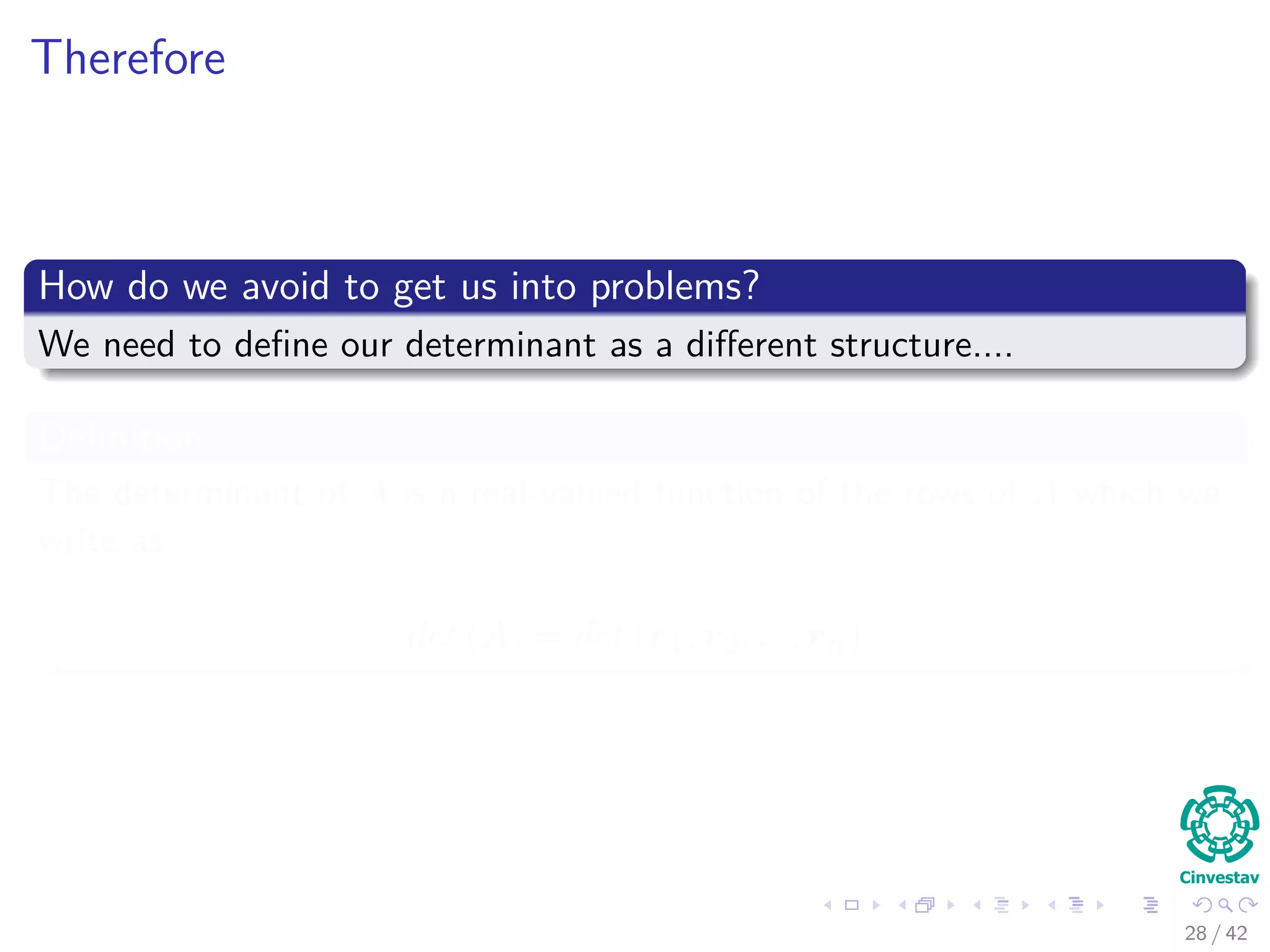
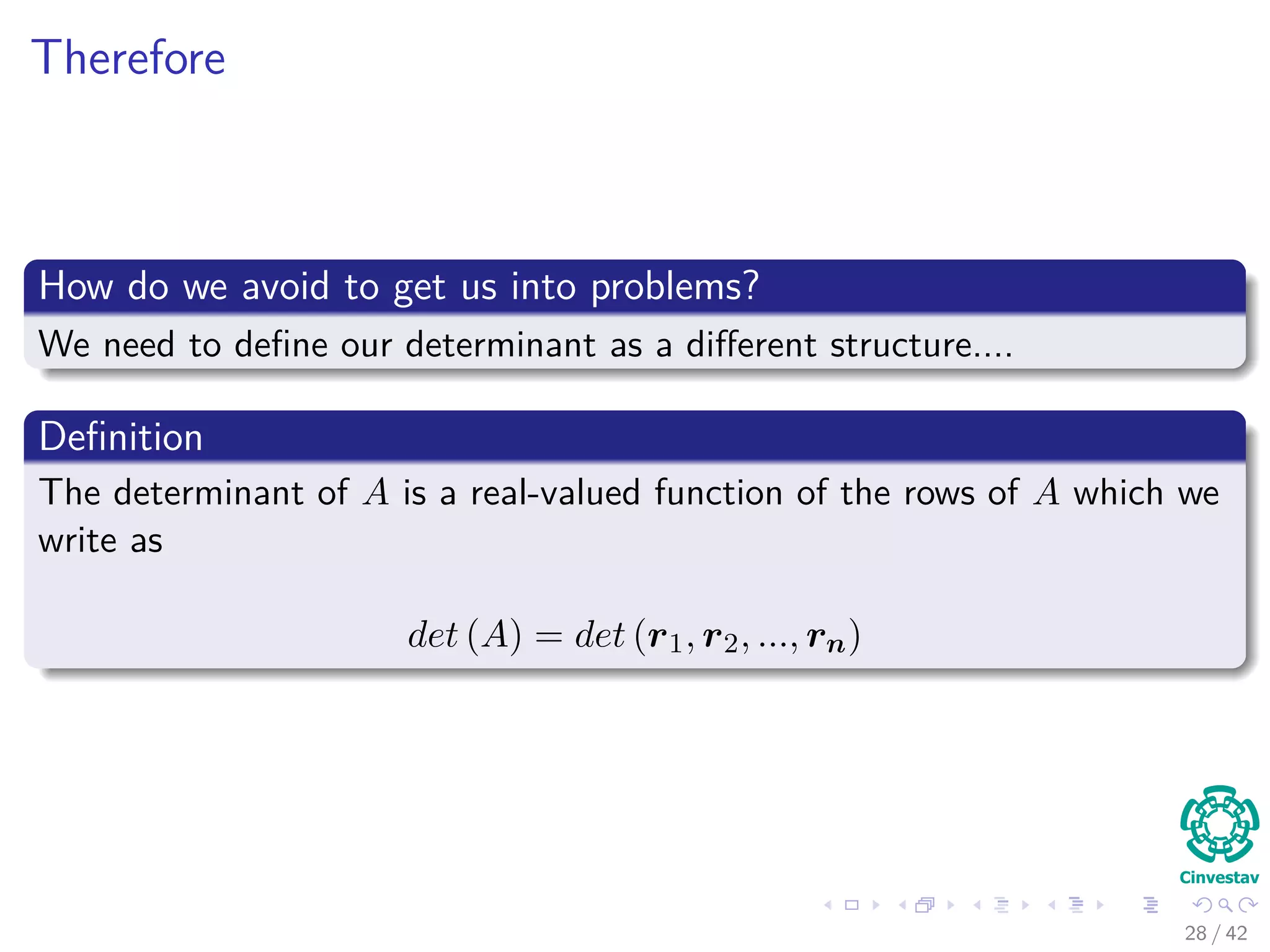
Therefore
How do we avoid to get us into problems?
We need to define our determinant as a different structure....
Definition
The determinant of A is a real-valued function of the rows of A which we
write as
det (A) = det (r1, r2, ..., rn)
28 / 42
Therefore
How do we avoid to get us into problems?
We need to define our determinant as a different structure....
Definition
The determinant of A is a real-valued function of the rows of A which we
write as
det (A) = det (r1, r2, ..., rn)
28 / 42
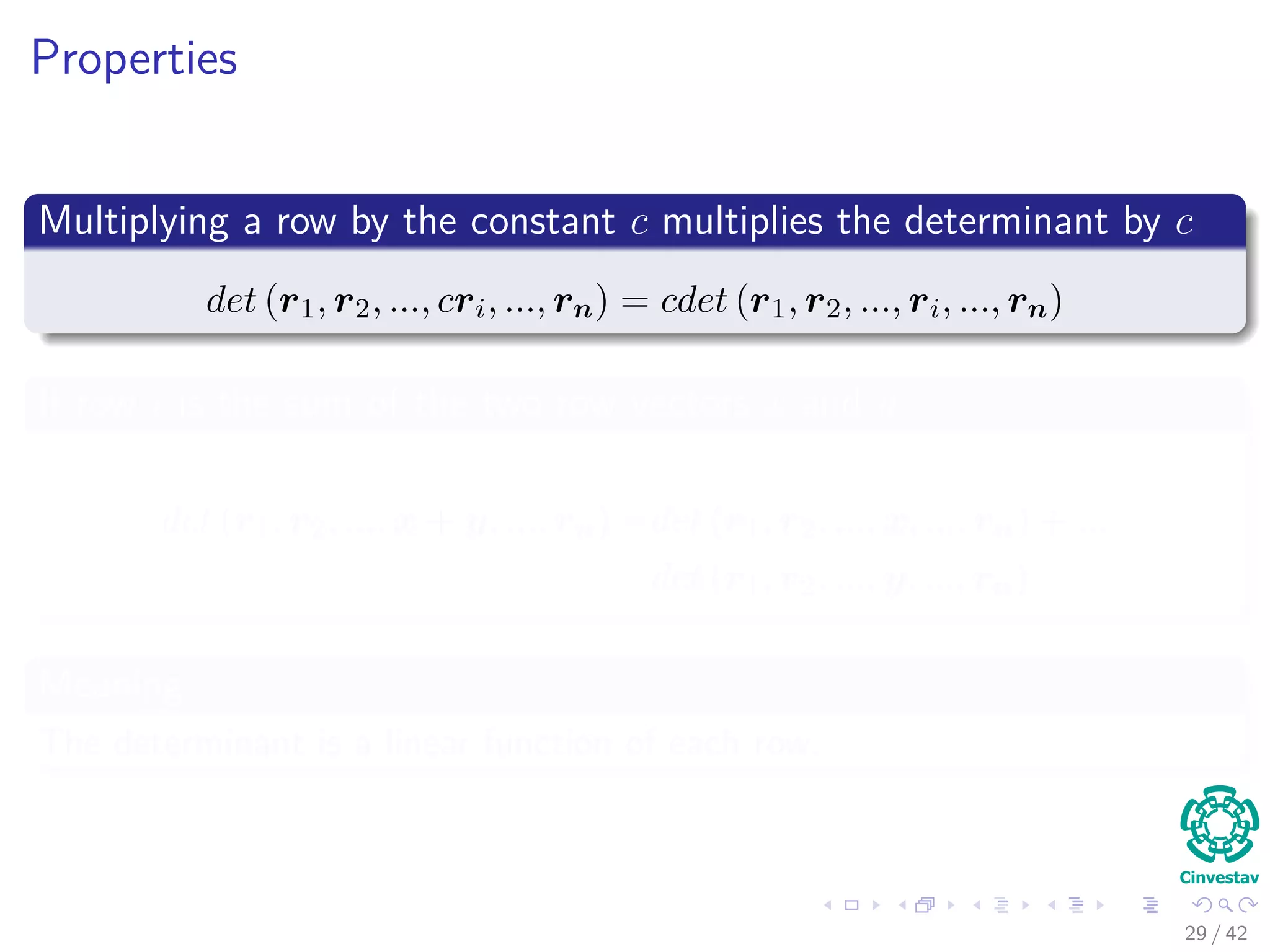
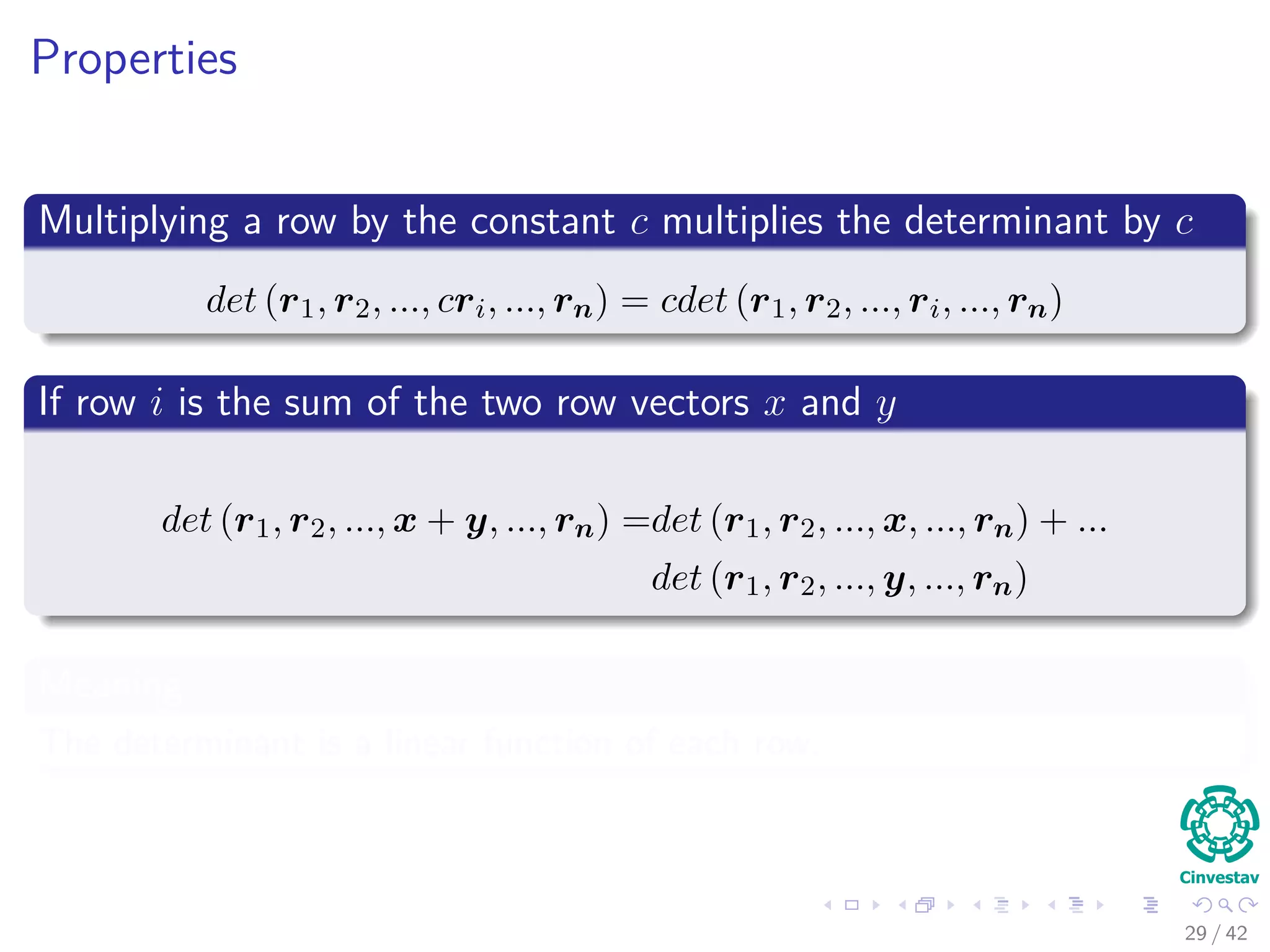
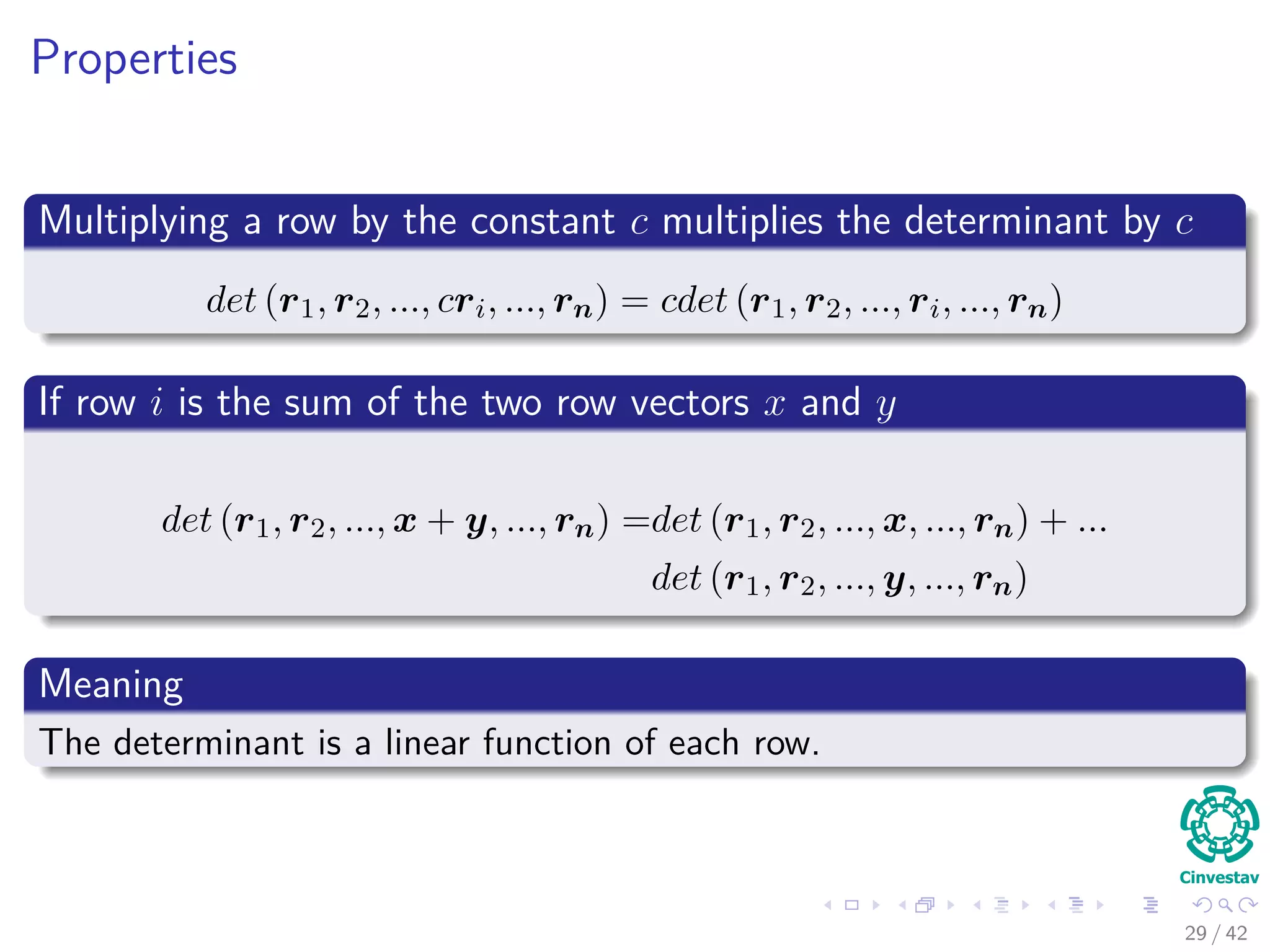
Properties
Multiplying a row by the constant c multiplies the determinant by c
det (r1, r2, ..., cri, ..., rn) = cdet (r1, r2, ..., ri, ..., rn)
If row i is the sum of the two row vectors x and y
det (r1, r2, ..., x + y, ..., rn) =det (r1, r2, ..., x, ..., rn) + ...
det (r1, r2, ..., y, ..., rn)
Meaning
The determinant is a linear function of each row.
29 / 42
Properties
Multiplying a row by the constant c multiplies the determinant by c
det (r1, r2, ..., cri, ..., rn) = cdet (r1, r2, ..., ri, ..., rn)
If row i is the sum of the two row vectors x and y
det (r1, r2, ..., x + y, ..., rn) =det (r1, r2, ..., x, ..., rn) + ...
det (r1, r2, ..., y, ..., rn)
Meaning
The determinant is a linear function of each row.
29 / 42
Properties
Multiplying a row by the constant c multiplies the determinant by c
det (r1, r2, ..., cri, ..., rn) = cdet (r1, r2, ..., ri, ..., rn)
If row i is the sum of the two row vectors x and y
det (r1, r2, ..., x + y, ..., rn) =det (r1, r2, ..., x, ..., rn) + ...
det (r1, r2, ..., y, ..., rn)
Meaning
The determinant is a linear function of each row.
29 / 42
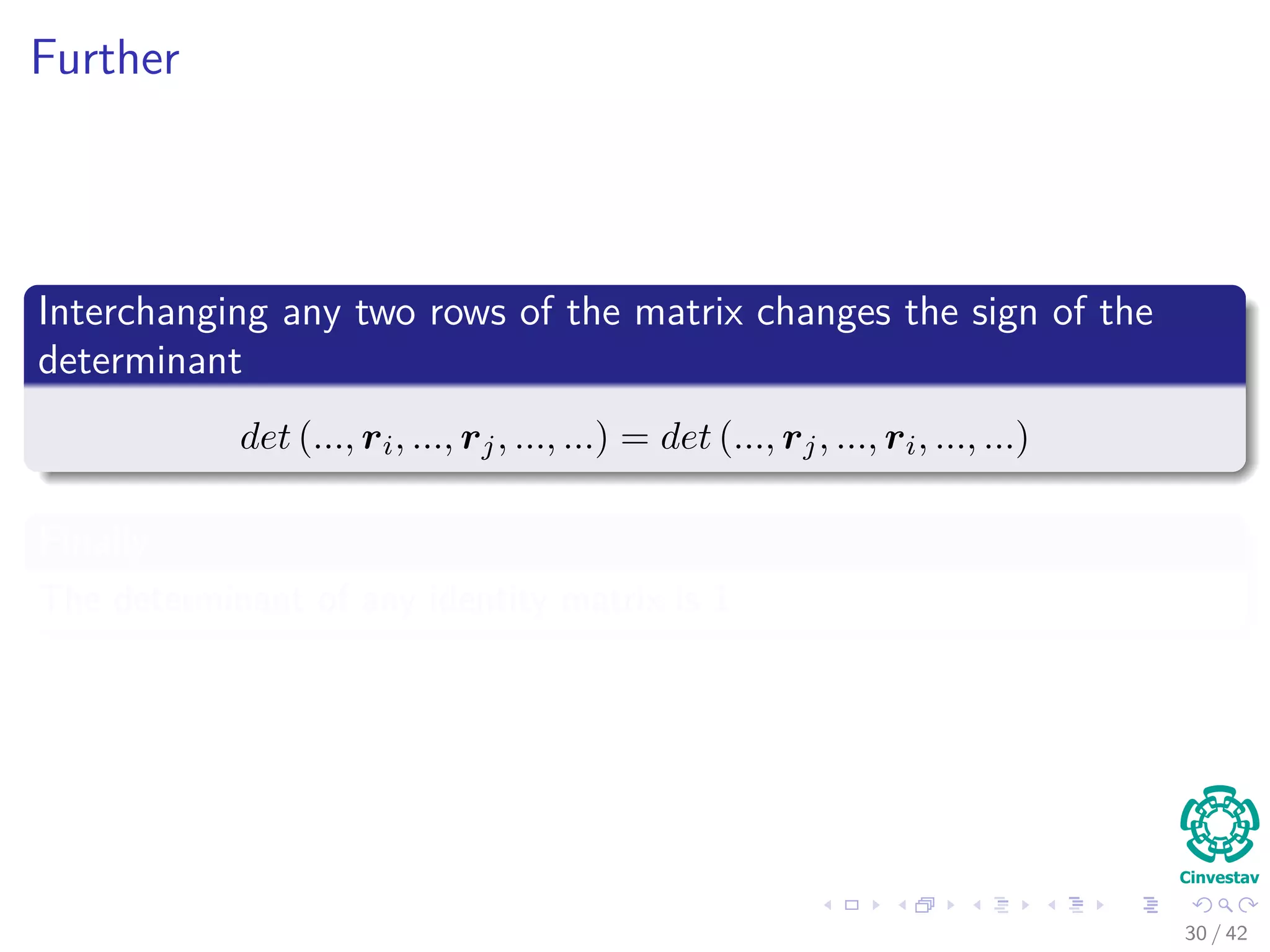
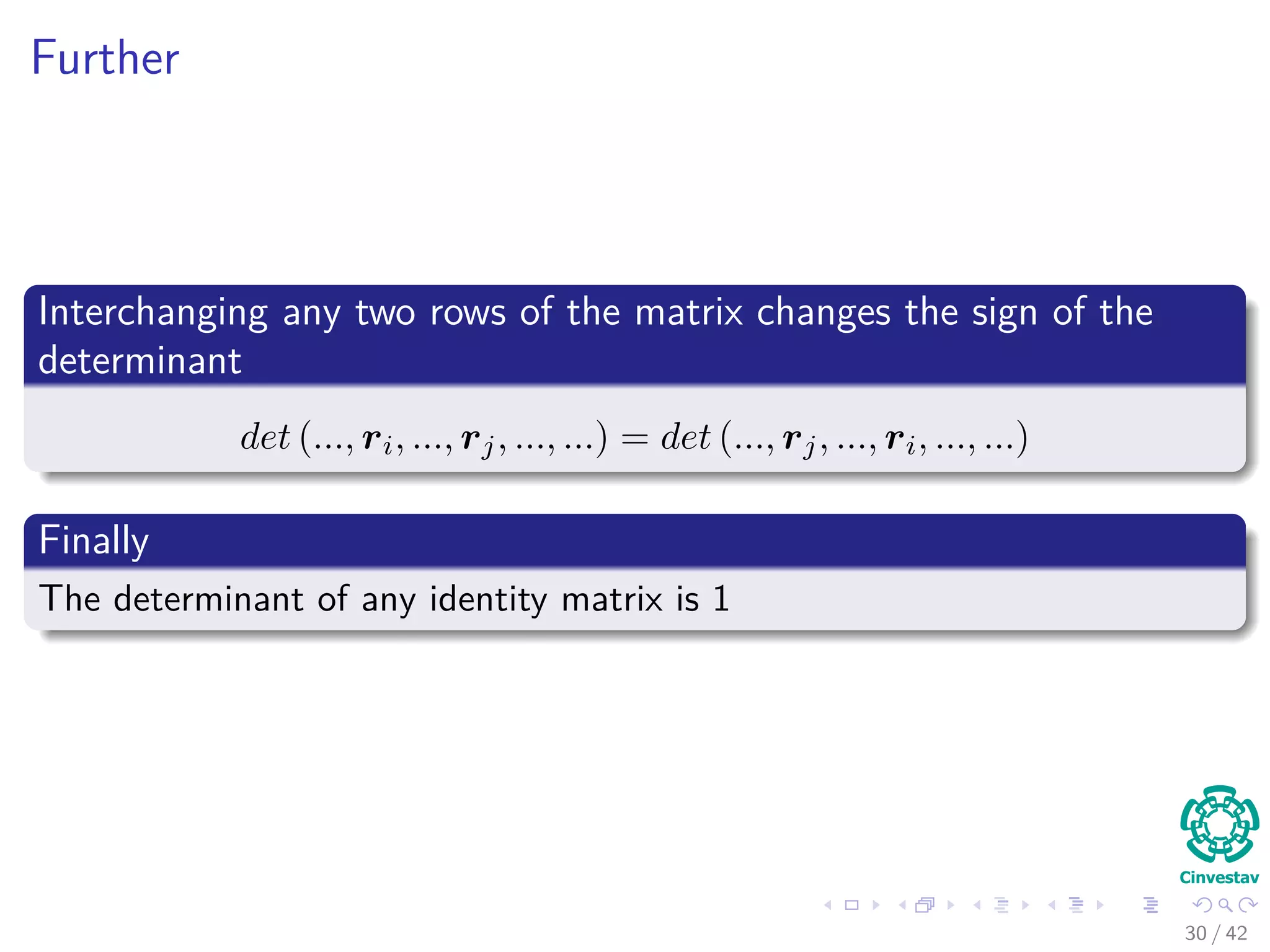
Further
Interchanging any two rows of the matrix changes the sign of the
determinant
det (..., ri, ..., rj, ..., ...) = det (..., rj, ..., ri, ..., ...)
Finally
The determinant of any identity matrix is 1
30 / 42
Further
Interchanging any two rows of the matrix changes the sign of the
determinant
det (..., ri, ..., rj, ..., ...) = det (..., rj, ..., ri, ..., ...)
Finally
The determinant of any identity matrix is 1
30 / 42
Outline
1 Square Matrices
Introduction
The Inverse
Solution to Ax = y
Algorithm for the Inverse of a Matrix
2 Determinants
Introduction
Complexity Increases
Reducing the Complexity
Some Consequences of the definition
Special Determinants
31 / 42
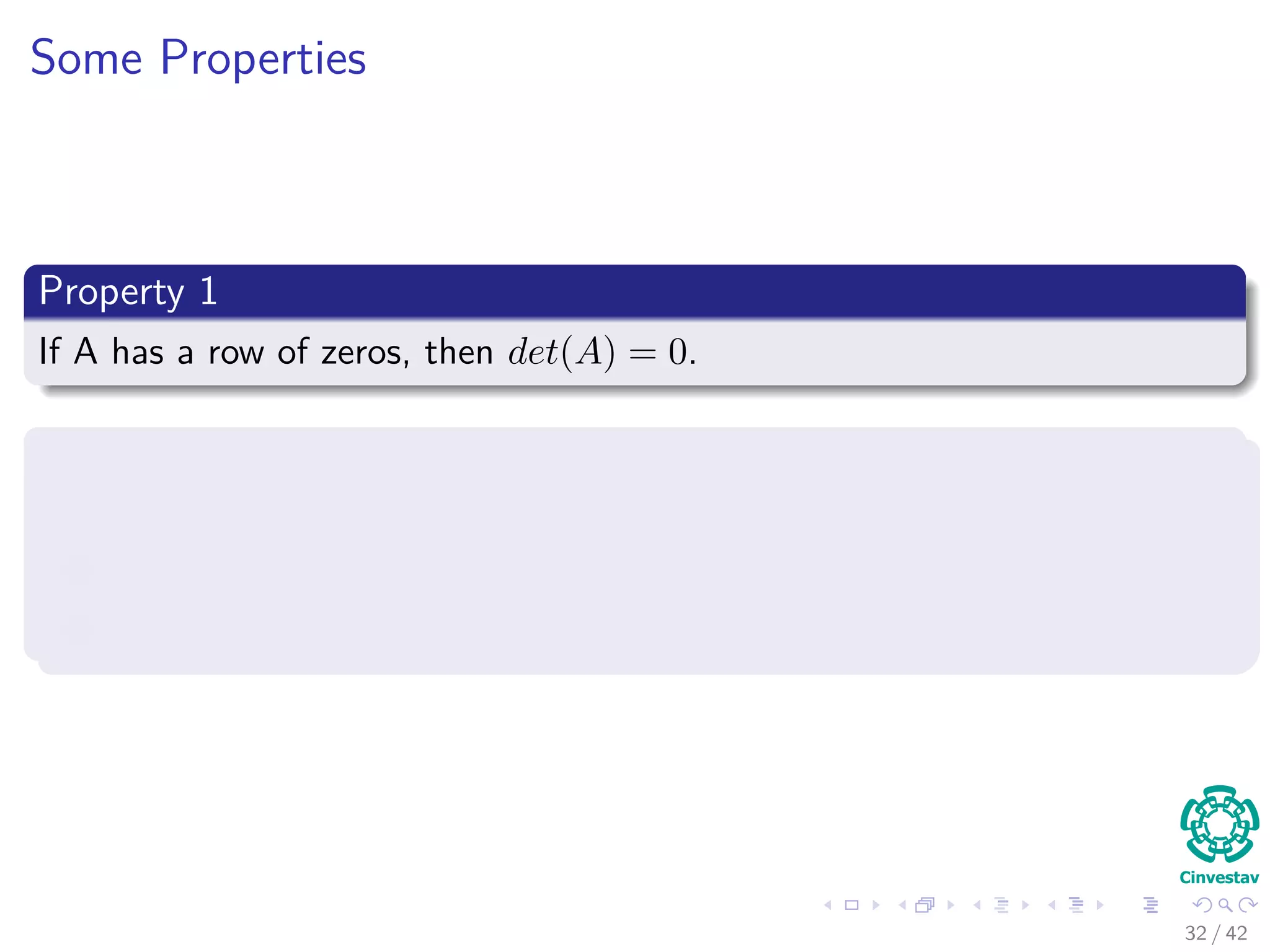
Some Properties
Property 1
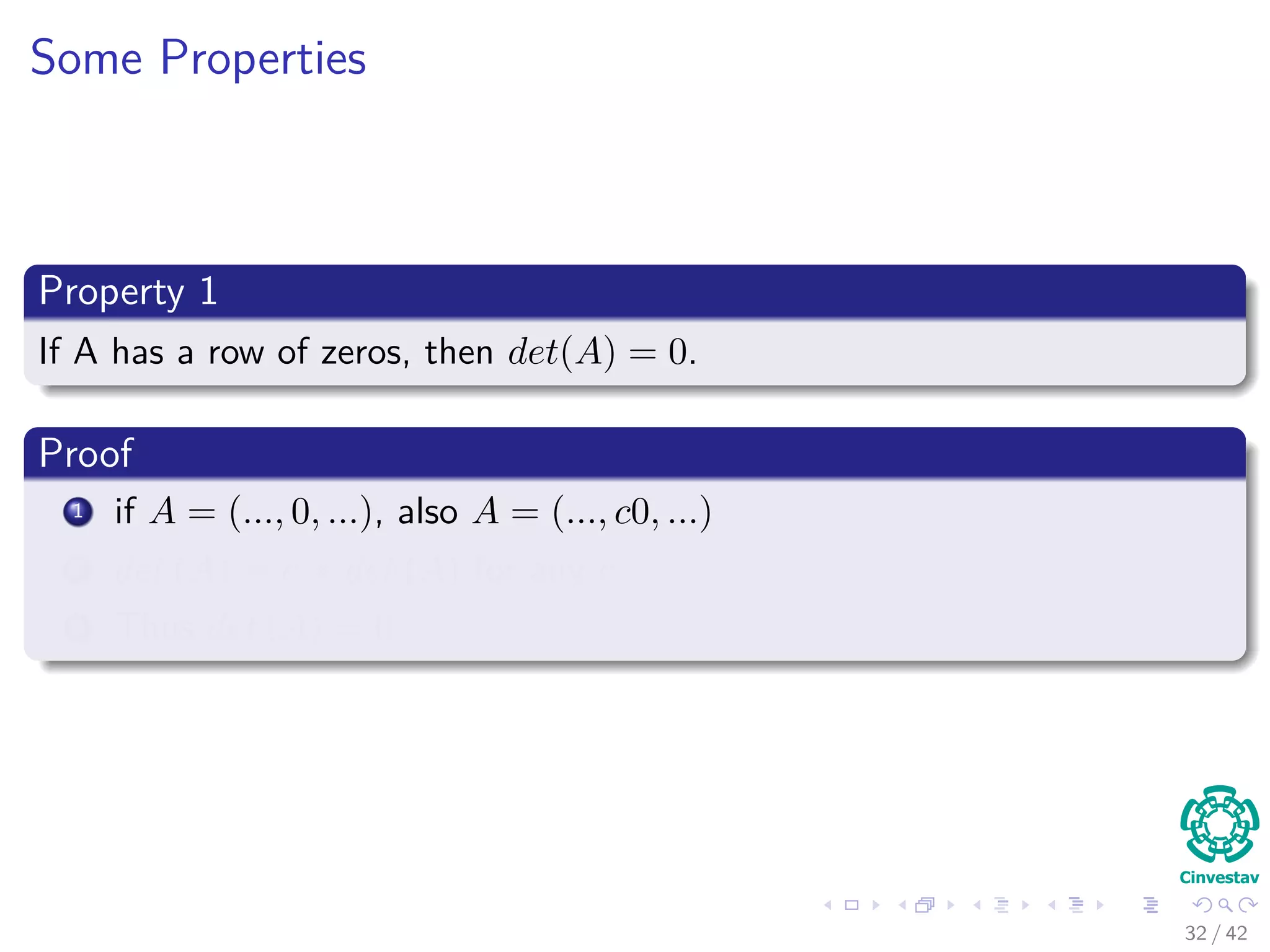
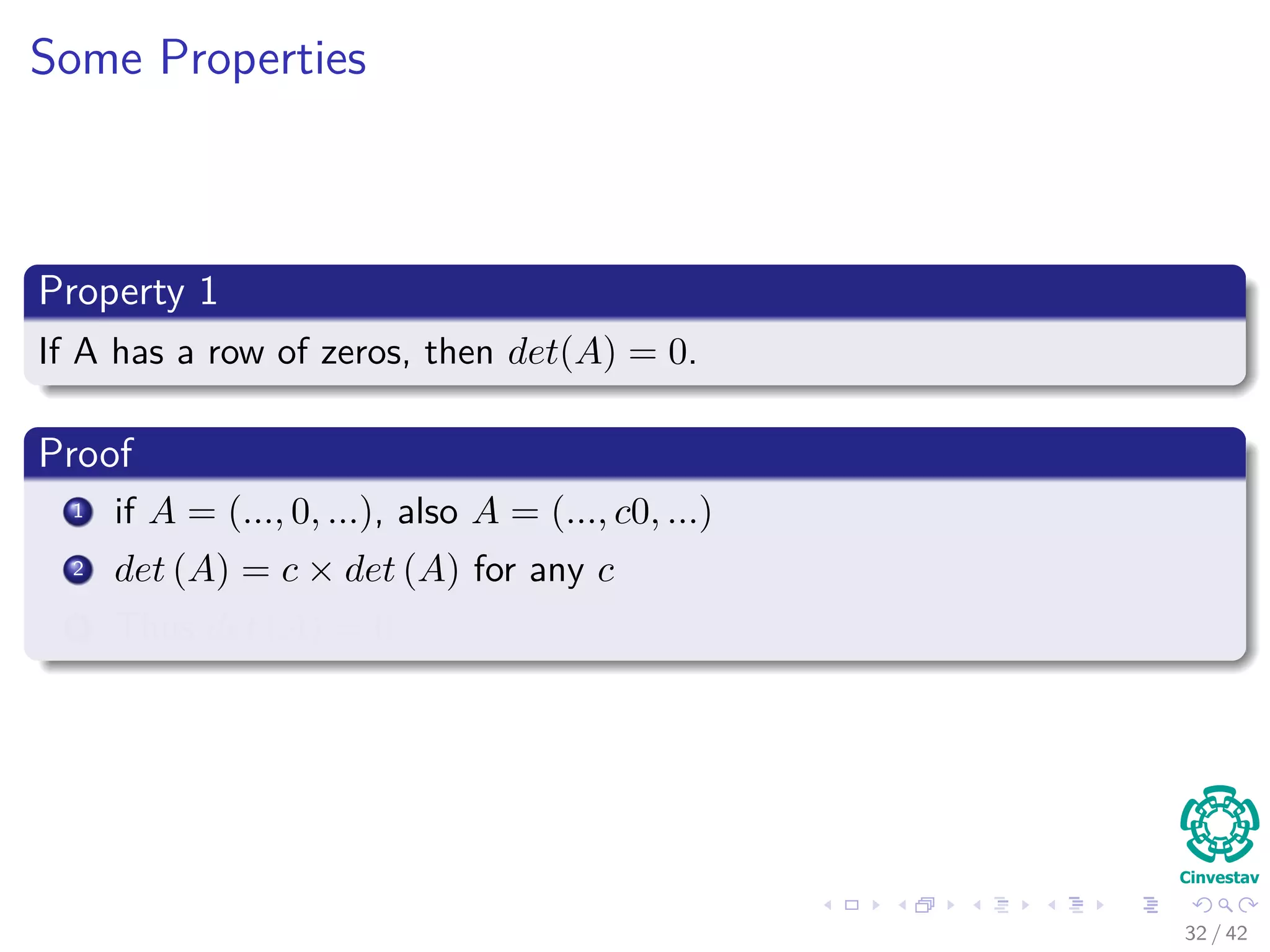
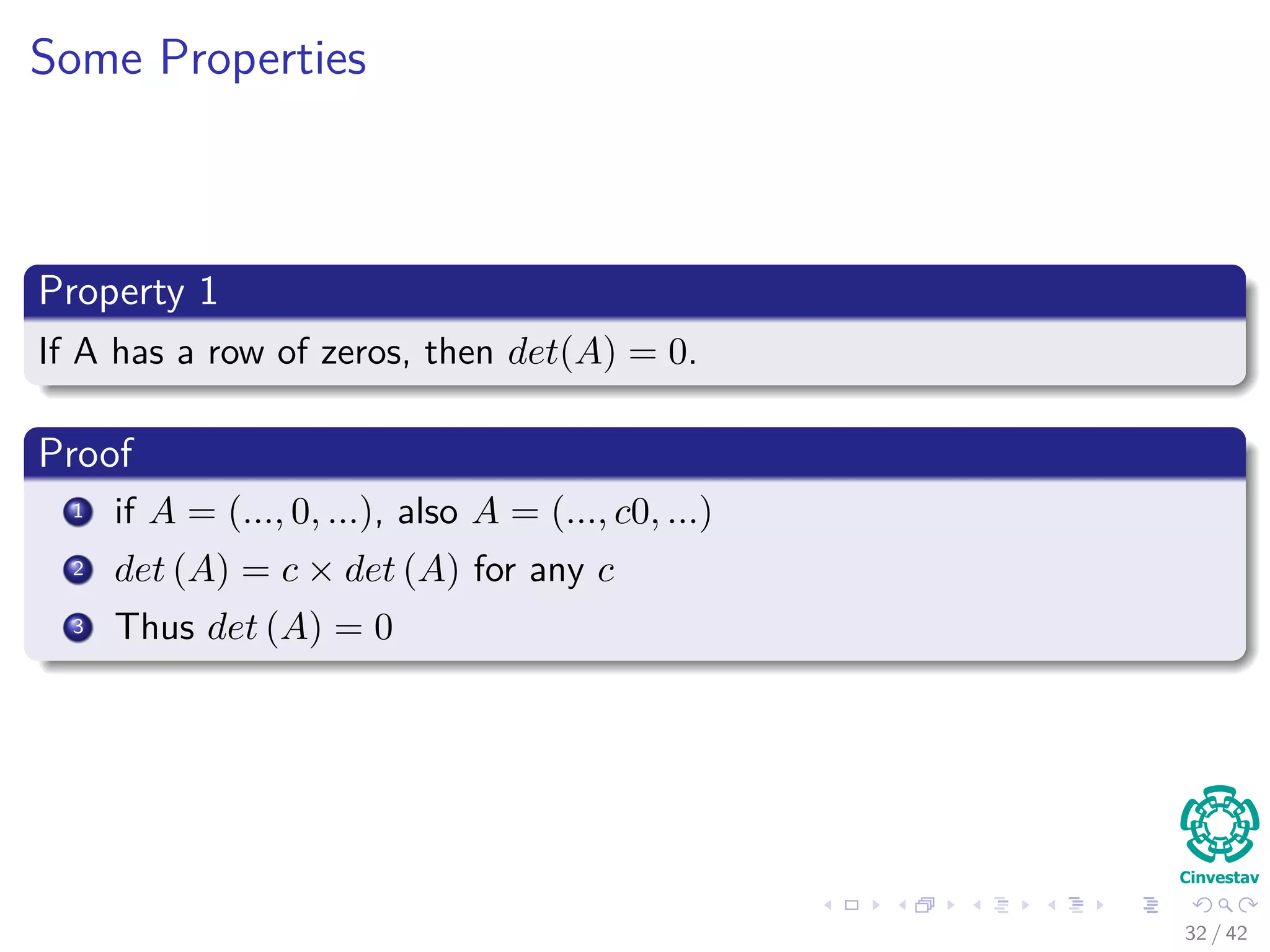
If A has a row of zeros, then det(A) = 0.
Proof
1 if A = (..., 0, ...), also A = (..., c0, ...)
2 det (A) = c × det (A) for any c
3 Thus det (A) = 0
32 / 42
Some Properties
Property 1
If A has a row of zeros, then det(A) = 0.
Proof
1 if A = (..., 0, ...), also A = (..., c0, ...)
2 det (A) = c × det (A) for any c
3 Thus det (A) = 0
32 / 42
Some Properties
Property 1
If A has a row of zeros, then det(A) = 0.
Proof
1 if A = (..., 0, ...), also A = (..., c0, ...)
2 det (A) = c × det (A) for any c
3 Thus det (A) = 0
32 / 42
Some Properties
Property 1
If A has a row of zeros, then det(A) = 0.
Proof
1 if A = (..., 0, ...), also A = (..., c0, ...)
2 det (A) = c × det (A) for any c
3 Thus det (A) = 0
32 / 42
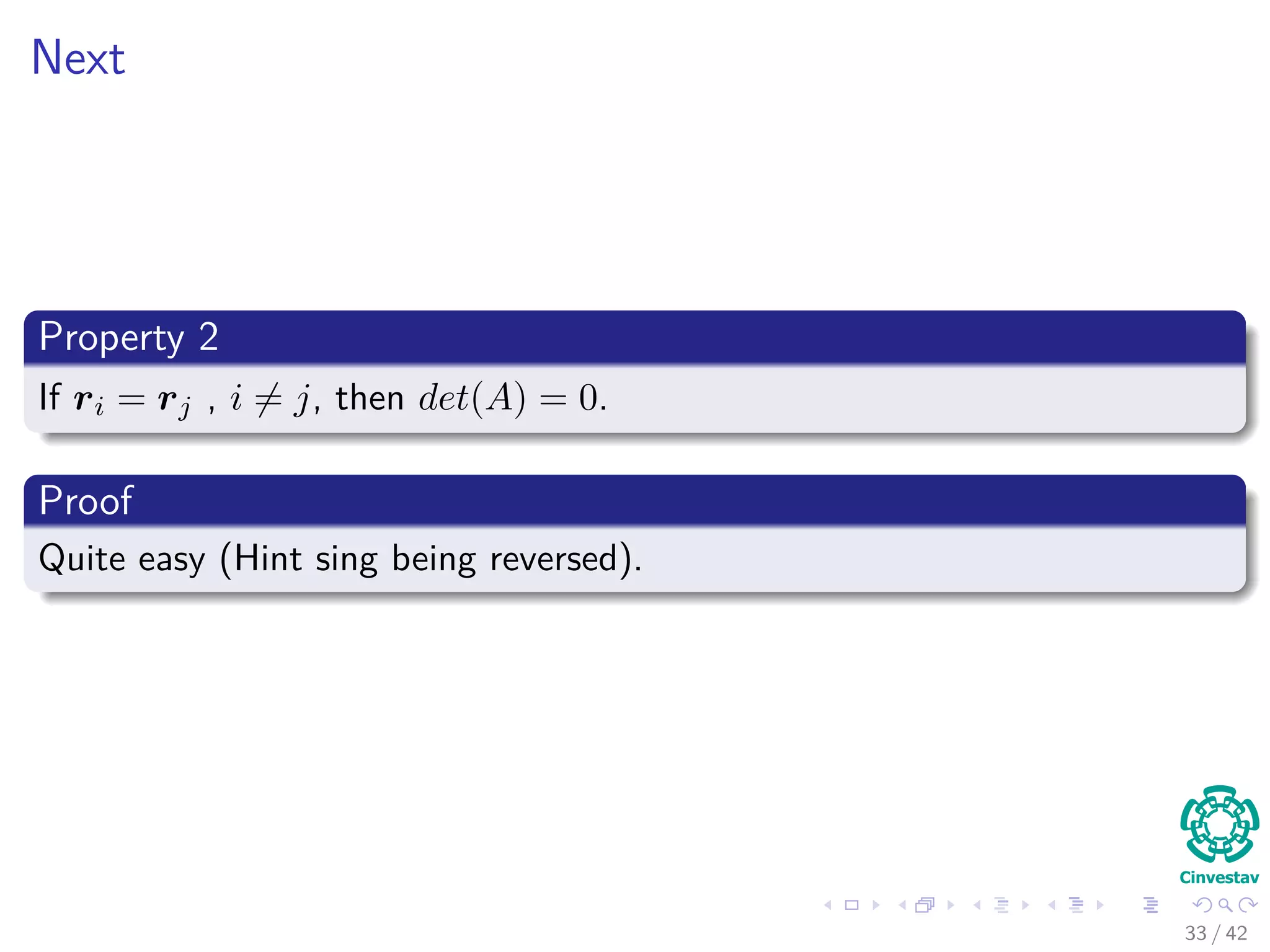
Next
Property 2
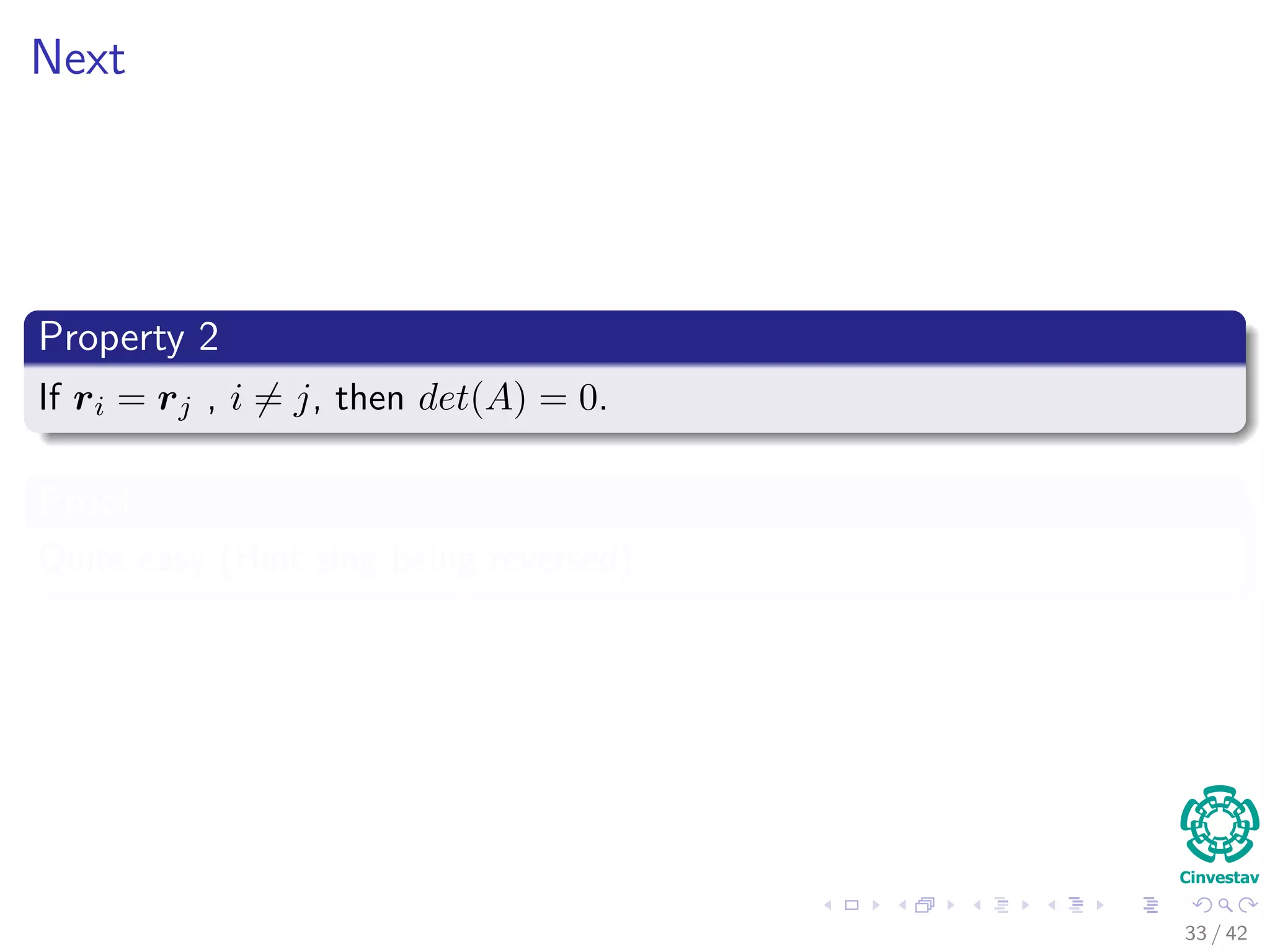
If ri = rj , i = j, then det(A) = 0.
Proof
Quite easy (Hint sing being reversed).
33 / 42
Next
Property 2
If ri = rj , i = j, then det(A) = 0.
Proof
Quite easy (Hint sing being reversed).
33 / 42
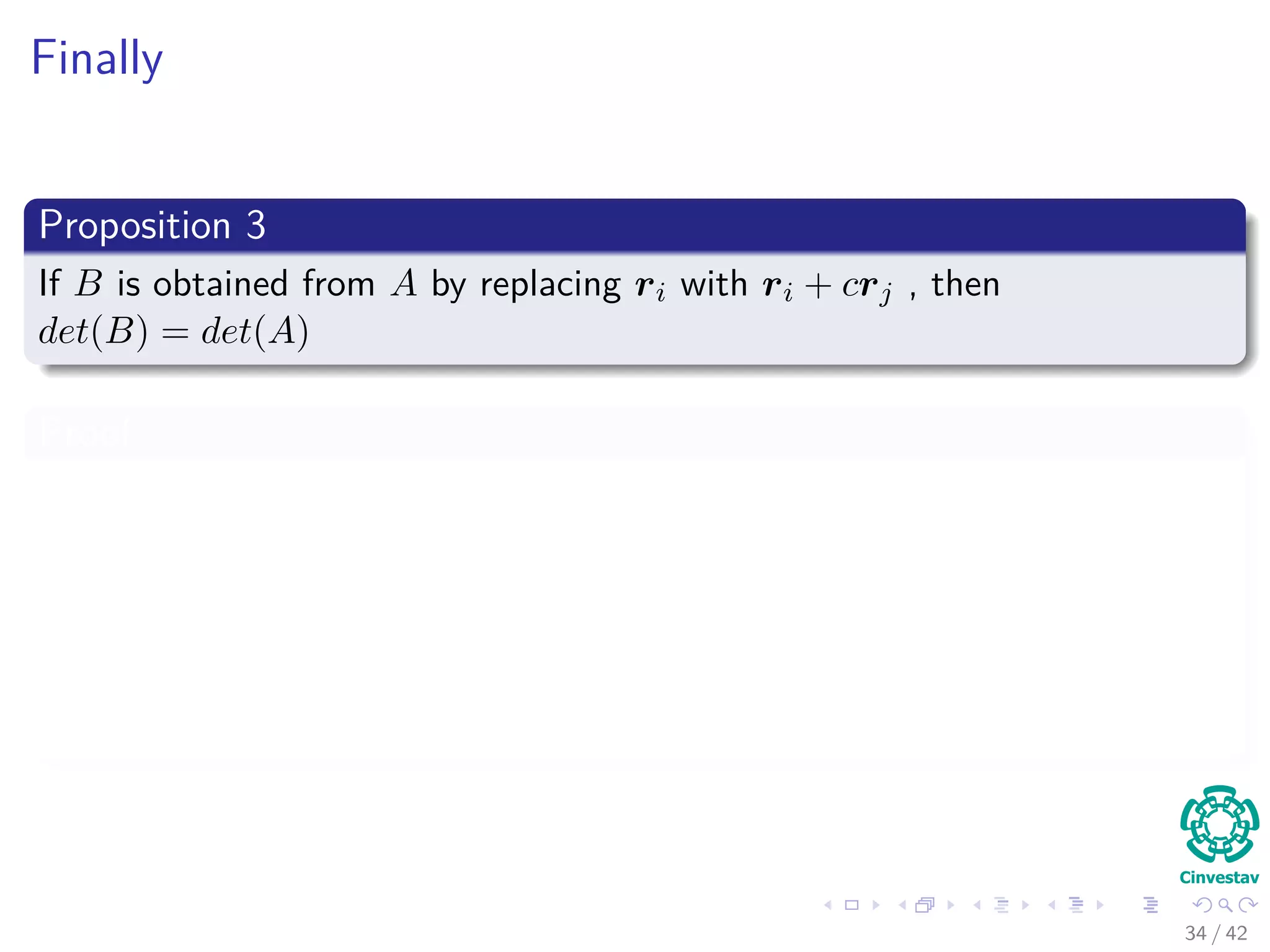
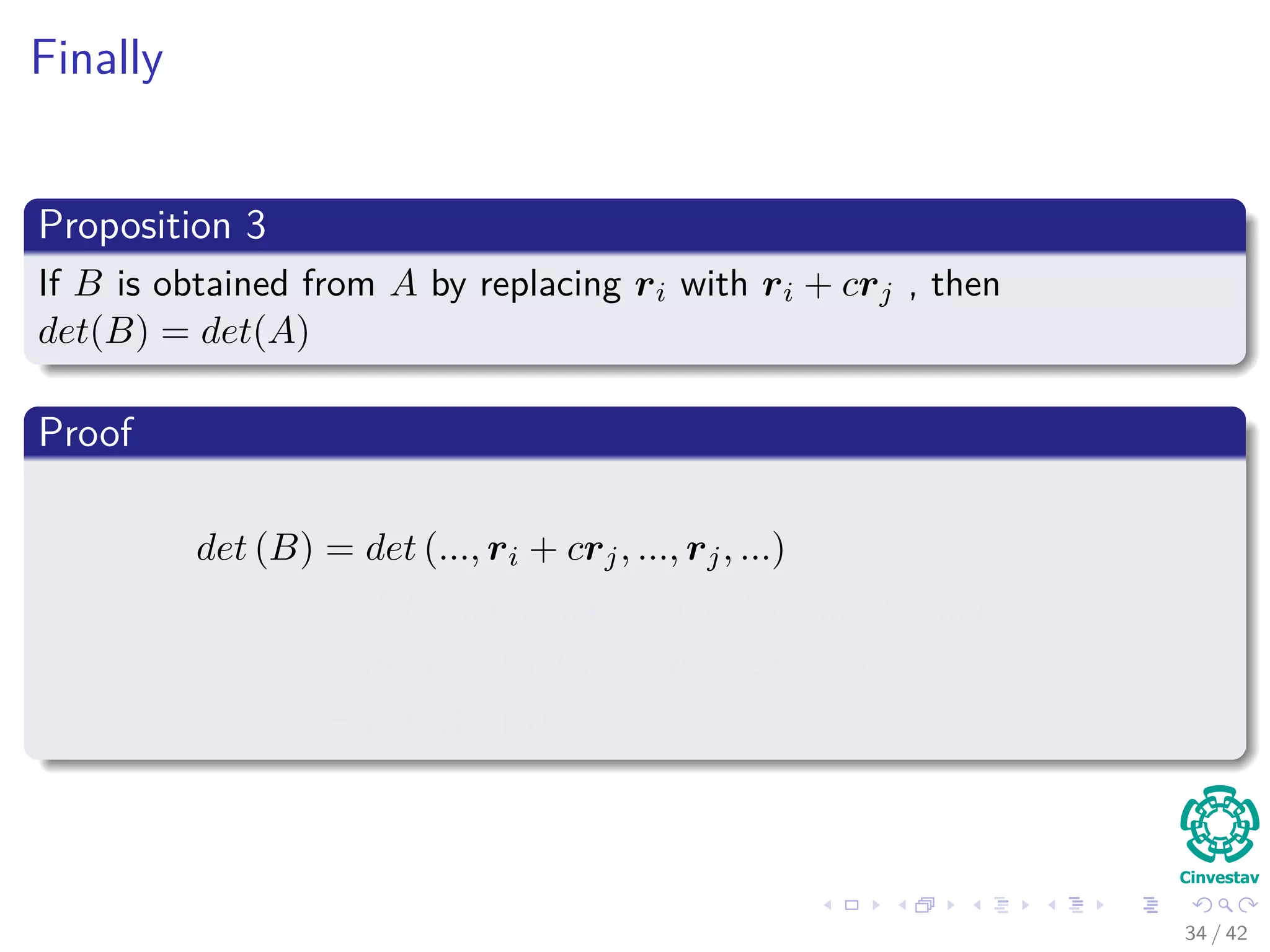
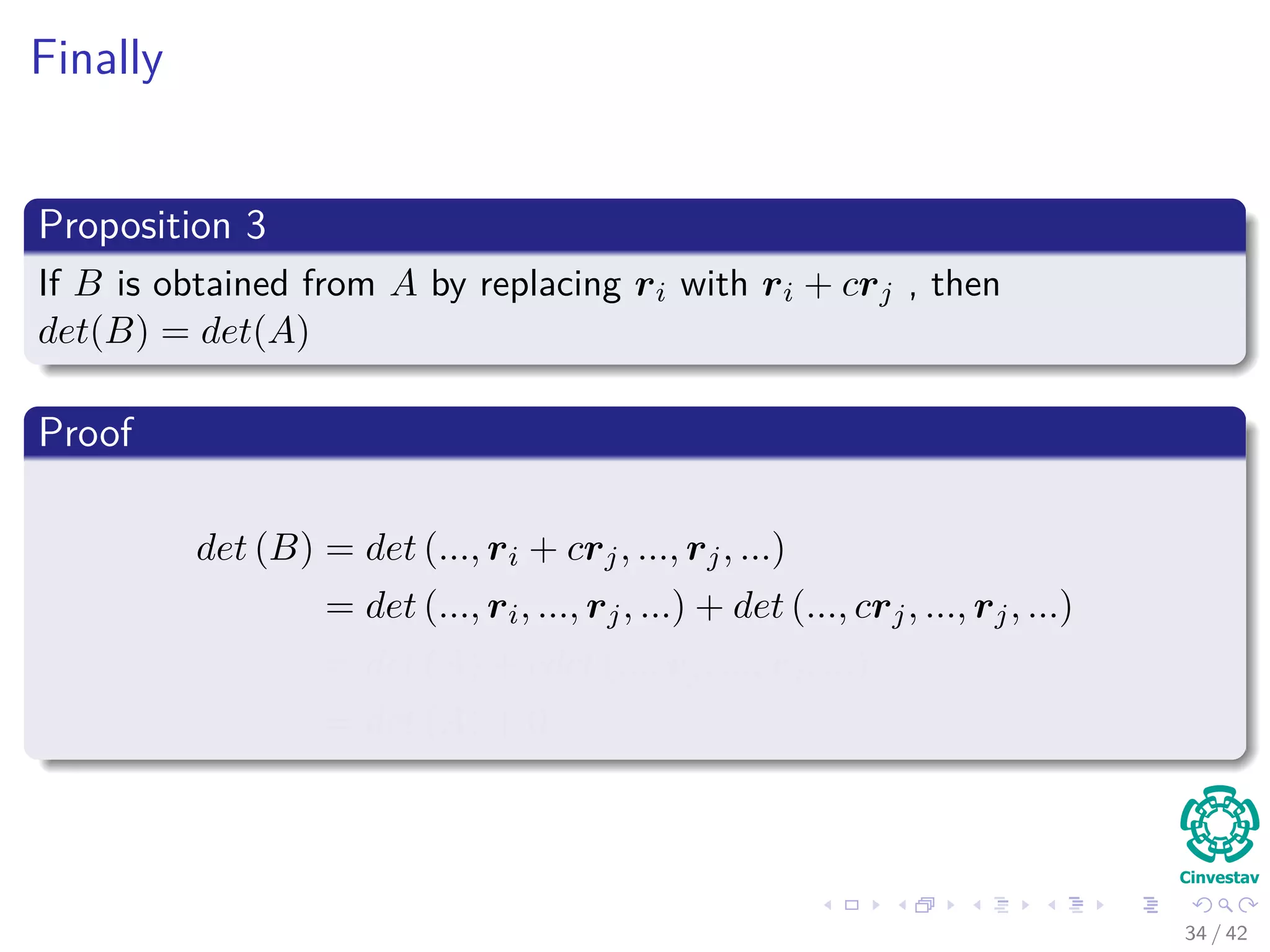
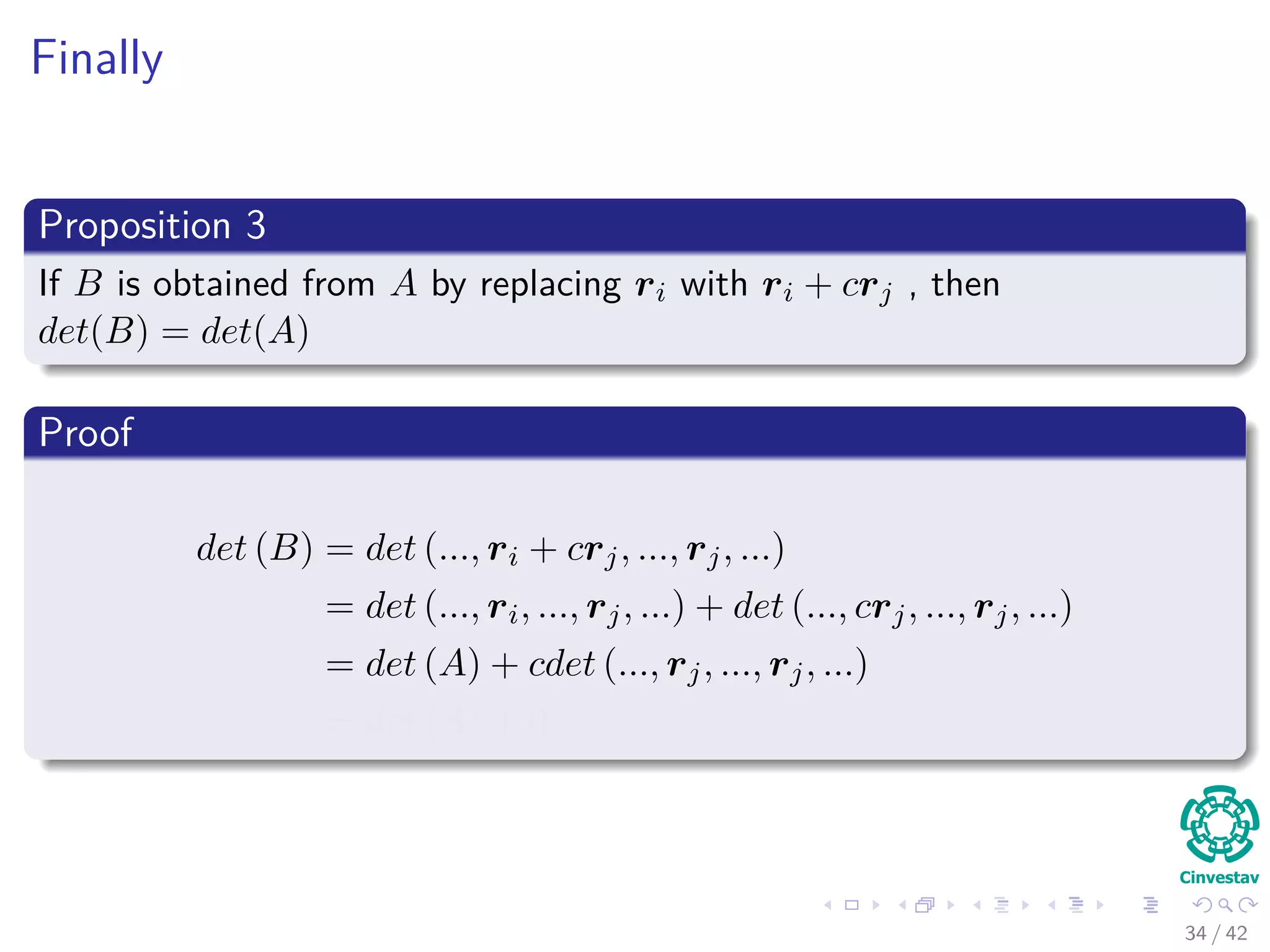
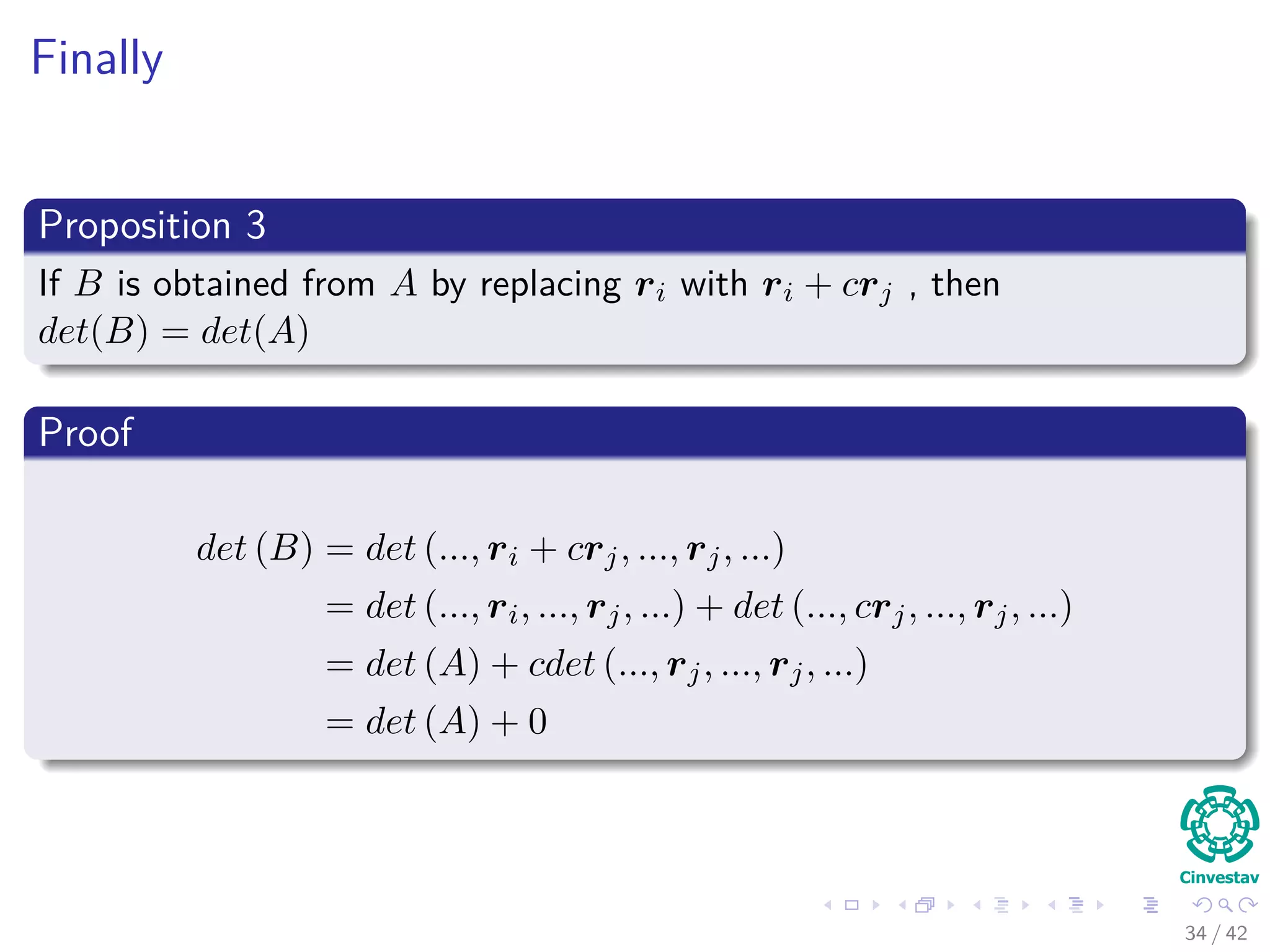
Finally
Proposition 3
If B is obtained from A by replacing ri with ri + crj , then
det(B) = det(A)
Proof
det (B) = det (..., ri + crj, ..., rj, ...)
= det (..., ri, ..., rj, ...) + det (..., crj, ..., rj, ...)
= det (A) + cdet (..., rj, ..., rj, ...)
= det (A) + 0
34 / 42
Finally
Proposition 3
If B is obtained from A by replacing ri with ri + crj , then
det(B) = det(A)
Proof
det (B) = det (..., ri + crj, ..., rj, ...)
= det (..., ri, ..., rj, ...) + det (..., crj, ..., rj, ...)
= det (A) + cdet (..., rj, ..., rj, ...)
= det (A) + 0
34 / 42
Finally
Proposition 3
If B is obtained from A by replacing ri with ri + crj , then
det(B) = det(A)
Proof
det (B) = det (..., ri + crj, ..., rj, ...)
= det (..., ri, ..., rj, ...) + det (..., crj, ..., rj, ...)
= det (A) + cdet (..., rj, ..., rj, ...)
= det (A) + 0
34 / 42
Finally
Proposition 3
If B is obtained from A by replacing ri with ri + crj , then
det(B) = det(A)
Proof
det (B) = det (..., ri + crj, ..., rj, ...)
= det (..., ri, ..., rj, ...) + det (..., crj, ..., rj, ...)
= det (A) + cdet (..., rj, ..., rj, ...)
= det (A) + 0
34 / 42
Finally
Proposition 3
If B is obtained from A by replacing ri with ri + crj , then
det(B) = det(A)
Proof
det (B) = det (..., ri + crj, ..., rj, ...)
= det (..., ri, ..., rj, ...) + det (..., crj, ..., rj, ...)
= det (A) + cdet (..., rj, ..., rj, ...)
= det (A) + 0
34 / 42
Outline
1 Square Matrices
Introduction
The Inverse
Solution to Ax = y
Algorithm for the Inverse of a Matrix
2 Determinants
Introduction
Complexity Increases
Reducing the Complexity
Some Consequences of the definition
Special Determinants
35 / 42
Therefore
Theorem
The determinant of an upper or lower triangular matrix is equal to the
product of the entries on the main diagonal.
Proof
Suppose A is upper triangular and that none of the entries on the
main diagonal is 0.
This means all the entries beneath the main diagonal are zero.
Using Proposition 3, we can convert it into a diagonal matrix.
Then, by property 1
det (Adiag) = [
n
i aii] det (I) =
n
i aii
36 / 42
Therefore
Theorem
The determinant of an upper or lower triangular matrix is equal to the
product of the entries on the main diagonal.
Proof
Suppose A is upper triangular and that none of the entries on the
main diagonal is 0.
This means all the entries beneath the main diagonal are zero.
Using Proposition 3, we can convert it into a diagonal matrix.
Then, by property 1
det (Adiag) = [
n
i aii] det (I) =
n
i aii
36 / 42
Therefore
Theorem
The determinant of an upper or lower triangular matrix is equal to the
product of the entries on the main diagonal.
Proof
Suppose A is upper triangular and that none of the entries on the
main diagonal is 0.
This means all the entries beneath the main diagonal are zero.
Using Proposition 3, we can convert it into a diagonal matrix.
Then, by property 1
det (Adiag) = [
n
i aii] det (I) =
n
i aii
36 / 42
Therefore
Theorem
The determinant of an upper or lower triangular matrix is equal to the
product of the entries on the main diagonal.
Proof
Suppose A is upper triangular and that none of the entries on the
main diagonal is 0.
This means all the entries beneath the main diagonal are zero.
Using Proposition 3, we can convert it into a diagonal matrix.
Then, by property 1
det (Adiag) = [
n
i aii] det (I) =
n
i aii
36 / 42
Therefore
Theorem
The determinant of an upper or lower triangular matrix is equal to the
product of the entries on the main diagonal.
Proof
Suppose A is upper triangular and that none of the entries on the
main diagonal is 0.
This means all the entries beneath the main diagonal are zero.
Using Proposition 3, we can convert it into a diagonal matrix.
Then, by property 1
det (Adiag) = [
n
i aii] det (I) =
n
i aii
36 / 42
Remark
Question
This is the property we use to compute determinants!!! How?
37 / 42
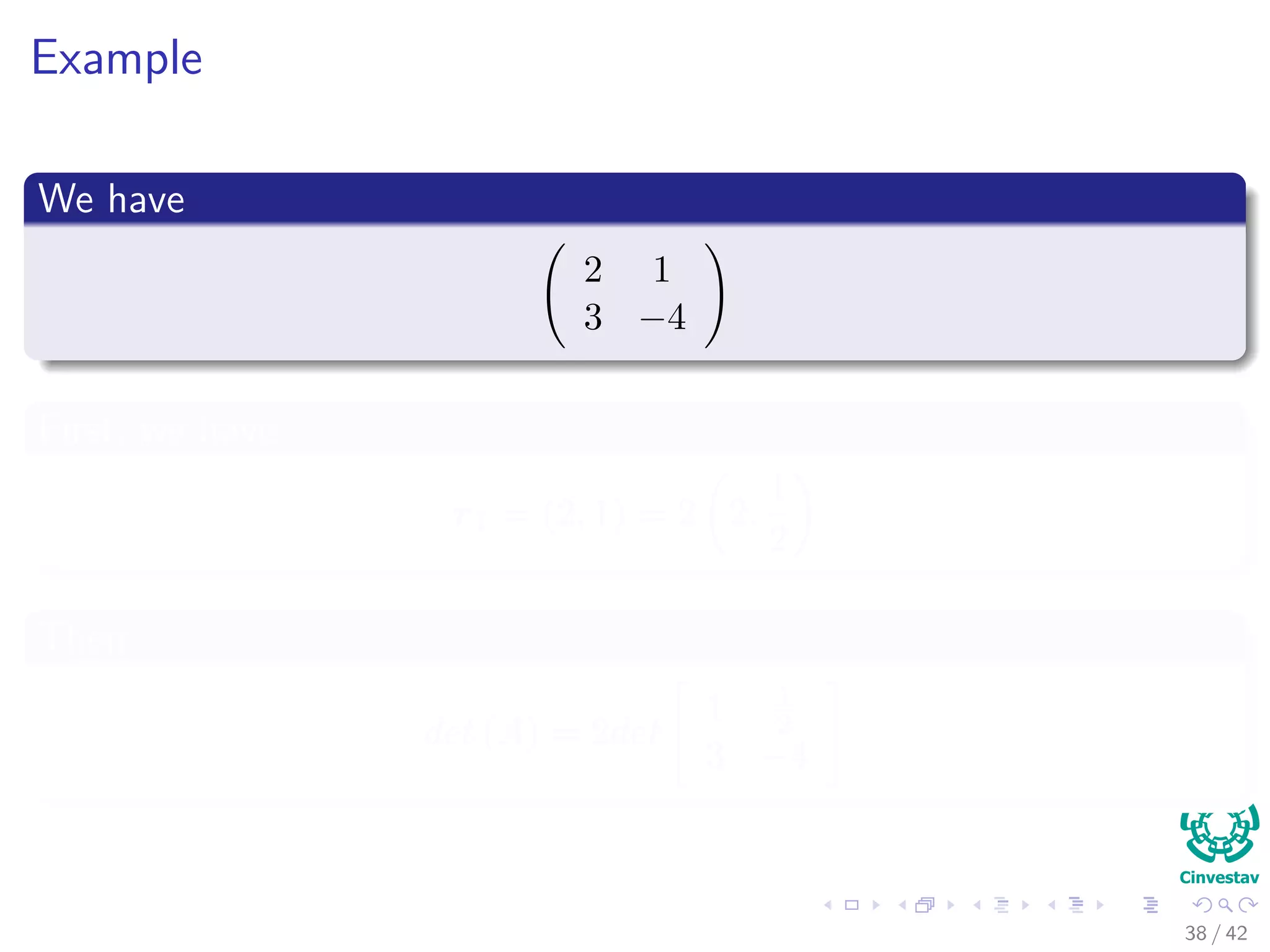
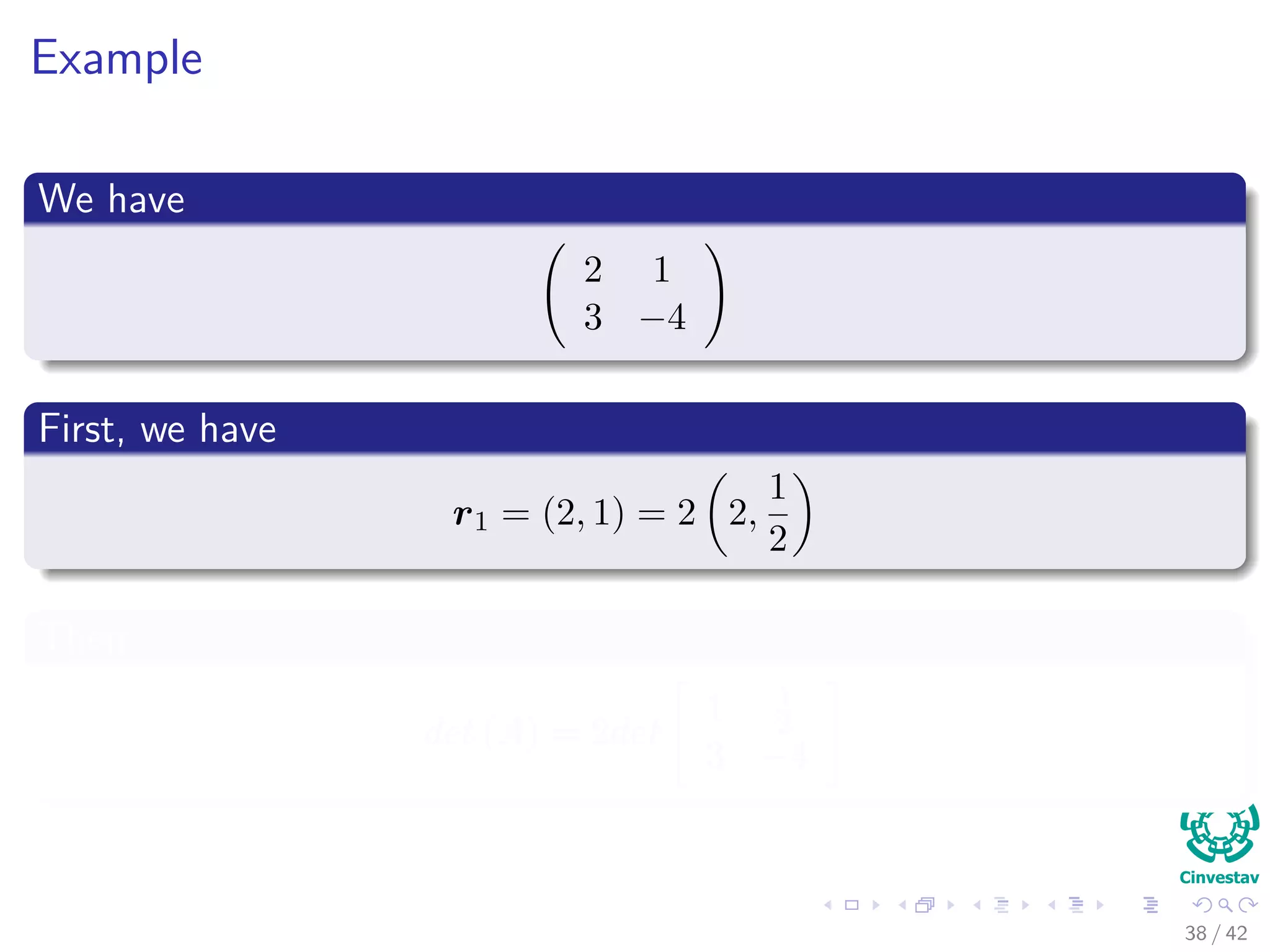
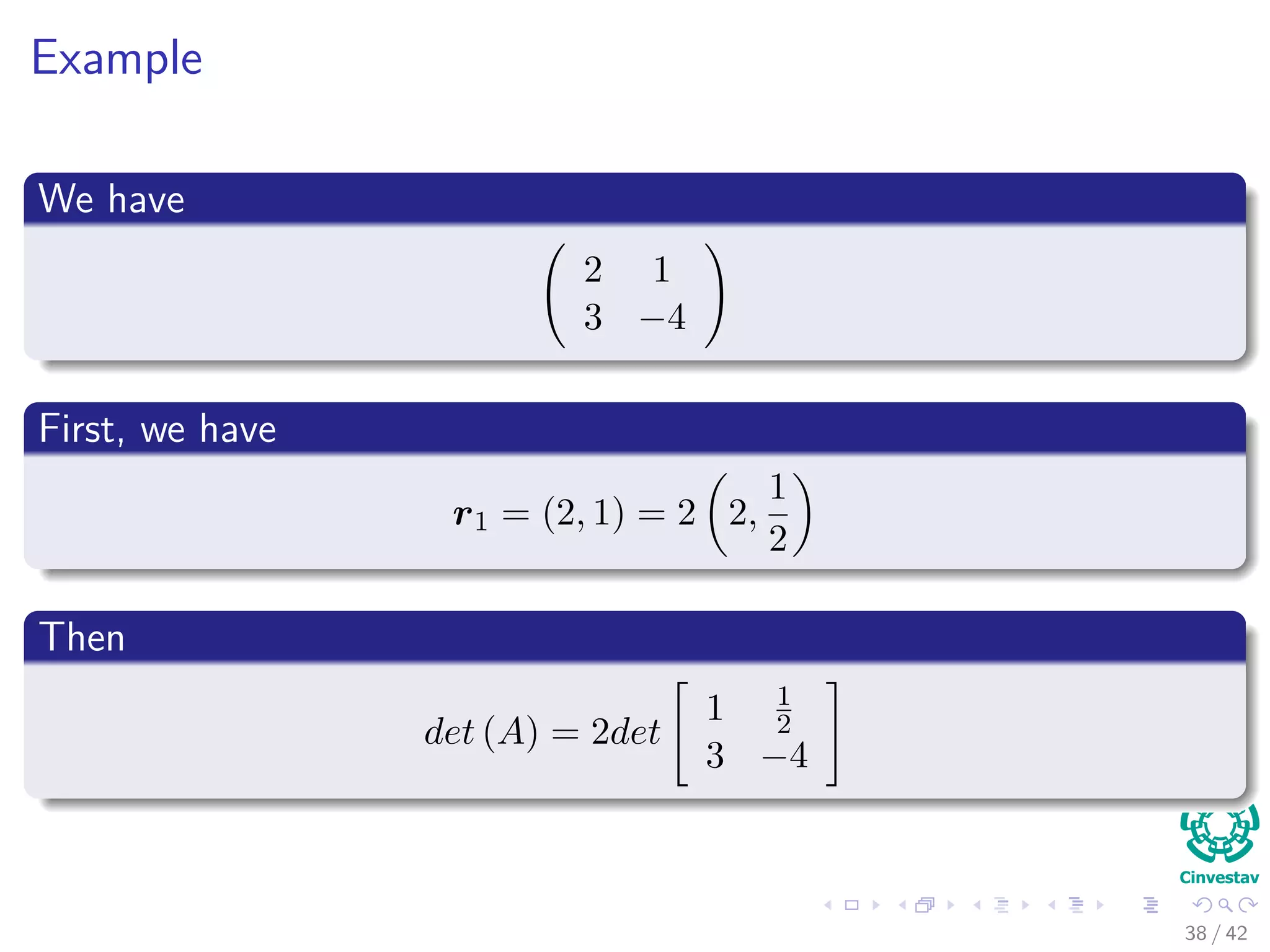
Example
We have
2 1
3 −4
First, we have
r1 = (2, 1) = 2 2,
1
2
Then
det (A) = 2det
1 1
2
3 −4
38 / 42
Example
We have
2 1
3 −4
First, we have
r1 = (2, 1) = 2 2,
1
2
Then
det (A) = 2det
1 1
2
3 −4
38 / 42
Example
We have
2 1
3 −4
First, we have
r1 = (2, 1) = 2 2,
1
2
Then
det (A) = 2det
1 1
2
3 −4
38 / 42
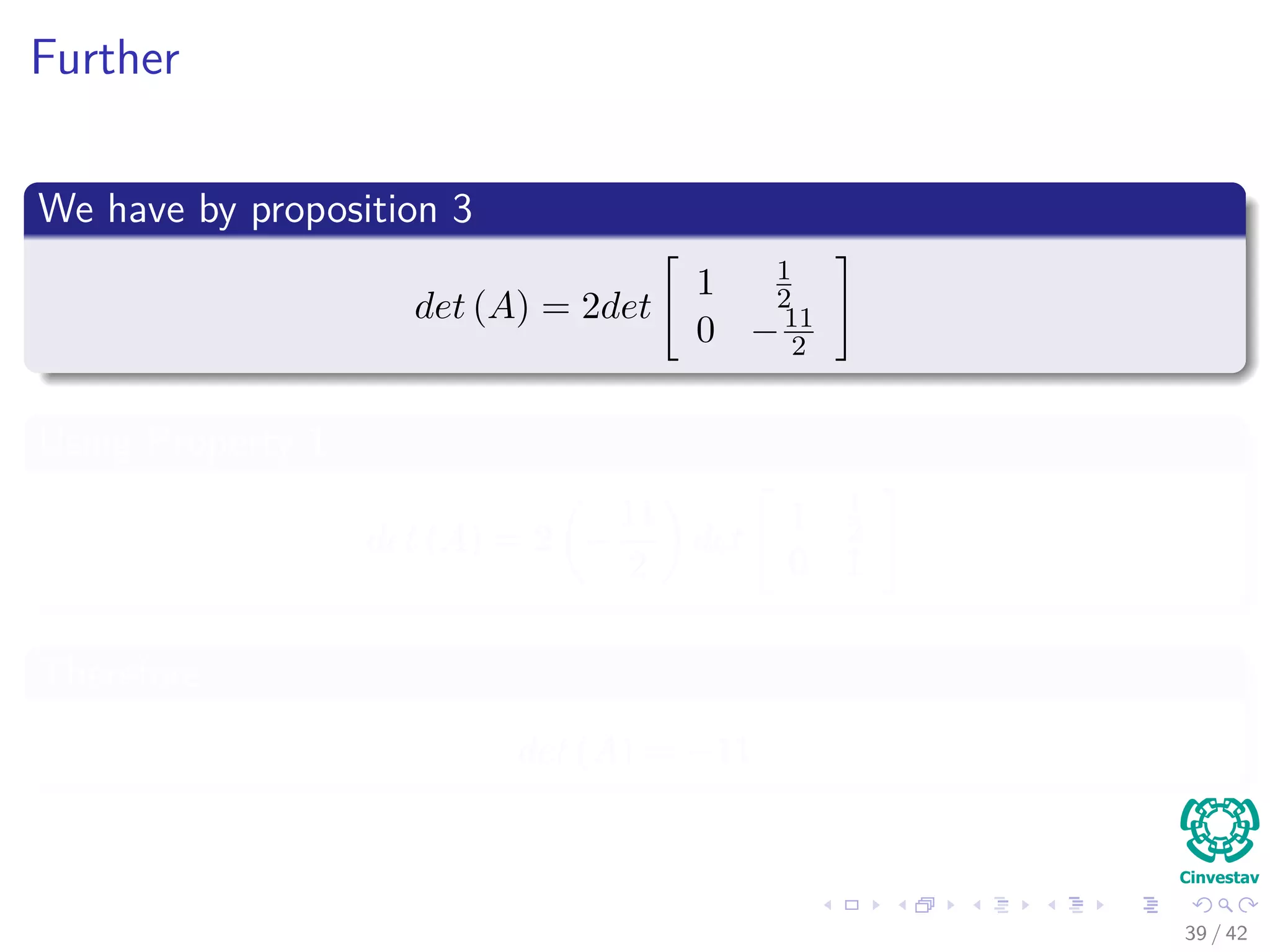
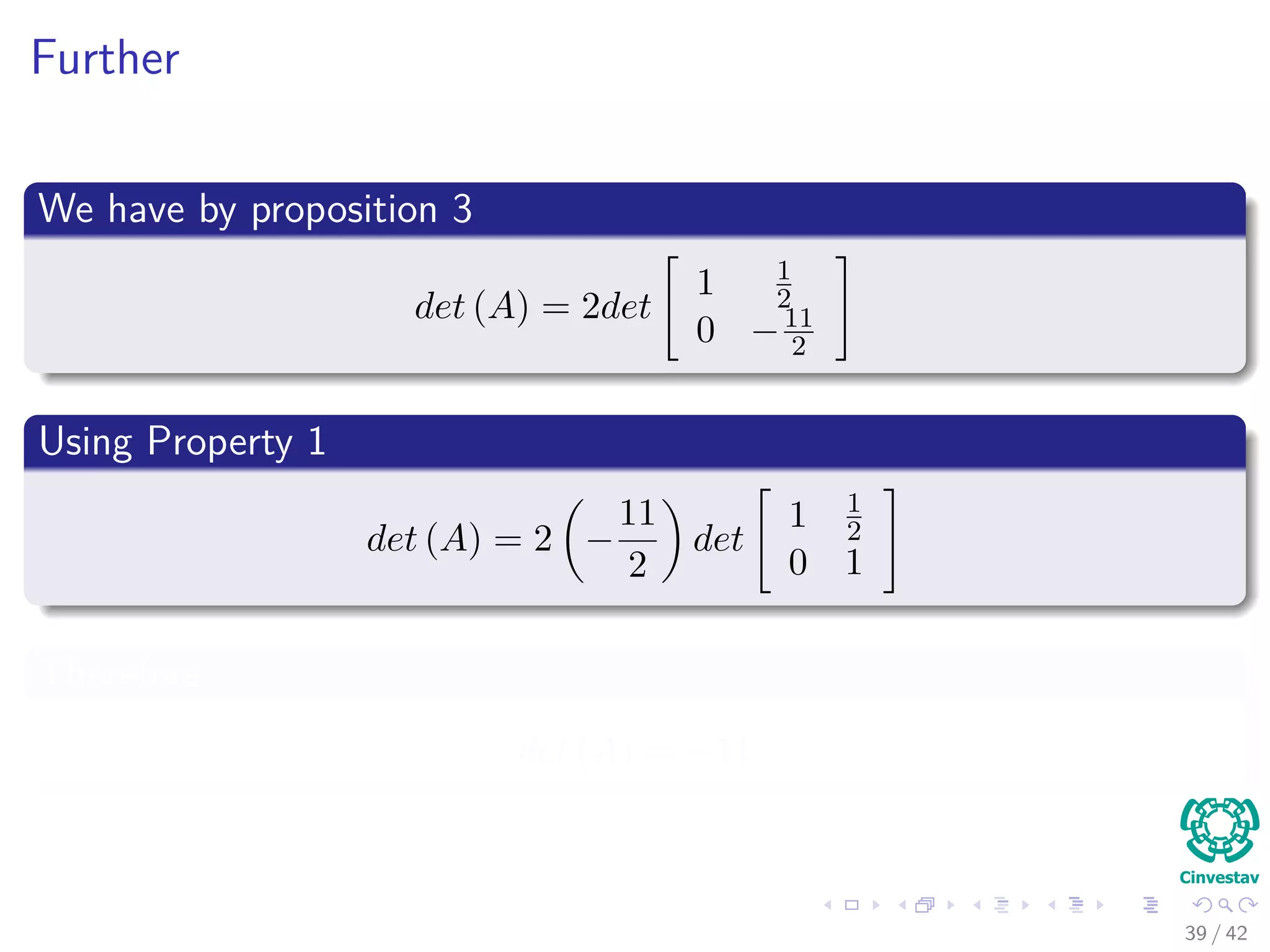
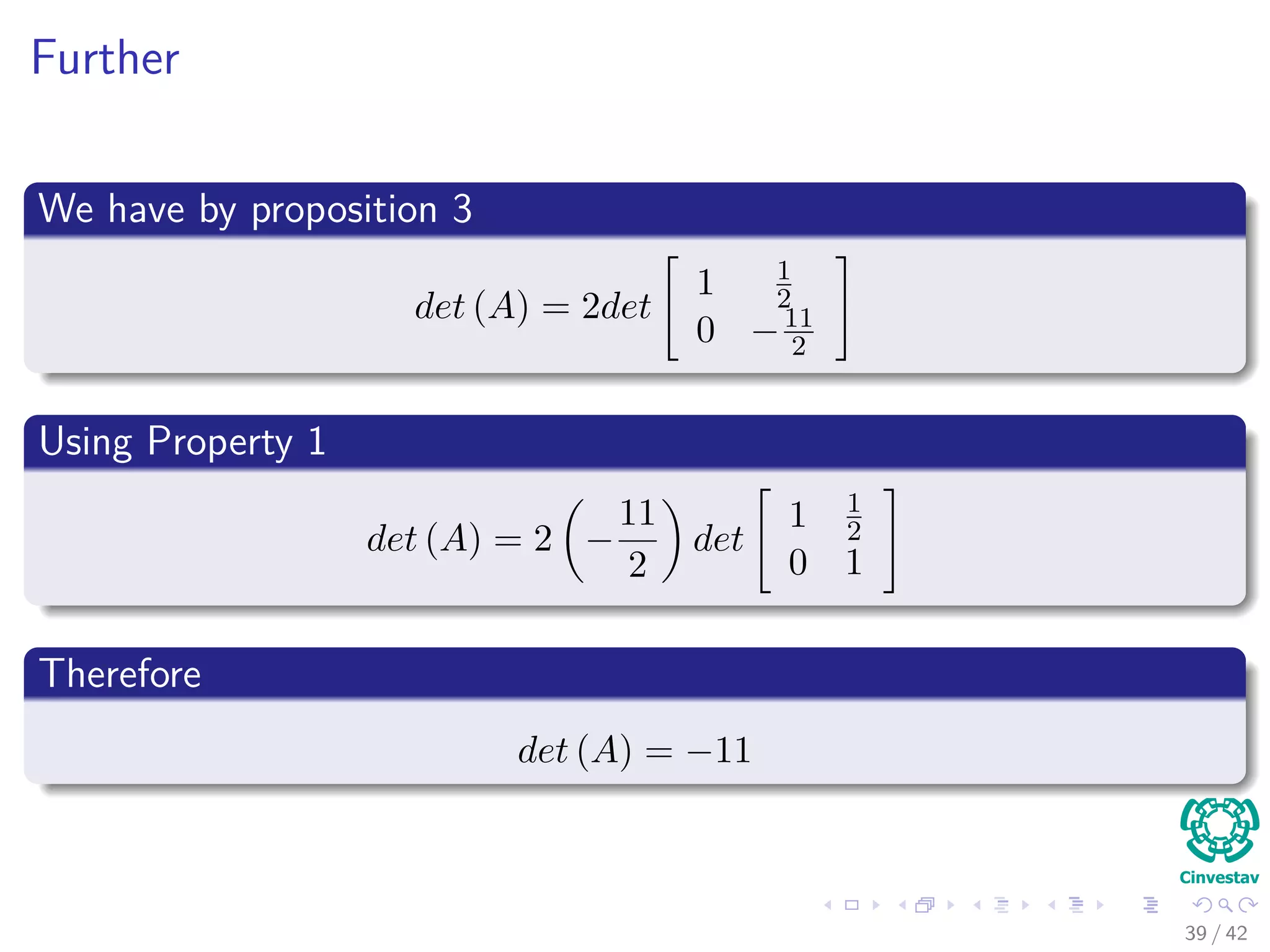
Further
We have by proposition 3
det (A) = 2det
1 1
2
0 −11
2
Using Property 1
det (A) = 2 −
11
2
det
1 1
2
0 1
Therefore
det (A) = −11
39 / 42
Further
We have by proposition 3
det (A) = 2det
1 1
2
0 −11
2
Using Property 1
det (A) = 2 −
11
2
det
1 1
2
0 1
Therefore
det (A) = −11
39 / 42
Further
We have by proposition 3
det (A) = 2det
1 1
2
0 −11
2
Using Property 1
det (A) = 2 −
11
2
det
1 1
2
0 1
Therefore
det (A) = −11
39 / 42
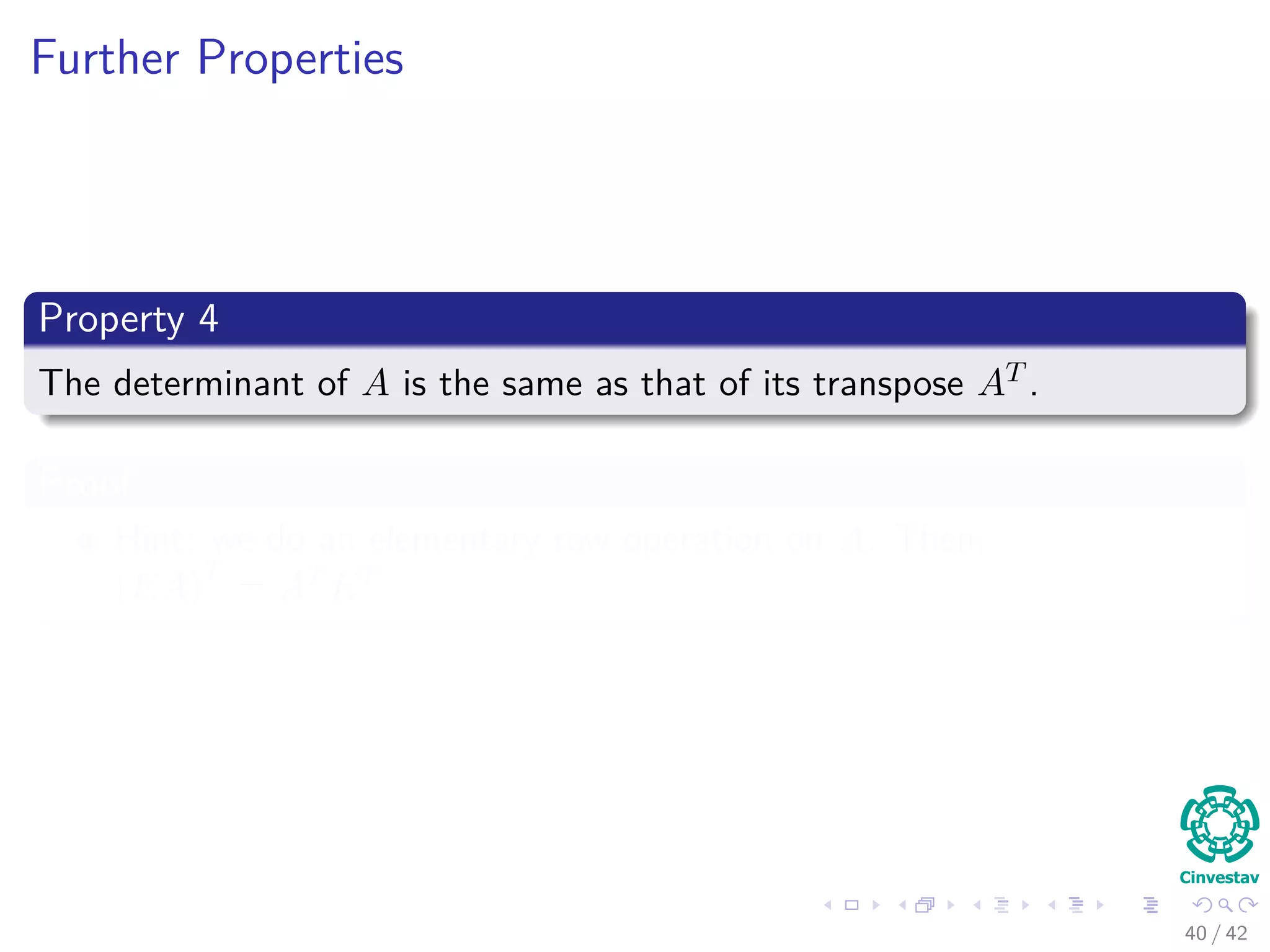
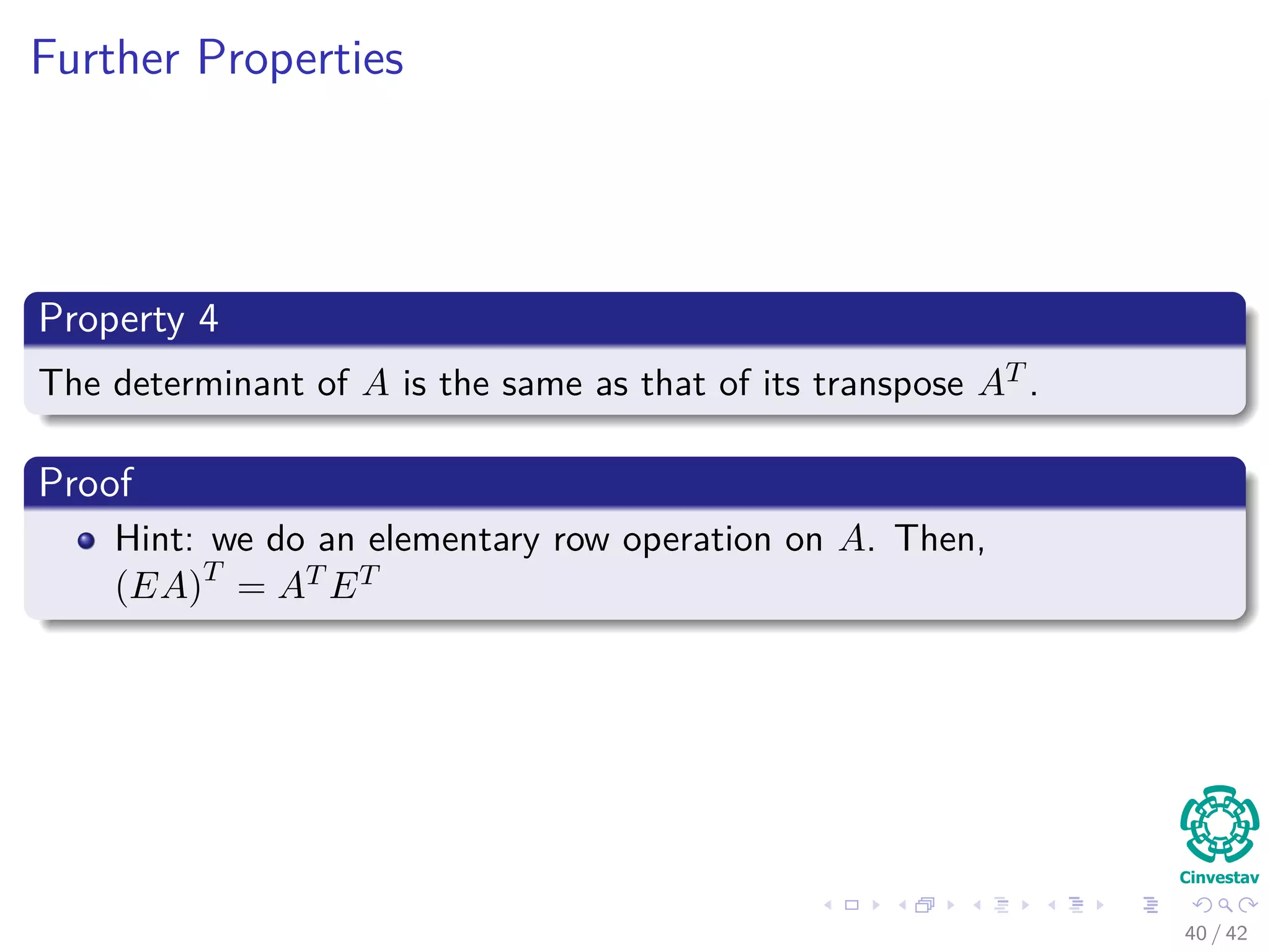
Further Properties
Property 4
The determinant of A is the same as that of its transpose AT .
Proof
Hint: we do an elementary row operation on A. Then,
(EA)T
= AT ET
40 / 42
Further Properties
Property 4
The determinant of A is the same as that of its transpose AT .
Proof
Hint: we do an elementary row operation on A. Then,
(EA)T
= AT ET
40 / 42
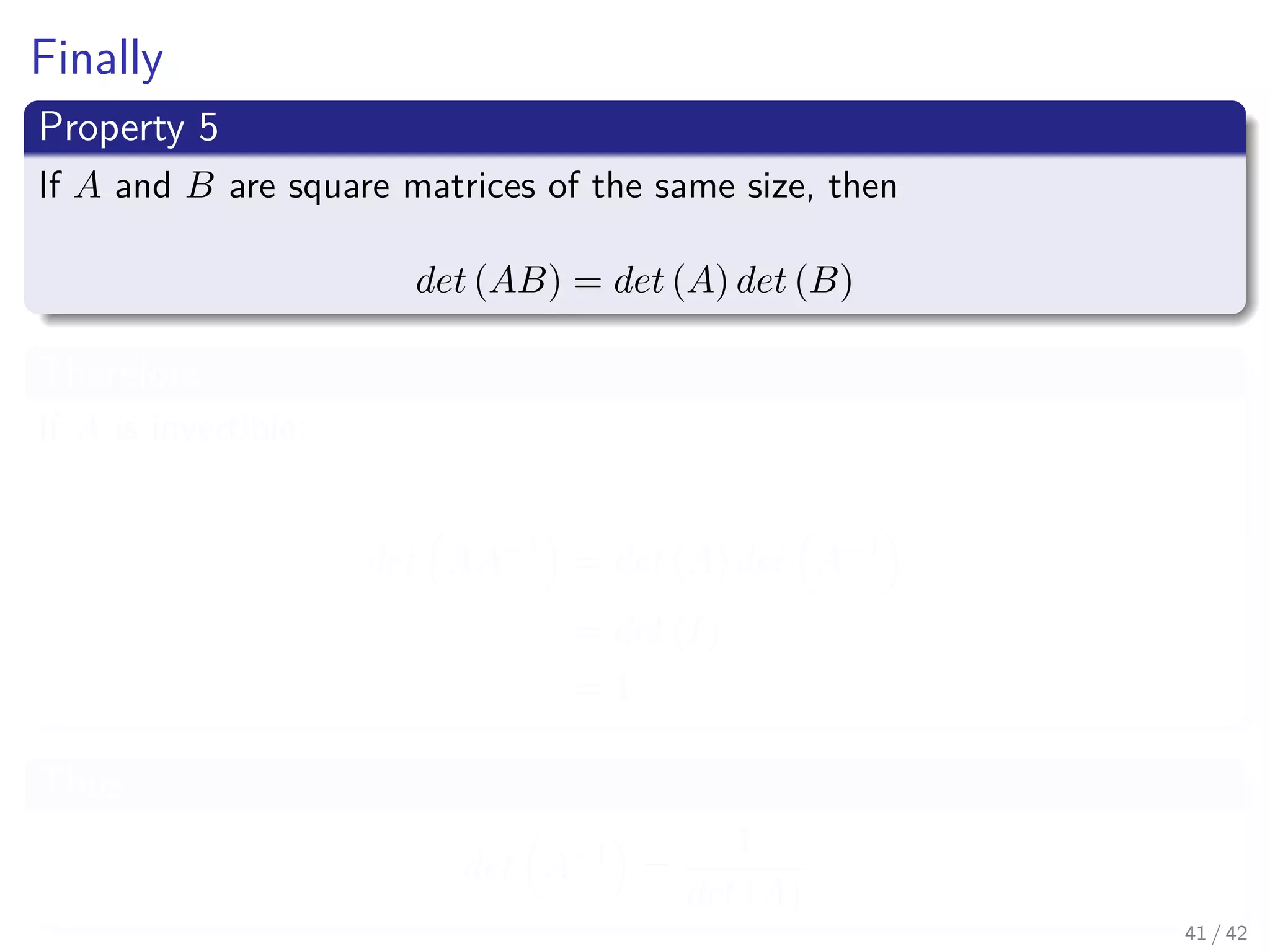
Finally
Property 5
If A and B are square matrices of the same size, then
det (AB) = det (A) det (B)
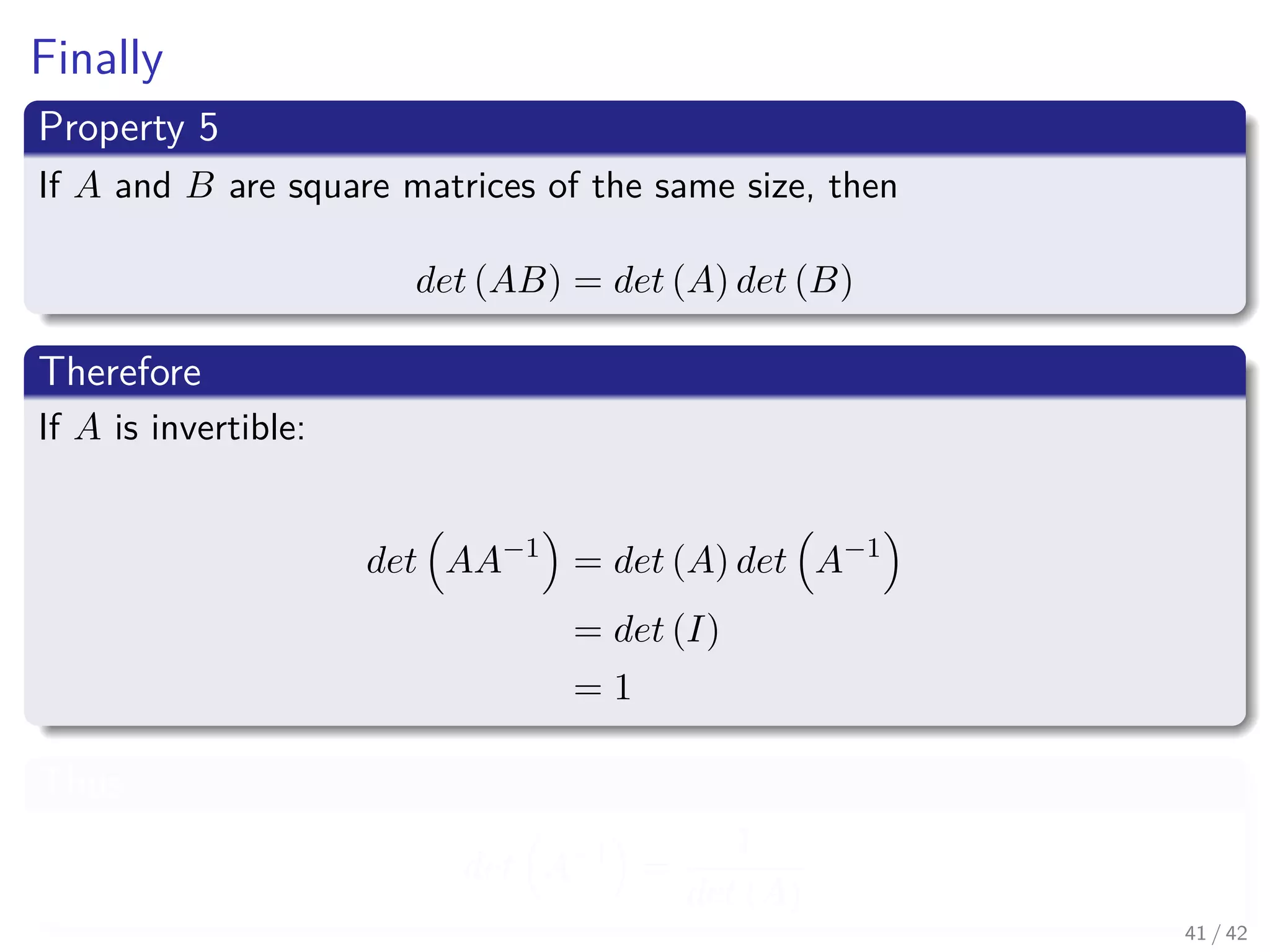
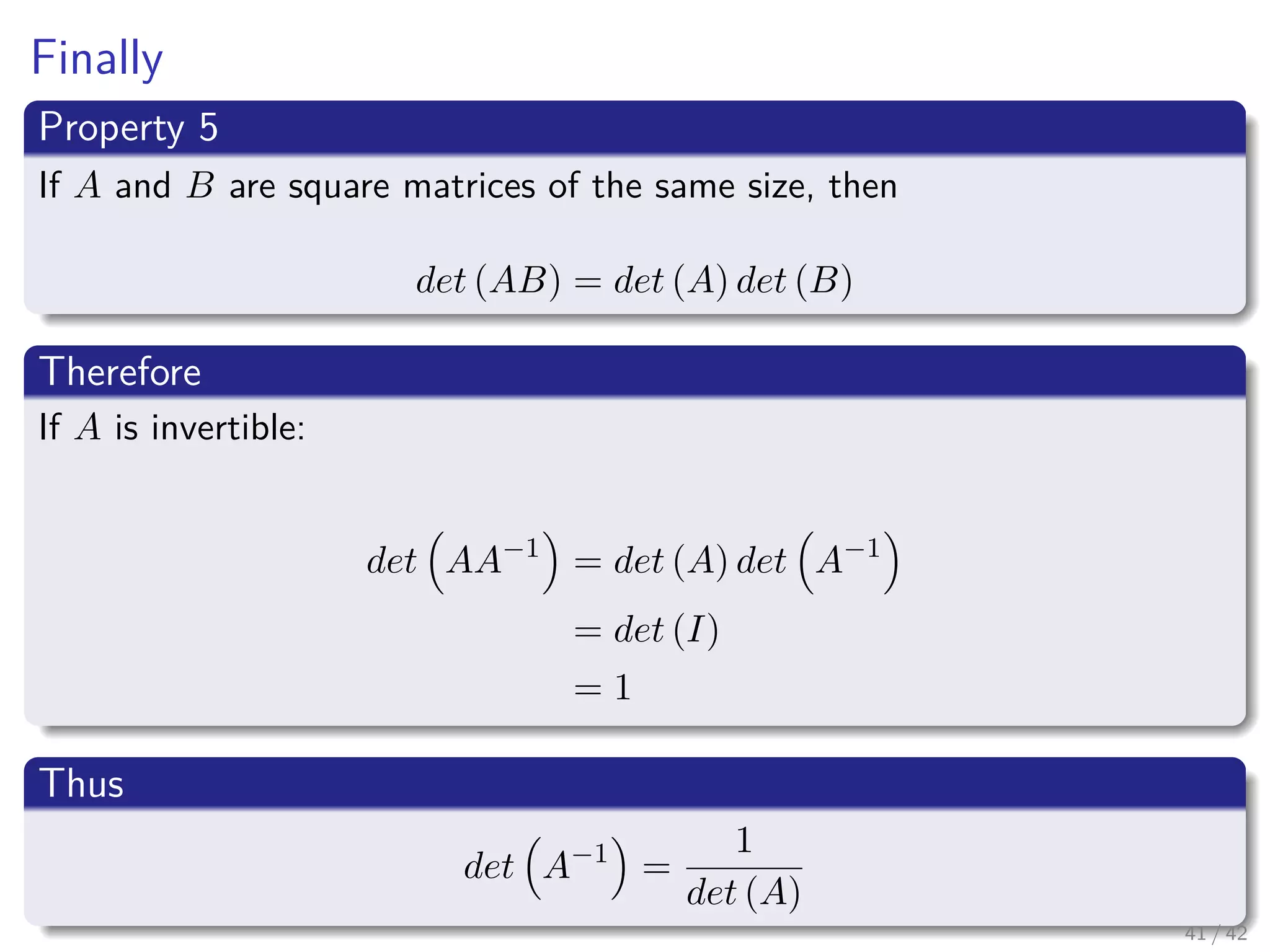
Therefore
If A is invertible:
det AA−1
= det (A) det A−1
= det (I)
= 1
Thus
det A−1
=
1
det (A)
41 / 42
Finally
Property 5
If A and B are square matrices of the same size, then
det (AB) = det (A) det (B)
Therefore
If A is invertible:
det AA−1
= det (A) det A−1
= det (I)
= 1
Thus
det A−1
=
1
det (A)
41 / 42
Finally
Property 5
If A and B are square matrices of the same size, then
det (AB) = det (A) det (B)
Therefore
If A is invertible:
det AA−1
= det (A) det A−1
= det (I)
= 1
Thus
det A−1
=
1
det (A)
41 / 42
Finally
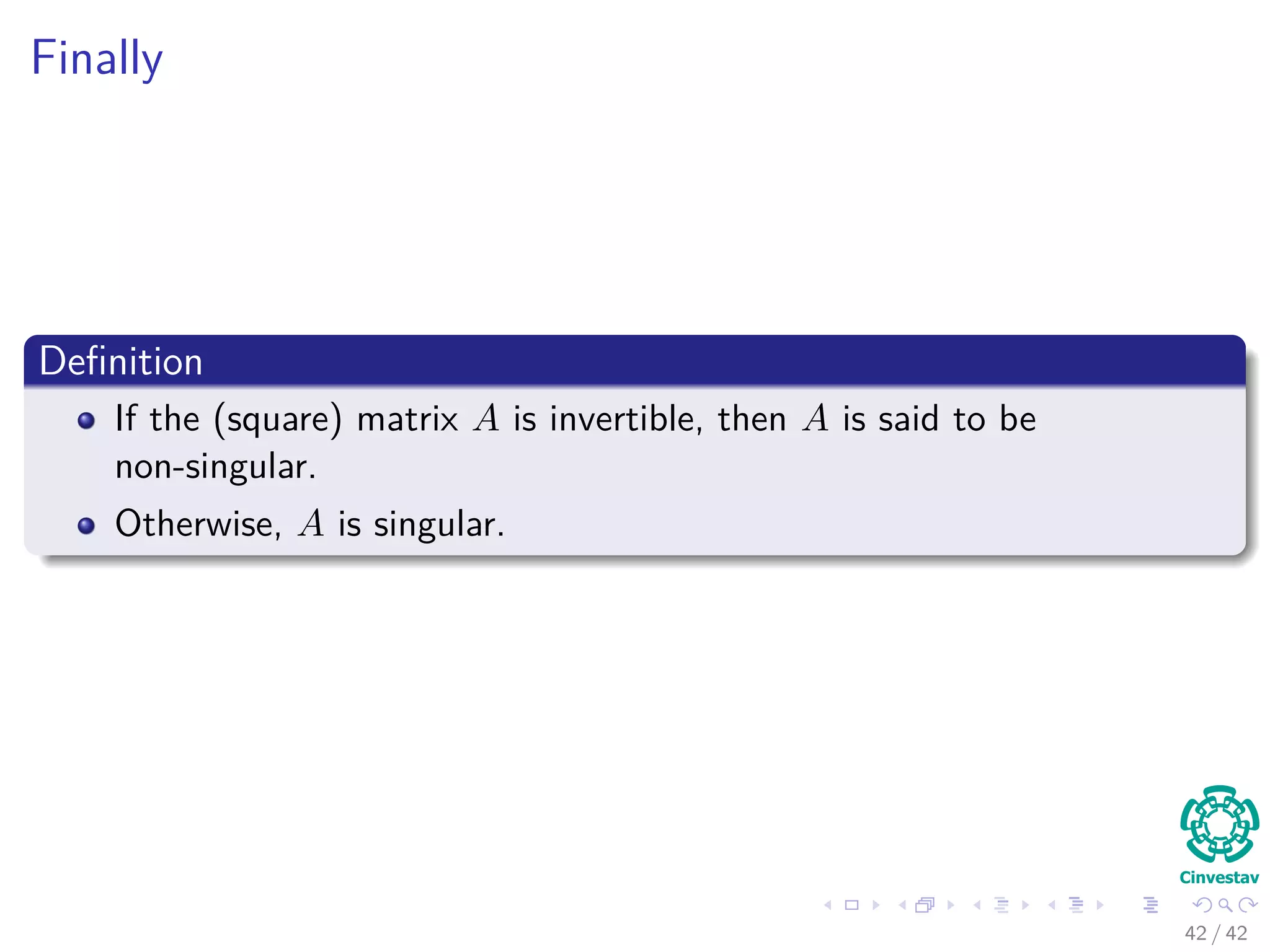
Definition
If the (square) matrix A is invertible, then A is said to be
non-singular.
Otherwise, A is singular.
42 / 42

01.03 squared matrices_and_other_issues

  • 1.
    Mathematics for ArtificialIntelligence Square Matrices and Related Matters Andres Mendez-Vazquez March 2, 2020 1 / 42
  • 2.
    Outline 1 Square Matrices Introduction TheInverse Solution to Ax = y Algorithm for the Inverse of a Matrix 2 Determinants Introduction Complexity Increases Reducing the Complexity Some Consequences of the definition Special Determinants 2 / 42
  • 3.
    Outline 1 Square Matrices Introduction TheInverse Solution to Ax = y Algorithm for the Inverse of a Matrix 2 Determinants Introduction Complexity Increases Reducing the Complexity Some Consequences of the definition Special Determinants 3 / 42
  • 4.
    Square Matrices Observation Square matricesare the only matrices that can have inverses. Further In a system of linear algebraic equations: 1 If the number of equations equals the number of unknowns 2 Then the associated coefficient matrix A is square. Now, use the Gauss-Jordan What can happen? 4 / 42
  • 5.
    Square Matrices Observation Square matricesare the only matrices that can have inverses. Further In a system of linear algebraic equations: 1 If the number of equations equals the number of unknowns 2 Then the associated coefficient matrix A is square. Now, use the Gauss-Jordan What can happen? 4 / 42
  • 6.
    Square Matrices Observation Square matricesare the only matrices that can have inverses. Further In a system of linear algebraic equations: 1 If the number of equations equals the number of unknowns 2 Then the associated coefficient matrix A is square. Now, use the Gauss-Jordan What can happen? 4 / 42
  • 7.
    Outline 1 Square Matrices Introduction TheInverse Solution to Ax = y Algorithm for the Inverse of a Matrix 2 Determinants Introduction Complexity Increases Reducing the Complexity Some Consequences of the definition Special Determinants 5 / 42
  • 8.
    We have twopossibilities First case The Gauss-Jordan form for An×n is the n × n identity matrix In Second case The Gauss-Jordan form for A has at least one row of zeros 6 / 42
  • 9.
    We have twopossibilities First case The Gauss-Jordan form for An×n is the n × n identity matrix In Second case The Gauss-Jordan form for A has at least one row of zeros 6 / 42
  • 10.
    Explanation In the firstcase We can show that A is invertible. How? Do you remember? EkEk−1...E2E1A = I, Setting B = EkEk−1...E2E1 We have BA = I therefore B = A−1 7 / 42
  • 11.
    Explanation In the firstcase We can show that A is invertible. How? Do you remember? EkEk−1...E2E1A = I, Setting B = EkEk−1...E2E1 We have BA = I therefore B = A−1 7 / 42
  • 12.
    Explanation In the firstcase We can show that A is invertible. How? Do you remember? EkEk−1...E2E1A = I, Setting B = EkEk−1...E2E1 We have BA = I therefore B = A−1 7 / 42
  • 13.
    Furthermore We can buildthe following matrix E−1 1 E−1 2 · · · E−1 k Then E−1 1 E−1 2 · · · E−1 k BA = E−1 1 E−1 2 · · · E−1 k I Thus E−1 1 E−1 2 · · · E−1 k (EkEk−1...E2E1) A = E−1 1 E−1 2 · · · E−1 k 8 / 42
  • 14.
    Furthermore We can buildthe following matrix E−1 1 E−1 2 · · · E−1 k Then E−1 1 E−1 2 · · · E−1 k BA = E−1 1 E−1 2 · · · E−1 k I Thus E−1 1 E−1 2 · · · E−1 k (EkEk−1...E2E1) A = E−1 1 E−1 2 · · · E−1 k 8 / 42
  • 15.
    Furthermore We can buildthe following matrix E−1 1 E−1 2 · · · E−1 k Then E−1 1 E−1 2 · · · E−1 k BA = E−1 1 E−1 2 · · · E−1 k I Thus E−1 1 E−1 2 · · · E−1 k (EkEk−1...E2E1) A = E−1 1 E−1 2 · · · E−1 k 8 / 42
  • 16.
    Therefore We have A =E−1 1 E−1 2 · · · E−1 k Theorem The following are equivalent: 1 The square matrix A is invertible. 2 The Gauss-Jordan or reduced echelon form of A is the identity matrix. 3 Acan be written as a product of elementary matrices. 9 / 42
  • 17.
    Therefore We have A =E−1 1 E−1 2 · · · E−1 k Theorem The following are equivalent: 1 The square matrix A is invertible. 2 The Gauss-Jordan or reduced echelon form of A is the identity matrix. 3 Acan be written as a product of elementary matrices. 9 / 42
  • 18.
    The Second Case TheGauss-Jordan form of An×n It can only have at most n leading entries. If the Gauss-Jordan form of A is not I We have something quite different Then the GJ form has n − 1 or fewer leading entries Therefore, it has at least one row of zeros. 10 / 42
  • 19.
    The Second Case TheGauss-Jordan form of An×n It can only have at most n leading entries. If the Gauss-Jordan form of A is not I We have something quite different Then the GJ form has n − 1 or fewer leading entries Therefore, it has at least one row of zeros. 10 / 42
  • 20.
    The Second Case TheGauss-Jordan form of An×n It can only have at most n leading entries. If the Gauss-Jordan form of A is not I We have something quite different Then the GJ form has n − 1 or fewer leading entries Therefore, it has at least one row of zeros. 10 / 42
  • 21.
    Example Given A = 2 1 12 What do we need to do? Look at the blackboard... Therefore A−1 = E4E3E2E1 11 / 42
  • 22.
    Example Given A = 2 1 12 What do we need to do? Look at the blackboard... Therefore A−1 = E4E3E2E1 11 / 42
  • 23.
    Example Given A = 2 1 12 What do we need to do? Look at the blackboard... Therefore A−1 = E4E3E2E1 11 / 42
  • 24.
    Outline 1 Square Matrices Introduction TheInverse Solution to Ax = y Algorithm for the Inverse of a Matrix 2 Determinants Introduction Complexity Increases Reducing the Complexity Some Consequences of the definition Special Determinants 12 / 42
  • 25.
    If A isinvertible a.k.a. full rank Equation Ax = y has the unique solution Ax = y ⇔ A−1 Ax = A−1 y ⇔ x = A−1 y If A is not invertible Then there is at least one free variable. There are non-trivial solutions to Ax = 0. If y = 0 Either Ax = y is inconsistent. Solutions to the system exist, but there are infinitely many. 13 / 42
  • 26.
    If A isinvertible a.k.a. full rank Equation Ax = y has the unique solution Ax = y ⇔ A−1 Ax = A−1 y ⇔ x = A−1 y If A is not invertible Then there is at least one free variable. There are non-trivial solutions to Ax = 0. If y = 0 Either Ax = y is inconsistent. Solutions to the system exist, but there are infinitely many. 13 / 42
  • 27.
    If A isinvertible a.k.a. full rank Equation Ax = y has the unique solution Ax = y ⇔ A−1 Ax = A−1 y ⇔ x = A−1 y If A is not invertible Then there is at least one free variable. There are non-trivial solutions to Ax = 0. If y = 0 Either Ax = y is inconsistent. Solutions to the system exist, but there are infinitely many. 13 / 42
  • 28.
    If A isinvertible a.k.a. full rank Equation Ax = y has the unique solution Ax = y ⇔ A−1 Ax = A−1 y ⇔ x = A−1 y If A is not invertible Then there is at least one free variable. There are non-trivial solutions to Ax = 0. If y = 0 Either Ax = y is inconsistent. Solutions to the system exist, but there are infinitely many. 13 / 42
  • 29.
    If A isinvertible a.k.a. full rank Equation Ax = y has the unique solution Ax = y ⇔ A−1 Ax = A−1 y ⇔ x = A−1 y If A is not invertible Then there is at least one free variable. There are non-trivial solutions to Ax = 0. If y = 0 Either Ax = y is inconsistent. Solutions to the system exist, but there are infinitely many. 13 / 42
  • 30.
    Outline 1 Square Matrices Introduction TheInverse Solution to Ax = y Algorithm for the Inverse of a Matrix 2 Determinants Introduction Complexity Increases Reducing the Complexity Some Consequences of the definition Special Determinants 14 / 42
  • 31.
    Something Quite Important Wehave done something important It leads immediately to an algorithm for constructing the inverse of A. Observation Suppose Bn×p is another matrix with the same number of rows as An×n Then C = (A|B)n×(n+p) 15 / 42
  • 32.
    Something Quite Important Wehave done something important It leads immediately to an algorithm for constructing the inverse of A. Observation Suppose Bn×p is another matrix with the same number of rows as An×n Then C = (A|B)n×(n+p) 15 / 42
  • 33.
    Something Quite Important Wehave done something important It leads immediately to an algorithm for constructing the inverse of A. Observation Suppose Bn×p is another matrix with the same number of rows as An×n Then C = (A|B)n×(n+p) 15 / 42
  • 34.
    Then It is obvious EC= (EA|EB)n×(n+p) Where EA is a n × n matrix. EB is a n × p matrix 16 / 42
  • 35.
    Then It is obvious EC= (EA|EB)n×(n+p) Where EA is a n × n matrix. EB is a n × p matrix 16 / 42
  • 36.
    Algorithm Form the partitionedmatrix C = (A|I) Apply the Gauss-Jordan reduction EkEk−1 · · · E1 (A|I) = (EkEk−1 · · · E1A|EkEk−1 · · · E1I) Therefore, if A is invertible (EkEk−1 · · · E1A|EkEk−1 · · · E1I) = I|A−1 17 / 42
  • 37.
    Algorithm Form the partitionedmatrix C = (A|I) Apply the Gauss-Jordan reduction EkEk−1 · · · E1 (A|I) = (EkEk−1 · · · E1A|EkEk−1 · · · E1I) Therefore, if A is invertible (EkEk−1 · · · E1A|EkEk−1 · · · E1I) = I|A−1 17 / 42
  • 38.
    Algorithm Form the partitionedmatrix C = (A|I) Apply the Gauss-Jordan reduction EkEk−1 · · · E1 (A|I) = (EkEk−1 · · · E1A|EkEk−1 · · · E1I) Therefore, if A is invertible (EkEk−1 · · · E1A|EkEk−1 · · · E1I) = I|A−1 17 / 42
  • 39.
    Remark The individual factorsin the product of A−1 are not unique They depend on how we do the row reduction. 18 / 42
  • 40.
    Outline 1 Square Matrices Introduction TheInverse Solution to Ax = y Algorithm for the Inverse of a Matrix 2 Determinants Introduction Complexity Increases Reducing the Complexity Some Consequences of the definition Special Determinants 19 / 42
  • 41.
    Before the Matrixwe had the Determinant You have seen determinants in your classes long ago A = a b c d =⇒ det (A) = ad − bc What about    a11 a12 a13 a21 a22 a23 a31 a32 a33    Then det (A) =a11a22a33 + a12a21a32 + a12a23a31 − ... a12a21a33 − a11a23a32 − a13a22a31 20 / 42
  • 42.
    Before the Matrixwe had the Determinant You have seen determinants in your classes long ago A = a b c d =⇒ det (A) = ad − bc What about    a11 a12 a13 a21 a22 a23 a31 a32 a33    Then det (A) =a11a22a33 + a12a21a32 + a12a23a31 − ... a12a21a33 − a11a23a32 − a13a22a31 20 / 42
  • 43.
    Before the Matrixwe had the Determinant You have seen determinants in your classes long ago A = a b c d =⇒ det (A) = ad − bc What about    a11 a12 a13 a21 a22 a23 a31 a32 a33    Then det (A) =a11a22a33 + a12a21a32 + a12a23a31 − ... a12a21a33 − a11a23a32 − a13a22a31 20 / 42
  • 44.
    Recursive Definition Definition Let Abe a n × n matrix. Then the determinant of A is defined as follow: det (A) = a11 if n = 1 n i=1 ai1Ai1 if n > 1 Where Aij is the (i, j) −cofactor where Aij = (−1)i+j det (Mij) Here Mij is the (n − 1) × (n − 1) matrix obtained from A by removing its ith row and jth column. 21 / 42
  • 45.
    Recursive Definition Definition Let Abe a n × n matrix. Then the determinant of A is defined as follow: det (A) = a11 if n = 1 n i=1 ai1Ai1 if n > 1 Where Aij is the (i, j) −cofactor where Aij = (−1)i+j det (Mij) Here Mij is the (n − 1) × (n − 1) matrix obtained from A by removing its ith row and jth column. 21 / 42
  • 46.
    Recursive Definition Definition Let Abe a n × n matrix. Then the determinant of A is defined as follow: det (A) = a11 if n = 1 n i=1 ai1Ai1 if n > 1 Where Aij is the (i, j) −cofactor where Aij = (−1)i+j det (Mij) Here Mij is the (n − 1) × (n − 1) matrix obtained from A by removing its ith row and jth column. 21 / 42
  • 47.
    Example We have    1 11 0 2 1 0 0 3    22 / 42
  • 48.
    Outline 1 Square Matrices Introduction TheInverse Solution to Ax = y Algorithm for the Inverse of a Matrix 2 Determinants Introduction Complexity Increases Reducing the Complexity Some Consequences of the definition Special Determinants 23 / 42
  • 49.
    Problems Will Robinson!!! Wehave that for a An×n det (A) has n factorials (n!)terms Problems The fastest computer of the world will take forever to finish 24 / 42
  • 50.
    Problems Will Robinson!!! Wehave that for a An×n det (A) has n factorials (n!)terms Problems The fastest computer of the world will take forever to finish 24 / 42
  • 51.
    Thus, we havesome problems with that Floating point arithmetic It is not at all the same thing as working with real numbers. Representation x = (d1d2d3 · · · dn) × 2a1a2···am (1) The problem is at the round off When we do a calculation on a computer, we almost never get the right answer. 25 / 42
  • 52.
    Thus, we havesome problems with that Floating point arithmetic It is not at all the same thing as working with real numbers. Representation x = (d1d2d3 · · · dn) × 2a1a2···am (1) The problem is at the round off When we do a calculation on a computer, we almost never get the right answer. 25 / 42
  • 53.
    Thus, we havesome problems with that Floating point arithmetic It is not at all the same thing as working with real numbers. Representation x = (d1d2d3 · · · dn) × 2a1a2···am (1) The problem is at the round off When we do a calculation on a computer, we almost never get the right answer. 25 / 42
  • 54.
    Another Problems We wouldlove the floating points to be represented uniformly The floating point numbers are distributed logarithmically which is quite different from the even distribution of the rationals. Computations do not scale well 2 multiplications and 1 addition to compute the 2 × 2 determinant 12 multiplications and 5 additions to compute the 3 × 3 determinant 72 multiplications and 23 additions to 26 / 42
  • 55.
    Another Problems We wouldlove the floating points to be represented uniformly The floating point numbers are distributed logarithmically which is quite different from the even distribution of the rationals. Computations do not scale well 2 multiplications and 1 addition to compute the 2 × 2 determinant 12 multiplications and 5 additions to compute the 3 × 3 determinant 72 multiplications and 23 additions to 26 / 42
  • 56.
    Another Problems We wouldlove the floating points to be represented uniformly The floating point numbers are distributed logarithmically which is quite different from the even distribution of the rationals. Computations do not scale well 2 multiplications and 1 addition to compute the 2 × 2 determinant 12 multiplications and 5 additions to compute the 3 × 3 determinant 72 multiplications and 23 additions to 26 / 42
  • 57.
    Another Problems We wouldlove the floating points to be represented uniformly The floating point numbers are distributed logarithmically which is quite different from the even distribution of the rationals. Computations do not scale well 2 multiplications and 1 addition to compute the 2 × 2 determinant 12 multiplications and 5 additions to compute the 3 × 3 determinant 72 multiplications and 23 additions to 26 / 42
  • 58.
    Outline 1 Square Matrices Introduction TheInverse Solution to Ax = y Algorithm for the Inverse of a Matrix 2 Determinants Introduction Complexity Increases Reducing the Complexity Some Consequences of the definition Special Determinants 27 / 42
  • 59.
    Therefore How do weavoid to get us into problems? We need to define our determinant as a different structure.... Definition The determinant of A is a real-valued function of the rows of A which we write as det (A) = det (r1, r2, ..., rn) 28 / 42
  • 60.
    Therefore How do weavoid to get us into problems? We need to define our determinant as a different structure.... Definition The determinant of A is a real-valued function of the rows of A which we write as det (A) = det (r1, r2, ..., rn) 28 / 42
  • 61.
    Properties Multiplying a rowby the constant c multiplies the determinant by c det (r1, r2, ..., cri, ..., rn) = cdet (r1, r2, ..., ri, ..., rn) If row i is the sum of the two row vectors x and y det (r1, r2, ..., x + y, ..., rn) =det (r1, r2, ..., x, ..., rn) + ... det (r1, r2, ..., y, ..., rn) Meaning The determinant is a linear function of each row. 29 / 42
  • 62.
    Properties Multiplying a rowby the constant c multiplies the determinant by c det (r1, r2, ..., cri, ..., rn) = cdet (r1, r2, ..., ri, ..., rn) If row i is the sum of the two row vectors x and y det (r1, r2, ..., x + y, ..., rn) =det (r1, r2, ..., x, ..., rn) + ... det (r1, r2, ..., y, ..., rn) Meaning The determinant is a linear function of each row. 29 / 42
  • 63.
    Properties Multiplying a rowby the constant c multiplies the determinant by c det (r1, r2, ..., cri, ..., rn) = cdet (r1, r2, ..., ri, ..., rn) If row i is the sum of the two row vectors x and y det (r1, r2, ..., x + y, ..., rn) =det (r1, r2, ..., x, ..., rn) + ... det (r1, r2, ..., y, ..., rn) Meaning The determinant is a linear function of each row. 29 / 42
  • 64.
    Further Interchanging any tworows of the matrix changes the sign of the determinant det (..., ri, ..., rj, ..., ...) = det (..., rj, ..., ri, ..., ...) Finally The determinant of any identity matrix is 1 30 / 42
  • 65.
    Further Interchanging any tworows of the matrix changes the sign of the determinant det (..., ri, ..., rj, ..., ...) = det (..., rj, ..., ri, ..., ...) Finally The determinant of any identity matrix is 1 30 / 42
  • 66.
    Outline 1 Square Matrices Introduction TheInverse Solution to Ax = y Algorithm for the Inverse of a Matrix 2 Determinants Introduction Complexity Increases Reducing the Complexity Some Consequences of the definition Special Determinants 31 / 42
  • 67.
    Some Properties Property 1 IfA has a row of zeros, then det(A) = 0. Proof 1 if A = (..., 0, ...), also A = (..., c0, ...) 2 det (A) = c × det (A) for any c 3 Thus det (A) = 0 32 / 42
  • 68.
    Some Properties Property 1 IfA has a row of zeros, then det(A) = 0. Proof 1 if A = (..., 0, ...), also A = (..., c0, ...) 2 det (A) = c × det (A) for any c 3 Thus det (A) = 0 32 / 42
  • 69.
    Some Properties Property 1 IfA has a row of zeros, then det(A) = 0. Proof 1 if A = (..., 0, ...), also A = (..., c0, ...) 2 det (A) = c × det (A) for any c 3 Thus det (A) = 0 32 / 42
  • 70.
    Some Properties Property 1 IfA has a row of zeros, then det(A) = 0. Proof 1 if A = (..., 0, ...), also A = (..., c0, ...) 2 det (A) = c × det (A) for any c 3 Thus det (A) = 0 32 / 42
  • 71.
    Next Property 2 If ri= rj , i = j, then det(A) = 0. Proof Quite easy (Hint sing being reversed). 33 / 42
  • 72.
    Next Property 2 If ri= rj , i = j, then det(A) = 0. Proof Quite easy (Hint sing being reversed). 33 / 42
  • 73.
    Finally Proposition 3 If Bis obtained from A by replacing ri with ri + crj , then det(B) = det(A) Proof det (B) = det (..., ri + crj, ..., rj, ...) = det (..., ri, ..., rj, ...) + det (..., crj, ..., rj, ...) = det (A) + cdet (..., rj, ..., rj, ...) = det (A) + 0 34 / 42
  • 74.
    Finally Proposition 3 If Bis obtained from A by replacing ri with ri + crj , then det(B) = det(A) Proof det (B) = det (..., ri + crj, ..., rj, ...) = det (..., ri, ..., rj, ...) + det (..., crj, ..., rj, ...) = det (A) + cdet (..., rj, ..., rj, ...) = det (A) + 0 34 / 42
  • 75.
    Finally Proposition 3 If Bis obtained from A by replacing ri with ri + crj , then det(B) = det(A) Proof det (B) = det (..., ri + crj, ..., rj, ...) = det (..., ri, ..., rj, ...) + det (..., crj, ..., rj, ...) = det (A) + cdet (..., rj, ..., rj, ...) = det (A) + 0 34 / 42
  • 76.
    Finally Proposition 3 If Bis obtained from A by replacing ri with ri + crj , then det(B) = det(A) Proof det (B) = det (..., ri + crj, ..., rj, ...) = det (..., ri, ..., rj, ...) + det (..., crj, ..., rj, ...) = det (A) + cdet (..., rj, ..., rj, ...) = det (A) + 0 34 / 42
  • 77.
    Finally Proposition 3 If Bis obtained from A by replacing ri with ri + crj , then det(B) = det(A) Proof det (B) = det (..., ri + crj, ..., rj, ...) = det (..., ri, ..., rj, ...) + det (..., crj, ..., rj, ...) = det (A) + cdet (..., rj, ..., rj, ...) = det (A) + 0 34 / 42
  • 78.
    Outline 1 Square Matrices Introduction TheInverse Solution to Ax = y Algorithm for the Inverse of a Matrix 2 Determinants Introduction Complexity Increases Reducing the Complexity Some Consequences of the definition Special Determinants 35 / 42
  • 79.
    Therefore Theorem The determinant ofan upper or lower triangular matrix is equal to the product of the entries on the main diagonal. Proof Suppose A is upper triangular and that none of the entries on the main diagonal is 0. This means all the entries beneath the main diagonal are zero. Using Proposition 3, we can convert it into a diagonal matrix. Then, by property 1 det (Adiag) = [ n i aii] det (I) = n i aii 36 / 42
  • 80.
    Therefore Theorem The determinant ofan upper or lower triangular matrix is equal to the product of the entries on the main diagonal. Proof Suppose A is upper triangular and that none of the entries on the main diagonal is 0. This means all the entries beneath the main diagonal are zero. Using Proposition 3, we can convert it into a diagonal matrix. Then, by property 1 det (Adiag) = [ n i aii] det (I) = n i aii 36 / 42
  • 81.
    Therefore Theorem The determinant ofan upper or lower triangular matrix is equal to the product of the entries on the main diagonal. Proof Suppose A is upper triangular and that none of the entries on the main diagonal is 0. This means all the entries beneath the main diagonal are zero. Using Proposition 3, we can convert it into a diagonal matrix. Then, by property 1 det (Adiag) = [ n i aii] det (I) = n i aii 36 / 42
  • 82.
    Therefore Theorem The determinant ofan upper or lower triangular matrix is equal to the product of the entries on the main diagonal. Proof Suppose A is upper triangular and that none of the entries on the main diagonal is 0. This means all the entries beneath the main diagonal are zero. Using Proposition 3, we can convert it into a diagonal matrix. Then, by property 1 det (Adiag) = [ n i aii] det (I) = n i aii 36 / 42
  • 83.
    Therefore Theorem The determinant ofan upper or lower triangular matrix is equal to the product of the entries on the main diagonal. Proof Suppose A is upper triangular and that none of the entries on the main diagonal is 0. This means all the entries beneath the main diagonal are zero. Using Proposition 3, we can convert it into a diagonal matrix. Then, by property 1 det (Adiag) = [ n i aii] det (I) = n i aii 36 / 42
  • 84.
    Remark Question This is theproperty we use to compute determinants!!! How? 37 / 42
  • 85.
    Example We have 2 1 3−4 First, we have r1 = (2, 1) = 2 2, 1 2 Then det (A) = 2det 1 1 2 3 −4 38 / 42
  • 86.
    Example We have 2 1 3−4 First, we have r1 = (2, 1) = 2 2, 1 2 Then det (A) = 2det 1 1 2 3 −4 38 / 42
  • 87.
    Example We have 2 1 3−4 First, we have r1 = (2, 1) = 2 2, 1 2 Then det (A) = 2det 1 1 2 3 −4 38 / 42
  • 88.
    Further We have byproposition 3 det (A) = 2det 1 1 2 0 −11 2 Using Property 1 det (A) = 2 − 11 2 det 1 1 2 0 1 Therefore det (A) = −11 39 / 42
  • 89.
    Further We have byproposition 3 det (A) = 2det 1 1 2 0 −11 2 Using Property 1 det (A) = 2 − 11 2 det 1 1 2 0 1 Therefore det (A) = −11 39 / 42
  • 90.
    Further We have byproposition 3 det (A) = 2det 1 1 2 0 −11 2 Using Property 1 det (A) = 2 − 11 2 det 1 1 2 0 1 Therefore det (A) = −11 39 / 42
  • 91.
    Further Properties Property 4 Thedeterminant of A is the same as that of its transpose AT . Proof Hint: we do an elementary row operation on A. Then, (EA)T = AT ET 40 / 42
  • 92.
    Further Properties Property 4 Thedeterminant of A is the same as that of its transpose AT . Proof Hint: we do an elementary row operation on A. Then, (EA)T = AT ET 40 / 42
  • 93.
    Finally Property 5 If Aand B are square matrices of the same size, then det (AB) = det (A) det (B) Therefore If A is invertible: det AA−1 = det (A) det A−1 = det (I) = 1 Thus det A−1 = 1 det (A) 41 / 42
  • 94.
    Finally Property 5 If Aand B are square matrices of the same size, then det (AB) = det (A) det (B) Therefore If A is invertible: det AA−1 = det (A) det A−1 = det (I) = 1 Thus det A−1 = 1 det (A) 41 / 42
  • 95.
    Finally Property 5 If Aand B are square matrices of the same size, then det (AB) = det (A) det (B) Therefore If A is invertible: det AA−1 = det (A) det A−1 = det (I) = 1 Thus det A−1 = 1 det (A) 41 / 42
  • 96.
    Finally Definition If the (square)matrix A is invertible, then A is said to be non-singular. Otherwise, A is singular. 42 / 42