Determinants
Inverse Matrix
&
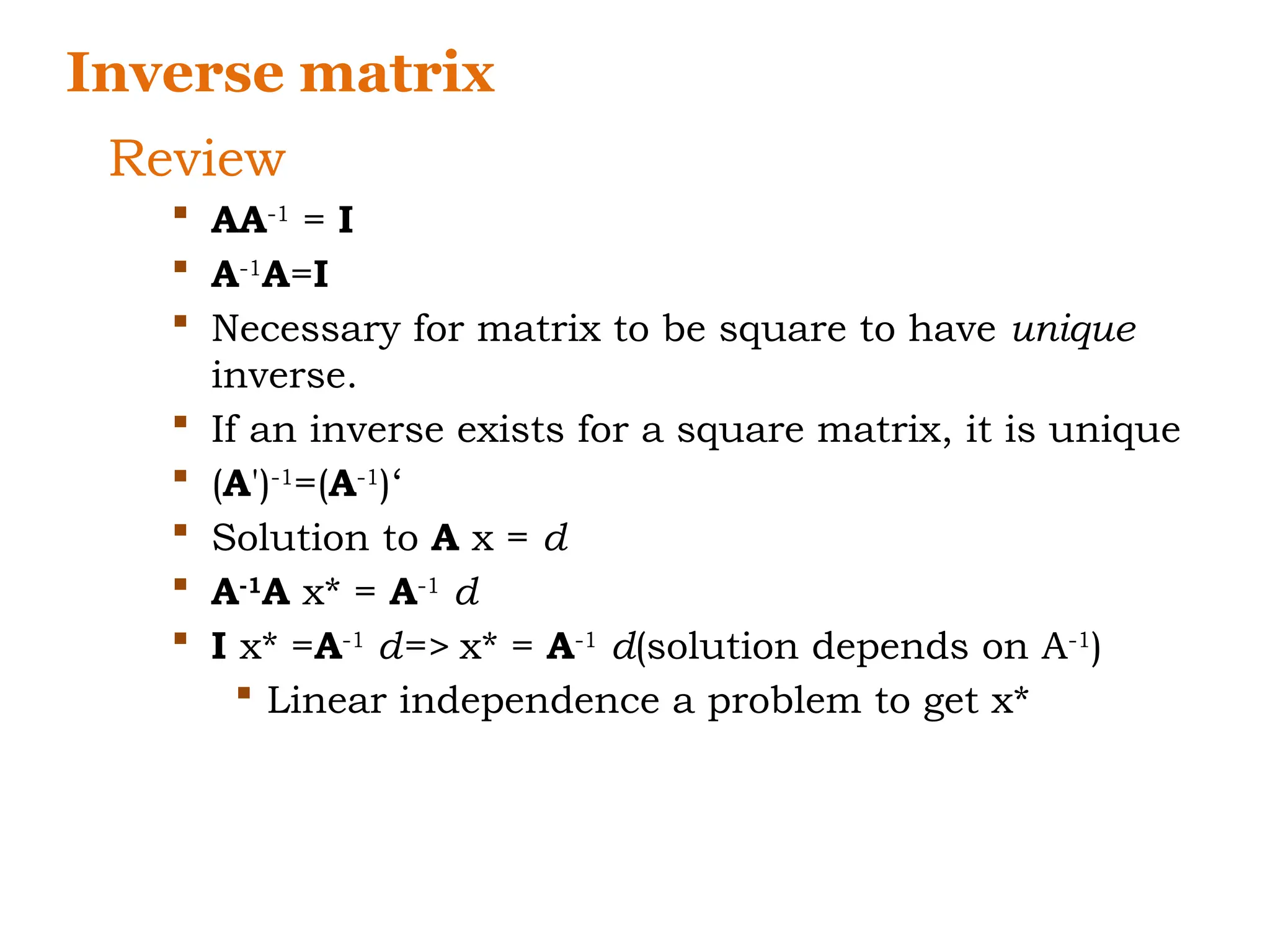
Inverse matrix
Review
 AA-1
= I
 A-1
A=I
 Necessary for matrix to be square to have unique
inverse.
 If an inverse exists for a square matrix, it is unique
 (A')-1
=(A-1
)‘
 Solution to A x = d
 A-1
A x* = A-1
d
 I x* =A-1
d=> x* = A-1
d(solution depends on A-1
)
 Linear independence a problem to get x*
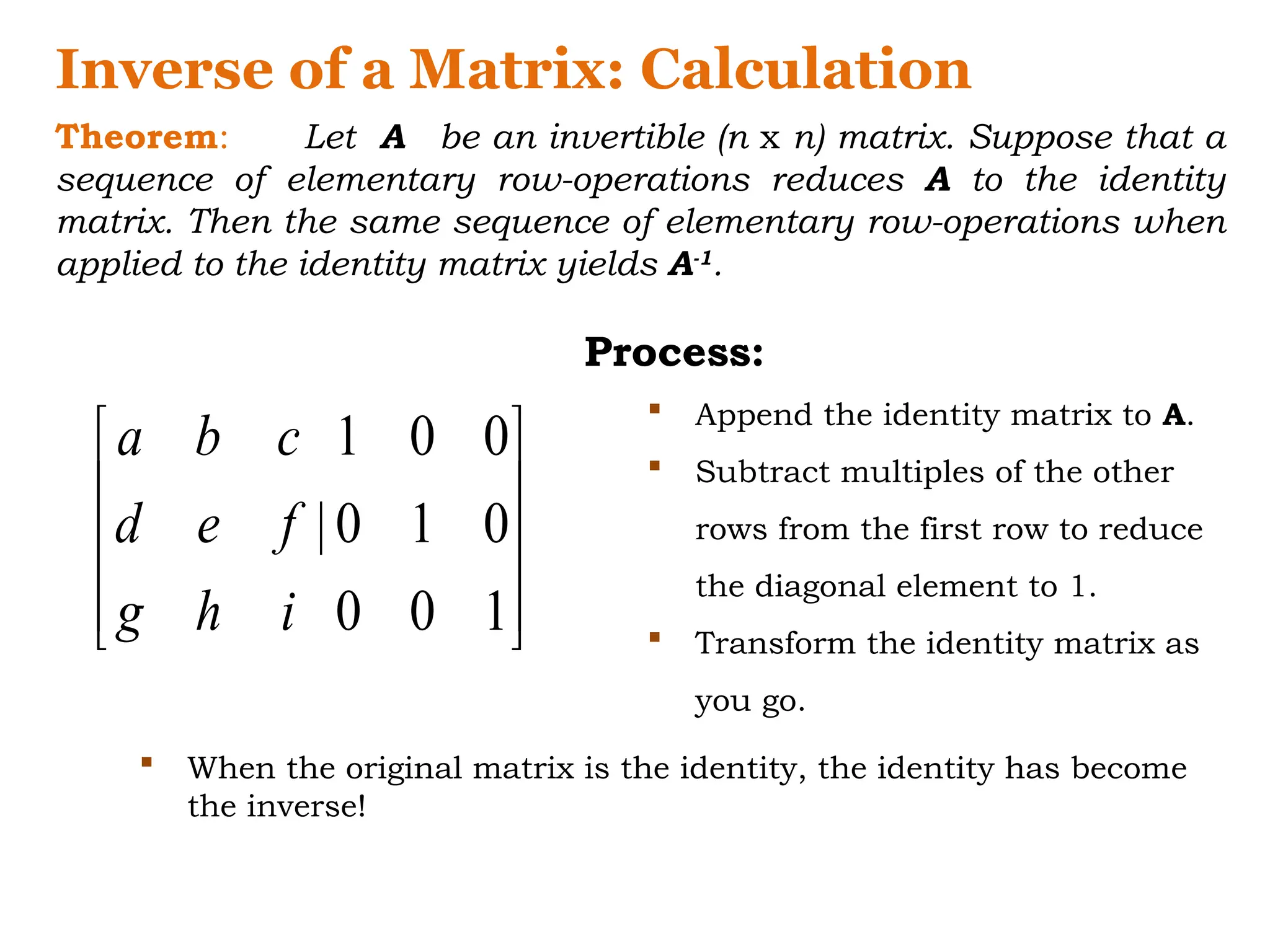
Inverse of a Matrix: Calculation










1
0
0
0
1
0
0
0
1
|
i
h
g
f
e
d
c
b
a
Process:
 Append the identity matrix to A.
 Subtract multiples of the other
rows from the first row to reduce
the diagonal element to 1.
 Transform the identity matrix as
you go.
Theorem: Let A be an invertible (n x n) matrix. Suppose that a
sequence of elementary row-operations reduces A to the identity
matrix. Then the same sequence of elementary row-operations when
applied to the identity matrix yields A-1
.
 When the original matrix is the identity, the identity has become
the inverse!
Determination of the Inverse
(Gauss-Jordan Elimination)
AX = I
I X = K
I X = X = A-1
=> K = A-1
1) Augmented matrix
all A, X and I are (n x n)
square matrices
X = A-1
Gauss elimination Gauss-Jordan
elimination
UT: upper triangular
further row
operations
[A I ] [ UT H] [ I K]
2) Transform augmented matrix
Wilhelm Jordan (1842– 1899)
Find A-1
using the Gauss-Jordan method.
Gauss-Jordan Elimination: Example 1











2
1
1
1
2
1
1
1
2
A















 












1
0
0
2
1
1
0
1
0
1
2
1
0
0
2
1
2
1
2
1
1
1
0
0
2
1
1
0
1
0
1
2
1
0
0
1
1
1
2
|
.
1 )
2
/
1
(
1
R
I
A






















 

















1
0
2
1
2
3
2
1
0
0
1
2
1
2
1
2
3
0
0
0
2
1
2
1
2
1
1
1
0
0
2
1
1
0
1
0
1
2
1
0
0
2
1
2
1
2
1
1
.
2 )
1
(
&
)
1
( 31
21 R
R
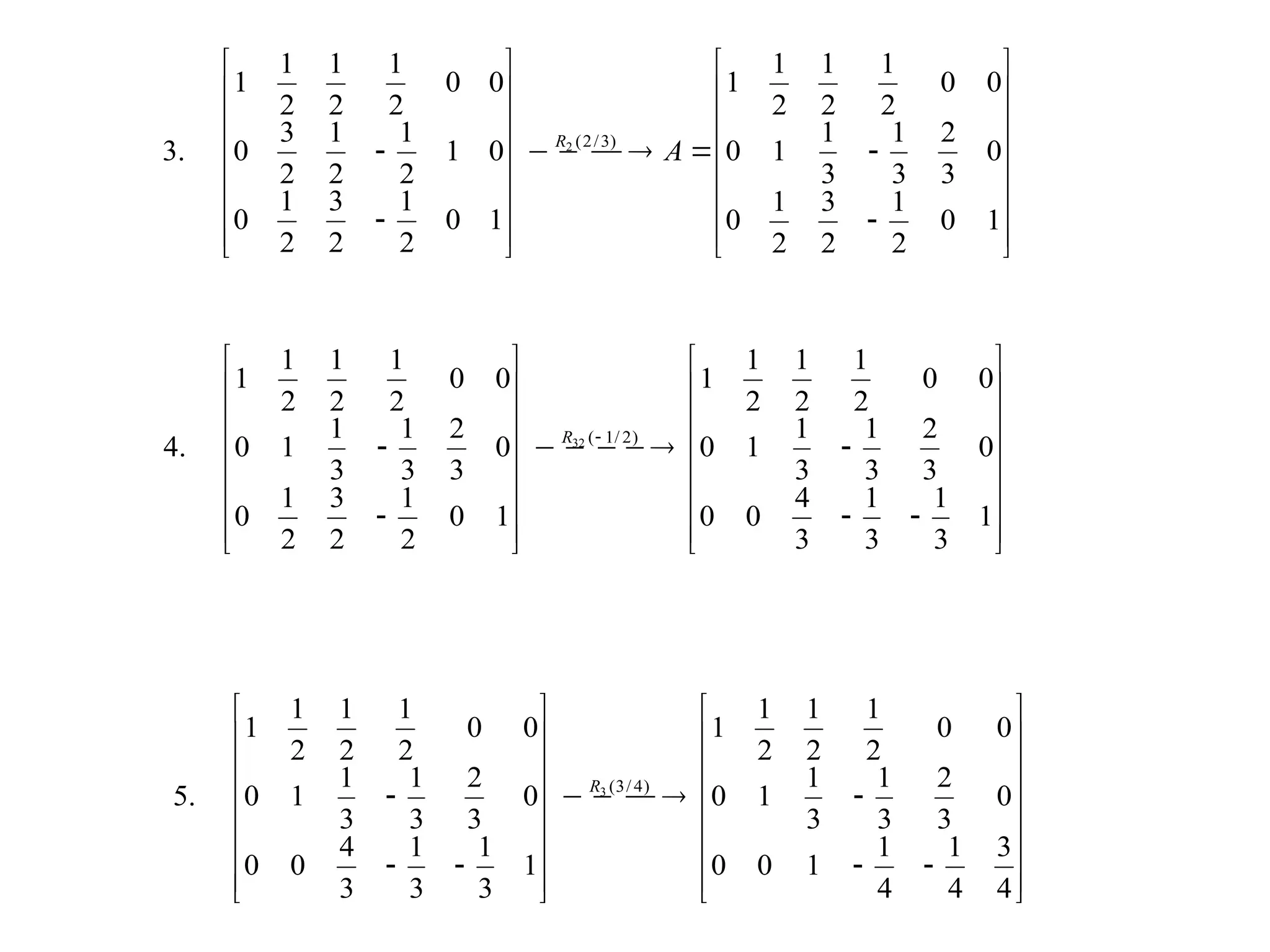
Process:
Expand A|I. Start scaling and adding rows to get I|A-1
.





















 



















1
0
2
1
2
3
2
1
0
0
3
2
3
1
3
1
1
0
0
0
2
1
2
1
2
1
1
1
0
2
1
2
3
2
1
0
0
1
2
1
2
1
2
3
0
0
0
2
1
2
1
2
1
1
.
3 )
3
/
2
(
2
A
R





















 


















 
1
3
1
3
1
3
4
0
0
0
3
2
3
1
3
1
1
0
0
0
2
1
2
1
2
1
1
1
0
2
1
2
3
2
1
0
0
3
2
3
1
3
1
1
0
0
0
2
1
2
1
2
1
1
.
4 )
2
/
1
(
32
R





















 




















4
3
4
1
4
1
1
0
0
0
3
2
3
1
3
1
1
0
0
0
2
1
2
1
2
1
1
1
3
1
3
1
3
4
0
0
0
3
2
3
1
3
1
1
0
0
0
2
1
2
1
2
1
1
.
5 )
4
/
3
(
3
R


























 



















 

4
3
4
1
4
1
1
0
0
4
1
4
3
4
1
0
1
0
8
3
8
1
8
5
0
2
1
1
4
3
4
1
4
1
1
0
0
0
3
2
3
1
3
1
1
0
0
0
2
1
2
1
2
1
1
.
6 )
2
/
1
(
&
)
3
/
1
( 13
23 R
R























 























4
3
4
1
4
1
1
0
0
4
1
4
3
4
1
0
1
0
8
2
8
2
8
6
0
0
1
4
3
4
1
4
1
1
0
0
4
1
4
3
4
1
0
1
0
8
3
8
1
8
5
0
2
1
1
.
7 )
2
/
1
(
12
R














































 

4
3
4
1
4
1
4
1
4
3
4
1
4
1
4
1
4
3
4
3
4
1
4
1
1
0
0
4
1
4
3
4
1
0
1
0
8
2
8
2
8
6
0
0
1
|
.
8 1
1
A
A
I
Gauss-Jordan Elimination: Example 2























 



























 























 
















 










































D
D
I
D
D
I
D
D
D
I
I
I
I
I
I
I
I
XX
YX
XY
XX
XX
YX
XY
XX
XX
R
R
XY
XX
YX
YY
XX
YX
XX
XY
XX
R
XX
YX
XY
XX
YX
YY
XX
XY
XX
R
R
YY
YX
XX
XY
XX
R
YY
YX
XY
XX
XY
XX
XY
XX
YX
YY
YX
XX
)
(
0
0
.
4
]
[
where
)
(
0
0
.
3
0
0
.
2
0
0
0
0
.
1
1
1
1
1
1
1
1
1
1
1
]
[
1
1
1
1
1
1
2
1
1
2
1
1
1
2
1
1
Partitioned inverse (using the Gauss-Jordan method).
Trace of a Matrix
 The trace of an n x n matrix A is defined to be the sum of the
elements on the main diagonal of A:
trace(A) = tr (A) = Σi aii.
where aii is the entry on the ith row and ith column of A.
 Properties:
- tr(A + B) = tr(A) + tr(B)
- tr(cA) = c tr(A)
- tr(AB) = tr(BA)
- tr(ABC) = tr(CAB) (invariant under cyclic
permutations.)
- tr(A) = tr(AT
)
- d tr(A) = tr(dA) (differential of trace)
- tr(A) = rank(A) when A is idempotent –i.e., A=
A2
.
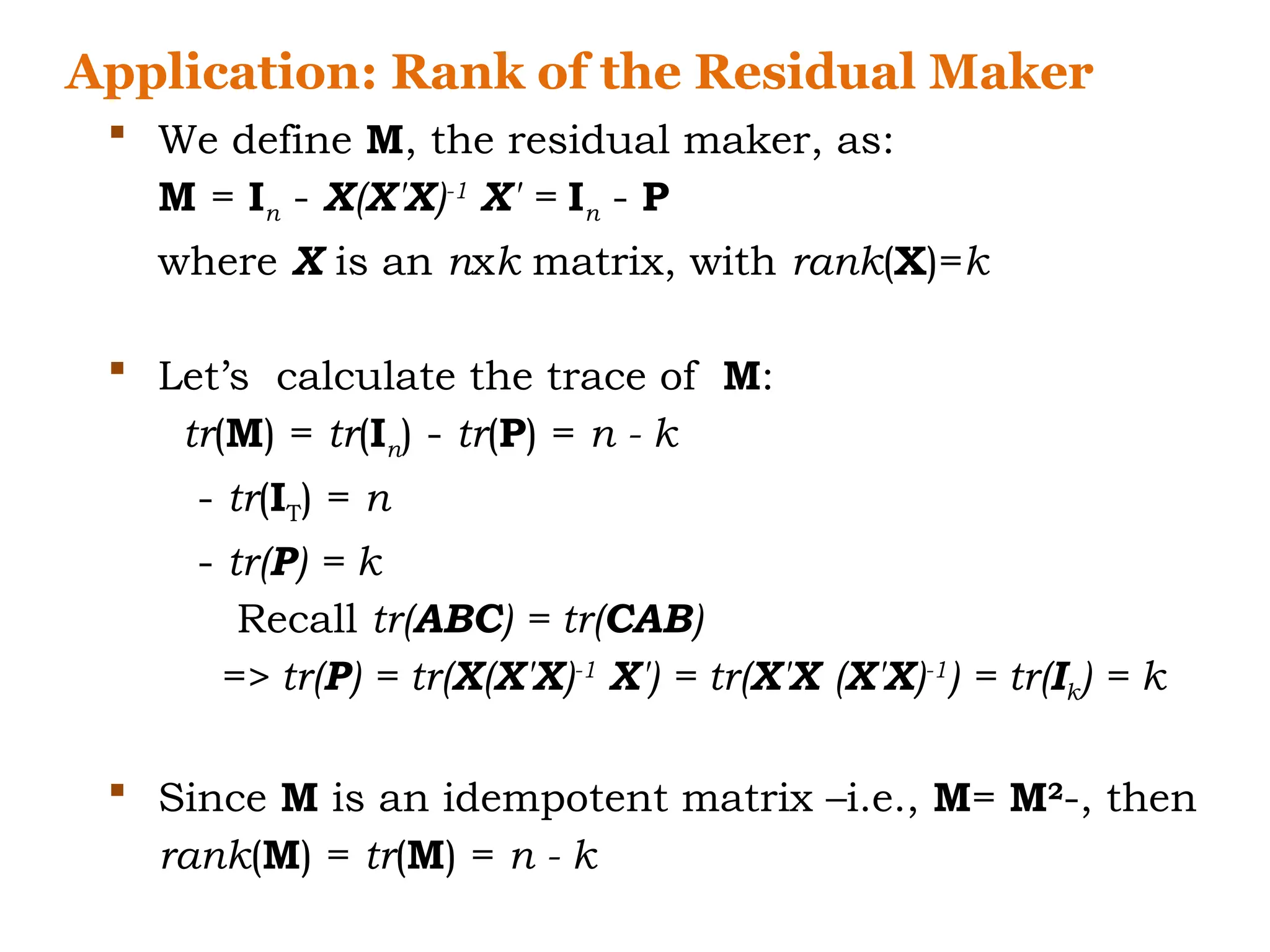
Application: Rank of the Residual Maker
 We define M, the residual maker, as:
M = In - X(X′X)-1
X′ = In - P
where X is an nxk matrix, with rank(X)=k
 Let’s calculate the trace of M:
tr(M) = tr(In) - tr(P) = n - k
- tr(IT) = n
- tr(P) = k
Recall tr(ABC) = tr(CAB)
=> tr(P) = tr(X(X′X)-1
X′) = tr(X′X (X′X)-1
) = tr(Ik) = k
 Since M is an idempotent matrix –i.e., M= M2
-, then
rank(M) = tr(M) = n - k
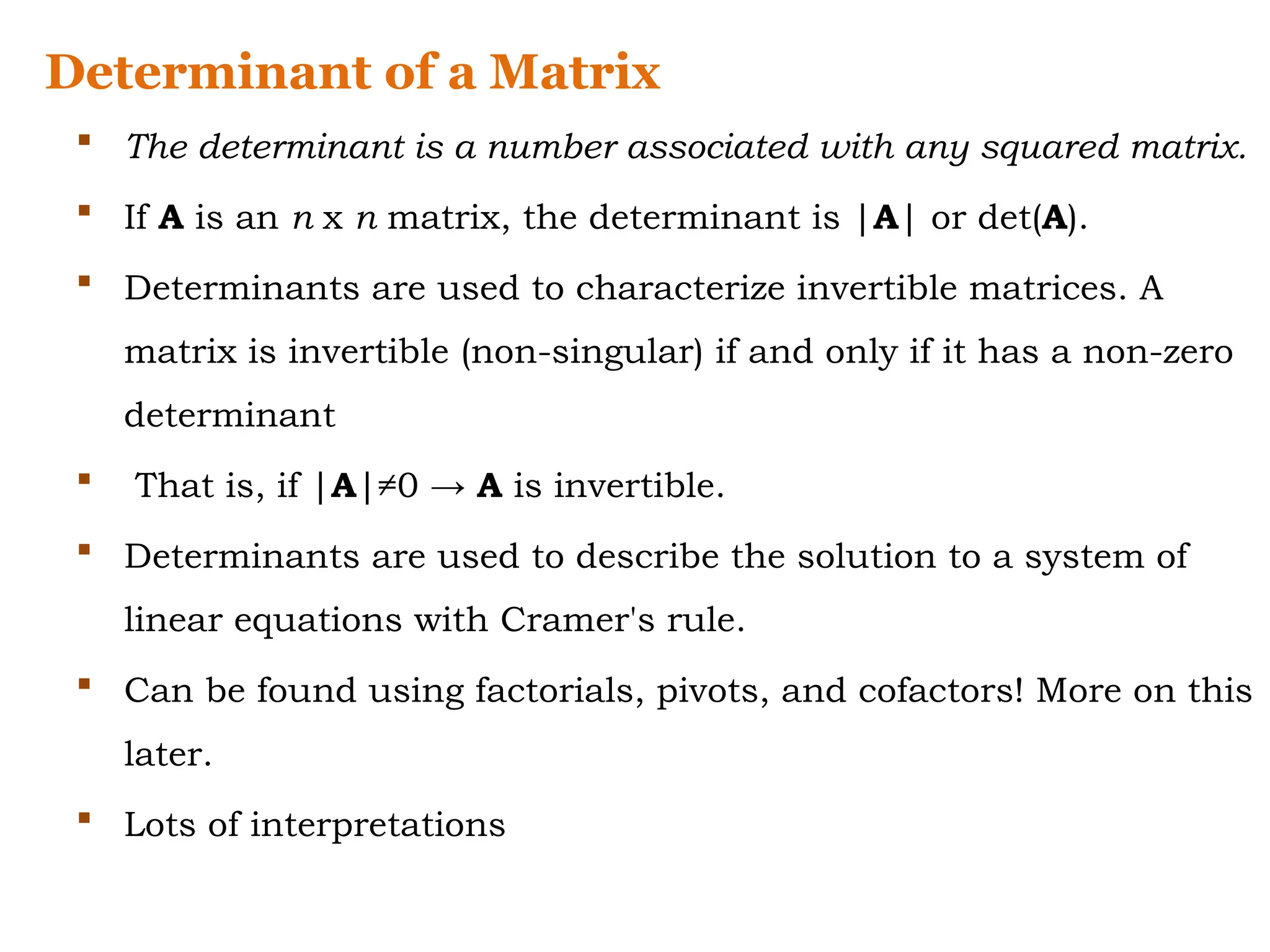
Determinant of a Matrix
 The determinant is a number associated with any squared matrix.
 If A is an n x n matrix, the determinant is |A| or det(A).
 Determinants are used to characterize invertible matrices. A
matrix is invertible (non-singular) if and only if it has a non-zero
determinant
 That is, if |A|≠0 → A is invertible.
 Determinants are used to describe the solution to a system of
linear equations with Cramer's rule.
 Can be found using factorials, pivots, and cofactors! More on this
later.
 Lots of interpretations
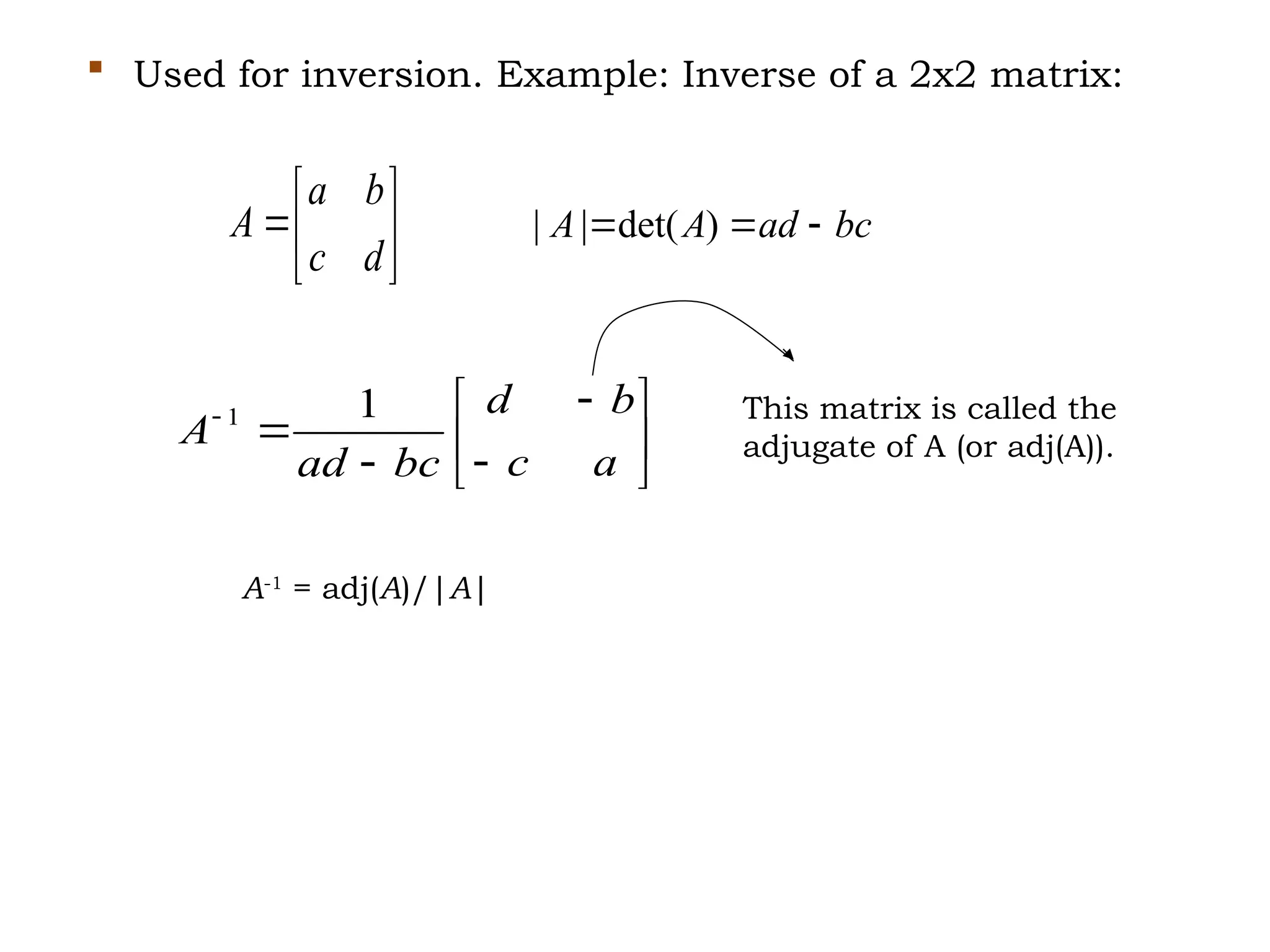
 Used for inversion. Example: Inverse of a 2x2 matrix:







d
c
b
a
A bc
ad
A
A 

 )
det(
|
|











a
c
b
d
bc
ad
A
1
1 This matrix is called the
adjugate of A (or adj(A)).
A-1
= adj(A)/|A|
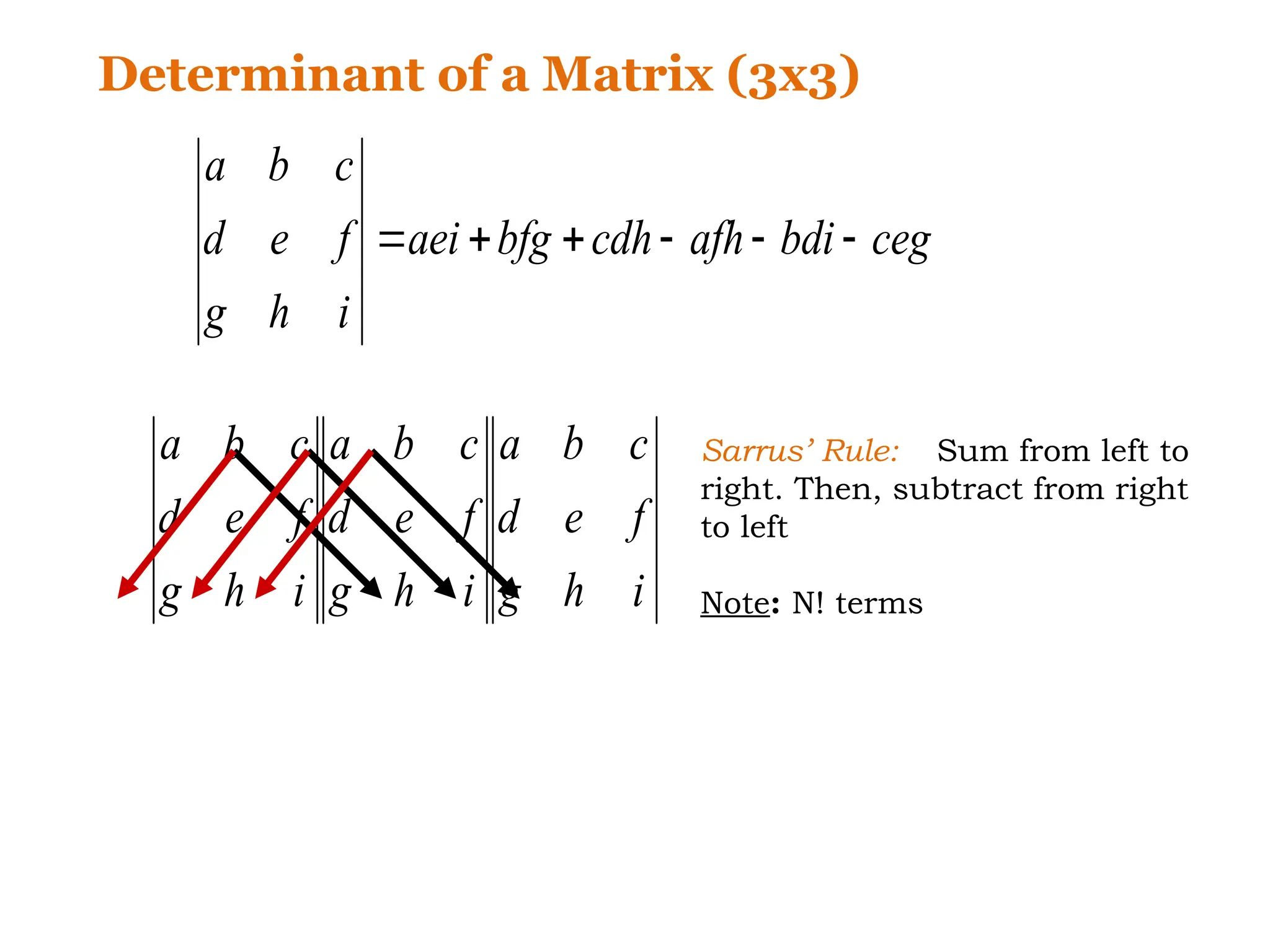
Determinant of a Matrix (3x3)
ceg
bdi
afh
cdh
bfg
aei
i
h
g
f
e
d
c
b
a






i
h
g
f
e
d
c
b
a
i
h
g
f
e
d
c
b
a
i
h
g
f
e
d
c
b
a Sarrus’ Rule: Sum from left to
right. Then, subtract from right
to left
Note: N! terms
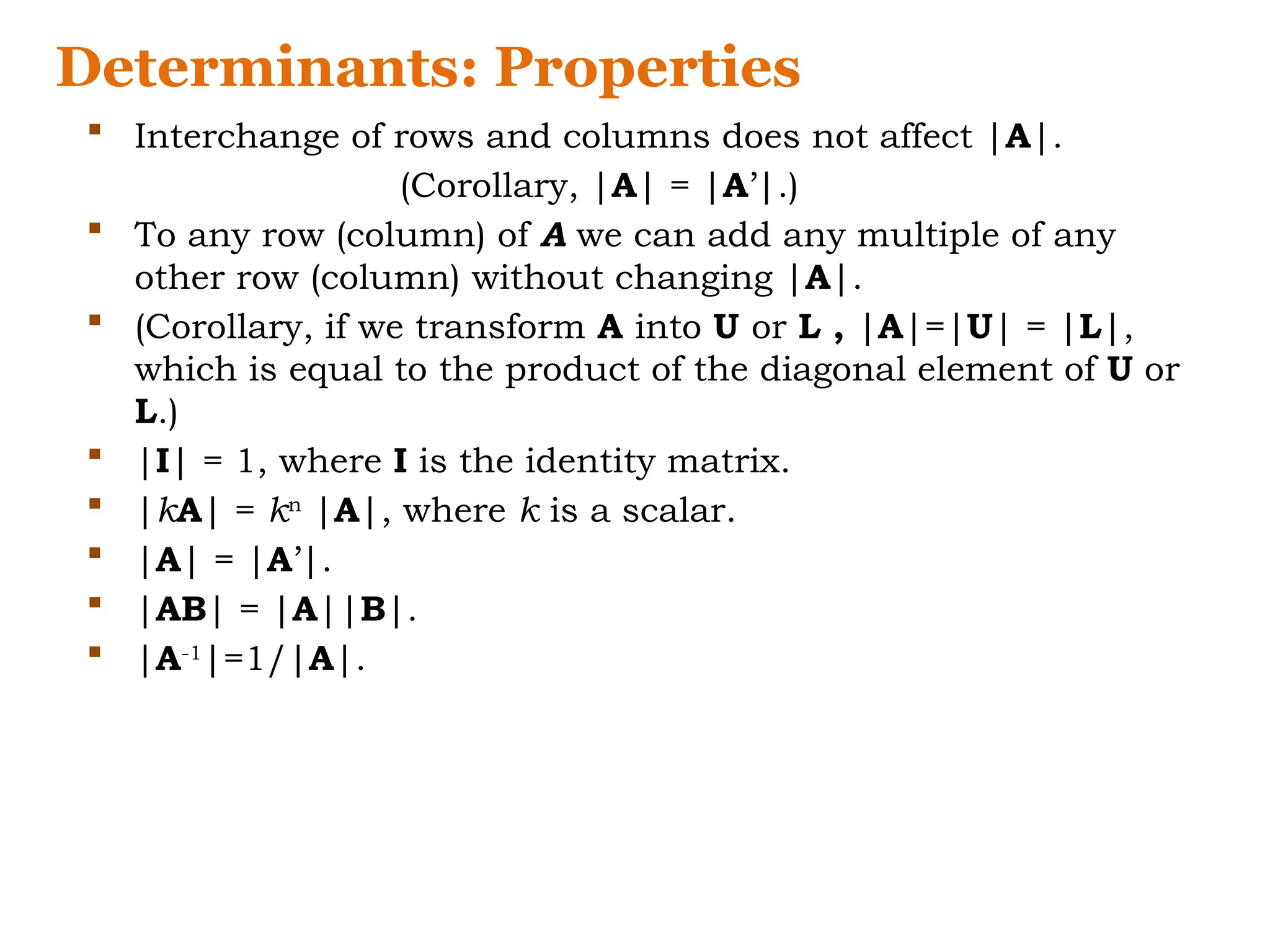
Determinants: Properties
 Interchange of rows and columns does not affect |A|.
(Corollary, |A| = |A’|.)
 To any row (column) of A we can add any multiple of any
other row (column) without changing |A|.
 (Corollary, if we transform A into U or L , |A|=|U| = |L|,
which is equal to the product of the diagonal element of U or
L.)
 |I| = 1, where I is the identity matrix.
 |kA| = kn
|A|, where k is a scalar.
 |A| = |A’|.
 |AB| = |A||B|.
 |A-1
|=1/|A|.

Study material for matrix and determinant.pptx

  • 1.
  • 2.
    Inverse matrix Review  AA-1 =I  A-1 A=I  Necessary for matrix to be square to have unique inverse.  If an inverse exists for a square matrix, it is unique  (A')-1 =(A-1 )‘  Solution to A x = d  A-1 A x* = A-1 d  I x* =A-1 d=> x* = A-1 d(solution depends on A-1 )  Linear independence a problem to get x*
  • 3.
    Inverse of aMatrix: Calculation           1 0 0 0 1 0 0 0 1 | i h g f e d c b a Process:  Append the identity matrix to A.  Subtract multiples of the other rows from the first row to reduce the diagonal element to 1.  Transform the identity matrix as you go. Theorem: Let A be an invertible (n x n) matrix. Suppose that a sequence of elementary row-operations reduces A to the identity matrix. Then the same sequence of elementary row-operations when applied to the identity matrix yields A-1 .  When the original matrix is the identity, the identity has become the inverse!
  • 4.
    Determination of theInverse (Gauss-Jordan Elimination) AX = I I X = K I X = X = A-1 => K = A-1 1) Augmented matrix all A, X and I are (n x n) square matrices X = A-1 Gauss elimination Gauss-Jordan elimination UT: upper triangular further row operations [A I ] [ UT H] [ I K] 2) Transform augmented matrix Wilhelm Jordan (1842– 1899)
  • 5.
    Find A-1 using theGauss-Jordan method. Gauss-Jordan Elimination: Example 1            2 1 1 1 2 1 1 1 2 A                              1 0 0 2 1 1 0 1 0 1 2 1 0 0 2 1 2 1 2 1 1 1 0 0 2 1 1 0 1 0 1 2 1 0 0 1 1 1 2 | . 1 ) 2 / 1 ( 1 R I A                                          1 0 2 1 2 3 2 1 0 0 1 2 1 2 1 2 3 0 0 0 2 1 2 1 2 1 1 1 0 0 2 1 1 0 1 0 1 2 1 0 0 2 1 2 1 2 1 1 . 2 ) 1 ( & ) 1 ( 31 21 R R Process: Expand A|I. Start scaling and adding rows to get I|A-1 .
  • 6.
                                              1 0 2 1 2 3 2 1 0 0 3 2 3 1 3 1 1 0 0 0 2 1 2 1 2 1 1 1 0 2 1 2 3 2 1 0 0 1 2 1 2 1 2 3 0 0 0 2 1 2 1 2 1 1 . 3 ) 3 / 2 ( 2 A R                                           1 3 1 3 1 3 4 0 0 0 3 2 3 1 3 1 1 0 0 0 2 1 2 1 2 1 1 1 0 2 1 2 3 2 1 0 0 3 2 3 1 3 1 1 0 0 0 2 1 2 1 2 1 1 . 4 ) 2 / 1 ( 32 R                                            4 3 4 1 4 1 1 0 0 0 3 2 3 1 3 1 1 0 0 0 2 1 2 1 2 1 1 1 3 1 3 1 3 4 0 0 0 3 2 3 1 3 1 1 0 0 0 2 1 2 1 2 1 1 . 5 ) 4 / 3 ( 3 R
  • 7.
                                                      4 3 4 1 4 1 1 0 0 4 1 4 3 4 1 0 1 0 8 3 8 1 8 5 0 2 1 1 4 3 4 1 4 1 1 0 0 0 3 2 3 1 3 1 1 0 0 0 2 1 2 1 2 1 1 . 6) 2 / 1 ( & ) 3 / 1 ( 13 23 R R                                                 4 3 4 1 4 1 1 0 0 4 1 4 3 4 1 0 1 0 8 2 8 2 8 6 0 0 1 4 3 4 1 4 1 1 0 0 4 1 4 3 4 1 0 1 0 8 3 8 1 8 5 0 2 1 1 . 7 ) 2 / 1 ( 12 R                                                  4 3 4 1 4 1 4 1 4 3 4 1 4 1 4 1 4 3 4 3 4 1 4 1 1 0 0 4 1 4 3 4 1 0 1 0 8 2 8 2 8 6 0 0 1 | . 8 1 1 A A I
  • 8.
    Gauss-Jordan Elimination: Example2                                                                                                                                            D D I D D I D D D I I I I I I I I XX YX XY XX XX YX XY XX XX R R XY XX YX YY XX YX XX XY XX R XX YX XY XX YX YY XX XY XX R R YY YX XX XY XX R YY YX XY XX XY XX XY XX YX YY YX XX ) ( 0 0 . 4 ] [ where ) ( 0 0 . 3 0 0 . 2 0 0 0 0 . 1 1 1 1 1 1 1 1 1 1 1 ] [ 1 1 1 1 1 1 2 1 1 2 1 1 1 2 1 1 Partitioned inverse (using the Gauss-Jordan method).
  • 9.
    Trace of aMatrix  The trace of an n x n matrix A is defined to be the sum of the elements on the main diagonal of A: trace(A) = tr (A) = Σi aii. where aii is the entry on the ith row and ith column of A.  Properties: - tr(A + B) = tr(A) + tr(B) - tr(cA) = c tr(A) - tr(AB) = tr(BA) - tr(ABC) = tr(CAB) (invariant under cyclic permutations.) - tr(A) = tr(AT ) - d tr(A) = tr(dA) (differential of trace) - tr(A) = rank(A) when A is idempotent –i.e., A= A2 .
  • 10.
    Application: Rank ofthe Residual Maker  We define M, the residual maker, as: M = In - X(X′X)-1 X′ = In - P where X is an nxk matrix, with rank(X)=k  Let’s calculate the trace of M: tr(M) = tr(In) - tr(P) = n - k - tr(IT) = n - tr(P) = k Recall tr(ABC) = tr(CAB) => tr(P) = tr(X(X′X)-1 X′) = tr(X′X (X′X)-1 ) = tr(Ik) = k  Since M is an idempotent matrix –i.e., M= M2 -, then rank(M) = tr(M) = n - k
  • 11.
    Determinant of aMatrix  The determinant is a number associated with any squared matrix.  If A is an n x n matrix, the determinant is |A| or det(A).  Determinants are used to characterize invertible matrices. A matrix is invertible (non-singular) if and only if it has a non-zero determinant  That is, if |A|≠0 → A is invertible.  Determinants are used to describe the solution to a system of linear equations with Cramer's rule.  Can be found using factorials, pivots, and cofactors! More on this later.  Lots of interpretations
  • 12.
     Used forinversion. Example: Inverse of a 2x2 matrix:        d c b a A bc ad A A    ) det( | |            a c b d bc ad A 1 1 This matrix is called the adjugate of A (or adj(A)). A-1 = adj(A)/|A|
  • 13.
    Determinant of aMatrix (3x3) ceg bdi afh cdh bfg aei i h g f e d c b a       i h g f e d c b a i h g f e d c b a i h g f e d c b a Sarrus’ Rule: Sum from left to right. Then, subtract from right to left Note: N! terms
  • 14.
    Determinants: Properties  Interchangeof rows and columns does not affect |A|. (Corollary, |A| = |A’|.)  To any row (column) of A we can add any multiple of any other row (column) without changing |A|.  (Corollary, if we transform A into U or L , |A|=|U| = |L|, which is equal to the product of the diagonal element of U or L.)  |I| = 1, where I is the identity matrix.  |kA| = kn |A|, where k is a scalar.  |A| = |A’|.  |AB| = |A||B|.  |A-1 |=1/|A|.