


Regional Anaesthesia for 
Caesarean Section 
Warwick D. Ngan Kee 
Dept of Anaesthesia & Intensive Care 
The Chinese University of Hong Kong
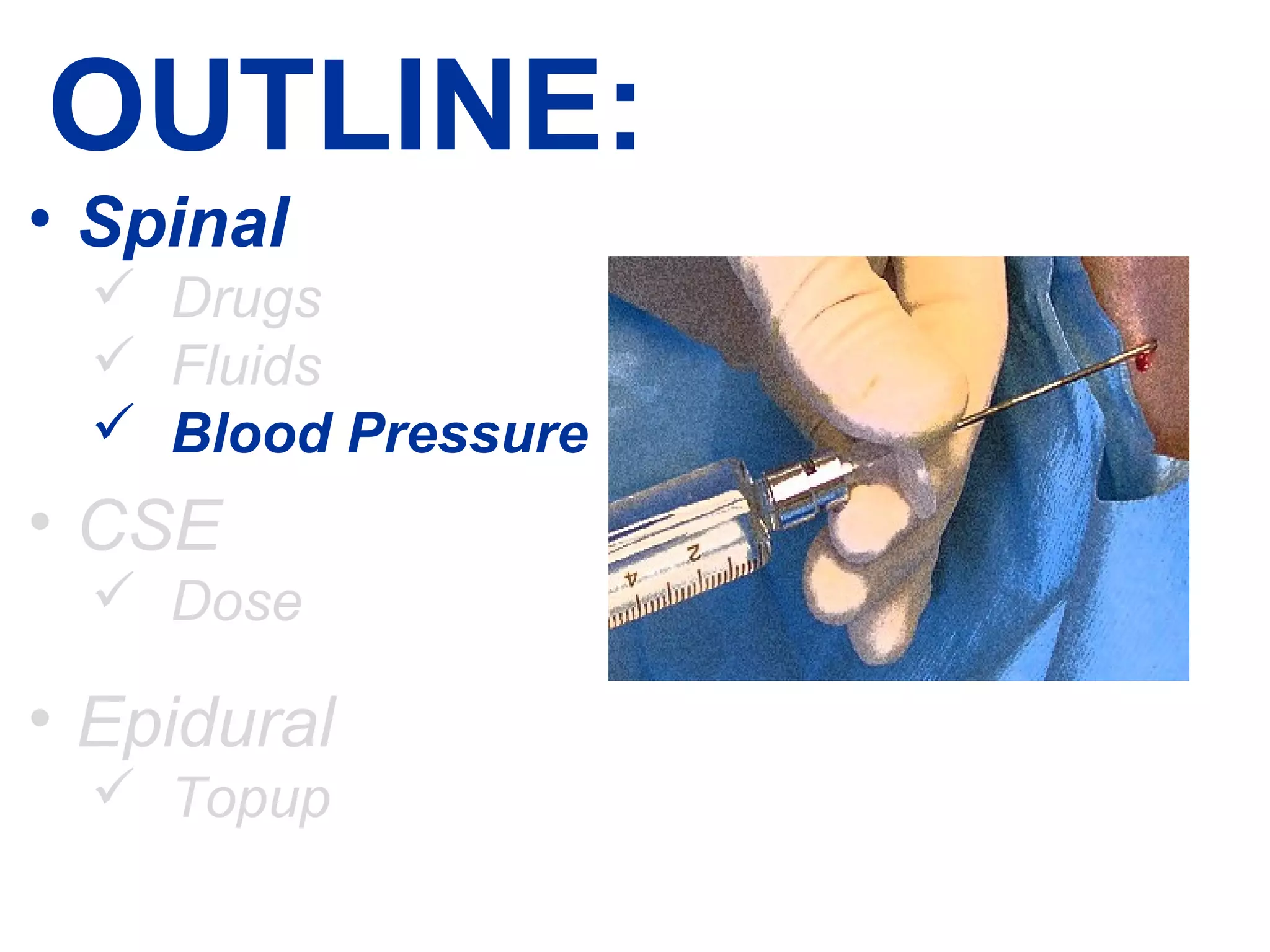
OUTLINE: 
• Spinal 
 Drugs 
 Fluids 
 Blood Pressure 
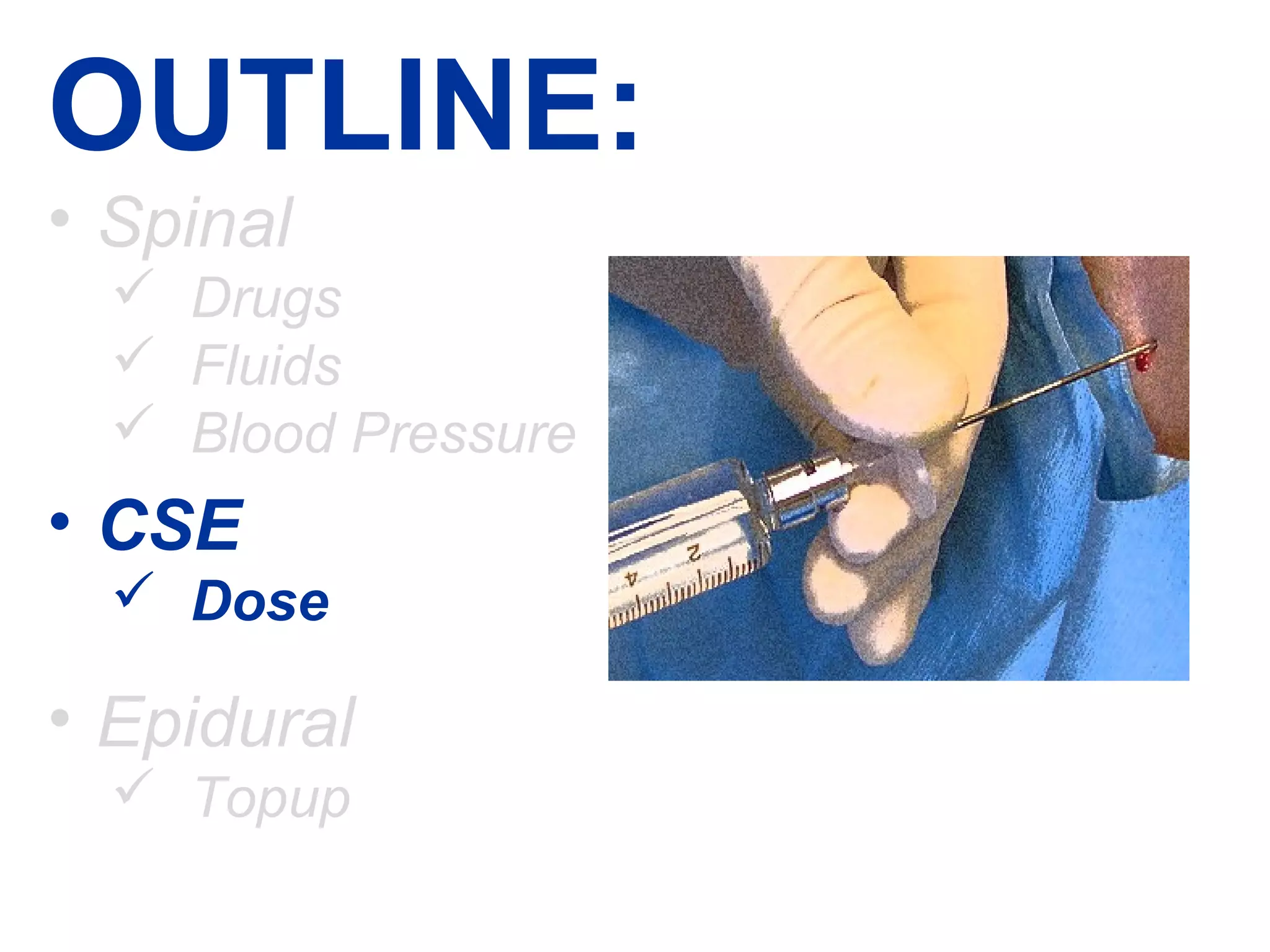
• CSE 
 Dose 
• Epidural 
 Topup
OUTLINE: 
• Spinal 
 Drugs 
 Fluids 
 Blood Pressure 
• CSE 
 Dose 
• Epidural 
 Topup
Local 
Anaesthetic 
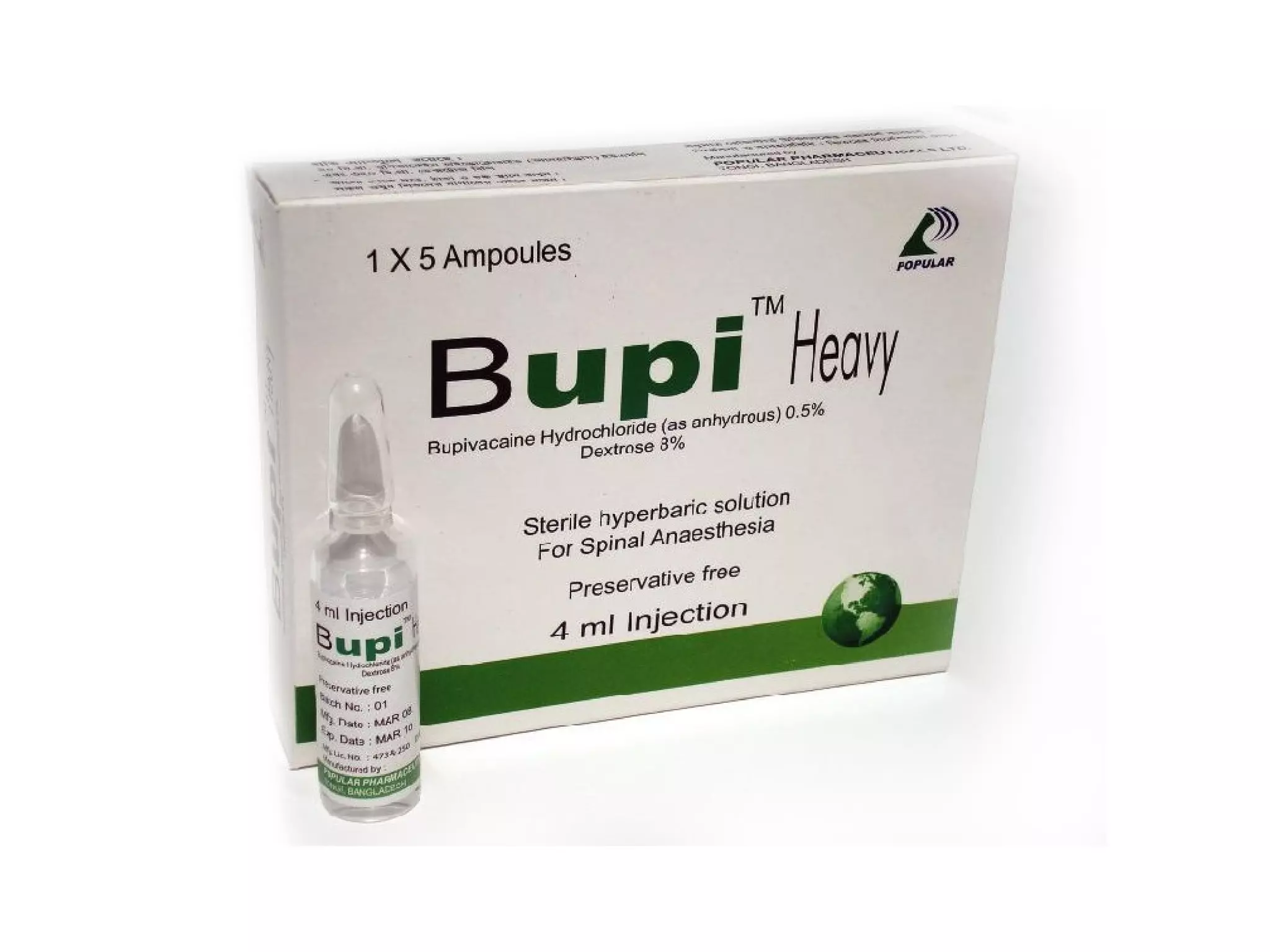
Bupivacaine 
Bupivacaine is the local anaesthetic of choice
Hyperbaric vs Plain: 
• Faster onset 
• Less conversion to GA
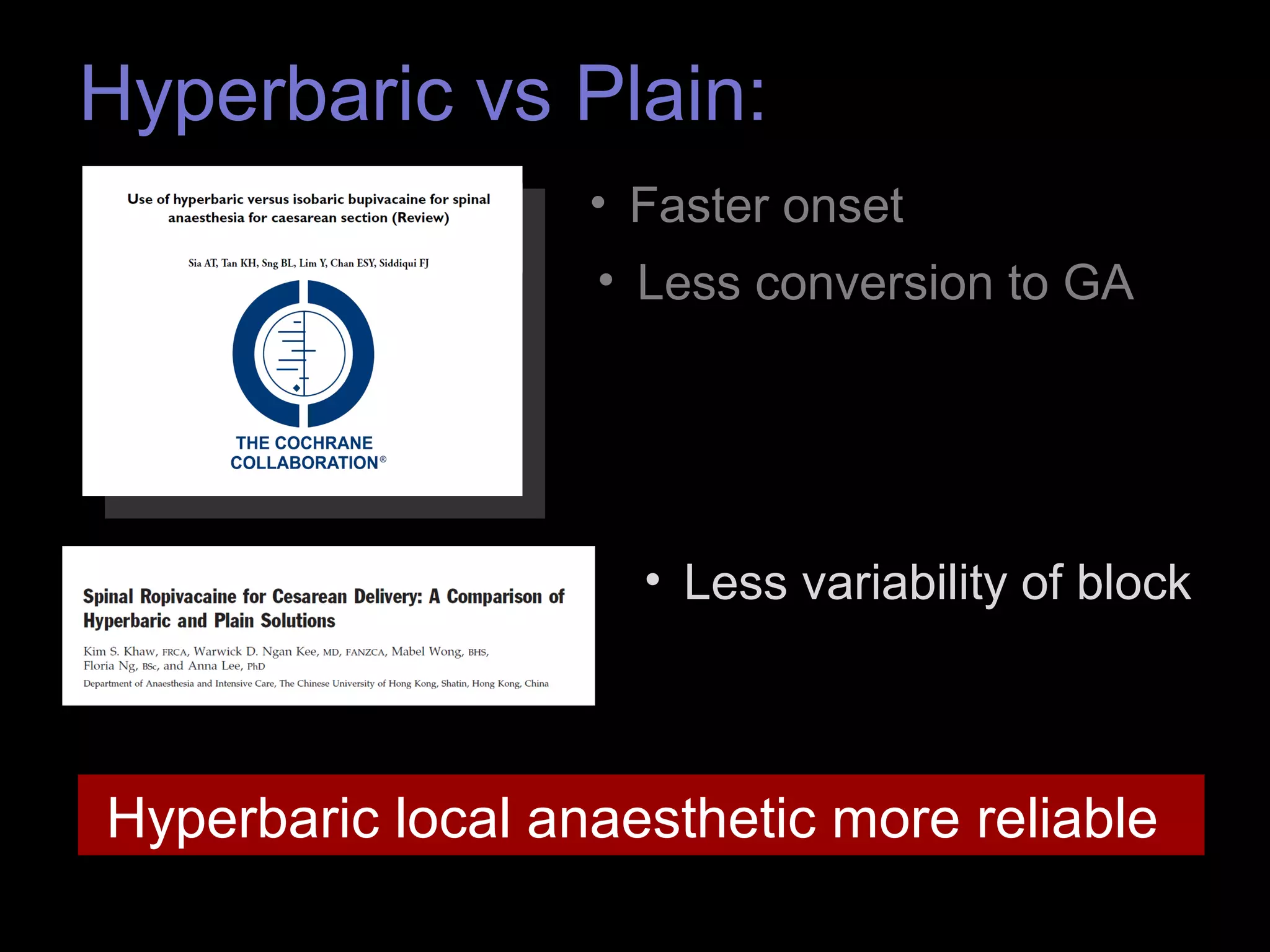
Hyperbaric vs Plain: 
• Faster onset 
• Less conversion to GA 
• Less variability of block 
Hyperbaric local anaesthetic more reliable
Local 
Anaesthetic 
Bupivacaine 
Additives +
• Opioids 
• Adrenaline 
• Clonidine 
• Neostigmine 
• Ketamine
Adding adjunct agents 
Possible advantages: 
1. Decrease side effects 
2. Increase efficacy
Adding adjunct agents 
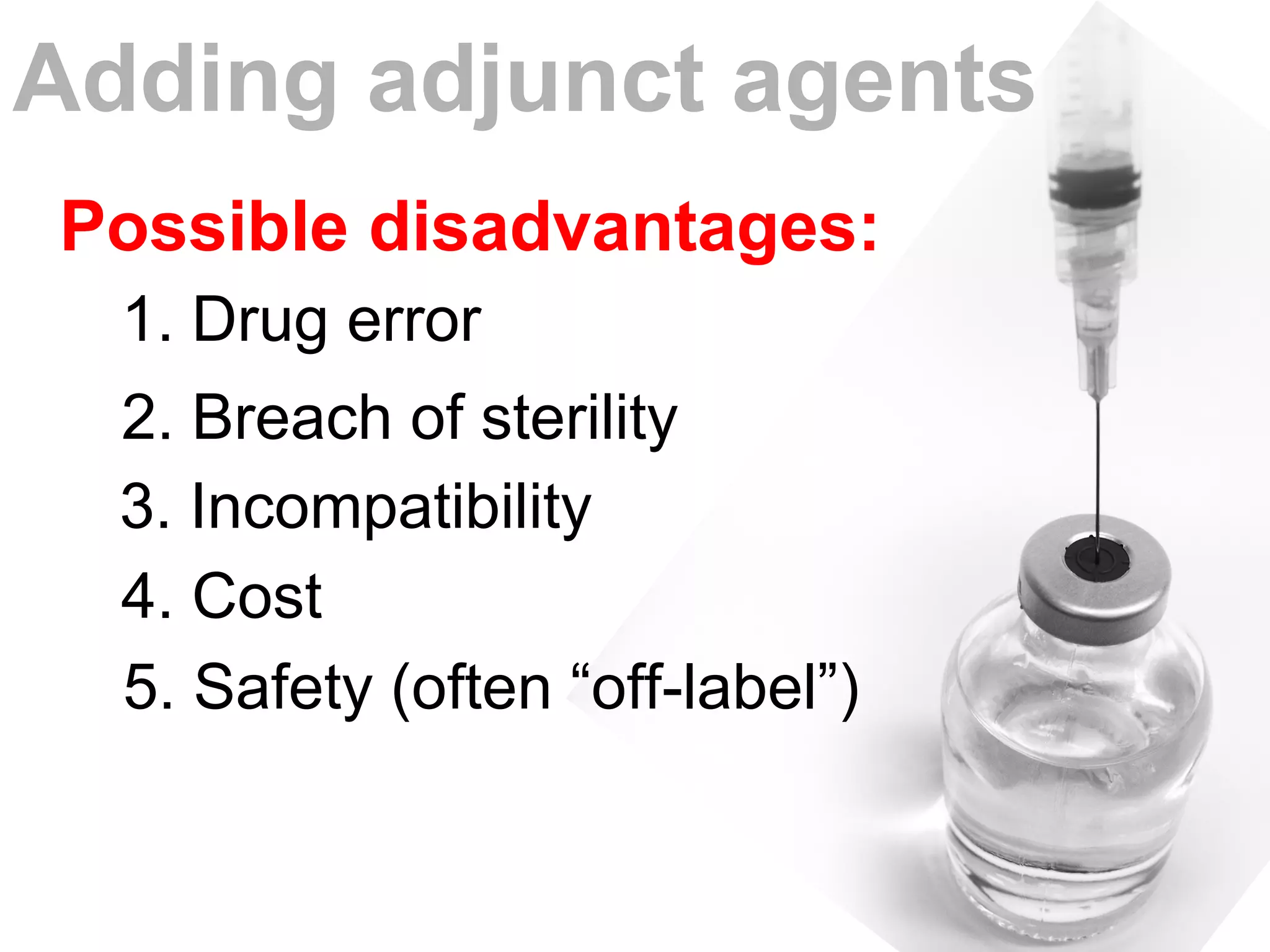
Possible disadvantages: 
1. Drug error 
2. Breach of sterility 
3. Incompatibility 
4. Cost 
5. Safety (often “off-label”)
• Opioids 
• Adrenaline 
• Clonidine 
• Neostigmine 
• Ketamine 
Only add an opioid
Local 
Anaesthetic 
Lipophilic 
+ Opioid 
Bupivacaine Fentanyl
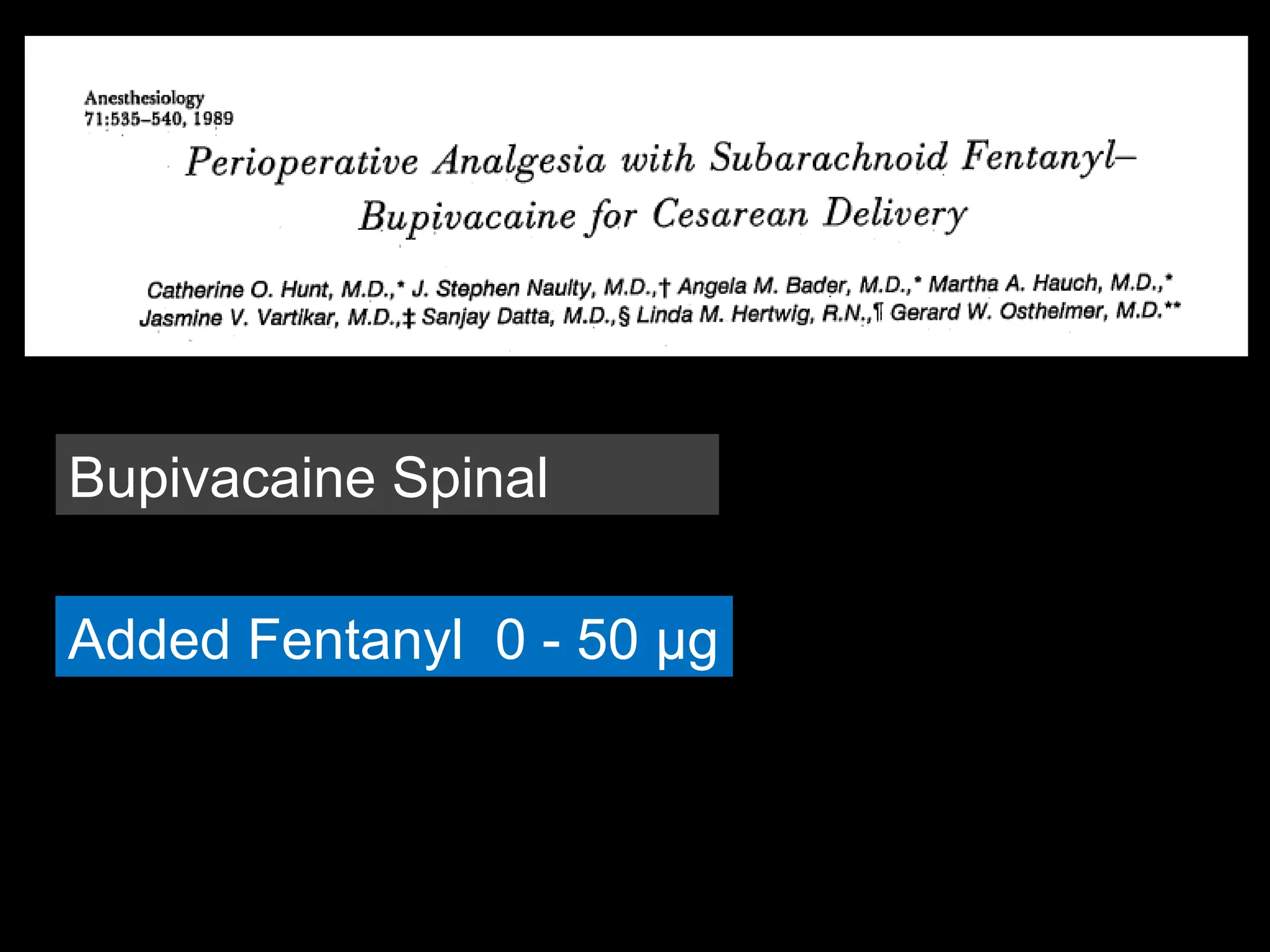
Bupivacaine Spinal 
Added Fentanyl 0 - 50 μg
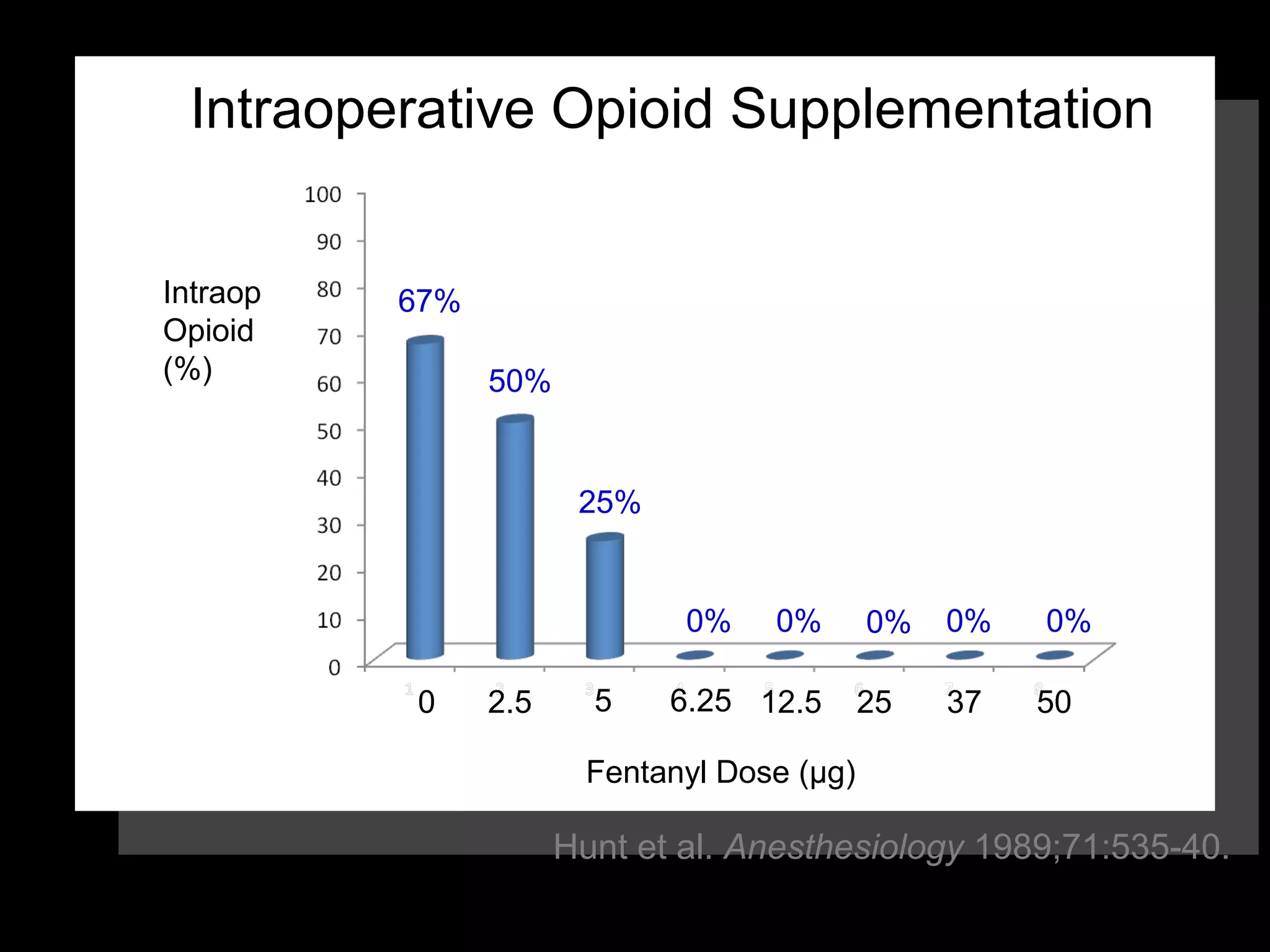
Intraoperative Opioid Supplementation 
0 2.5 5 6.25 12.5 25 37 50 
Fentanyl Dose (μg) 
Intraop 
Opioid 
(%) 
67% 
50% 
25% 
0% 0% 0% 0% 0% 
Hunt et al. Anesthesiology 1989;71:535-40.
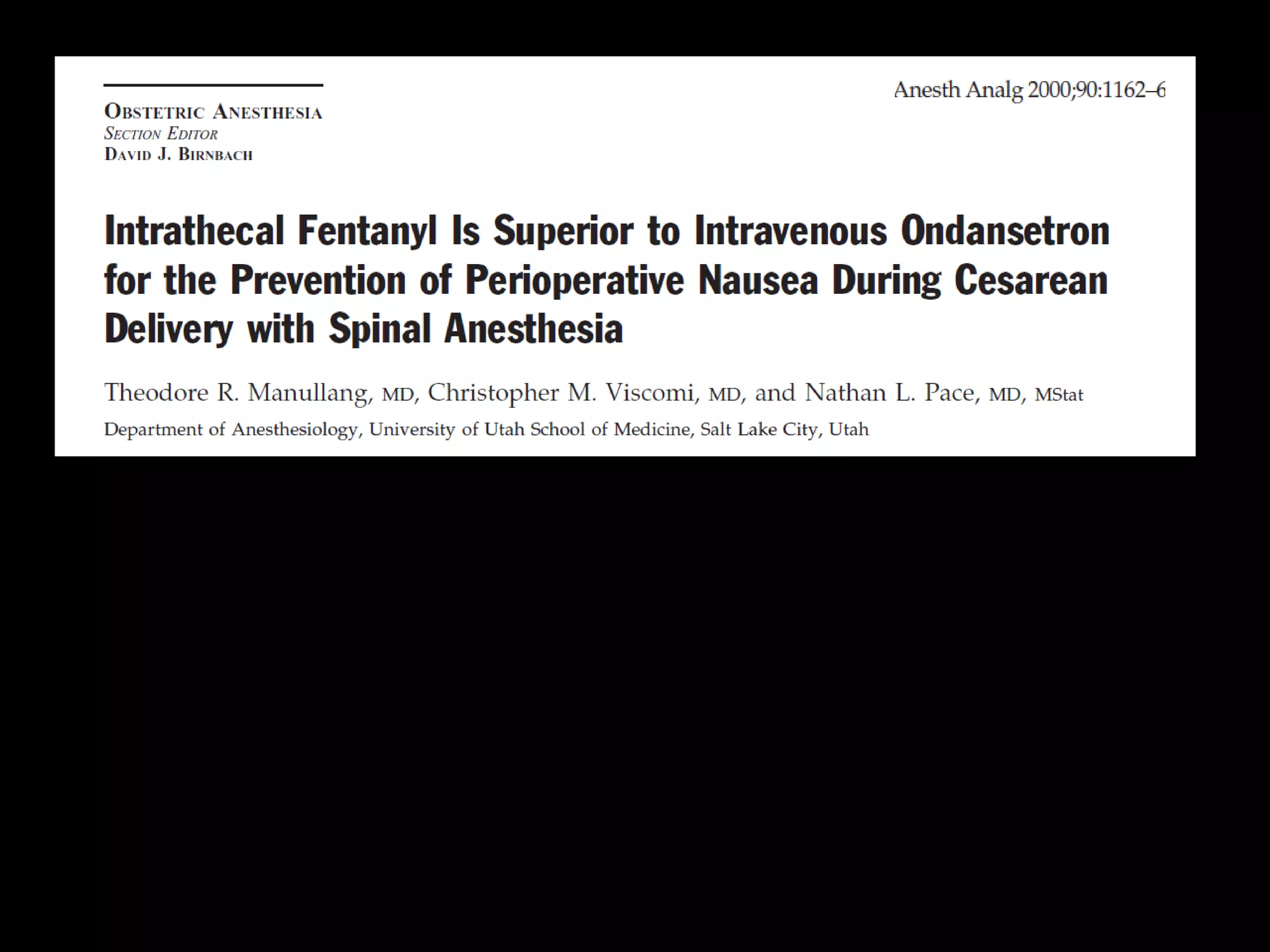
Nausea and Vomiting?
Elective Spinal Caesarean (n=30) 
Hyperbaric Bupivacaine 12 mg 
• FENTANYL: Less intraoperative pain 
• FENTANYL: Less intraoperative nausea 
Manullang et al. Anesth Analg 2000;90:1162-6. 
IV Ondansetron 
4 mg 
IT Fentanyl 
15 μg 
Adding an opioid improves patient comfort
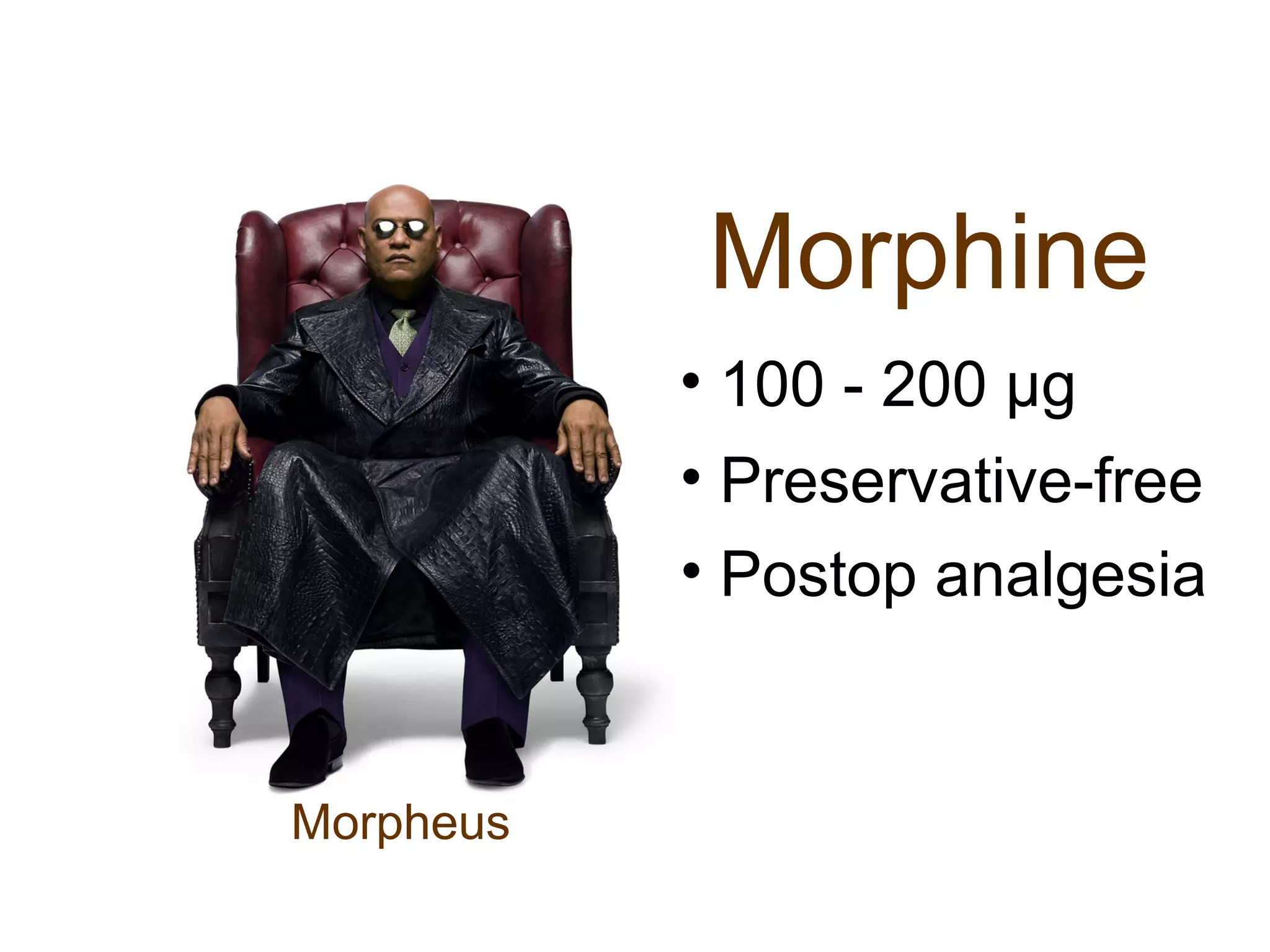
Morphine 
• 100 - 200 μg 
• Preservative-free 
• Postop analgesia 
Morpheus
OUTLINE: 
• Spinal 
 Drugs 
 Fluids 
 Blood Pressure 
• CSE 
 Dose 
• Epidural 
 Topup
Intravenous fluids 
Many Uncertainties
Colloid 
vs 
Crystalloid?
Prehydration 
vs 
Cohydration?
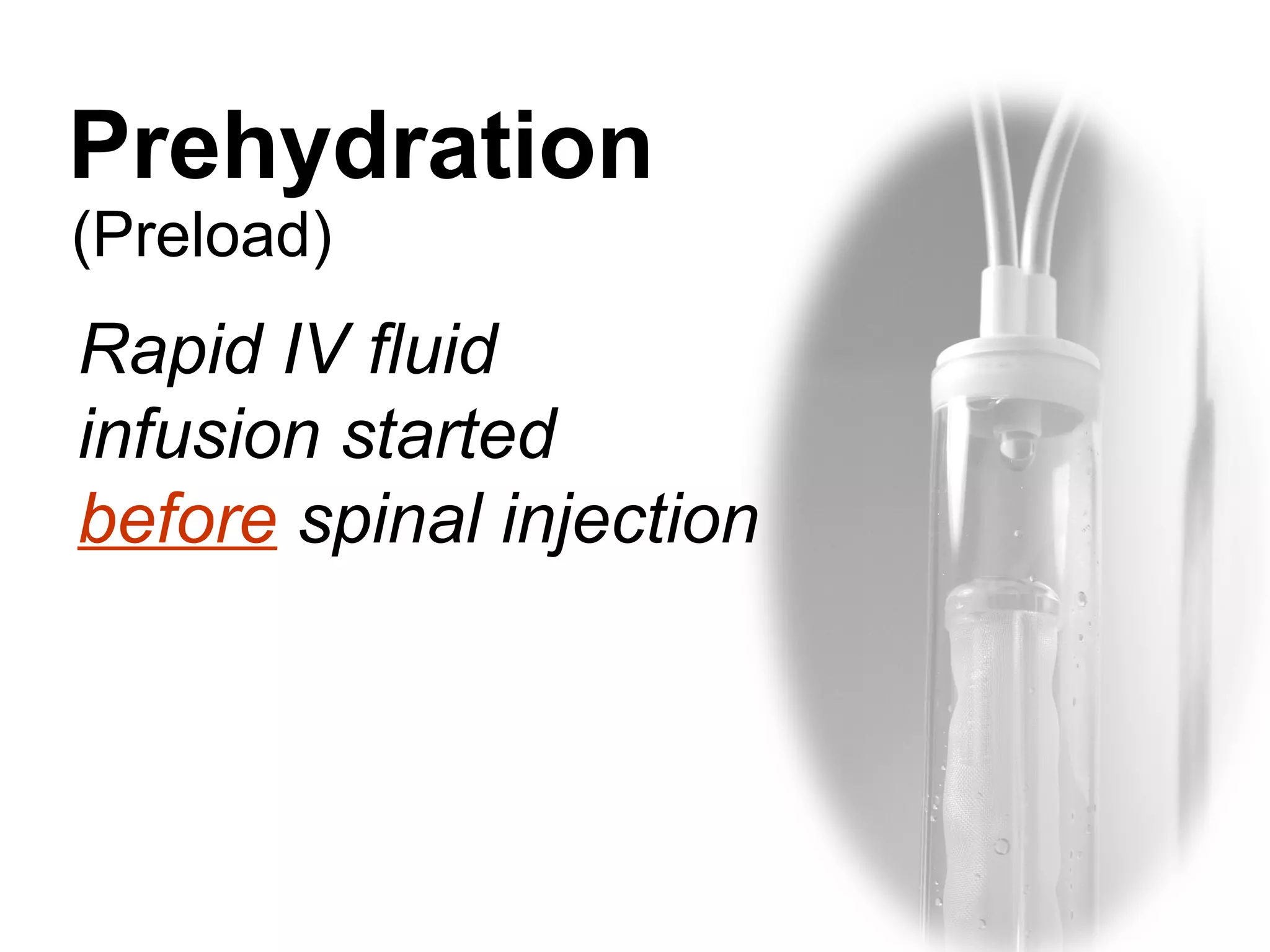
Prehydration 
(Preload) 
Rapid IV fluid 
infusion started 
before spinal injection
Cohydration 
(Coload) 
Rapid IV fluid 
infusion started 
after spinal injection
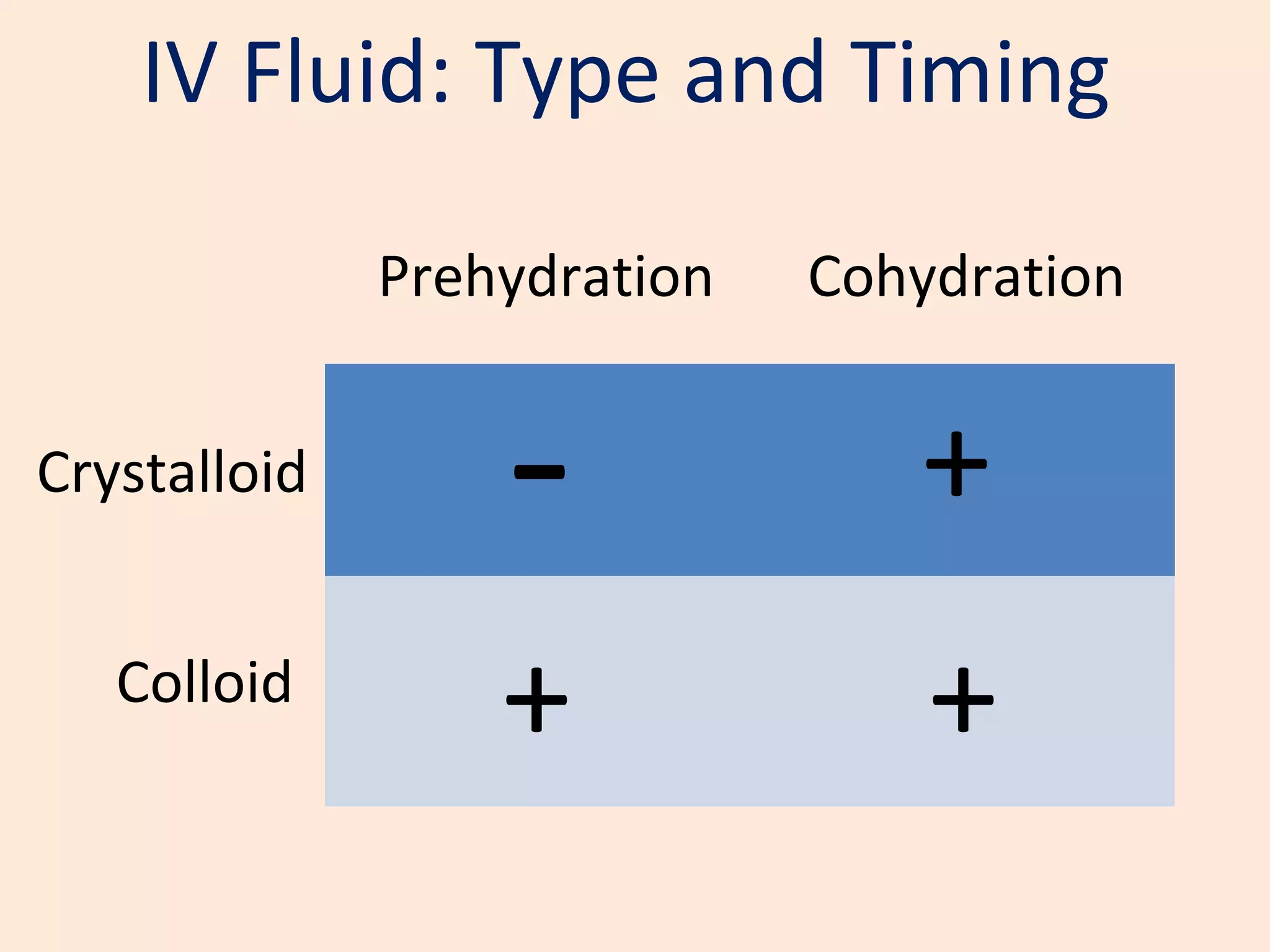
IV Fluid: Type and Timing 
Crystalloid 
Prehydration Cohydration 
Colloid
IV Fluid: Type and Timing 
Crystalloid 
Prehydration Cohydration 
Colloid 
- + 
+ +
Colloid Prehydration: 
D I S A D V A N T A G E S 
• Cost. 
• Effects on coagulation. 
• Fluid overload. 
• Haemodilution. 
• Allergic reactions.
Recommendation: 
• Crystalloid: cohydration 
• Colloid: prehydration or cohydration 
• Don't rely on IV fluids 
• Don't delay for IV fluids
OUTLINE: 
• Spinal 
 Drugs 
 Fluids 
 Blood Pressure 
• CSE 
 Dose 
• Epidural 
 Topup
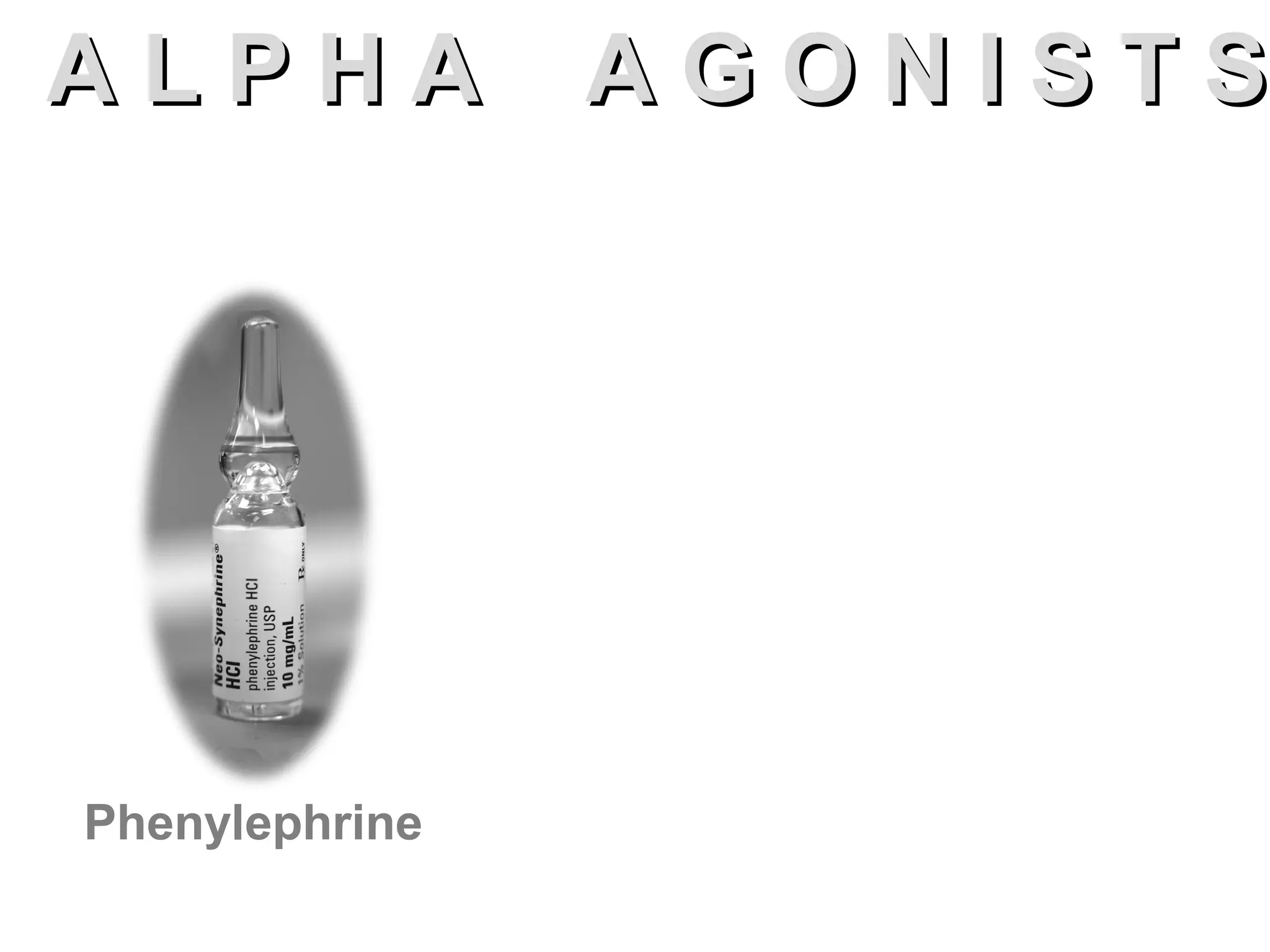
AA LL PP HH AA AA GG OO NN II SS TT SS 
Phenylephrine
AA LL PP HH AA AA GG OO NN II SS TT SS 
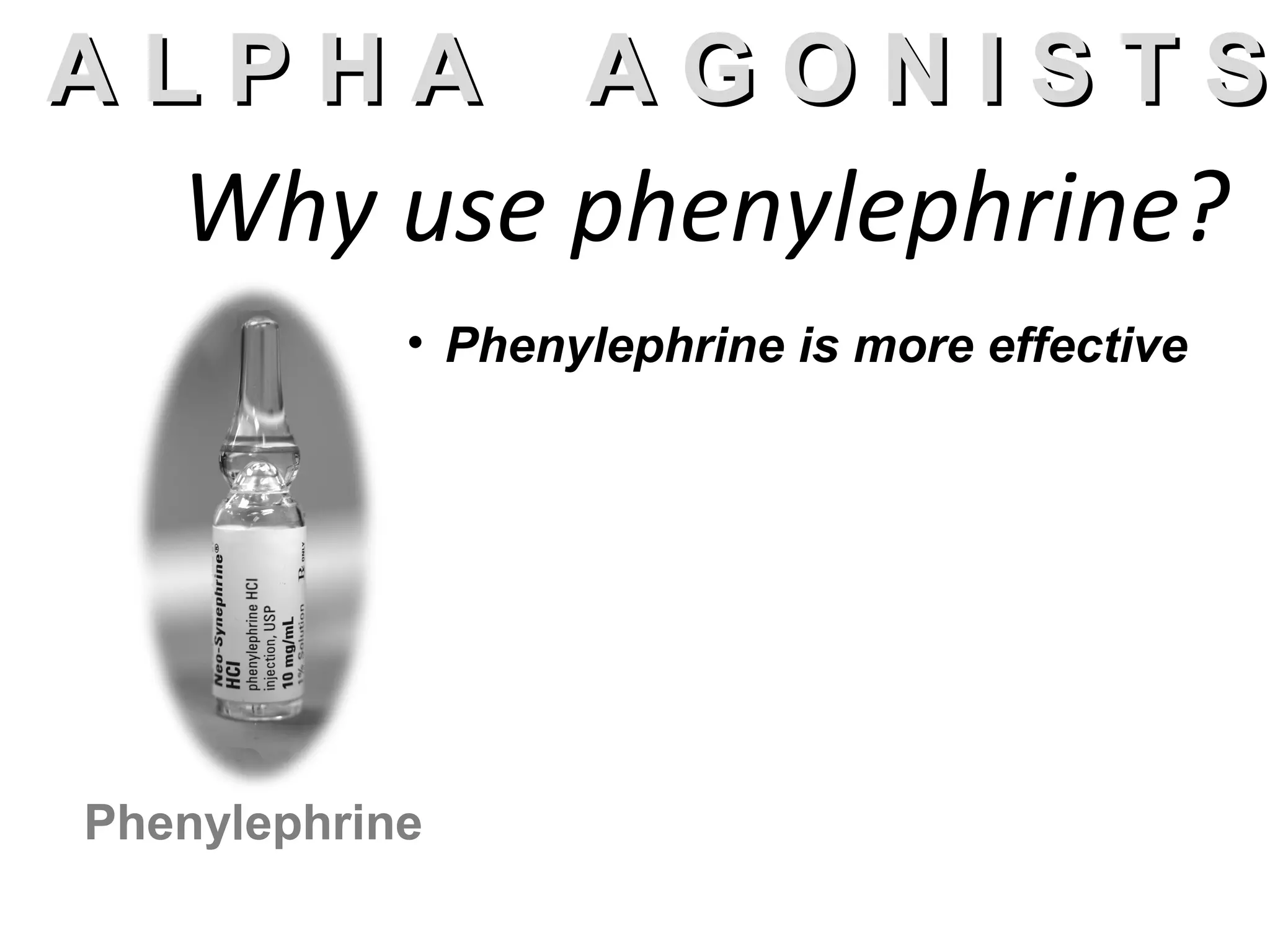
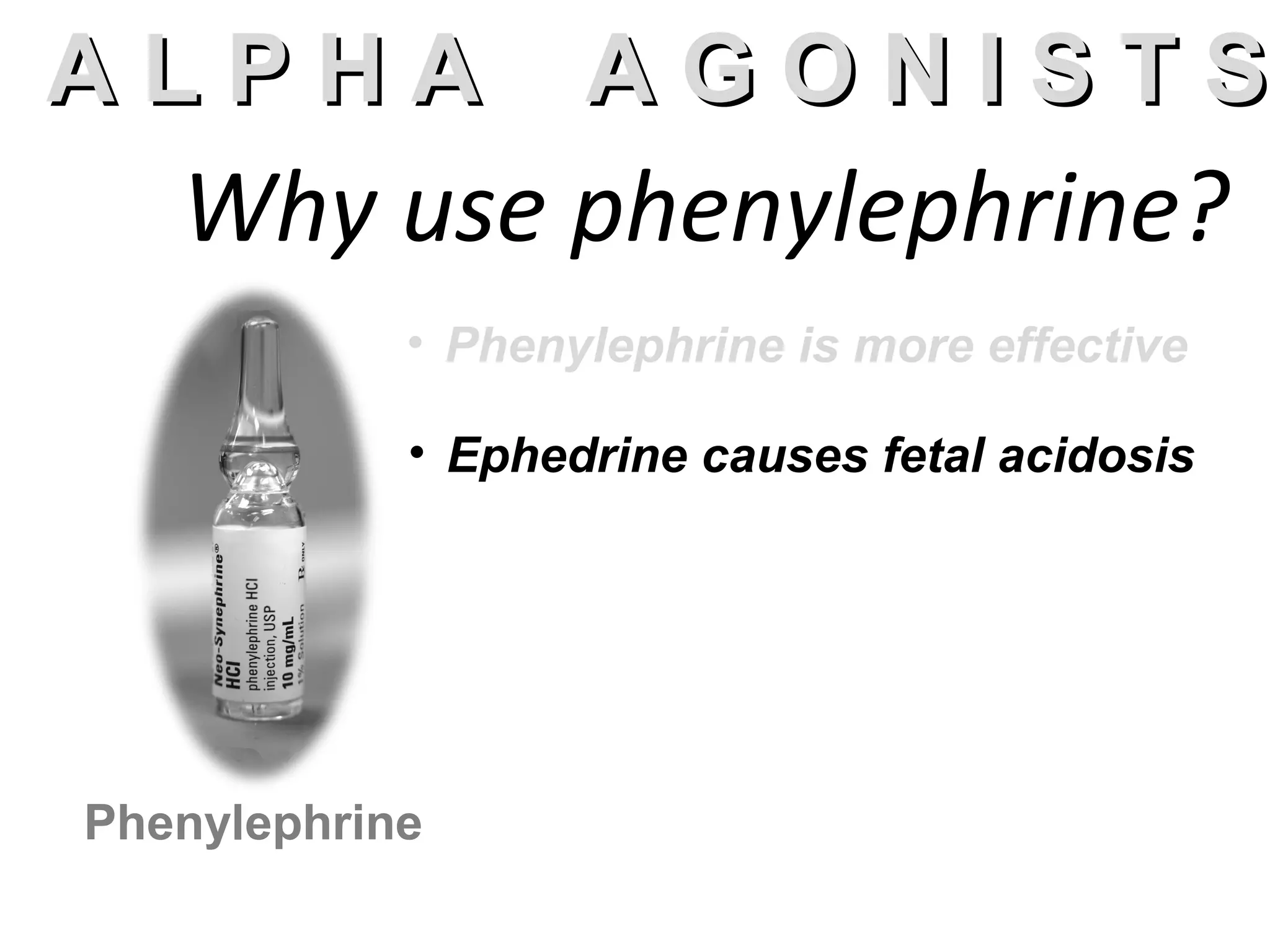
Why use phenylephrine? 
• Phenylephrine is more effective 
Phenylephrine
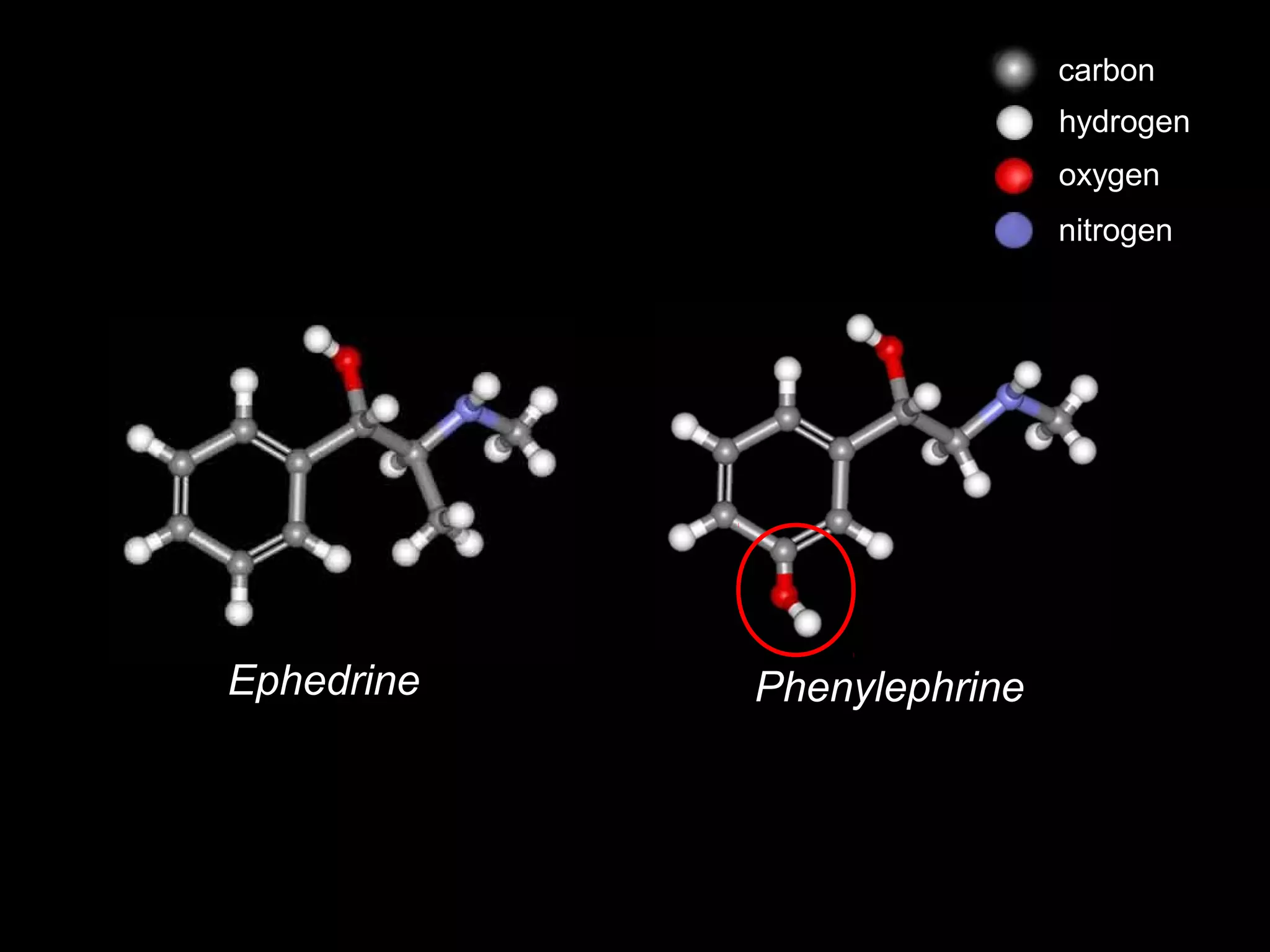
Ephedrine Phenylephrine 
carbon 
hydrogen 
oxygen 
nitrogen
AA LL PP HH AA AA GG OO NN II SS TT SS 
Why use phenylephrine? 
• Phenylephrine is more effective 
• Ephedrine causes fetal acidosis 
Phenylephrine
Ephedrine depresses fetal pH and BE 
Figure 1. Meta-analysis of trials - effect on umbilical arterial pH 
Favours ephedrine Favours phenylephrine 
Alahuhta 
Hall 
LaPorta 
Moran 
Pierce 
Thomas 
Overall effect 
-0.10 -0.05 0.00 0.05 0.10 
Weighted mean difference (umbilical cord arterial blood pH) 
Lee A, Ngan Kee WD, Gin T. Anesth Analg 2002;94 920-6.
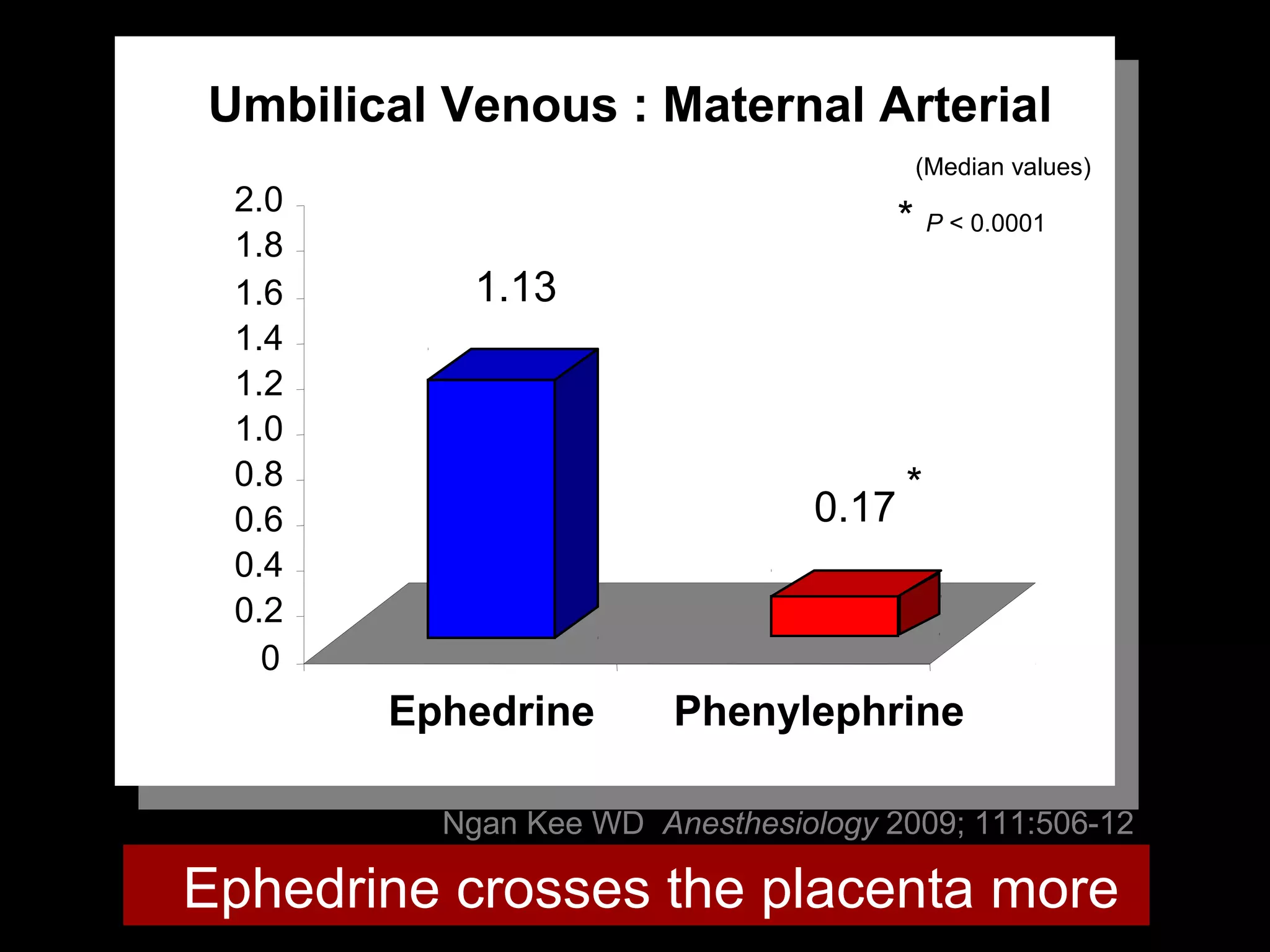
Umbilical Venous : Maternal Arterial 
2.0 
1.8 
1.6 
1.4 
1.2 
1.0 
0.8 
0.6 
0.4 
0.2 
0 
1.13 
(Median values) 
* P < 0.0001 
0.17 * 
Ephedrine Phenylephrine 
Ngan Kee WD Anesthesiology 2009; 111:506-12 
Ephedrine crosses the placenta more
How to use phenylephrine? 
Phenylephrine 
• Preparation 
• Timing 
• Method of Giving
Preparation.... 
Dilute carefully….. 
+ = 100 μg/ml 
10 mg / 1ml 100 ml
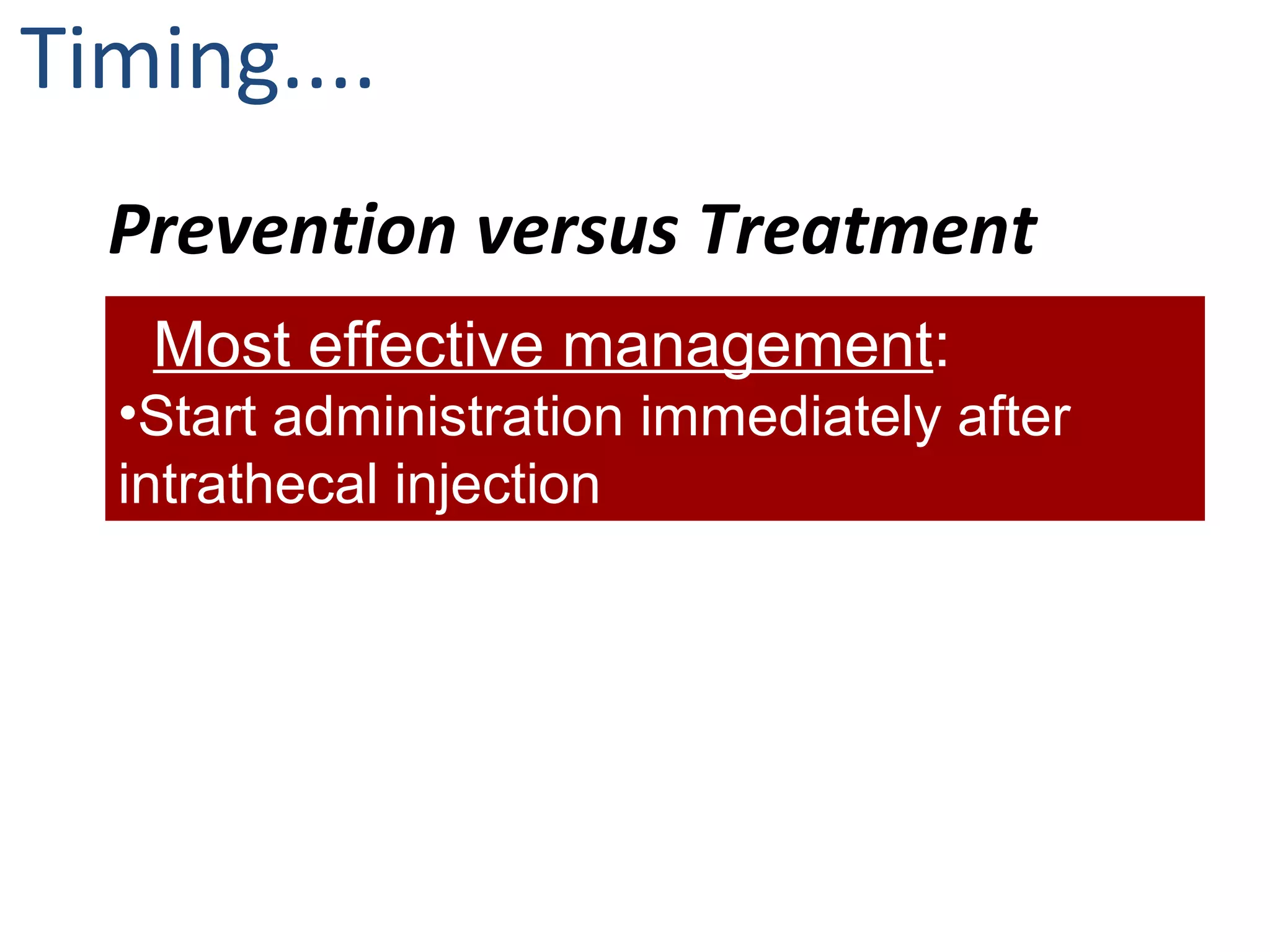
Timing.... 
Prevention versus Treatment 
Most effective management: 
•Start administration immediately after 
intrathecal injection
Method of Giving.... 
Infusion versus Boluses 
• Both effective 
• Intermittent bolus simple 
• Infusion convenient
Recommendation: 
Bolus technique: 
• Bolus dose: 50-100 μg (0.5-1ml) 
• Begin immediately after IT injection 
• Measure BP Q1min 
• Further boluses when BP start to decrease
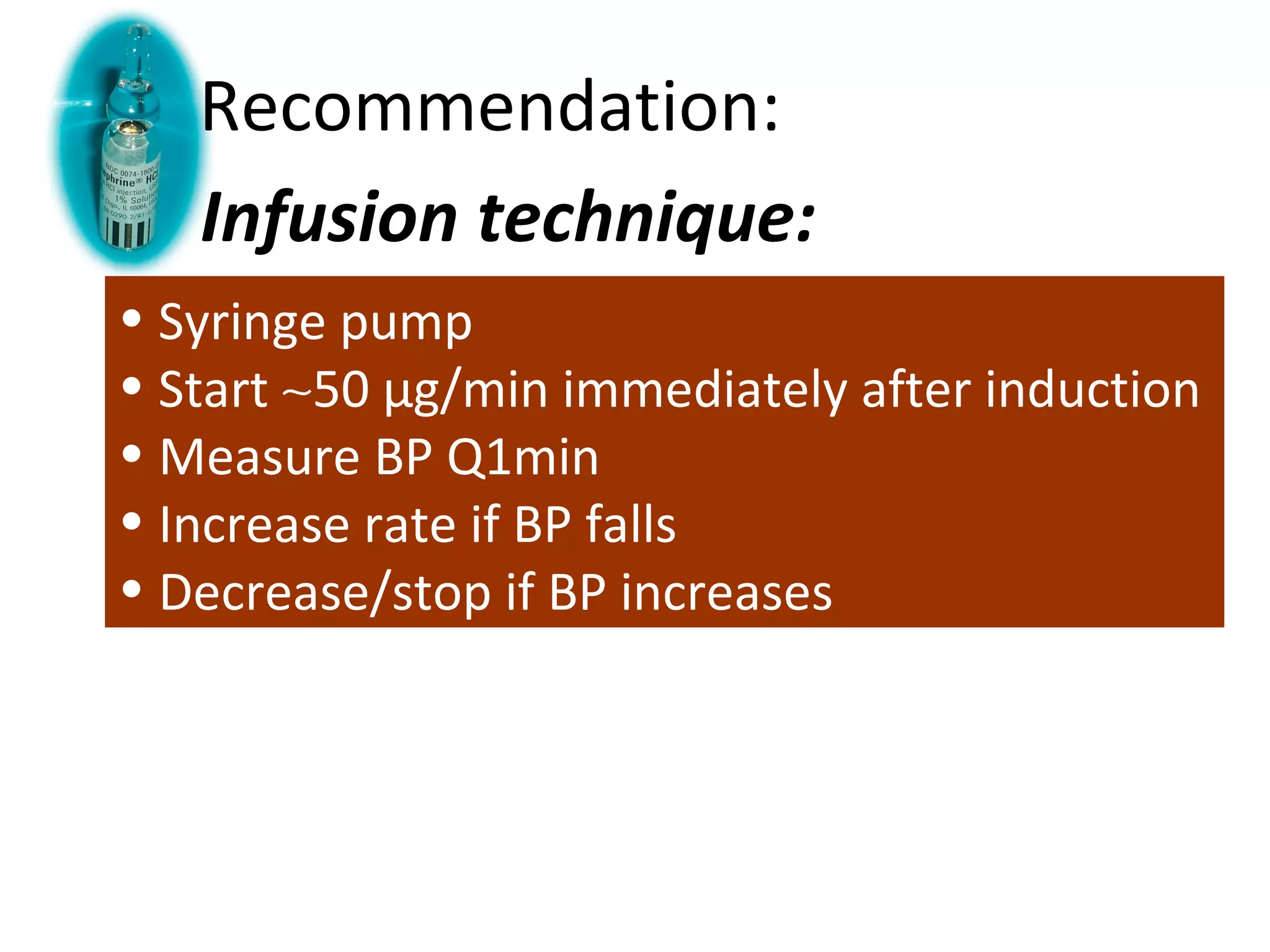
Recommendation: 
Infusion technique: 
• Syringe pump 
• Start ~50 μg/min immediately after induction 
• Measure BP Q1min 
• Increase rate if BP falls 
• Decrease/stop if BP increases
Recommendation: 
What about bradycardia? 
• Associated with ¯cardiac output 
• Tolerate to ~ 50-60 bpm 
• BP high/normal: stop and wait! 
• BP low: IVF, ephedrine, 
atropine/glycopyrrolate* 
* Beware hypertension with 
anticholinergics!
Recommendation: 
What about high risk cases? 
• Preeclampsia 
• Fetal compromise 
• Few studies 
• Less vasopressor needed 
• Use less aggressive dosing
OUTLINE: 
• Spinal 
 Drugs 
 Fluids 
 Blood Pressure 
• CSE 
 Dose 
• Epidural 
 Topup
Single shot spinal 
Dose required for adequate spinal block
Single shot spinal 
Dose required for adequate spinal block
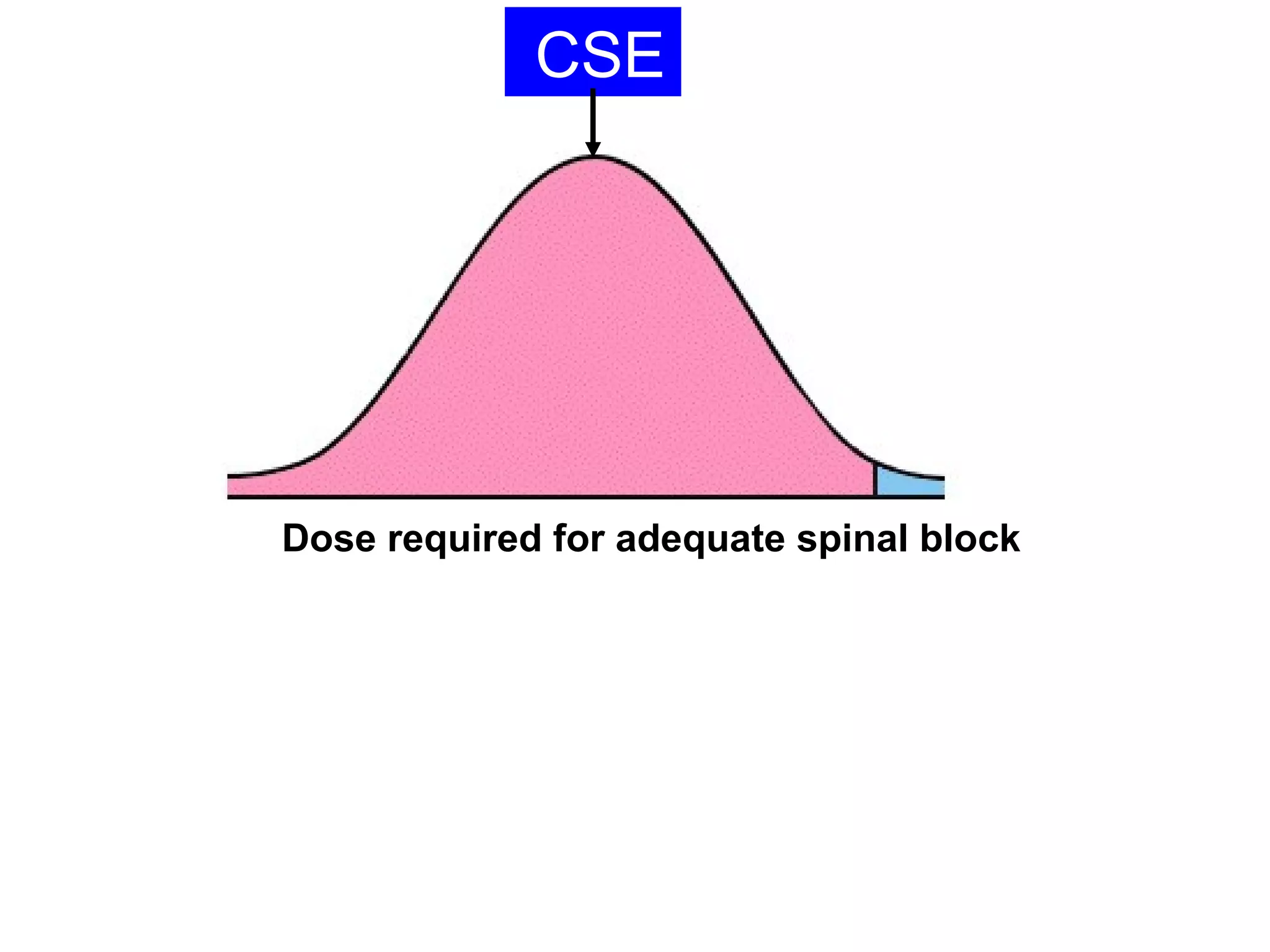
CSE 
Dose required for adequate spinal block
Incidence of Hypotension 
100 
80 
60 
40 
20 
0 
** 
P < 0.001 
Low Dose Standard 
Hypotension 
(%) 73% 
14% 
Teoh et al. Int J Obstet Anesth 2006;15:273-8
OUTLINE: 
• Spinal 
 Drugs 
 Fluids 
 Blood Pressure 
• CSE 
 Dose 
• Epidural 
 Topup
2008-2009 
• 93,000 Emerg C-sections 
• 22% Epidural Anaesthesia 
Labour Epidural Topups 
Hillyard et al. Br J Anaesth 2011;107:668-78
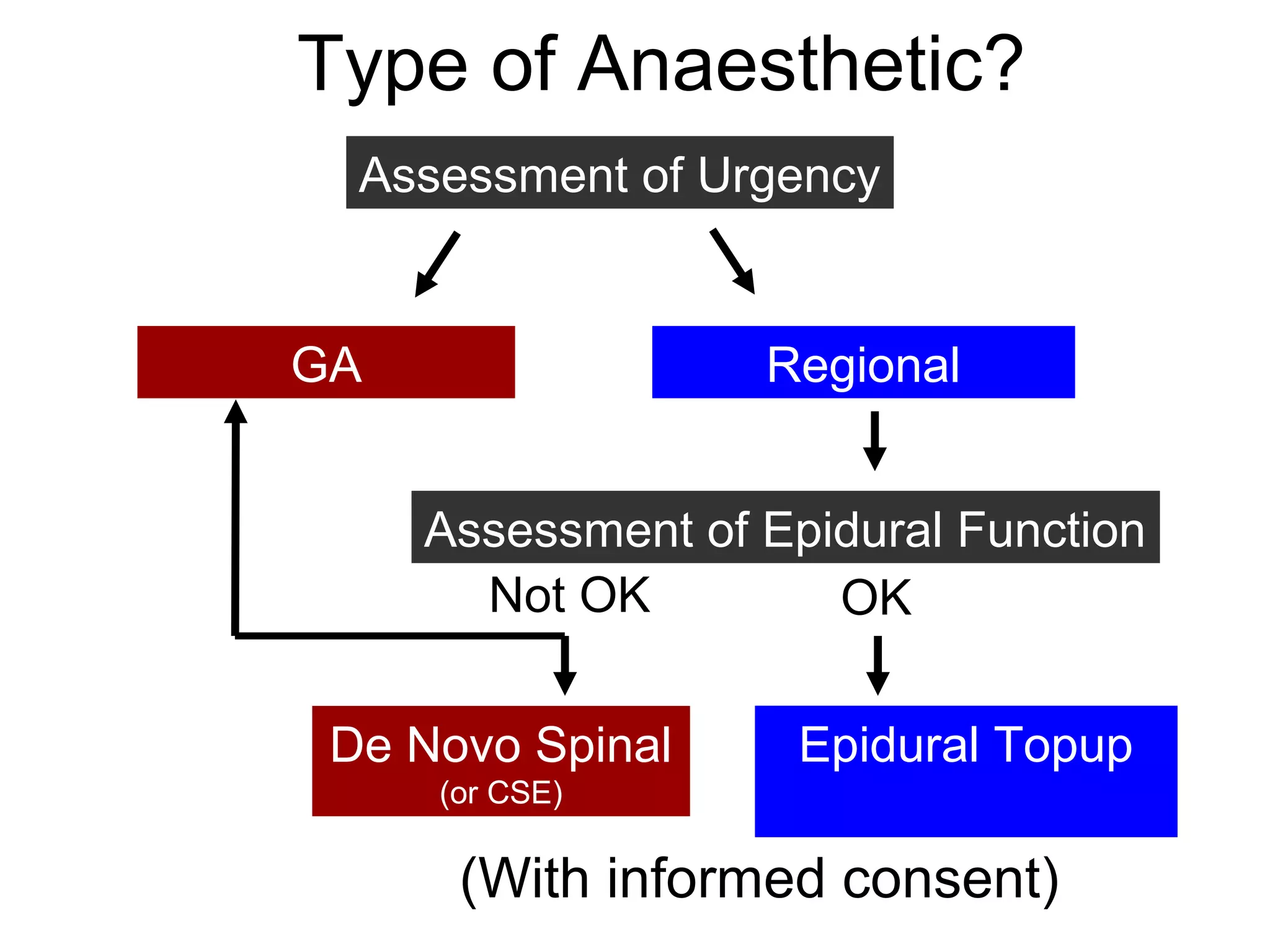
Type of Anaesthetic? 
Assessment of Urgency 
GA Regional 
Assessment of Epidural Function 
OK 
Epidural Topup 
Not OK 
De Novo Spinal 
(or CSE) 
(With informed consent)
Assessment of Epidural Function
Epidural Topup…. 
….or De Novo Spinal? 
Assessing Epidural: 
• How is pain control? 
• What is block height? 
• How much local anaesthetic? 
• How frequent interventions?
Epidural Topup…. 
….What Drug?
Bupivacaine 
Levobupivacaine 
Ropivacaine 
Lidocaine 
(+ epinephrine)
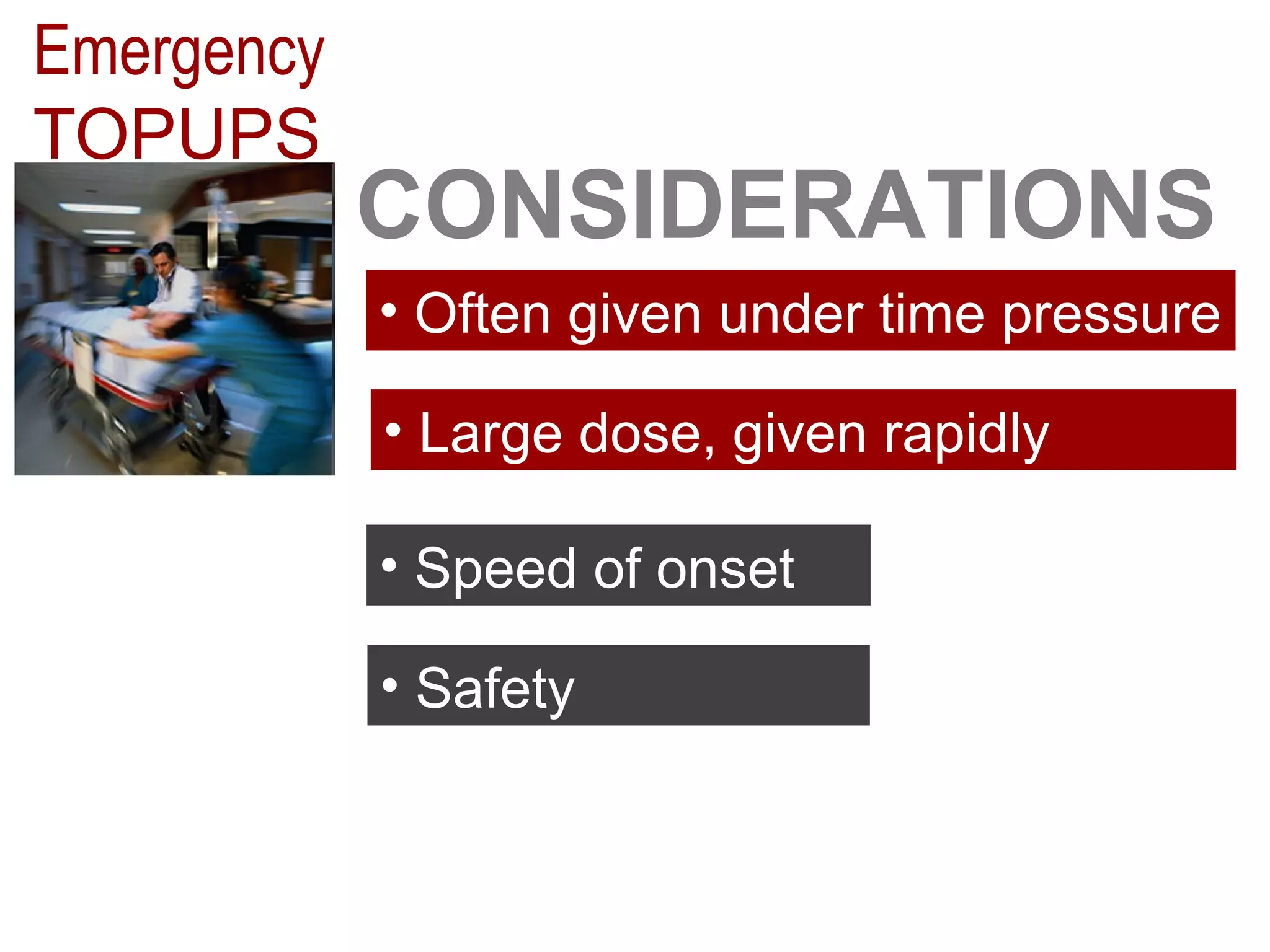
Emergency 
TOPUPS 
CONSIDERATIONS 
• Often given under time pressure 
• Large dose, given rapidly 
• Speed of onset 
• Safety
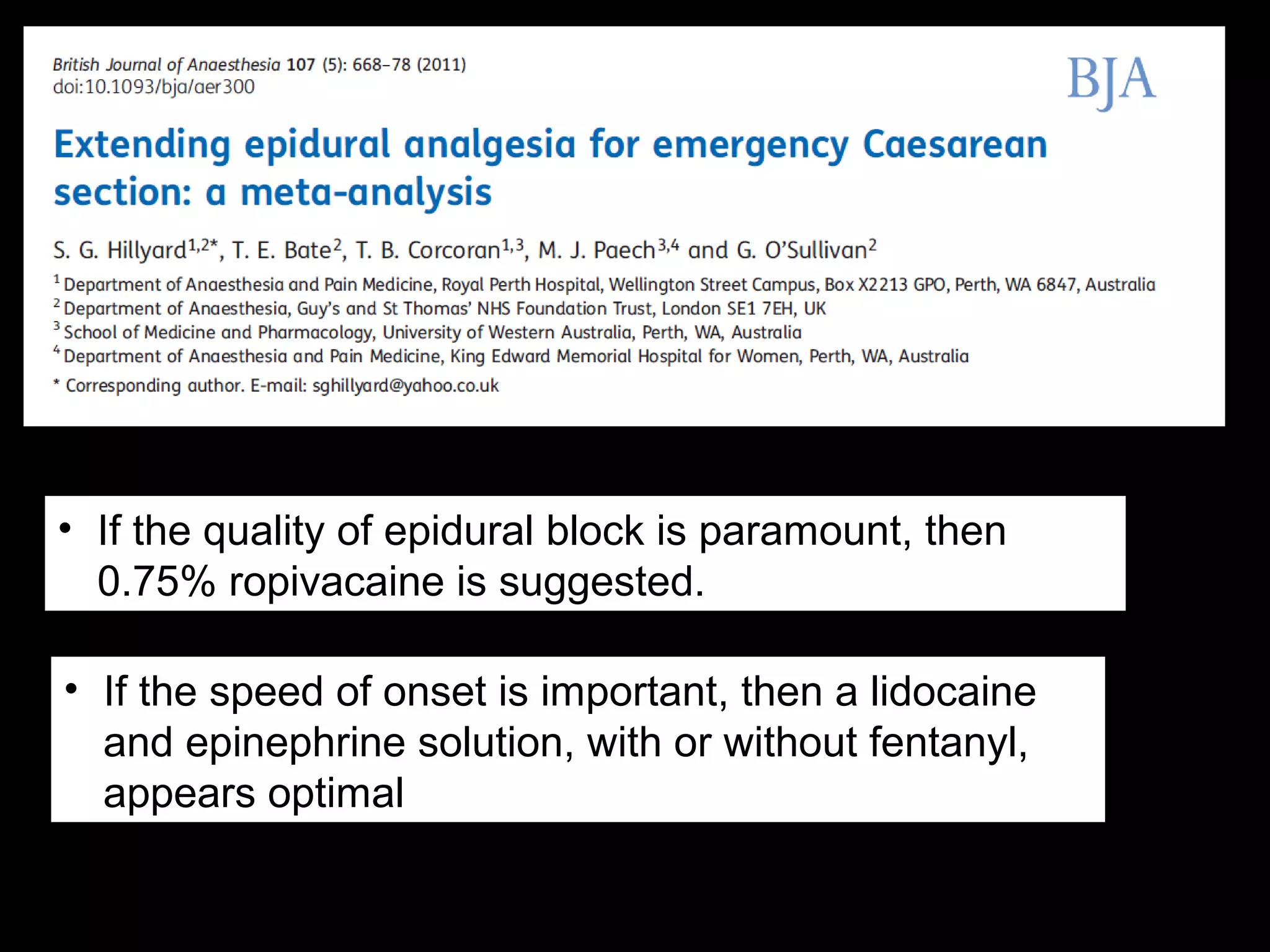
• If the quality of epidural block is paramount, then 
0.75% ropivacaine is suggested. 
• If the speed of onset is important, then a lidocaine 
and epinephrine solution, with or without fentanyl, 
appears optimal
Complications of Extension of 
Epidural Block 
Epidural Block 
8 
14 
6 
2 
1 
12 
Regan KL, O'Sullivan G. Anaesthesia 2008;63:136-42
F A I L E D B L O C K
F A I L E D B L O C K 
Assessment & Discussion 
GA Regional 
De Novo Spinal 
(or CSE) 
(With informed consent)
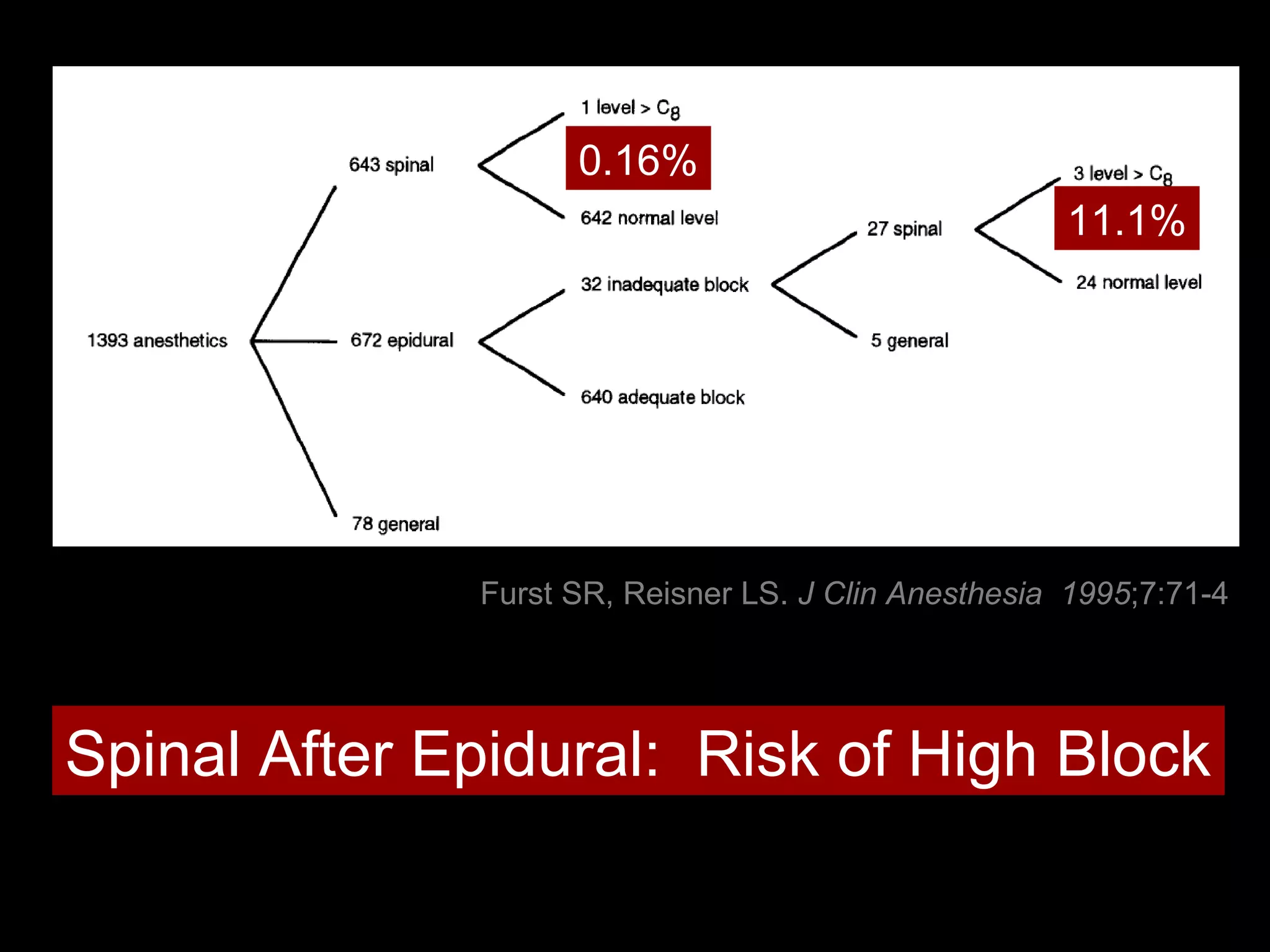
0.16% 
11.1% 
Furst SR, Reisner LS. J Clin Anesthesia 1995;7:71-4 
Spinal After Epidural: Risk of High Block
F A I L E D B L O C K 
Assessment & Discussion 
GA Regional 
De Novo Spinal 
(or CSE) 
Reduce Dose
Regional Anaesthesia for 
Caesarean Section 
K E Y P O I N T S
Regional Anaesthesia for 
Caesarean Section 
K E Y P O I N T S 
Spinal Anaesthesia 
• Hyperbaric local anaesthetic 
• + Fentanyl / Sufentanil 
• ± Morphine
Regional Anaesthesia for 
Caesarean Section 
K E Y P O I N T S 
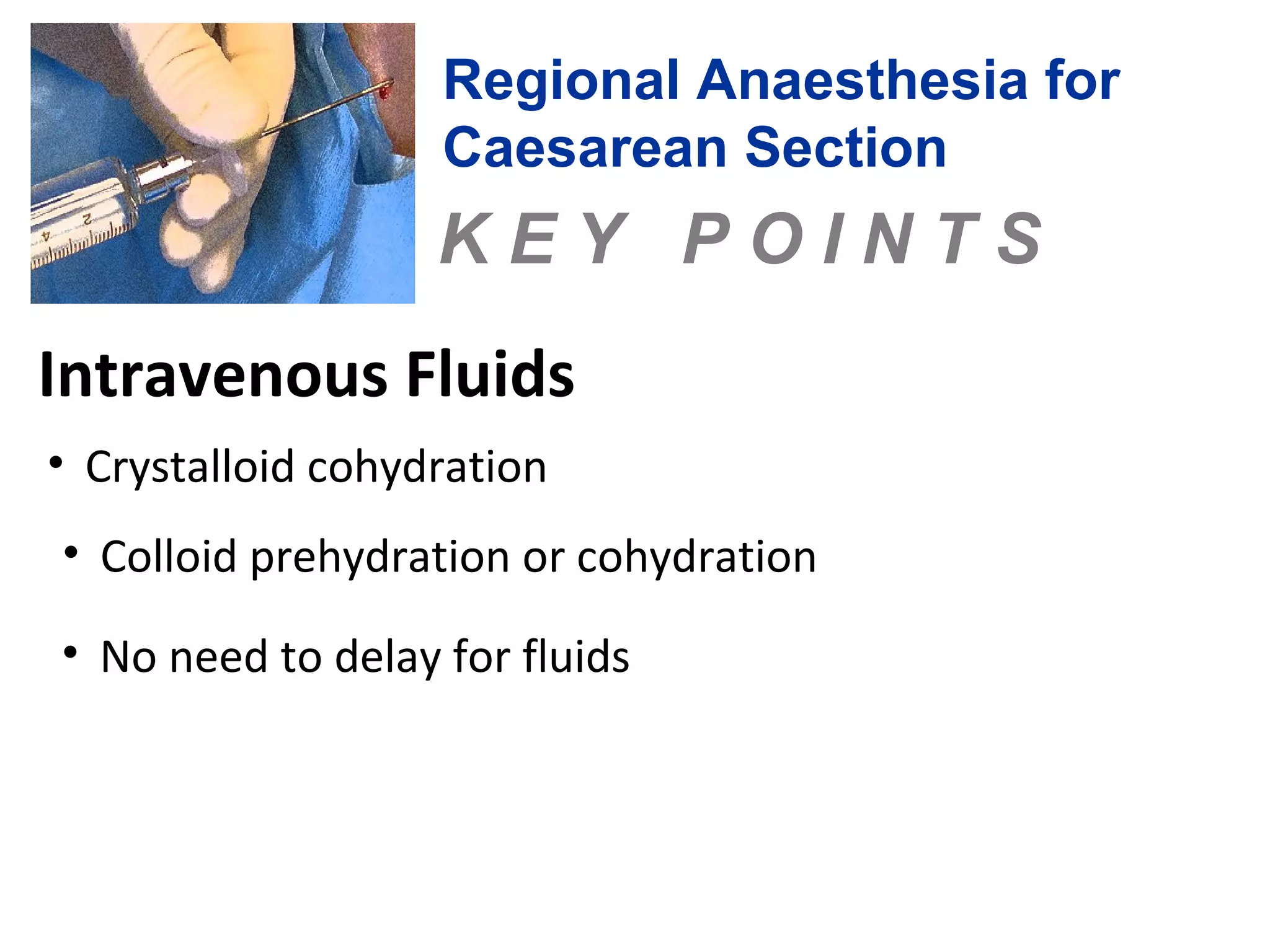
Intravenous Fluids 
• Crystalloid cohydration 
• Colloid prehydration or cohydration 
• No need to delay for fluids
Regional Anaesthesia for 
Caesarean Section 
K E Y P O I N T S 
Vasopressors 
• Avoid large doses of ephedrine before delivery 
• Phenylephrine preferred 
• Bolus or infusion 
• Bradycardia: stop and wait.
Regional Anaesthesia for 
Caesarean Section 
K E Y P O I N T S 
Combined Spinal Epidural (CSE) 
• Good for reducing dose 
• Better haemodynamic stability 
• Useful for prolonged surgery
Regional Anaesthesia for 
Caesarean Section 
K E Y P O I N T S 
Epidural Topup for C-Section 
• 2% Lidocaine + Adrenaline ± Bicarbonate 
• 0.75% Ropivacaine 
• Spinal after epidural: reduce dose
Regional Anaesthesia for 
Caesarean Section 
Warwick D. Ngan Kee 
Dept of Anaesthesia & Intensive Care 
The Chinese University of Hong Kong

03 warwick ngan kee

  • 1.
    Regional Anaesthesia for Caesarean Section Warwick D. Ngan Kee Dept of Anaesthesia & Intensive Care The Chinese University of Hong Kong
  • 2.
    OUTLINE: • Spinal  Drugs  Fluids  Blood Pressure • CSE  Dose • Epidural  Topup
  • 3.
    OUTLINE: • Spinal  Drugs  Fluids  Blood Pressure • CSE  Dose • Epidural  Topup
  • 4.
    Local Anaesthetic Bupivacaine Bupivacaine is the local anaesthetic of choice
  • 7.
    Hyperbaric vs Plain: • Faster onset • Less conversion to GA
  • 9.
    Hyperbaric vs Plain: • Faster onset • Less conversion to GA • Less variability of block Hyperbaric local anaesthetic more reliable
  • 10.
  • 11.
    • Opioids •Adrenaline • Clonidine • Neostigmine • Ketamine
  • 12.
    Adding adjunct agents Possible advantages: 1. Decrease side effects 2. Increase efficacy
  • 13.
    Adding adjunct agents Possible disadvantages: 1. Drug error 2. Breach of sterility 3. Incompatibility 4. Cost 5. Safety (often “off-label”)
  • 14.
    • Opioids •Adrenaline • Clonidine • Neostigmine • Ketamine Only add an opioid
  • 15.
    Local Anaesthetic Lipophilic + Opioid Bupivacaine Fentanyl
  • 16.
    Bupivacaine Spinal AddedFentanyl 0 - 50 μg
  • 17.
    Intraoperative Opioid Supplementation 0 2.5 5 6.25 12.5 25 37 50 Fentanyl Dose (μg) Intraop Opioid (%) 67% 50% 25% 0% 0% 0% 0% 0% Hunt et al. Anesthesiology 1989;71:535-40.
  • 18.
  • 20.
    Elective Spinal Caesarean(n=30) Hyperbaric Bupivacaine 12 mg • FENTANYL: Less intraoperative pain • FENTANYL: Less intraoperative nausea Manullang et al. Anesth Analg 2000;90:1162-6. IV Ondansetron 4 mg IT Fentanyl 15 μg Adding an opioid improves patient comfort
  • 21.
    Morphine • 100- 200 μg • Preservative-free • Postop analgesia Morpheus
  • 22.
    OUTLINE: • Spinal  Drugs  Fluids  Blood Pressure • CSE  Dose • Epidural  Topup
  • 23.
  • 24.
  • 25.
  • 26.
    Prehydration (Preload) RapidIV fluid infusion started before spinal injection
  • 27.
    Cohydration (Coload) RapidIV fluid infusion started after spinal injection
  • 28.
    IV Fluid: Typeand Timing Crystalloid Prehydration Cohydration Colloid
  • 29.
    IV Fluid: Typeand Timing Crystalloid Prehydration Cohydration Colloid - + + +
  • 30.
    Colloid Prehydration: DI S A D V A N T A G E S • Cost. • Effects on coagulation. • Fluid overload. • Haemodilution. • Allergic reactions.
  • 31.
    Recommendation: • Crystalloid:cohydration • Colloid: prehydration or cohydration • Don't rely on IV fluids • Don't delay for IV fluids
  • 32.
    OUTLINE: • Spinal  Drugs  Fluids  Blood Pressure • CSE  Dose • Epidural  Topup
  • 33.
    AA LL PPHH AA AA GG OO NN II SS TT SS Phenylephrine
  • 34.
    AA LL PPHH AA AA GG OO NN II SS TT SS Why use phenylephrine? • Phenylephrine is more effective Phenylephrine
  • 35.
    Ephedrine Phenylephrine carbon hydrogen oxygen nitrogen
  • 36.
    AA LL PPHH AA AA GG OO NN II SS TT SS Why use phenylephrine? • Phenylephrine is more effective • Ephedrine causes fetal acidosis Phenylephrine
  • 37.
    Ephedrine depresses fetalpH and BE Figure 1. Meta-analysis of trials - effect on umbilical arterial pH Favours ephedrine Favours phenylephrine Alahuhta Hall LaPorta Moran Pierce Thomas Overall effect -0.10 -0.05 0.00 0.05 0.10 Weighted mean difference (umbilical cord arterial blood pH) Lee A, Ngan Kee WD, Gin T. Anesth Analg 2002;94 920-6.
  • 39.
    Umbilical Venous :Maternal Arterial 2.0 1.8 1.6 1.4 1.2 1.0 0.8 0.6 0.4 0.2 0 1.13 (Median values) * P < 0.0001 0.17 * Ephedrine Phenylephrine Ngan Kee WD Anesthesiology 2009; 111:506-12 Ephedrine crosses the placenta more
  • 40.
    How to usephenylephrine? Phenylephrine • Preparation • Timing • Method of Giving
  • 41.
    Preparation.... Dilute carefully….. + = 100 μg/ml 10 mg / 1ml 100 ml
  • 42.
    Timing.... Prevention versusTreatment Most effective management: •Start administration immediately after intrathecal injection
  • 43.
    Method of Giving.... Infusion versus Boluses • Both effective • Intermittent bolus simple • Infusion convenient
  • 44.
    Recommendation: Bolus technique: • Bolus dose: 50-100 μg (0.5-1ml) • Begin immediately after IT injection • Measure BP Q1min • Further boluses when BP start to decrease
  • 45.
    Recommendation: Infusion technique: • Syringe pump • Start ~50 μg/min immediately after induction • Measure BP Q1min • Increase rate if BP falls • Decrease/stop if BP increases
  • 46.
    Recommendation: What aboutbradycardia? • Associated with ¯cardiac output • Tolerate to ~ 50-60 bpm • BP high/normal: stop and wait! • BP low: IVF, ephedrine, atropine/glycopyrrolate* * Beware hypertension with anticholinergics!
  • 47.
    Recommendation: What abouthigh risk cases? • Preeclampsia • Fetal compromise • Few studies • Less vasopressor needed • Use less aggressive dosing
  • 48.
    OUTLINE: • Spinal  Drugs  Fluids  Blood Pressure • CSE  Dose • Epidural  Topup
  • 49.
    Single shot spinal Dose required for adequate spinal block
  • 50.
    Single shot spinal Dose required for adequate spinal block
  • 51.
    CSE Dose requiredfor adequate spinal block
  • 53.
    Incidence of Hypotension 100 80 60 40 20 0 ** P < 0.001 Low Dose Standard Hypotension (%) 73% 14% Teoh et al. Int J Obstet Anesth 2006;15:273-8
  • 54.
    OUTLINE: • Spinal  Drugs  Fluids  Blood Pressure • CSE  Dose • Epidural  Topup
  • 55.
    2008-2009 • 93,000Emerg C-sections • 22% Epidural Anaesthesia Labour Epidural Topups Hillyard et al. Br J Anaesth 2011;107:668-78
  • 56.
    Type of Anaesthetic? Assessment of Urgency GA Regional Assessment of Epidural Function OK Epidural Topup Not OK De Novo Spinal (or CSE) (With informed consent)
  • 57.
  • 58.
    Epidural Topup…. ….orDe Novo Spinal? Assessing Epidural: • How is pain control? • What is block height? • How much local anaesthetic? • How frequent interventions?
  • 59.
  • 60.
    Bupivacaine Levobupivacaine Ropivacaine Lidocaine (+ epinephrine)
  • 61.
    Emergency TOPUPS CONSIDERATIONS • Often given under time pressure • Large dose, given rapidly • Speed of onset • Safety
  • 62.
    • If thequality of epidural block is paramount, then 0.75% ropivacaine is suggested. • If the speed of onset is important, then a lidocaine and epinephrine solution, with or without fentanyl, appears optimal
  • 63.
    Complications of Extensionof Complications of Extension of Epidural Block Epidural Block 8 14 6 2 1 12 Regan KL, O'Sullivan G. Anaesthesia 2008;63:136-42
  • 64.
    F A IL E D B L O C K
  • 65.
    F A IL E D B L O C K Assessment & Discussion GA Regional De Novo Spinal (or CSE) (With informed consent)
  • 67.
    0.16% 11.1% FurstSR, Reisner LS. J Clin Anesthesia 1995;7:71-4 Spinal After Epidural: Risk of High Block
  • 68.
    F A IL E D B L O C K Assessment & Discussion GA Regional De Novo Spinal (or CSE) Reduce Dose
  • 69.
    Regional Anaesthesia for Caesarean Section K E Y P O I N T S
  • 70.
    Regional Anaesthesia for Caesarean Section K E Y P O I N T S Spinal Anaesthesia • Hyperbaric local anaesthetic • + Fentanyl / Sufentanil • ± Morphine
  • 71.
    Regional Anaesthesia for Caesarean Section K E Y P O I N T S Intravenous Fluids • Crystalloid cohydration • Colloid prehydration or cohydration • No need to delay for fluids
  • 72.
    Regional Anaesthesia for Caesarean Section K E Y P O I N T S Vasopressors • Avoid large doses of ephedrine before delivery • Phenylephrine preferred • Bolus or infusion • Bradycardia: stop and wait.
  • 73.
    Regional Anaesthesia for Caesarean Section K E Y P O I N T S Combined Spinal Epidural (CSE) • Good for reducing dose • Better haemodynamic stability • Useful for prolonged surgery
  • 74.
    Regional Anaesthesia for Caesarean Section K E Y P O I N T S Epidural Topup for C-Section • 2% Lidocaine + Adrenaline ± Bicarbonate • 0.75% Ropivacaine • Spinal after epidural: reduce dose
  • 75.
    Regional Anaesthesia for Caesarean Section Warwick D. Ngan Kee Dept of Anaesthesia & Intensive Care The Chinese University of Hong Kong