Architecting A Business
  Process Environment
                  Aligning BPM and EA


Sandy Kemsley l www.column2.com l @skemsley
My History in BPM
   l   Mid-late 80’s: from satellite imaging to
       document imaging to workflow
   l   Early 90’s: desktop imaging/workflow
       product
   l   Mid-late 90’s: integrate imaging, workflow,
       EAI and e-commerce systems
   l   2000-1: FileNet (now IBM) BPM evangelist
   l   2002-now: process architect and BPM
       industry analyst
                    Copyright Kemsley Design Ltd., 2011   2
My BPM Calling Card
   l   Column2.com: “a blog about BPM,
       Enterprise 2.0 and technology trends in
       business”
   l   Community of up to 3,000/day
   l   Best known for:
       l   Conference blogging
       l   Product reviews
       l   Independent opinions


                      Copyright Kemsley Design Ltd., 2011   3
Agenda
   l   What is Enterprise Architecture?
   l   What is Business Process Management?
   l   EA-BPM Relationships and Synergies
   l   Model Types and Interactions
   l   Using BPMN 2.0 (Business Process Model
       and Notation)


                   Copyright Kemsley Design Ltd., 2011   4
Definitions, Synergies and
Benefits
           Copyright Kemsley Design Ltd., 2011   5
What is EA?
     EA is the process of translating business vision
     and strategy into effective organizational change
     by creating, communicating and improving the key
     requirements, principles and models that describe
     the organization’s future state and enable its
     evolution.

                                                         Gartner


                   Copyright Kemsley Design Ltd., 2011             6
What Is EA?
   1. A formal description of a system, or a
      detailed plan of the system at a
      component level to guide its
      implementation
                              - OR -
   2. The structure of components, their inter-
      relationships, and the principles and
      guidelines governing their design and
      evolution over time
                                                       TOGAF
                 Copyright Kemsley Design Ltd., 2011           7
What Is EA?
     An architectural discipline that merges
     strategic business and IT objectives with
     opportunities for change and governs the
     resulting change initiatives
                                                      IBM


                Copyright Kemsley Design Ltd., 2011         8
EA Defined
   l   Strategy (evolutionary path) to achieve
       desired business future state
   l   Artefacts for documenting and
       communicating strategy
   l   Many methodologies/frameworks: may be
       a process, a taxonomy or a practice


                   Copyright Kemsley Design Ltd., 2011   9
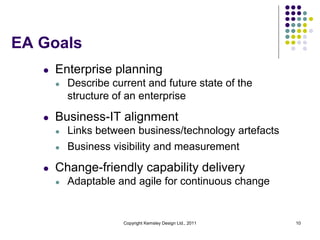
EA Goals
   l   Enterprise planning
       l   Describe current and future state of the
           structure of an enterprise

   l   Business-IT alignment
       l   Links between business/technology artefacts
       l   Business visibility and measurement

   l   Change-friendly capability delivery
       l   Adaptable and agile for continuous change


                       Copyright Kemsley Design Ltd., 2011   10
What is BPM?
    BPM is a management discipline that treats
    processes as assets that directly contribute to
    enterprise performance by driving operational
    excellence and business process agility.
    BPM employs methods, policies, metrics,
    management practices and software tools to
    continuously optimize the organization’s
    processes to improve business performance
    against goals and objectives
                                                        Gartner

                  Copyright Kemsley Design Ltd., 2011             11
BPM Defined
   l   A management discipline for improving
       cross-functional business processes
   l   The methods and technology tools used to
       manage and optimize business processes


                  Copyright Kemsley Design Ltd., 2011   12
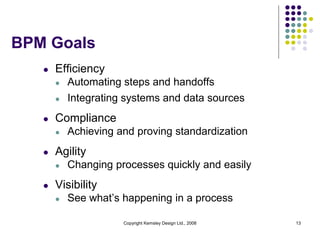
BPM Goals
   l   Efficiency
       l   Automating steps and handoffs
       l   Integrating systems and data sources
   l   Compliance
       l   Achieving and proving standardization
   l   Agility
       l   Changing processes quickly and easily
   l   Visibility
       l   See what’s happening in a process

                      Copyright Kemsley Design Ltd., 2008   13
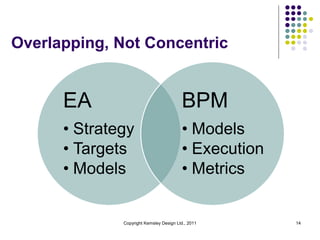
Overlapping, Not Concentric


      EA                                 BPM
      • Strategy                         • Models
      • Targets                          • Execution
      • Models                           • Metrics


              Copyright Kemsley Design Ltd., 2011      14
Linking EA and BPM
   l   Connect EA strategy and BPM execution
       tactics
       l   EA shows what needs to be done to get from
           strategy to execution
       l   BPM is an accelerator that turns EA concepts
           into BPM initiatives to facilitate that goal

   l   Natural synergy from planning to solution
       delivery


                      Copyright Kemsley Design Ltd., 2011   15
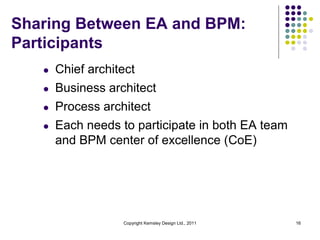
Sharing Between EA and BPM:
Participants
   l   Chief architect
   l   Business architect
   l   Process architect
   l   Each needs to participate in both EA team
       and BPM center of excellence (CoE)


                   Copyright Kemsley Design Ltd., 2011   16
Sharing Between EA and BPM:
Activities
   l   End-to-end enterprise process modelling
   l   Conceptual and logical process design
   l   Establish process standards
   l   Establish and maintain artefact repository


                   Copyright Kemsley Design Ltd., 2011   17
Sharing Between EA and BPM:
Key Models
   l   Process models
       l   Functional flow between people and systems

   l   Organizational models
       l   Roles, skills, hierarchy

   l   Data models
       l   Information structures shared by systems


                       Copyright Kemsley Design Ltd., 2011   18
Sharing Between EA and BPM:
Goals and Performance Indicators
   l   EA creates targets for business
       measurement
       l   Future state models
       l   Requirements and principles

   l   BPM feeds back metrics to assess EA
       targets
       l   Inform and improve planning with actual
           performance data


                      Copyright Kemsley Design Ltd., 2011   19
EA-BPM Additional Benefits
   l   EA helps BPM to evolve from a project to a
       centre of excellence (CoE)
       l   Widen scope to holistic end-to-end processes
       l   Sharing of resources, artefacts and repositories
       l   Encourage governance and standards

   l   BPM encourages process thinking in EA
       l   Focus on end-to-end processes
       l   Push for service-oriented architecture


                       Copyright Kemsley Design Ltd., 2011    20
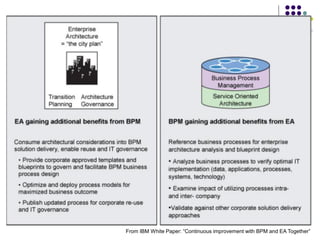
EA and BPM: Better Together


             Copyright Kemsley Design Ltd., 2011                               21
              From IBM White Paper: “Continuous improvement with BPM and EA Together”
Separation of Concerns
   l   Scheduling:
       l   Enterprise planning versus solution delivery
       l   Ongoing activities versus project-specific

   l   Artefacts:
       l   Suitability for planning versus design
       l   Shared versus one-way translation versus bi-
           directional round-trip
       l   Usability for different audiences


                       Copyright Kemsley Design Ltd., 2011   22
Model Types And Interactions

          Copyright Kemsley Design Ltd., 2011   23
Horizontal and Vertical Model
Alignment
    l   Linking process models to other model
        types in a taxonomy:
        l   Data
        l   Organizational
        l   Security
        l   Rules
        l   Events

    l   Process models: levels and usages


                       Copyright Kemsley Design Ltd., 2011   24
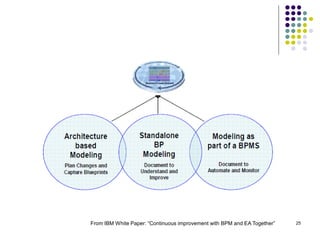
From IBM White Paper: “Continuous Ltd., 2011
           Copyright Kemsley Design improvement with BPM and EA Together”   25
A Taxonomy Of EA Models
(Zachman)
                 Data         Function          Network              People         Time       Motivation
                (What)         (How)            (Where)              (Who)         (When)       (Why)
Scope        List of Things     List of          List of            List of    List of Cycles List of Goals
                              Processes         Locations        Organizations

Business      Business        Business          Business            Business      Business      Business
Model        Entity Model     Process           Network             Workflow     Event Model    Strategy
                               Model             Model               Model                       Model
System       Logical Data      System            System             Human      System Event     Business
Model           Model          Process           Network           Interface     Diagram       Rule Model
                                Model             Model           Architecture
Technology    Physical        Application       Network           Presentation   Technology    Rule Design
Model        Data Model        Structure       Technology         Architecture     Event         Model
                                Chart            Model                            Diagram
Components      Data     Program     Network                       Interface       Event        Rule
             Components Components Components                     Components     Components Specifications


                                     Copyright Kemsley Design Ltd., 2011                                26
Interrelated Model Types
    l   Process models                                                 Data


    l   Organizational models
    l   Data models                                 Events                           Organization


    l   Security models                                              Process

    l   Event models
    l   Rules models                                         Rules             Security


                   Copyright Kemsley Design Ltd., 2011                                      27
Linking Process and Data Models
   l   Process activities require data input/output
       l   Information presented to or gathered from
           person
       l   Data passed to or from automated service

   l   Process design includes process instance
       data model
       l   Subset of enterprise data model


                      Copyright Kemsley Design Ltd., 2011   28
Copyright Kemsley Design Ltd., 2010   29
Linking Process, Organizational
and Security Models
    l   Process activities require specific skills or
        security access levels
    l   Process activities assigned to roles
    l   Process activities may use implied
        organizational hierarchy


                     Copyright Kemsley Design Ltd., 2011   30
Copyright Kemsley Design Ltd., 2010   31
Linking Process and Rule Models
   l   Process decisions represent business rules
       l   Branching/routing decisions
       l   Data validation
       l   Get/set data values

   l   Rules can be externalized as decision
       services, or inherent in process model


                      Copyright Kemsley Design Ltd., 2011   32
Copyright Kemsley Design Ltd., 2011   33
Linking Process and Event
Models
   l   Events are external actions (information or
       control) that impact that process
       l   Event triggers a process
       l   Process triggers an event
       l   Event interrupts or diverts process

   l   Events increase process responsiveness to
       changing conditions


                       Copyright Kemsley Design Ltd., 2011   34
Process Model Levels
   l   EA
       l   Strategy: processes linked to business
           motivation and strategies

   l   BPM
       l   Documentation: implementation-independent
           models for as-is/to-be analysis
       l   Implementation: model-driven design in a BPM
           system (BPMS)


                      Copyright Kemsley Design Ltd., 2011   35
Different Perspectives on Process
Models
    l   Different modelling tools:
        l   Process modelling in EA tool
        l   Standalone business process analysis (BPA)
            tool
        l   Visio and other unstructured environments
        l   Business perspective in BPMS tool
        l   Technical/design perspective in BPMS tool

    l   Translations between perspectives and
        tools

                       Copyright Kemsley Design Ltd., 2011   36
Copyright Kemsley Design Ltd., 2010   37
Copyright Kemsley Design Ltd., 2011   38
BPMN 2.0 In Practice

          Copyright Kemsley Design Ltd., 2011   39
Why BPMN?
   l   OMG-supported standard
   l   Support by many tool vendors
   l   Training and certification programs
   l   Ongoing enhancements in BPMN 2.0:
       l   Advanced event modelling
       l   Serialization for model interchange
       l   Execution semantics


                      Copyright Kemsley Design Ltd., 2011   40
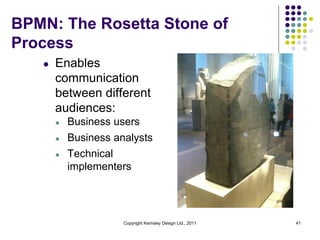
BPMN: The Rosetta Stone of
Process
   l   Enables
       communication
       between different
       audiences:
       l   Business users
       l   Business analysts
       l   Technical
           implementers


                      Copyright Kemsley Design Ltd., 2011   41
BPMN Is Simple...
    l   Activity

    l   Gateway

    l   Event

    l   Data
Source: http://bpmb.de/poster
The BPMN 2.0 Problem
   l   More than 100 elements
   l   Unlikely to be fully understood by most
       experts, much less users
   l   Unlikely to be fully supported by most
       vendors
   l   Has led to rejection of BPMN in favor of
       “simpler” modeling paradigms
Source: M. zur Muehlen,
                                      Stevens Institute of
                                      Technology

Copyright Kemsley Design Ltd., 2011                 45
The BPMN 2.0 Solution
   l   Not everyone needs to learn everything
   l   Group BPMN elements into sets used by
       different personas
       l   Business user
       l   Business analyst
       l   Architect/developer

   l   Each level adds more detail to model
BPMN 2.0 Subclasses:
Early Version
                                                                       COMPLETE
                                               DODAF
                        DESCRIPTIVE
                                                                       Plus 50 elements
      SIMPLE                                   Plus 29 elements
                        Pool
      sequenceFlow      Lane
      Task (none)       messageFlow
      subProcess(embed) userTask
      exclusiveGateway  serviceTask
      parallelGateway   Re-Usable subProcess
      startEvent (none) dataObject
      endEvent (none)   dataInput
                        dataOutput
                        textAnnotation
                        Association
                        dataAssociation
                        dataStore
                        messageStartEvent
                        messageEndEvent
                        timerStartEvent
                        terminateEndEvent


                                Source: Workflow Management Coalition’s “Update on BPMN Release 2.0”
BPMN 2.0 Conformance
Subclasses
   l   Descriptive
       l   Visible elements for high-level models
       l   Used by business analysts

   l   Analytic
       l   All of Descriptive plus elements for DoDAF
           enterprise architecture models

   l   Common Executable
       l   All of analytic plus elements for executable
           models
Descriptive Subclass
                                      l   dataObject
     l   participant (pool)           l   textAnnotation
     l   laneSet                      l   association/dataAssociation
     l   sequenceFlow (unconditional) l   dataStoreReference
     l   messageFlow                  l   startEvent (None)
     l   exclusiveGateway             l   endEvent (None)
     l   parallelGateway              l   messageStartEvent
     l   task (None)                  l   messageEndEvent
     l   userTask                     l   timerStartEvent
     l   serviceTask                  l   terminateEndEvent
     l   subProcess (expanded)        l   documentation
     l   subProcess (collapsed)       l   group
     l   callActivity
Source: Workflow Management Coalition’s “Update on BPMN Release 2.0”


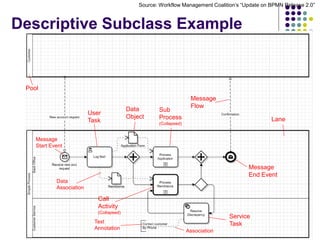
Descriptive Subclass Example


 Pool
                                                                     Message
                                                                     Flow
                                           Data       Sub
                          User
                                           Object     Process                                     Lane
                          Task                        (Collapsed)


    Message
    Start Event


                                                                                         Message
                                                                                         End Event
            Data
            Association

                             Call
                             Activity
                             (Collapsed)
                                                                                  Service
                            Text                                                  Task
                            Annotation
                                                                    Association
Descriptive Subclass Example


         Data
         Store


                 Source: Workflow Management Coalition’s “Update on BPMN Release 2.0”
Analytic Subclass
   l   sequenceFlow             l   eventBasedGateway
       (conditional)            l   signalStartEvent
   l   sequenceFlow (default)   l   signalEndEvent
   l   sendTask                 l   errorEndEvent
   l   receiveTask              l   message
   l   Looping Activity
   l   MultiInstance Activity   l   Plus: Intermediate
   l   exclusiveGateway             events
   l   inclusiveGateway
Analytic Subclass: Intermediate
Events
    l   Catching message      l   Throwing escalation
    l   Throwing message      l   escalationEndEvent
    l   Boundary message      l   Catching signal
    l   Non-interrupting      l   Throwing signal
        Boundary message      l   Boundary signal
    l   Catching timer        l   Non-interrupting
    l   Boundary timer            Boundary signal
    l   Non-interrupting      l   condtionalStartEvent
        Boundary timer        l   Catching conditional
    l   Boundary error        l   Boundary conditional
    l   Non-interrupting      l   Non-interrupting
        Boundary escalation       Boundary conditional
The Analyst’s Dilemma
   l   Descriptive is a manageable subset
   l   Analytic is too much, except for serious
       process experts
   l   Some of the event concepts in analytic
       subset are required for analysis and
       modeling
Modeling Events In Processes


             Copyright Kemsley Design Ltd., 2010   55
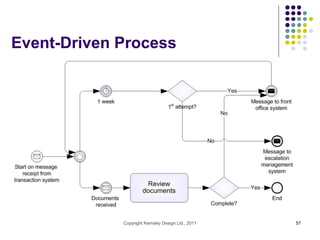
Example: Event-Driven Financial
Process
    l   Scenario: loan origination documents
    l   Customer documents created or gathered
        in front office
    l   Transactions created by front office
    l   Back office verifies documents against
        transactions


                    Copyright Kemsley Design Ltd., 2011   56
Event-Driven Process


             Copyright Kemsley Design Ltd., 2011   57
What Do Business Users Really
Need?
   l   Smaller subset of elements (?)
       l   Depends on user skills/aptitude

   l   Comprehension of BPMN without
       necessarily being able to model:
       l   Work with analysts to capture processes
       l   Review and approve models, with a cheat sheet
           or generous annotation
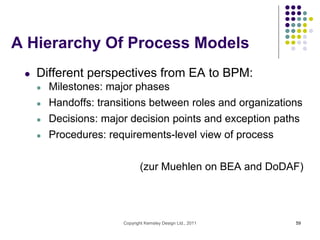
A Hierarchy Of Process Models
 l   Different perspectives from EA to BPM:
     l   Milestones: major phases
     l   Handoffs: transitions between roles and organizations
     l   Decisions: major decision points and exception paths
     l   Procedures: requirements-level view of process


                               (zur Muehlen on BEA and DoDAF)


                        Copyright Kemsley Design Ltd., 2011   59
Summary

          Copyright Kemsley Design Ltd., 2011   60
BPM In An EA Context
   l   Defining BPM and EA
   l   Synergies
       l   Participants
       l   Activities
       l   Models
       l   Goals

   l   Model types and interactions
   l   Using BPMN for process modelling

                          Copyright Kemsley Design Ltd., 2011   61
Sandy Kemsley
         Kemsley Design Ltd.
email: sandy@kemsleydesign.com
blog: www.column2.com
twitter: @skemsley

Questions?

                   Copyright Kemsley Design Ltd., 2011   62

Architecting a Business Process Environment

  • 1.
    Architecting A Business Process Environment Aligning BPM and EA Sandy Kemsley l www.column2.com l @skemsley
  • 2.
    My History inBPM l Mid-late 80’s: from satellite imaging to document imaging to workflow l Early 90’s: desktop imaging/workflow product l Mid-late 90’s: integrate imaging, workflow, EAI and e-commerce systems l 2000-1: FileNet (now IBM) BPM evangelist l 2002-now: process architect and BPM industry analyst Copyright Kemsley Design Ltd., 2011 2
  • 3.
    My BPM CallingCard l Column2.com: “a blog about BPM, Enterprise 2.0 and technology trends in business” l Community of up to 3,000/day l Best known for: l Conference blogging l Product reviews l Independent opinions Copyright Kemsley Design Ltd., 2011 3
  • 4.
    Agenda l What is Enterprise Architecture? l What is Business Process Management? l EA-BPM Relationships and Synergies l Model Types and Interactions l Using BPMN 2.0 (Business Process Model and Notation) Copyright Kemsley Design Ltd., 2011 4
  • 5.
    Definitions, Synergies and Benefits Copyright Kemsley Design Ltd., 2011 5
  • 6.
    What is EA? EA is the process of translating business vision and strategy into effective organizational change by creating, communicating and improving the key requirements, principles and models that describe the organization’s future state and enable its evolution. Gartner Copyright Kemsley Design Ltd., 2011 6
  • 7.
    What Is EA? 1. A formal description of a system, or a detailed plan of the system at a component level to guide its implementation - OR - 2. The structure of components, their inter- relationships, and the principles and guidelines governing their design and evolution over time TOGAF Copyright Kemsley Design Ltd., 2011 7
  • 8.
    What Is EA? An architectural discipline that merges strategic business and IT objectives with opportunities for change and governs the resulting change initiatives IBM Copyright Kemsley Design Ltd., 2011 8
  • 9.
    EA Defined l Strategy (evolutionary path) to achieve desired business future state l Artefacts for documenting and communicating strategy l Many methodologies/frameworks: may be a process, a taxonomy or a practice Copyright Kemsley Design Ltd., 2011 9
  • 10.
    EA Goals l Enterprise planning l Describe current and future state of the structure of an enterprise l Business-IT alignment l Links between business/technology artefacts l Business visibility and measurement l Change-friendly capability delivery l Adaptable and agile for continuous change Copyright Kemsley Design Ltd., 2011 10
  • 11.
    What is BPM? BPM is a management discipline that treats processes as assets that directly contribute to enterprise performance by driving operational excellence and business process agility. BPM employs methods, policies, metrics, management practices and software tools to continuously optimize the organization’s processes to improve business performance against goals and objectives Gartner Copyright Kemsley Design Ltd., 2011 11
  • 12.
    BPM Defined l A management discipline for improving cross-functional business processes l The methods and technology tools used to manage and optimize business processes Copyright Kemsley Design Ltd., 2011 12
  • 13.
    BPM Goals l Efficiency l Automating steps and handoffs l Integrating systems and data sources l Compliance l Achieving and proving standardization l Agility l Changing processes quickly and easily l Visibility l See what’s happening in a process Copyright Kemsley Design Ltd., 2008 13
  • 14.
    Overlapping, Not Concentric EA BPM • Strategy • Models • Targets • Execution • Models • Metrics Copyright Kemsley Design Ltd., 2011 14
  • 15.
    Linking EA andBPM l Connect EA strategy and BPM execution tactics l EA shows what needs to be done to get from strategy to execution l BPM is an accelerator that turns EA concepts into BPM initiatives to facilitate that goal l Natural synergy from planning to solution delivery Copyright Kemsley Design Ltd., 2011 15
  • 16.
    Sharing Between EAand BPM: Participants l Chief architect l Business architect l Process architect l Each needs to participate in both EA team and BPM center of excellence (CoE) Copyright Kemsley Design Ltd., 2011 16
  • 17.
    Sharing Between EAand BPM: Activities l End-to-end enterprise process modelling l Conceptual and logical process design l Establish process standards l Establish and maintain artefact repository Copyright Kemsley Design Ltd., 2011 17
  • 18.
    Sharing Between EAand BPM: Key Models l Process models l Functional flow between people and systems l Organizational models l Roles, skills, hierarchy l Data models l Information structures shared by systems Copyright Kemsley Design Ltd., 2011 18
  • 19.
    Sharing Between EAand BPM: Goals and Performance Indicators l EA creates targets for business measurement l Future state models l Requirements and principles l BPM feeds back metrics to assess EA targets l Inform and improve planning with actual performance data Copyright Kemsley Design Ltd., 2011 19
  • 20.
    EA-BPM Additional Benefits l EA helps BPM to evolve from a project to a centre of excellence (CoE) l Widen scope to holistic end-to-end processes l Sharing of resources, artefacts and repositories l Encourage governance and standards l BPM encourages process thinking in EA l Focus on end-to-end processes l Push for service-oriented architecture Copyright Kemsley Design Ltd., 2011 20
  • 21.
    EA and BPM:Better Together Copyright Kemsley Design Ltd., 2011 21 From IBM White Paper: “Continuous improvement with BPM and EA Together”
  • 22.
    Separation of Concerns l Scheduling: l Enterprise planning versus solution delivery l Ongoing activities versus project-specific l Artefacts: l Suitability for planning versus design l Shared versus one-way translation versus bi- directional round-trip l Usability for different audiences Copyright Kemsley Design Ltd., 2011 22
  • 23.
    Model Types AndInteractions Copyright Kemsley Design Ltd., 2011 23
  • 24.
    Horizontal and VerticalModel Alignment l Linking process models to other model types in a taxonomy: l Data l Organizational l Security l Rules l Events l Process models: levels and usages Copyright Kemsley Design Ltd., 2011 24
  • 25.
    From IBM WhitePaper: “Continuous Ltd., 2011 Copyright Kemsley Design improvement with BPM and EA Together” 25
  • 26.
    A Taxonomy OfEA Models (Zachman) Data Function Network People Time Motivation (What) (How) (Where) (Who) (When) (Why) Scope List of Things List of List of List of List of Cycles List of Goals Processes Locations Organizations Business Business Business Business Business Business Business Model Entity Model Process Network Workflow Event Model Strategy Model Model Model Model System Logical Data System System Human System Event Business Model Model Process Network Interface Diagram Rule Model Model Model Architecture Technology Physical Application Network Presentation Technology Rule Design Model Data Model Structure Technology Architecture Event Model Chart Model Diagram Components Data Program Network Interface Event Rule Components Components Components Components Components Specifications Copyright Kemsley Design Ltd., 2011 26
  • 27.
    Interrelated Model Types l Process models Data l Organizational models l Data models Events Organization l Security models Process l Event models l Rules models Rules Security Copyright Kemsley Design Ltd., 2011 27
  • 28.
    Linking Process andData Models l Process activities require data input/output l Information presented to or gathered from person l Data passed to or from automated service l Process design includes process instance data model l Subset of enterprise data model Copyright Kemsley Design Ltd., 2011 28
  • 29.
  • 30.
    Linking Process, Organizational andSecurity Models l Process activities require specific skills or security access levels l Process activities assigned to roles l Process activities may use implied organizational hierarchy Copyright Kemsley Design Ltd., 2011 30
  • 31.
  • 32.
    Linking Process andRule Models l Process decisions represent business rules l Branching/routing decisions l Data validation l Get/set data values l Rules can be externalized as decision services, or inherent in process model Copyright Kemsley Design Ltd., 2011 32
  • 33.
  • 34.
    Linking Process andEvent Models l Events are external actions (information or control) that impact that process l Event triggers a process l Process triggers an event l Event interrupts or diverts process l Events increase process responsiveness to changing conditions Copyright Kemsley Design Ltd., 2011 34
  • 35.
    Process Model Levels l EA l Strategy: processes linked to business motivation and strategies l BPM l Documentation: implementation-independent models for as-is/to-be analysis l Implementation: model-driven design in a BPM system (BPMS) Copyright Kemsley Design Ltd., 2011 35
  • 36.
    Different Perspectives onProcess Models l Different modelling tools: l Process modelling in EA tool l Standalone business process analysis (BPA) tool l Visio and other unstructured environments l Business perspective in BPMS tool l Technical/design perspective in BPMS tool l Translations between perspectives and tools Copyright Kemsley Design Ltd., 2011 36
  • 37.
  • 38.
  • 39.
    BPMN 2.0 InPractice Copyright Kemsley Design Ltd., 2011 39
  • 40.
    Why BPMN? l OMG-supported standard l Support by many tool vendors l Training and certification programs l Ongoing enhancements in BPMN 2.0: l Advanced event modelling l Serialization for model interchange l Execution semantics Copyright Kemsley Design Ltd., 2011 40
  • 41.
    BPMN: The RosettaStone of Process l Enables communication between different audiences: l Business users l Business analysts l Technical implementers Copyright Kemsley Design Ltd., 2011 41
  • 42.
    BPMN Is Simple... l Activity l Gateway l Event l Data
  • 43.
  • 44.
    The BPMN 2.0Problem l More than 100 elements l Unlikely to be fully understood by most experts, much less users l Unlikely to be fully supported by most vendors l Has led to rejection of BPMN in favor of “simpler” modeling paradigms
  • 45.
    Source: M. zurMuehlen, Stevens Institute of Technology Copyright Kemsley Design Ltd., 2011 45
  • 46.
    The BPMN 2.0Solution l Not everyone needs to learn everything l Group BPMN elements into sets used by different personas l Business user l Business analyst l Architect/developer l Each level adds more detail to model
  • 47.
    BPMN 2.0 Subclasses: EarlyVersion COMPLETE DODAF DESCRIPTIVE Plus 50 elements SIMPLE Plus 29 elements Pool sequenceFlow Lane Task (none) messageFlow subProcess(embed) userTask exclusiveGateway serviceTask parallelGateway Re-Usable subProcess startEvent (none) dataObject endEvent (none) dataInput dataOutput textAnnotation Association dataAssociation dataStore messageStartEvent messageEndEvent timerStartEvent terminateEndEvent Source: Workflow Management Coalition’s “Update on BPMN Release 2.0”
  • 48.
    BPMN 2.0 Conformance Subclasses l Descriptive l Visible elements for high-level models l Used by business analysts l Analytic l All of Descriptive plus elements for DoDAF enterprise architecture models l Common Executable l All of analytic plus elements for executable models
  • 49.
    Descriptive Subclass l dataObject l participant (pool) l textAnnotation l laneSet l association/dataAssociation l sequenceFlow (unconditional) l dataStoreReference l messageFlow l startEvent (None) l exclusiveGateway l endEvent (None) l parallelGateway l messageStartEvent l task (None) l messageEndEvent l userTask l timerStartEvent l serviceTask l terminateEndEvent l subProcess (expanded) l documentation l subProcess (collapsed) l group l callActivity
  • 50.
    Source: Workflow ManagementCoalition’s “Update on BPMN Release 2.0” Descriptive Subclass Example Pool Message Flow Data Sub User Object Process Lane Task (Collapsed) Message Start Event Message End Event Data Association Call Activity (Collapsed) Service Text Task Annotation Association
  • 51.
    Descriptive Subclass Example Data Store Source: Workflow Management Coalition’s “Update on BPMN Release 2.0”
  • 52.
    Analytic Subclass l sequenceFlow l eventBasedGateway (conditional) l signalStartEvent l sequenceFlow (default) l signalEndEvent l sendTask l errorEndEvent l receiveTask l message l Looping Activity l MultiInstance Activity l Plus: Intermediate l exclusiveGateway events l inclusiveGateway
  • 53.
    Analytic Subclass: Intermediate Events l Catching message l Throwing escalation l Throwing message l escalationEndEvent l Boundary message l Catching signal l Non-interrupting l Throwing signal Boundary message l Boundary signal l Catching timer l Non-interrupting l Boundary timer Boundary signal l Non-interrupting l condtionalStartEvent Boundary timer l Catching conditional l Boundary error l Boundary conditional l Non-interrupting l Non-interrupting Boundary escalation Boundary conditional
  • 54.
    The Analyst’s Dilemma l Descriptive is a manageable subset l Analytic is too much, except for serious process experts l Some of the event concepts in analytic subset are required for analysis and modeling
  • 55.
    Modeling Events InProcesses Copyright Kemsley Design Ltd., 2010 55
  • 56.
    Example: Event-Driven Financial Process l Scenario: loan origination documents l Customer documents created or gathered in front office l Transactions created by front office l Back office verifies documents against transactions Copyright Kemsley Design Ltd., 2011 56
  • 57.
    Event-Driven Process Copyright Kemsley Design Ltd., 2011 57
  • 58.
    What Do BusinessUsers Really Need? l Smaller subset of elements (?) l Depends on user skills/aptitude l Comprehension of BPMN without necessarily being able to model: l Work with analysts to capture processes l Review and approve models, with a cheat sheet or generous annotation
  • 59.
    A Hierarchy OfProcess Models l Different perspectives from EA to BPM: l Milestones: major phases l Handoffs: transitions between roles and organizations l Decisions: major decision points and exception paths l Procedures: requirements-level view of process (zur Muehlen on BEA and DoDAF) Copyright Kemsley Design Ltd., 2011 59
  • 60.
    Summary Copyright Kemsley Design Ltd., 2011 60
  • 61.
    BPM In AnEA Context l Defining BPM and EA l Synergies l Participants l Activities l Models l Goals l Model types and interactions l Using BPMN for process modelling Copyright Kemsley Design Ltd., 2011 61
  • 62.
    Sandy Kemsley Kemsley Design Ltd. email: sandy@kemsleydesign.com blog: www.column2.com twitter: @skemsley Questions? Copyright Kemsley Design Ltd., 2011 62