1
2
Lean Business
Architecture
Lessons from Lean for business architecture practitioners.
Andrew Blain
Director, Elabor8
tweety: @_andrewblain_
email: andrew.blain@elabor8.com.au
3
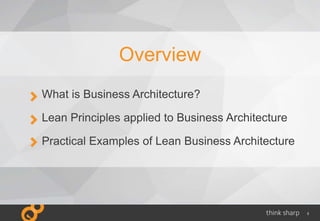
What is Business Architecture?
Lean Principles applied to Business Architecture
Practical Examples of Lean Business Architecture
Overview
4
What is Business Architecture?
5
What is Business Architecture?
Nick Malik:
• Business architecture is a ‘thing’; OR
• Business architecture is a process; OR
• Business architecture is a broader purpose; OR;
• Some combination of the above.
http://blogs.msdn.com/b/nickmalik/archive/2012/09/11/many-flawed-definitions-of-business-architecture.aspx
6
Who Definition
Terry Roach
"A business architecture articulates organisational objectives and associated strategies in a conceptual model of the domain, the behaviour and the governance of business
operations. "
Bruce McNaughton "The business strategy, governance, organization, and key business process information, as well as the interaction among these concepts." (derived from TOGAF)
Sunil Muduli Business Architecture is about Modeling/Capturing Business Motivation, Capability, Process (Level 0 & 1) and People(Role/Responsibility)
Rubina Polovina Business Architecture—A model of real-world that contains discourse relevant for an IT-intensive endeavor (or, simply, IT endeavor)
OMG Business Architecture Group A blueprint of the enterprise that provides a common understanding of the organization and is used to align strategic objectives and tactical demands. (Bizbok 2.1)
Tim Blaxall
Business Architecture helps to implement our business strategy by designing the developments needed in the way our business operates.
Overview: The Business Architecture defines the business strategy, governance, organization, and key business processes.
TOGAF
Definition: A description of the structure and interaction between the business strategy, organization, functions, business processes, and information needs. (TOGAF 9.1,
Section 3.22)
Taurai Christopher Ushewokunze
Business Architecture is the process of planning, designing and implementing macro level to micro level business structures at a minimum it defines the relationships between
finance, marketing, operations and technology.
Nick Ananin
Business Architecture is the process and outcomes of planning, designing and building a system that delivers tradable products (goods, services etc) that are of value to
customers.
Michael Poulin
Enterprise Business Architecture is architecture that comprises business functionality and business informational models, positions itself across business administrative and
organisational enterprise structures, and that transforms goals and objectives defined in a business enterprise model and refined in the Strategic Business Plans into the
functional and informational definition for a corporate business
Joanne Dong
Business Architecture is a holistic set of descriptive representations of the different components of the business and their relationships. The purpose of a business architecture is
to ensure proper alignments and integration among the components.
Ralph Whittle
Informal: the Business Architecture is a blueprint of the enterprise built using architectural disciplines to improve performance. Formal: The Business Architecture defines the
enterprise value streams and their relationships to all external entities, other enterprise value streams, and the events that trigger instantiation. It is a definition of what the
enterprise must produce to satisfy its customers, compete in a market, deal with its suppliers, sustain operations, and care for its employees. (Source)
Tim Manning
Business Architecture is a discipline and set of methods for the holistic design of organisations. The architecture of a business is “the arrangement of the functions and features
that achieve a given set of business objectives” (adapted from King, 2010).
Sam Holcman
Business Architecture is explicitly representing an organization’s desired state and as-is state, through a set of independent, non-redundant artifacts, defining how these artifacts
relate with each other, and developing a set of prioritized, aligned capabilities needed to meet the organization’s goals, communicating this understanding to stakeholders, and
advancing the organization from its as-is state to its desired state. (BACOE, EACOE)
Nick Malik
Formal: Business Architecture is (1.) 1. A specialization of the Enterprise Architecture business function that collects and manages functional, structural, and motivation-related
information using a rigorous scientific and engineered approach for the purposes of business design, functional improvement, motivational alignment and decision support. (2.)
One of the four traditional domains of Enterprise Architecture. Informal: Business Architecture -- A specialization of the Enterprise Architecture business function that uses
science and engineering to design and implement business functional and process improvements and strategically-aligned change initiatives.
Derek Miers (Forrester)
An organized and repeatable approach to describe and analyze an organization’s business and operating models to support a wide variety of organizational change purposes;
from cost reduction and restructuring, to process change and transformation.
Art Caston (as cited by Dave
Woods)
Business Architecture supports business opportunity assessments, strategy development, and business transformation program planning by creating various business reference
models, populating these reference models with current business information, and creating integrated target architecture models to show future market positioning, product and
service capabilities, enterprise structure and responsibilities, and proposed business partner relationships. These target models are used by related business planning functions
to structure, organize, and govern related transformation programs.
IASA (as cited by Kevin in
comments below)
A business architecture is a part of an enterprise architecture related to architectural organization of business, and the documents and diagrams that describe that architectural
organization.
Ben Gray
A business architecture [noun] helps a client (the business owner/director) to better understand the landscape (business environment, context, or market); understand their
choices and constraints; and articulate their vision (requirements) such that designers (of processes, roles, systems, apps, etc) can create a coherent set of artefacts that can be
used to plan and build/buy and test against
7
What is Business Architecture?
His conclusion?
Business architecture is a ‘thing’ AND
Business architecture is a process; AND
Business architecture is a broader purpose.
BizBoK definition:
“A blueprint of the enterprise that provides a common
understanding of the organization and is used to align
strategic objectives and tactical demands."
Business Architecture Body of Knowledge (http://www.businessarchitectureguild.org/About)
8
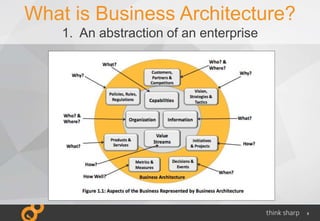
What is Business Architecture?
1. An abstraction of an enterprise
9
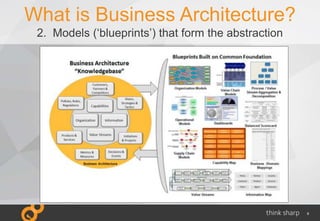
What is Business Architecture?
2. Models (‘blueprints’) that form the abstraction
10
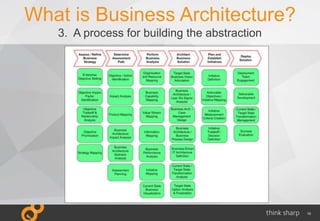
What is Business Architecture?
3. A process for building the abstraction
11
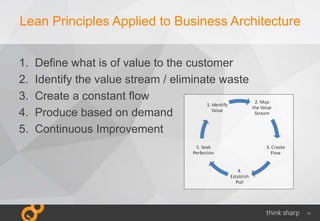
Lean Principles Applied to Business Architecture
1. Define what is of value to the customer
2. Identify the value stream / eliminate waste
3. Create a constant flow
4. Produce based on demand
5. Continuous Improvement
12
Lean Principles Applied to Business Architecture
1. Define What is of Value to the Customer
“It is not enough that management commit themselves to
quality and productivity, they must know what it is they must
do.”
“A system must be managed. It will not manage itself. Left
to themselves, components become selfish, competitive,
independent profit centers, and thus destroy the system.
The secret is cooperation between components…”
W. Edwards Deming
13
Lean Principles Applied to Business Architecture
1. Define What is of Value to the Customer
Who is the customer of Business Architecture?
• C Level Execs?
• Senior Management?
• Others?
What do they value?
14
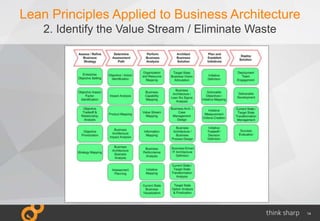
Lean Principles Applied to Business Architecture
2. Identify the Value Stream / Eliminate Waste
15
Lean Principles Applied to Business Architecture
2. Identify the Value Stream / Eliminate Waste
Look out for queues and large batch sizes
• (don’t bite off too much!)
Avoid analysis paralysis:
• P = 40-70
• Colin Powell: “More money and time are wasted
every day in the business world due to indecision
than any other reason”
16
Lean Principles Applied to Business Architecture
3. Create a Constant Flow
Limit Work in Progress
• Don’t try and model the whole enterprise at
once
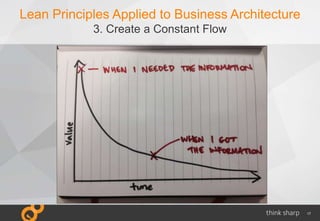
Apply “Lean Economics”:
• Prioritise based on “Cost of Delay” of
information
• Focus on the most critical areas
17
Lean Principles Applied to Business Architecture
3. Create a Constant Flow
18
Lean Principles Applied to Business Architecture
4. Produce Based on Demand
“Pull” value through your Business Architecture function
Consider the value of abstracts:
• Who knows about them?
• Who really understands them?
• Are they still valid?
19
Lean Principles Applied to Business Architecture
5. Continuous Improvement
• Continuous Improvement requires a shared
understanding
• Radiate Business Architecture outputs widely
• Encourage participation
• Give people the tools to contribute
20
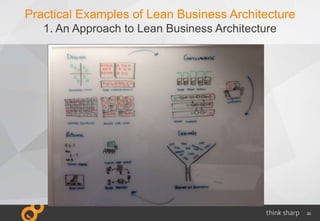
Practical Examples of Lean Business Architecture
1. An Approach to Lean Business Architecture
21
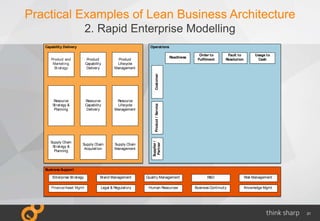
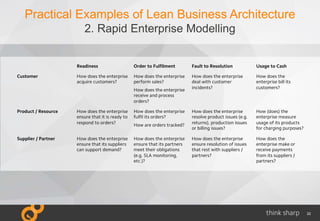
Practical Examples of Lean Business Architecture
2. Rapid Enterprise Modelling
BusinessSupport
OperationsCapability Delivery
Enterprise Strategy Brand Management Quality Management R&D
Finance/Asset Mgmt Legal & Regulatory Human Resources Business Continuity
Risk Management
Knowledge Mgmt
Product and
Marketing
Strategy
Product
Capability
Delivery
Product
Lifecycle
Management
Supply Chain
Strategy &
Planning
Supply Chain
Acquisition
Supply Chain
Management
Customer
Fault to
Resolution
Usage to
Cash
Order to
Fulfilment
Supplier/
Partner
Readiness
Product/Service
Resource
Strategy &
Planning
Resource
Capability
Delivery
Resource
Lifecycle
Management
22
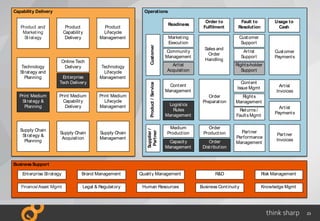
Practical Examples of Lean Business Architecture
2. Rapid Enterprise Modelling
23
BusinessSupport
OperationsCapability Delivery
Enterprise Strategy Brand Management Quality Management R&D
Finance/Asset Mgmt Legal & Regulatory Human Resources Business Continuity
Risk Management
Knowledge Mgmt
Product and
Marketing
Strategy
Product
Capability
Delivery
Product
Lifecycle
Management
Supply Chain
Strategy &
Planning
Supply Chain
Acquisition
Supply Chain
Management
Technology
Strategy and
Planning
Online Tech
Delivery Technology
Lifecycle
Management
Sales and
Order
Handling
Order
Preparation
Content
Management
Partner
Performance
Management
Partner
Invoices
Marketing
Execution
Community
Management
Artist
Acquisition
Logistics
Rules
Management
Customer
Support
Artist
Support
Rights-holder
Support
Content
Issue Mgmt
Rights
Management
Returns /
Faults Mgmt
Customer
Payments
Artist
Invoices
Artist
Payments
Medium
Production
Capacity
Management
Order
Production
Order
Distribution
Print Medium
Strategy &
Planning
Enterprise
Tech Delivery
Print Medium
Capability
Delivery
Print Medium
Lifecycle
Management
Customer
Fault to
Resolution
Usage to
Cash
Order to
Fulfilment
Supplier/
Partner
Readiness
Product/Service
24
Practical Examples of Lean Business Architecture
3. Use Existing Models
• You’re not the only XXX to ever exist!
• Use industry models to get a start
• Don’t reinvent the wheel
• Re-use best practices
• Don’t chase perfection
25
Some things to look into...
• Business Model Generation and Business Model Canvas
– http://www.businessmodelgeneration.com/
• Lean Canvas
– https://leanstack.com/LeanCanvas.pdf
• IBM’s Component Business Model
– https://www-935.ibm.com/services/us/imc/pdf/g510-6163-component-business-
models.pdf
• APQC
– http://www.apqc.org/
• eTOM
– www.tmforum.org
• Business Architecture Body of Knowledge
– http://www.businessarchitectureguild.org/
26
Thank you!
elabor8.com.au

Lean Business Architecture

  • 1.
  • 2.
    2 Lean Business Architecture Lessons fromLean for business architecture practitioners. Andrew Blain Director, Elabor8 tweety: @_andrewblain_ email: andrew.blain@elabor8.com.au
  • 3.
    3 What is BusinessArchitecture? Lean Principles applied to Business Architecture Practical Examples of Lean Business Architecture Overview
  • 4.
    4 What is BusinessArchitecture?
  • 5.
    5 What is BusinessArchitecture? Nick Malik: • Business architecture is a ‘thing’; OR • Business architecture is a process; OR • Business architecture is a broader purpose; OR; • Some combination of the above. http://blogs.msdn.com/b/nickmalik/archive/2012/09/11/many-flawed-definitions-of-business-architecture.aspx
  • 6.
    6 Who Definition Terry Roach "Abusiness architecture articulates organisational objectives and associated strategies in a conceptual model of the domain, the behaviour and the governance of business operations. " Bruce McNaughton "The business strategy, governance, organization, and key business process information, as well as the interaction among these concepts." (derived from TOGAF) Sunil Muduli Business Architecture is about Modeling/Capturing Business Motivation, Capability, Process (Level 0 & 1) and People(Role/Responsibility) Rubina Polovina Business Architecture—A model of real-world that contains discourse relevant for an IT-intensive endeavor (or, simply, IT endeavor) OMG Business Architecture Group A blueprint of the enterprise that provides a common understanding of the organization and is used to align strategic objectives and tactical demands. (Bizbok 2.1) Tim Blaxall Business Architecture helps to implement our business strategy by designing the developments needed in the way our business operates. Overview: The Business Architecture defines the business strategy, governance, organization, and key business processes. TOGAF Definition: A description of the structure and interaction between the business strategy, organization, functions, business processes, and information needs. (TOGAF 9.1, Section 3.22) Taurai Christopher Ushewokunze Business Architecture is the process of planning, designing and implementing macro level to micro level business structures at a minimum it defines the relationships between finance, marketing, operations and technology. Nick Ananin Business Architecture is the process and outcomes of planning, designing and building a system that delivers tradable products (goods, services etc) that are of value to customers. Michael Poulin Enterprise Business Architecture is architecture that comprises business functionality and business informational models, positions itself across business administrative and organisational enterprise structures, and that transforms goals and objectives defined in a business enterprise model and refined in the Strategic Business Plans into the functional and informational definition for a corporate business Joanne Dong Business Architecture is a holistic set of descriptive representations of the different components of the business and their relationships. The purpose of a business architecture is to ensure proper alignments and integration among the components. Ralph Whittle Informal: the Business Architecture is a blueprint of the enterprise built using architectural disciplines to improve performance. Formal: The Business Architecture defines the enterprise value streams and their relationships to all external entities, other enterprise value streams, and the events that trigger instantiation. It is a definition of what the enterprise must produce to satisfy its customers, compete in a market, deal with its suppliers, sustain operations, and care for its employees. (Source) Tim Manning Business Architecture is a discipline and set of methods for the holistic design of organisations. The architecture of a business is “the arrangement of the functions and features that achieve a given set of business objectives” (adapted from King, 2010). Sam Holcman Business Architecture is explicitly representing an organization’s desired state and as-is state, through a set of independent, non-redundant artifacts, defining how these artifacts relate with each other, and developing a set of prioritized, aligned capabilities needed to meet the organization’s goals, communicating this understanding to stakeholders, and advancing the organization from its as-is state to its desired state. (BACOE, EACOE) Nick Malik Formal: Business Architecture is (1.) 1. A specialization of the Enterprise Architecture business function that collects and manages functional, structural, and motivation-related information using a rigorous scientific and engineered approach for the purposes of business design, functional improvement, motivational alignment and decision support. (2.) One of the four traditional domains of Enterprise Architecture. Informal: Business Architecture -- A specialization of the Enterprise Architecture business function that uses science and engineering to design and implement business functional and process improvements and strategically-aligned change initiatives. Derek Miers (Forrester) An organized and repeatable approach to describe and analyze an organization’s business and operating models to support a wide variety of organizational change purposes; from cost reduction and restructuring, to process change and transformation. Art Caston (as cited by Dave Woods) Business Architecture supports business opportunity assessments, strategy development, and business transformation program planning by creating various business reference models, populating these reference models with current business information, and creating integrated target architecture models to show future market positioning, product and service capabilities, enterprise structure and responsibilities, and proposed business partner relationships. These target models are used by related business planning functions to structure, organize, and govern related transformation programs. IASA (as cited by Kevin in comments below) A business architecture is a part of an enterprise architecture related to architectural organization of business, and the documents and diagrams that describe that architectural organization. Ben Gray A business architecture [noun] helps a client (the business owner/director) to better understand the landscape (business environment, context, or market); understand their choices and constraints; and articulate their vision (requirements) such that designers (of processes, roles, systems, apps, etc) can create a coherent set of artefacts that can be used to plan and build/buy and test against
  • 7.
    7 What is BusinessArchitecture? His conclusion? Business architecture is a ‘thing’ AND Business architecture is a process; AND Business architecture is a broader purpose. BizBoK definition: “A blueprint of the enterprise that provides a common understanding of the organization and is used to align strategic objectives and tactical demands." Business Architecture Body of Knowledge (http://www.businessarchitectureguild.org/About)
  • 8.
    8 What is BusinessArchitecture? 1. An abstraction of an enterprise
  • 9.
    9 What is BusinessArchitecture? 2. Models (‘blueprints’) that form the abstraction
  • 10.
    10 What is BusinessArchitecture? 3. A process for building the abstraction
  • 11.
    11 Lean Principles Appliedto Business Architecture 1. Define what is of value to the customer 2. Identify the value stream / eliminate waste 3. Create a constant flow 4. Produce based on demand 5. Continuous Improvement
  • 12.
    12 Lean Principles Appliedto Business Architecture 1. Define What is of Value to the Customer “It is not enough that management commit themselves to quality and productivity, they must know what it is they must do.” “A system must be managed. It will not manage itself. Left to themselves, components become selfish, competitive, independent profit centers, and thus destroy the system. The secret is cooperation between components…” W. Edwards Deming
  • 13.
    13 Lean Principles Appliedto Business Architecture 1. Define What is of Value to the Customer Who is the customer of Business Architecture? • C Level Execs? • Senior Management? • Others? What do they value?
  • 14.
    14 Lean Principles Appliedto Business Architecture 2. Identify the Value Stream / Eliminate Waste
  • 15.
    15 Lean Principles Appliedto Business Architecture 2. Identify the Value Stream / Eliminate Waste Look out for queues and large batch sizes • (don’t bite off too much!) Avoid analysis paralysis: • P = 40-70 • Colin Powell: “More money and time are wasted every day in the business world due to indecision than any other reason”
  • 16.
    16 Lean Principles Appliedto Business Architecture 3. Create a Constant Flow Limit Work in Progress • Don’t try and model the whole enterprise at once Apply “Lean Economics”: • Prioritise based on “Cost of Delay” of information • Focus on the most critical areas
  • 17.
    17 Lean Principles Appliedto Business Architecture 3. Create a Constant Flow
  • 18.
    18 Lean Principles Appliedto Business Architecture 4. Produce Based on Demand “Pull” value through your Business Architecture function Consider the value of abstracts: • Who knows about them? • Who really understands them? • Are they still valid?
  • 19.
    19 Lean Principles Appliedto Business Architecture 5. Continuous Improvement • Continuous Improvement requires a shared understanding • Radiate Business Architecture outputs widely • Encourage participation • Give people the tools to contribute
  • 20.
    20 Practical Examples ofLean Business Architecture 1. An Approach to Lean Business Architecture
  • 21.
    21 Practical Examples ofLean Business Architecture 2. Rapid Enterprise Modelling BusinessSupport OperationsCapability Delivery Enterprise Strategy Brand Management Quality Management R&D Finance/Asset Mgmt Legal & Regulatory Human Resources Business Continuity Risk Management Knowledge Mgmt Product and Marketing Strategy Product Capability Delivery Product Lifecycle Management Supply Chain Strategy & Planning Supply Chain Acquisition Supply Chain Management Customer Fault to Resolution Usage to Cash Order to Fulfilment Supplier/ Partner Readiness Product/Service Resource Strategy & Planning Resource Capability Delivery Resource Lifecycle Management
  • 22.
    22 Practical Examples ofLean Business Architecture 2. Rapid Enterprise Modelling
  • 23.
    23 BusinessSupport OperationsCapability Delivery Enterprise StrategyBrand Management Quality Management R&D Finance/Asset Mgmt Legal & Regulatory Human Resources Business Continuity Risk Management Knowledge Mgmt Product and Marketing Strategy Product Capability Delivery Product Lifecycle Management Supply Chain Strategy & Planning Supply Chain Acquisition Supply Chain Management Technology Strategy and Planning Online Tech Delivery Technology Lifecycle Management Sales and Order Handling Order Preparation Content Management Partner Performance Management Partner Invoices Marketing Execution Community Management Artist Acquisition Logistics Rules Management Customer Support Artist Support Rights-holder Support Content Issue Mgmt Rights Management Returns / Faults Mgmt Customer Payments Artist Invoices Artist Payments Medium Production Capacity Management Order Production Order Distribution Print Medium Strategy & Planning Enterprise Tech Delivery Print Medium Capability Delivery Print Medium Lifecycle Management Customer Fault to Resolution Usage to Cash Order to Fulfilment Supplier/ Partner Readiness Product/Service
  • 24.
    24 Practical Examples ofLean Business Architecture 3. Use Existing Models • You’re not the only XXX to ever exist! • Use industry models to get a start • Don’t reinvent the wheel • Re-use best practices • Don’t chase perfection
  • 25.
    25 Some things tolook into... • Business Model Generation and Business Model Canvas – http://www.businessmodelgeneration.com/ • Lean Canvas – https://leanstack.com/LeanCanvas.pdf • IBM’s Component Business Model – https://www-935.ibm.com/services/us/imc/pdf/g510-6163-component-business- models.pdf • APQC – http://www.apqc.org/ • eTOM – www.tmforum.org • Business Architecture Body of Knowledge – http://www.businessarchitectureguild.org/
  • 26.