1
ACHIEVING FLEXIBLE
DEVELOPMENT WITH SERVICES
AND WIDGETS
2
Industry trends in service-based architecture
Leveraging a modern services architecture
Business benefits
AGENDA
3
ARCHITECTURE TRENDS:
IN THE BEGINNING
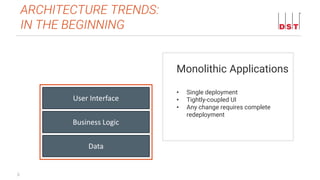
Monolithic Applications
• Single deployment
• Tightly-coupled UI
• Any change requires complete
redeployment
Data
Business Logic
User Interface
4
ARCHITECTURE TRENDS:
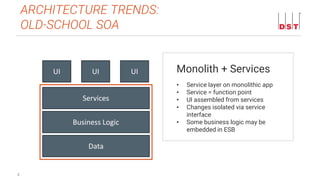
OLD-SCHOOL SOA
Monolith + Services
• Service layer on monolithic app
• Service = function point
• UI assembled from services
• Changes isolated via service
interface
• Some business logic may be
embedded in ESB
Data
Business Logic
Services
UI UI UI
5
ARCHITECTURE TRENDS:
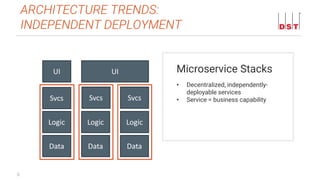
INDEPENDENT DEPLOYMENT
Microservice Stacks
Data
Logic
Svcs
UI UI
Svcs Svcs
Logic Logic
Data Data
• Decentralized, independently-
deployable services
• Service = business capability
6
ARCHITECTURE TRENDS:
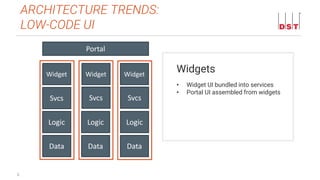
LOW-CODE UI
Widgets
Data
Logic
Svcs
Widget
Svcs Svcs
Logic Logic
Data Data
• Widget UI bundled into services
• Portal UI assembled from widgets
Portal
Widget Widget
7
Assemble services into applications
• Reuse services/business capabilities
• Consistent business logic
• Faster time to market
• Leverage model-driven development tools
• Less developer experience required
SERVICE ARCHITECTURE
TECHNOLOGY BENEFITS
8
Widgets improve user interface
• Widget UI created by UI design specialists
• Consistent user interface across applications
• Developers focus on functionality
SERVICE ARCHITECTURE
TECHNOLOGY BENEFITS
9
Built for change
• Add a new capability by plugging in a new service
• Microservice stacks developed, deployed and scaled
independently
• Leverage internal and external services
SERVICE ARCHITECTURE
TECHNOLOGY BENEFITS
10
Faster time to market
• Less development and testing time
Easier scalability
• Services can be scaled independently
Improved user experience
• Standardized widgets across all applications
SERVICE ARCHITECTURE
BUSINESS BENEFITS

Application Development with Microservices and Widgets

  • 1.
  • 2.
    2 Industry trends inservice-based architecture Leveraging a modern services architecture Business benefits AGENDA
  • 3.
    3 ARCHITECTURE TRENDS: IN THEBEGINNING Monolithic Applications • Single deployment • Tightly-coupled UI • Any change requires complete redeployment Data Business Logic User Interface
  • 4.
    4 ARCHITECTURE TRENDS: OLD-SCHOOL SOA Monolith+ Services • Service layer on monolithic app • Service = function point • UI assembled from services • Changes isolated via service interface • Some business logic may be embedded in ESB Data Business Logic Services UI UI UI
  • 5.
    5 ARCHITECTURE TRENDS: INDEPENDENT DEPLOYMENT MicroserviceStacks Data Logic Svcs UI UI Svcs Svcs Logic Logic Data Data • Decentralized, independently- deployable services • Service = business capability
  • 6.
    6 ARCHITECTURE TRENDS: LOW-CODE UI Widgets Data Logic Svcs Widget SvcsSvcs Logic Logic Data Data • Widget UI bundled into services • Portal UI assembled from widgets Portal Widget Widget
  • 7.
    7 Assemble services intoapplications • Reuse services/business capabilities • Consistent business logic • Faster time to market • Leverage model-driven development tools • Less developer experience required SERVICE ARCHITECTURE TECHNOLOGY BENEFITS
  • 8.
    8 Widgets improve userinterface • Widget UI created by UI design specialists • Consistent user interface across applications • Developers focus on functionality SERVICE ARCHITECTURE TECHNOLOGY BENEFITS
  • 9.
    9 Built for change •Add a new capability by plugging in a new service • Microservice stacks developed, deployed and scaled independently • Leverage internal and external services SERVICE ARCHITECTURE TECHNOLOGY BENEFITS
  • 10.
    10 Faster time tomarket • Less development and testing time Easier scalability • Services can be scaled independently Improved user experience • Standardized widgets across all applications SERVICE ARCHITECTURE BUSINESS BENEFITS