Sandy Kemsley ● www.column2.com ● @skemsley
The Future of Work
Leveraging new technologies and
adopting new cultural norms to
survive the new world of business
Agenda
 What’s different for the future of work?
 Technologies driving change
 Changing customer attitudes
 Changing employee attitudes
 How do we adapt?
 Applying technologies
 Cultural changes
Copyright Kemsley Design Ltd., 2015 2
The future is already here — it's just not
very evenly distributed
— William Gibson
Copyright Kemsley Design Ltd., 2015 3
Business Is Changing…
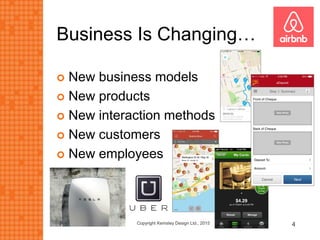
 New business models
 New products
 New interaction methods
 New customers
 New employees
Copyright Kemsley Design Ltd., 2015 4
Is Your Business Keeping
Pace?
 Creating desirable products
 Reducing transactional friction
 Adopting new technologies
 Attracting valuable customers
 Attracting skilled employees
Copyright Kemsley Design Ltd., 2015 5
Technology Drives Change
The impact of new consumer and enterprise technologies
Copyright Kemsley Design Ltd., 2015 6
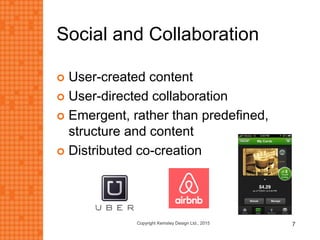
Social and Collaboration
 User-created content
 User-directed collaboration
 Emergent, rather than predefined,
structure and content
 Distributed co-creation
Copyright Kemsley Design Ltd., 2015 7
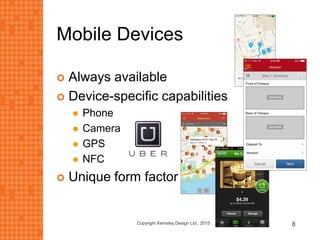
Mobile Devices
 Always available
 Device-specific capabilities
 Phone
 Camera
 GPS
 NFC
 Unique form factor
Copyright Kemsley Design Ltd., 2015 8
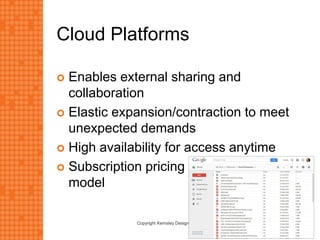
Cloud Platforms
 Enables external sharing and
collaboration
 Elastic expansion/contraction to meet
unexpected demands
 High availability for access anytime
 Subscription pricing
model
Copyright Kemsley Design Ltd., 2015 9
Internet of Things
 Connected devices generate and
consume information
 Devices become actors within a
business process
Copyright Kemsley Design Ltd., 2015 10
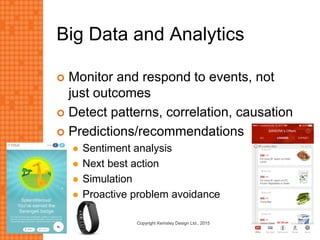
Big Data and Analytics
 Monitor and respond to events, not
just outcomes
 Detect patterns, correlation, causation
 Predictions/recommendations
 Sentiment analysis
 Next best action
 Simulation
 Proactive problem avoidance
Copyright Kemsley Design Ltd., 2015 11
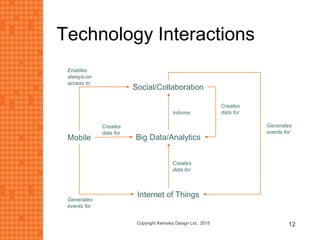
Technology Interactions
Copyright Kemsley Design Ltd., 2015 12
Social/Collaboration
Mobile
Enables
always-on
access to
Informs
Creates
data for
Big Data/Analytics
Creates
data for
Creates
data for
Internet of Things
Generates
events for
Generates
events for
Social in the Enterprise
 User-driven social interface to work
 Strengthen weak ties through social
interaction
 Goal-oriented social production
 Standalone or built-in social features
 Social platforms and networks
 Built into core business platforms for
“purposeful collaboration”
 Online communities of practice
Copyright Kemsley Design Ltd., 2015 13
Social BPM:
Ahead of the Curve
 Social at design time:
 Agile collaborative process modeling
 Social at runtime:
 Goal-directed processes with dynamic
modeling
 Ad hoc task management
 Ad hoc collaboration
 Activity stream view of events
Copyright Kemsley Design Ltd., 2015 14
Social BPM:
Adoption Failures
 IT/operational management disable
social features
 Attempt to control workers’ activities
 Results in ad hoc “off the record”
collaboration
 Workers ignore social features
 Insufficient training
 Insufficient incentives to collaborate
Copyright Kemsley Design Ltd., 2015 15
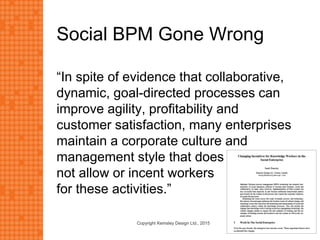
Social BPM Gone Wrong
“In spite of evidence that collaborative,
dynamic, goal-directed processes can
improve agility, profitability and
customer satisfaction, many enterprises
maintain a corporate culture and
management style that does
not allow or incent workers
for these activities.”
Copyright Kemsley Design Ltd., 2015 16
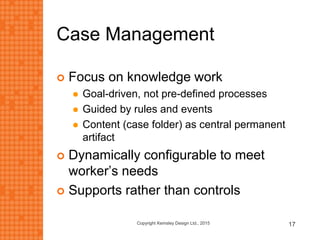
Case Management
 Focus on knowledge work
 Goal-driven, not pre-defined processes
 Guided by rules and events
 Content (case folder) as central permanent
artifact
 Dynamically configurable to meet
worker’s needs
 Supports rather than controls
Copyright Kemsley Design Ltd., 2015 17
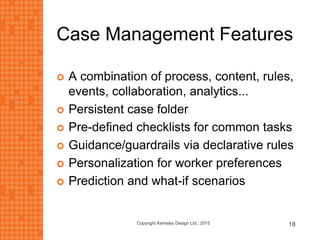
Case Management Features
 A combination of process, content, rules,
events, collaboration, analytics...
 Persistent case folder
 Pre-defined checklists for common tasks
 Guidance/guardrails via declarative rules
 Personalization for worker preferences
 Prediction and what-if scenarios
Copyright Kemsley Design Ltd., 2015 18
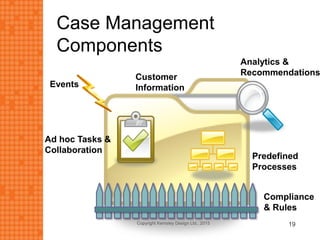
Case Management
Components
Copyright Kemsley Design Ltd., 2015 19
Customer
Information
Ad hoc Tasks &
Collaboration
Predefined
Processes
Events
Compliance
& Rules
Analytics &
Recommendations
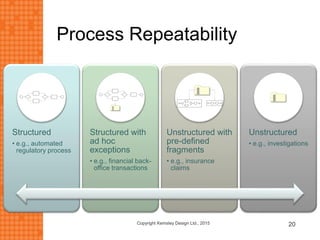
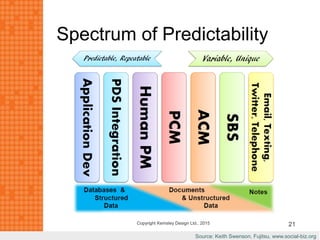
Process Repeatability
Copyright Kemsley Design Ltd., 2015 20
Structured
• e.g., automated
regulatory process
Structured with
ad hoc
exceptions
• e.g., financial back-
office transactions
Unstructured with
pre-defined
fragments
• e.g., insurance
claims
Unstructured
• e.g., investigations
Spectrum of Predictability
Copyright Kemsley Design Ltd., 2015 21
Source: Keith Swenson, Fujitsu, www.social-biz.org
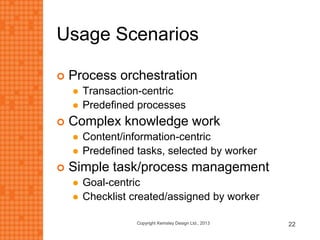
Usage Scenarios
 Process orchestration
 Transaction-centric
 Predefined processes
 Complex knowledge work
 Content/information-centric
 Predefined tasks, selected by worker
 Simple task/process management
 Goal-centric
 Checklist created/assigned by worker
Copyright Kemsley Design Ltd., 2013 22
The Changing Customer
Copyright Kemsley Design Ltd., 2015 23
More Informed, Less Loyal
 Always-on access to information
 Price/product comparison
 “Showrooming”
 Uses consumer services from multiple
vendors
 Switches vendors to take advantage
of offers
 Mobile plans
 Banks and credit cards
Copyright Kemsley Design Ltd., 2015 24
Higher Expectations
 User experience
 Problem resolution
 Price/performance
 Process transparency
Copyright Kemsley Design Ltd., 2015 25
Uncensored
 Read/write opinions on social media
 General social media platforms, e.g., Twitter,
Facebook
 Industry and product-specific communities,
e.g., TripAdvisor, Get Satisfaction
 Vendor marketing is no longer in
control of the message
 Ignore at your own peril
Copyright Kemsley Design Ltd., 2015 26
Challenges Retaining
Customers
 Competition from smaller/nimbler
companies
 Showrooming/price comparison
 Inability to personalize customer
experience
 No loyalty
Copyright Kemsley Design Ltd., 2015 27
The Changing Nature of
Work
Copyright Kemsley Design Ltd., 2015 28
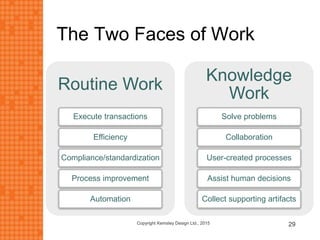
The Two Faces of Work
Copyright Kemsley Design Ltd., 2015 29
Routine Work
Execute transactions
Efficiency
Compliance/standardization
Process improvement
Automation
Knowledge
Work
Solve problems
Collaboration
User-created processes
Assist human decisions
Collect supporting artifacts
From Routine Work To
Knowledge Work
 Goals shift from efficiency to problem-
solving
 Routine work automated
 Unpredictable, customer-facing work
often ad hoc and poorly supported
Copyright Kemsley Design Ltd., 2015 30
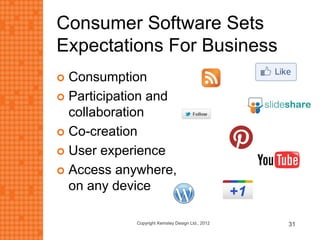
Consumer Software Sets
Expectations For Business
 Consumption
 Participation and
collaboration
 Co-creation
 User experience
 Access anywhere,
on any device
31Copyright Kemsley Design Ltd., 2012
Information Is Everywhere
 Transparency of business and
personal information
 Rich informational context for
decision-making
 Analytics refine, predict and
recommend
Copyright Kemsley Design Ltd., 2015 32
Challenges In Enabling
Knowledge Workers
 Rigid processes
 No incentives for collaboration or
innovation
 Inability to personalize employee
experience
Copyright Kemsley Design Ltd., 2015 33
Creating New Business
Models
Creating the business of the future
Copyright Kemsley Design Ltd., 2015 34
Changing Business Models
 Customer-centric/customer-inclusive
 Reinvent how business is done
 Innovate products
Copyright Kemsley Design Ltd., 2015 35
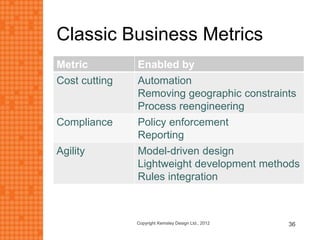
Classic Business Metrics
Metric Enabled by
Cost cutting Automation
Removing geographic constraints
Process reengineering
Compliance Policy enforcement
Reporting
Agility Model-driven design
Lightweight development methods
Rules integration
36Copyright Kemsley Design Ltd., 2012
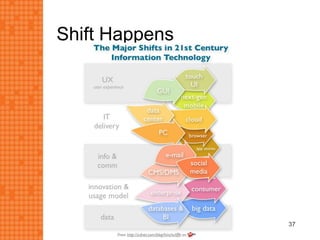
Shift Happens
37
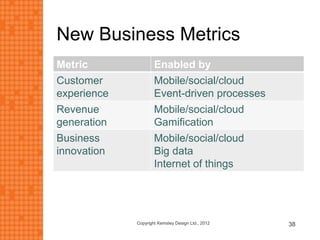
New Business Metrics
Metric Enabled by
Customer
experience
Mobile/social/cloud
Event-driven processes
Revenue
generation
Mobile/social/cloud
Gamification
Business
innovation
Mobile/social/cloud
Big data
Internet of things
38Copyright Kemsley Design Ltd., 2012
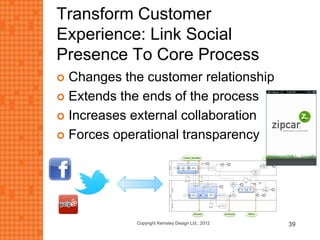
Transform Customer
Experience: Link Social
Presence To Core Process
 Changes the customer relationship
 Extends the ends of the process
 Increases external collaboration
 Forces operational transparency
39Copyright Kemsley Design Ltd., 2012
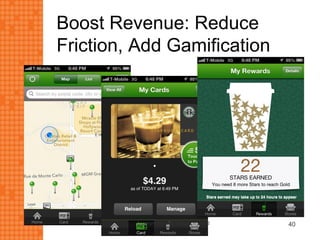
Boost Revenue: Reduce
Friction, Add Gamification
40Copyright Kemsley Design Ltd., 2012
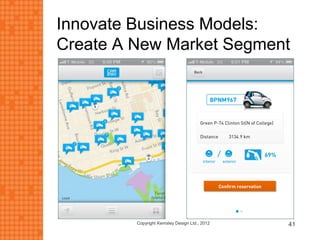
Innovate Business Models:
Create A New Market Segment
41Copyright Kemsley Design Ltd., 2012
Adopting Emerging
Technologies
Embracing new technologies to support the future of work
Copyright Kemsley Design Ltd., 2015 42
Customer Experience
 Platform agnostic: web, phone, in-
person, mobile app
 Always on
 Self service to full service: let your
customer do your work
 Personalized with customer’s
informational context
Copyright Kemsley Design Ltd., 2015 43
Think “Outside The Firewall”
 Model the customer as part of the
process
 Link external/social information to
core business processes
 Support customer devices of choice
44Copyright Kemsley Design Ltd., 2012
Tools for Knowledge Work
 Intelligent processes
 Contextual information
 Analytics
 Decisioning
 Recommendations
 Flexible, adaptive processes
 Internal and external collaboration
 Activity streams for monitoring
45Copyright Kemsley Design Ltd., 2012
Manage Events, Not Just
Outcomes
 Activity streams and event processing
 Real-time response to processes in
flight
 Predictive analytics to fix the problem
before it’s a problem
46Copyright Kemsley Design Ltd., 2012
Employee Experience
 Personalized for individual work
patterns
 Integrated user experience
 Automate all possible tasks to allow
focus on knowledge work
Copyright Kemsley Design Ltd., 2015 47
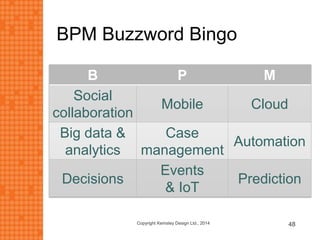
BPM Buzzword Bingo
B P M
Social
collaboration
Mobile Cloud
Big data &
analytics
Case
management
Automation
Decisions
Events
& IoT
Prediction
Copyright Kemsley Design Ltd., 2014 48
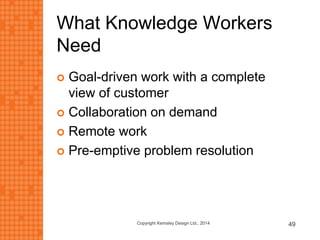
What Knowledge Workers
Need
 Goal-driven work with a complete
view of customer
 Collaboration on demand
 Remote work
 Pre-emptive problem resolution
Copyright Kemsley Design Ltd., 2014 49
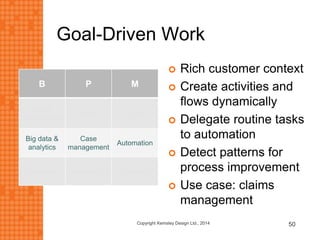
Goal-Driven Work
B P M
Social
collaboration
Mobile Cloud
Big data &
analytics
Case
management
Automation
Decisions Events & IoT Prediction
 Rich customer context
 Create activities and
flows dynamically
 Delegate routine tasks
to automation
 Detect patterns for
process improvement
 Use case: claims
management
Copyright Kemsley Design Ltd., 2014 50
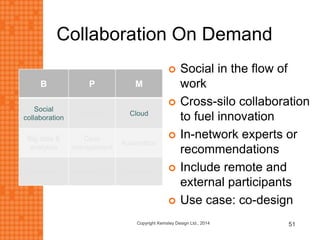
Collaboration On Demand
B P M
Social
collaboration
Mobile Cloud
Big data &
analytics
Case
management
Automation
Decisions Events & IoT Prediction
 Social in the flow of
work
 Cross-silo collaboration
to fuel innovation
 In-network experts or
recommendations
 Include remote and
external participants
 Use case: co-design
Copyright Kemsley Design Ltd., 2014 51
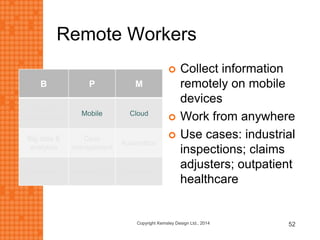
Remote Workers
B P M
Social
collaboration
Mobile Cloud
Big data &
analytics
Case
management
Automation
Decisions Events & IoT Prediction
 Collect information
remotely on mobile
devices
 Work from anywhere
 Use cases: industrial
inspections; claims
adjusters; outpatient
healthcare
Copyright Kemsley Design Ltd., 2014 52
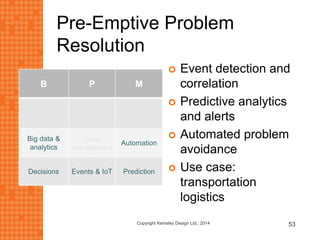
Pre-Emptive Problem
Resolution
B P M
Social
collaboration
Mobile Cloud
Big data &
analytics
Case
management
Automation
Decisions Events & IoT Prediction
 Event detection and
correlation
 Predictive analytics
and alerts
 Automated problem
avoidance
 Use case:
transportation
logistics
Copyright Kemsley Design Ltd., 2014 53
Managing Work in a
Customer-Led World
 Understanding what contributes to
business success: not a piece-work
mentality
Copyright Kemsley Design Ltd., 2015 54
Encouraging Cultural
Change
Changing how you work
Copyright Kemsley Design Ltd., 2015 55
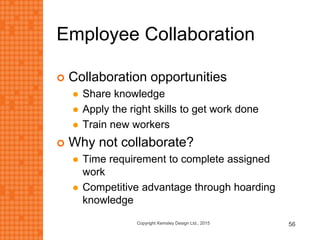
Employee Collaboration
 Collaboration opportunities
 Share knowledge
 Apply the right skills to get work done
 Train new workers
 Why not collaborate?
 Time requirement to complete assigned
work
 Competitive advantage through hoarding
knowledge
Copyright Kemsley Design Ltd., 2015 56
Identifying Mismatch of
Rewards and Goals
 Intrinsic versus extrinsic motivations
 Recognition versus monetary rewards
 Team versus individual goals
Copyright Kemsley Design Ltd., 2015 57
Building In Social Incentives
 Capture social metrics on systems of
interaction
 Social graph and interactions
 Flexibility and innovation
 Quality of decision/problem resolution
 Peer assessment
 Combine with traditional metrics
 Immediate feedback with social
recognition and gamification
Copyright Kemsley Design Ltd., 2015 58
Boost Teamwork
 Reward team goals as well as individual
 Strengthen weak ties with dynamic, self-
organizing teams
 Encourage joint ownership of goals,
activities to increase buy-in
 Leverage social ties/pressure to adopt
new ideas
 Teamwork is not just “doing your job”
Copyright Kemsley Design Ltd., 2015 59
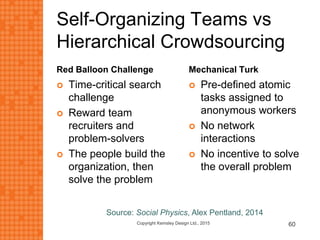
Self-Organizing Teams vs
Hierarchical Crowdsourcing
Red Balloon Challenge
 Time-critical search
challenge
 Reward team
recruiters and
problem-solvers
 The people build the
organization, then
solve the problem
Mechanical Turk
 Pre-defined atomic
tasks assigned to
anonymous workers
 No network
interactions
 No incentive to solve
the overall problem
Copyright Kemsley Design Ltd., 2015 60
Source: Social Physics, Alex Pentland, 2014
Align Incentives with
Business Objectives
 Reward problem-solving over
efficiency
 Reward for valuable work outside their
job description
 Reward workers for recruiting problem
solvers
Copyright Kemsley Design Ltd., 2015 61
Summary
 The changing business landscape
 The technologies driving change
 Changing customer behaviour
 Changing nature of work
 Dealing with change
 Creating new business models
 Leveraging emerging technologies
 Creating incentives for change
Copyright Kemsley Design Ltd., 2015 62
Questions
Sandy Kemsley
sandy@kemsleydesign.com
www.column2.com
@skemsley
Copyright Kemsley Design Ltd., 2015 63

The Future of Work

  • 1.
    Sandy Kemsley ●www.column2.com ● @skemsley The Future of Work Leveraging new technologies and adopting new cultural norms to survive the new world of business
  • 2.
    Agenda  What’s differentfor the future of work?  Technologies driving change  Changing customer attitudes  Changing employee attitudes  How do we adapt?  Applying technologies  Cultural changes Copyright Kemsley Design Ltd., 2015 2
  • 3.
    The future isalready here — it's just not very evenly distributed — William Gibson Copyright Kemsley Design Ltd., 2015 3
  • 4.
    Business Is Changing… New business models  New products  New interaction methods  New customers  New employees Copyright Kemsley Design Ltd., 2015 4
  • 5.
    Is Your BusinessKeeping Pace?  Creating desirable products  Reducing transactional friction  Adopting new technologies  Attracting valuable customers  Attracting skilled employees Copyright Kemsley Design Ltd., 2015 5
  • 6.
    Technology Drives Change Theimpact of new consumer and enterprise technologies Copyright Kemsley Design Ltd., 2015 6
  • 7.
    Social and Collaboration User-created content  User-directed collaboration  Emergent, rather than predefined, structure and content  Distributed co-creation Copyright Kemsley Design Ltd., 2015 7
  • 8.
    Mobile Devices  Alwaysavailable  Device-specific capabilities  Phone  Camera  GPS  NFC  Unique form factor Copyright Kemsley Design Ltd., 2015 8
  • 9.
    Cloud Platforms  Enablesexternal sharing and collaboration  Elastic expansion/contraction to meet unexpected demands  High availability for access anytime  Subscription pricing model Copyright Kemsley Design Ltd., 2015 9
  • 10.
    Internet of Things Connected devices generate and consume information  Devices become actors within a business process Copyright Kemsley Design Ltd., 2015 10
  • 11.
    Big Data andAnalytics  Monitor and respond to events, not just outcomes  Detect patterns, correlation, causation  Predictions/recommendations  Sentiment analysis  Next best action  Simulation  Proactive problem avoidance Copyright Kemsley Design Ltd., 2015 11
  • 12.
    Technology Interactions Copyright KemsleyDesign Ltd., 2015 12 Social/Collaboration Mobile Enables always-on access to Informs Creates data for Big Data/Analytics Creates data for Creates data for Internet of Things Generates events for Generates events for
  • 13.
    Social in theEnterprise  User-driven social interface to work  Strengthen weak ties through social interaction  Goal-oriented social production  Standalone or built-in social features  Social platforms and networks  Built into core business platforms for “purposeful collaboration”  Online communities of practice Copyright Kemsley Design Ltd., 2015 13
  • 14.
    Social BPM: Ahead ofthe Curve  Social at design time:  Agile collaborative process modeling  Social at runtime:  Goal-directed processes with dynamic modeling  Ad hoc task management  Ad hoc collaboration  Activity stream view of events Copyright Kemsley Design Ltd., 2015 14
  • 15.
    Social BPM: Adoption Failures IT/operational management disable social features  Attempt to control workers’ activities  Results in ad hoc “off the record” collaboration  Workers ignore social features  Insufficient training  Insufficient incentives to collaborate Copyright Kemsley Design Ltd., 2015 15
  • 16.
    Social BPM GoneWrong “In spite of evidence that collaborative, dynamic, goal-directed processes can improve agility, profitability and customer satisfaction, many enterprises maintain a corporate culture and management style that does not allow or incent workers for these activities.” Copyright Kemsley Design Ltd., 2015 16
  • 17.
    Case Management  Focuson knowledge work  Goal-driven, not pre-defined processes  Guided by rules and events  Content (case folder) as central permanent artifact  Dynamically configurable to meet worker’s needs  Supports rather than controls Copyright Kemsley Design Ltd., 2015 17
  • 18.
    Case Management Features A combination of process, content, rules, events, collaboration, analytics...  Persistent case folder  Pre-defined checklists for common tasks  Guidance/guardrails via declarative rules  Personalization for worker preferences  Prediction and what-if scenarios Copyright Kemsley Design Ltd., 2015 18
  • 19.
    Case Management Components Copyright KemsleyDesign Ltd., 2015 19 Customer Information Ad hoc Tasks & Collaboration Predefined Processes Events Compliance & Rules Analytics & Recommendations
  • 20.
    Process Repeatability Copyright KemsleyDesign Ltd., 2015 20 Structured • e.g., automated regulatory process Structured with ad hoc exceptions • e.g., financial back- office transactions Unstructured with pre-defined fragments • e.g., insurance claims Unstructured • e.g., investigations
  • 21.
    Spectrum of Predictability CopyrightKemsley Design Ltd., 2015 21 Source: Keith Swenson, Fujitsu, www.social-biz.org
  • 22.
    Usage Scenarios  Processorchestration  Transaction-centric  Predefined processes  Complex knowledge work  Content/information-centric  Predefined tasks, selected by worker  Simple task/process management  Goal-centric  Checklist created/assigned by worker Copyright Kemsley Design Ltd., 2013 22
  • 23.
    The Changing Customer CopyrightKemsley Design Ltd., 2015 23
  • 24.
    More Informed, LessLoyal  Always-on access to information  Price/product comparison  “Showrooming”  Uses consumer services from multiple vendors  Switches vendors to take advantage of offers  Mobile plans  Banks and credit cards Copyright Kemsley Design Ltd., 2015 24
  • 25.
    Higher Expectations  Userexperience  Problem resolution  Price/performance  Process transparency Copyright Kemsley Design Ltd., 2015 25
  • 26.
    Uncensored  Read/write opinionson social media  General social media platforms, e.g., Twitter, Facebook  Industry and product-specific communities, e.g., TripAdvisor, Get Satisfaction  Vendor marketing is no longer in control of the message  Ignore at your own peril Copyright Kemsley Design Ltd., 2015 26
  • 27.
    Challenges Retaining Customers  Competitionfrom smaller/nimbler companies  Showrooming/price comparison  Inability to personalize customer experience  No loyalty Copyright Kemsley Design Ltd., 2015 27
  • 28.
    The Changing Natureof Work Copyright Kemsley Design Ltd., 2015 28
  • 29.
    The Two Facesof Work Copyright Kemsley Design Ltd., 2015 29 Routine Work Execute transactions Efficiency Compliance/standardization Process improvement Automation Knowledge Work Solve problems Collaboration User-created processes Assist human decisions Collect supporting artifacts
  • 30.
    From Routine WorkTo Knowledge Work  Goals shift from efficiency to problem- solving  Routine work automated  Unpredictable, customer-facing work often ad hoc and poorly supported Copyright Kemsley Design Ltd., 2015 30
  • 31.
    Consumer Software Sets ExpectationsFor Business  Consumption  Participation and collaboration  Co-creation  User experience  Access anywhere, on any device 31Copyright Kemsley Design Ltd., 2012
  • 32.
    Information Is Everywhere Transparency of business and personal information  Rich informational context for decision-making  Analytics refine, predict and recommend Copyright Kemsley Design Ltd., 2015 32
  • 33.
    Challenges In Enabling KnowledgeWorkers  Rigid processes  No incentives for collaboration or innovation  Inability to personalize employee experience Copyright Kemsley Design Ltd., 2015 33
  • 34.
    Creating New Business Models Creatingthe business of the future Copyright Kemsley Design Ltd., 2015 34
  • 35.
    Changing Business Models Customer-centric/customer-inclusive  Reinvent how business is done  Innovate products Copyright Kemsley Design Ltd., 2015 35
  • 36.
    Classic Business Metrics MetricEnabled by Cost cutting Automation Removing geographic constraints Process reengineering Compliance Policy enforcement Reporting Agility Model-driven design Lightweight development methods Rules integration 36Copyright Kemsley Design Ltd., 2012
  • 37.
  • 38.
    New Business Metrics MetricEnabled by Customer experience Mobile/social/cloud Event-driven processes Revenue generation Mobile/social/cloud Gamification Business innovation Mobile/social/cloud Big data Internet of things 38Copyright Kemsley Design Ltd., 2012
  • 39.
    Transform Customer Experience: LinkSocial Presence To Core Process  Changes the customer relationship  Extends the ends of the process  Increases external collaboration  Forces operational transparency 39Copyright Kemsley Design Ltd., 2012
  • 40.
    Boost Revenue: Reduce Friction,Add Gamification 40Copyright Kemsley Design Ltd., 2012
  • 41.
    Innovate Business Models: CreateA New Market Segment 41Copyright Kemsley Design Ltd., 2012
  • 42.
    Adopting Emerging Technologies Embracing newtechnologies to support the future of work Copyright Kemsley Design Ltd., 2015 42
  • 43.
    Customer Experience  Platformagnostic: web, phone, in- person, mobile app  Always on  Self service to full service: let your customer do your work  Personalized with customer’s informational context Copyright Kemsley Design Ltd., 2015 43
  • 44.
    Think “Outside TheFirewall”  Model the customer as part of the process  Link external/social information to core business processes  Support customer devices of choice 44Copyright Kemsley Design Ltd., 2012
  • 45.
    Tools for KnowledgeWork  Intelligent processes  Contextual information  Analytics  Decisioning  Recommendations  Flexible, adaptive processes  Internal and external collaboration  Activity streams for monitoring 45Copyright Kemsley Design Ltd., 2012
  • 46.
    Manage Events, NotJust Outcomes  Activity streams and event processing  Real-time response to processes in flight  Predictive analytics to fix the problem before it’s a problem 46Copyright Kemsley Design Ltd., 2012
  • 47.
    Employee Experience  Personalizedfor individual work patterns  Integrated user experience  Automate all possible tasks to allow focus on knowledge work Copyright Kemsley Design Ltd., 2015 47
  • 48.
    BPM Buzzword Bingo BP M Social collaboration Mobile Cloud Big data & analytics Case management Automation Decisions Events & IoT Prediction Copyright Kemsley Design Ltd., 2014 48
  • 49.
    What Knowledge Workers Need Goal-driven work with a complete view of customer  Collaboration on demand  Remote work  Pre-emptive problem resolution Copyright Kemsley Design Ltd., 2014 49
  • 50.
    Goal-Driven Work B PM Social collaboration Mobile Cloud Big data & analytics Case management Automation Decisions Events & IoT Prediction  Rich customer context  Create activities and flows dynamically  Delegate routine tasks to automation  Detect patterns for process improvement  Use case: claims management Copyright Kemsley Design Ltd., 2014 50
  • 51.
    Collaboration On Demand BP M Social collaboration Mobile Cloud Big data & analytics Case management Automation Decisions Events & IoT Prediction  Social in the flow of work  Cross-silo collaboration to fuel innovation  In-network experts or recommendations  Include remote and external participants  Use case: co-design Copyright Kemsley Design Ltd., 2014 51
  • 52.
    Remote Workers B PM Social collaboration Mobile Cloud Big data & analytics Case management Automation Decisions Events & IoT Prediction  Collect information remotely on mobile devices  Work from anywhere  Use cases: industrial inspections; claims adjusters; outpatient healthcare Copyright Kemsley Design Ltd., 2014 52
  • 53.
    Pre-Emptive Problem Resolution B PM Social collaboration Mobile Cloud Big data & analytics Case management Automation Decisions Events & IoT Prediction  Event detection and correlation  Predictive analytics and alerts  Automated problem avoidance  Use case: transportation logistics Copyright Kemsley Design Ltd., 2014 53
  • 54.
    Managing Work ina Customer-Led World  Understanding what contributes to business success: not a piece-work mentality Copyright Kemsley Design Ltd., 2015 54
  • 55.
    Encouraging Cultural Change Changing howyou work Copyright Kemsley Design Ltd., 2015 55
  • 56.
    Employee Collaboration  Collaborationopportunities  Share knowledge  Apply the right skills to get work done  Train new workers  Why not collaborate?  Time requirement to complete assigned work  Competitive advantage through hoarding knowledge Copyright Kemsley Design Ltd., 2015 56
  • 57.
    Identifying Mismatch of Rewardsand Goals  Intrinsic versus extrinsic motivations  Recognition versus monetary rewards  Team versus individual goals Copyright Kemsley Design Ltd., 2015 57
  • 58.
    Building In SocialIncentives  Capture social metrics on systems of interaction  Social graph and interactions  Flexibility and innovation  Quality of decision/problem resolution  Peer assessment  Combine with traditional metrics  Immediate feedback with social recognition and gamification Copyright Kemsley Design Ltd., 2015 58
  • 59.
    Boost Teamwork  Rewardteam goals as well as individual  Strengthen weak ties with dynamic, self- organizing teams  Encourage joint ownership of goals, activities to increase buy-in  Leverage social ties/pressure to adopt new ideas  Teamwork is not just “doing your job” Copyright Kemsley Design Ltd., 2015 59
  • 60.
    Self-Organizing Teams vs HierarchicalCrowdsourcing Red Balloon Challenge  Time-critical search challenge  Reward team recruiters and problem-solvers  The people build the organization, then solve the problem Mechanical Turk  Pre-defined atomic tasks assigned to anonymous workers  No network interactions  No incentive to solve the overall problem Copyright Kemsley Design Ltd., 2015 60 Source: Social Physics, Alex Pentland, 2014
  • 61.
    Align Incentives with BusinessObjectives  Reward problem-solving over efficiency  Reward for valuable work outside their job description  Reward workers for recruiting problem solvers Copyright Kemsley Design Ltd., 2015 61
  • 62.
    Summary  The changingbusiness landscape  The technologies driving change  Changing customer behaviour  Changing nature of work  Dealing with change  Creating new business models  Leveraging emerging technologies  Creating incentives for change Copyright Kemsley Design Ltd., 2015 62
  • 63.