

















Maximizing Success in
Automation Projects
Sandy Kemsley
Independent Analyst
Copyright Kemsley Design Ltd., 2022 1
The current state of business automation
Copyright Kemsley Design Ltd., 2022 2
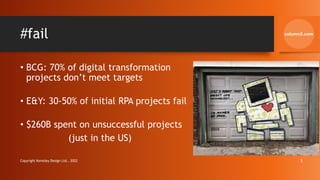
#fail
• BCG: 70% of digital transformation
projects don’t meet targets
• E&Y: 30-50% of initial RPA projects fail
• $260B spent on unsuccessful projects
(just in the US)
Copyright Kemsley Design Ltd., 2022 3
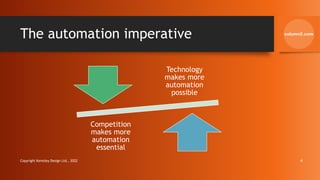
The automation imperative
Technology
makes more
automation
possible
Competition
makes more
automation
essential
Copyright Kemsley Design Ltd., 2022 4
Automation technologies
Copyright Kemsley Design Ltd., 2022 5
Copyright Kemsley Design Ltd., 2022 6
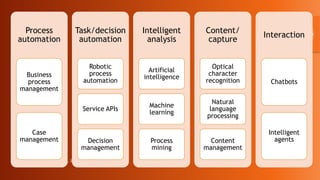
Process
automation
Business
process
management
Case
management
Task/decision
automation
Robotic
process
automation
Service APIs
Decision
management
Intelligent
analysis
Artificial
intelligence
Machine
learning
Process
mining
Content/
capture
Optical
character
recognition
Natural
language
processing
Content
management
Interaction
Chatbots
Intelligent
agents
Best practices for automation success
Copyright Kemsley Design Ltd., 2022 7
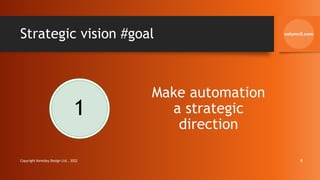
Strategic vision #goal
1
Make automation
a strategic
direction
Copyright Kemsley Design Ltd., 2022 8
Strategic vision #goal
2 Pick the right
process
Copyright Kemsley Design Ltd., 2022 9
Design #goal
3
Create metrics
aligned with
corporate goals
Copyright Kemsley Design Ltd., 2022 10
Design #goal
4
Listen to the
experts “six
levels down”
Copyright Kemsley Design Ltd., 2022 11
Design #goal
5 Automate
whatever possible
Copyright Kemsley Design Ltd., 2022 12
Design #goal
6
Don’t automate
out people where
they add value
Copyright Kemsley Design Ltd., 2022 13
Methodology #goal
7
Get something
into production
fast (MVP)
Copyright Kemsley Design Ltd., 2022 14
Methodology #goal
8 Be prepared to
pivot
Copyright Kemsley Design Ltd., 2022 15
How to tell when you’re failing
Copyright Kemsley Design Ltd., 2022 16
Strategic vision #fail
1
No one cares
about the process
being automated
Copyright Kemsley Design Ltd., 2022 17
Methodology #fail
2 Waterfall
methodology
Copyright Kemsley Design Ltd., 2022 18
Methodology #fail
3
Taking too long
and/or
over-spending
Copyright Kemsley Design Ltd., 2022 19
Design #fail
4
Fragile/inflexible
processes and
decisions
Copyright Kemsley Design Ltd., 2022 20
Design #fail
5
Outdated
procedures built
into new
processes
Copyright Kemsley Design Ltd., 2022 21
Knowledge transfer #fail
6
Knowledge of
process/tools is
not internalized
Copyright Kemsley Design Ltd., 2022 22
Transformation through automation
Copyright Kemsley Design Ltd., 2022 23
Use case: Insurance claims
Copyright Kemsley Design Ltd., 2022 24
Claims in theory: easy
• Policyholder submits claim
• Claims manager decides whether/how much to pay
• Policyholder received payment
Copyright Kemsley Design Ltd., 2022 25
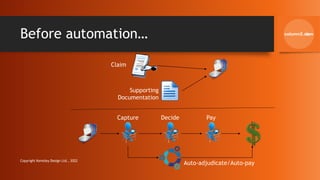
Before automation…
Capture Decide Pay
Claim
Supporting
Documentation
Auto-adjudicate/Auto-pay
26
Copyright Kemsley Design Ltd., 2022
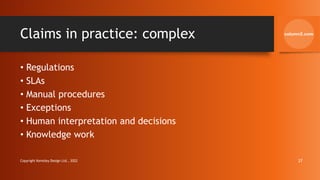
Claims in practice: complex
• Regulations
• SLAs
• Manual procedures
• Exceptions
• Human interpretation and decisions
• Knowledge work
Copyright Kemsley Design Ltd., 2022 27
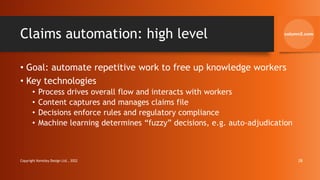
Claims automation: high level
• Goal: automate repetitive work to free up knowledge workers
• Key technologies
• Process drives overall flow and interacts with workers
• Content captures and manages claims file
• Decisions enforce rules and regulatory compliance
• Machine learning determines “fuzzy” decisions, e.g. auto-adjudication
Copyright Kemsley Design Ltd., 2022 28
Intelligent claims
Claim
Supporting
Documentation
Intelligent Capture Auto-adjudicate/Auto-pay
Exception Handling
29
Copyright Kemsley Design Ltd., 2022
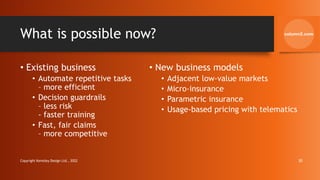
What is possible now?
• Existing business
• Automate repetitive tasks
– more efficient
• Decision guardrails
– less risk
- faster training
• Fast, fair claims
– more competitive
• New business models
• Adjacent low-value markets
• Micro-insurance
• Parametric insurance
• Usage-based pricing with telematics
Copyright Kemsley Design Ltd., 2022 30
Summing it up
• Understand the automation imperative
• A lot of companies are failing at business automation, but
you don’t have to be one of them
• Align automation metrics with corporate goals
• Design the right thing the right way
• Get something into production fast, then prepare to pivot
• Watch for #fail indicators
Copyright Kemsley Design Ltd., 2022 31
Questions?
Sandy Kemsley
sandy@kemsleydesign.com
Read my blog at column2.com
Find me on Twitter @skemsley
Copyright Kemsley Design Ltd., 2022
32

Maximizing Success in Automation Projects

Editor's Notes

  • #2 The success of business automation projects is measured by the degree of business improvement or transformation that is achieved, relative to the business goals. As simple as this seems, why do so many automation projects fail? Join Sandy Kemsley as she delves into some of the reasons for automation project failure, and what steps you can take to make your project a success. As a technology and business architect who helps her clients create large-scale automation solutions, as well as an industry analyst researching the application of technology to improve business, she offers a unique perspective on the factors leading to success or failure of these projects. You’ll learn about: What business leaders need to know about key automation technologies and their application to business operations Methodologies that can align the outcome of automation projects with your operational business goals Indicators that a business automation project is off course – and how you can steer it back in the right direction What’s possible with business transformation through automation, including a use case for how automation can drive maximum business benefit
  • #5 Pandemic plus technology advances have ramped up automation initiatives In the old days, it was (just) a waste of money Failure to successfully automate is a survival issue
  • #12 Michael Lewis “Against The Rules” podcast about Athena Health
  • #28 This is why it’s complex: Claims manager needs to figure out what is missing, and request it Each iteration, CM reviews file, figures out if they can make a decision, and makes it Too much manual decisioning and ad hoc processes Expertise is buried in the knowledge workers
  • #29 Goal: knowledge workers should be focused on handling decisions and customer interactions that are better managed by people – true for most business process automation Process to drive overall flow and interact with workers Decisions to determine auto versus manual tasks (e.g., auto-adjudication) ML to learn parameters of auto-adjudication, know when to ask for more information – learn from knowledge workers – explainable decisions based on past decisions and regulatory guidelines
  • #31 Usage-based pricing: Allianz BonusDrive for UBI using telematics, more competitive for different market segments Algorithmic: New Paradigm’s parametric insurance pays out automatically based on parameters, e.g., weather instead of handling individual claims