JOURNAL OF STRATEGIC INFORMATION SYSTEMS
ACHIEVING BENEFITS WITH
ENTERPRISE ARCHITECTURE
GRAEME SHANKSA,⁎, MARIANNE GLOETA, IDA ASADI SOMEHB, KEITH
FRAMPTONA, TOOMAS TAMMC
THE UNIVERSITY OF MELBOURNE, AUSTRALIA
PUBLISHED IN 7 MARCH 2018
ADVANCE MANAGEMENT INFORMATION SYSTEM
INSTRUCTOR: ASST. PROF. DR. MÜESSER NAT
PREPARED BY MUNSF SOKIYNA
DEPARTMENT OF MIS
OUTLINE
• What is Enterprise Architecture?
• Enterprise Architecture definitions.
• Enterprise Architecture types
• When we use EA?
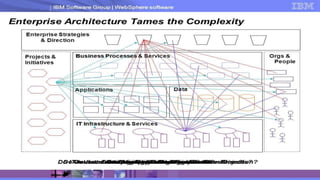
• Enterprise architecture Diagrams.
• Enterprise Architecture Frameworks.
• How Enterprise architecture align business ?
• Short video .
OUTLINE
• The emergence of Enterprise Architecture?
• Enterprise Architecture definitions.
• Enterprise Architecture types
• When we use EA?
• Enterprise architecture Diagrams.
• Enterprise Architecture Frameworks.
• How Enterprise architecture align business ?
• Short video .
WHAT IS ENTERPRISE
ARCHITECTURE ?
• The concept of enterprise architecture was discovered in 1978
by IT and Business Consultant John Zachman, who published
his popular article in “IBM journal”, Its title was "A framework
for Information Technology Architecture "(Hermans, 2015).
• Systems Development Life Cycle (SDLC).
OUTLINE
• What is Enterprise Architecture?
• Enterprise Architecture definitions.
• Enterprise Architecture types
• When we use EA?
• Enterprise architecture Diagrams.
• Enterprise Architecture Frameworks.
• How Enterprise architecture align business ?
• Short video .
ENTERPRISE ARCHITECTURE DEFINITIONS
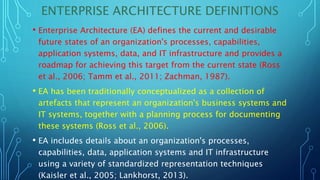
• Enterprise Architecture (EA) defines the current and desirable
future states of an organization's processes, capabilities,
application systems, data, and IT infrastructure and provides a
roadmap for achieving this target from the current state (Ross
et al., 2006; Tamm et al., 2011; Zachman, 1987).
• EA has been traditionally conceptualized as a collection of
artefacts that represent an organization's business systems and
IT systems, together with a planning process for documenting
these systems (Ross et al., 2006).
• EA includes details about an organization's processes,
capabilities, data, application systems and IT infrastructure
using a variety of standardized representation techniques
(Kaisler et al., 2005; Lankhorst, 2013).
ENTERPRISE ARCHITECTURE DEFINITIONS
• The Open Group definition : Enterprise Architecture is about
understanding all of the different components that go to make
up the enterprise and how those components inter-relate.
• Wikipedia :Enterprise Architecture is the practice of applying a
comprehensive and rigorous method for describing a current
and/or future structure and behavior for an organization's
processes, (information) systems, personnel and organizational
sub-units, so that they align with the organization's core goals
and strategic direction. Although often associated strictly with
information technology, it relates more broadly to the practice
of business optimization in that it addresses business
architecture, performance management, organizational
structure and process architecture as well.
Enterprise architecture is a complete expression
of the enterprise; a master plan which “acts as a
collaboration force” between aspects of business
planning such as goals, visions, strategies and
governance principles; aspects of business
operations such as business terms, organization
structures, processes and data; aspects of
automation such as information systems and
databases; and the enabling technological
infrastructure of the business such as computers,
IFEAD
OUTLINE
• What is Enterprise Architecture?
• Enterprise Architecture definitions.
• Enterprise Architecture types
• When we use EA?
• Enterprise architecture Diagrams.
• Enterprise Architecture Frameworks.
• How Enterprise architecture align business ?
• Short video .
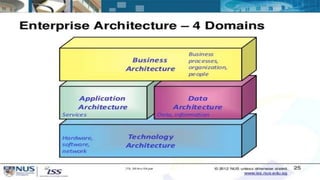
ENTERPRISE ARCHITECTURE TYPES
• Business architecture: business process,
organization, people.
• Information system architectures
• Data or information architecture: data and Information
• Application architecture: Services
• Technology architecture: hardware, software,
network.
OUTLINE
• What is Enterprise Architecture?
• Enterprise Architecture definitions.
• Enterprise Architecture types
• When we use EA?
• Enterprise architecture Diagrams.
• Enterprise Architecture Frameworks.
• How Enterprise architecture align business ?
• Short video .
When we use Enterprise
architecture.
System complexity—Organizations were
spending more and more money building IT
systems.
Poor business alignment—Organizations
were finding it more and more difficult to
keep those increasingly expensive IT
systems aligned with business need.
OUTLINE
• What is Enterprise Architecture?
• Enterprise Architecture definitions.
• Enterprise Architecture types
• When we use EA?
• Enterprise architecture Diagrams.
• Enterprise Architecture Frameworks.
• How Enterprise architecture align business ?
• Short video .
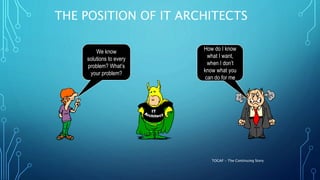
THE POSITION OF IT ARCHITECTS
We know
solutions to every
problem? What’s
your problem?
How do I know
what I want,
when I don’t
know what you
can do for me
Architect
IT
TOGAF - The Continuing Story
ENTERPRISE ARCHITECTURE
Business architecture that
defines the organisation
Infrastructure that supports the IS
What to do, Where to do it, and
How to do it?
Applications and information
Business
Technology
Information
Systems
Strategy
The Enterprise Architecture discipline defines and
maintains the architecture models, governance, and
transition initiatives needed to effectively co-ordinate
semi-autonomous groups towards common
business and IT goals
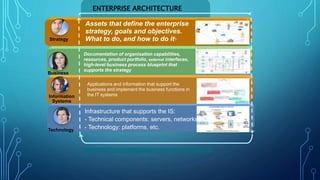
ENTERPRISE ARCHITECTURE
Business
Technology
Information
Systems
Strategy
Documentation of organisation capabilities,
resources, product portfolio, external interfaces,
high-level business process blueprint that
supports the strategy
Infrastructure that supports the IS:
- Technical components: servers, networks, etc.
- Technology: platforms, etc.
Applications and information that support the
business and implement the business functions in
the IT systems
Assets that define the enterprise
strategy, goals and objectives.
What to do, and how to do it?
OUTLINE
• What is Enterprise Architecture?
• Enterprise Architecture definitions.
• Enterprise Architecture types
• When we use EA?
• Enterprise architecture Diagrams.
• Enterprise Architecture Frameworks.
• How Enterprise architecture align business ?
• Short video .
ENTERPRISE ARCHITECTURE FRAMEWORKS
• An architectural framework is a tool for:
• Designing a broad range of a architectures.
• Assisting the evaluation of different architectures.
• Selecting and building the right architecture for an
organization.
ZACHMAN’S EA FRAMEWORK
TDT4252, Spring 2013
LECTURE 14 - ENTERPRISE
ARCHITECTURE: ZACHMAN,
TOGAF
21
e.g.DATA
ENTERPRISEARCHITECTURE-AFRAMEWORK
Builder
SCOPE
(CONTEXTUAL)
MODEL
(CONCEPTUAL)
ENTERPRISE
Designer
SYSTEM
MODEL
(LOGICAL)
TECHNOLOGY
MODEL
(PHYSICAL)
DETAILED
REPRESEN-
TATIONS
(OUT-OF-
CONTEXT)
Sub-
Contractor
FUNCTIONING
ENTERPRISE
DATA FUNCTION NETWORK
e.g.DataDefinition
Ent=Field
Reln=Address
e.g.PhysicalDataModel
Ent=Segment/Table/etc.
Reln=Pointer/Key/etc.
e.g.LogicalDataModel
Ent=DataEntity
Reln=DataRelationship
e.g.SemanticModel
Ent=BusinessEntity
Reln=BusinessRelationship
ListofThingsImportant
totheBusiness
ENTITY=Classof
BusinessThing
ListofProcessesthe
BusinessPerforms
Function=Classof
BusinessProcess
e.g.ApplicationArchitecture
I/O=UserViews
Proc.=ApplicationFunction
e.g.SystemDesign
I/O=DataElements/Sets
Proc.=ComputerFunction
e.g.Program
I/O=ControlBlock
Proc.=LanguageStmt
e.g.FUNCTION
e.g.BusinessProcessModel
Proc.=BusinessProcess
I/O=BusinessResources
ListofLocationsinwhich
theBusinessOperates
Node=MajorBusiness
Location
e.g.BusinessLogistics
System
Node=BusinessLocation
Link=BusinessLinkage
e.g.DistributedSystem
Node=I/SFunction
(Processor,Storage,etc)
Link=LineCharacteristics
e.g.TechnologyArchitecture
Node=Hardware/System
Software
Link=LineSpecifications
e.g.NetworkArchitecture
Node=Addresses
Link=Protocols
e.g.NETWORK
Architecture
Planner
Owner
Builder
ENTERPRISE
MODEL
(CONCEPTUAL)
Designer
SYSTEM
MODEL
(LOGICAL)
TECHNOLOGY
MODEL
(PHYSICAL)
DETAILED
REPRESEN-
TATIONS
(OUT-OF
CONTEXT)
Sub-
Contractor
FUNCTIONING
MOTIVATIONTIMEPEOPLE
e.g.RuleSpecification
End=Sub-condition
Means=Step
e.g.RuleDesign
End=Condition
Means=Action
e.g.,BusinessRuleModel
End=StructuralAssertion
Means=ActionAssertion
End=BusinessObjective
Means=BusinessStrategy
ListofBusinessGoals/Strat
Ends/Means=MajorBus.Goal/
CriticalSuccessFactor
ListofEventsSignificant
Time=MajorBusinessEvent
e.g.ProcessingStructure
Cycle=ProcessingCycle
Time=SystemEvent
e.g.ControlStructure
Cycle=ComponentCycle
Time=Execute
e.g.TimingDefinition
Cycle=MachineCycle
Time=Interrupt
e.g.SCHEDULE
e.g.MasterSchedule
Time=BusinessEvent
Cycle=BusinessCycle
ListofOrganizations
People=MajorOrganizations
e.g.WorkFlowModel
People=OrganizationUnit
Work=WorkProduct
e.g.HumanInterface
People=Role
Work=Deliverable
e.g.PresentationArchitecture
People=User
Work=ScreenFormat
e.g.SecurityArchitecture
People=Identity
Work=Job
e.g.ORGANIZATION
Planner
Owner
totheBusinessImportanttotheBusiness
What How Where Who When Why
JohnA.Zachman,ZachmanInternational(810)231-0531
SCOPE
(CONTEXTUAL)
Architecture
e.g.STRATEGY
ENTERPRISE
e.g.BusinessPlan
TM
View
Aspects
Viewpoints
TOGAF’S ENTERPRISE
ARCHITECTURE
TDT4252, Spring 2013
LECTURE 14 - ENTERPRISE
ARCHITECTURE: ZACHMAN,
TOGAF
Describes the
processes the
business uses to
meet its goals.
Describes how
specific applications
are designed and
how they interact
with each other.
Describes how the
enterprise datastores
are organised and
accessed.
Describes the hardware
and software
infrastructure that
supports applications
and their interactions.
TOGAF are complements Zachman’s
Framework: Zachman tell you how to
categorise artifacts;
TOGAF provides a process for creating
them.
OUTLINE
• What is Enterprise Architecture?
• Enterprise Architecture definitions.
• Enterprise Architecture types
• When we use EA?
• Enterprise architecture Diagrams.
• Enterprise Architecture Frameworks.
• How Enterprise architecture align business ?
• Short video .
• Deeper understanding of organizational strategic intent.
• Correct IT investment allocation.
• Realized economies of scale.
• Elimination of redundancies.
• Reduced IT delivery time due to reuse Higher-quality decision making
at all levels An organization that works on the right things at the right
time.
• Selection/identification of correct technologies/functionality required
by the organization.
• An understanding of what we are doing and why and how individual
roles and responsibilities support.
• Creation of an environment for enterprise success
Business alignment through
EA
LECTURE 14 - ENTERPRISE
ARCHITECTURE: ZACHMAN,
TOGAF
OUTLINE
• What is Enterprise Architecture?
• Enterprise Architecture definitions.
• Enterprise Architecture types
• When we use EA?
• Enterprise architecture Diagrams.
• Enterprise Architecture Frameworks.
• How Enterprise architecture align business ?
• Short video .
IT Enterprise architecture ppt

IT Enterprise architecture ppt

  • 1.
    JOURNAL OF STRATEGICINFORMATION SYSTEMS ACHIEVING BENEFITS WITH ENTERPRISE ARCHITECTURE GRAEME SHANKSA,⁎, MARIANNE GLOETA, IDA ASADI SOMEHB, KEITH FRAMPTONA, TOOMAS TAMMC THE UNIVERSITY OF MELBOURNE, AUSTRALIA PUBLISHED IN 7 MARCH 2018 ADVANCE MANAGEMENT INFORMATION SYSTEM INSTRUCTOR: ASST. PROF. DR. MÜESSER NAT PREPARED BY MUNSF SOKIYNA DEPARTMENT OF MIS
  • 2.
    OUTLINE • What isEnterprise Architecture? • Enterprise Architecture definitions. • Enterprise Architecture types • When we use EA? • Enterprise architecture Diagrams. • Enterprise Architecture Frameworks. • How Enterprise architecture align business ? • Short video .
  • 4.
    OUTLINE • The emergenceof Enterprise Architecture? • Enterprise Architecture definitions. • Enterprise Architecture types • When we use EA? • Enterprise architecture Diagrams. • Enterprise Architecture Frameworks. • How Enterprise architecture align business ? • Short video .
  • 5.
    WHAT IS ENTERPRISE ARCHITECTURE? • The concept of enterprise architecture was discovered in 1978 by IT and Business Consultant John Zachman, who published his popular article in “IBM journal”, Its title was "A framework for Information Technology Architecture "(Hermans, 2015). • Systems Development Life Cycle (SDLC).
  • 6.
    OUTLINE • What isEnterprise Architecture? • Enterprise Architecture definitions. • Enterprise Architecture types • When we use EA? • Enterprise architecture Diagrams. • Enterprise Architecture Frameworks. • How Enterprise architecture align business ? • Short video .
  • 7.
    ENTERPRISE ARCHITECTURE DEFINITIONS •Enterprise Architecture (EA) defines the current and desirable future states of an organization's processes, capabilities, application systems, data, and IT infrastructure and provides a roadmap for achieving this target from the current state (Ross et al., 2006; Tamm et al., 2011; Zachman, 1987). • EA has been traditionally conceptualized as a collection of artefacts that represent an organization's business systems and IT systems, together with a planning process for documenting these systems (Ross et al., 2006). • EA includes details about an organization's processes, capabilities, data, application systems and IT infrastructure using a variety of standardized representation techniques (Kaisler et al., 2005; Lankhorst, 2013).
  • 8.
    ENTERPRISE ARCHITECTURE DEFINITIONS •The Open Group definition : Enterprise Architecture is about understanding all of the different components that go to make up the enterprise and how those components inter-relate. • Wikipedia :Enterprise Architecture is the practice of applying a comprehensive and rigorous method for describing a current and/or future structure and behavior for an organization's processes, (information) systems, personnel and organizational sub-units, so that they align with the organization's core goals and strategic direction. Although often associated strictly with information technology, it relates more broadly to the practice of business optimization in that it addresses business architecture, performance management, organizational structure and process architecture as well.
  • 9.
    Enterprise architecture isa complete expression of the enterprise; a master plan which “acts as a collaboration force” between aspects of business planning such as goals, visions, strategies and governance principles; aspects of business operations such as business terms, organization structures, processes and data; aspects of automation such as information systems and databases; and the enabling technological infrastructure of the business such as computers, IFEAD
  • 10.
    OUTLINE • What isEnterprise Architecture? • Enterprise Architecture definitions. • Enterprise Architecture types • When we use EA? • Enterprise architecture Diagrams. • Enterprise Architecture Frameworks. • How Enterprise architecture align business ? • Short video .
  • 11.
    ENTERPRISE ARCHITECTURE TYPES •Business architecture: business process, organization, people. • Information system architectures • Data or information architecture: data and Information • Application architecture: Services • Technology architecture: hardware, software, network.
  • 12.
    OUTLINE • What isEnterprise Architecture? • Enterprise Architecture definitions. • Enterprise Architecture types • When we use EA? • Enterprise architecture Diagrams. • Enterprise Architecture Frameworks. • How Enterprise architecture align business ? • Short video .
  • 13.
    When we useEnterprise architecture. System complexity—Organizations were spending more and more money building IT systems. Poor business alignment—Organizations were finding it more and more difficult to keep those increasingly expensive IT systems aligned with business need.
  • 14.
    OUTLINE • What isEnterprise Architecture? • Enterprise Architecture definitions. • Enterprise Architecture types • When we use EA? • Enterprise architecture Diagrams. • Enterprise Architecture Frameworks. • How Enterprise architecture align business ? • Short video .
  • 15.
    THE POSITION OFIT ARCHITECTS We know solutions to every problem? What’s your problem? How do I know what I want, when I don’t know what you can do for me Architect IT TOGAF - The Continuing Story
  • 17.
    ENTERPRISE ARCHITECTURE Business architecturethat defines the organisation Infrastructure that supports the IS What to do, Where to do it, and How to do it? Applications and information Business Technology Information Systems Strategy The Enterprise Architecture discipline defines and maintains the architecture models, governance, and transition initiatives needed to effectively co-ordinate semi-autonomous groups towards common business and IT goals
  • 18.
    ENTERPRISE ARCHITECTURE Business Technology Information Systems Strategy Documentation oforganisation capabilities, resources, product portfolio, external interfaces, high-level business process blueprint that supports the strategy Infrastructure that supports the IS: - Technical components: servers, networks, etc. - Technology: platforms, etc. Applications and information that support the business and implement the business functions in the IT systems Assets that define the enterprise strategy, goals and objectives. What to do, and how to do it?
  • 20.
    OUTLINE • What isEnterprise Architecture? • Enterprise Architecture definitions. • Enterprise Architecture types • When we use EA? • Enterprise architecture Diagrams. • Enterprise Architecture Frameworks. • How Enterprise architecture align business ? • Short video .
  • 21.
    ENTERPRISE ARCHITECTURE FRAMEWORKS •An architectural framework is a tool for: • Designing a broad range of a architectures. • Assisting the evaluation of different architectures. • Selecting and building the right architecture for an organization.
  • 22.
    ZACHMAN’S EA FRAMEWORK TDT4252,Spring 2013 LECTURE 14 - ENTERPRISE ARCHITECTURE: ZACHMAN, TOGAF 21 e.g.DATA ENTERPRISEARCHITECTURE-AFRAMEWORK Builder SCOPE (CONTEXTUAL) MODEL (CONCEPTUAL) ENTERPRISE Designer SYSTEM MODEL (LOGICAL) TECHNOLOGY MODEL (PHYSICAL) DETAILED REPRESEN- TATIONS (OUT-OF- CONTEXT) Sub- Contractor FUNCTIONING ENTERPRISE DATA FUNCTION NETWORK e.g.DataDefinition Ent=Field Reln=Address e.g.PhysicalDataModel Ent=Segment/Table/etc. Reln=Pointer/Key/etc. e.g.LogicalDataModel Ent=DataEntity Reln=DataRelationship e.g.SemanticModel Ent=BusinessEntity Reln=BusinessRelationship ListofThingsImportant totheBusiness ENTITY=Classof BusinessThing ListofProcessesthe BusinessPerforms Function=Classof BusinessProcess e.g.ApplicationArchitecture I/O=UserViews Proc.=ApplicationFunction e.g.SystemDesign I/O=DataElements/Sets Proc.=ComputerFunction e.g.Program I/O=ControlBlock Proc.=LanguageStmt e.g.FUNCTION e.g.BusinessProcessModel Proc.=BusinessProcess I/O=BusinessResources ListofLocationsinwhich theBusinessOperates Node=MajorBusiness Location e.g.BusinessLogistics System Node=BusinessLocation Link=BusinessLinkage e.g.DistributedSystem Node=I/SFunction (Processor,Storage,etc) Link=LineCharacteristics e.g.TechnologyArchitecture Node=Hardware/System Software Link=LineSpecifications e.g.NetworkArchitecture Node=Addresses Link=Protocols e.g.NETWORK Architecture Planner Owner Builder ENTERPRISE MODEL (CONCEPTUAL) Designer SYSTEM MODEL (LOGICAL) TECHNOLOGY MODEL (PHYSICAL) DETAILED REPRESEN- TATIONS (OUT-OF CONTEXT) Sub- Contractor FUNCTIONING MOTIVATIONTIMEPEOPLE e.g.RuleSpecification End=Sub-condition Means=Step e.g.RuleDesign End=Condition Means=Action e.g.,BusinessRuleModel End=StructuralAssertion Means=ActionAssertion End=BusinessObjective Means=BusinessStrategy ListofBusinessGoals/Strat Ends/Means=MajorBus.Goal/ CriticalSuccessFactor ListofEventsSignificant Time=MajorBusinessEvent e.g.ProcessingStructure Cycle=ProcessingCycle Time=SystemEvent e.g.ControlStructure Cycle=ComponentCycle Time=Execute e.g.TimingDefinition Cycle=MachineCycle Time=Interrupt e.g.SCHEDULE e.g.MasterSchedule Time=BusinessEvent Cycle=BusinessCycle ListofOrganizations People=MajorOrganizations e.g.WorkFlowModel People=OrganizationUnit Work=WorkProduct e.g.HumanInterface People=Role Work=Deliverable e.g.PresentationArchitecture People=User Work=ScreenFormat e.g.SecurityArchitecture People=Identity Work=Job e.g.ORGANIZATION Planner Owner totheBusinessImportanttotheBusiness What How Where Who When Why JohnA.Zachman,ZachmanInternational(810)231-0531 SCOPE (CONTEXTUAL) Architecture e.g.STRATEGY ENTERPRISE e.g.BusinessPlan TM View Aspects Viewpoints
  • 24.
    TOGAF’S ENTERPRISE ARCHITECTURE TDT4252, Spring2013 LECTURE 14 - ENTERPRISE ARCHITECTURE: ZACHMAN, TOGAF Describes the processes the business uses to meet its goals. Describes how specific applications are designed and how they interact with each other. Describes how the enterprise datastores are organised and accessed. Describes the hardware and software infrastructure that supports applications and their interactions.
  • 25.
    TOGAF are complementsZachman’s Framework: Zachman tell you how to categorise artifacts; TOGAF provides a process for creating them.
  • 26.
    OUTLINE • What isEnterprise Architecture? • Enterprise Architecture definitions. • Enterprise Architecture types • When we use EA? • Enterprise architecture Diagrams. • Enterprise Architecture Frameworks. • How Enterprise architecture align business ? • Short video .
  • 27.
    • Deeper understandingof organizational strategic intent. • Correct IT investment allocation. • Realized economies of scale. • Elimination of redundancies. • Reduced IT delivery time due to reuse Higher-quality decision making at all levels An organization that works on the right things at the right time. • Selection/identification of correct technologies/functionality required by the organization. • An understanding of what we are doing and why and how individual roles and responsibilities support. • Creation of an environment for enterprise success Business alignment through EA LECTURE 14 - ENTERPRISE ARCHITECTURE: ZACHMAN, TOGAF
  • 28.
    OUTLINE • What isEnterprise Architecture? • Enterprise Architecture definitions. • Enterprise Architecture types • When we use EA? • Enterprise architecture Diagrams. • Enterprise Architecture Frameworks. • How Enterprise architecture align business ? • Short video .