Dr Alexander Samarin Enterprise Solutions Architect www.samarin.biz Architecting enterprise BPM systems for optimal agility
About me Practical adviser for the design and implementation of enterprise solutions Current specialisation is improving business process management systems effectiveness (“Do the right things”) efficiency (“Do the things right”) Knowledge how to use together the following technologies:  BPM, SOA, EA, ECM and IT governance
The goal  – optimal agility (easy evolution of a BPM system) Experience shows that business wants separate requests for change to be implemented quickly These changes are typically small (from the point of view of the business) and unpredictable (from the point of view of IT)  To carry out these changes easily and in a managed way, BPM systems must be properly  architected  /  designed  /  engineered
Challenge of optimal agility (1) Bad news it is enterprise-wide it can’t be bought (similar to a person’s health) we have to deal with a complex and dynamic system evolution should be via small improvements the need for agility may change over time it has a socio-technical nature:  how  you do something is sometimes more important than  what  you do
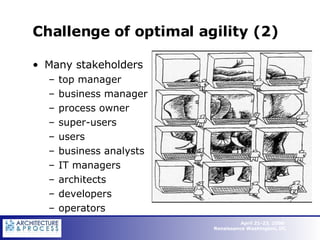
Challenge of optimal agility (2)  Many stakeholders top manager business manager process owner super-users users business analysts IT managers  architects  developers  operators
Challenge of optimal agility (3) Good news there are many good business process improvement methods BPM is appreciated an enterprise-wide management discipline there is understanding of the relationship between BPM and other business process improvement methods “ BPM suite” software products are available agile development has been proven to be feasible Service-Oriented Architecture (SOA) is maturing
BPM and BPM systems Definition of BPM (as a discipline): BPM allows you to  model ,  execute ,  control ,  automate ,  measure  and  optimise  the flow of business activities that span your enterprise’s systems, people, customers and partners within and beyond your corporate boundaries Obviously, all enterprises have their own BPM system, but often a BPM system: is a “problem” of its history, suffers from problems of complexity, inefficiency Not surprisingly, many enterprises want to improve their BPM systems
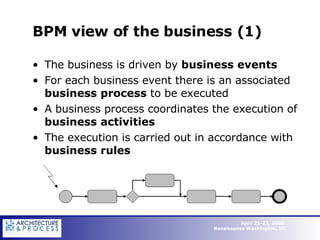
BPM view of the business (1) The business is driven by  business events For each business event there is an associated  business process  to be executed A business process coordinates the execution of  business activities The execution is carried out in accordance with  business rules
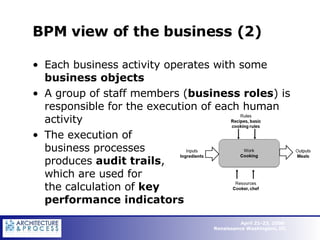
BPM view of the business (2) Each business activity operates with some  business objects A group of staff members ( business roles ) is responsible for the execution of each human activity  The execution of  business processes  produces  audit trails ,  which are used for  the calculation of  key  performance indicators
Architecting an enterprise BPM system (with systems thinking) A BPM system is a dynamic set of artefacts  Artefacts are interconnected and interdependent We have to anticipate potential changes:  policies, priorities, compliance, technology, etc. Implementation of such changes necessitates the evolution of some artefacts and the relationships between them It must be easy to modify all artefacts and relationships without causing any negative effects
Principal artefacts: services and processes The business world understood a long time ago that services and processes are the backbones of most businesses  The IT world recently “re-discovered” and accepted the notion of services, and so emerged SOA But IT is still not very comfortable with processes (often, an application is a mixture of data-entry and workflow-driven approaches)
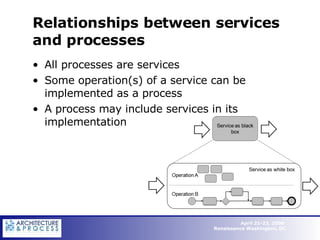
Relationships between services and processes All processes are services Some operation(s) of a service can be implemented as a process A process may include services in its implementation
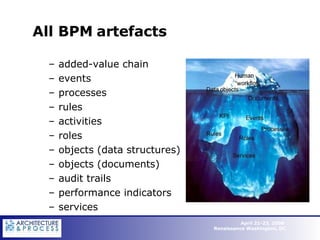
All BPM artefacts added-value chain events processes rules activities roles objects (data structures) objects (documents) audit trails performance indicators services
Main architecting principles All artefacts must be improved to become  digital ,  external  and  virtual All artefacts must be  versionable  throughout their lifecycle All relationships between these artefacts are  modelled explicitly  All models are made to be  executable
Improvement of artefacts Digitalised – available in electronic form Externalised – available as separate entities with proper definition, naming, versioning, storing, security, traceability, etc.  e.g. transportation of objects between services Virtualised – available independently of traditional IT resources (servers, databases, media, browsers) as services
Relationships between artefacts Reveal all hidden relationships and structure them  Examples: static (in design phase) dynamic (in execution phase) composition (from atomic artefacts to a composite artefact) instantiation (from a template to instances) compatibility (between different versions) If possible, model relationships as formal, explicit, traceable, testable, secure, SLA aware and executable
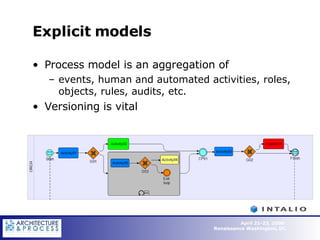
Explicit models Process model is an aggregation of  events, human and automated activities, roles, objects, rules, audits, etc. Versioning is vital
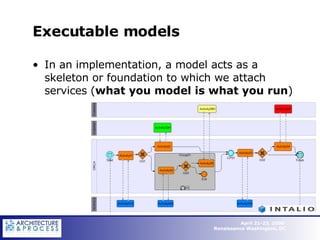
Executable models In an implementation, a model acts as a skeleton or foundation to which we attach services ( what you model is what you run )
Synergy between BPM and SOA SOA is an architectural approach for constructing complex software-intensive systems from a set of  universally interconnected  and  interdependent  building blocks, called services  (stand-alone unit of functionality) BPM, by revealing the artefacts and the relationships between them, provides the necessary context (e.g. granularity) for the definition of services  SOA provides recommendations for the implementation, execution and governance of services
Role of architecture (1) Consider a complex and dynamic system with many artefacts relationships potential changes stakeholders Explain to each group of stakeholders artefacts under their control relationships under their control how to address their concerns
Role of architecture (2) Provide the step-by-step improvement of a system (as Deming wheel) plan do (or implement) check (or validate) act (or refactor) Consider together different technologies, such as BPM, SOA, ECM, EA and IT governance Build an agile system in an agile way
An architectural framework for improving BPM systems  A comprehensive set of recommendations, models, patterns and examples of how to transform existing disparate IT systems into a coherent, agile and flexible BPM/SOA solution Documented in soon-to-be-published book  www.improving-BPM-systems.com Further slides are examples of what this framework brings to different stakeholders
Strategy: top managers The architectural framework is not about how to make your products better, different and more attractive for the market place – this is for the managers to decide  What it offers is to help managers reduce the overheads in doing so – your flexible BPM system will become an enabler for your business innovations
Business: managers The architectural framework goal is to help you to streamline your critical business processes by  automating their management eliminating work which does not add value integrating existing applications around the business needs evolving information systems in an architected and coordinated manner
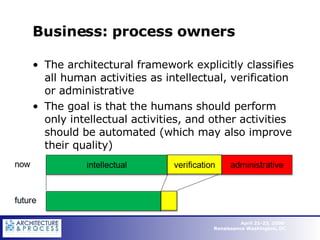
Business: process owners The architectural framework explicitly classifies all human activities as intellectual, verification or administrative  The goal is that the humans should perform only intellectual activities, and other activities should be automated (which may also improve their quality)
Business: super-users Proactive control over execution of business processes Delegation of complex tasks to less-qualified staff members Control of some artefacts and relationships between them without  systematic  involvement  of the IT
Project: managers Common understanding within a project achieved through clarification of the business and IT views of artefacts Better visibility of artefacts Shorten the gap between modelling and implementation
Example – selection of a single tool Situation 30 different tools for electronic publishing 2 years of heated discussions without result Task Define criteria for the selection of a single tool Action Modelling of business processes to find out common services Result (after several meetings) An agreed list of services as selection criteria
Example – real agility achieved Micro-projects  – agile implementations of new features are carried out in a manner similar to Deming’s wheel Meta-projects  – architectural framework governance for the management of many micro-projects looks like maintenance rather than development
Project: business analysts A modelling procedure four phase guidance to produce executable models diagramming style naming conventions several practical patterns Promoting joint work between the business and IT Quick iterations for building an operational prototype
Example – early industrialisation of a business system Intensive training for business process modelling Use of open source BPM suite for modelling in BPMN Tailoring of the modelling procedure for organisational needs Common modelling in two major projects new ECM new ERP
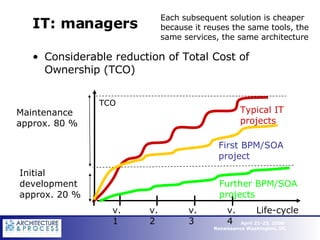
IT: managers Considerable reduction of Total Cost of Ownership (TCO) v.1 v.2 v.3 v.4 Life-cycle TCO First BPM/SOA project  Further BPM/SOA projects Each subsequent solution is cheaper because it reuses the same tools, the same services, the same architecture Maintenance approx. 80 % Initial development approx. 20 %   Typical IT projects
Example – a production system in place for several years Complexity 3 000 complex products per year  60 persons for about 50 different tasks 3 production chains 6 repositories 40 IT services  The maintenance and evolution of this production system required several times less resources Several successful (and easy to do) migrations were undertaken
IT: enterprise architects Architected flexibility – your BPM system is easy adaptable to practically all aspects of the organisation policies and priorities  constantly changing business processes business innovations computer knowledge and culture of the users  IT systems  size and complexity  data  SLA
Minimum disruptions for internal applications Direct participation of external users in internal business processes  Maximum traceability (easily certified) Example – Solution architecture for an e-gov project (1) Gov Internal application Internal application Internal application Integration services e-gov environment Collaborative extranet External users
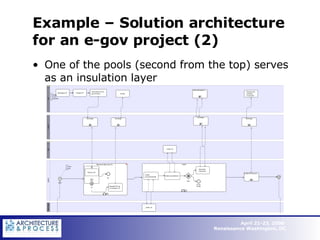
Example – Solution architecture for an e-gov project (2) One of the pools (second from the top) serves as an insulation layer
Example – Solution architecture for an e-gov project (3) Classification of services Business-specific to be used in a particular solution Business-generic to be used in several solutions Technology-generic protecting business from technological changes Technology-specific
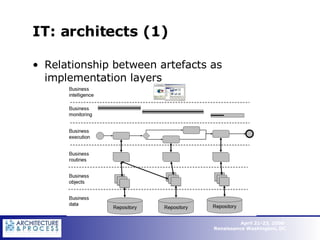
IT: architects (1) Relationship between artefacts as implementation layers
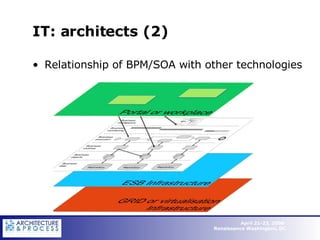
IT: architects (2) Relationship of BPM/SOA with other technologies
Example – complete redesign of a business system The following recommendations were provided principles for building BPM systems typology of BPM artefacts for the understanding and construction of artefacts architecting flexibility of BPM systems,  e.g. rules for versioning, conventions for WSDL and XSD, etc. design consideration for implemention of artefacts
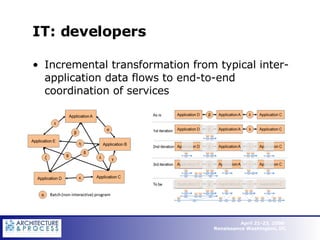
IT: developers Incremental transformation from typical inter-application data flows to end-to-end coordination of services
Example –  typical timing of micro-projects The architectural framework provides the big picture which is represented graphically (and therefore easily understood), agreed internally by consensus, addressing BPM and not “parachuted in” by consultants or a vendor Many projects become very agile Definition phase: 1 hour  Specification / conception phases: a few hours Development / test / validation phases: a few hours / days (depending on the user’s availability) Production phase: practically instant
IT: operators The architectural framework helps to manage the complexity of a mixture of interconnected and interdependent services by making explicit all relationships between services  It thus allows a correct evaluation of the availability of business-facing services from the known availability of technology-related services
Example – efficient error handling Error handling is carried out by everyone: the business users process their errors themselves (and not through an IT helpdesk) the IT staff treat their errors before they impact the business Monitoring of all services (dummy data are necessary) Error recovery is taken into account in the design of the business process
Conclusion – Main ways of achieving optimal agility are actionable enterprise architecture addressing BPM guaranteeing flexibility by design digitalisation, externalisation and virtualisation of BPM artefacts formalising (via executable models) more and more relationships between BPM artefacts shortening the loop between modelling and implementation
Thank  you! Dr Alexander Samarin Enterprise Solutions Architect www.samarin.biz Contact information: +41 76 573 40 61 [email_address]

Architecting Enterprise BPM Systems for Optimal Agility

  • 1.
    Dr Alexander SamarinEnterprise Solutions Architect www.samarin.biz Architecting enterprise BPM systems for optimal agility
  • 2.
    About me Practicaladviser for the design and implementation of enterprise solutions Current specialisation is improving business process management systems effectiveness (“Do the right things”) efficiency (“Do the things right”) Knowledge how to use together the following technologies: BPM, SOA, EA, ECM and IT governance
  • 3.
    The goal – optimal agility (easy evolution of a BPM system) Experience shows that business wants separate requests for change to be implemented quickly These changes are typically small (from the point of view of the business) and unpredictable (from the point of view of IT) To carry out these changes easily and in a managed way, BPM systems must be properly architected / designed / engineered
  • 4.
    Challenge of optimalagility (1) Bad news it is enterprise-wide it can’t be bought (similar to a person’s health) we have to deal with a complex and dynamic system evolution should be via small improvements the need for agility may change over time it has a socio-technical nature: how you do something is sometimes more important than what you do
  • 5.
    Challenge of optimalagility (2) Many stakeholders top manager business manager process owner super-users users business analysts IT managers architects developers operators
  • 6.
    Challenge of optimalagility (3) Good news there are many good business process improvement methods BPM is appreciated an enterprise-wide management discipline there is understanding of the relationship between BPM and other business process improvement methods “ BPM suite” software products are available agile development has been proven to be feasible Service-Oriented Architecture (SOA) is maturing
  • 7.
    BPM and BPMsystems Definition of BPM (as a discipline): BPM allows you to model , execute , control , automate , measure and optimise the flow of business activities that span your enterprise’s systems, people, customers and partners within and beyond your corporate boundaries Obviously, all enterprises have their own BPM system, but often a BPM system: is a “problem” of its history, suffers from problems of complexity, inefficiency Not surprisingly, many enterprises want to improve their BPM systems
  • 8.
    BPM view ofthe business (1) The business is driven by business events For each business event there is an associated business process to be executed A business process coordinates the execution of business activities The execution is carried out in accordance with business rules
  • 9.
    BPM view ofthe business (2) Each business activity operates with some business objects A group of staff members ( business roles ) is responsible for the execution of each human activity The execution of business processes produces audit trails , which are used for the calculation of key performance indicators
  • 10.
    Architecting an enterpriseBPM system (with systems thinking) A BPM system is a dynamic set of artefacts Artefacts are interconnected and interdependent We have to anticipate potential changes: policies, priorities, compliance, technology, etc. Implementation of such changes necessitates the evolution of some artefacts and the relationships between them It must be easy to modify all artefacts and relationships without causing any negative effects
  • 11.
    Principal artefacts: servicesand processes The business world understood a long time ago that services and processes are the backbones of most businesses The IT world recently “re-discovered” and accepted the notion of services, and so emerged SOA But IT is still not very comfortable with processes (often, an application is a mixture of data-entry and workflow-driven approaches)
  • 12.
    Relationships between servicesand processes All processes are services Some operation(s) of a service can be implemented as a process A process may include services in its implementation
  • 13.
    All BPM artefactsadded-value chain events processes rules activities roles objects (data structures) objects (documents) audit trails performance indicators services
  • 14.
    Main architecting principlesAll artefacts must be improved to become digital , external and virtual All artefacts must be versionable throughout their lifecycle All relationships between these artefacts are modelled explicitly All models are made to be executable
  • 15.
    Improvement of artefactsDigitalised – available in electronic form Externalised – available as separate entities with proper definition, naming, versioning, storing, security, traceability, etc. e.g. transportation of objects between services Virtualised – available independently of traditional IT resources (servers, databases, media, browsers) as services
  • 16.
    Relationships between artefactsReveal all hidden relationships and structure them Examples: static (in design phase) dynamic (in execution phase) composition (from atomic artefacts to a composite artefact) instantiation (from a template to instances) compatibility (between different versions) If possible, model relationships as formal, explicit, traceable, testable, secure, SLA aware and executable
  • 17.
    Explicit models Processmodel is an aggregation of events, human and automated activities, roles, objects, rules, audits, etc. Versioning is vital
  • 18.
    Executable models Inan implementation, a model acts as a skeleton or foundation to which we attach services ( what you model is what you run )
  • 19.
    Synergy between BPMand SOA SOA is an architectural approach for constructing complex software-intensive systems from a set of universally interconnected and interdependent building blocks, called services (stand-alone unit of functionality) BPM, by revealing the artefacts and the relationships between them, provides the necessary context (e.g. granularity) for the definition of services SOA provides recommendations for the implementation, execution and governance of services
  • 20.
    Role of architecture(1) Consider a complex and dynamic system with many artefacts relationships potential changes stakeholders Explain to each group of stakeholders artefacts under their control relationships under their control how to address their concerns
  • 21.
    Role of architecture(2) Provide the step-by-step improvement of a system (as Deming wheel) plan do (or implement) check (or validate) act (or refactor) Consider together different technologies, such as BPM, SOA, ECM, EA and IT governance Build an agile system in an agile way
  • 22.
    An architectural frameworkfor improving BPM systems A comprehensive set of recommendations, models, patterns and examples of how to transform existing disparate IT systems into a coherent, agile and flexible BPM/SOA solution Documented in soon-to-be-published book www.improving-BPM-systems.com Further slides are examples of what this framework brings to different stakeholders
  • 23.
    Strategy: top managersThe architectural framework is not about how to make your products better, different and more attractive for the market place – this is for the managers to decide What it offers is to help managers reduce the overheads in doing so – your flexible BPM system will become an enabler for your business innovations
  • 24.
    Business: managers Thearchitectural framework goal is to help you to streamline your critical business processes by automating their management eliminating work which does not add value integrating existing applications around the business needs evolving information systems in an architected and coordinated manner
  • 25.
    Business: process ownersThe architectural framework explicitly classifies all human activities as intellectual, verification or administrative The goal is that the humans should perform only intellectual activities, and other activities should be automated (which may also improve their quality)
  • 26.
    Business: super-users Proactivecontrol over execution of business processes Delegation of complex tasks to less-qualified staff members Control of some artefacts and relationships between them without systematic involvement of the IT
  • 27.
    Project: managers Commonunderstanding within a project achieved through clarification of the business and IT views of artefacts Better visibility of artefacts Shorten the gap between modelling and implementation
  • 28.
    Example – selectionof a single tool Situation 30 different tools for electronic publishing 2 years of heated discussions without result Task Define criteria for the selection of a single tool Action Modelling of business processes to find out common services Result (after several meetings) An agreed list of services as selection criteria
  • 29.
    Example – realagility achieved Micro-projects – agile implementations of new features are carried out in a manner similar to Deming’s wheel Meta-projects – architectural framework governance for the management of many micro-projects looks like maintenance rather than development
  • 30.
    Project: business analystsA modelling procedure four phase guidance to produce executable models diagramming style naming conventions several practical patterns Promoting joint work between the business and IT Quick iterations for building an operational prototype
  • 31.
    Example – earlyindustrialisation of a business system Intensive training for business process modelling Use of open source BPM suite for modelling in BPMN Tailoring of the modelling procedure for organisational needs Common modelling in two major projects new ECM new ERP
  • 32.
    IT: managers Considerablereduction of Total Cost of Ownership (TCO) v.1 v.2 v.3 v.4 Life-cycle TCO First BPM/SOA project Further BPM/SOA projects Each subsequent solution is cheaper because it reuses the same tools, the same services, the same architecture Maintenance approx. 80 % Initial development approx. 20 % Typical IT projects
  • 33.
    Example – aproduction system in place for several years Complexity 3 000 complex products per year 60 persons for about 50 different tasks 3 production chains 6 repositories 40 IT services The maintenance and evolution of this production system required several times less resources Several successful (and easy to do) migrations were undertaken
  • 34.
    IT: enterprise architectsArchitected flexibility – your BPM system is easy adaptable to practically all aspects of the organisation policies and priorities constantly changing business processes business innovations computer knowledge and culture of the users IT systems size and complexity data SLA
  • 35.
    Minimum disruptions forinternal applications Direct participation of external users in internal business processes Maximum traceability (easily certified) Example – Solution architecture for an e-gov project (1) Gov Internal application Internal application Internal application Integration services e-gov environment Collaborative extranet External users
  • 36.
    Example – Solutionarchitecture for an e-gov project (2) One of the pools (second from the top) serves as an insulation layer
  • 37.
    Example – Solutionarchitecture for an e-gov project (3) Classification of services Business-specific to be used in a particular solution Business-generic to be used in several solutions Technology-generic protecting business from technological changes Technology-specific
  • 38.
    IT: architects (1)Relationship between artefacts as implementation layers
  • 39.
    IT: architects (2)Relationship of BPM/SOA with other technologies
  • 40.
    Example – completeredesign of a business system The following recommendations were provided principles for building BPM systems typology of BPM artefacts for the understanding and construction of artefacts architecting flexibility of BPM systems, e.g. rules for versioning, conventions for WSDL and XSD, etc. design consideration for implemention of artefacts
  • 41.
    IT: developers Incrementaltransformation from typical inter-application data flows to end-to-end coordination of services
  • 42.
    Example – typical timing of micro-projects The architectural framework provides the big picture which is represented graphically (and therefore easily understood), agreed internally by consensus, addressing BPM and not “parachuted in” by consultants or a vendor Many projects become very agile Definition phase: 1 hour Specification / conception phases: a few hours Development / test / validation phases: a few hours / days (depending on the user’s availability) Production phase: practically instant
  • 43.
    IT: operators Thearchitectural framework helps to manage the complexity of a mixture of interconnected and interdependent services by making explicit all relationships between services It thus allows a correct evaluation of the availability of business-facing services from the known availability of technology-related services
  • 44.
    Example – efficienterror handling Error handling is carried out by everyone: the business users process their errors themselves (and not through an IT helpdesk) the IT staff treat their errors before they impact the business Monitoring of all services (dummy data are necessary) Error recovery is taken into account in the design of the business process
  • 45.
    Conclusion – Mainways of achieving optimal agility are actionable enterprise architecture addressing BPM guaranteeing flexibility by design digitalisation, externalisation and virtualisation of BPM artefacts formalising (via executable models) more and more relationships between BPM artefacts shortening the loop between modelling and implementation
  • 46.
    Thank you!Dr Alexander Samarin Enterprise Solutions Architect www.samarin.biz Contact information: +41 76 573 40 61 [email_address]