
Copyright Kemsley Design Ltd., 2015 1
Sandy Kemsley ● www.column2.com ● @skemsley
Changing Incentives
for Knowledge
Workers
Aligning incentives with the social
enterprise
Agenda
 Knowledge work: best when it’s social
 Social business #fail
 Intrinsic motivation
 Knowledge work incentives
Copyright Kemsley Design Ltd., 2015 3
How The Enterprise
Became Social
The shift in enterprise processes, attitudes and goals
Copyright Kemsley Design Ltd., 2015 4
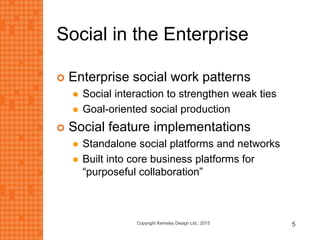
Social in the Enterprise
 Enterprise social work patterns
 Social interaction to strengthen weak ties
 Goal-oriented social production
 Social feature implementations
 Standalone social platforms and networks
 Built into core business platforms for
“purposeful collaboration”
Copyright Kemsley Design Ltd., 2015 5
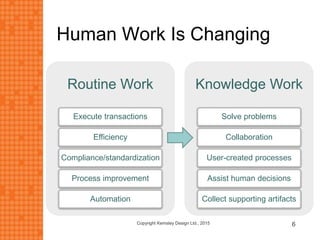
Human Work Is Changing
Copyright Kemsley Design Ltd., 2015 6
Routine Work
Execute transactions
Efficiency
Compliance/standardization
Process improvement
Automation
Knowledge Work
Solve problems
Collaboration
User-created processes
Assist human decisions
Collect supporting artifacts
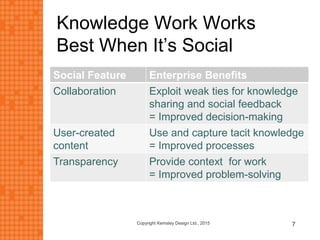
Knowledge Work Works
Best When It’s Social
Social Feature Enterprise Benefits
Collaboration Exploit weak ties for knowledge
sharing and social feedback
= Improved decision-making
User-created
content
Use and capture tacit knowledge
= Improved processes
Transparency Provide context for work
= Improved problem-solving
Copyright Kemsley Design Ltd., 2015 7
What Makes Social
Business Social?
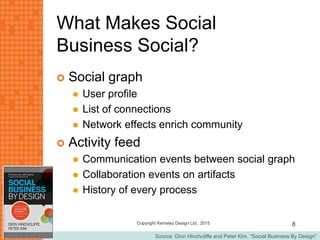
 Social graph
 User profile
 List of connections
 Network effects enrich community
 Activity feed
 Communication events between social graph
 Collaboration events on artifacts
 History of every process
Copyright Kemsley Design Ltd., 2015 8
Source: Dion Hinchcliffe and Peter Kim, “Social Business By Design”
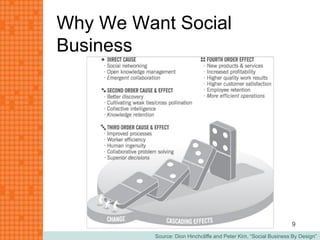
Why We Want Social
Business
9
Source: Dion Hinchcliffe and Peter Kim, “Social Business By Design”
The Collaboration Dilemma
What is limiting the adoption of social enterprise processes?
Copyright Kemsley Design Ltd., 2015 10
Social Business Gone
Wrong
In spite of evidence that collaborative,
dynamic, goal-directed processes can
improve agility, profitability and
customer satisfaction, many
enterprises maintain a corporate culture
and management style that
does not incent workers
for these activities.
Copyright Kemsley Design Ltd., 2015 11
Social Business Adoption
Failures
 Management disables social features
 Attempt to control workers’ activities
 Results in “off the record” collaboration
 Workers ignore social features
 Insufficient training
 Insufficient incentives to collaborate
Copyright Kemsley Design Ltd., 2015 12
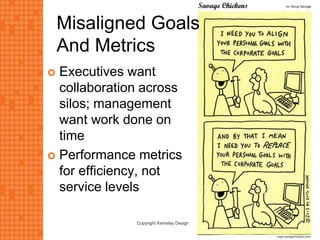
 Executives want
collaboration across
silos; management
want work done on
time
 Performance metrics
for efficiency, not
service levels
Copyright Kemsley Design Ltd., 2015 13
Misaligned Goals
And Metrics
The Incentives Conflict
Copyright Kemsley Design Ltd., 2015 14
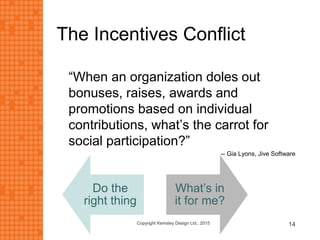
“When an organization doles out
bonuses, raises, awards and
promotions based on individual
contributions, what’s the carrot for
social participation?”
-- Gia Lyons, Jive Software
Do the
right thing
What’s in
it for me?
Aligning Incentives with
Goals
Changing why you work in order to change how you work
Copyright Kemsley Design Ltd., 2015 15
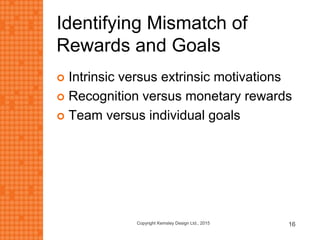
Identifying Mismatch of
Rewards and Goals
 Intrinsic versus extrinsic motivations
 Recognition versus monetary rewards
 Team versus individual goals
Copyright Kemsley Design Ltd., 2015 16
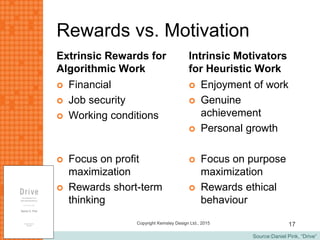
Source:Daniel Pink, “Drive”
Rewards vs. Motivation
Extrinsic Rewards for
Algorithmic Work
 Financial
 Job security
 Working conditions
 Focus on profit
maximization
 Rewards short-term
thinking
Intrinsic Motivators
for Heuristic Work
 Enjoyment of work
 Genuine
achievement
 Personal growth
 Focus on purpose
maximization
 Rewards ethical
behaviour
Copyright Kemsley Design Ltd., 2015 17
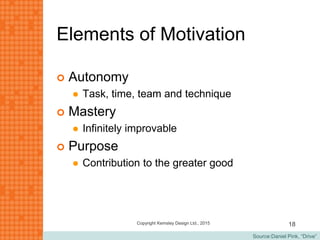
Elements of Motivation
 Autonomy
 Task, time, team and technique
 Mastery
 Infinitely improvable
 Purpose
 Contribution to the greater good
Copyright Kemsley Design Ltd., 2015 18
Source:Daniel Pink, “Drive”
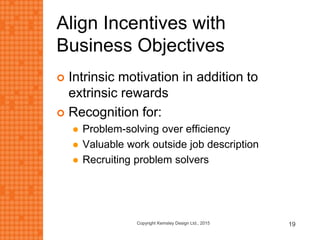
Align Incentives with
Business Objectives
 Intrinsic motivation in addition to
extrinsic rewards
 Recognition for:
 Problem-solving over efficiency
 Valuable work outside job description
 Recruiting problem solvers
Copyright Kemsley Design Ltd., 2015 19
Boost Teamwork
 Reward team goals as well as individual
 Strengthen weak ties with dynamic, self-
organizing teams
 Encourage joint ownership of goals,
activities to increase buy-in
 Leverage social ties/pressure to adopt
new ideas
 Teamwork is not just “doing your job”
Copyright Kemsley Design Ltd., 2015 20
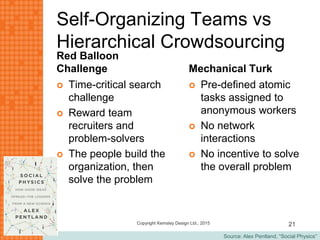
Source: Alex Pentland, “Social Physics”
Self-Organizing Teams vs
Hierarchical Crowdsourcing
Red Balloon
Challenge
 Time-critical search
challenge
 Reward team
recruiters and
problem-solvers
 The people build the
organization, then
solve the problem
Mechanical Turk
 Pre-defined atomic
tasks assigned to
anonymous workers
 No network
interactions
 No incentive to solve
the overall problem
Copyright Kemsley Design Ltd., 2015 21
Source: Ted Coine and Mark Babbitt, “A World Gone Social”; Frederic Laloux, “Reinventing Organizations”
Flat Leadership For Greater
Competitiveness
 Workers are more engaged
 Set goals and make decisions
 More productive, less absenteeism
 Freedom (and will) to innovate
 Reduced “management tax”
 Less hierarchy = reduced costs
 Less bureaucracy = improved efficiency
 Zappos, W.L. Gore, Basecamp
Copyright Kemsley Design Ltd., 2015 22
The Metrics Of
Knowledge Work Incentives
Copyright Kemsley Design Ltd., 2015 23
Problem-Solving Metrics
 Customer satisfaction
 Time to achieve business goal (not
just complete task)
 Quality of decision/goal achievement
 Correlate with degree of collaboration
Copyright Kemsley Design Ltd., 2015 24
Enterprise Social Scoring
 Social graph connectivity/strength
 Indicator of collaboration
 Detect/boost weak ties
 Reputation-based recommendations
 Social reputation
 Indicator of contribution to community
 Incorporate peer recognition
Copyright Kemsley Design Ltd., 2015 25
Building In Social Incentives
 Capture social metrics on systems of
interaction
 Social graph and interactions
 Flexibility and innovation
 Quality of decision/problem resolution
 Peer assessment
 Combine with traditional metrics
 Immediate feedback with recognition
and gamification
Copyright Kemsley Design Ltd., 2015 26
Next-Generation Social
Analytics
 Evaluate (and reward) collaborative
behaviors that:
 Are aligned with organizational culture
 Get work done
 Assist others to achieve shared goals
 Resistant to “gaming” by workers
Copyright Kemsley Design Ltd., 2015 27
Summary
Copyright Kemsley Design Ltd., 2015 28
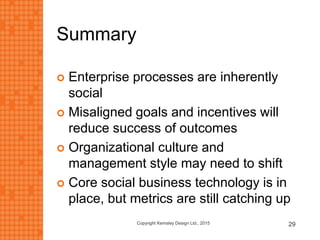
Summary
 Enterprise processes are inherently
social
 Misaligned goals and incentives will
reduce success of outcomes
 Organizational culture and
management style may need to shift
 Core social business technology is in
place, but metrics are still catching up
Copyright Kemsley Design Ltd., 2015 29
Questions
Sandy Kemsley
sandy@kemsleydesign.com
www.column2.com
@skemsley
www.slideshare.net/skemsley
Copyright Kemsley Design Ltd., 2015 30

Knowledge Work Incentives

  • 1.
  • 2.
    Sandy Kemsley ●www.column2.com ● @skemsley Changing Incentives for Knowledge Workers Aligning incentives with the social enterprise
  • 3.
    Agenda  Knowledge work:best when it’s social  Social business #fail  Intrinsic motivation  Knowledge work incentives Copyright Kemsley Design Ltd., 2015 3
  • 4.
    How The Enterprise BecameSocial The shift in enterprise processes, attitudes and goals Copyright Kemsley Design Ltd., 2015 4
  • 5.
    Social in theEnterprise  Enterprise social work patterns  Social interaction to strengthen weak ties  Goal-oriented social production  Social feature implementations  Standalone social platforms and networks  Built into core business platforms for “purposeful collaboration” Copyright Kemsley Design Ltd., 2015 5
  • 6.
    Human Work IsChanging Copyright Kemsley Design Ltd., 2015 6 Routine Work Execute transactions Efficiency Compliance/standardization Process improvement Automation Knowledge Work Solve problems Collaboration User-created processes Assist human decisions Collect supporting artifacts
  • 7.
    Knowledge Work Works BestWhen It’s Social Social Feature Enterprise Benefits Collaboration Exploit weak ties for knowledge sharing and social feedback = Improved decision-making User-created content Use and capture tacit knowledge = Improved processes Transparency Provide context for work = Improved problem-solving Copyright Kemsley Design Ltd., 2015 7
  • 8.
    What Makes Social BusinessSocial?  Social graph  User profile  List of connections  Network effects enrich community  Activity feed  Communication events between social graph  Collaboration events on artifacts  History of every process Copyright Kemsley Design Ltd., 2015 8 Source: Dion Hinchcliffe and Peter Kim, “Social Business By Design”
  • 9.
    Why We WantSocial Business 9 Source: Dion Hinchcliffe and Peter Kim, “Social Business By Design”
  • 10.
    The Collaboration Dilemma Whatis limiting the adoption of social enterprise processes? Copyright Kemsley Design Ltd., 2015 10
  • 11.
    Social Business Gone Wrong Inspite of evidence that collaborative, dynamic, goal-directed processes can improve agility, profitability and customer satisfaction, many enterprises maintain a corporate culture and management style that does not incent workers for these activities. Copyright Kemsley Design Ltd., 2015 11
  • 12.
    Social Business Adoption Failures Management disables social features  Attempt to control workers’ activities  Results in “off the record” collaboration  Workers ignore social features  Insufficient training  Insufficient incentives to collaborate Copyright Kemsley Design Ltd., 2015 12
  • 13.
     Executives want collaborationacross silos; management want work done on time  Performance metrics for efficiency, not service levels Copyright Kemsley Design Ltd., 2015 13 Misaligned Goals And Metrics
  • 14.
    The Incentives Conflict CopyrightKemsley Design Ltd., 2015 14 “When an organization doles out bonuses, raises, awards and promotions based on individual contributions, what’s the carrot for social participation?” -- Gia Lyons, Jive Software Do the right thing What’s in it for me?
  • 15.
    Aligning Incentives with Goals Changingwhy you work in order to change how you work Copyright Kemsley Design Ltd., 2015 15
  • 16.
    Identifying Mismatch of Rewardsand Goals  Intrinsic versus extrinsic motivations  Recognition versus monetary rewards  Team versus individual goals Copyright Kemsley Design Ltd., 2015 16
  • 17.
    Source:Daniel Pink, “Drive” Rewardsvs. Motivation Extrinsic Rewards for Algorithmic Work  Financial  Job security  Working conditions  Focus on profit maximization  Rewards short-term thinking Intrinsic Motivators for Heuristic Work  Enjoyment of work  Genuine achievement  Personal growth  Focus on purpose maximization  Rewards ethical behaviour Copyright Kemsley Design Ltd., 2015 17
  • 18.
    Elements of Motivation Autonomy  Task, time, team and technique  Mastery  Infinitely improvable  Purpose  Contribution to the greater good Copyright Kemsley Design Ltd., 2015 18 Source:Daniel Pink, “Drive”
  • 19.
    Align Incentives with BusinessObjectives  Intrinsic motivation in addition to extrinsic rewards  Recognition for:  Problem-solving over efficiency  Valuable work outside job description  Recruiting problem solvers Copyright Kemsley Design Ltd., 2015 19
  • 20.
    Boost Teamwork  Rewardteam goals as well as individual  Strengthen weak ties with dynamic, self- organizing teams  Encourage joint ownership of goals, activities to increase buy-in  Leverage social ties/pressure to adopt new ideas  Teamwork is not just “doing your job” Copyright Kemsley Design Ltd., 2015 20
  • 21.
    Source: Alex Pentland,“Social Physics” Self-Organizing Teams vs Hierarchical Crowdsourcing Red Balloon Challenge  Time-critical search challenge  Reward team recruiters and problem-solvers  The people build the organization, then solve the problem Mechanical Turk  Pre-defined atomic tasks assigned to anonymous workers  No network interactions  No incentive to solve the overall problem Copyright Kemsley Design Ltd., 2015 21
  • 22.
    Source: Ted Coineand Mark Babbitt, “A World Gone Social”; Frederic Laloux, “Reinventing Organizations” Flat Leadership For Greater Competitiveness  Workers are more engaged  Set goals and make decisions  More productive, less absenteeism  Freedom (and will) to innovate  Reduced “management tax”  Less hierarchy = reduced costs  Less bureaucracy = improved efficiency  Zappos, W.L. Gore, Basecamp Copyright Kemsley Design Ltd., 2015 22
  • 23.
    The Metrics Of KnowledgeWork Incentives Copyright Kemsley Design Ltd., 2015 23
  • 24.
    Problem-Solving Metrics  Customersatisfaction  Time to achieve business goal (not just complete task)  Quality of decision/goal achievement  Correlate with degree of collaboration Copyright Kemsley Design Ltd., 2015 24
  • 25.
    Enterprise Social Scoring Social graph connectivity/strength  Indicator of collaboration  Detect/boost weak ties  Reputation-based recommendations  Social reputation  Indicator of contribution to community  Incorporate peer recognition Copyright Kemsley Design Ltd., 2015 25
  • 26.
    Building In SocialIncentives  Capture social metrics on systems of interaction  Social graph and interactions  Flexibility and innovation  Quality of decision/problem resolution  Peer assessment  Combine with traditional metrics  Immediate feedback with recognition and gamification Copyright Kemsley Design Ltd., 2015 26
  • 27.
    Next-Generation Social Analytics  Evaluate(and reward) collaborative behaviors that:  Are aligned with organizational culture  Get work done  Assist others to achieve shared goals  Resistant to “gaming” by workers Copyright Kemsley Design Ltd., 2015 27
  • 28.
  • 29.
    Summary  Enterprise processesare inherently social  Misaligned goals and incentives will reduce success of outcomes  Organizational culture and management style may need to shift  Core social business technology is in place, but metrics are still catching up Copyright Kemsley Design Ltd., 2015 29
  • 30.