GRAPHS IN PHYSICS


                    1
Linear Graphs

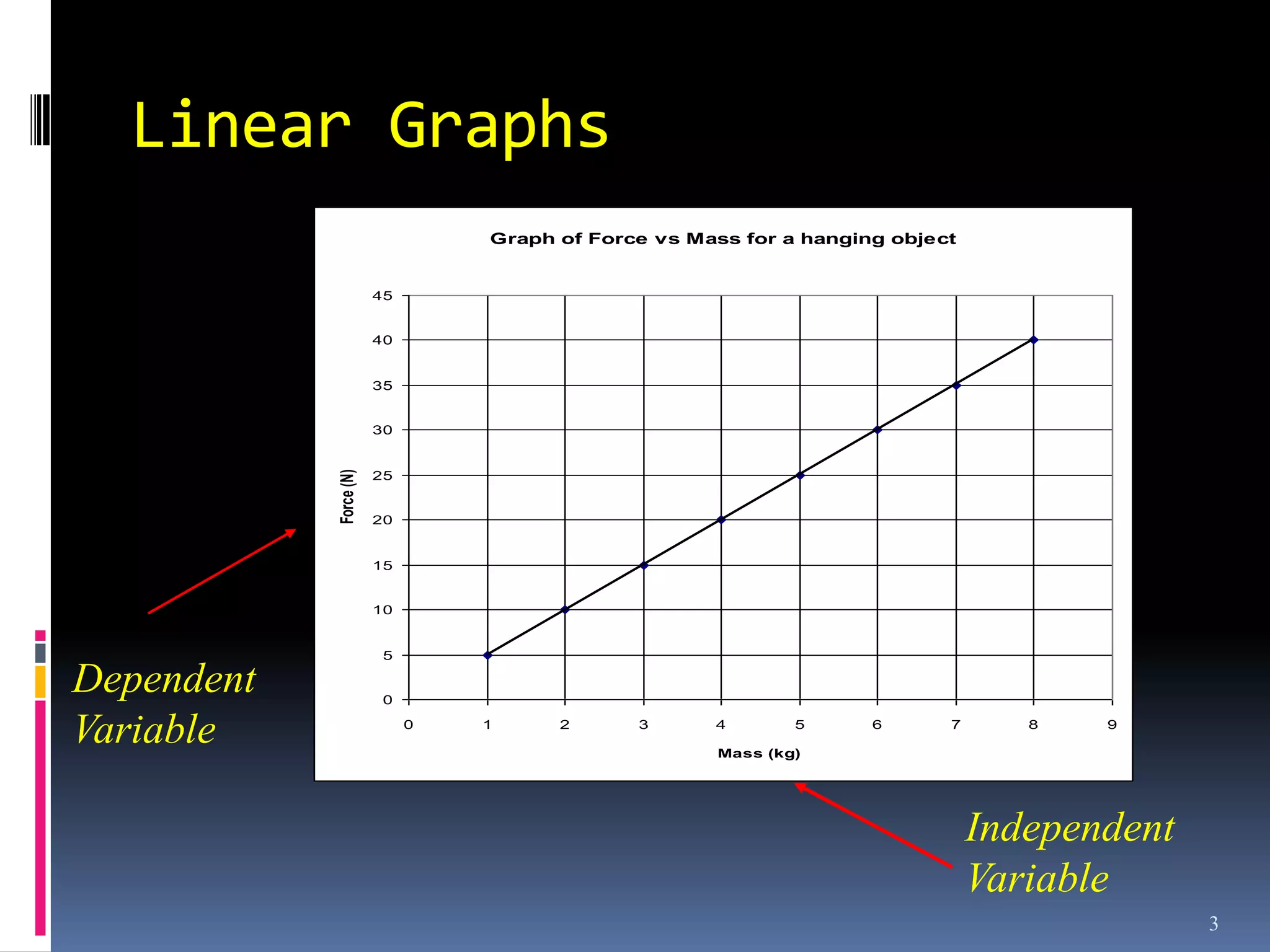
Graphing data shows if a relationship exists
between two quantities also called variables.
If two variables show a linear relationship they
are directly proportional to each other.


 Examine the following graph:


                                                   2
Linear Graphs
                                 Graph of Force vs Mass for a hanging object


                        45


                        40


                        35


                        30
            Force (N)


                        25


                        20


                        15


                        10


                         5

Dependent                0


Variable                     0   1     2      3      4       5

                                                     Mass (kg)
                                                                    6      7      8   9


                                                                               Independent
                                                                               Variable
                                                                                             3
Linear Graphs – Slope of a Line


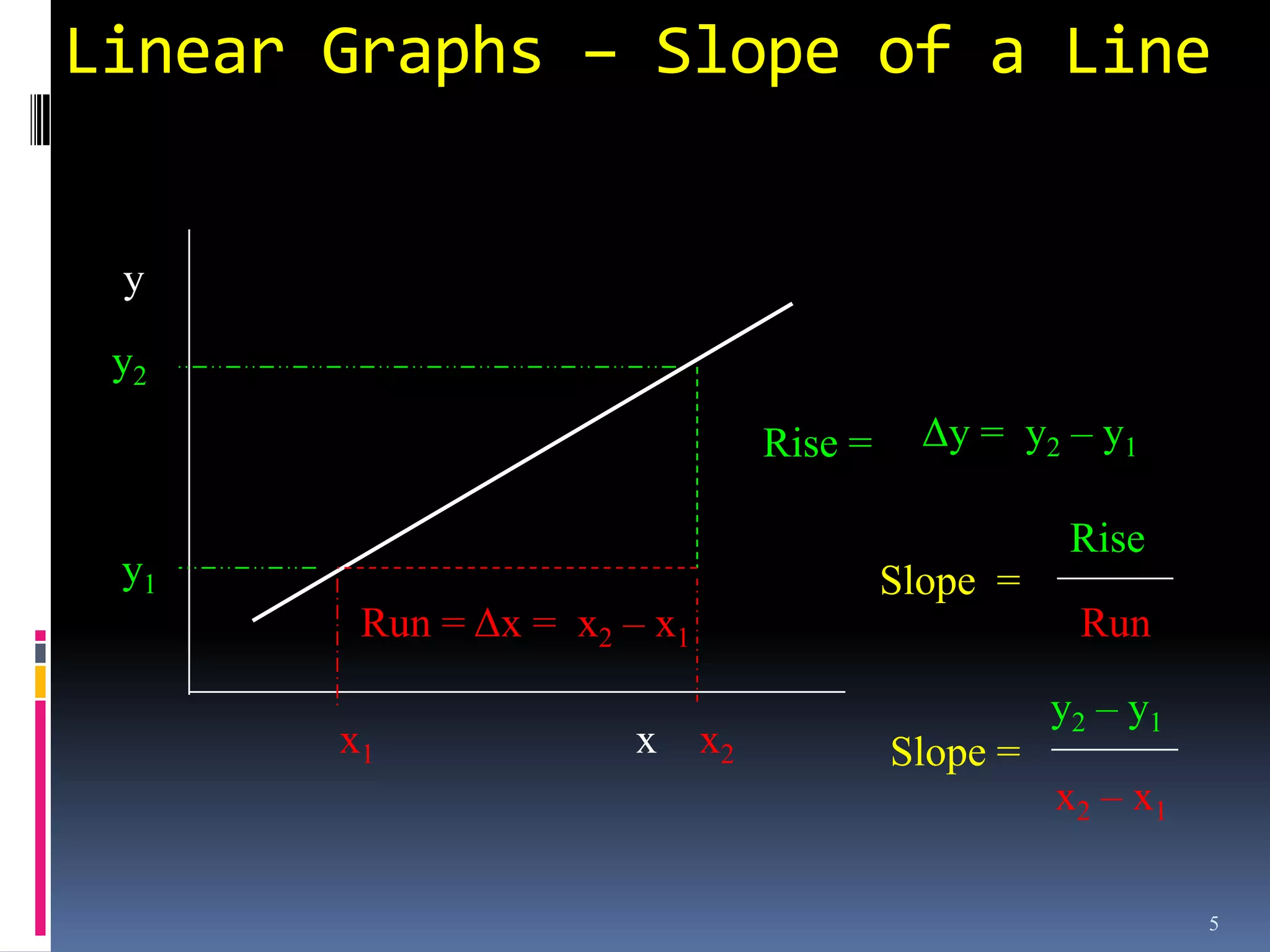
The slope of a line is a ratio between the
change in the y-value and the change in
the x- value.

This ratio tells whether the two quantities
are related mathematically.

Calculating the slope of a line is easy!

                                              4
Linear Graphs – Slope of a Line


 y
 y2
                                  Rise =     Δy = y2 – y1

                                                      Rise
 y1                                        Slope =
        Run = Δx = x2 – x1                            Run

                                                     y2 – y1
       x1              x     x2            Slope =
                                                     x2 – x1

                                                               5
Linear Graphs – Equation of a Line

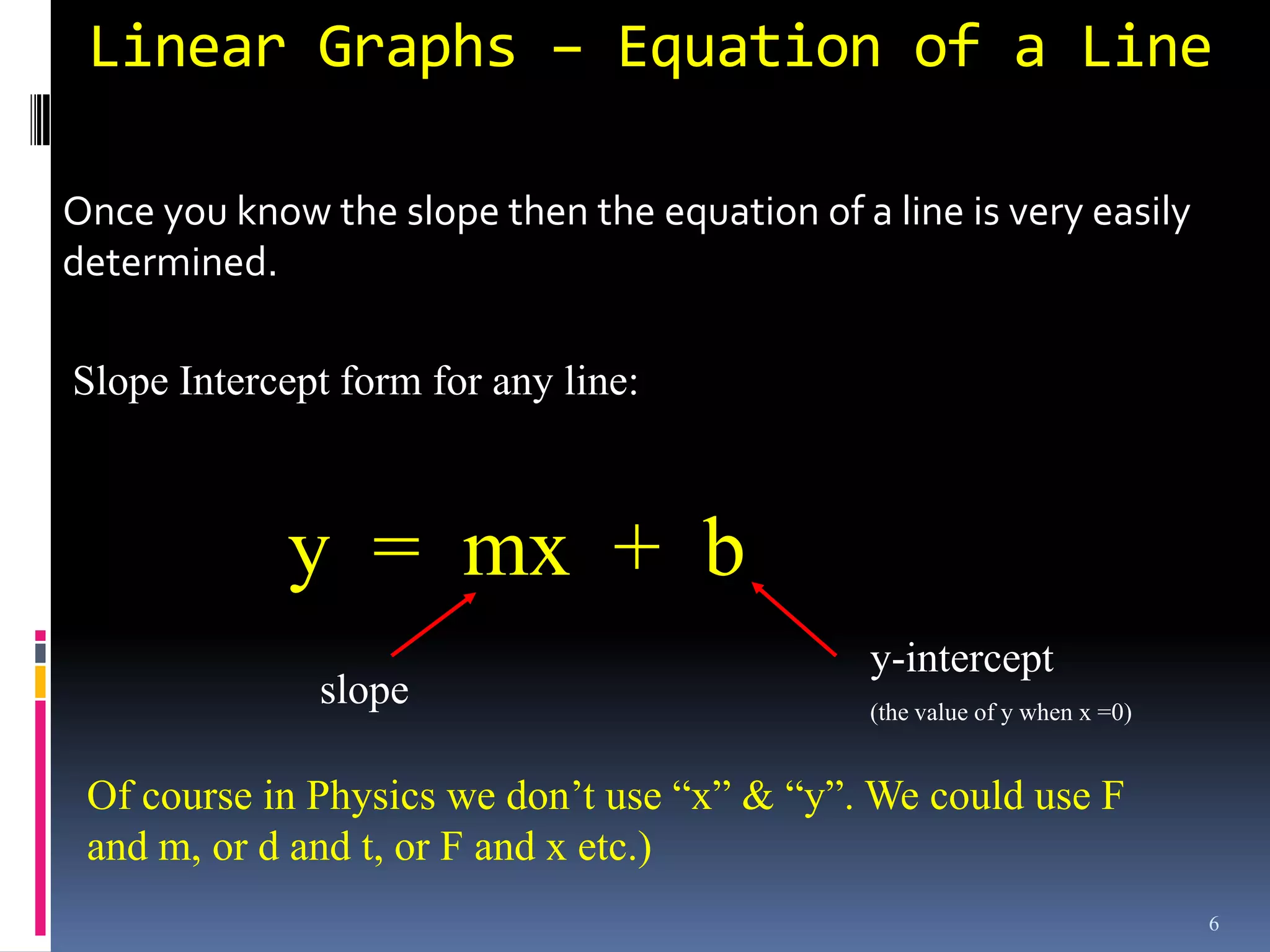
Once you know the slope then the equation of a line is very easily
determined.

Slope Intercept form for any line:


             y = mx + b
                                               y-intercept
               slope                           (the value of y when x =0)


 Of course in Physics we don’t use “x” & “y”. We could use F
 and m, or d and t, or F and x etc.)
                                                                            6
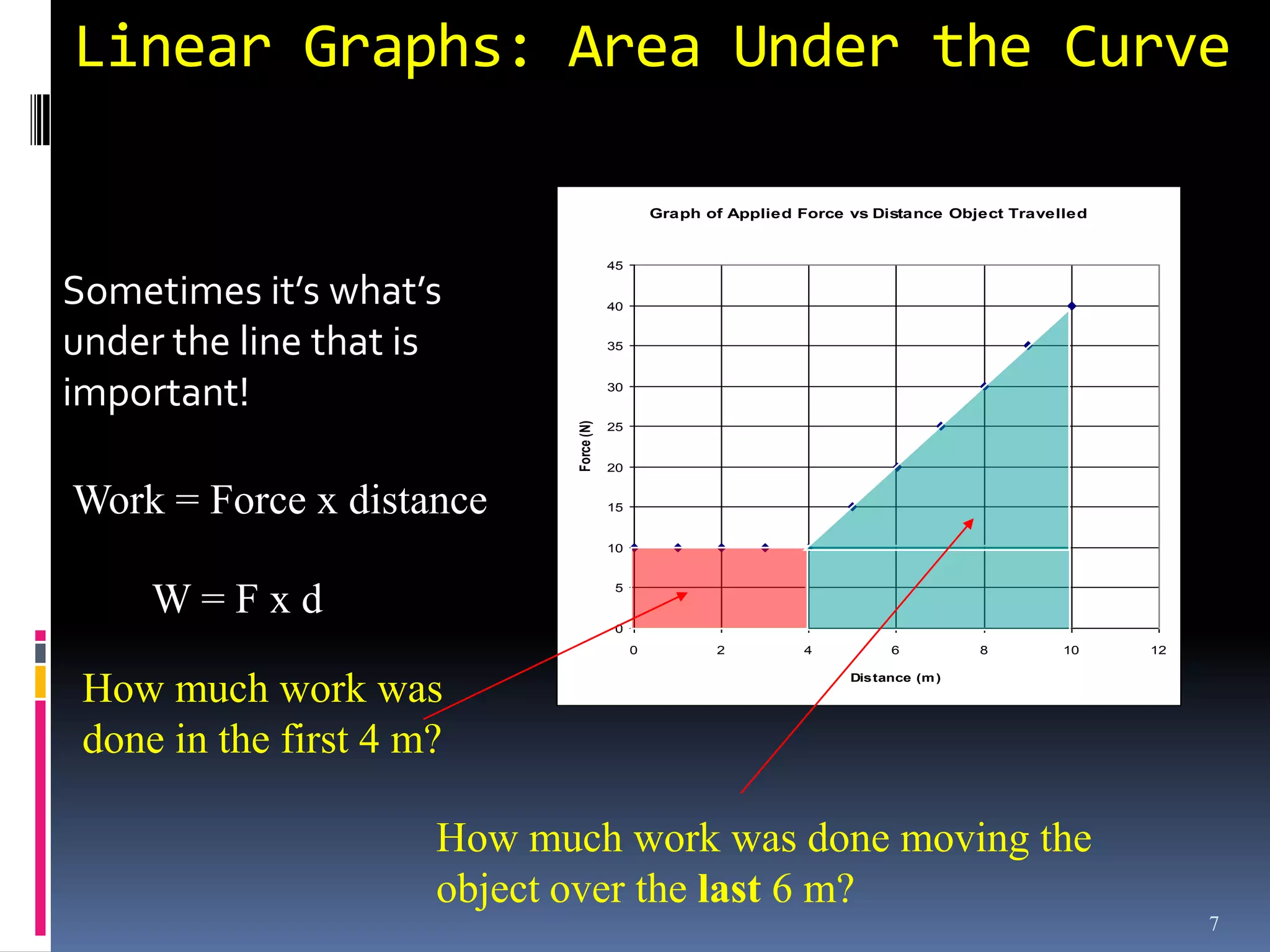
Linear Graphs: Area Under the Curve

                                                  Graph of Applied Force vs Distance Object Travelled


                                         45

Sometimes it’s what’s                    40


under the line that is                   35


important!                               30


                             Force (N)
                                         25


                                         20


Work = Force x distance                  15


                                         10


     W=Fxd                               5


                                         0
                                              0          2          4         6          8        10    12


 How much work was                                                       Distance (m )


 done in the first 4 m?

                      How much work was done moving the
                      object over the last 6 m?
                                                                                                             7
Non Linear Relationships

 Not all relationships between variables are linear.
 Some are curves which show a squared or square
 root relationship


In this course we use simple techniques to
“straighten the curve” into linear relationship.


                                                        8
Non Linear Relationships

                                                      60
     60


     50                                               50


     40                                               40


                                                  y
     30                                               30
 y


     20                                               20


     10                                               10


     0                                                0
          0   1     2   3   4   5   6   7   8              0   10   20      30       40   50   60
                            x                                            x-squared


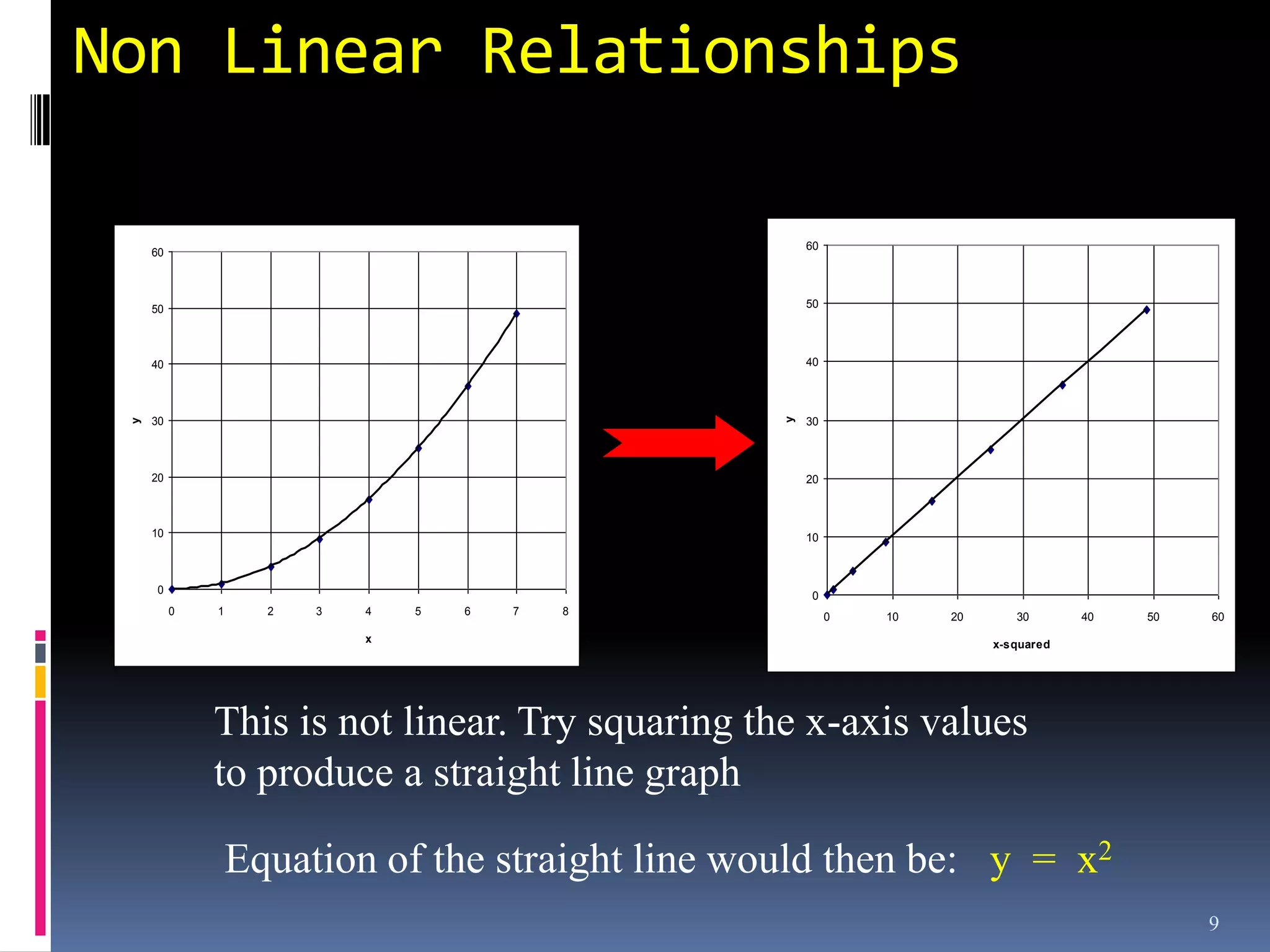
              This is not linear. Try squaring the x-axis values
              to produce a straight line graph

                  Equation of the straight line would then be: y = x2
                                                                                               9
Non Linear Relationships
     1.2                                                   1.2


      1                                                     1


     0.8                                                   0.8


                                                           0.6


                                                       y
 y


     0.6


     0.4                                                   0.4


     0.2                                                   0.2


      0                                                     0

           0   1    2   3   4   5   6   7   8                    0   0.2   0.4   0.6   0.8   1   1.2

                            x                                                    1/x


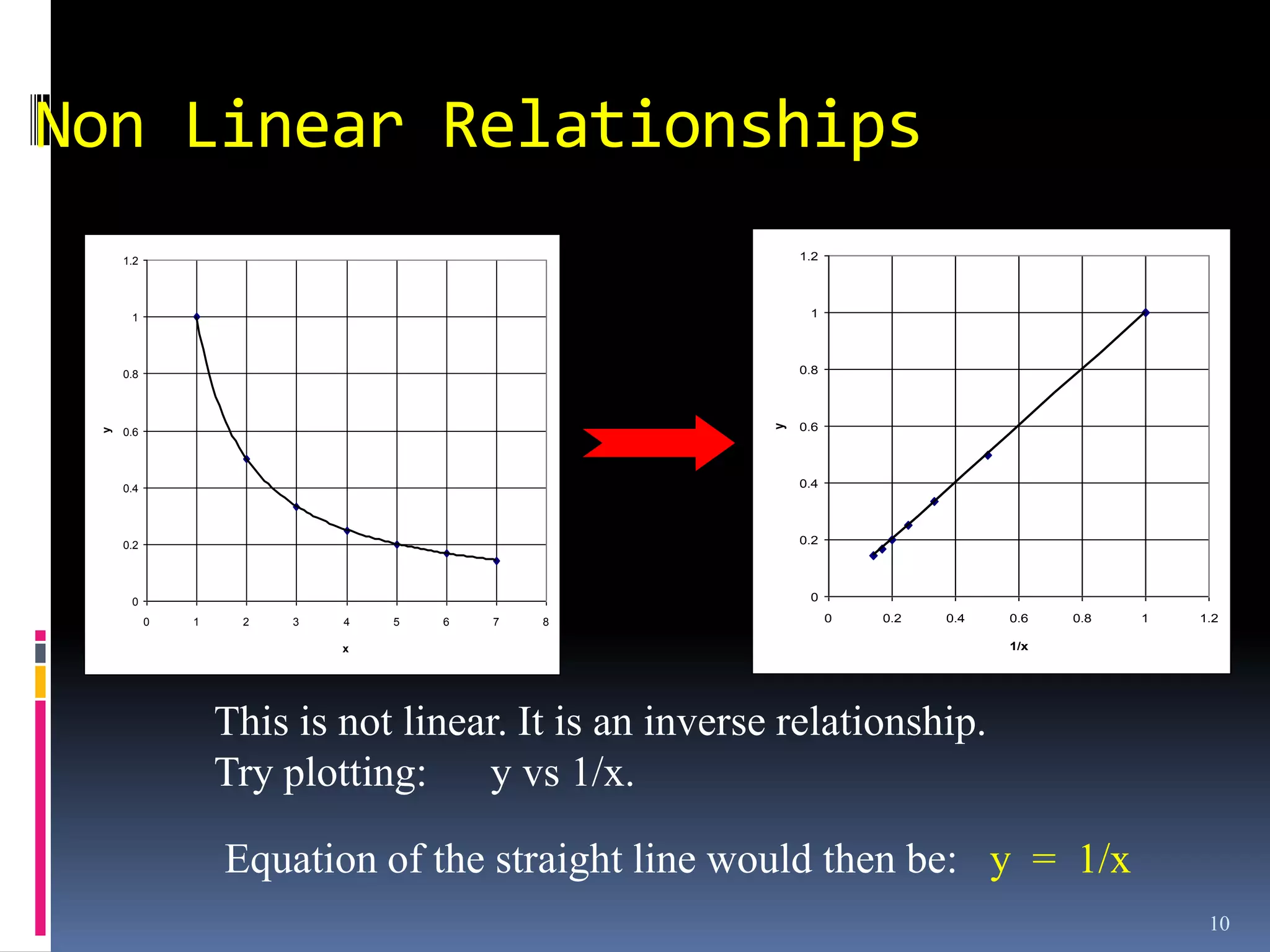
                   This is not linear. It is an inverse relationship.
                   Try plotting: y vs 1/x.

                   Equation of the straight line would then be: y = 1/x
                                                                                                  10
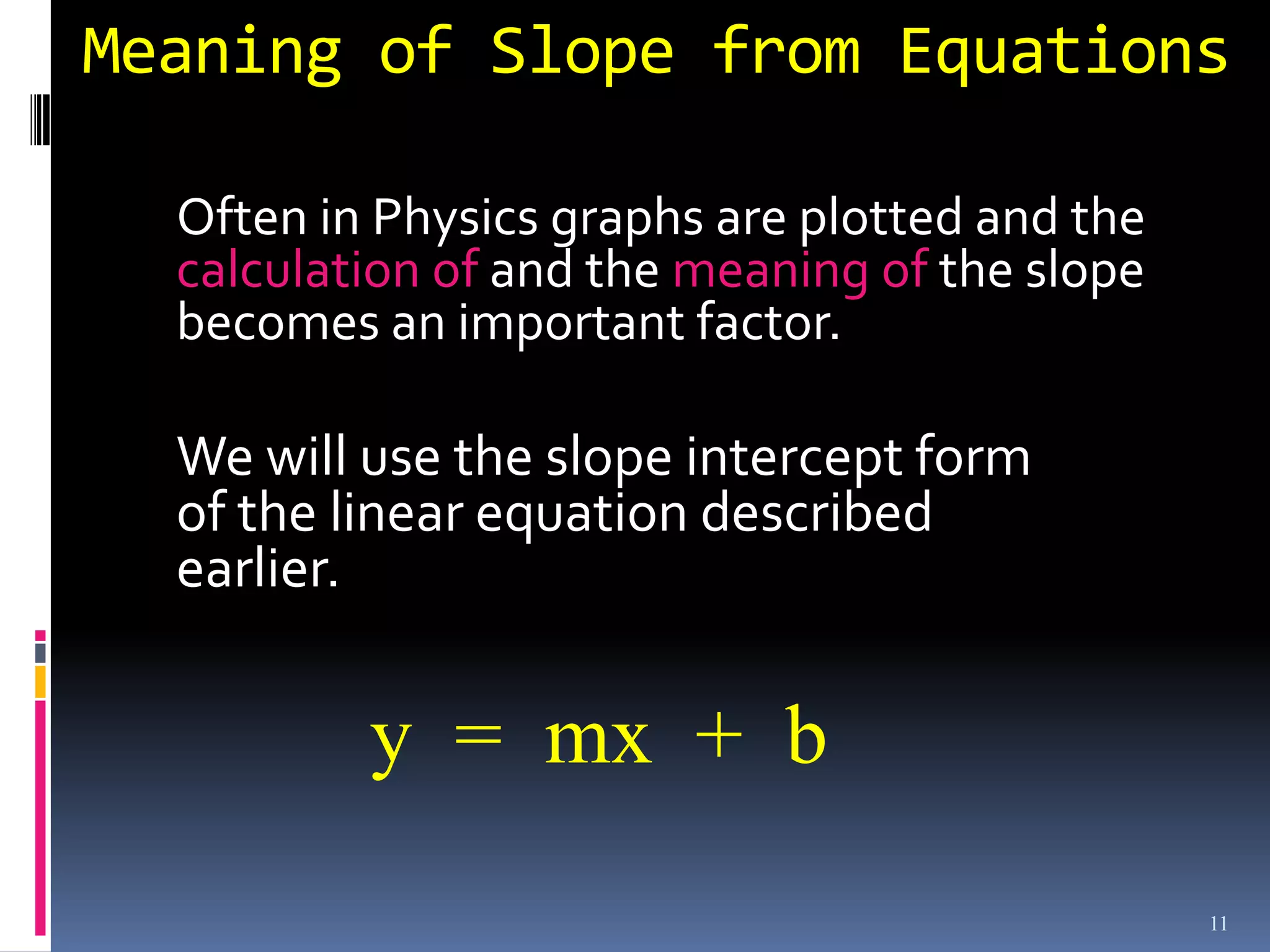
Meaning of Slope from Equations

  Often in Physics graphs are plotted and the
  calculation of and the meaning of the slope
  becomes an important factor.

  We will use the slope intercept form
  of the linear equation described
  earlier.


          y = mx + b
                                                11
Meaning of Slope from Equations
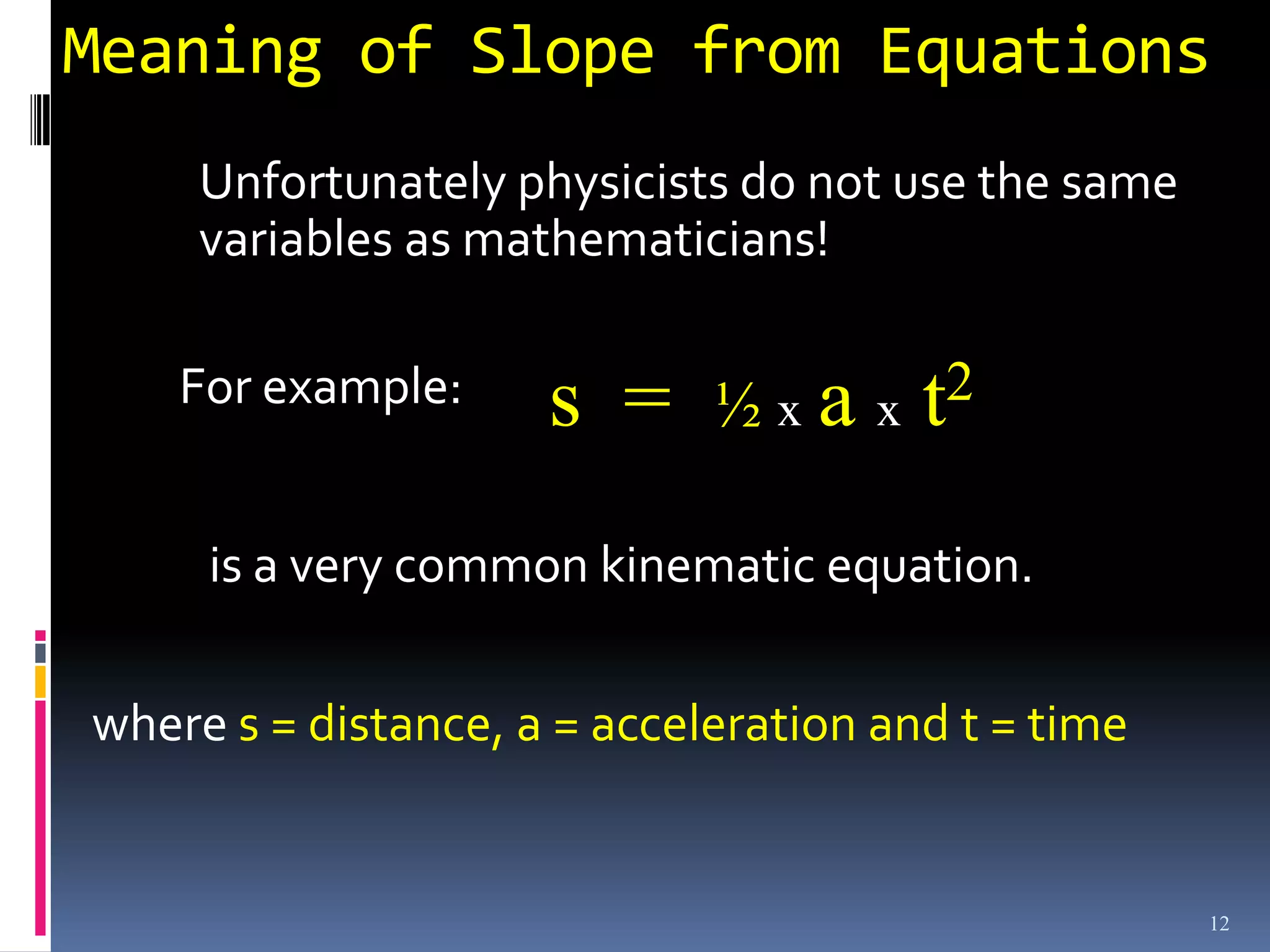
     Unfortunately physicists do not use the same
     variables as mathematicians!

    For example:     s =     ½xa     x t
                                        2


     is a very common kinematic equation.

where s = distance, a = acceleration and t = time


                                                    12
Meaning of Slope from Equations
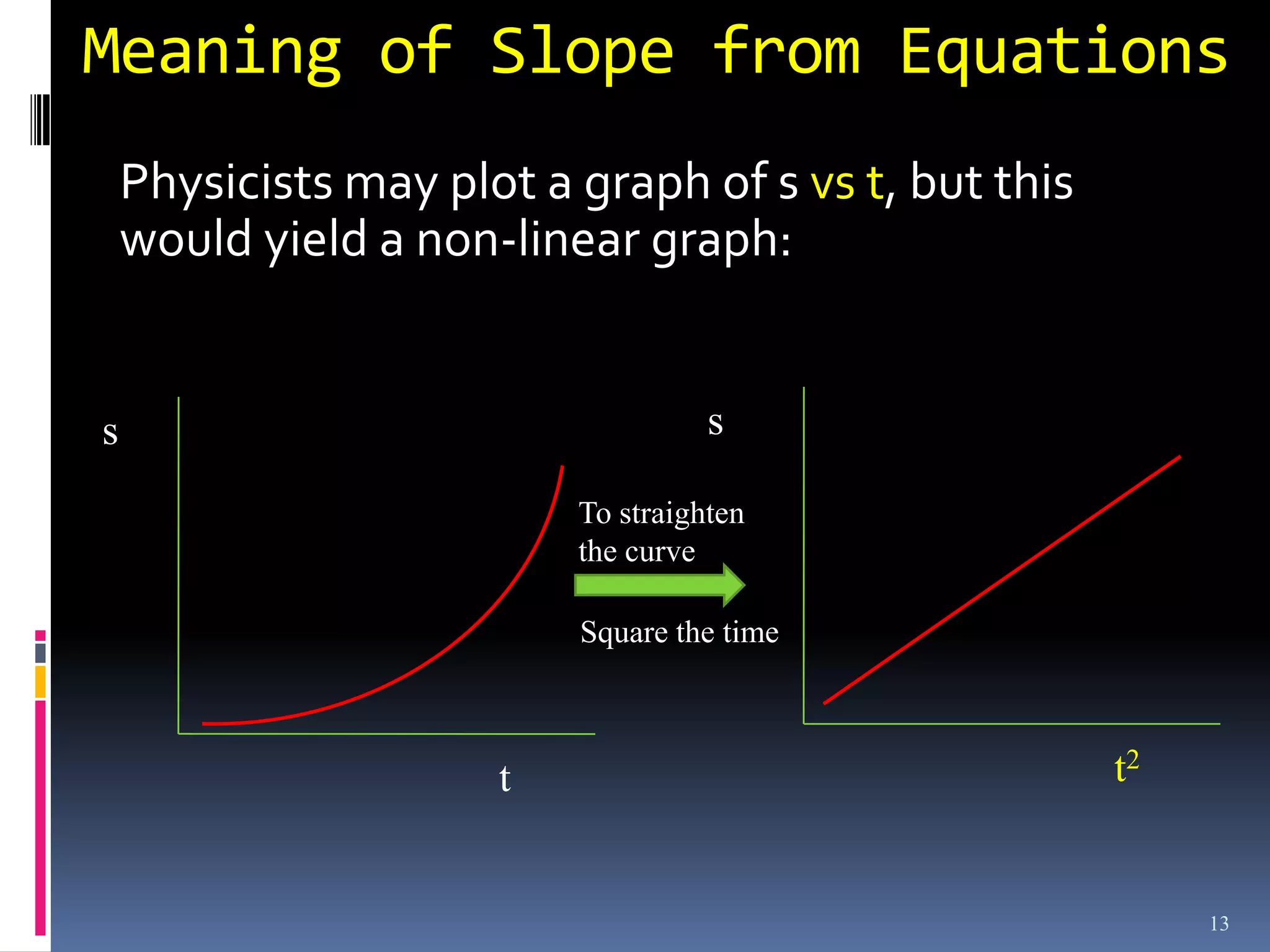
    Physicists may plot a graph of s vs t, but this
    would yield a non-linear graph:


s                                   s

                          To straighten
                          the curve

                          Square the time


                      t                               t2


                                                           13
Meaning of Slope from Equations

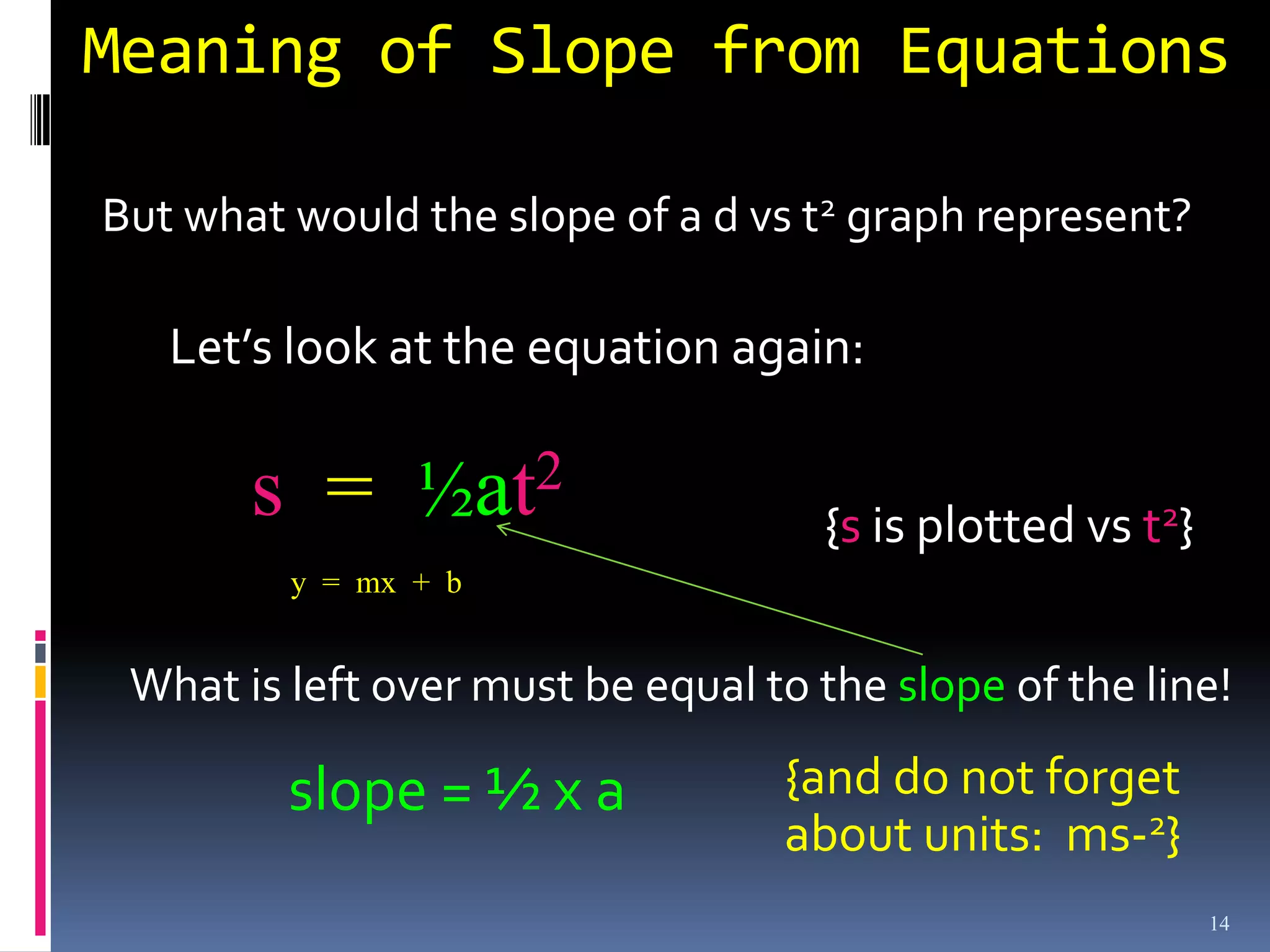
But what would the slope of a d vs t2 graph represent?

   Let’s look at the equation again:

       s = ½at2                     {s is plotted vs t2}
         y = mx + b


 What is left over must be equal to the slope of the line!

         slope = ½ x a            {and do not forget
                                  about units: ms-2}
                                                           14
Meaning of Slope from Equations
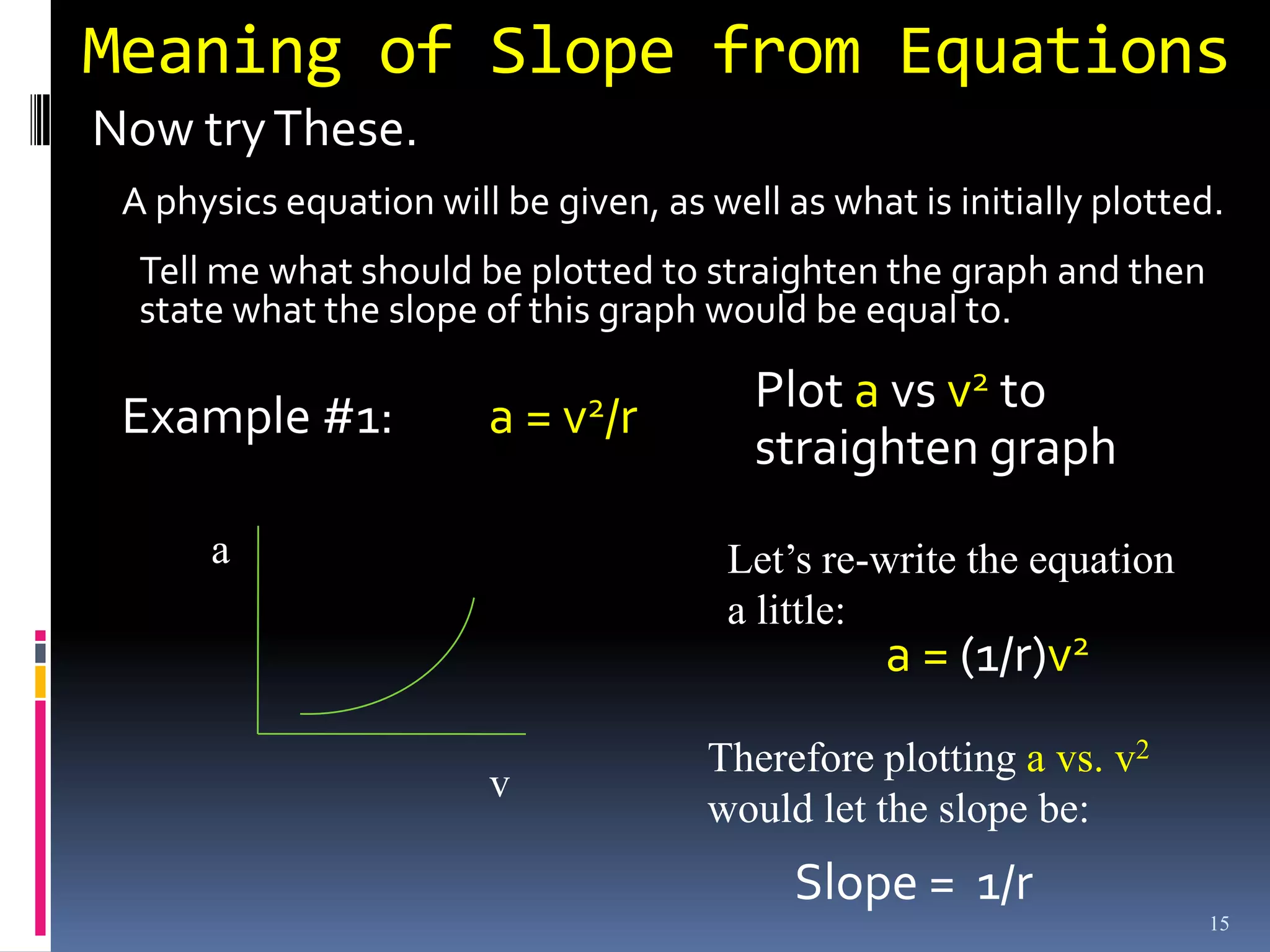
Now try These.
 A physics equation will be given, as well as what is initially plotted.
  Tell me what should be plotted to straighten the graph and then
  state what the slope of this graph would be equal to.

 Example #1:            a = v2/r         Plot a vs v2 to
                                         straighten graph
      a                                Let’s re-write the equation
                                       a little:
                                                  a = (1/r)v2
                                      Therefore plotting a vs. v2
                        v
                                      would let the slope be:
                                            Slope = 1/r
                                                                       15
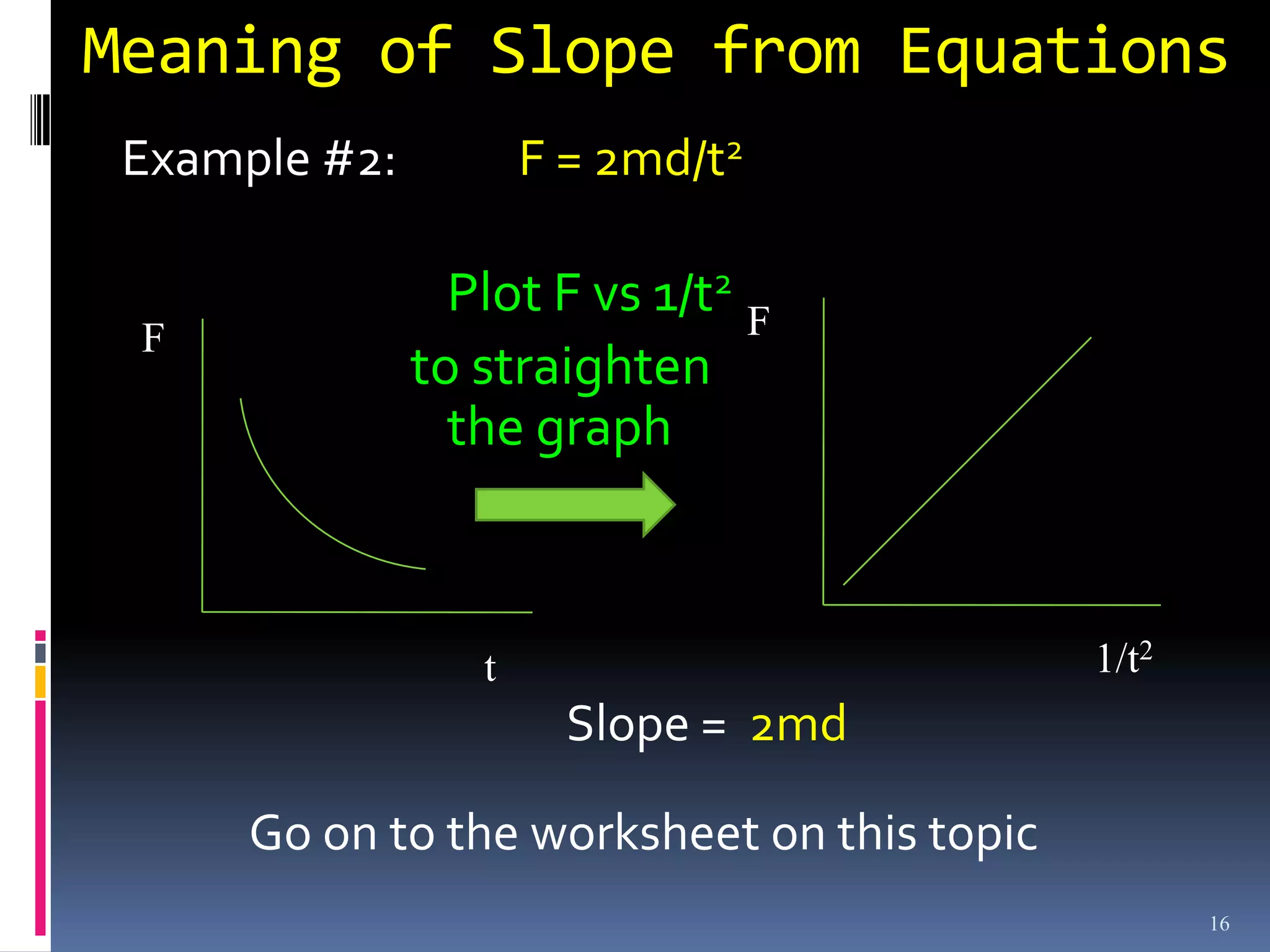
Meaning of Slope from Equations
 Example #2:          F = 2md/t2

                 Plot F vs 1/t2 F
 F
               to straighten
                 the graph


                  t                          1/t2
                        Slope = 2md

      Go on to the worksheet on this topic
                                                    16
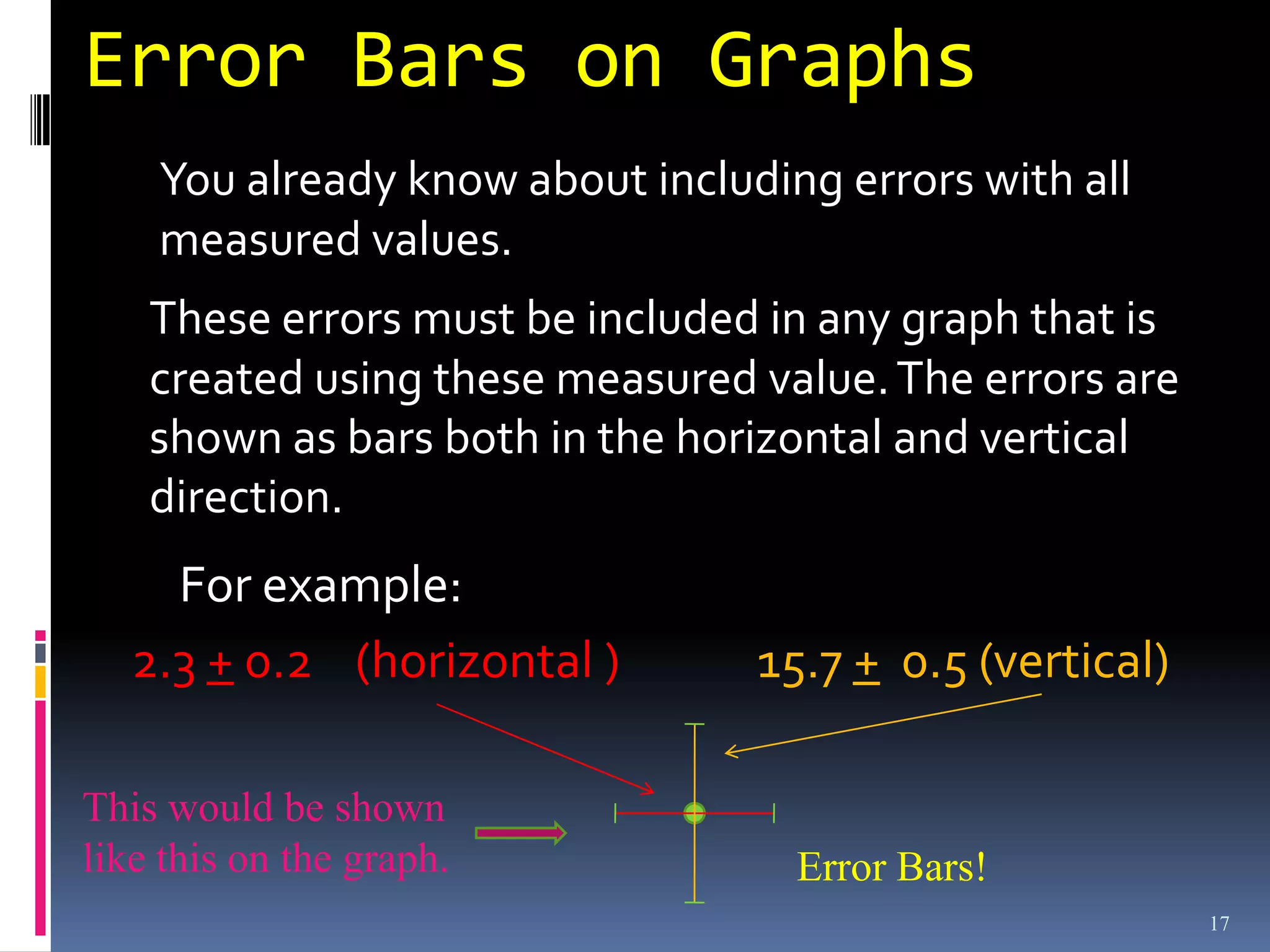
Error Bars on Graphs
    You already know about including errors with all
    measured values.
    These errors must be included in any graph that is
    created using these measured value. The errors are
    shown as bars both in the horizontal and vertical
    direction.
     For example:
   2.3 + 0.2 (horizontal )       15.7 + 0.5 (vertical)

This would be shown
like this on the graph.            Error Bars!
                                                         17
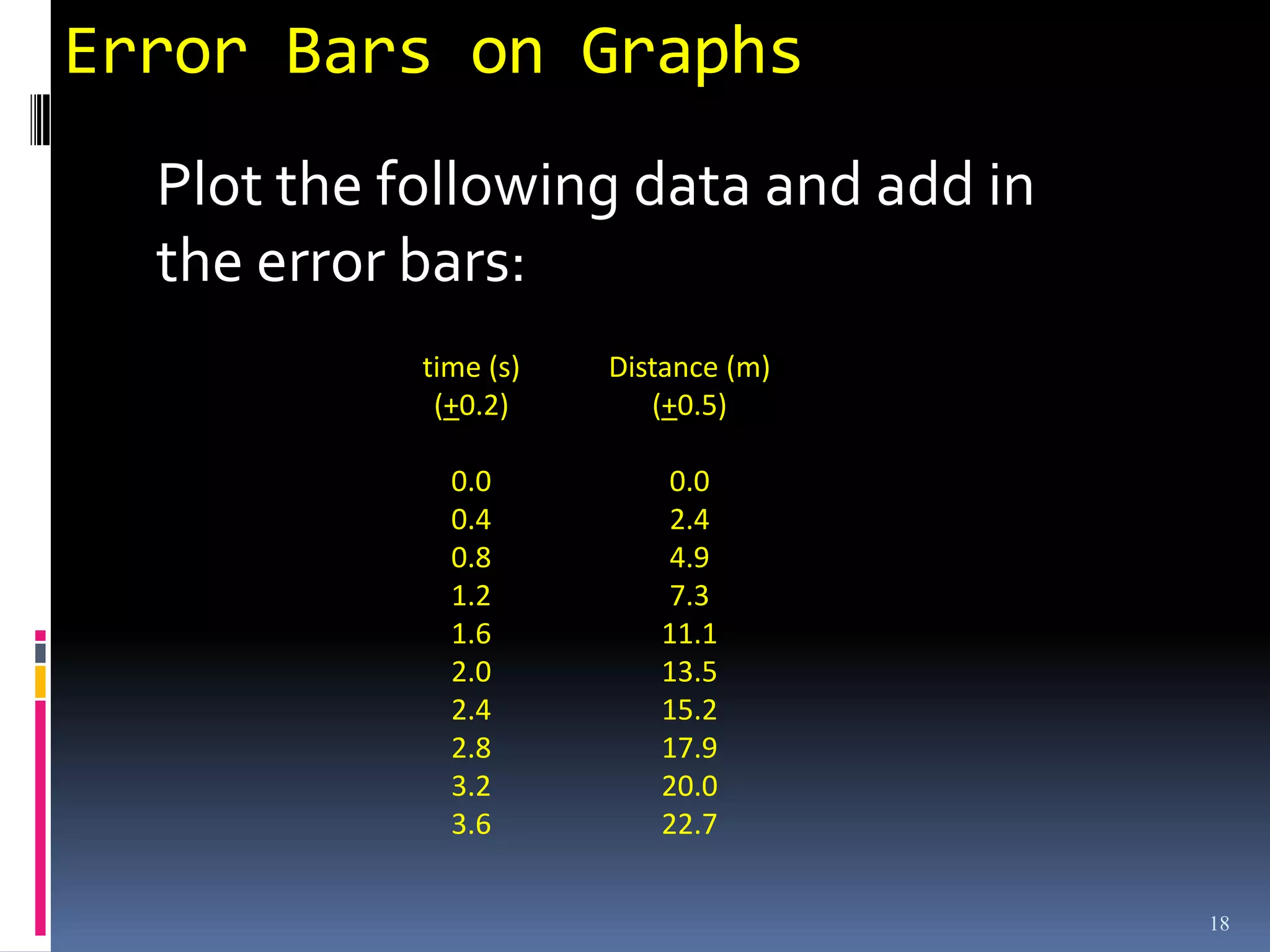
Error Bars on Graphs
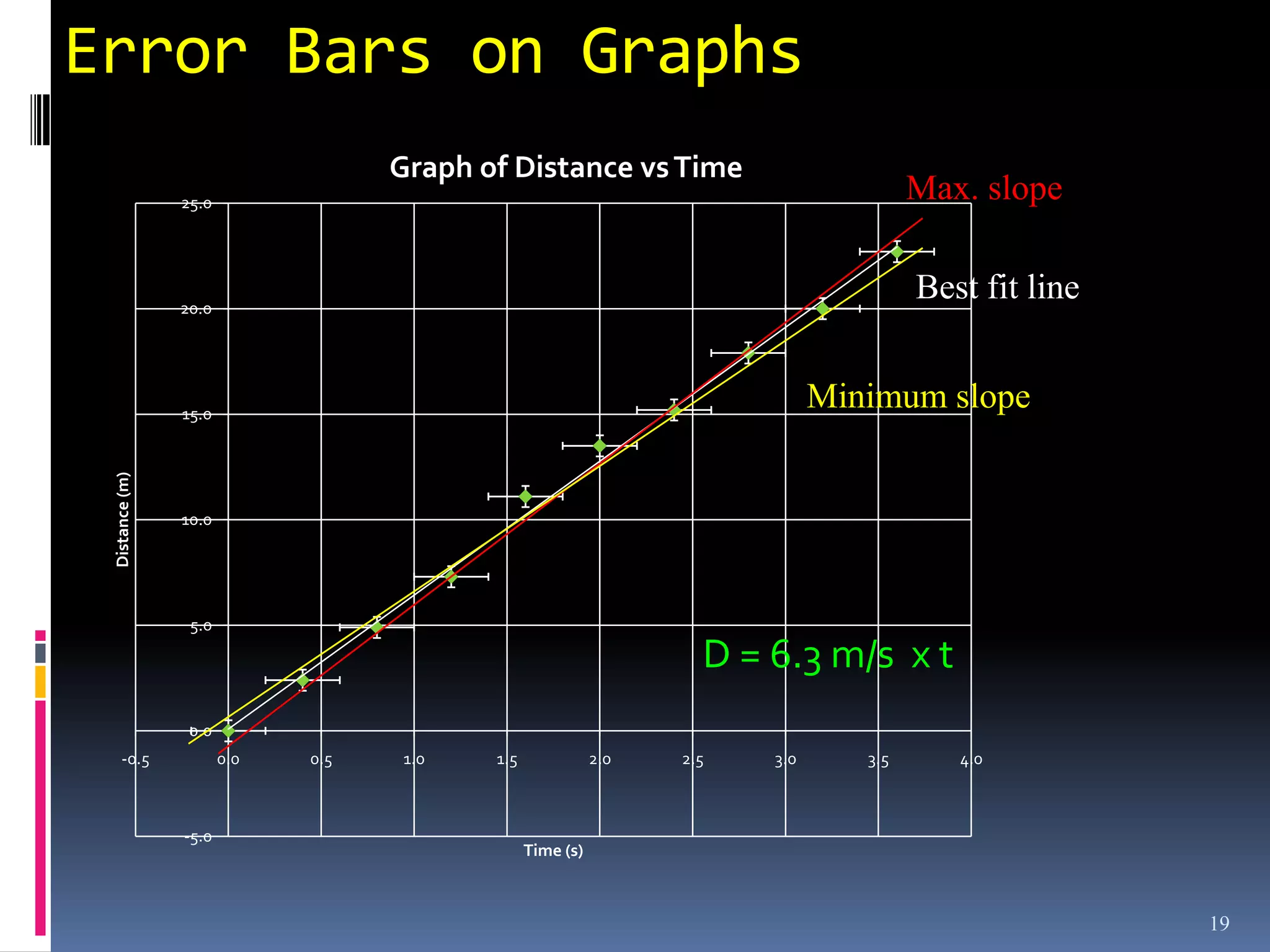
  Plot the following data and add in
  the error bars:
            time (s)   Distance (m)
             (+0.2)       (+0.5)

              0.0         0.0
              0.4         2.4
              0.8         4.9
              1.2         7.3
              1.6         11.1
              2.0         13.5
              2.4         15.2
              2.8         17.9
              3.2         20.0
              3.6         22.7


                                       18
Error Bars on Graphs
                                   Graph of Distance vs Time
                25.0
                                                                                      Max. slope


                20.0
                                                                                      Best fit line


                15.0
                                                                             Minimum slope
 Distance (m)


                10.0


                 5.0

                                                                   D = 6.3 m/s x t
                 0.0
     -0.5              0.0   0.5   1.0    1.5              2.0   2.5   3.0      3.5      4.0


                -5.0
                                                Time (s)


                                                                                                      19

Graphs in physics

  • 1.
  • 2.
    Linear Graphs Graphing datashows if a relationship exists between two quantities also called variables. If two variables show a linear relationship they are directly proportional to each other. Examine the following graph: 2
  • 3.
    Linear Graphs Graph of Force vs Mass for a hanging object 45 40 35 30 Force (N) 25 20 15 10 5 Dependent 0 Variable 0 1 2 3 4 5 Mass (kg) 6 7 8 9 Independent Variable 3
  • 4.
    Linear Graphs –Slope of a Line The slope of a line is a ratio between the change in the y-value and the change in the x- value. This ratio tells whether the two quantities are related mathematically. Calculating the slope of a line is easy! 4
  • 5.
    Linear Graphs –Slope of a Line y y2 Rise = Δy = y2 – y1 Rise y1 Slope = Run = Δx = x2 – x1 Run y2 – y1 x1 x x2 Slope = x2 – x1 5
  • 6.
    Linear Graphs –Equation of a Line Once you know the slope then the equation of a line is very easily determined. Slope Intercept form for any line: y = mx + b y-intercept slope (the value of y when x =0) Of course in Physics we don’t use “x” & “y”. We could use F and m, or d and t, or F and x etc.) 6
  • 7.
    Linear Graphs: AreaUnder the Curve Graph of Applied Force vs Distance Object Travelled 45 Sometimes it’s what’s 40 under the line that is 35 important! 30 Force (N) 25 20 Work = Force x distance 15 10 W=Fxd 5 0 0 2 4 6 8 10 12 How much work was Distance (m ) done in the first 4 m? How much work was done moving the object over the last 6 m? 7
  • 8.
    Non Linear Relationships Not all relationships between variables are linear.  Some are curves which show a squared or square root relationship In this course we use simple techniques to “straighten the curve” into linear relationship. 8
  • 9.
    Non Linear Relationships 60 60 50 50 40 40 y 30 30 y 20 20 10 10 0 0 0 1 2 3 4 5 6 7 8 0 10 20 30 40 50 60 x x-squared This is not linear. Try squaring the x-axis values to produce a straight line graph Equation of the straight line would then be: y = x2 9
  • 10.
    Non Linear Relationships 1.2 1.2 1 1 0.8 0.8 0.6 y y 0.6 0.4 0.4 0.2 0.2 0 0 0 1 2 3 4 5 6 7 8 0 0.2 0.4 0.6 0.8 1 1.2 x 1/x This is not linear. It is an inverse relationship. Try plotting: y vs 1/x. Equation of the straight line would then be: y = 1/x 10
  • 11.
    Meaning of Slopefrom Equations Often in Physics graphs are plotted and the calculation of and the meaning of the slope becomes an important factor. We will use the slope intercept form of the linear equation described earlier. y = mx + b 11
  • 12.
    Meaning of Slopefrom Equations Unfortunately physicists do not use the same variables as mathematicians! For example: s = ½xa x t 2 is a very common kinematic equation. where s = distance, a = acceleration and t = time 12
  • 13.
    Meaning of Slopefrom Equations Physicists may plot a graph of s vs t, but this would yield a non-linear graph: s s To straighten the curve Square the time t t2 13
  • 14.
    Meaning of Slopefrom Equations But what would the slope of a d vs t2 graph represent? Let’s look at the equation again: s = ½at2 {s is plotted vs t2} y = mx + b What is left over must be equal to the slope of the line! slope = ½ x a {and do not forget about units: ms-2} 14
  • 15.
    Meaning of Slopefrom Equations Now try These. A physics equation will be given, as well as what is initially plotted. Tell me what should be plotted to straighten the graph and then state what the slope of this graph would be equal to. Example #1: a = v2/r Plot a vs v2 to straighten graph a Let’s re-write the equation a little: a = (1/r)v2 Therefore plotting a vs. v2 v would let the slope be: Slope = 1/r 15
  • 16.
    Meaning of Slopefrom Equations Example #2: F = 2md/t2 Plot F vs 1/t2 F F to straighten the graph t 1/t2 Slope = 2md Go on to the worksheet on this topic 16
  • 17.
    Error Bars onGraphs You already know about including errors with all measured values. These errors must be included in any graph that is created using these measured value. The errors are shown as bars both in the horizontal and vertical direction. For example: 2.3 + 0.2 (horizontal ) 15.7 + 0.5 (vertical) This would be shown like this on the graph. Error Bars! 17
  • 18.
    Error Bars onGraphs Plot the following data and add in the error bars: time (s) Distance (m) (+0.2) (+0.5) 0.0 0.0 0.4 2.4 0.8 4.9 1.2 7.3 1.6 11.1 2.0 13.5 2.4 15.2 2.8 17.9 3.2 20.0 3.6 22.7 18
  • 19.
    Error Bars onGraphs Graph of Distance vs Time 25.0 Max. slope 20.0 Best fit line 15.0 Minimum slope Distance (m) 10.0 5.0 D = 6.3 m/s x t 0.0 -0.5 0.0 0.5 1.0 1.5 2.0 2.5 3.0 3.5 4.0 -5.0 Time (s) 19