Shape Contexts

Newton Petersen
4/25/2008

    "Shape Matching and Object
 Recognition Using Shape Contexts",
   Belongie et al. PAMI April 2002
Agenda
 Study Matlab code for computing shape
  context
 Look at limitations of descriptor
 Explore effect of noise
 Explore rotation invariance
 Explore effect of locality
 Explore Thin Plate Spline

                 "Shape Matching and Object
              Recognition Using Shape Contexts",
                Belongie et al. PAMI April 2002
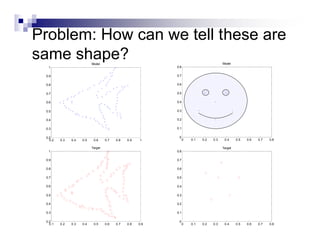
Problem: How can we tell these are
same shape?                Model                                                        Model
  1                                                         0.8

 0.9                                                        0.7

 0.8                                                        0.6

 0.7                                                        0.5

 0.6                                                        0.4

 0.5                                                        0.3

 0.4                                                        0.2

 0.3                                                        0.1


 0.2                                                         0
   0.2   0.3   0.4   0.5    0.6     0.7   0.8   0.9   1           0   0.1   0.2   0.3    0.4     0.5   0.6   0.7   0.8

                           Target                                                       Target
  1                                                         0.8

 0.9                                                        0.7

 0.8                                                        0.6

 0.7                                                        0.5

 0.6                                                        0.4

 0.5                                                        0.3

 0.4                                                        0.2

 0.3                                                        0.1

 0.2                                                         0
   0.1   0.2   0.3   0.4    0.5     0.6   0.7   0.8   0.9         0   0.1   0.2   0.3    0.4     0.5   0.6   0.7   0.8
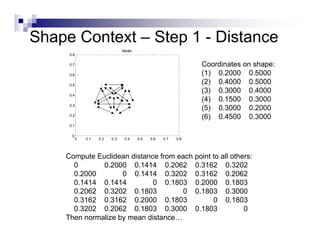
Shape Context – Step 1 - Distance
                                 Model
     0.8

     0.7                                                         Coordinates on shape:
     0.6                                                         (1) 0.2000 0.5000
     0.5
                                                                 (2) 0.4000 0.5000
                                                                 (3) 0.3000 0.4000
     0.4
                                                                 (4) 0.1500 0.3000
     0.3
                                                                 (5) 0.3000 0.2000
     0.2
                                                                 (6) 0.4500 0.3000
     0.1

      0
           0   0.1   0.2   0.3    0.4    0.5   0.6   0.7   0.8


    Compute Euclidean distance from each point to all others:
      0       0.2000 0.1414 0.2062 0.3162 0.3202
      0.2000        0 0.1414 0.3202 0.3162 0.2062
      0.1414 0.1414          0 0.1803 0.2000 0.1803
      0.2062 0.3202 0.1803           0 0.1803 0.3000
      0.3162 0.3162 0.2000 0.1803              0 0.1803
      0.3202 0.2062 0.1803 0.3000 0.1803                  0
    Then normalize by mean distance…
Shape Context – Step 2 – Bin
Distances
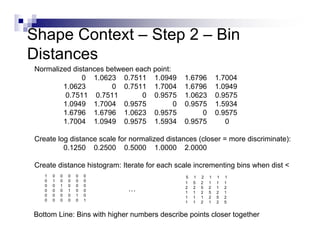
Normalized distances between each point:
              0 1.0623 0.7511 1.0949          1.6796           1.7004
        1.0623         0 0.7511 1.7004        1.6796           1.0949
         0.7511 0.7511         0 0.9575       1.0623           0.9575
        1.0949 1.7004 0.9575             0    0.9575           1.5934
        1.6796 1.6796 1.0623 0.9575                0           0.9575
        1.7004 1.0949 0.9575 1.5934           0.9575              0

Create log distance scale for normalized distances (closer = more discriminate):
         0.1250 0.2500 0.5000 1.0000 2.0000

Create distance histogram: Iterate for each scale incrementing bins when dist <
   1   0   0   0   0   0                       5   1   2   1   1   1
   0   1   0   0   0   0                       1   5   2   1   1   1
   0   0   1   0   0   0
   0   0   0   1   0   0     …                 2
                                               1
                                                   2
                                                   1
                                                       5
                                                       2
                                                           2
                                                           5
                                                               1
                                                               2
                                                                   2
                                                                   1
   0   0   0   0   1   0                       1   1   1   2   5   2
   0   0   0   0   0   1                       1   1   2   1   2   5


Bottom Line: Bins with higher numbers describe points closer together
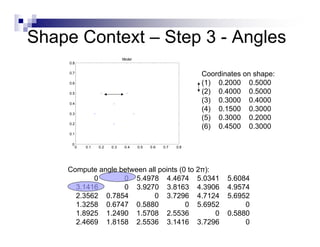
Shape Context – Step 3 - Angles
                                 Model
     0.8

     0.7
                                                                 Coordinates on shape:
     0.6                                                         (1) 0.2000 0.5000
     0.5                                                         (2) 0.4000 0.5000
     0.4
                                                                 (3) 0.3000 0.4000
                                                                 (4) 0.1500 0.3000
     0.3
                                                                 (5) 0.3000 0.2000
     0.2
                                                                 (6) 0.4500 0.3000
     0.1

      0
           0   0.1   0.2   0.3    0.4    0.5   0.6   0.7   0.8


    Compute angle between all points (0 to 2π):
           0       0 5.4978 4.4674 5.0341                               5.6084
      3.1416       0 3.9270 3.8163 4.3906                               4.9574
      2.3562 0.7854         0 3.7296 4.7124                             5.6952
      1.3258 0.6747 0.5880             0 5.6952                              0
      1.8925 1.2490 1.5708 2.5536               0                       0.5880
      2.4669 1.8158 2.5536 3.1416 3.7296                                     0
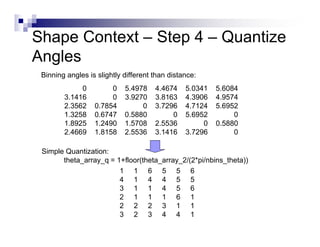
Shape Context – Step 4 – Quantize
Angles
 Binning angles is slightly different than distance:
             0         0    5.4978    4.4674    5.0341   5.6084
        3.1416         0    3.9270    3.8163    4.3906   4.9574
        2.3562    0.7854         0    3.7296    4.7124   5.6952
        1.3258    0.6747    0.5880         0    5.6952        0
        1.8925    1.2490    1.5708    2.5536         0   0.5880
        2.4669    1.8158    2.5536    3.1416    3.7296        0

 Simple Quantization:
       theta_array_q = 1+floor(theta_array_2/(2*pi/nbins_theta))
                        1 1 6 5 5 6
                        4 1 4 4 5 5
                        3 1 1 4 5 6
                        2 1 1 1 6 1
                        2 2 2 3 1 1
                        3 2 3 4 4 1
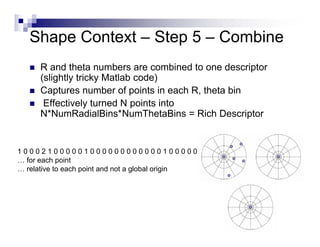
Shape Context – Step 5 – Combine
      R and theta numbers are combined to one descriptor
       (slightly tricky Matlab code)
      Captures number of points in each R, theta bin
       Effectively turned N points into
       N*NumRadialBins*NumThetaBins = Rich Descriptor


100021000001000000000000100000
… for each point
… relative to each point and not a global origin
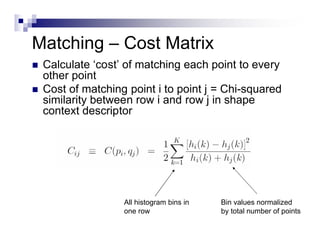
Matching – Cost Matrix
   Calculate ‘cost’ of matching each point to every
    other point
   Cost of matching point i to point j = Chi-squared
    similarity between row i and row j in shape
    context descriptor


                    All histogram bins in   Bin values normalized
                    one row                 by total number of points
Matching – Additional Cost Terms
 Easy to add in other terms
 For ‘real’ images, possible to add in other
  measures of difference between point i
  and j
     Surrounding Color Difference
     Surrounding Texture Difference
     Surrounding Brightness Difference
     Tangent Angle Difference


                       "Shape Matching and Object
                    Recognition Using Shape Contexts",
                      Belongie et al. PAMI April 2002
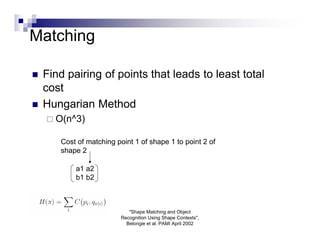
Matching

   Find pairing of points that leads to least total
    cost
   Hungarian Method
     O(n^3)

       Cost of matching point 1 of shape 1 to point 2 of
       shape 2

           a1 a2
           b1 b2


                             "Shape Matching and Object
                          Recognition Using Shape Contexts",
                            Belongie et al. PAMI April 2002
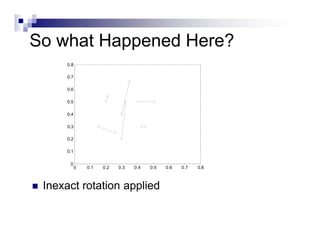
So what Happened Here?
         0.8

         0.7

         0.6

         0.5

         0.4

         0.3

         0.2

         0.1

          0
               0   0.1   0.2   0.3   0.4   0.5   0.6   0.7   0.8


   Inexact rotation applied
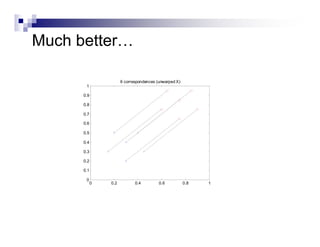
Much better…

                      6 correspondences (unwarped X)
       1

      0.9

      0.8

      0.7

      0.6

      0.5

      0.4

      0.3

      0.2

      0.1

       0
            0   0.2          0.4         0.6           0.8   1
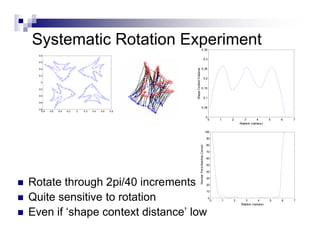
Systematic Rotation Experiment                                                               0.35
      0.8
                                                                                                                0.3
      0.6

      0.4                                                                                        0.25


                                                                 Shape Context Distance
      0.2
                                                                                                                0.2
        0

      -0.2                                                                                       0.15

      -0.4
                                                                                                                0.1
      -0.6

                                                                                                 0.05
      -0.8
         -0.8   -0.6   -0.4   -0.2   0   0.2   0.4   0.6   0.8

                                                                                                                    0
                                                                                                                        0       1       2      3          4       5   6   7
                                                                                                                                            Rotation (radians)

                                                                                                                    100

                                                                                                                     90

                                                                                                                     80


                                                                                     Number Point Matches Correct
                                                                                                                     70

                                                                                                                     60

                                                                                                                     50

                                                                                                                     40


    Rotate through 2pi/40 increments
                                                                                                                     30

                                                                                                                    20

                                                                                                                     10

   Quite sensitive to rotation                                                                                         0
                                                                                                                            0       1   2       3          4
                                                                                                                                             Rotation (radians)
                                                                                                                                                                  5   6   7


   Even if ‘shape context distance’ low
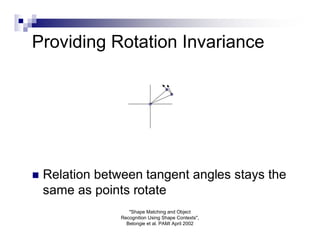
Providing Rotation Invariance


   Relation between tangent angles stays the
    same as points rotate
                    "Shape Matching and Object
                 Recognition Using Shape Contexts",
                   Belongie et al. PAMI April 2002
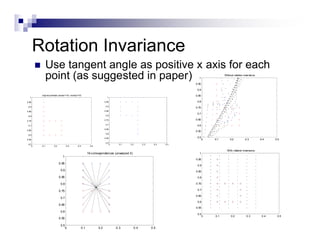
Rotation Invariance
                    Use tangent angle as positive x axis for each
                     point (as suggested in paper)                                                                            1
                                                                                                                                             Without rotation invariance


                                                                                                                            0.95

                                                                                                                             0.9

               original pointsets (nsamp1=16, nsamp2=16)                                                                    0.85
  1                                                                             1

0.95                                                                          0.95                                           0.8
 0.9                                                                           0.9
                                                                                                                            0.75
0.85                                                                          0.85
                                                                                                                             0.7
 0.8                                                                           0.8

0.75                                                                          0.75                                          0.65
                                                                               0.7                                           0.6
 0.7
                                                                              0.65
0.65                                                                                                                        0.55
                                                                               0.6
 0.6
                                                                              0.55                                           0.5
0.55                                                                                                                               0   0.1       0.2           0.3         0.4    0.5
                                                                               0.5
 0.5                                                                                 0     0.1   0.2     0.3    0.4   0.5
       0       0.1         0.2          0.3         0.4           0.5

                                                                                                                                               With rotation invariance
                                                                16 correspondences (unwarped X)                                1
                                    1
                                                                                                                            0.95
                                 0.95
                                                                                                                             0.9
                                  0.9                                                                                       0.85

                                 0.85                                                                                        0.8

                                  0.8                                                                                       0.75

                                 0.75                                                                                        0.7

                                                                                                                            0.65
                                  0.7
                                                                                                                             0.6
                                 0.65
                                                                                                                            0.55
                                  0.6
                                                                                                                             0.5
                                                                                                                                   0   0.1        0.2           0.3         0.4    0.5
                                 0.55

                                  0.5
                                        0                 0.1           0.2              0.3       0.4         0.5
Rotation Invariance

 Do you really want 6 and 9 matched?
 Depends on the shape…


                 "Shape Matching and Object
              Recognition Using Shape Contexts",
                Belongie et al. PAMI April 2002
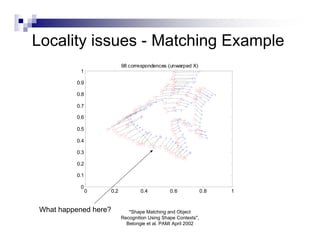
Locality issues - Matching Example
                         98 correspondences (unwarped X)
          1

         0.9

         0.8

         0.7

         0.6

         0.5

         0.4

         0.3

         0.2

         0.1

          0
               0   0.2           0.4          0.6             0.8   1


What happened here?         "Shape Matching and Object
                         Recognition Using Shape Contexts",
                           Belongie et al. PAMI April 2002
What could produce ‘incorrect’
descriptors?
   As we just saw,
      Rotation that puts points in different relative bins
      Different numbers of points in different regions of
       shapes
   Any important distinction that ends up in the same bin is
    effectively lost
      Chance of happening increases with distance
   Conversely any nearby feature relation that is
    unimportant is granted a distinction in the descriptor


                         "Shape Matching and Object
                      Recognition Using Shape Contexts",
                        Belongie et al. PAMI April 2002
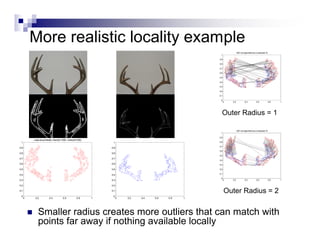
More realistic locality example
                                                                                                                      250 correspondences (unwarped X)
                                                                                                       1

                                                                                                      0.9

                                                                                                      0.8

                                                                                                      0.7

                                                                                                      0.6

                                                                                                      0.5

                                                                                                      0.4

                                                                                                      0.3

                                                                                                      0.2

                                                                                                      0.1

                                                                                                       0
                                                                                                            0   0.2           0.4         0.6            0.8   1


                                                                                                        Outer Radius = 1

                                                                                                                      250 correspondences (unwarped X)
                                                                                                       1

                                                                                                      0.9
              original pointsets (nsamp1=250, nsamp2=250)
 1                                                               1                                    0.8

                                                                                                      0.7
0.9                                                             0.9
                                                                                                      0.6
0.8                                                             0.8
                                                                                                      0.5
0.7                                                             0.7
                                                                                                      0.4
0.6                                                             0.6                                   0.3

0.5                                                             0.5                                   0.2

                                                                                                      0.1
0.4                                                             0.4
                                                                                                       0
0.3                                                             0.3                                         0   0.2           0.4         0.6            0.8   1

0.2                                                             0.2

0.1                                                             0.1
                                                                                                            Outer Radius = 2
 0                                                               0
      0        0.2         0.4          0.6         0.8     1         0   0.2   0.4   0.6   0.8   1


                Smaller radius creates more outliers that can match with
                 points far away if nothing available locally
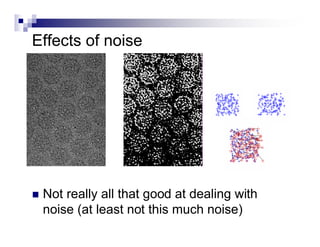
Effects of noise


   Not really all that good at dealing with
    noise (at least not this much noise)
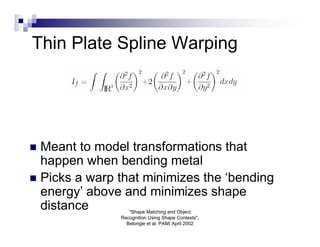
Thin Plate Spline Warping


 Meant to model transformations that
  happen when bending metal
 Picks a warp that minimizes the ‘bending
  energy’ above and minimizes shape
  distance        "Shape Matching and Object
               Recognition Using Shape Contexts",
                 Belongie et al. PAMI April 2002
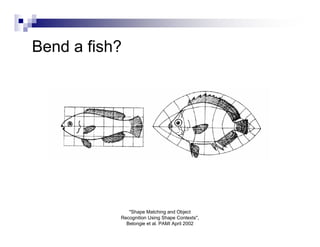
Bend a fish?


              "Shape Matching and Object
           Recognition Using Shape Contexts",
             Belongie et al. PAMI April 2002
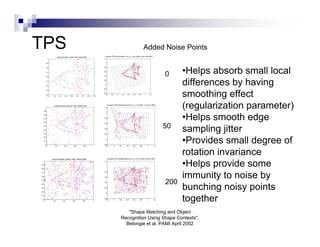
TPS                          original pointsets (nsamp1=98, nsamp2=98)
                                                                                                                                                 Added Noise Points
                                                                                      recovered TPS transformation (k=5,o=1, I=0.014625, error=0.0016206)
                                                                                                                              f
                  1                                                                  1.2

              0.9                                                                      1


                                                                                                                                                                           •Helps absorb small local
              0.8                                                                    0.8


                                                                                                                                                                     0
              0.7                                                                    0.6

                                                                                     0.4
              0.6

              0.5

              0.4
                                                                                     0.2

                                                                                       0

                                                                                     -0.2
                                                                                                                                                                           differences by having
                                                                                                                                                                           smoothing effect
              0.3
                                                                                     -0.4
              0.2                                                                       -0.4     -0.2       0         0.2    0.4   0.6   0.8     1       1.2
                0.1    0.2      0.3     0.4    0.5         0.6   0.7     0.8   0.9


  0.9
          1
                        original pointsets (nsamp1=148, nsamp2=148)
                                                                                      1.2
                                                                                            recovered TPS transformation (k=5,o =1, I=0.36361, error=0.21063)
                                                                                                                                     f
                                                                                                                                                                           (regularization parameter)
                                                                                                                                                                           •Helps smooth edge
                                                                                        1
  0.8

  0.7                                                                                 0.8

  0.6


                                                                                                                                                                     50
                                                                                      0.6


                                                                                                                                                                           sampling jitter
  0.5
                                                                                      0.4
  0.4

  0.3                                                                                 0.2


                                                                                                                                                                           •Provides small degree of
  0.2
                                                                                        0
  0.1

          0                                                                          -0.2
              0          0.2           0.4            0.6          0.8         1       -0.2             0       0.2         0.4    0.6     0.8       1         1.2


                                                                                            recovered TPS transformation (k=5, o=1, I=0.33138, error=0.3767)
                                                                                                                                                                           rotation invariance
                                                                                                                                                                           •Helps provide some
                      original pointsets (nsamp1=298, nsamp2=298)                                                                    f
 1                                                                                    1.2

0.9
                                                                                        1
0.8


                                                                                                                                                                           immunity to noise by
0.7                                                                                   0.8

0.6                                                                                   0.6
0.5
                                                                                                                                                                     200
                                                                                                                                                                           bunching noisy points
                                                                                      0.4
0.4

0.3                                                                                   0.2

0.2
                                                                                        0


                                                                                                                                                                           together
0.1
                                                                                     -0.2
 0                                                                                     -0.2             0       0.2         0.4    0.6     0.8       1         1.2
      0                0.2            0.4            0.6          0.8          1


                                                                                                                    "Shape Matching and Object
                                                                                                                 Recognition Using Shape Contexts",
                                                                                                                   Belongie et al. PAMI April 2002
Conclusion
 Shape context => binning of spatial
  relationships between points
 Good for ‘clean’ shapes
     Examples from paper => handwriting,
      trademarks
   Struggles with clutter noise
     Thin   Plate Spline helps quite a bit


                        "Shape Matching and Object
                     Recognition Using Shape Contexts",
                       Belongie et al. PAMI April 2002
Discussion

   How does this compare to other descriptors?
   What would work better with Maysam’s viruses?
   Any ideas for making descriptor know what
    geometrical relationships are most important?
    (like active appearance models)
   Any ideas for improving runtime


                     "Shape Matching and Object
                  Recognition Using Shape Contexts",
                    Belongie et al. PAMI April 2002

Shape contexts

  • 1.
    Shape Contexts Newton Petersen 4/25/2008 "Shape Matching and Object Recognition Using Shape Contexts", Belongie et al. PAMI April 2002
  • 2.
    Agenda  Study Matlabcode for computing shape context  Look at limitations of descriptor  Explore effect of noise  Explore rotation invariance  Explore effect of locality  Explore Thin Plate Spline "Shape Matching and Object Recognition Using Shape Contexts", Belongie et al. PAMI April 2002
  • 3.
    Problem: How canwe tell these are same shape? Model Model 1 0.8 0.9 0.7 0.8 0.6 0.7 0.5 0.6 0.4 0.5 0.3 0.4 0.2 0.3 0.1 0.2 0 0.2 0.3 0.4 0.5 0.6 0.7 0.8 0.9 1 0 0.1 0.2 0.3 0.4 0.5 0.6 0.7 0.8 Target Target 1 0.8 0.9 0.7 0.8 0.6 0.7 0.5 0.6 0.4 0.5 0.3 0.4 0.2 0.3 0.1 0.2 0 0.1 0.2 0.3 0.4 0.5 0.6 0.7 0.8 0.9 0 0.1 0.2 0.3 0.4 0.5 0.6 0.7 0.8
  • 4.
    Shape Context –Step 1 - Distance Model 0.8 0.7 Coordinates on shape: 0.6 (1) 0.2000 0.5000 0.5 (2) 0.4000 0.5000 (3) 0.3000 0.4000 0.4 (4) 0.1500 0.3000 0.3 (5) 0.3000 0.2000 0.2 (6) 0.4500 0.3000 0.1 0 0 0.1 0.2 0.3 0.4 0.5 0.6 0.7 0.8 Compute Euclidean distance from each point to all others: 0 0.2000 0.1414 0.2062 0.3162 0.3202 0.2000 0 0.1414 0.3202 0.3162 0.2062 0.1414 0.1414 0 0.1803 0.2000 0.1803 0.2062 0.3202 0.1803 0 0.1803 0.3000 0.3162 0.3162 0.2000 0.1803 0 0.1803 0.3202 0.2062 0.1803 0.3000 0.1803 0 Then normalize by mean distance…
  • 5.
    Shape Context –Step 2 – Bin Distances Normalized distances between each point: 0 1.0623 0.7511 1.0949 1.6796 1.7004 1.0623 0 0.7511 1.7004 1.6796 1.0949 0.7511 0.7511 0 0.9575 1.0623 0.9575 1.0949 1.7004 0.9575 0 0.9575 1.5934 1.6796 1.6796 1.0623 0.9575 0 0.9575 1.7004 1.0949 0.9575 1.5934 0.9575 0 Create log distance scale for normalized distances (closer = more discriminate): 0.1250 0.2500 0.5000 1.0000 2.0000 Create distance histogram: Iterate for each scale incrementing bins when dist < 1 0 0 0 0 0 5 1 2 1 1 1 0 1 0 0 0 0 1 5 2 1 1 1 0 0 1 0 0 0 0 0 0 1 0 0 … 2 1 2 1 5 2 2 5 1 2 2 1 0 0 0 0 1 0 1 1 1 2 5 2 0 0 0 0 0 1 1 1 2 1 2 5 Bottom Line: Bins with higher numbers describe points closer together
  • 6.
    Shape Context –Step 3 - Angles Model 0.8 0.7 Coordinates on shape: 0.6 (1) 0.2000 0.5000 0.5 (2) 0.4000 0.5000 0.4 (3) 0.3000 0.4000 (4) 0.1500 0.3000 0.3 (5) 0.3000 0.2000 0.2 (6) 0.4500 0.3000 0.1 0 0 0.1 0.2 0.3 0.4 0.5 0.6 0.7 0.8 Compute angle between all points (0 to 2π): 0 0 5.4978 4.4674 5.0341 5.6084 3.1416 0 3.9270 3.8163 4.3906 4.9574 2.3562 0.7854 0 3.7296 4.7124 5.6952 1.3258 0.6747 0.5880 0 5.6952 0 1.8925 1.2490 1.5708 2.5536 0 0.5880 2.4669 1.8158 2.5536 3.1416 3.7296 0
  • 7.
    Shape Context –Step 4 – Quantize Angles Binning angles is slightly different than distance: 0 0 5.4978 4.4674 5.0341 5.6084 3.1416 0 3.9270 3.8163 4.3906 4.9574 2.3562 0.7854 0 3.7296 4.7124 5.6952 1.3258 0.6747 0.5880 0 5.6952 0 1.8925 1.2490 1.5708 2.5536 0 0.5880 2.4669 1.8158 2.5536 3.1416 3.7296 0 Simple Quantization: theta_array_q = 1+floor(theta_array_2/(2*pi/nbins_theta)) 1 1 6 5 5 6 4 1 4 4 5 5 3 1 1 4 5 6 2 1 1 1 6 1 2 2 2 3 1 1 3 2 3 4 4 1
  • 8.
    Shape Context –Step 5 – Combine  R and theta numbers are combined to one descriptor (slightly tricky Matlab code)  Captures number of points in each R, theta bin  Effectively turned N points into N*NumRadialBins*NumThetaBins = Rich Descriptor 100021000001000000000000100000 … for each point … relative to each point and not a global origin
  • 9.
    Matching – CostMatrix  Calculate ‘cost’ of matching each point to every other point  Cost of matching point i to point j = Chi-squared similarity between row i and row j in shape context descriptor All histogram bins in Bin values normalized one row by total number of points
  • 10.
    Matching – AdditionalCost Terms  Easy to add in other terms  For ‘real’ images, possible to add in other measures of difference between point i and j  Surrounding Color Difference  Surrounding Texture Difference  Surrounding Brightness Difference  Tangent Angle Difference "Shape Matching and Object Recognition Using Shape Contexts", Belongie et al. PAMI April 2002
  • 11.
    Matching  Find pairing of points that leads to least total cost  Hungarian Method  O(n^3) Cost of matching point 1 of shape 1 to point 2 of shape 2 a1 a2 b1 b2 "Shape Matching and Object Recognition Using Shape Contexts", Belongie et al. PAMI April 2002
  • 12.
    So what HappenedHere? 0.8 0.7 0.6 0.5 0.4 0.3 0.2 0.1 0 0 0.1 0.2 0.3 0.4 0.5 0.6 0.7 0.8  Inexact rotation applied
  • 13.
    Much better… 6 correspondences (unwarped X) 1 0.9 0.8 0.7 0.6 0.5 0.4 0.3 0.2 0.1 0 0 0.2 0.4 0.6 0.8 1
  • 14.
    Systematic Rotation Experiment 0.35 0.8 0.3 0.6 0.4 0.25 Shape Context Distance 0.2 0.2 0 -0.2 0.15 -0.4 0.1 -0.6 0.05 -0.8 -0.8 -0.6 -0.4 -0.2 0 0.2 0.4 0.6 0.8 0 0 1 2 3 4 5 6 7 Rotation (radians) 100 90 80 Number Point Matches Correct 70 60 50 40 Rotate through 2pi/40 increments 30  20 10  Quite sensitive to rotation 0 0 1 2 3 4 Rotation (radians) 5 6 7  Even if ‘shape context distance’ low
  • 15.
    Providing Rotation Invariance  Relation between tangent angles stays the same as points rotate "Shape Matching and Object Recognition Using Shape Contexts", Belongie et al. PAMI April 2002
  • 16.
    Rotation Invariance  Use tangent angle as positive x axis for each point (as suggested in paper) 1 Without rotation invariance 0.95 0.9 original pointsets (nsamp1=16, nsamp2=16) 0.85 1 1 0.95 0.95 0.8 0.9 0.9 0.75 0.85 0.85 0.7 0.8 0.8 0.75 0.75 0.65 0.7 0.6 0.7 0.65 0.65 0.55 0.6 0.6 0.55 0.5 0.55 0 0.1 0.2 0.3 0.4 0.5 0.5 0.5 0 0.1 0.2 0.3 0.4 0.5 0 0.1 0.2 0.3 0.4 0.5 With rotation invariance 16 correspondences (unwarped X) 1 1 0.95 0.95 0.9 0.9 0.85 0.85 0.8 0.8 0.75 0.75 0.7 0.65 0.7 0.6 0.65 0.55 0.6 0.5 0 0.1 0.2 0.3 0.4 0.5 0.55 0.5 0 0.1 0.2 0.3 0.4 0.5
  • 17.
    Rotation Invariance  Doyou really want 6 and 9 matched?  Depends on the shape… "Shape Matching and Object Recognition Using Shape Contexts", Belongie et al. PAMI April 2002
  • 18.
    Locality issues -Matching Example 98 correspondences (unwarped X) 1 0.9 0.8 0.7 0.6 0.5 0.4 0.3 0.2 0.1 0 0 0.2 0.4 0.6 0.8 1 What happened here? "Shape Matching and Object Recognition Using Shape Contexts", Belongie et al. PAMI April 2002
  • 19.
    What could produce‘incorrect’ descriptors?  As we just saw,  Rotation that puts points in different relative bins  Different numbers of points in different regions of shapes  Any important distinction that ends up in the same bin is effectively lost  Chance of happening increases with distance  Conversely any nearby feature relation that is unimportant is granted a distinction in the descriptor "Shape Matching and Object Recognition Using Shape Contexts", Belongie et al. PAMI April 2002
  • 20.
    More realistic localityexample 250 correspondences (unwarped X) 1 0.9 0.8 0.7 0.6 0.5 0.4 0.3 0.2 0.1 0 0 0.2 0.4 0.6 0.8 1 Outer Radius = 1 250 correspondences (unwarped X) 1 0.9 original pointsets (nsamp1=250, nsamp2=250) 1 1 0.8 0.7 0.9 0.9 0.6 0.8 0.8 0.5 0.7 0.7 0.4 0.6 0.6 0.3 0.5 0.5 0.2 0.1 0.4 0.4 0 0.3 0.3 0 0.2 0.4 0.6 0.8 1 0.2 0.2 0.1 0.1 Outer Radius = 2 0 0 0 0.2 0.4 0.6 0.8 1 0 0.2 0.4 0.6 0.8 1  Smaller radius creates more outliers that can match with points far away if nothing available locally
  • 21.
    Effects of noise  Not really all that good at dealing with noise (at least not this much noise)
  • 22.
    Thin Plate SplineWarping  Meant to model transformations that happen when bending metal  Picks a warp that minimizes the ‘bending energy’ above and minimizes shape distance "Shape Matching and Object Recognition Using Shape Contexts", Belongie et al. PAMI April 2002
  • 23.
    Bend a fish? "Shape Matching and Object Recognition Using Shape Contexts", Belongie et al. PAMI April 2002
  • 24.
    TPS original pointsets (nsamp1=98, nsamp2=98) Added Noise Points recovered TPS transformation (k=5,o=1, I=0.014625, error=0.0016206) f 1 1.2 0.9 1 •Helps absorb small local 0.8 0.8 0 0.7 0.6 0.4 0.6 0.5 0.4 0.2 0 -0.2 differences by having smoothing effect 0.3 -0.4 0.2 -0.4 -0.2 0 0.2 0.4 0.6 0.8 1 1.2 0.1 0.2 0.3 0.4 0.5 0.6 0.7 0.8 0.9 0.9 1 original pointsets (nsamp1=148, nsamp2=148) 1.2 recovered TPS transformation (k=5,o =1, I=0.36361, error=0.21063) f (regularization parameter) •Helps smooth edge 1 0.8 0.7 0.8 0.6 50 0.6 sampling jitter 0.5 0.4 0.4 0.3 0.2 •Provides small degree of 0.2 0 0.1 0 -0.2 0 0.2 0.4 0.6 0.8 1 -0.2 0 0.2 0.4 0.6 0.8 1 1.2 recovered TPS transformation (k=5, o=1, I=0.33138, error=0.3767) rotation invariance •Helps provide some original pointsets (nsamp1=298, nsamp2=298) f 1 1.2 0.9 1 0.8 immunity to noise by 0.7 0.8 0.6 0.6 0.5 200 bunching noisy points 0.4 0.4 0.3 0.2 0.2 0 together 0.1 -0.2 0 -0.2 0 0.2 0.4 0.6 0.8 1 1.2 0 0.2 0.4 0.6 0.8 1 "Shape Matching and Object Recognition Using Shape Contexts", Belongie et al. PAMI April 2002
  • 25.
    Conclusion  Shape context=> binning of spatial relationships between points  Good for ‘clean’ shapes  Examples from paper => handwriting, trademarks  Struggles with clutter noise  Thin Plate Spline helps quite a bit "Shape Matching and Object Recognition Using Shape Contexts", Belongie et al. PAMI April 2002
  • 26.
    Discussion  How does this compare to other descriptors?  What would work better with Maysam’s viruses?  Any ideas for making descriptor know what geometrical relationships are most important? (like active appearance models)  Any ideas for improving runtime "Shape Matching and Object Recognition Using Shape Contexts", Belongie et al. PAMI April 2002