Teacher: Elizer C. Himisola
What is your insight about the text?
Solve the following problem.
1. If a = 1 and b = 2, then what is a ∙ b?
2. If x =(2)(2k) and y = (3)(3k) then what
is x+y ?
3. If h = (3i+4j) and k = (2i+j) then what
is h+k?
DOT OR
SCALAR PRODUCT
Directions: Read the questions
carefully. Choose the letter of your
answer.
1.Dot product is also called as _____?
a.Scalar b. power
c. work d. energy
2. It is done whenever energy is
transferred from one store to another.
a.Scalar b. power
c. work d. energy
3. It is the energy that it
possesses due to its motion.
a. Scalar b. kinetic
c. work d. energy
4. It is defined as the rate at
which work is done upon an
object.
a.Scalar b. kinetic
c. work d. power
5. Given the two vector 𝑎 =
1
4
−3
and
𝑏 =
2
7
5
what is 𝑎 ∙ 𝑏 ?
a. 5 b. 10 c. 15 d. 20
6. Calculate work: A 100 Newton
force is applied to move a 15 kg
object a distance of 5 meters?
a. 20 Joules b. 500 Joules
c. 75 Joules d. 1500 Joules
7. A force exerted over a
distance to move an object is
a. power b. watt
c. work d. momentum
8. A 5000N block is lifted 10m.
How much work was done?
a. 50000 J b. 5000 J
c. 500 J d. 50 J
9. In which of these cases is work being
done?
a. A student sleeps
b. a student carries his chair into
another room
c. A student pushes a locked door that
does not move
d. A student sits on the carpet
10. The unit used to measure
work is the
a. watt b. Newton
c. Joule d. meter
The dot product, also called scalar
product of two vectors is one of the
two ways we learn how to multiply
two vectors together, the other way
being the cross product, also called
vector product.
Notation
Given two vectors u u→ and v v→ we
refer to the scalar product by writing:
u ∙v = u→∙v→
In other words by writing a dot between
the two vectors, which explains why we
also call it the dot product.
Scalar Product: using the components of the
vectors. 2D Vectors
Given two vectors 𝑢 =
𝑢1
𝑢2
and 𝑣 =
𝑣1
𝑣2
their scalar product is: 𝑢 ∙ 𝑣 =
u1v1 + u2v2
Example:
Given two vectors
𝑎 =
2
−5
and 𝑏 =
1
−3
.
𝑎 ∙ 𝑏 = (2)(1) + (-5)(-3) = 2+15 = 17
Given two vectors 𝑢 =
𝑢1
𝑢2
𝑢3
and 𝑣 =
𝑣1
𝑣2
𝑣3
their scalar product is: 𝑢 ∙ 𝑣 = u1v1 + 𝑢2𝑣2 +
𝑢3𝑣3
3D Vectors
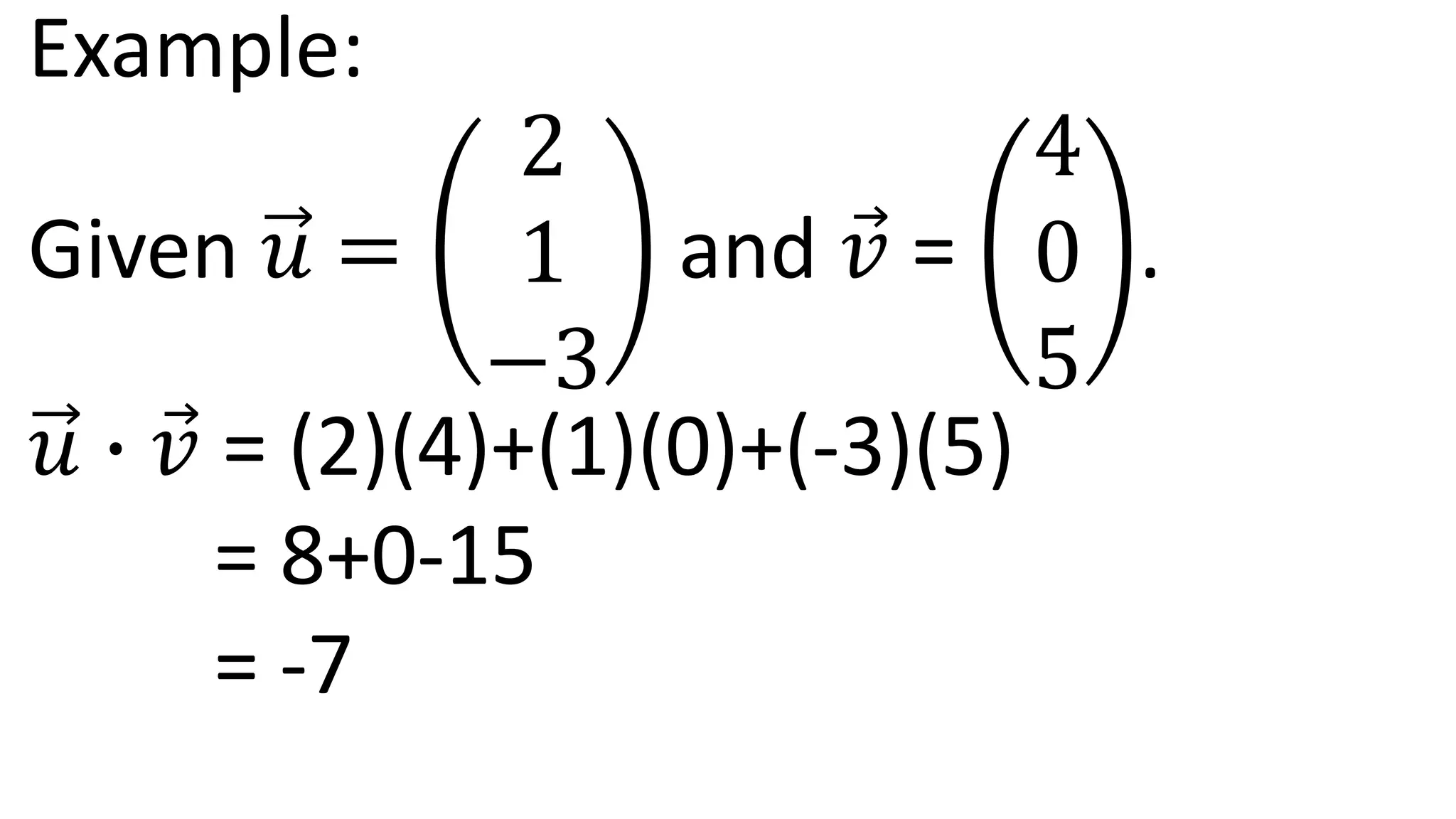
Example:
Given 𝑢 =
2
1
−3
and 𝑣 =
4
0
5
.
𝑢 ∙ 𝑣 = (2)(4)+(1)(0)+(-3)(5)
= 8+0-15
= -7
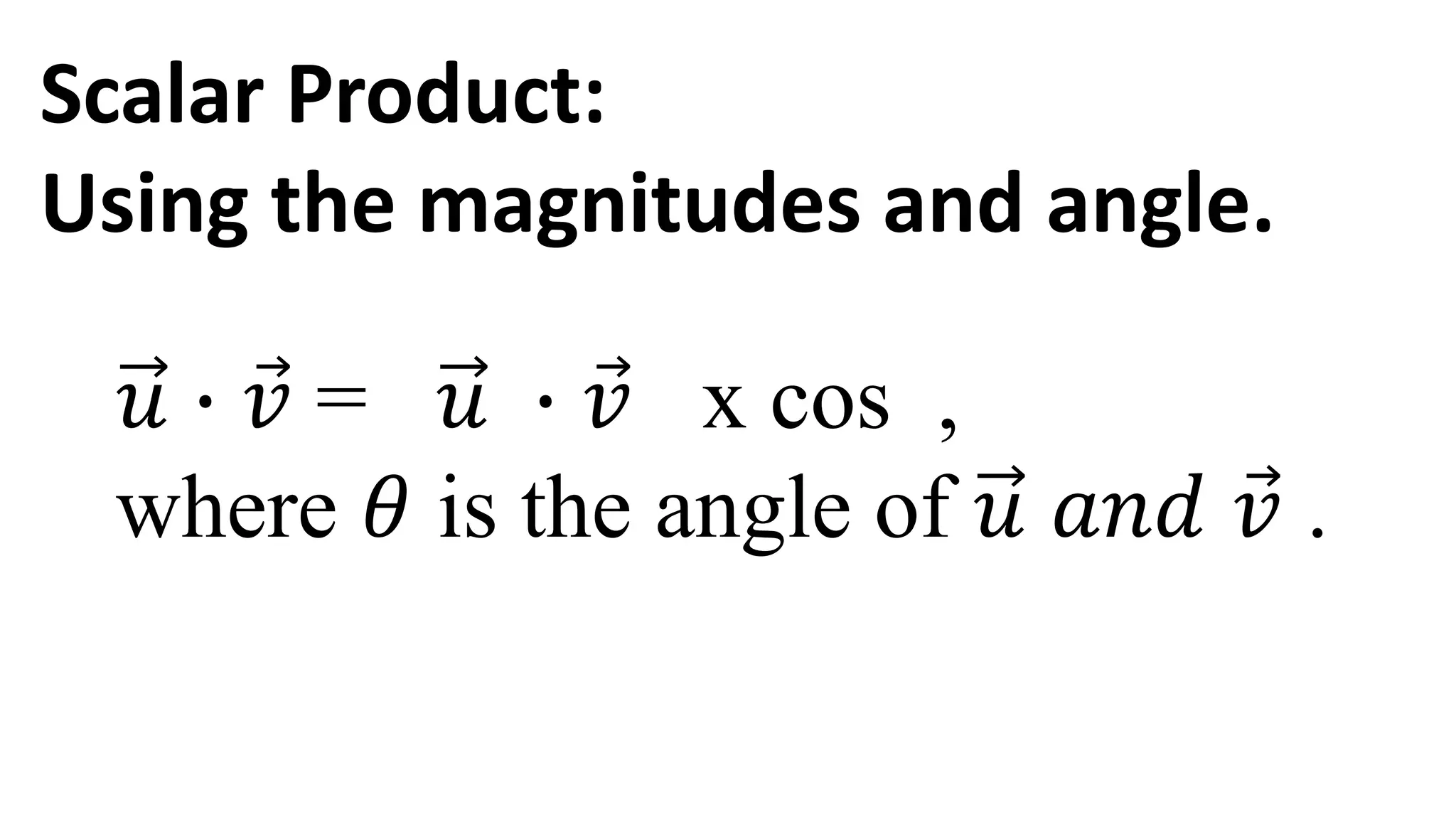
Scalar Product:
Using the magnitudes and angle.
𝑢 ∙ 𝑣 = 𝑢 ∙ 𝑣 x cos ,
where 𝜃 is the angle of 𝑢 𝑎𝑛𝑑 𝑣 .
Example:
Given two vectors a ∙ b such that
a = 4, b = 5
and the angle between them is θ
=60°.
a ∙ b = 4 x 5 x cos ( 60°) = 20 x 0. 5
= 10
Romans 3:20—Through the law we become
conscious of sin.
The Scalar product, like the
biblical law, makes us conscious of
the steps to obtain the correct
answer.
Work Done
by Force or Energy
For work to be done, a force must be
exerted and there must be motion or
displacement in the direction of the force.
The work done by a force acting on an
object is equal to the magnitude of the
force multiplied by the distance moved in
the direction of the force. Work has only
magnitude and no direction. Hence, work
is a scalar quantity.
W = F x d
The SI unit of work is Joule (J). For
example, if a force of 5 newtons is
applied to an object and moves 2
meters, the work done will be 10
newton-meter or 10 Joule.
Example:
An object is horizontally dragged
across the surface by a 100 N force
acting parallel to the surface. Find
out the amount of work done by the
force in moving the object through a
distance of 8 m.
Types of Energy
 Mechanical energy
 Mechanical wave energy
 Chemical energy
 Electric energy
 Magnetic energy
 Radiant energy
 Nuclear energy
 Ionization energy
 Elastic energy
 Gravitational energy
 Thermal energy
 Heat Energy
Energy is the ability to perform work. Energy
can neither be created nor destroyed, and it
can only be transformed from one form to
another. The unit of Energy is the same as of
Work, i.e. Joules. Energy is found in many
things, and thus there are different types of
energy.
The SI unit of energy is Joules (J), named in
honour of James Prescott Joule.
Kinetic energy
Kinetic energy (KE) of an object is
the energy that it possesses due to
its motion. It is defined as the work
needed to accelerate a body of a
given mass from rest to its stated
velocity.
KE = 0.5 • m • v2
where;
m = mass of object
v = speed of object
Example:
1.Determine the kinetic energy of a
625-kg roller coaster car that is
moving with a speed of 18.3 m/s.
KE = 0.5*m*v2
KE = (0.5) (625 kg) (18.3 m/s)2
2.If the roller coaster car in
the above problem were
moving with twice the speed,
then what would be its new
kinetic energy?
If the speed is doubled, then the KE is
quadrupled. Thus, KE = 4 * (1.04653 x
105 J) = 4.19 x 10⁵ Joules.
or
KE = 0.5*m*v2
KE = 0.5*625 kg*(36.6 m/s)2
KE = 4.19 x 10⁵ Joules
3. Missy Diwater, the former platform
diver for the Ringling Brother's Circus,
had a kinetic energy of 12 000 J just
prior to hitting the bucket of water. If
Missy's mass is 40 kg, then what is her
speed?
Power is a physical concept with
several different meanings, depending
on the context and the available
information. We can define power as
the rate of doing work, and it is the
amount of energy consumed per unit
of time.
P = 𝑾/𝑻
Example
A garage hoist lifts a truck up 2
meters above the ground in 15
seconds. Find the power delivered
to the truck. [Given: 1000 kg as the
mass of the truck]
Example
A garage hoist lifts a truck up 2
meters above the ground in 15
seconds. Find the power delivered
to the truck. [Given: 1000 kg as
the mass of the truck]
First we need to calculate the work done,
which requires the force necessary to lift
the truck against gravity:
F = mg = 1000 x 9.81 = 9810 N.
W = Fd = 9810N x 2m = 19620 Nm =
19620 J.?//
The power is P = W/t = 19620J / 15s =
1308 J/s = 1308 W.
Example 1: If you lift a 10-
kilogram object to a height
of 5 meters in 2 seconds, the
power required would be?
Romans 3:20—Through the law we
become conscious of sin
The Scalar product, like
the biblical law, makes us
conscious of the steps to
obtain the correct answer.
Directions: Read the questions carefully. Choose the letter
of your answer.
1. The amount of work done depends on:
a. the size of the force on the object, the distance the
object moves
b. the size of the force on the object, the speed of
movement
c. the size of the object, the distance the object moves
d. the size of the force on the object, the friction acting
upon the object
2. The gravitational force of any object
near Earth's surface is
a. unknown c. friction
b. c. 9.8 m/s2 d. Newton's first law
3. Work done = Force x_______.
a. weight b. Distance
c. Newton d. friction
4. Which of the following is the best
example of work being done.
a. doing homework
b. pushing a stationary box
c. holding a box
d. lifting a box
5. The unit used to measure work is
the
a. Watt b. Newton
c. Joules d. meter
6. Find the dot product
of <1, -2> and <3, 2>
a. 1 b. -1
c. 0 d. (1,-1)
7. What is the answer when you
take dot product between two
vectors?
a. a vector b. a vector and scale
c. a scalar d. none
8. Which of the following
symbols represent vectors?
a. 𝑣 b. v
c. vcts d. β
9. Find the vector u × v when
u = [3,−1,1] and v = [2,5,1].
a. 1 b. 0
c. 3 d. 2
10. Find the vector u × v when
u = [3,4,6] and v = [0,1,1]
a. 8 b. 9
c. 10 d. 11

grade 12 DOT or SCALAR PRODUCT.pptx

  • 1.
  • 2.
    What is yourinsight about the text?
  • 3.
    Solve the followingproblem. 1. If a = 1 and b = 2, then what is a ∙ b? 2. If x =(2)(2k) and y = (3)(3k) then what is x+y ? 3. If h = (3i+4j) and k = (2i+j) then what is h+k?
  • 4.
  • 5.
    Directions: Read thequestions carefully. Choose the letter of your answer. 1.Dot product is also called as _____? a.Scalar b. power c. work d. energy
  • 6.
    2. It isdone whenever energy is transferred from one store to another. a.Scalar b. power c. work d. energy
  • 7.
    3. It isthe energy that it possesses due to its motion. a. Scalar b. kinetic c. work d. energy
  • 8.
    4. It isdefined as the rate at which work is done upon an object. a.Scalar b. kinetic c. work d. power
  • 9.
    5. Given thetwo vector 𝑎 = 1 4 −3 and 𝑏 = 2 7 5 what is 𝑎 ∙ 𝑏 ? a. 5 b. 10 c. 15 d. 20
  • 10.
    6. Calculate work:A 100 Newton force is applied to move a 15 kg object a distance of 5 meters? a. 20 Joules b. 500 Joules c. 75 Joules d. 1500 Joules
  • 11.
    7. A forceexerted over a distance to move an object is a. power b. watt c. work d. momentum
  • 12.
    8. A 5000Nblock is lifted 10m. How much work was done? a. 50000 J b. 5000 J c. 500 J d. 50 J
  • 13.
    9. In whichof these cases is work being done? a. A student sleeps b. a student carries his chair into another room c. A student pushes a locked door that does not move d. A student sits on the carpet
  • 14.
    10. The unitused to measure work is the a. watt b. Newton c. Joule d. meter
  • 15.
    The dot product,also called scalar product of two vectors is one of the two ways we learn how to multiply two vectors together, the other way being the cross product, also called vector product.
  • 16.
    Notation Given two vectorsu u→ and v v→ we refer to the scalar product by writing: u ∙v = u→∙v→ In other words by writing a dot between the two vectors, which explains why we also call it the dot product.
  • 17.
    Scalar Product: usingthe components of the vectors. 2D Vectors Given two vectors 𝑢 = 𝑢1 𝑢2 and 𝑣 = 𝑣1 𝑣2 their scalar product is: 𝑢 ∙ 𝑣 = u1v1 + u2v2
  • 18.
    Example: Given two vectors 𝑎= 2 −5 and 𝑏 = 1 −3 . 𝑎 ∙ 𝑏 = (2)(1) + (-5)(-3) = 2+15 = 17
  • 19.
    Given two vectors𝑢 = 𝑢1 𝑢2 𝑢3 and 𝑣 = 𝑣1 𝑣2 𝑣3 their scalar product is: 𝑢 ∙ 𝑣 = u1v1 + 𝑢2𝑣2 + 𝑢3𝑣3 3D Vectors
  • 20.
    Example: Given 𝑢 = 2 1 −3 and𝑣 = 4 0 5 . 𝑢 ∙ 𝑣 = (2)(4)+(1)(0)+(-3)(5) = 8+0-15 = -7
  • 21.
    Scalar Product: Using themagnitudes and angle. 𝑢 ∙ 𝑣 = 𝑢 ∙ 𝑣 x cos , where 𝜃 is the angle of 𝑢 𝑎𝑛𝑑 𝑣 .
  • 22.
    Example: Given two vectorsa ∙ b such that a = 4, b = 5 and the angle between them is θ =60°. a ∙ b = 4 x 5 x cos ( 60°) = 20 x 0. 5 = 10
  • 23.
    Romans 3:20—Through thelaw we become conscious of sin. The Scalar product, like the biblical law, makes us conscious of the steps to obtain the correct answer.
  • 24.
  • 25.
    For work tobe done, a force must be exerted and there must be motion or displacement in the direction of the force. The work done by a force acting on an object is equal to the magnitude of the force multiplied by the distance moved in the direction of the force. Work has only magnitude and no direction. Hence, work is a scalar quantity.
  • 26.
    W = Fx d The SI unit of work is Joule (J). For example, if a force of 5 newtons is applied to an object and moves 2 meters, the work done will be 10 newton-meter or 10 Joule.
  • 27.
    Example: An object ishorizontally dragged across the surface by a 100 N force acting parallel to the surface. Find out the amount of work done by the force in moving the object through a distance of 8 m.
  • 28.
    Types of Energy Mechanical energy  Mechanical wave energy  Chemical energy  Electric energy  Magnetic energy  Radiant energy  Nuclear energy  Ionization energy  Elastic energy  Gravitational energy  Thermal energy  Heat Energy
  • 29.
    Energy is theability to perform work. Energy can neither be created nor destroyed, and it can only be transformed from one form to another. The unit of Energy is the same as of Work, i.e. Joules. Energy is found in many things, and thus there are different types of energy. The SI unit of energy is Joules (J), named in honour of James Prescott Joule.
  • 30.
    Kinetic energy Kinetic energy(KE) of an object is the energy that it possesses due to its motion. It is defined as the work needed to accelerate a body of a given mass from rest to its stated velocity.
  • 31.
    KE = 0.5• m • v2 where; m = mass of object v = speed of object
  • 32.
    Example: 1.Determine the kineticenergy of a 625-kg roller coaster car that is moving with a speed of 18.3 m/s. KE = 0.5*m*v2 KE = (0.5) (625 kg) (18.3 m/s)2
  • 33.
    2.If the rollercoaster car in the above problem were moving with twice the speed, then what would be its new kinetic energy?
  • 34.
    If the speedis doubled, then the KE is quadrupled. Thus, KE = 4 * (1.04653 x 105 J) = 4.19 x 10⁵ Joules. or KE = 0.5*m*v2 KE = 0.5*625 kg*(36.6 m/s)2 KE = 4.19 x 10⁵ Joules
  • 35.
    3. Missy Diwater,the former platform diver for the Ringling Brother's Circus, had a kinetic energy of 12 000 J just prior to hitting the bucket of water. If Missy's mass is 40 kg, then what is her speed?
  • 36.
    Power is aphysical concept with several different meanings, depending on the context and the available information. We can define power as the rate of doing work, and it is the amount of energy consumed per unit of time.
  • 37.
    P = 𝑾/𝑻 Example Agarage hoist lifts a truck up 2 meters above the ground in 15 seconds. Find the power delivered to the truck. [Given: 1000 kg as the mass of the truck]
  • 38.
    Example A garage hoistlifts a truck up 2 meters above the ground in 15 seconds. Find the power delivered to the truck. [Given: 1000 kg as the mass of the truck]
  • 39.
    First we needto calculate the work done, which requires the force necessary to lift the truck against gravity: F = mg = 1000 x 9.81 = 9810 N. W = Fd = 9810N x 2m = 19620 Nm = 19620 J.?// The power is P = W/t = 19620J / 15s = 1308 J/s = 1308 W.
  • 40.
    Example 1: Ifyou lift a 10- kilogram object to a height of 5 meters in 2 seconds, the power required would be?
  • 41.
    Romans 3:20—Through thelaw we become conscious of sin The Scalar product, like the biblical law, makes us conscious of the steps to obtain the correct answer.
  • 42.
    Directions: Read thequestions carefully. Choose the letter of your answer. 1. The amount of work done depends on: a. the size of the force on the object, the distance the object moves b. the size of the force on the object, the speed of movement c. the size of the object, the distance the object moves d. the size of the force on the object, the friction acting upon the object
  • 43.
    2. The gravitationalforce of any object near Earth's surface is a. unknown c. friction b. c. 9.8 m/s2 d. Newton's first law
  • 44.
    3. Work done= Force x_______. a. weight b. Distance c. Newton d. friction
  • 45.
    4. Which ofthe following is the best example of work being done. a. doing homework b. pushing a stationary box c. holding a box d. lifting a box
  • 46.
    5. The unitused to measure work is the a. Watt b. Newton c. Joules d. meter
  • 47.
    6. Find thedot product of <1, -2> and <3, 2> a. 1 b. -1 c. 0 d. (1,-1)
  • 48.
    7. What isthe answer when you take dot product between two vectors? a. a vector b. a vector and scale c. a scalar d. none
  • 49.
    8. Which ofthe following symbols represent vectors? a. 𝑣 b. v c. vcts d. β
  • 50.
    9. Find thevector u × v when u = [3,−1,1] and v = [2,5,1]. a. 1 b. 0 c. 3 d. 2
  • 51.
    10. Find thevector u × v when u = [3,4,6] and v = [0,1,1] a. 8 b. 9 c. 10 d. 11