KNOWLEDGE MANAGEMENT


Presented By
Sehar Abbas
Saima Hanif
2   CONTENTS


           Data, Information & Knowledge
           Knowledge Hierarchy
           Types of Knowledge
           What Is Knowledge Management
           Why KM
           History of KM
           KM Models
           KM life cycle

    KNOWLEDGE MANAGEMENT
3
                                        C ONTINUE …


           Characteristics of KM in Libraries

           Terms Used in KM


    KNOWLEDGE MANAGEMENT
4
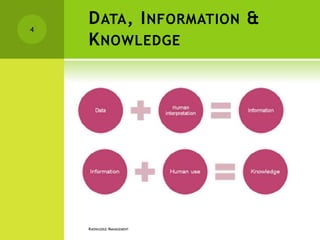
    D ATA , I NFORMATION &
    K NOWLEDGE


    KNOWLEDGE MANAGEMENT
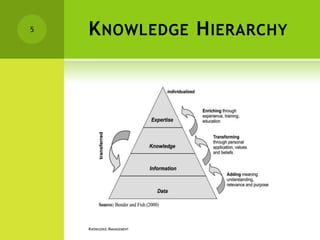
5   K NOWLEDGE H IERARCHY


    KNOWLEDGE MANAGEMENT
6
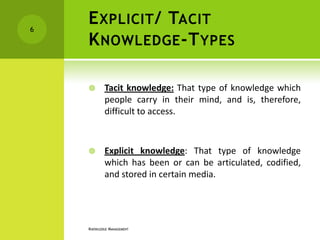
    E XPLICIT / TACIT
    K NOWLEDGE -T YPES

           Tacit knowledge: That type of knowledge which
            people carry in their mind, and is, therefore,
            difficult to access.


           Explicit knowledge: That type of knowledge
            which has been or can be articulated, codified,
            and stored in certain media.


    KNOWLEDGE MANAGEMENT
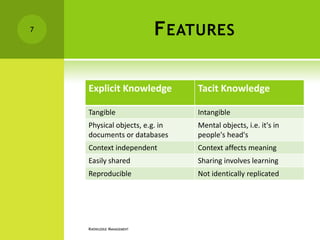
7                          F EATURES

    Explicit Knowledge          Tacit Knowledge

    Tangible                    Intangible
    Physical objects, e.g. in   Mental objects, i.e. it's in
    documents or databases      people's head's
    Context independent         Context affects meaning
    Easily shared               Sharing involves learning
    Reproducible                Not identically replicated


    KNOWLEDGE MANAGEMENT
8
    W HAT I S K NOWLEDGE
    M ANAGEMENT

            Knowledge Management is the
             collection of processes that govern the
             creation, dissemination, and utilization
             of knowledge.


     KNOWLEDGE MANAGEMENT
9   W HY KM

           To share the knowledge, a company creates
            exponential benefits from the knowledge as
            people learn from it.


           To build better sensitivity to “brain drain”


           To reacting to new business opportunities


    KNOWLEDGE MANAGEMENT
10


     H ISTORY O F KM


     KNOWLEDGE MANAGEMENT
11   I N 70’S

       A       number of management theorists            have
               contributed to the evaluation of KM.

              Peter Drucker: Information and knowledge as
               organizational resources

              Peter Senge: "learning organization"

              Chaparral Steel: A company having knowledge
               management strategy


       KNOWLEDGE MANAGEMENT
12   I N 80’ S

            Knowledge as a competitive asset was apparent.

            Managing knowledge that relied on work done in
             artificial intelligence and expert systems.

            Knowledge management-related articles began
             appearing in journals and books .


     KNOWLEDGE MANAGEMENT
13   I N 90’ S U NTIL N OW

            A number of management consulting firms had
             begun in-house knowledge management
             programs. E.g. ADAM’s Model

            Knowledge management was introduced in the
             popular press.

            The International Knowledge Management
             Network(IKMN) went online in 1994.


     KNOWLEDGE MANAGEMENT
14   KM M ODELS

     There are some KM Models:

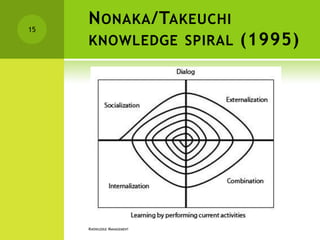
            Nonaka/Takeuchi Knowledge Spiral (1995)

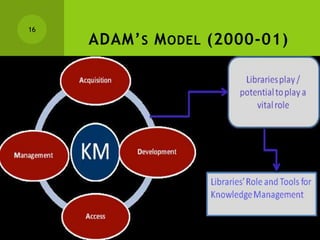
            ADAM’s Model (2000-01)

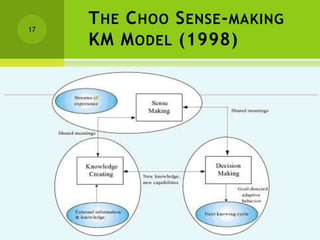
            The Choo Sense-making KM Model (1998)

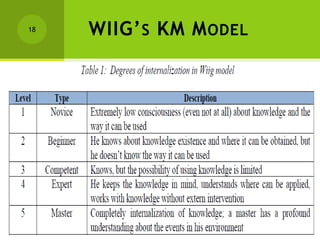
            WIIG KM Model


     KNOWLEDGE MANAGEMENT
15
     N ONAKA /TAKEUCHI
     KNOWLEDGE SPIRAL       (1995)


     KNOWLEDGE MANAGEMENT
16
     ADAM’ S M ODEL (2000-01)


     KNOWLEDGE MANAGEMENT
17
     T HE C HOO S ENSE - MAKING
     KM M ODEL (1998)


     KNOWLEDGE MANAGEMENT
18   WIIG’ S KM M ODEL


     KNOWLEDGE MANAGEMENT
19
     K NOWLEDGE F ORM BY
     WIIG M ODEL

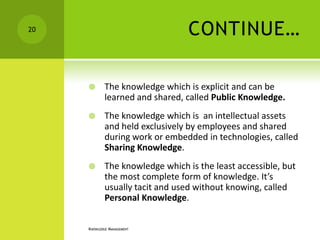
            Public Knowledge
            Sharing Knowledge
            Personal Knowledge


     KNOWLEDGE MANAGEMENT
20                                CONTINUE…

            The knowledge which is explicit and can be
             learned and shared, called Public Knowledge.
            The knowledge which is an intellectual assets
             and held exclusively by employees and shared
             during work or embedded in technologies, called
             Sharing Knowledge.
            The knowledge which is the least accessible, but
             the most complete form of knowledge. It’s
             usually tacit and used without knowing, called
             Personal Knowledge.


     KNOWLEDGE MANAGEMENT
21
     K NOWLEDGE T YPES BY
     WIIG M ODEL

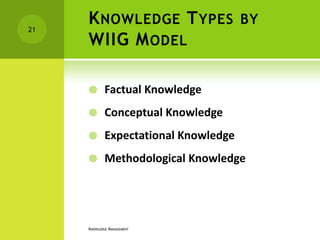
            Factual Knowledge
            Conceptual Knowledge
            Expectational Knowledge
            Methodological Knowledge


     KNOWLEDGE MANAGEMENT
22                                  C ONTINUE …

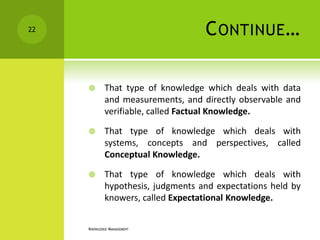
            That type of knowledge which deals with data
             and measurements, and directly observable and
             verifiable, called Factual Knowledge.

            That type of knowledge which deals with
             systems, concepts and perspectives, called
             Conceptual Knowledge.

            That type of knowledge which deals with
             hypothesis, judgments and expectations held by
             knowers, called Expectational Knowledge.


     KNOWLEDGE MANAGEMENT
23                                C ONTINUE …

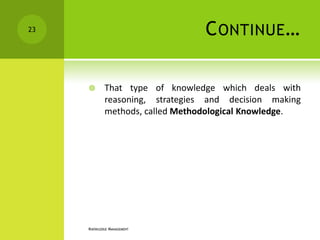
            That type of knowledge which deals with
             reasoning, strategies and decision making
             methods, called Methodological Knowledge.


     KNOWLEDGE MANAGEMENT
24


     KM L IFE CYCLE


      KNOWLEDGE MANAGEMENT
25


     KNOWLEDGE MANAGEMENT
26                                   C ONTINUE …

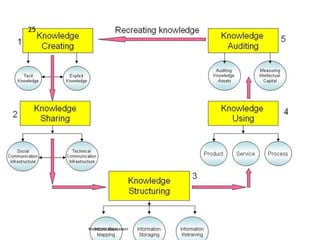
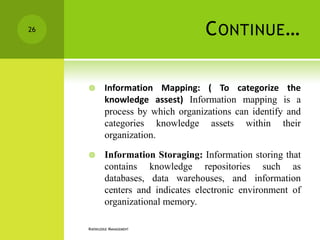
            Information Mapping: ( To categorize the
             knowledge assest) Information mapping is a
             process by which organizations can identify and
             categories knowledge assets within their
             organization.

            Information Storaging: Information storing that
             contains knowledge repositories such as
             databases, data warehouses, and information
             centers and indicates electronic environment of
             organizational memory.

     KNOWLEDGE MANAGEMENT
27                                  CONTINUES …


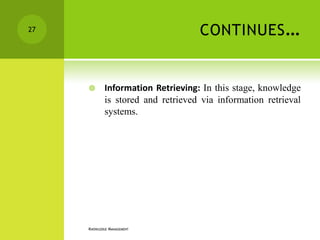
            Information Retrieving: In this stage, knowledge
             is stored and retrieved via information retrieval
             systems.


     KNOWLEDGE MANAGEMENT
28   K NOWLEDGE U SING

     Organizations use knowledge for three reasons:

            Knowledge can be used for determining
             organization’s work processes and making
             strategies for sustainable competitive advantage.

            Knowledge can be used for designing and
             marketing product.

            Knowledge plays a critical role of organization’s
             services quality


     KNOWLEDGE MANAGEMENT
29   K NOWLEDGE A UDITING

            Knowledge auditing means what amount of
             knowledge can be used in organization’s
             products, services and processes.


     KNOWLEDGE MANAGEMENT
30
     C HARACTERISTICS OF KM IN
     L IBRARIES

     The characteristics of KM in libraries are:

            Human Resource Management Is the Core of
             Knowledge Management in Libraries.

            The Objective of Knowledge Management in Libraries
             is to Promote Knowledge Innovation.

            Information Technology Is a Tool for Knowledge
             Management in Libraries.

            The knowledge acquired must be accumulated and
             converged into knowledge warehouses of libraries.

     KNOWLEDGE MANAGEMENT
31   T ERMS U SED                  IN   KM

     There are some terms used in KM:

            Knowledge architect

            Knowledge assets

            Knowledge bridge

            Knowledge Workers

            Knowledge Economy


     KNOWLEDGE MANAGEMENT
32   K NOWLEDGE                   ARCHITECT


            Knowledge architect is the staff member who
             oversees the definitions of knowledge and
             intellectual processes and then identifies the
             technological and human resources required to
             create, capture, organize, access and use
             knowledge assets.


     KNOWLEDGE MANAGEMENT
33   K NOWLEDGE                     ASSETS


            Knowledge assets, also called intellectual capital,
             are the human, structural and recorded
             resources available to the organization. Assets
             reside within the minds of members, customers,
             and colleagues and also include physical
             structures and recorded media.


     KNOWLEDGE MANAGEMENT
34   K NOWLEDGE                    BRIDGE


            Knowledge bridge is the connection that a KM
             expert builds between the business processes
             and the technological, sociological, personal,
             financial, sales, creative, and customer oriented
             functions of the organization.


     KNOWLEDGE MANAGEMENT
35   K NOWLEDGE W ORKERS

            Employees and managers who contribute
             significantly to the intellectual capital of the
             company are called knowledge workers.


     KNOWLEDGE MANAGEMENT
36   K NOWLEDGE E CONOMY

            The knowledge economy is a term that refers
             either to an economy of knowledge focused on
             the production and management of knowledge
             in the frame of economic constraints, or to a
             knowledge-based economy.


     KNOWLEDGE MANAGEMENT
37   R EFERENCES

            http://www.slideshare.net/nabendumaji/knowle
             dge-management-10353260
            http://www.skyrme.com/kmbasics/kchars.htm
            http://www.bridgefieldgroup.com/bridgefieldgro
             up/glos5.htm
            http://www.unc.edu/~sunnyliu/inls258/Introduct
             ion_to_Knowledge_Management.html
            http://en.wikipedia.org/wiki/Knowledge_econo
             my

     KNOWLEDGE MANAGEMENT
38                                       C ONTINUE …

            http://home.earthlink.net/~ddstuhlman/defin1.htm

            Shanhong, T. “Knowledge Management in Libraries
             in the 21st Century”

            SAĞSAN , M. “A NEW LIFE CYCLE MODEL FOR
             PROCESSING OF KNOWLEDGE MANAGEMENT”

            Crista, S.D. (2009), “Perspectives on knowledge
             management models”

            Bergeron, B. “Essentials of Knowledge Management”


     KNOWLEDGE MANAGEMENT
39


     KNOWLEDGE MANAGEMENT

Knowledge management

  • 1.
  • 2.
    2 CONTENTS  Data, Information & Knowledge  Knowledge Hierarchy  Types of Knowledge  What Is Knowledge Management  Why KM  History of KM  KM Models  KM life cycle KNOWLEDGE MANAGEMENT
  • 3.
    3 C ONTINUE …  Characteristics of KM in Libraries  Terms Used in KM KNOWLEDGE MANAGEMENT
  • 4.
    4 D ATA , I NFORMATION & K NOWLEDGE KNOWLEDGE MANAGEMENT
  • 5.
    5 K NOWLEDGE H IERARCHY KNOWLEDGE MANAGEMENT
  • 6.
    6 E XPLICIT / TACIT K NOWLEDGE -T YPES  Tacit knowledge: That type of knowledge which people carry in their mind, and is, therefore, difficult to access.  Explicit knowledge: That type of knowledge which has been or can be articulated, codified, and stored in certain media. KNOWLEDGE MANAGEMENT
  • 7.
    7 F EATURES Explicit Knowledge Tacit Knowledge Tangible Intangible Physical objects, e.g. in Mental objects, i.e. it's in documents or databases people's head's Context independent Context affects meaning Easily shared Sharing involves learning Reproducible Not identically replicated KNOWLEDGE MANAGEMENT
  • 8.
    8 W HAT I S K NOWLEDGE M ANAGEMENT  Knowledge Management is the collection of processes that govern the creation, dissemination, and utilization of knowledge. KNOWLEDGE MANAGEMENT
  • 9.
    9 W HY KM  To share the knowledge, a company creates exponential benefits from the knowledge as people learn from it.  To build better sensitivity to “brain drain”  To reacting to new business opportunities KNOWLEDGE MANAGEMENT
  • 10.
    10 H ISTORY O F KM KNOWLEDGE MANAGEMENT
  • 11.
    11 I N 70’S A number of management theorists have contributed to the evaluation of KM.  Peter Drucker: Information and knowledge as organizational resources  Peter Senge: "learning organization"  Chaparral Steel: A company having knowledge management strategy KNOWLEDGE MANAGEMENT
  • 12.
    12 I N 80’ S  Knowledge as a competitive asset was apparent.  Managing knowledge that relied on work done in artificial intelligence and expert systems.  Knowledge management-related articles began appearing in journals and books . KNOWLEDGE MANAGEMENT
  • 13.
    13 I N 90’ S U NTIL N OW  A number of management consulting firms had begun in-house knowledge management programs. E.g. ADAM’s Model  Knowledge management was introduced in the popular press.  The International Knowledge Management Network(IKMN) went online in 1994. KNOWLEDGE MANAGEMENT
  • 14.
    14 KM M ODELS There are some KM Models:  Nonaka/Takeuchi Knowledge Spiral (1995)  ADAM’s Model (2000-01)  The Choo Sense-making KM Model (1998)  WIIG KM Model KNOWLEDGE MANAGEMENT
  • 15.
    15 N ONAKA /TAKEUCHI KNOWLEDGE SPIRAL (1995) KNOWLEDGE MANAGEMENT
  • 16.
    16 ADAM’ S M ODEL (2000-01) KNOWLEDGE MANAGEMENT
  • 17.
    17 T HE C HOO S ENSE - MAKING KM M ODEL (1998) KNOWLEDGE MANAGEMENT
  • 18.
    18 WIIG’ S KM M ODEL KNOWLEDGE MANAGEMENT
  • 19.
    19 K NOWLEDGE F ORM BY WIIG M ODEL  Public Knowledge  Sharing Knowledge  Personal Knowledge KNOWLEDGE MANAGEMENT
  • 20.
    20 CONTINUE…  The knowledge which is explicit and can be learned and shared, called Public Knowledge.  The knowledge which is an intellectual assets and held exclusively by employees and shared during work or embedded in technologies, called Sharing Knowledge.  The knowledge which is the least accessible, but the most complete form of knowledge. It’s usually tacit and used without knowing, called Personal Knowledge. KNOWLEDGE MANAGEMENT
  • 21.
    21 K NOWLEDGE T YPES BY WIIG M ODEL  Factual Knowledge  Conceptual Knowledge  Expectational Knowledge  Methodological Knowledge KNOWLEDGE MANAGEMENT
  • 22.
    22 C ONTINUE …  That type of knowledge which deals with data and measurements, and directly observable and verifiable, called Factual Knowledge.  That type of knowledge which deals with systems, concepts and perspectives, called Conceptual Knowledge.  That type of knowledge which deals with hypothesis, judgments and expectations held by knowers, called Expectational Knowledge. KNOWLEDGE MANAGEMENT
  • 23.
    23 C ONTINUE …  That type of knowledge which deals with reasoning, strategies and decision making methods, called Methodological Knowledge. KNOWLEDGE MANAGEMENT
  • 24.
    24 KM L IFE CYCLE KNOWLEDGE MANAGEMENT
  • 25.
    25 KNOWLEDGE MANAGEMENT
  • 26.
    26 C ONTINUE …  Information Mapping: ( To categorize the knowledge assest) Information mapping is a process by which organizations can identify and categories knowledge assets within their organization.  Information Storaging: Information storing that contains knowledge repositories such as databases, data warehouses, and information centers and indicates electronic environment of organizational memory. KNOWLEDGE MANAGEMENT
  • 27.
    27 CONTINUES …  Information Retrieving: In this stage, knowledge is stored and retrieved via information retrieval systems. KNOWLEDGE MANAGEMENT
  • 28.
    28 K NOWLEDGE U SING Organizations use knowledge for three reasons:  Knowledge can be used for determining organization’s work processes and making strategies for sustainable competitive advantage.  Knowledge can be used for designing and marketing product.  Knowledge plays a critical role of organization’s services quality KNOWLEDGE MANAGEMENT
  • 29.
    29 K NOWLEDGE A UDITING  Knowledge auditing means what amount of knowledge can be used in organization’s products, services and processes. KNOWLEDGE MANAGEMENT
  • 30.
    30 C HARACTERISTICS OF KM IN L IBRARIES The characteristics of KM in libraries are:  Human Resource Management Is the Core of Knowledge Management in Libraries.  The Objective of Knowledge Management in Libraries is to Promote Knowledge Innovation.  Information Technology Is a Tool for Knowledge Management in Libraries.  The knowledge acquired must be accumulated and converged into knowledge warehouses of libraries. KNOWLEDGE MANAGEMENT
  • 31.
    31 T ERMS U SED IN KM There are some terms used in KM:  Knowledge architect  Knowledge assets  Knowledge bridge  Knowledge Workers  Knowledge Economy KNOWLEDGE MANAGEMENT
  • 32.
    32 K NOWLEDGE ARCHITECT  Knowledge architect is the staff member who oversees the definitions of knowledge and intellectual processes and then identifies the technological and human resources required to create, capture, organize, access and use knowledge assets. KNOWLEDGE MANAGEMENT
  • 33.
    33 K NOWLEDGE ASSETS  Knowledge assets, also called intellectual capital, are the human, structural and recorded resources available to the organization. Assets reside within the minds of members, customers, and colleagues and also include physical structures and recorded media. KNOWLEDGE MANAGEMENT
  • 34.
    34 K NOWLEDGE BRIDGE  Knowledge bridge is the connection that a KM expert builds between the business processes and the technological, sociological, personal, financial, sales, creative, and customer oriented functions of the organization. KNOWLEDGE MANAGEMENT
  • 35.
    35 K NOWLEDGE W ORKERS  Employees and managers who contribute significantly to the intellectual capital of the company are called knowledge workers. KNOWLEDGE MANAGEMENT
  • 36.
    36 K NOWLEDGE E CONOMY  The knowledge economy is a term that refers either to an economy of knowledge focused on the production and management of knowledge in the frame of economic constraints, or to a knowledge-based economy. KNOWLEDGE MANAGEMENT
  • 37.
    37 R EFERENCES  http://www.slideshare.net/nabendumaji/knowle dge-management-10353260  http://www.skyrme.com/kmbasics/kchars.htm  http://www.bridgefieldgroup.com/bridgefieldgro up/glos5.htm  http://www.unc.edu/~sunnyliu/inls258/Introduct ion_to_Knowledge_Management.html  http://en.wikipedia.org/wiki/Knowledge_econo my KNOWLEDGE MANAGEMENT
  • 38.
    38 C ONTINUE …  http://home.earthlink.net/~ddstuhlman/defin1.htm  Shanhong, T. “Knowledge Management in Libraries in the 21st Century”  SAĞSAN , M. “A NEW LIFE CYCLE MODEL FOR PROCESSING OF KNOWLEDGE MANAGEMENT”  Crista, S.D. (2009), “Perspectives on knowledge management models”  Bergeron, B. “Essentials of Knowledge Management” KNOWLEDGE MANAGEMENT
  • 39.
    39 KNOWLEDGE MANAGEMENT