Welcome To our
Presentation.
Md. Mazharul Islam Rana
2014010004016
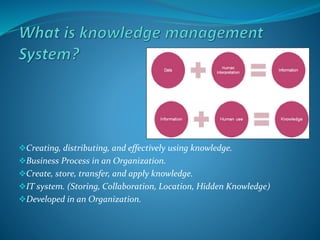
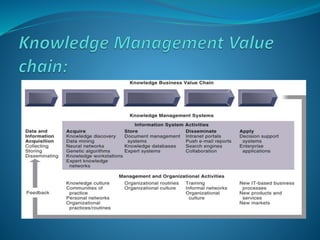
Creating, distributing, and effectively using knowledge.
Business Process in an Organization.
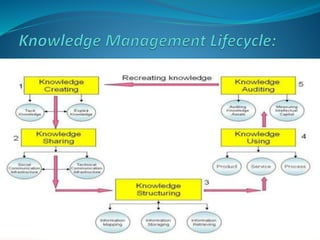
Create, store, transfer, and apply knowledge.
IT system. (Storing, Collaboration, Location, Hidden Knowledge)
Developed in an Organization.
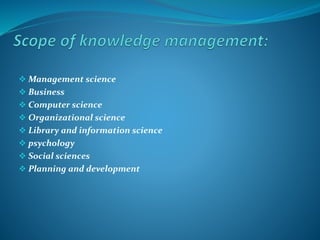
 Management science
 Business
 Computer science
 Organizational science
 Library and information science
 psychology
 Social sciences
 Planning and development
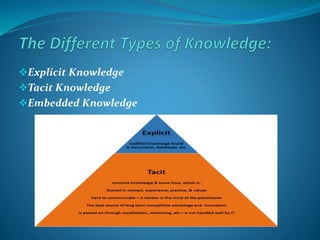
Explicit Knowledge
Tacit Knowledge
Embedded Knowledge
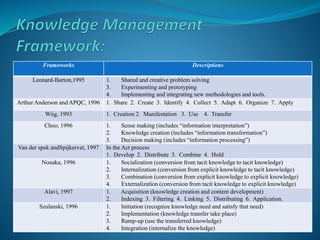
Frameworks Descriptions
Leonard-Barton,1995 1. Shared and creative problem solving
3. Experimenting and prototyping
4. Implementing and integrating new methodologies and tools.
Arthur Anderson and APQC, 1996 1. Share 2. Create 3. Identify 4. Collect 5. Adapt 6. Organize 7. Apply
Wiig, 1993 1. Creation 2. Manifestation 3. Use 4. Transfer
Choo, 1996 1. Sense making (includes “information interpretation”)
2. Knowledge creation (includes “information transformation”)
3. Decision making (includes “information processing”)
Van der spek andSpijkervet, 1997 In the Act process
1. Develop 2. Distribute 3. Combine 4. Hold
Nonaka, 1996 1. Socialization (conversion from tacit knowledge to tacit knowledge)
2. Internalization (conversion from explicit knowledge to tacit knowledge)
3. Combination (conversion from explicit knowledge to explicit knowledge)
4. Externalization (conversion from tacit knowledge to explicit knowledge)
Alavi, 1997 1. Acquisition (knowledge creation and content development)
2. Indexing 3. Filtering 4. Linking 5. Distributing 6. Application.
Szulanski, 1996 1. Initiation (recognize knowledge need and satisfy that need)
2. Implementation (knowledge transfer take place)
3. Ramp-up (use the transferred knowledge)
4. Integration (internalize the knowledge)
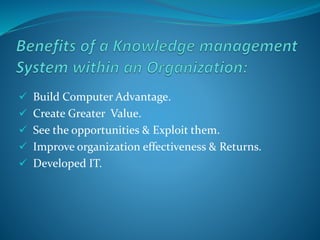
 Build Computer Advantage.
 Create Greater Value.
 See the opportunities & Exploit them.
 Improve organization effectiveness & Returns.
 Developed IT.
Think
Find information
Communicate
Debate
Knowledge Management System. MIS

Knowledge Management System. MIS

  • 1.
  • 2.
    Md. Mazharul IslamRana 2014010004016
  • 5.
    Creating, distributing, andeffectively using knowledge. Business Process in an Organization. Create, store, transfer, and apply knowledge. IT system. (Storing, Collaboration, Location, Hidden Knowledge) Developed in an Organization.
  • 9.
     Management science Business  Computer science  Organizational science  Library and information science  psychology  Social sciences  Planning and development
  • 10.
  • 11.
    Frameworks Descriptions Leonard-Barton,1995 1.Shared and creative problem solving 3. Experimenting and prototyping 4. Implementing and integrating new methodologies and tools. Arthur Anderson and APQC, 1996 1. Share 2. Create 3. Identify 4. Collect 5. Adapt 6. Organize 7. Apply Wiig, 1993 1. Creation 2. Manifestation 3. Use 4. Transfer Choo, 1996 1. Sense making (includes “information interpretation”) 2. Knowledge creation (includes “information transformation”) 3. Decision making (includes “information processing”) Van der spek andSpijkervet, 1997 In the Act process 1. Develop 2. Distribute 3. Combine 4. Hold Nonaka, 1996 1. Socialization (conversion from tacit knowledge to tacit knowledge) 2. Internalization (conversion from explicit knowledge to tacit knowledge) 3. Combination (conversion from explicit knowledge to explicit knowledge) 4. Externalization (conversion from tacit knowledge to explicit knowledge) Alavi, 1997 1. Acquisition (knowledge creation and content development) 2. Indexing 3. Filtering 4. Linking 5. Distributing 6. Application. Szulanski, 1996 1. Initiation (recognize knowledge need and satisfy that need) 2. Implementation (knowledge transfer take place) 3. Ramp-up (use the transferred knowledge) 4. Integration (internalize the knowledge)
  • 12.
     Build ComputerAdvantage.  Create Greater Value.  See the opportunities & Exploit them.  Improve organization effectiveness & Returns.  Developed IT.
  • 15.