Knowledge
Management
Concepts and methods for delivering
knowledge in the digital age

.
Objectives for this session
• To explore the concepts & theory of
Knowledge Management (KM)
• To learn about some KM programs
• To discuss the idea of KM in
Postsecondary Education and in IR
• To identify some of the controversies
around KM
Knowledge Management

© United Features Syndicate, Inc.
What is Knowledge
Management?
• Defined in a variety of ways.
• KM in education: a strategy to enable people
to develop a set of practices to create,
capture, share & use knowledge to advance.
• KM focuses on:
• people who create and use knowledge.
• processes and technologies by which knowledge is
created, maintained and accessed.
• artifacts in which knowledge is stored (manuals,
databases, intranets, books, heads).
Sources: Petrides, L.A. & Nodine, T.R (2003). Knowledge management in education: Defining the landscape. Edvinsson, L. &
Malone, M.S. (1997). Intellectual capital: Realizing your company's true value by finding its hidden brainpower . Ford, N. (1989).
From information- to knowledge-management. Journal of Information Science Principles & Practice.
What is Knowledge
Management?
“Knowledge management is a discipline
that promotes an integrated approach
to identifying, managing and sharing all
of an enterprise’s information needs.
These information assets may include
databases, documents, policies and
procedures as well as previously
unarticulated expertise and experience
resident in individual workers.”
Source: GartnerGroup Research.
A Community College’s
Definition
“A discipline and framework
designed to help our organization
acquire, package and share “what
we know” to enable decisionmaking, creativity, innovation and
communication.” (Cuyahoga Community
College)
Where does KM come from?
• Technology
• Infrastructure, Database, Web, Interface

• Globalization
• World wide markets, North American integration

• Demographics
• Aging population, workforce mobility, diversity

• Economics
• Knowledge economy

• Customer relations
• Quality

• Increase in information
• Specialization, Volume, Order
Sources: Brown J.S. & Duguid, P. (1991). Organisational learning and communities-of-practice.
Organisational Science. .O’Dell C. & Grayson Jr., C.J. (1998). If only we knew what we know. Stewart, T.
(2002). The wealth of knowledge.
The Rise of the
Knowledge Worker
100%
90%
80%
70%
60%
50%
40%
30%
20%
10%
0%
1900

1910

1920

1930

farmworkers
service
managerial & admin.
Source: Stewart T.A. (1997). Intellectual capital.

1940

1950

1960

labourers & operators
clerical
prof. & tech.

1970

1980

crafts
sales

1990

2000
Labour market employment
shift to a knowledge economy
Average annual rate of growth in Canadian
labour market sectors (%) 1971-1996
2.1

Overall

0.6

Production

2.6

Services

2.2

Data

7.6

Management

4.1

Knowledge

0

2

4

Source: Lavoie, M. & Roy, R. (1998). Employment in the knowledge-based economy.

6

8
Digital Students
By age 21, the average college student
will have spent:
•
•
•
•
•

10,000 hours video games
200,000 emails
20,000 hours TV
10,000 hours cell phone
Under 5,000 hours reading

Source: F. Prochaska, Students and Faculty Today: Inhabiting the Evolving Universe of
Teaching, Learning, and Technology, 2003.
Why KM?

Source: Luan, J & Serban, A. (2002, June). Knowledge management concepts, models and
applications. Paper presented at Annual AIR Forum, Toronto.
What is Knowledge?
• Knowledge is justified true belief. Ayer, A.J. (1956). The
Problem of Knowledge.
• Knowledge is a fluid mix of framed
experience, values, contextual information
and expert insight that provides a framework
for evaluating and incorporating new
experience and information. It originates and
is applied in the minds of knowers. In
organizations it often becomes embedded
not only in documents or repositories but
also in organizational processes, practices
and norms. Davenport, T.H. & Prusak, L (1998). Working Knowledge.
• Knowledge is information in action. O’Dell C. & Grayson
Jr., C.J. (1998). If only we knew what we know.
Data, Information & Knowledge
DATA
Def init ion

Reason

I NFORMATI ON

KNOWLEDGE

Raw facts, figures
and records
contained in a
system.

Data placed into
a form that is
accessible, timely
and accurate.

Processing

Storing /
Accessing.

Information in
context to make
it insightful and
relevant for
human action.
Insight,
innovation,
improvement.

Source: Luan, J & Serban, A. (2002, June). Knowledge management concepts, models and applications. Paper
presented at Annual AIR Forum, Toronto.

"We are drowning in information but starved for knowledge"
Naisbitt , J. (1984) Megatrends: Ten new directions transforming our lives.
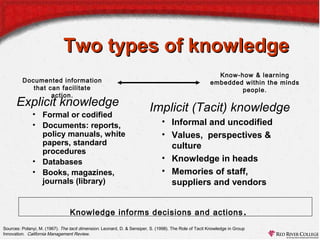
Two types of knowledge
Documented information
that can facilitate
action.

Explicit knowledge
• Formal or codified
• Documents: reports,
policy manuals, white
papers, standard
procedures
• Databases
• Books, magazines,
journals (library)

Know-how & learning
embedded within the minds
people.

Implicit (Tacit) knowledge
• Informal and uncodified
• Values, perspectives &
culture
• Knowledge in heads
• Memories of staff,
suppliers and vendors

Knowledge informs decisions and actions .
Sources: Polanyi, M. (1967). The tacit dimension. Leonard, D. & Sensiper, S. (1998). The Role of Tacit Knowledge in Group
Innovation. California Management Review.

Knowledge management

  • 1.
    Knowledge Management Concepts and methodsfor delivering knowledge in the digital age .
  • 2.
    Objectives for thissession • To explore the concepts & theory of Knowledge Management (KM) • To learn about some KM programs • To discuss the idea of KM in Postsecondary Education and in IR • To identify some of the controversies around KM
  • 3.
    Knowledge Management © UnitedFeatures Syndicate, Inc.
  • 4.
    What is Knowledge Management? •Defined in a variety of ways. • KM in education: a strategy to enable people to develop a set of practices to create, capture, share & use knowledge to advance. • KM focuses on: • people who create and use knowledge. • processes and technologies by which knowledge is created, maintained and accessed. • artifacts in which knowledge is stored (manuals, databases, intranets, books, heads). Sources: Petrides, L.A. & Nodine, T.R (2003). Knowledge management in education: Defining the landscape. Edvinsson, L. & Malone, M.S. (1997). Intellectual capital: Realizing your company's true value by finding its hidden brainpower . Ford, N. (1989). From information- to knowledge-management. Journal of Information Science Principles & Practice.
  • 5.
    What is Knowledge Management? “Knowledgemanagement is a discipline that promotes an integrated approach to identifying, managing and sharing all of an enterprise’s information needs. These information assets may include databases, documents, policies and procedures as well as previously unarticulated expertise and experience resident in individual workers.” Source: GartnerGroup Research.
  • 6.
    A Community College’s Definition “Adiscipline and framework designed to help our organization acquire, package and share “what we know” to enable decisionmaking, creativity, innovation and communication.” (Cuyahoga Community College)
  • 7.
    Where does KMcome from? • Technology • Infrastructure, Database, Web, Interface • Globalization • World wide markets, North American integration • Demographics • Aging population, workforce mobility, diversity • Economics • Knowledge economy • Customer relations • Quality • Increase in information • Specialization, Volume, Order Sources: Brown J.S. & Duguid, P. (1991). Organisational learning and communities-of-practice. Organisational Science. .O’Dell C. & Grayson Jr., C.J. (1998). If only we knew what we know. Stewart, T. (2002). The wealth of knowledge.
  • 8.
    The Rise ofthe Knowledge Worker 100% 90% 80% 70% 60% 50% 40% 30% 20% 10% 0% 1900 1910 1920 1930 farmworkers service managerial & admin. Source: Stewart T.A. (1997). Intellectual capital. 1940 1950 1960 labourers & operators clerical prof. & tech. 1970 1980 crafts sales 1990 2000
  • 9.
    Labour market employment shiftto a knowledge economy Average annual rate of growth in Canadian labour market sectors (%) 1971-1996 2.1 Overall 0.6 Production 2.6 Services 2.2 Data 7.6 Management 4.1 Knowledge 0 2 4 Source: Lavoie, M. & Roy, R. (1998). Employment in the knowledge-based economy. 6 8
  • 10.
    Digital Students By age21, the average college student will have spent: • • • • • 10,000 hours video games 200,000 emails 20,000 hours TV 10,000 hours cell phone Under 5,000 hours reading Source: F. Prochaska, Students and Faculty Today: Inhabiting the Evolving Universe of Teaching, Learning, and Technology, 2003.
  • 11.
    Why KM? Source: Luan,J & Serban, A. (2002, June). Knowledge management concepts, models and applications. Paper presented at Annual AIR Forum, Toronto.
  • 12.
    What is Knowledge? •Knowledge is justified true belief. Ayer, A.J. (1956). The Problem of Knowledge. • Knowledge is a fluid mix of framed experience, values, contextual information and expert insight that provides a framework for evaluating and incorporating new experience and information. It originates and is applied in the minds of knowers. In organizations it often becomes embedded not only in documents or repositories but also in organizational processes, practices and norms. Davenport, T.H. & Prusak, L (1998). Working Knowledge. • Knowledge is information in action. O’Dell C. & Grayson Jr., C.J. (1998). If only we knew what we know.
  • 13.
    Data, Information &Knowledge DATA Def init ion Reason I NFORMATI ON KNOWLEDGE Raw facts, figures and records contained in a system. Data placed into a form that is accessible, timely and accurate. Processing Storing / Accessing. Information in context to make it insightful and relevant for human action. Insight, innovation, improvement. Source: Luan, J & Serban, A. (2002, June). Knowledge management concepts, models and applications. Paper presented at Annual AIR Forum, Toronto. "We are drowning in information but starved for knowledge" Naisbitt , J. (1984) Megatrends: Ten new directions transforming our lives.
  • 14.
    Two types ofknowledge Documented information that can facilitate action. Explicit knowledge • Formal or codified • Documents: reports, policy manuals, white papers, standard procedures • Databases • Books, magazines, journals (library) Know-how & learning embedded within the minds people. Implicit (Tacit) knowledge • Informal and uncodified • Values, perspectives & culture • Knowledge in heads • Memories of staff, suppliers and vendors Knowledge informs decisions and actions . Sources: Polanyi, M. (1967). The tacit dimension. Leonard, D. & Sensiper, S. (1998). The Role of Tacit Knowledge in Group Innovation. California Management Review.