Knowledge Management
explained

Enamul Haque
Senior Process owner, Knowledge Management
Nokia


 1
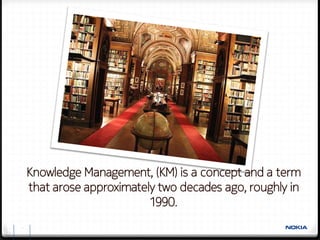
Knowledge Management, (KM) is a concept and a term
    that arose approximately two decades ago, roughly in
                           1990.
2
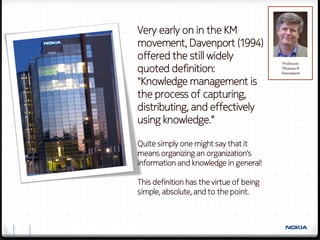
Very early on in the KM
    movement, Davenport (1994)
    offered the still widely
                                              Professor
    quoted definition:                        Thomas H
                                              Davenport

    "Knowledge management is
    the process of capturing,
    distributing, and effectively
    using knowledge.“

    Quite simply one might say that it
    means organizing an organization's
    information and knowledge in general!

    This definition has the virtue of being
    simple, absolute, and to the point.


3
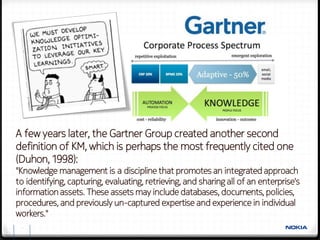
A few years later, the Gartner Group created another second
definition of KM, which is perhaps the most frequently cited one
(Duhon, 1998):
"Knowledge management is a discipline that promotes an integrated approach
to identifying, capturing, evaluating, retrieving, and sharing all of an enterprise's
information assets. These assets may include databases, documents, policies,
procedures, and previously un-captured expertise and experience in individual
workers."
 4
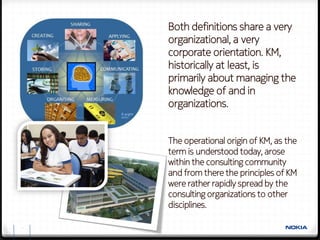
Both definitions share a very
    organizational, a very
    corporate orientation. KM,
    historically at least, is
    primarily about managing the
    knowledge of and in
    organizations.


    The operational origin of KM, as the
    term is understood today, arose
    within the consulting community
    and from there the principles of KM
    were rather rapidly spread by the
    consulting organizations to other
    disciplines.

5
A product was born!

A new product of course needed a name, and the name chosen, or at least
arrived at, was Knowledge Management.

The timing was favorable, as the enthusiasm for intellectual capital in the 1980s,
had primed the pump for the recognition of information and knowledge as
essential assets for any organization.
   6
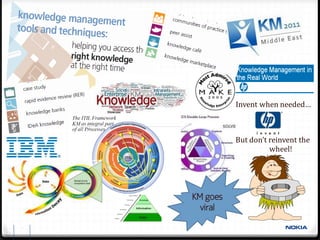
Invent when needed…


              But don’t reinvent the
                        wheel!


    KM goes
      viral

7
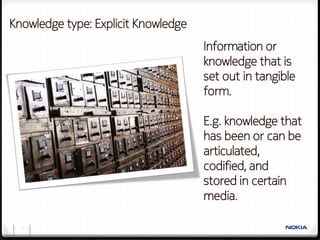
Knowledge type: Explicit Knowledge
                                     Information or
                                     knowledge that is
                                     set out in tangible
                                     form.

                                     E.g. knowledge that
                                     has been or can be
                                     articulated,
                                     codified, and
                                     stored in certain
                                     media.

  8
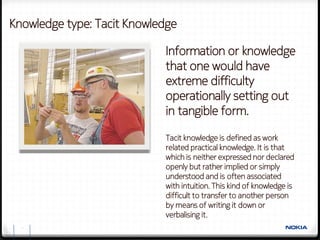
Knowledge type: Tacit Knowledge

                            Information or knowledge
                            that one would have
                            extreme difficulty
                            operationally setting out
                            in tangible form.

                            Tacit knowledge is defined as work
                            related practical knowledge. It is that
                            which is neither expressed nor declared
                            openly but rather implied or simply
                            understood and is often associated
                            with intuition. This kind of knowledge is
                            difficult to transfer to another person
                            by means of writing it down or
                            verbalising it.
  9
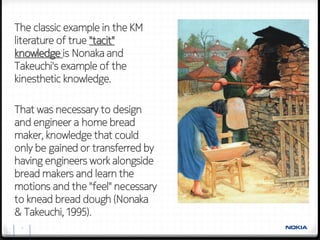
The classic example in the KM
literature of true "tacit"
knowledge is Nonaka and
Takeuchi's example of the
kinesthetic knowledge.

That was necessary to design
and engineer a home bread
maker, knowledge that could
only be gained or transferred by
having engineers work alongside
bread makers and learn the
motions and the "feel" necessary
to knead bread dough (Nonaka
& Takeuchi, 1995).
 10
What operationally constitutes KM?
     (1) Lessons Learned Databases
        0 Lessons Learned databases are databases that
          attempt to capture and to make accessible
          knowledge that has been operationally obtained
          and typically would not have been captured in a
          fixed medium
     (2) Expertise Location
        0 If knowledge resides in people, then one of the best
          ways to learn what an expert knows is to talk with
          that expert. Locating the right expert with the
          knowledge you need, though, can be a problem.
     (3) Communities of Practice (CoPs)
         0 CoPs are groups of individuals with shared
           interests that come together in person or virtually
           to tell stories, to share and discuss problems and
           opportunities, discuss best practices, and talk
           over lessons learned (Wenger, 1998; Wenger &
           Snyder, 1999).


11
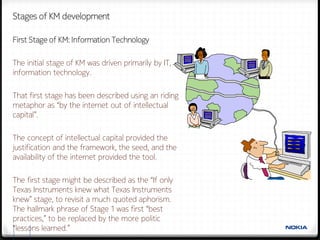
Stages of KM development

First Stage of KM: Information Technology

The initial stage of KM was driven primarily by IT,
information technology.

That first stage has been described using an riding
metaphor as “by the internet out of intellectual
capital”.

The concept of intellectual capital provided the
justification and the framework, the seed, and the
availability of the internet provided the tool.

The first stage might be described as the “If only
Texas Instruments knew what Texas Instruments
knew” stage, to revisit a much quoted aphorism.
The hallmark phrase of Stage 1 was first “best
practices,” to be replaced by the more politic
“lessons learned.”
  12
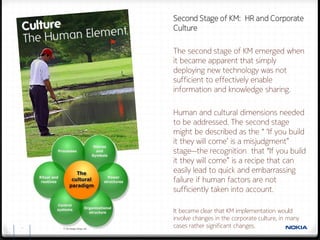
Second Stage of KM: HR and Corporate
     Culture

     The second stage of KM emerged when
     it became apparent that simply
     deploying new technology was not
     sufficient to effectively enable
     information and knowledge sharing.

     Human and cultural dimensions needed
     to be addressed. The second stage
     might be described as the “ ‘If you build
     it they will come’ is a misjudgment”
     stage—the recognition that “If you build
     it they will come” is a recipe that can
     easily lead to quick and embarrassing
     failure if human factors are not
     sufficiently taken into account.

     It became clear that KM implementation would
     involve changes in the corporate culture, in many
13   cases rather significant changes.
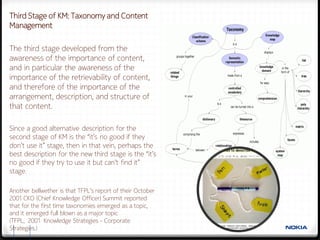
Third Stage of KM: Taxonomy and Content
Management

The third stage developed from the
awareness of the importance of content,
and in particular the awareness of the
importance of the retrievability of content,
and therefore of the importance of the
arrangement, description, and structure of
that content.

Since a good alternative description for the
second stage of KM is the “it’s no good if they
don’t use it” stage, then in that vein, perhaps the
best description for the new third stage is the “it’s
no good if they try to use it but can’t find it”
stage.

Another bellwether is that TFPL’s report of their October
2001 CKO (Chief Knowledge Officer) Summit reported
that for the first time taxonomies emerged as a topic,
and it emerged full blown as a major topic
(TFPL, 2001 Knowledge Strategies – Corporate
Strategies.)
    14
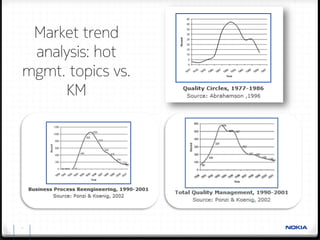
Is KM here to stay?

     The answer certainly appears to be
     yes.

     Most business enthusiasms grow
     rapidly and reach a peak after
     about five years, and then decline
     almost as rapidly as they grew.

     For KM, it looks different


15
Market trend
  analysis: hot
 mgmt. topics vs.
      KM


16
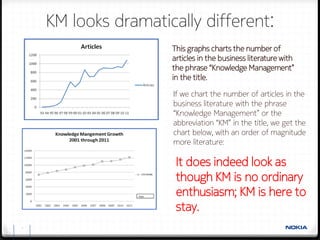
KM looks dramatically different:
                      This graphs charts the number of
                      articles in the business literature with
                      the phrase “Knowledge Management”
                      in the title.

                      If we chart the number of articles in the
                      business literature with the phrase
                      “Knowledge Management” or the
                      abbreviation “KM” in the title, we get the
                      chart below, with an order of magnitude
                      more literature:

                       It does indeed look as
                       though KM is no ordinary
                       enthusiasm; KM is here to
                       stay.
17
References:
0        What is KM? Knowledge Management Explained by Michael E. D. Koenig
0        Abrahamson, E. & Fairchild, G. (1999). Management fashion: lifecycles, triggers, and collective learning processes. Administrative
         Science Quarterly, 44, 708-740.
0        Davenport, Thomas H. (1994), Saving IT's Soul: Human Centered Information Management. Harvard Business Review, March-April,
         72 (2)pp. 119-131. Duhon, Bryant (1998), It's All in our Heads. Inform, September, 12 (8).
0        Durham, Mary. (2004). Three Critical Roles for Knowledge Management Workspaces. In M.E.D. Koenig & T. K. Srikantaiah (Eds.),
         Knowledge Management: Lessons Learned: What Works and What Doesn't. (pp. 23-36). Medford NJ: Information Today, for The
         American Society for Information Science and Technology.
0        Koenig, M.E.D. (1990) Information Services and Downstream Productivity. In Martha E. Williams (Ed.), Annual Review of Information
         Science and Technology: Volume 25, (pp. 55-56). New York, NY: Elseview Science Publishers for the American Society for Information
         Science.
0        Koenig, M.E.D. (1992). The Information Environment and the Productivity of Research. In H. Collier (Ed.), Recent Advances in
         Chemical Information, (pp. 133-143). London: Royal Society of Chemistry. Mazzie, Mark. (2003). Personal Communication.
0        McInerney, Claire. M and Koenig, Michael E. D., (2011), Knowledge Management (KM) processes in Organizations: Theoretical
         Foundations and Practice , Morgan and Claypool.
0        Nonaka, I. & Takeuchi, H. (1995). The knowledge creating company: How Japanese Companies Create the Dynamics of Innovation.
         New York: Oxford University Press.
0        Ponzi, Leonard., & Koenig, M.E.D. (2002). Knowledge Management: Another Management Fad?" Information Research, 8(1). Retrieved
         from http://informationr.net/ir/8-1/paper145.html
0        Ponzi, L., & Koenig, M.E.D. (2002). Knowledge Management: Another Management Fad?", Information Research, 8(1). Retrieved from
         http://informationr.net/ir/8-1/paper145.html
0        Prusak, Larry. (1999). Where did Knowledge Management Come From?. Knowledge Directions, 1(1), 90-96. Prusak, Larry. (2004).
         Personal Communication.
0        Senge, Peter M.. (1990). The Fifth Discipline: The Art & Practice of the Learning Organization. New York, NY: Doubleday Currency.
0        Wenger, Etienne C. (1998). Communities of practice: Learning, meaning and identity. Cambridge: Cambridge University Press.
0        Wenger, Etienne C. & Snyder, W. M. (1999). Communities of practice: The organizational frontier. Harvard Business Review, 78(1),
    18   139-145.

Knowledge management explained by Enamul Haque

  • 1.
    Knowledge Management explained Enamul Haque SeniorProcess owner, Knowledge Management Nokia 1
  • 2.
    Knowledge Management, (KM)is a concept and a term that arose approximately two decades ago, roughly in 1990. 2
  • 3.
    Very early onin the KM movement, Davenport (1994) offered the still widely Professor quoted definition: Thomas H Davenport "Knowledge management is the process of capturing, distributing, and effectively using knowledge.“ Quite simply one might say that it means organizing an organization's information and knowledge in general! This definition has the virtue of being simple, absolute, and to the point. 3
  • 4.
    A few yearslater, the Gartner Group created another second definition of KM, which is perhaps the most frequently cited one (Duhon, 1998): "Knowledge management is a discipline that promotes an integrated approach to identifying, capturing, evaluating, retrieving, and sharing all of an enterprise's information assets. These assets may include databases, documents, policies, procedures, and previously un-captured expertise and experience in individual workers." 4
  • 5.
    Both definitions sharea very organizational, a very corporate orientation. KM, historically at least, is primarily about managing the knowledge of and in organizations. The operational origin of KM, as the term is understood today, arose within the consulting community and from there the principles of KM were rather rapidly spread by the consulting organizations to other disciplines. 5
  • 6.
    A product wasborn! A new product of course needed a name, and the name chosen, or at least arrived at, was Knowledge Management. The timing was favorable, as the enthusiasm for intellectual capital in the 1980s, had primed the pump for the recognition of information and knowledge as essential assets for any organization. 6
  • 7.
    Invent when needed… But don’t reinvent the wheel! KM goes viral 7
  • 8.
    Knowledge type: ExplicitKnowledge Information or knowledge that is set out in tangible form. E.g. knowledge that has been or can be articulated, codified, and stored in certain media. 8
  • 9.
    Knowledge type: TacitKnowledge Information or knowledge that one would have extreme difficulty operationally setting out in tangible form. Tacit knowledge is defined as work related practical knowledge. It is that which is neither expressed nor declared openly but rather implied or simply understood and is often associated with intuition. This kind of knowledge is difficult to transfer to another person by means of writing it down or verbalising it. 9
  • 10.
    The classic examplein the KM literature of true "tacit" knowledge is Nonaka and Takeuchi's example of the kinesthetic knowledge. That was necessary to design and engineer a home bread maker, knowledge that could only be gained or transferred by having engineers work alongside bread makers and learn the motions and the "feel" necessary to knead bread dough (Nonaka & Takeuchi, 1995). 10
  • 11.
    What operationally constitutesKM? (1) Lessons Learned Databases 0 Lessons Learned databases are databases that attempt to capture and to make accessible knowledge that has been operationally obtained and typically would not have been captured in a fixed medium (2) Expertise Location 0 If knowledge resides in people, then one of the best ways to learn what an expert knows is to talk with that expert. Locating the right expert with the knowledge you need, though, can be a problem. (3) Communities of Practice (CoPs) 0 CoPs are groups of individuals with shared interests that come together in person or virtually to tell stories, to share and discuss problems and opportunities, discuss best practices, and talk over lessons learned (Wenger, 1998; Wenger & Snyder, 1999). 11
  • 12.
    Stages of KMdevelopment First Stage of KM: Information Technology The initial stage of KM was driven primarily by IT, information technology. That first stage has been described using an riding metaphor as “by the internet out of intellectual capital”. The concept of intellectual capital provided the justification and the framework, the seed, and the availability of the internet provided the tool. The first stage might be described as the “If only Texas Instruments knew what Texas Instruments knew” stage, to revisit a much quoted aphorism. The hallmark phrase of Stage 1 was first “best practices,” to be replaced by the more politic “lessons learned.” 12
  • 13.
    Second Stage ofKM: HR and Corporate Culture The second stage of KM emerged when it became apparent that simply deploying new technology was not sufficient to effectively enable information and knowledge sharing. Human and cultural dimensions needed to be addressed. The second stage might be described as the “ ‘If you build it they will come’ is a misjudgment” stage—the recognition that “If you build it they will come” is a recipe that can easily lead to quick and embarrassing failure if human factors are not sufficiently taken into account. It became clear that KM implementation would involve changes in the corporate culture, in many 13 cases rather significant changes.
  • 14.
    Third Stage ofKM: Taxonomy and Content Management The third stage developed from the awareness of the importance of content, and in particular the awareness of the importance of the retrievability of content, and therefore of the importance of the arrangement, description, and structure of that content. Since a good alternative description for the second stage of KM is the “it’s no good if they don’t use it” stage, then in that vein, perhaps the best description for the new third stage is the “it’s no good if they try to use it but can’t find it” stage. Another bellwether is that TFPL’s report of their October 2001 CKO (Chief Knowledge Officer) Summit reported that for the first time taxonomies emerged as a topic, and it emerged full blown as a major topic (TFPL, 2001 Knowledge Strategies – Corporate Strategies.) 14
  • 15.
    Is KM hereto stay? The answer certainly appears to be yes. Most business enthusiasms grow rapidly and reach a peak after about five years, and then decline almost as rapidly as they grew. For KM, it looks different 15
  • 16.
    Market trend analysis: hot mgmt. topics vs. KM 16
  • 17.
    KM looks dramaticallydifferent: This graphs charts the number of articles in the business literature with the phrase “Knowledge Management” in the title. If we chart the number of articles in the business literature with the phrase “Knowledge Management” or the abbreviation “KM” in the title, we get the chart below, with an order of magnitude more literature: It does indeed look as though KM is no ordinary enthusiasm; KM is here to stay. 17
  • 18.
    References: 0 What is KM? Knowledge Management Explained by Michael E. D. Koenig 0 Abrahamson, E. & Fairchild, G. (1999). Management fashion: lifecycles, triggers, and collective learning processes. Administrative Science Quarterly, 44, 708-740. 0 Davenport, Thomas H. (1994), Saving IT's Soul: Human Centered Information Management. Harvard Business Review, March-April, 72 (2)pp. 119-131. Duhon, Bryant (1998), It's All in our Heads. Inform, September, 12 (8). 0 Durham, Mary. (2004). Three Critical Roles for Knowledge Management Workspaces. In M.E.D. Koenig & T. K. Srikantaiah (Eds.), Knowledge Management: Lessons Learned: What Works and What Doesn't. (pp. 23-36). Medford NJ: Information Today, for The American Society for Information Science and Technology. 0 Koenig, M.E.D. (1990) Information Services and Downstream Productivity. In Martha E. Williams (Ed.), Annual Review of Information Science and Technology: Volume 25, (pp. 55-56). New York, NY: Elseview Science Publishers for the American Society for Information Science. 0 Koenig, M.E.D. (1992). The Information Environment and the Productivity of Research. In H. Collier (Ed.), Recent Advances in Chemical Information, (pp. 133-143). London: Royal Society of Chemistry. Mazzie, Mark. (2003). Personal Communication. 0 McInerney, Claire. M and Koenig, Michael E. D., (2011), Knowledge Management (KM) processes in Organizations: Theoretical Foundations and Practice , Morgan and Claypool. 0 Nonaka, I. & Takeuchi, H. (1995). The knowledge creating company: How Japanese Companies Create the Dynamics of Innovation. New York: Oxford University Press. 0 Ponzi, Leonard., & Koenig, M.E.D. (2002). Knowledge Management: Another Management Fad?" Information Research, 8(1). Retrieved from http://informationr.net/ir/8-1/paper145.html 0 Ponzi, L., & Koenig, M.E.D. (2002). Knowledge Management: Another Management Fad?", Information Research, 8(1). Retrieved from http://informationr.net/ir/8-1/paper145.html 0 Prusak, Larry. (1999). Where did Knowledge Management Come From?. Knowledge Directions, 1(1), 90-96. Prusak, Larry. (2004). Personal Communication. 0 Senge, Peter M.. (1990). The Fifth Discipline: The Art & Practice of the Learning Organization. New York, NY: Doubleday Currency. 0 Wenger, Etienne C. (1998). Communities of practice: Learning, meaning and identity. Cambridge: Cambridge University Press. 0 Wenger, Etienne C. & Snyder, W. M. (1999). Communities of practice: The organizational frontier. Harvard Business Review, 78(1), 18 139-145.