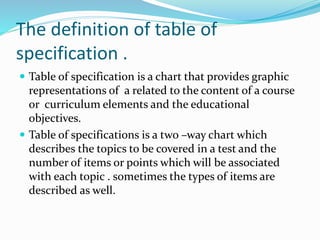
The definition of table of
specification .
 Table of specification is a chart that provides graphic
representations of a related to the content of a course
or curriculum elements and the educational
objectives.
 Table of specifications is a two –way chart which
describes the topics to be covered in a test and the
number of items or points which will be associated
with each topic . sometimes the types of items are
described as well.
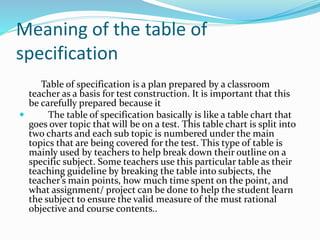
Meaning of the table of
specification
Table of specification is a plan prepared by a classroom
teacher as a basis for test construction. It is important that this
be carefully prepared because it
 The table of specification basically is like a table chart that
goes over topic that will be on a test. This table chart is split into
two charts and each sub topic is numbered under the main
topics that are being covered for the test. This type of table is
mainly used by teachers to help break down their outline on a
specific subject. Some teachers use this particular table as their
teaching guideline by breaking the table into subjects, the
teacher’s main points, how much time spent on the point, and
what assignment/ project can be done to help the student learn
the subject to ensure the valid measure of the must rational
objective and course contents..
What is the purpose of table of
specifications:
 The most important of table of specifications is to
achieve balance in the test and to identify the
achievement domains being measured and to ensure
that a fair and representative sample of questions
appear on the test .
 Table of specifications allow us to ensure that our test
focuses on the most important areas and weights
different areas based on their importance/time spent
teaching . A table of specifications also gives us the
proof we need to make sure our test has content
validity .
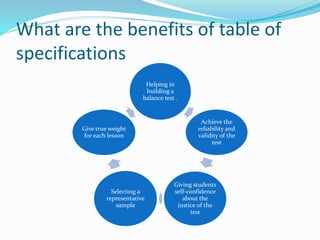
What are the benefits of table of
specifications
Helping in
building a
balance test .
Achieve the
reliability and
validity of the
test
Giving students
self-confidence
about the
justice of the
test
Selecting a
representative
sample
Give true weight
for each lesson
Things should be taken into account
when building a table of
specification s
 Table of specifications are designed based on :
 1-course objective .
 2-topics covered in class.
 3-amount of time spent on those topics .
 4-textbook chapter topics .
 5-emphasis and space provided in the test .
A table of specification could be
designed in 3simle steps:
 1-identify the domain that is to be assessed .
 2-break the domain into levels (e.g knowledge,
comprehension , application, analysis, and synthesis
and evalution)
 3-construct the table
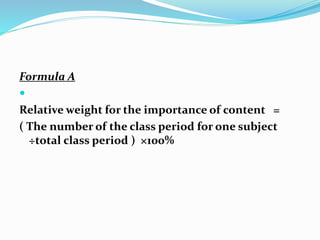
Formula A

Relative weight for the importance of content =
( The number of the class period for one subject
÷total class period ) ×100%
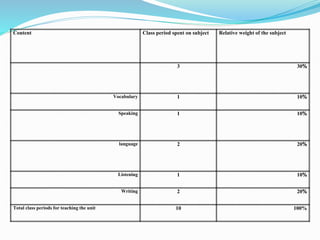
Relative weight of the subjectClass period spent on subjectContent
%303
%101Vocabulary
%101Speaking
%202language
%101Listening
%202Writing
100%10Total class periods for teaching the unit
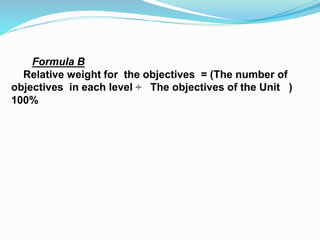
Formula B
Relative weight for the objectives = (The number of
objectives in each level ÷ The objectives of the Unit )
100%
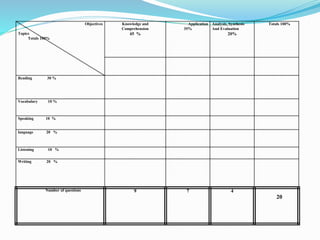
Objectives
Topics
Totals 100%
Knowledge and
Comprehension
45 %
Application
35%
Analysis, Synthesis
And Evaluation
20%
Totals 100%
Reading 30 %
Vocabulary 10 %
Speaking 10 %
language 20 %
Listening 10 %
Writing 20 %
Number of questions 9 7 4
20
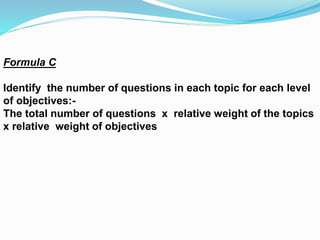
Formula C
Identify the number of questions in each topic for each level
of objectives:-
The total number of questions x relative weight of the topics
x relative weight of objectives
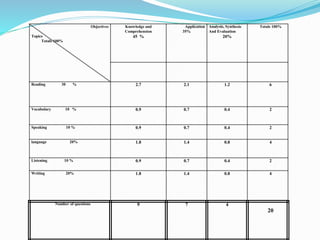
Objectives
Topics
Totals 100%
Knowledge and
Comprehension
45 %
Application
35%
Analysis, Synthesis
And Evaluation
20%
Totals 100%
Reading 30 % 2.7 2.1 1.2 6
Vocabulary 10 % 0.9 0.7 0.4 2
Speaking 10 % 0.9 0.7 0.4 2
language 20% 1.8 1.4 0.8 4
Listening 10 % 0.9 0.7 0.4 2
Writing 20% 1.8 1.4 0.8 4
Number of questions 9 7 4
20
Table of specification

Table of specification

  • 2.
    The definition oftable of specification .  Table of specification is a chart that provides graphic representations of a related to the content of a course or curriculum elements and the educational objectives.  Table of specifications is a two –way chart which describes the topics to be covered in a test and the number of items or points which will be associated with each topic . sometimes the types of items are described as well.
  • 3.
    Meaning of thetable of specification Table of specification is a plan prepared by a classroom teacher as a basis for test construction. It is important that this be carefully prepared because it  The table of specification basically is like a table chart that goes over topic that will be on a test. This table chart is split into two charts and each sub topic is numbered under the main topics that are being covered for the test. This type of table is mainly used by teachers to help break down their outline on a specific subject. Some teachers use this particular table as their teaching guideline by breaking the table into subjects, the teacher’s main points, how much time spent on the point, and what assignment/ project can be done to help the student learn the subject to ensure the valid measure of the must rational objective and course contents..
  • 4.
    What is thepurpose of table of specifications:  The most important of table of specifications is to achieve balance in the test and to identify the achievement domains being measured and to ensure that a fair and representative sample of questions appear on the test .  Table of specifications allow us to ensure that our test focuses on the most important areas and weights different areas based on their importance/time spent teaching . A table of specifications also gives us the proof we need to make sure our test has content validity .
  • 5.
    What are thebenefits of table of specifications Helping in building a balance test . Achieve the reliability and validity of the test Giving students self-confidence about the justice of the test Selecting a representative sample Give true weight for each lesson
  • 6.
    Things should betaken into account when building a table of specification s  Table of specifications are designed based on :  1-course objective .  2-topics covered in class.  3-amount of time spent on those topics .  4-textbook chapter topics .  5-emphasis and space provided in the test .
  • 7.
    A table ofspecification could be designed in 3simle steps:  1-identify the domain that is to be assessed .  2-break the domain into levels (e.g knowledge, comprehension , application, analysis, and synthesis and evalution)  3-construct the table
  • 8.
    Formula A  Relative weightfor the importance of content = ( The number of the class period for one subject ÷total class period ) ×100%
  • 9.
    Relative weight ofthe subjectClass period spent on subjectContent %303 %101Vocabulary %101Speaking %202language %101Listening %202Writing 100%10Total class periods for teaching the unit
  • 10.
    Formula B Relative weightfor the objectives = (The number of objectives in each level ÷ The objectives of the Unit ) 100%
  • 11.
    Objectives Topics Totals 100% Knowledge and Comprehension 45% Application 35% Analysis, Synthesis And Evaluation 20% Totals 100% Reading 30 % Vocabulary 10 % Speaking 10 % language 20 % Listening 10 % Writing 20 % Number of questions 9 7 4 20
  • 12.
    Formula C Identify thenumber of questions in each topic for each level of objectives:- The total number of questions x relative weight of the topics x relative weight of objectives
  • 13.
    Objectives Topics Totals 100% Knowledge and Comprehension 45% Application 35% Analysis, Synthesis And Evaluation 20% Totals 100% Reading 30 % 2.7 2.1 1.2 6 Vocabulary 10 % 0.9 0.7 0.4 2 Speaking 10 % 0.9 0.7 0.4 2 language 20% 1.8 1.4 0.8 4 Listening 10 % 0.9 0.7 0.4 2 Writing 20% 1.8 1.4 0.8 4 Number of questions 9 7 4 20