Preparing a
TABLE OF SPECIFICATION
EDUC 8
ASSESSMENT IN LEARNING 1
JACQUELYN P. SILLADOR
General Objective
Define Table of Specification
Discuss the importance of TOS in test
construction
Construct a Table of Specification
What is
TOS?
Table of Specification
A Table of Specifications is a plan prepared by
classroom teacher as basis for test construction
A tool used to ensure that a test measures the
content and thinking skills that the test intends to
measure
Table of Specification
A Table of Specifications is a test map that guides the teacher in constructing a test.
It helps ensure that the course’s intended outcomes, assessments and instructions
are aligned.
It is a table that maps out the;
test objectives,
contents, or topics covered by the test
the levels of cognitive behavior to be measured
the distribution of test items
number placement and weights of test items
 test format.
What is the
importance of
TOS?
Importance of TOS
1. Ensures that the instructional objectives and what the test captures match
2. Ensures that the test developer will not overlook details that are considered
essential to a good test
3. Ensures that a fair and representative questions appear on the test.
4. Makes developing a test easier and more efficient
5. Ensures that the test will sample all important content areas and processes
6. Improved the validity of teachers’ evaluations based on the test constructed.
7. Offers an opportunity for teachers and students to clarify achievement
expectations
Steps in
Developing
TOS
1. Determine the objectives of the test
There are 3 types of objectives:
• cognitive
• affective
• psychomotor
When planning for assessment, choose only the
objectives that can be best captured by a written test.
2. Determine the coverage of the test
Only topics or contents that
have been discussed in class
should be included in the test.
3. Calculate the weight for each topic
The weight assigned per topic in the test is based on the
time spent to cover each topic during instruction. The
percentage of time for a topic in a test is determined by
dividing the time spent for that topic during instruction by
the total amount of time spent for all topics covered in the
test.
4. Determine the number of items for the whole test.
As a general rule, students are given 30-60
seconds for each item in test formats with
choices. For a one- hour class, this means that
the test should not exceed 60 items
5. Determine the number of items per topic
To determine the number of
items to be included in the test, the
weights per topic are considered.
Determine the number of items per topic
Formats
of TOS
One-way TOS
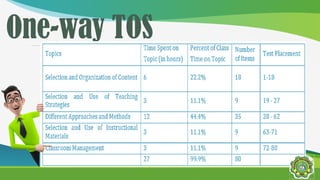
A one-way TOS maps out the content or topic test
objectives, number of hours spent, format number
and placement of items. A one-way TOS cannot ensure
that all levels of cognitive behaviors that should have
been developed by the course are covered in the test.
One-way TOS
Two-Way TOS
A two-way TOS reflects not only the content, time spent,
and the number of items but also the levels of cognitive
behavior targeted per test content. One advantage of this
format is that it allows one to see the levels of cognitive
skills and dimensions of knowledge that are emphasized
by the test.
Two-Way TOS
TOS.pptx TABLE OF SPECIFICATIONS .CTTO.HTT

TOS.pptx TABLE OF SPECIFICATIONS .CTTO.HTT

  • 1.
    Preparing a TABLE OFSPECIFICATION EDUC 8 ASSESSMENT IN LEARNING 1 JACQUELYN P. SILLADOR
  • 2.
    General Objective Define Tableof Specification Discuss the importance of TOS in test construction Construct a Table of Specification
  • 3.
  • 4.
    Table of Specification ATable of Specifications is a plan prepared by classroom teacher as basis for test construction A tool used to ensure that a test measures the content and thinking skills that the test intends to measure
  • 5.
    Table of Specification ATable of Specifications is a test map that guides the teacher in constructing a test. It helps ensure that the course’s intended outcomes, assessments and instructions are aligned. It is a table that maps out the; test objectives, contents, or topics covered by the test the levels of cognitive behavior to be measured the distribution of test items number placement and weights of test items  test format.
  • 6.
  • 7.
    Importance of TOS 1.Ensures that the instructional objectives and what the test captures match 2. Ensures that the test developer will not overlook details that are considered essential to a good test 3. Ensures that a fair and representative questions appear on the test. 4. Makes developing a test easier and more efficient 5. Ensures that the test will sample all important content areas and processes 6. Improved the validity of teachers’ evaluations based on the test constructed. 7. Offers an opportunity for teachers and students to clarify achievement expectations
  • 8.
  • 9.
    1. Determine theobjectives of the test There are 3 types of objectives: • cognitive • affective • psychomotor When planning for assessment, choose only the objectives that can be best captured by a written test.
  • 10.
    2. Determine thecoverage of the test Only topics or contents that have been discussed in class should be included in the test.
  • 11.
    3. Calculate theweight for each topic The weight assigned per topic in the test is based on the time spent to cover each topic during instruction. The percentage of time for a topic in a test is determined by dividing the time spent for that topic during instruction by the total amount of time spent for all topics covered in the test.
  • 12.
    4. Determine thenumber of items for the whole test. As a general rule, students are given 30-60 seconds for each item in test formats with choices. For a one- hour class, this means that the test should not exceed 60 items
  • 13.
    5. Determine thenumber of items per topic To determine the number of items to be included in the test, the weights per topic are considered.
  • 14.
    Determine the numberof items per topic
  • 15.
  • 16.
    One-way TOS A one-wayTOS maps out the content or topic test objectives, number of hours spent, format number and placement of items. A one-way TOS cannot ensure that all levels of cognitive behaviors that should have been developed by the course are covered in the test.
  • 17.
  • 18.
    Two-Way TOS A two-wayTOS reflects not only the content, time spent, and the number of items but also the levels of cognitive behavior targeted per test content. One advantage of this format is that it allows one to see the levels of cognitive skills and dimensions of knowledge that are emphasized by the test.
  • 19.

Editor's Notes

  • #9 There are objectives that are not meant for a written test. For example, if you test the psychomotor domain, it is better to do a performance-based assessment. Those that require demonstration or creation of something tangible like projects would also be more appropriately measured by performance-based assessment. For a written test, you can consider cognitive objectives that could be measured using common formats for testing.
  • #10 There are objectives that are not meant for a written test. For example, if you test the psychomotor domain, it is better to do a performance-based assessment. Those that require demonstration or creation of something tangible like projects would also be more appropriately measured by performance-based assessment. For a written test, you can consider cognitive objectives that could be measured using common formats for testing.
  • #11 There are objectives that are not meant for a written test. For example, if you test the psychomotor domain, it is better to do a performance-based assessment. Those that require demonstration or creation of something tangible like projects would also be more appropriately measured by performance-based assessment. For a written test, you can consider cognitive objectives that could be measured using common formats for testing.
  • #12 There are objectives that are not meant for a written test. For example, if you test the psychomotor domain, it is better to do a performance-based assessment. Those that require demonstration or creation of something tangible like projects would also be more appropriately measured by performance-based assessment. For a written test, you can consider cognitive objectives that could be measured using common formats for testing.
  • #13 There are objectives that are not meant for a written test. For example, if you test the psychomotor domain, it is better to do a performance-based assessment. Those that require demonstration or creation of something tangible like projects would also be more appropriately measured by performance-based assessment. For a written test, you can consider cognitive objectives that could be measured using common formats for testing.
  • #16 There are objectives that are not meant for a written test. For example, if you test the psychomotor domain, it is better to do a performance-based assessment. Those that require demonstration or creation of something tangible like projects would also be more appropriately measured by performance-based assessment. For a written test, you can consider cognitive objectives that could be measured using common formats for testing.
  • #17 There are objectives that are not meant for a written test. For example, if you test the psychomotor domain, it is better to do a performance-based assessment. Those that require demonstration or creation of something tangible like projects would also be more appropriately measured by performance-based assessment. For a written test, you can consider cognitive objectives that could be measured using common formats for testing.
  • #18 There are objectives that are not meant for a written test. For example, if you test the psychomotor domain, it is better to do a performance-based assessment. Those that require demonstration or creation of something tangible like projects would also be more appropriately measured by performance-based assessment. For a written test, you can consider cognitive objectives that could be measured using common formats for testing.
  • #19 There are objectives that are not meant for a written test. For example, if you test the psychomotor domain, it is better to do a performance-based assessment. Those that require demonstration or creation of something tangible like projects would also be more appropriately measured by performance-based assessment. For a written test, you can consider cognitive objectives that could be measured using common formats for testing.