Table of Specifications
“Classroom tests provide teachers with
essential information used to make
decisions about instruction and student
grades. A table of specification (TOS) can
be used to help teachers frame the decision
making process of test construction and
improve the validity of teachers’ evaluations
based on tests constructed for classroom
use.”
- Fives and DiDonato-Barnes (2013)
Table of Specifications (TOS)
A TOS, sometimes called a test blueprint, is a
table that helps teachers align objectives,
instruction, and assessment.
(Notar, Zuelke, Wilson, & Yunker,2004)
A table of specifications or TOS is a test map that
guides the teacher in constructing a test. (Navarro
and Santos, 2012)
Table of Specifications (TOS)
The TOS can be used in conjunction
with lesson and unit planning to help
teacher make clear the connections
between planning, instruction, and
assessment.
A TOS is one tool that teachers can use
to support their professional judgment
when creating or selecting test for use
with their students.
- Fives and DiDonato-Barnes (2013)
Importance of TOS
 useful to organize the planning process of
designing a test which allows the teacher to
determine the content of the test.
 helps teachers align objectives, instruction
and assessment
 ensures proper emphasis given to all elements
of a course of study
Importance of TOS
 ascertains content validity
 clearly defines the scope and relates objectives
to the content in order to ensure a balanced
test items.
 it helps to provide for optimal learning on the
part of students and optimal teaching
efficiency on the part of the teacher.
Significance and Components
of Table of Specifications
- Kubiszyn and Borich (2003) as cited by Melchor (2013)
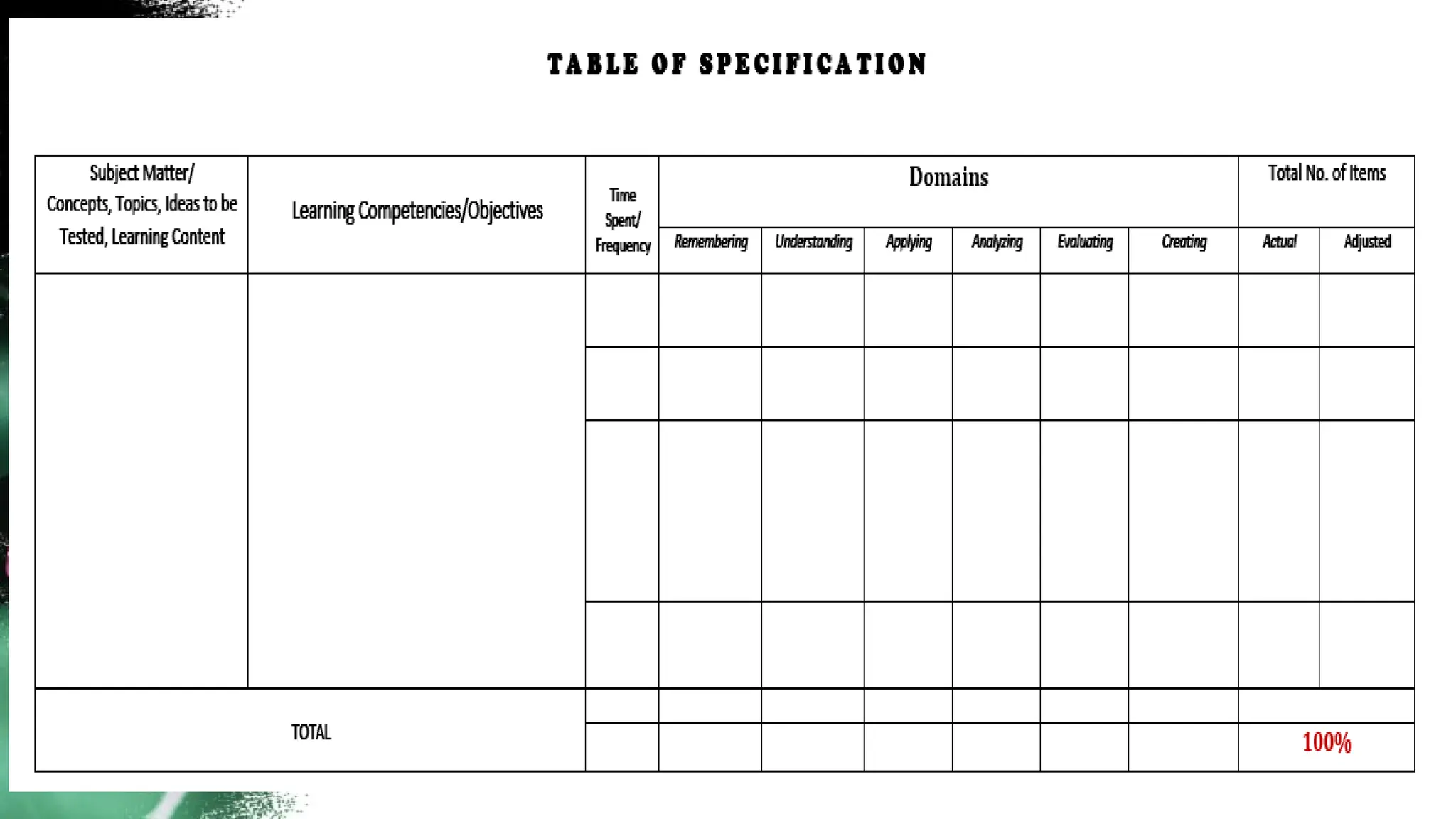
1. A table of specifications (TOS)
consists of a two-way chart or grid
relating instructional objectives to the
instructional content.
- The column of the chart lists the
objectives or levels of skills to be
addressed
- The rows list the key concepts or
content the test is to measure
Significance and Components
of Table of Specifications
- Kubiszyn and Borich (2003) as cited by Melchor (2013)
2. A table of specifications identifies not only the
content areas covered in class but also the
performance objectives at each level of the cognitive
domain of Bloom’s Taxonomy.
3. A table of specifications is developed before the test
is written. In fact, it should be constructed before the
actual teaching begins.
Significance and Components
of Table of Specifications
- Kubiszyn and Borich (2003) as cited by Melchor (2013)
4. The purpose of a TOS is to identify the
achievement domains being measured and to
ensure that a fair and representative sample of
questions appear on the test.
5. A TOS benefits students in two ways – it
improves the validity of teacher-made tests, it
can improve student learning as well.
Significance and Components
of Table of Specifications
- Kubiszyn and Borich (2003) as cited by Melchor (2013)
6. A TOS helps to ensure that there is a match between what
is taught and what is tested.
-Classroom assessment should be driven by classroom
teaching which itself is driven by course goals and objectives
-TOS provides the link between teaching and testing
(University of Kansas, 2013)
Constructing the Table of Specifications
To align the assessment process with the
K to 12 Basic Education Program, the
adapted Cognitive Process Dimensions by
Anderson and Krathwohl (2005) will be
adopted in constructing the table of
specifications (TOS) for summative
assessment specifically for the quarterly
examinations.
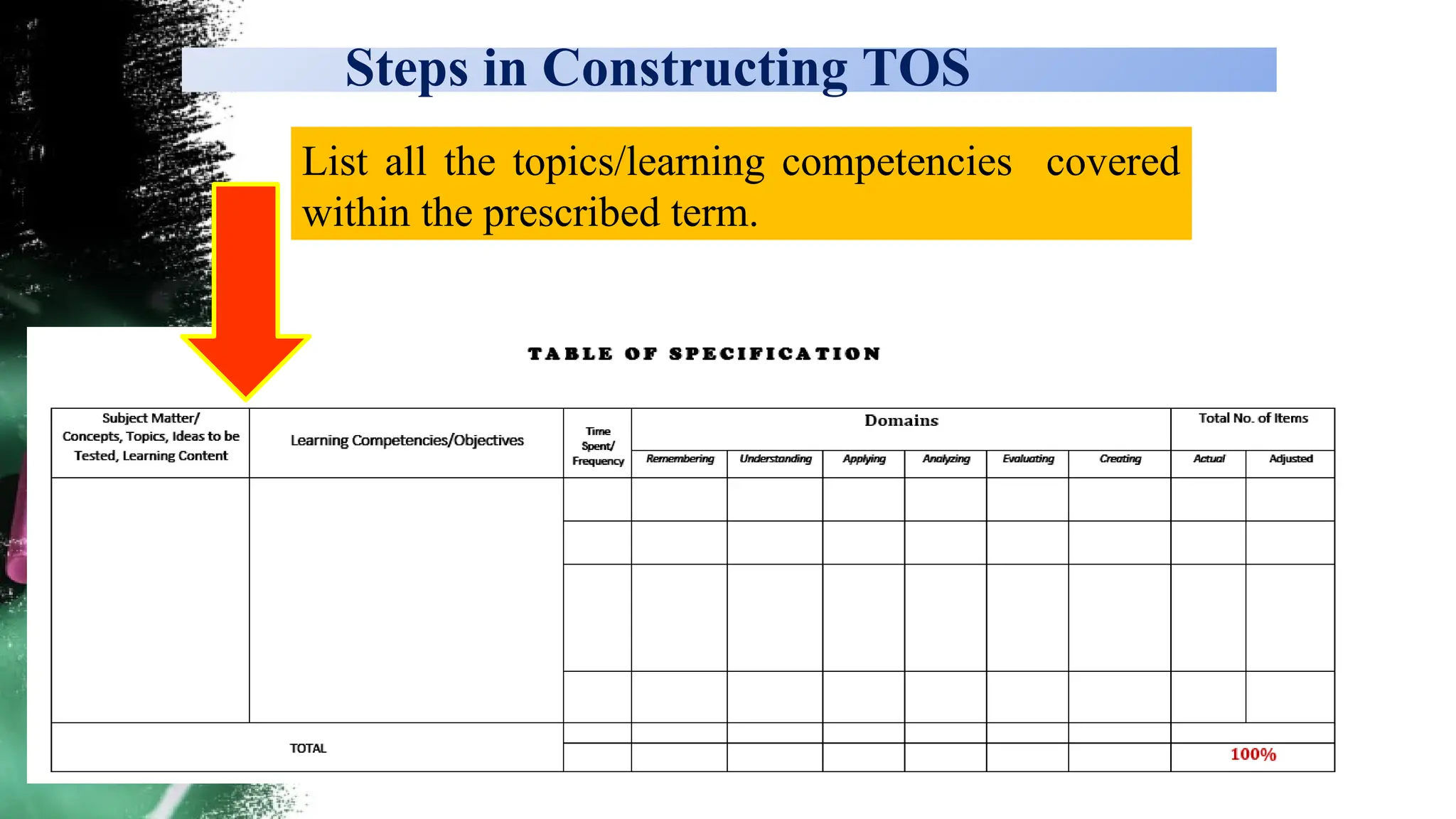
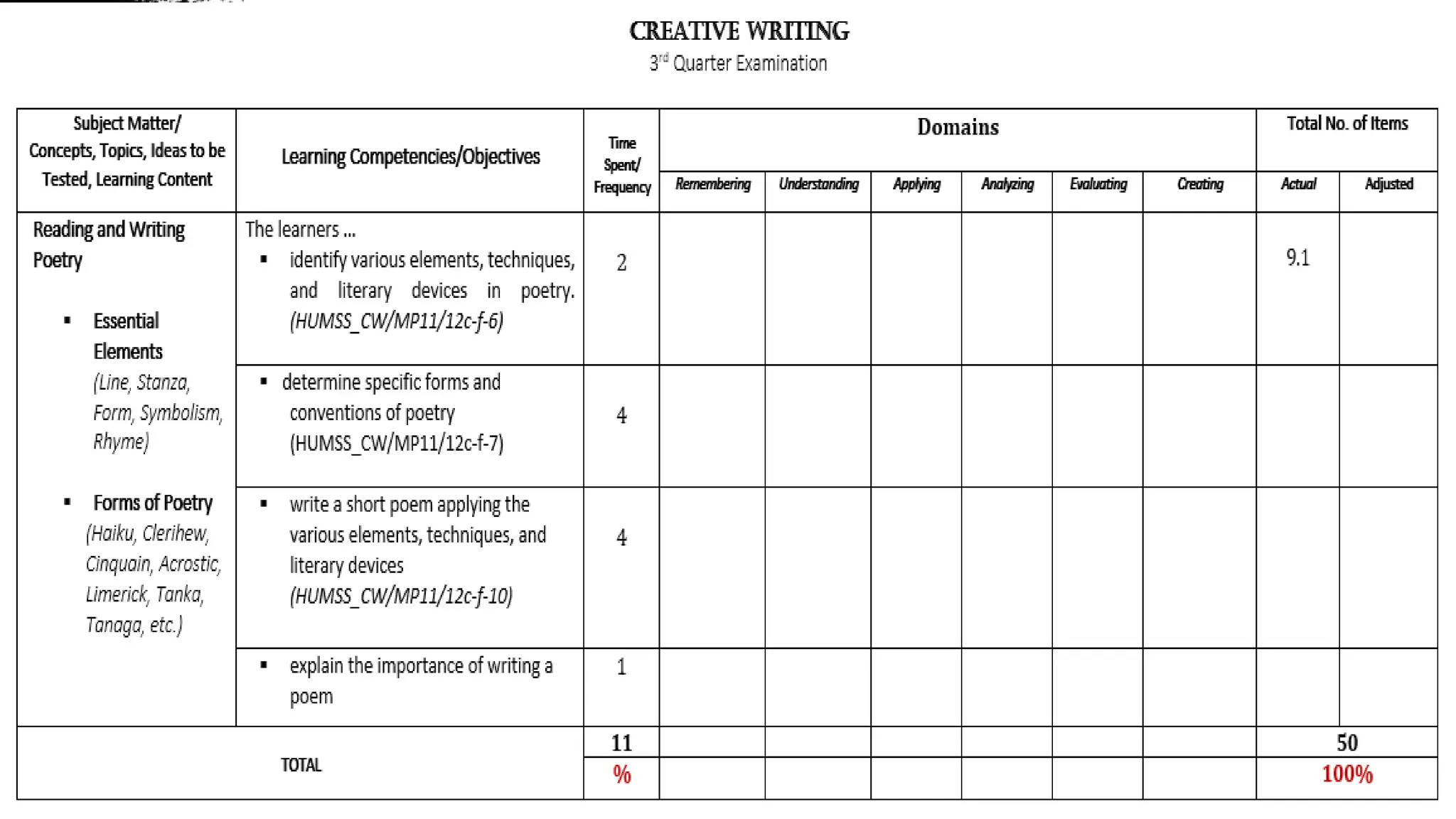
Steps in Constructing TOS
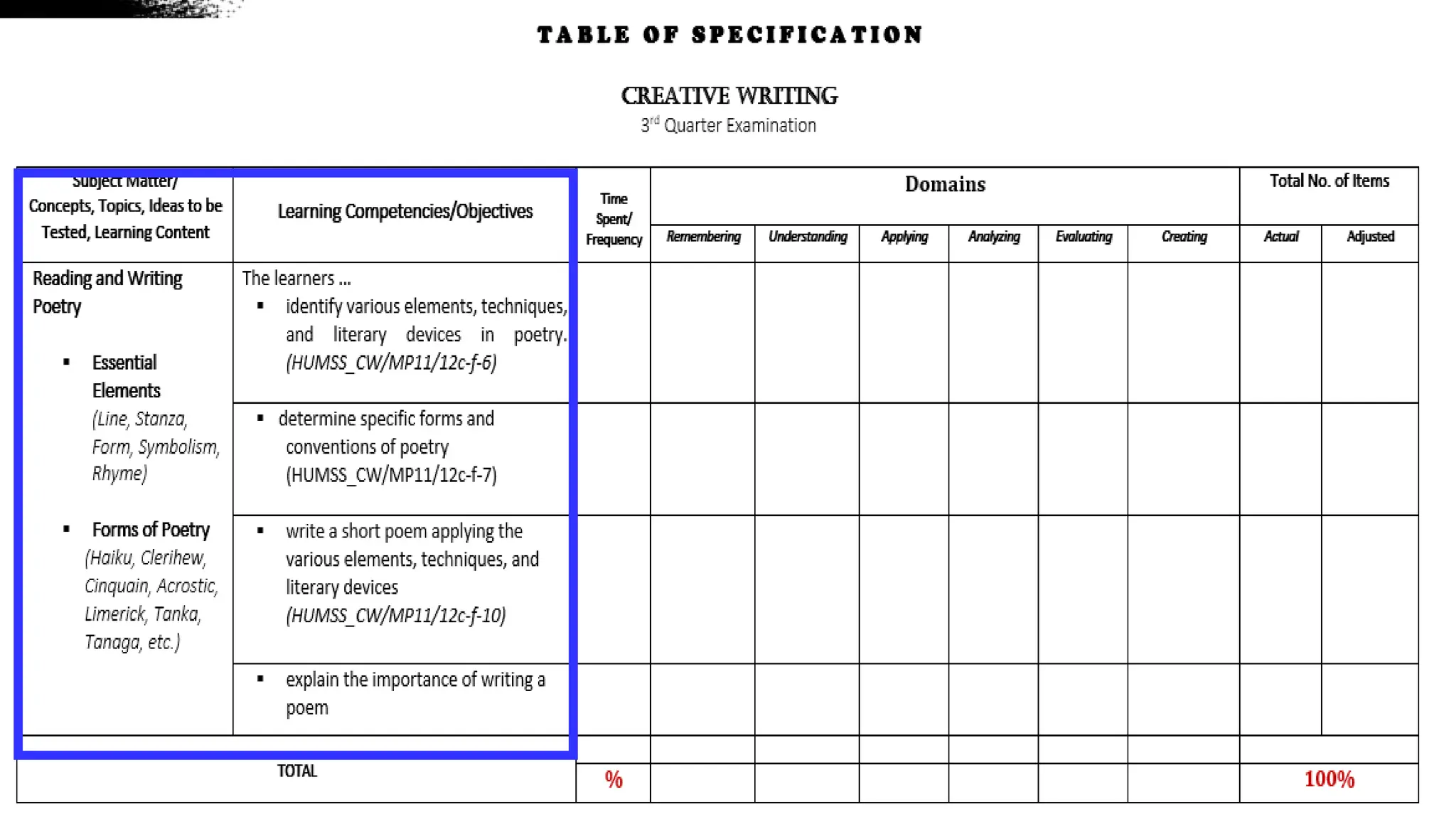
List all the topics/learning competencies covered
within the prescribed term.
Steps in Constructing TOS
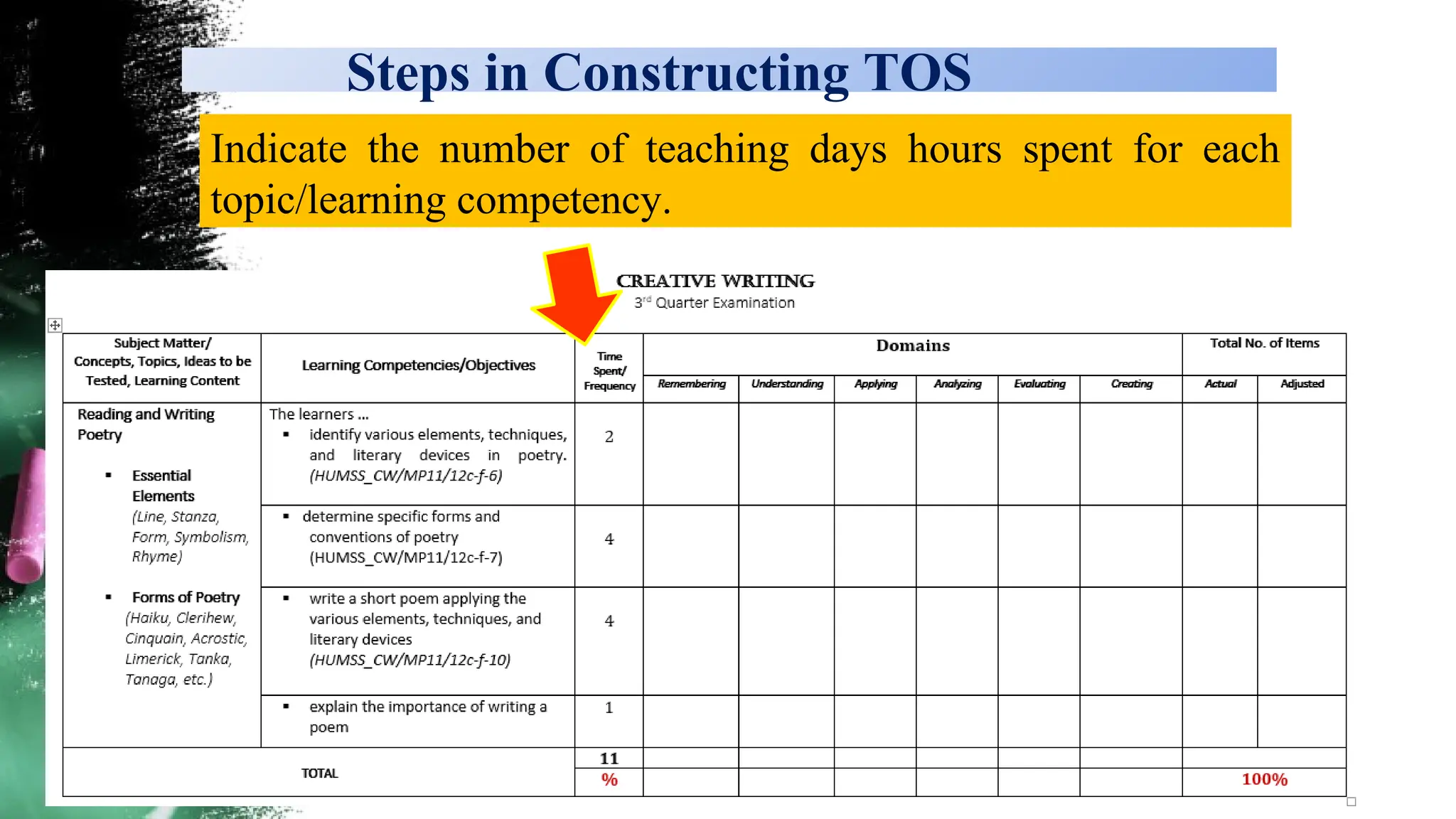
Indicate the number of teaching days hours spent for each
topic/learning competency.
45
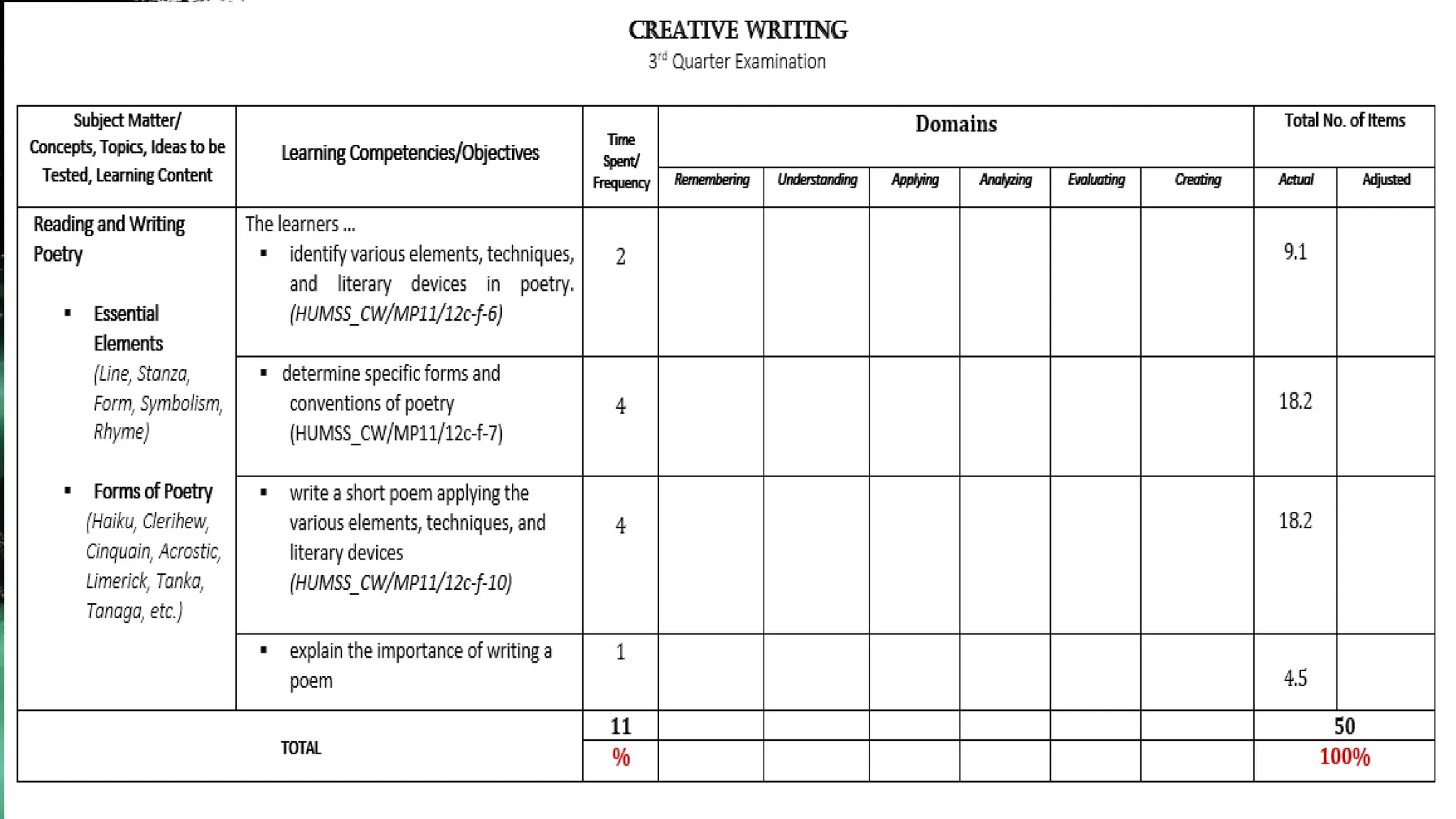
Steps in Constructing TOS
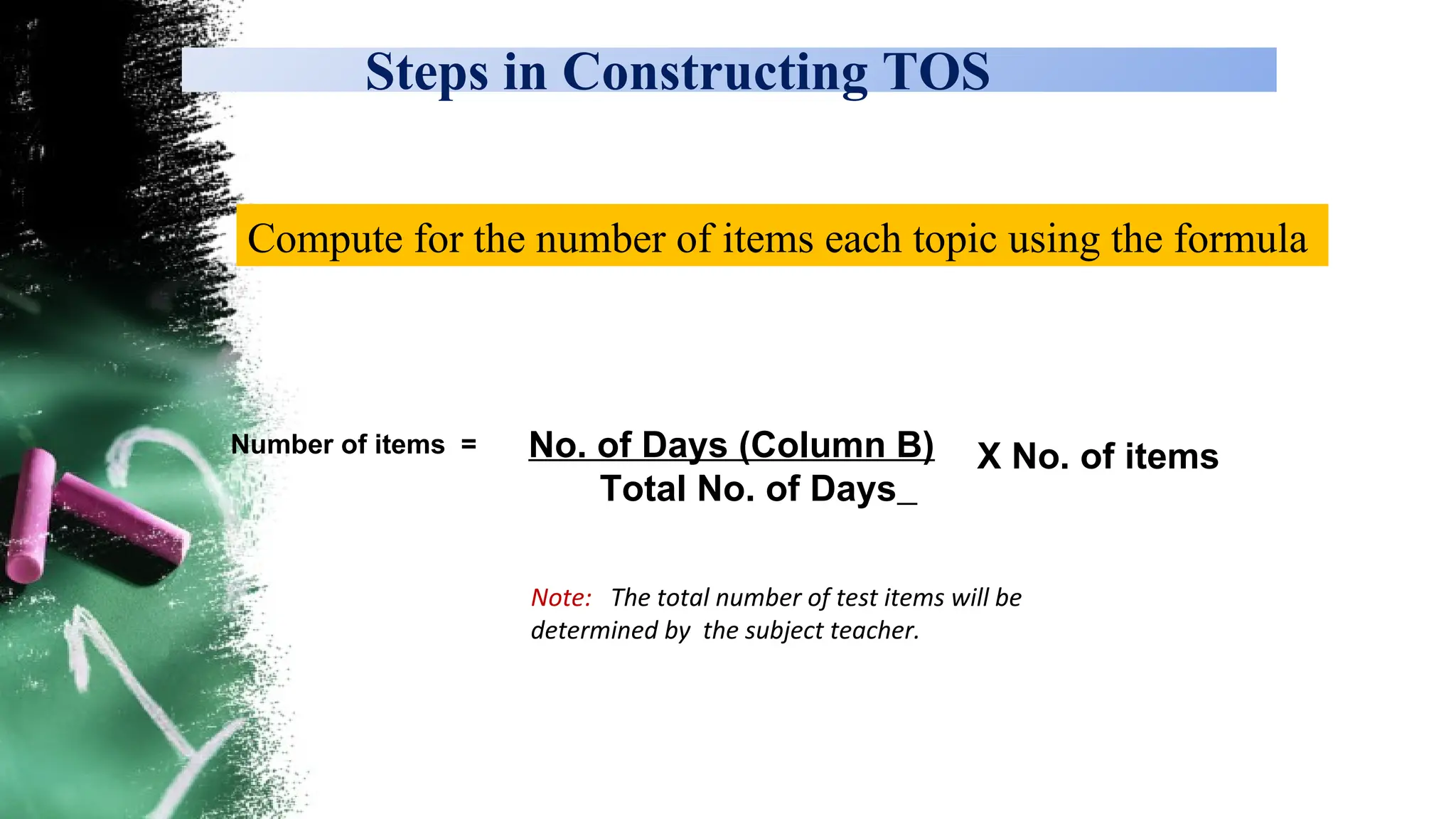
Compute for the number of items each topic using the formula
No. of Days (Column B)
Total No. of Days
X No. of items
Number of items =
Note: The total number of test items will be
determined by the subject teacher.
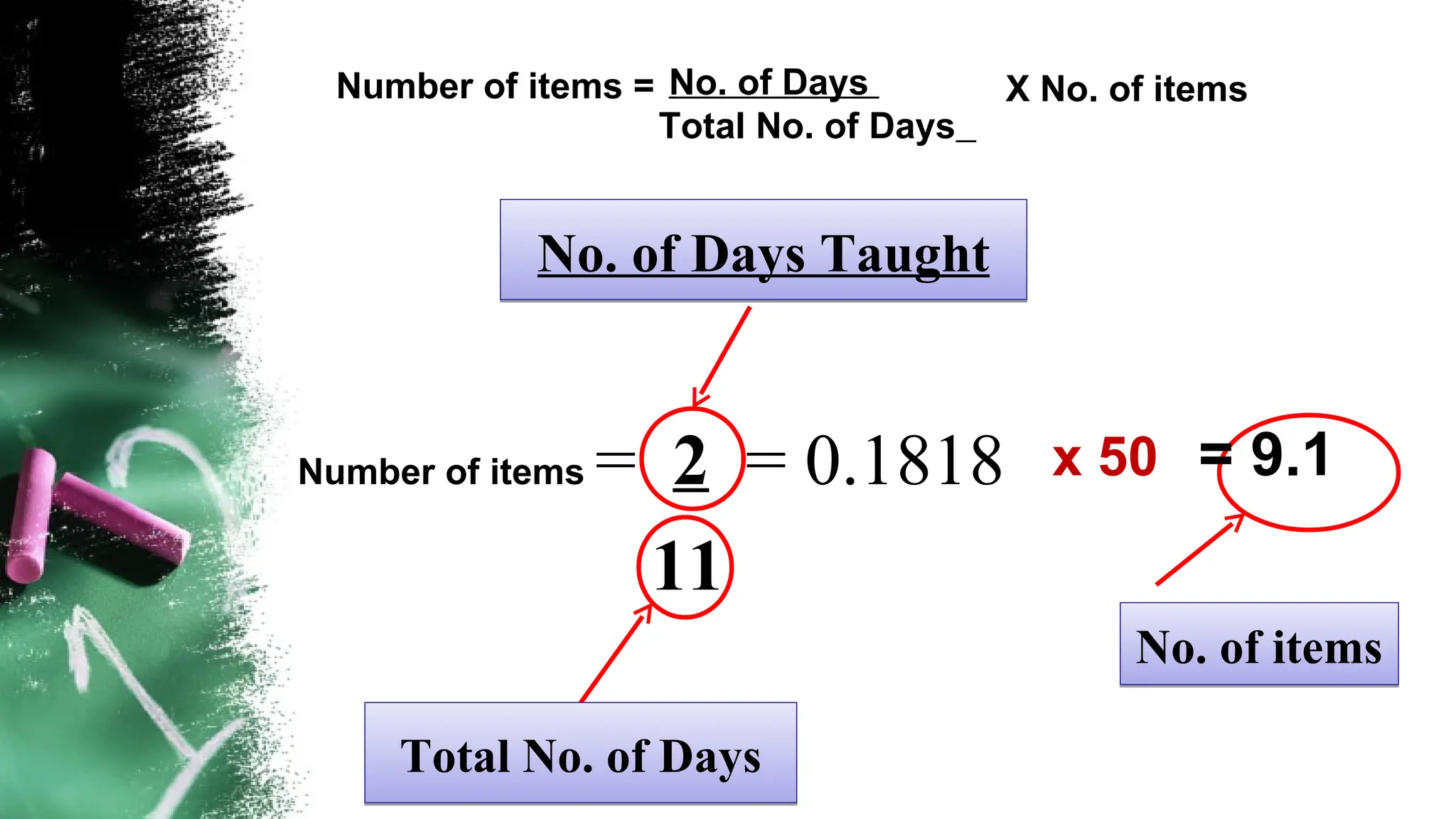
No. of Days
Total No. of Days
Number of items =
Number of items = 2 = 0.1818
11
No. of Days Taught
No. of Days Taught
Total No. of Days
Total No. of Days
No. of items
No. of items
X No. of items
x 50 = 9.1
Steps in Constructing TOS
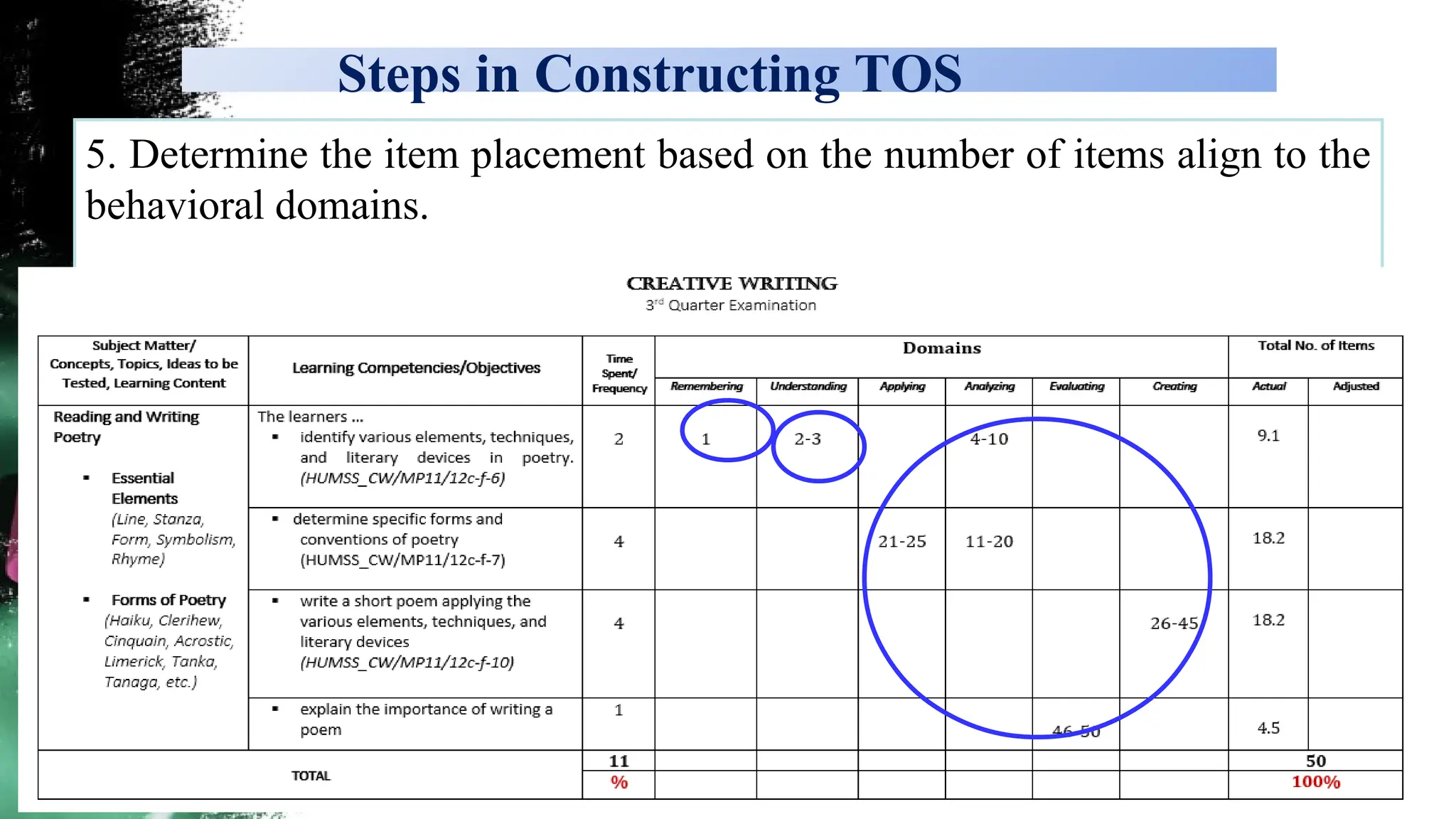
5. Determine the item placement based on the number of items align to the
behavioral domains.
Steps in Constructing TOS
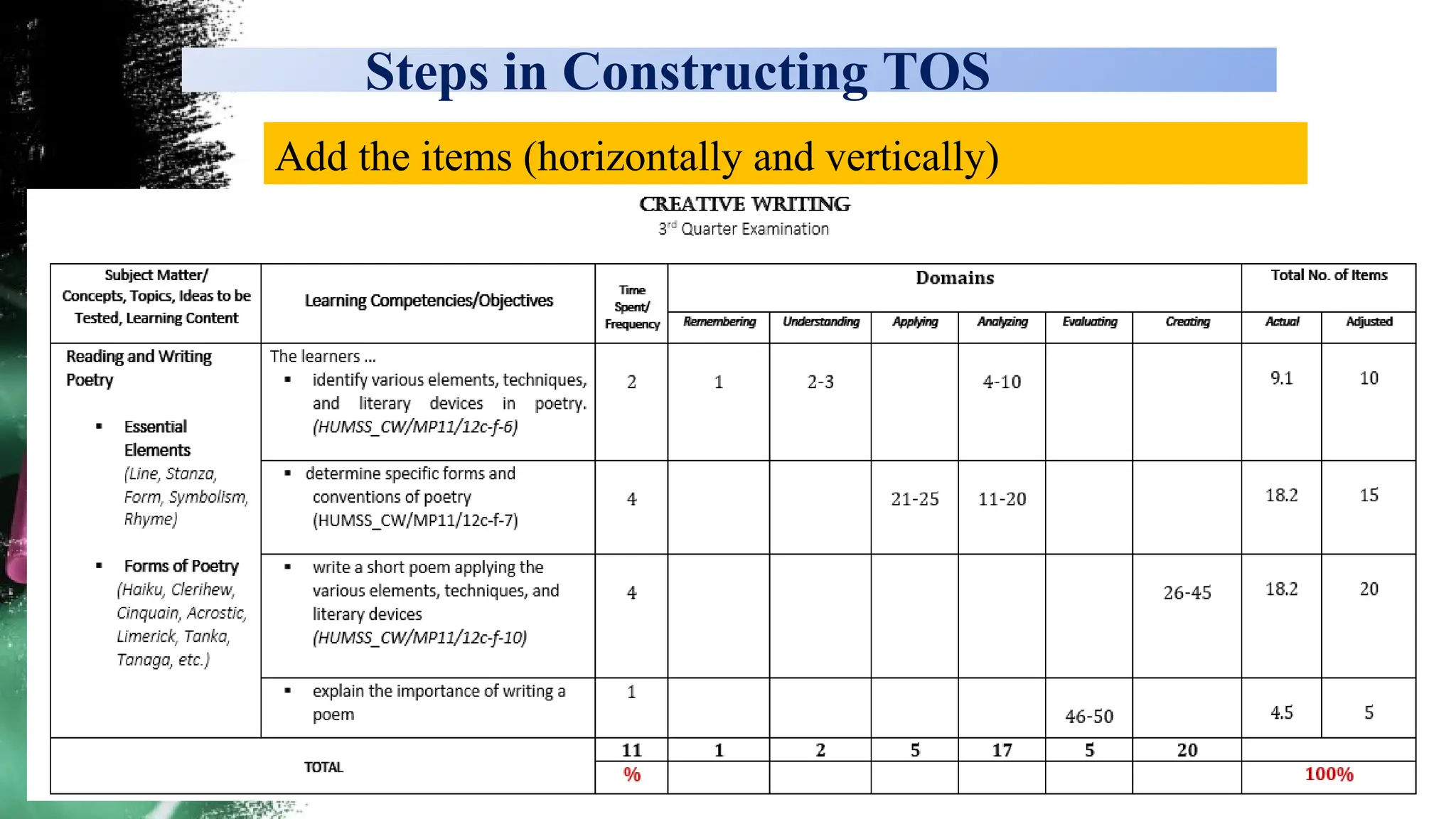
Add the items (horizontally and vertically)
Steps in Constructing TOS
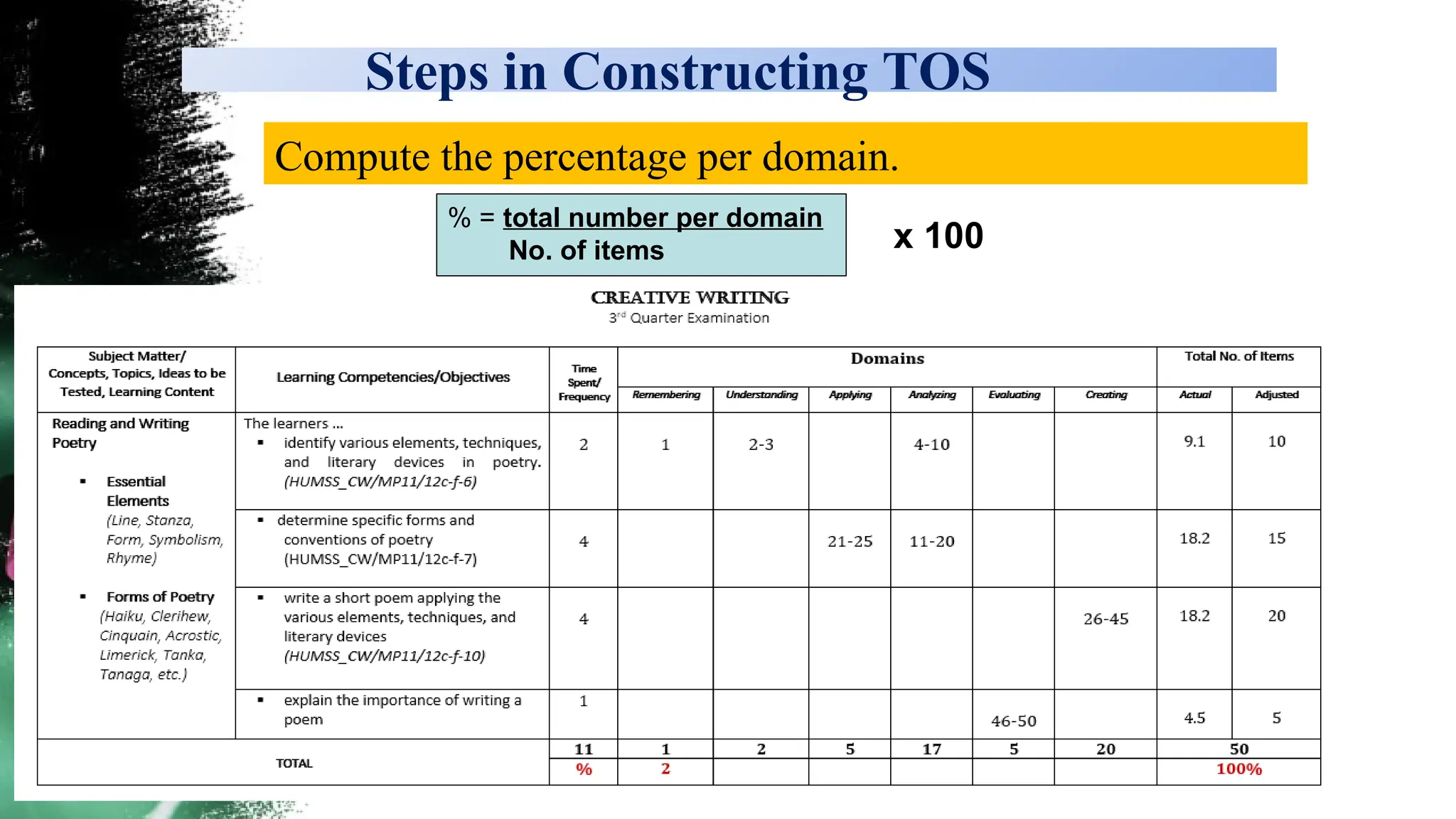
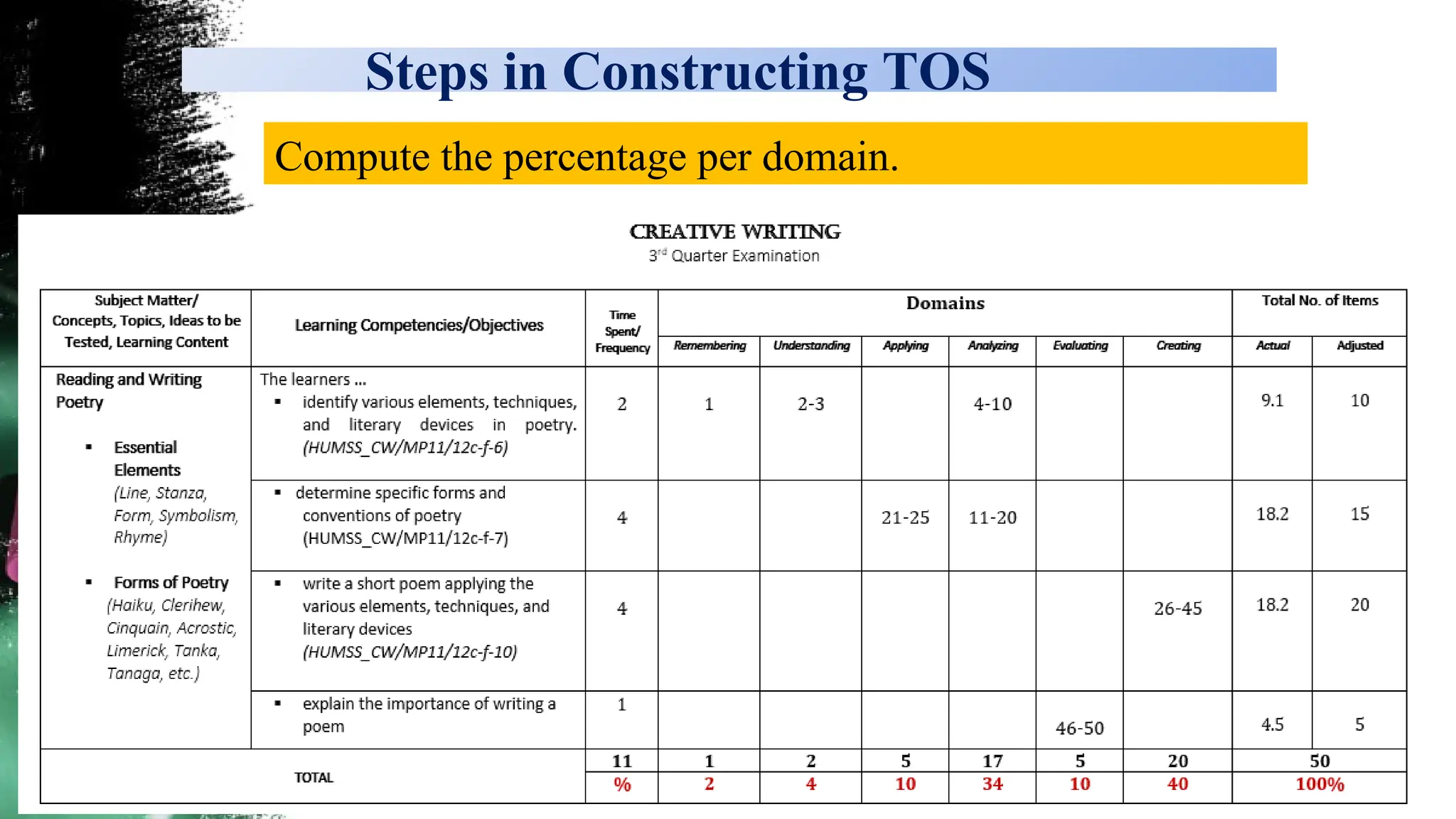
Compute the percentage per domain.
% = total number per domain
No. of items x 100
Steps in Constructing TOS
Compute the percentage per domain.
REFERENCES
DepEd Order No. 79, series 2003
DepEd Order No. 82, series 2003
DepEd Order No. 73, series 2012
Deped Order No. 8, series 2015
Downing, S. M., T. M. Haladyna (editors), Handbook of Test Development,
Mahwah, NJ: Lawrence Erlbaum, 2006
Tarrant, M., J. Ware, A. Mohammed, An assessment of functioning and
nonfunctioning distractors in multiple-choice questions: a descriptive analysis,
http://www.springerlink.com/content/e8k8618552465484/fulltext.pdf, 2009
REFERENCES
Alade, O.M. and Omoruyi, I.V. (2014). Table of Specification and Its
Relevance in Educational Development Assessment. European Journal of
Educational and Development Psychology Vol.2, No.1, pp.1-17, March 2014
Devine, M. & Yaghlian, N. Test Construction Manual (Construction of
Objective Tests). Accessed November 3, 2017 from www.cte.cornell.edu
Rivera, A. (2016). Table of Specifications with an Overview of Test
Construction. Accessed November 3, 2017 from
http://www.slideshare.net/sirarnelPHhistory
Rivera, A. (2016). Test Construction: The Art of Effective Evaluation.
Accessed November 3, 2017 from http://www.slideshare.net/ArnelSSI
REFERENCES
Anderson, L.W. (Ed.), Krathwohl, D.R. (Ed.), Airasian, P.W., Cruikshank, K.A., Mayer, R.E.,
Pintrich, P.R., Raths, J., & Wittrock, M.C. (2001). A taxonomy for learning, teaching, and
assessing: A revision of Bloom's Taxonomy of Educational Objectives (Complete edition). New
York: Longman.
Fives, Helenrose & DiDonato-Barnes, Nicole (2013). Classroom Test Construction: The Power
of a Table of Specifications. Practical Assessment, Research & Evaluation, 18(3). Available
online: http://pareonline.net/getvn.asp?v=18&n=3
Notar, C.E., Zuelke, D. C., Wilson, J. D. & Yunker, B. D. (2004). The table of specifications:
Insuring accountability in teacher made tests. Journal of Instructional Psychology, 31, 115-129.
Ivanova, V. Construction and Evaluation of Achievement Test in English. Accessed November 3,
2017 from
http://sci-gems.math.bas.bg/jspui/bitstream/10525/1554/1/adis-may-2011-276p-285p.pdf
https://polguart.wordpress.com/2010/03/17/module-3-teacher-made-test-construction/

TOS_Presentation-2024 Assessment of Learning.pdf

  • 4.
    Table of Specifications “Classroomtests provide teachers with essential information used to make decisions about instruction and student grades. A table of specification (TOS) can be used to help teachers frame the decision making process of test construction and improve the validity of teachers’ evaluations based on tests constructed for classroom use.” - Fives and DiDonato-Barnes (2013)
  • 5.
    Table of Specifications(TOS) A TOS, sometimes called a test blueprint, is a table that helps teachers align objectives, instruction, and assessment. (Notar, Zuelke, Wilson, & Yunker,2004) A table of specifications or TOS is a test map that guides the teacher in constructing a test. (Navarro and Santos, 2012)
  • 6.
    Table of Specifications(TOS) The TOS can be used in conjunction with lesson and unit planning to help teacher make clear the connections between planning, instruction, and assessment. A TOS is one tool that teachers can use to support their professional judgment when creating or selecting test for use with their students. - Fives and DiDonato-Barnes (2013)
  • 7.
    Importance of TOS useful to organize the planning process of designing a test which allows the teacher to determine the content of the test.  helps teachers align objectives, instruction and assessment  ensures proper emphasis given to all elements of a course of study
  • 8.
    Importance of TOS ascertains content validity  clearly defines the scope and relates objectives to the content in order to ensure a balanced test items.  it helps to provide for optimal learning on the part of students and optimal teaching efficiency on the part of the teacher.
  • 9.
    Significance and Components ofTable of Specifications - Kubiszyn and Borich (2003) as cited by Melchor (2013) 1. A table of specifications (TOS) consists of a two-way chart or grid relating instructional objectives to the instructional content. - The column of the chart lists the objectives or levels of skills to be addressed - The rows list the key concepts or content the test is to measure
  • 10.
    Significance and Components ofTable of Specifications - Kubiszyn and Borich (2003) as cited by Melchor (2013) 2. A table of specifications identifies not only the content areas covered in class but also the performance objectives at each level of the cognitive domain of Bloom’s Taxonomy. 3. A table of specifications is developed before the test is written. In fact, it should be constructed before the actual teaching begins.
  • 11.
    Significance and Components ofTable of Specifications - Kubiszyn and Borich (2003) as cited by Melchor (2013) 4. The purpose of a TOS is to identify the achievement domains being measured and to ensure that a fair and representative sample of questions appear on the test. 5. A TOS benefits students in two ways – it improves the validity of teacher-made tests, it can improve student learning as well.
  • 12.
    Significance and Components ofTable of Specifications - Kubiszyn and Borich (2003) as cited by Melchor (2013) 6. A TOS helps to ensure that there is a match between what is taught and what is tested. -Classroom assessment should be driven by classroom teaching which itself is driven by course goals and objectives -TOS provides the link between teaching and testing (University of Kansas, 2013)
  • 13.
    Constructing the Tableof Specifications To align the assessment process with the K to 12 Basic Education Program, the adapted Cognitive Process Dimensions by Anderson and Krathwohl (2005) will be adopted in constructing the table of specifications (TOS) for summative assessment specifically for the quarterly examinations.
  • 15.
    Steps in ConstructingTOS List all the topics/learning competencies covered within the prescribed term.
  • 17.
    Steps in ConstructingTOS Indicate the number of teaching days hours spent for each topic/learning competency. 45
  • 18.
    Steps in ConstructingTOS Compute for the number of items each topic using the formula No. of Days (Column B) Total No. of Days X No. of items Number of items = Note: The total number of test items will be determined by the subject teacher.
  • 19.
    No. of Days TotalNo. of Days Number of items = Number of items = 2 = 0.1818 11 No. of Days Taught No. of Days Taught Total No. of Days Total No. of Days No. of items No. of items X No. of items x 50 = 9.1
  • 22.
    Steps in ConstructingTOS 5. Determine the item placement based on the number of items align to the behavioral domains.
  • 23.
    Steps in ConstructingTOS Add the items (horizontally and vertically)
  • 24.
    Steps in ConstructingTOS Compute the percentage per domain. % = total number per domain No. of items x 100
  • 25.
    Steps in ConstructingTOS Compute the percentage per domain.
  • 29.
    REFERENCES DepEd Order No.79, series 2003 DepEd Order No. 82, series 2003 DepEd Order No. 73, series 2012 Deped Order No. 8, series 2015 Downing, S. M., T. M. Haladyna (editors), Handbook of Test Development, Mahwah, NJ: Lawrence Erlbaum, 2006 Tarrant, M., J. Ware, A. Mohammed, An assessment of functioning and nonfunctioning distractors in multiple-choice questions: a descriptive analysis, http://www.springerlink.com/content/e8k8618552465484/fulltext.pdf, 2009
  • 30.
    REFERENCES Alade, O.M. andOmoruyi, I.V. (2014). Table of Specification and Its Relevance in Educational Development Assessment. European Journal of Educational and Development Psychology Vol.2, No.1, pp.1-17, March 2014 Devine, M. & Yaghlian, N. Test Construction Manual (Construction of Objective Tests). Accessed November 3, 2017 from www.cte.cornell.edu Rivera, A. (2016). Table of Specifications with an Overview of Test Construction. Accessed November 3, 2017 from http://www.slideshare.net/sirarnelPHhistory Rivera, A. (2016). Test Construction: The Art of Effective Evaluation. Accessed November 3, 2017 from http://www.slideshare.net/ArnelSSI
  • 31.
    REFERENCES Anderson, L.W. (Ed.),Krathwohl, D.R. (Ed.), Airasian, P.W., Cruikshank, K.A., Mayer, R.E., Pintrich, P.R., Raths, J., & Wittrock, M.C. (2001). A taxonomy for learning, teaching, and assessing: A revision of Bloom's Taxonomy of Educational Objectives (Complete edition). New York: Longman. Fives, Helenrose & DiDonato-Barnes, Nicole (2013). Classroom Test Construction: The Power of a Table of Specifications. Practical Assessment, Research & Evaluation, 18(3). Available online: http://pareonline.net/getvn.asp?v=18&n=3 Notar, C.E., Zuelke, D. C., Wilson, J. D. & Yunker, B. D. (2004). The table of specifications: Insuring accountability in teacher made tests. Journal of Instructional Psychology, 31, 115-129. Ivanova, V. Construction and Evaluation of Achievement Test in English. Accessed November 3, 2017 from http://sci-gems.math.bas.bg/jspui/bitstream/10525/1554/1/adis-may-2011-276p-285p.pdf https://polguart.wordpress.com/2010/03/17/module-3-teacher-made-test-construction/