Spore-Forming Gram + Rods
Bacillus & Clostridium
 Gram positive rods.
 Form endospores. (heat & cold resistance spores)
 Either strict aerobes or aerotolerant anaerobes (that
is, they can grow in the presence of O2 BUT don’t
require it).
 Two medically important bacillus spp. B.anthracis &
B.cereus.
 Most of the bacillus spp. Are found in soil, water and
as airborne contaminants in medical laboratory.
 Bacillus anthracis, cause Anthrax is most important
member of this genus.
General Characteristics of Bacillus
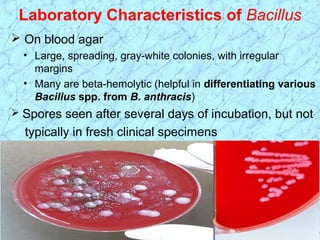
 On blood agar
• Large, spreading, gray-white colonies, with irregular
margins
• Many are beta-hemolytic (helpful in differentiating various
Bacillus spp. from B. anthracis)
 Spores seen after several days of incubation, but not
typically in fresh clinical specimens
Laboratory Characteristics of Bacillus
Bacillus anthracis
Properties of Bacillus anthracis
Large gram + rod.
Square ends, frequently found in chains.
Antiphagocytic capsule is composed of D-glutamate. (This
is unique capsules of other bacteria are polysaccharide).
Nonmotile, other members of the genus are motile.
Culture on blood agar.
3 forms of anthrax:
Cutaneous Painless ulcer with a black eschar.
pulmonary – inhalation of spores
gastrointestinal – ingested spores
Laboratory diagnosis
Cultured on blood agar, B.anthracis forms
large, grayish, nonhemolytic colonies with
irregular borders.
A direct immunofluorescence assay aids in
the identification of the organism.
Q. What’s the reason that Spore are usually not
seen in smears of exudate?
Laboratory diagnosis
Ans. Because spores form when nutrients are
insufficient and plentiful in infected tissue.
B.anthracis – gram stain. Arrow points to Skin lesion, a necrotic lesion covered
Edema and necrosis
around eye
Inhalation anthrax with
bilateral pneumonia, more
severe in left lower lung.
Bacillus anthracis
viewed under fluorescence
microscope
Bacillus cereus
Laboratory diagnosis
and
CLiniCaL features
Cause food poisoning.
Spores on grains such as rice.
Two symptoms a. Short incubation (4hrs)
const. nausea & vomiting. b. Long incubation
(18hrs) watery, nonbloody diarrhea.
Lab. Diagnosis not usually done.
Only symptomatic treatment is given.
Quest. Recognize anthracis VS cereus
Clostridium spp. characteristics
Gram positive.
Large rods that produce endospores.
Most spp. Are motile.
All clostridia are anaerobic.
Cultured on blood agar.
Clostridium botulinum
Cause botulism (food poisoning e.g.
canned meat).
There are eight immunologic type of
toxins (e.g. Botox)
Clinical findings: *flaccid paralysis,
diplopia (double vision), dysphagia and
respiratory muscle failure.
No fever are present.
Laboratory diagnosis
Usually organisms not cultured.
Use mouse protection test for botulinum toxin
detection, they’ll die unless protected by antitoxin. Or
by using ELISA assay.
Egg yolk emulsion agar
Clostridium tetani
Laboratory diagnosis and
CLiniCaL features
• Cause tetanus (lockjaw).
• Germination of spores favored necrotic tissue.
• Has one antigenic type (tetanospasm) unlike
botulinum has eight.
• Clinical findings: *Spastic paralysis, Risus
sardonicus & opisthotonos (back spasm) due
to rigid contraction of the jaw muscle.
• Diagnosis is based on clinical findings.
• Diazepam (valium) as a treatment to prevent
spasm.
Tetanus. Note the marked hyperextension
of the back, a position
called opisthotonus. Caused by tetanus
toxin, an exotoxin that inhibits the release
of mediators of the inhibitory neurons in
the spinal cord
Clostridium perfringens
Laboratory diagnosis and
CLiniCaL features
Cause two distinct disease, food poisoning & gas gangrene
(myonecrosis).
Associated with war wounds, automobile, motorcycle an
accidents and septic abortion (endometritis) inner layer of the
uterus.
Clinical findings pain, edema, cellulitis and necrosis (gangrene).
When cultured unaerobically produces a unique double zone of
B-hemolysis. Egg yolk agar used to demonstrate the presence of
the lecithinase (alpha toxin). Other biochemical test as sugar
fermentation (glucose) and organic acid production such as
acetic acid.
Gas gangrene. Note large area of necrosis
on lateral aspect of foot. Necrosis mainly
caused by lecithinase produced
by Clostridium perfringens. Gas in tissue
is a feature of gangrene produced by this
anaerobic bacteria. A large gas and fluid-
filled bulla is seen near the ankle.
Clostridium perfringens
Gram stain
Arrow points to a large gram-
positive rod
Clostridium difficile
Laboratory diagnosis and
CLiniCaL features
Cause antibiotic associated pseudomembranous
colitis. e.g. clindamycin, cephalosporin and ampicillin.
 Clinical findings: AAD antibiotic associated diarrhea, usually
nonbloody, fever and abdominal cramping often occur.
 Two types of tests usually used to detect the exotoxins, 1st
ELISA for stool samples. 2nd
PCR assay. The presence of a
pseudomembrane in the colon can be detected by
endoscopy.
Pseudomembranous colitis. Note
yellowish plaque-like lesions in
sigmoid colon that inhibits a
signal transduction protein,
leading to death of enterocytes.
Important Features of Pathogenesis by
Clostridium Species
Spore forming

Spore forming

  • 1.
    Spore-Forming Gram +Rods Bacillus & Clostridium
  • 2.
     Gram positiverods.  Form endospores. (heat & cold resistance spores)  Either strict aerobes or aerotolerant anaerobes (that is, they can grow in the presence of O2 BUT don’t require it).  Two medically important bacillus spp. B.anthracis & B.cereus.  Most of the bacillus spp. Are found in soil, water and as airborne contaminants in medical laboratory.  Bacillus anthracis, cause Anthrax is most important member of this genus. General Characteristics of Bacillus
  • 3.
     On bloodagar • Large, spreading, gray-white colonies, with irregular margins • Many are beta-hemolytic (helpful in differentiating various Bacillus spp. from B. anthracis)  Spores seen after several days of incubation, but not typically in fresh clinical specimens Laboratory Characteristics of Bacillus
  • 4.
  • 5.
    Properties of Bacillusanthracis Large gram + rod. Square ends, frequently found in chains. Antiphagocytic capsule is composed of D-glutamate. (This is unique capsules of other bacteria are polysaccharide). Nonmotile, other members of the genus are motile. Culture on blood agar. 3 forms of anthrax: Cutaneous Painless ulcer with a black eschar. pulmonary – inhalation of spores gastrointestinal – ingested spores
  • 6.
    Laboratory diagnosis Cultured onblood agar, B.anthracis forms large, grayish, nonhemolytic colonies with irregular borders. A direct immunofluorescence assay aids in the identification of the organism. Q. What’s the reason that Spore are usually not seen in smears of exudate?
  • 7.
    Laboratory diagnosis Ans. Becausespores form when nutrients are insufficient and plentiful in infected tissue. B.anthracis – gram stain. Arrow points to Skin lesion, a necrotic lesion covered
  • 8.
    Edema and necrosis aroundeye Inhalation anthrax with bilateral pneumonia, more severe in left lower lung.
  • 9.
    Bacillus anthracis viewed underfluorescence microscope
  • 11.
  • 12.
    Laboratory diagnosis and CLiniCaL features Causefood poisoning. Spores on grains such as rice. Two symptoms a. Short incubation (4hrs) const. nausea & vomiting. b. Long incubation (18hrs) watery, nonbloody diarrhea. Lab. Diagnosis not usually done. Only symptomatic treatment is given.
  • 13.
  • 15.
    Clostridium spp. characteristics Grampositive. Large rods that produce endospores. Most spp. Are motile. All clostridia are anaerobic. Cultured on blood agar.
  • 16.
    Clostridium botulinum Cause botulism(food poisoning e.g. canned meat). There are eight immunologic type of toxins (e.g. Botox) Clinical findings: *flaccid paralysis, diplopia (double vision), dysphagia and respiratory muscle failure. No fever are present.
  • 17.
    Laboratory diagnosis Usually organismsnot cultured. Use mouse protection test for botulinum toxin detection, they’ll die unless protected by antitoxin. Or by using ELISA assay. Egg yolk emulsion agar
  • 18.
  • 19.
    Laboratory diagnosis and CLiniCaLfeatures • Cause tetanus (lockjaw). • Germination of spores favored necrotic tissue. • Has one antigenic type (tetanospasm) unlike botulinum has eight. • Clinical findings: *Spastic paralysis, Risus sardonicus & opisthotonos (back spasm) due to rigid contraction of the jaw muscle. • Diagnosis is based on clinical findings. • Diazepam (valium) as a treatment to prevent spasm.
  • 20.
    Tetanus. Note themarked hyperextension of the back, a position called opisthotonus. Caused by tetanus toxin, an exotoxin that inhibits the release of mediators of the inhibitory neurons in the spinal cord
  • 21.
  • 22.
    Laboratory diagnosis and CLiniCaLfeatures Cause two distinct disease, food poisoning & gas gangrene (myonecrosis). Associated with war wounds, automobile, motorcycle an accidents and septic abortion (endometritis) inner layer of the uterus. Clinical findings pain, edema, cellulitis and necrosis (gangrene). When cultured unaerobically produces a unique double zone of B-hemolysis. Egg yolk agar used to demonstrate the presence of the lecithinase (alpha toxin). Other biochemical test as sugar fermentation (glucose) and organic acid production such as acetic acid.
  • 23.
    Gas gangrene. Notelarge area of necrosis on lateral aspect of foot. Necrosis mainly caused by lecithinase produced by Clostridium perfringens. Gas in tissue is a feature of gangrene produced by this anaerobic bacteria. A large gas and fluid- filled bulla is seen near the ankle. Clostridium perfringens Gram stain Arrow points to a large gram- positive rod
  • 25.
  • 26.
    Laboratory diagnosis and CLiniCaLfeatures Cause antibiotic associated pseudomembranous colitis. e.g. clindamycin, cephalosporin and ampicillin.  Clinical findings: AAD antibiotic associated diarrhea, usually nonbloody, fever and abdominal cramping often occur.  Two types of tests usually used to detect the exotoxins, 1st ELISA for stool samples. 2nd PCR assay. The presence of a pseudomembrane in the colon can be detected by endoscopy.
  • 27.
    Pseudomembranous colitis. Note yellowishplaque-like lesions in sigmoid colon that inhibits a signal transduction protein, leading to death of enterocytes.
  • 28.
    Important Features ofPathogenesis by Clostridium Species