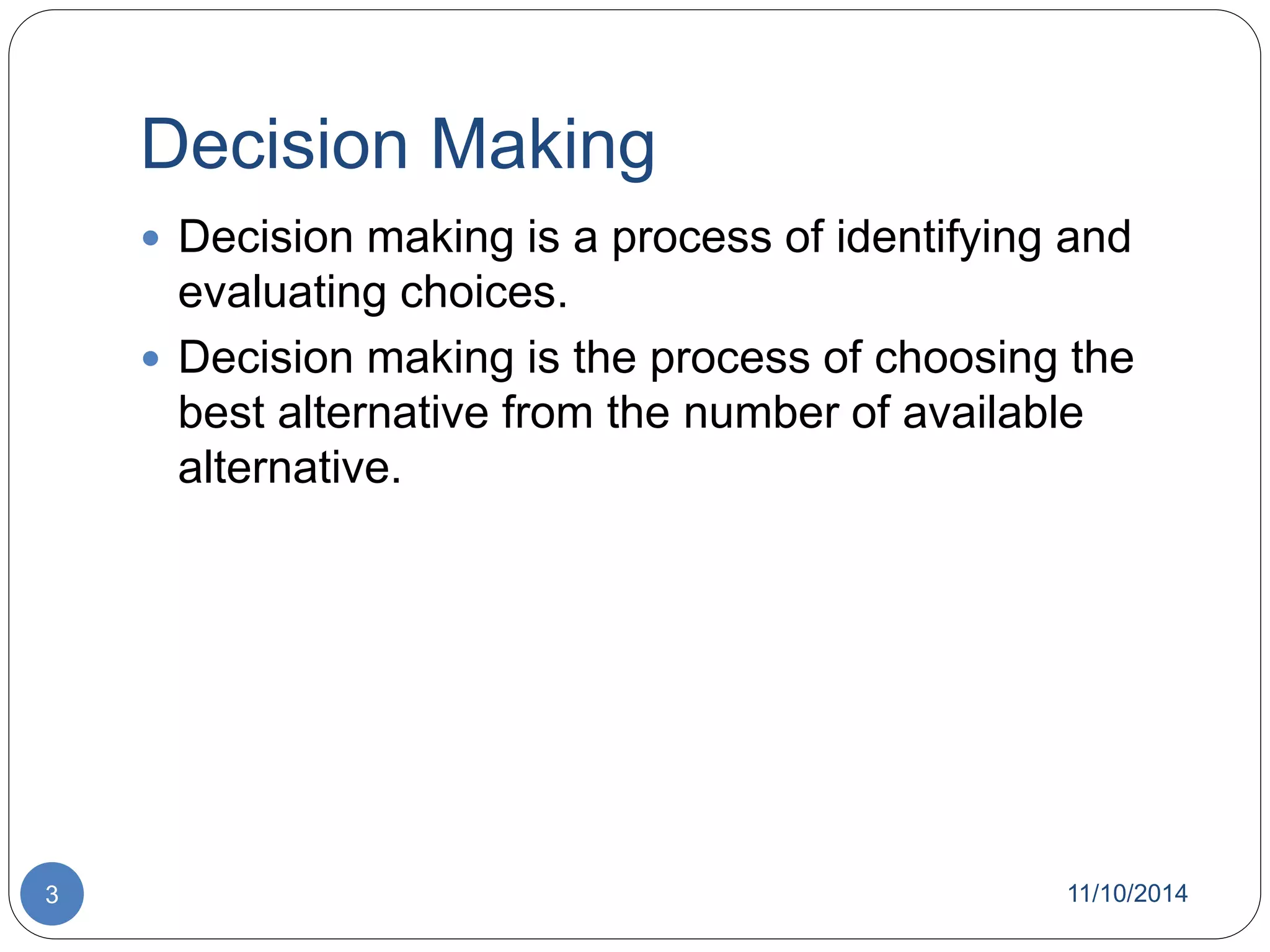

Decision Theory 
Presented by: 
Bina Gupta 
Presented to: 
Shiva Shrestha 
1 BIM Department,HSM 11/10/2014
Contents 
 Definition 
 Types of decisions 
 Decision making conditions 
 Decision Making Process 
 Decision Tree 
 Decision Styles 
 Decision Theories 
 Group Decision Making 
 Improving Decision Making 
2 11/10/2014
Decision Making 
 Decision making is a process of identifying and 
evaluating choices. 
 Decision making is the process of choosing the 
best alternative from the number of available 
alternative. 
3 11/10/2014
Decision Making 
 Decision making is very important in human life: 
 In personal life, 
 Which profession to choose 
 What to have for dinner 
 Whether to do home work or watch movie 
 Whom to marry. 
 In Business environment, 
 How much to charge for a product. 
 Where and how much to invest . 
 Which candidate to hire for a job. 
 Which advertising media to adopt 
4 11/10/2014
Types of Decision Making 
Types by frequency 
 Programmed decisions 
 decision making that relate to the day to day 
running of an organization 
 predetermined rules and procedures 
 structured type and recurs with some frequency 
 Decision making is done by low level management 
5 11/10/2014
Types of Decision Making 
 Non-programmed decisions 
 decisions making with unusual and exceptional 
problems. 
 Poorly structured 
 Decision making is done by top level management 
6 11/10/2014
Types of Decision Making 
Types by nature 
 Operating decisions 
 Similar to programmed decision 
 Day to day decision 
 Aim at maximizing the efficiency and probability of 
the organization’s current operations. 
 Decision making is done by low level management 
team 
7 11/10/2014
Types of Decision Making 
 Strategic decisions 
 Focuses on the issues external to the organization. 
 Concerned with goals and objectives of the 
organization, selection of product- market mix etc. 
 Decision making is done by top level management 
 Administrative decisions 
 Link between operational and strategic decision 
 deal with the issues such as rules, procedures, 
reward system etc. 
 Decision making is done by middle level 
management 
8 11/10/2014
Decision Making 
Conditions/Environment 
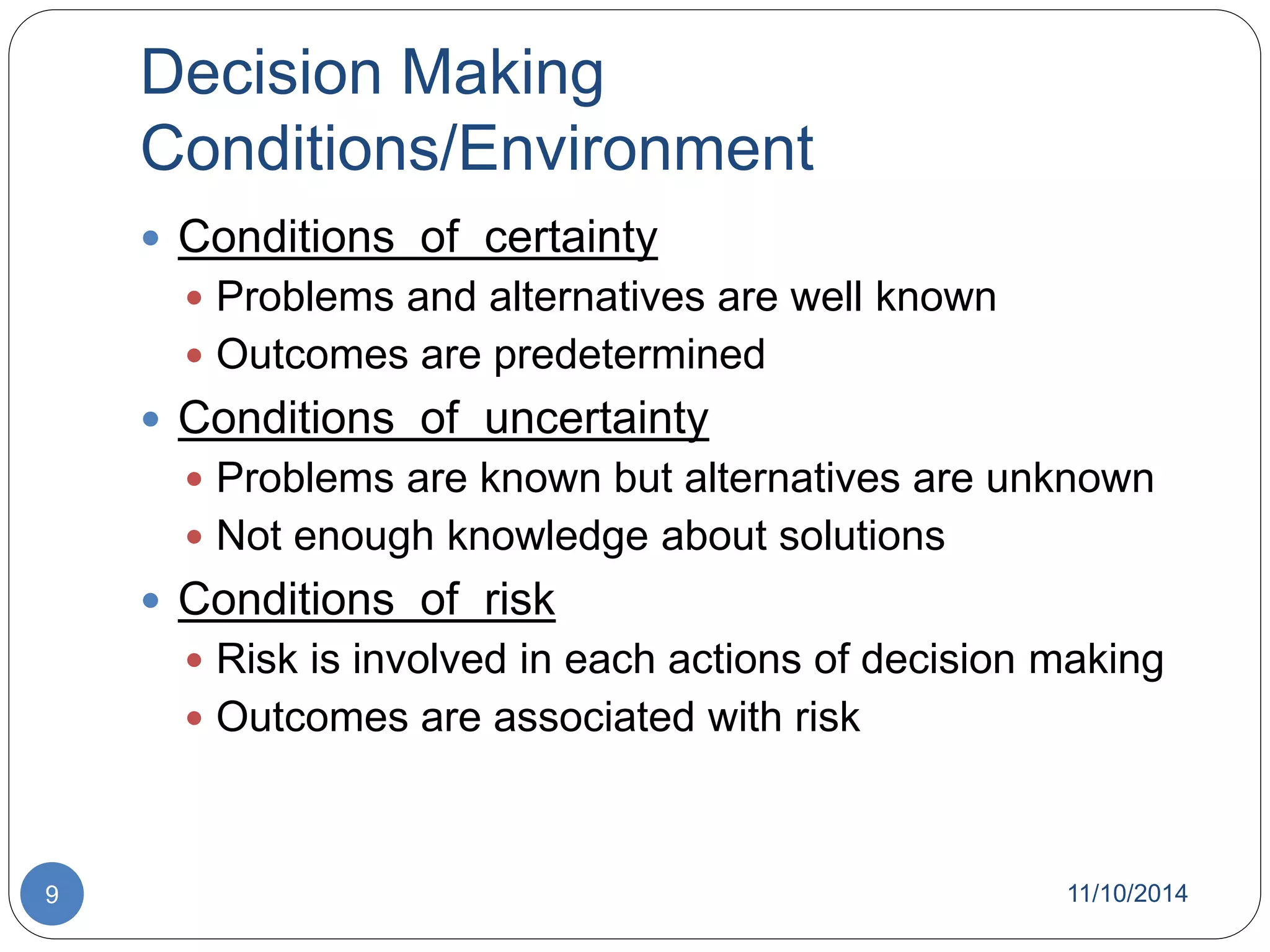
 Conditions of certainty 
 Problems and alternatives are well known 
 Outcomes are predetermined 
 Conditions of uncertainty 
 Problems are known but alternatives are unknown 
 Not enough knowledge about solutions 
 Conditions of risk 
 Risk is involved in each actions of decision making 
 Outcomes are associated with risk 
9 11/10/2014
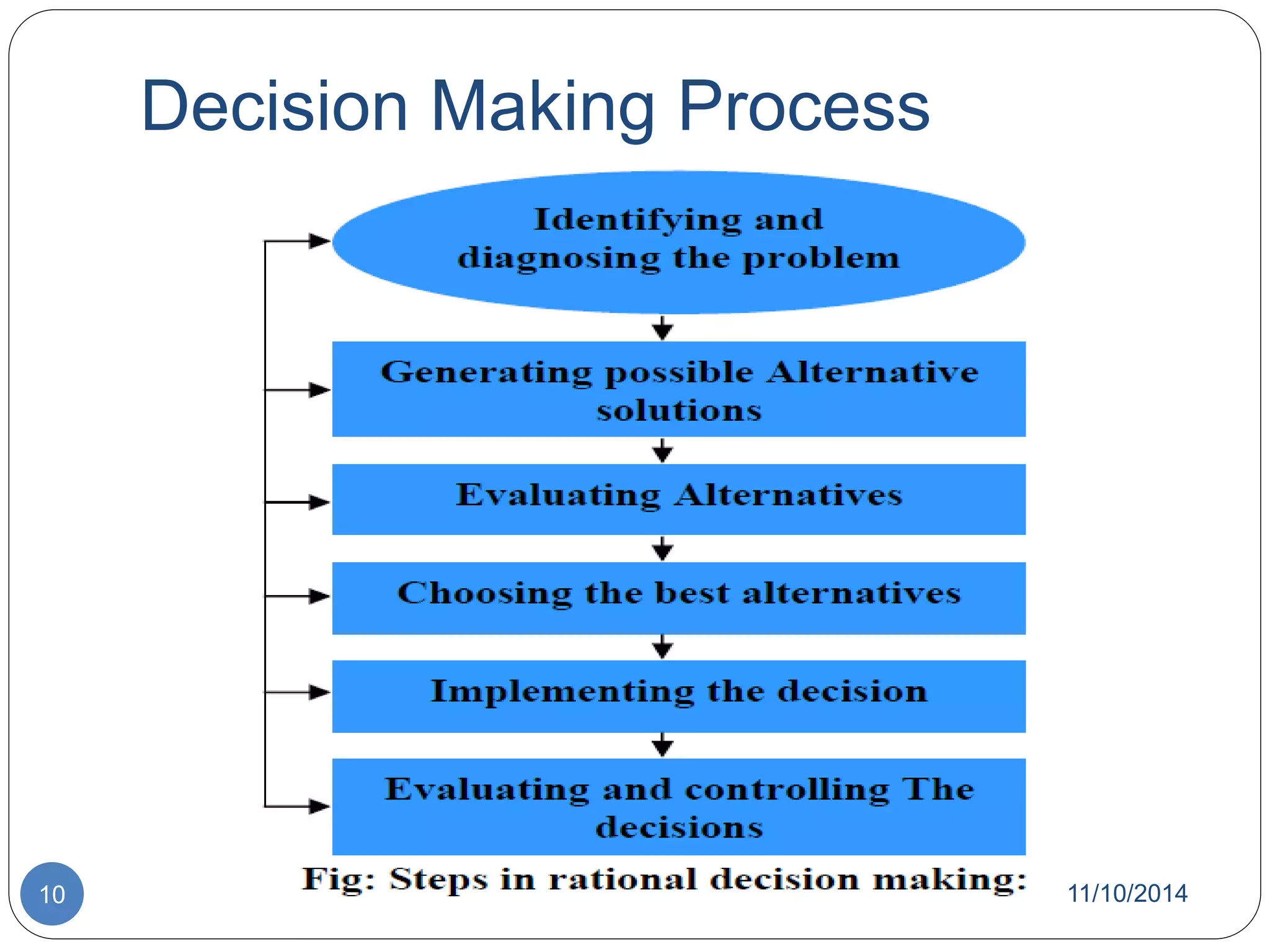
Decision Making Process 
10 11/10/2014
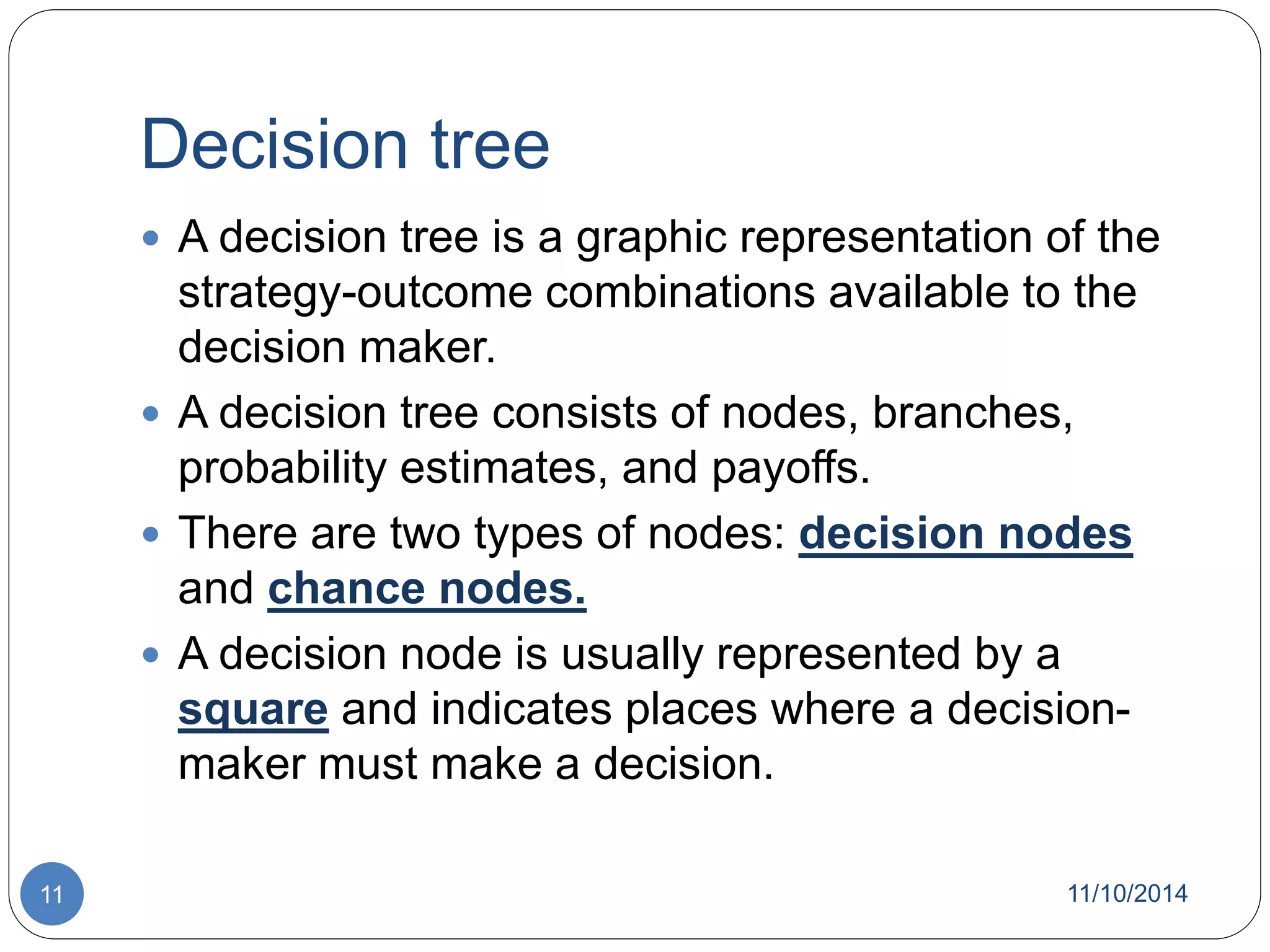
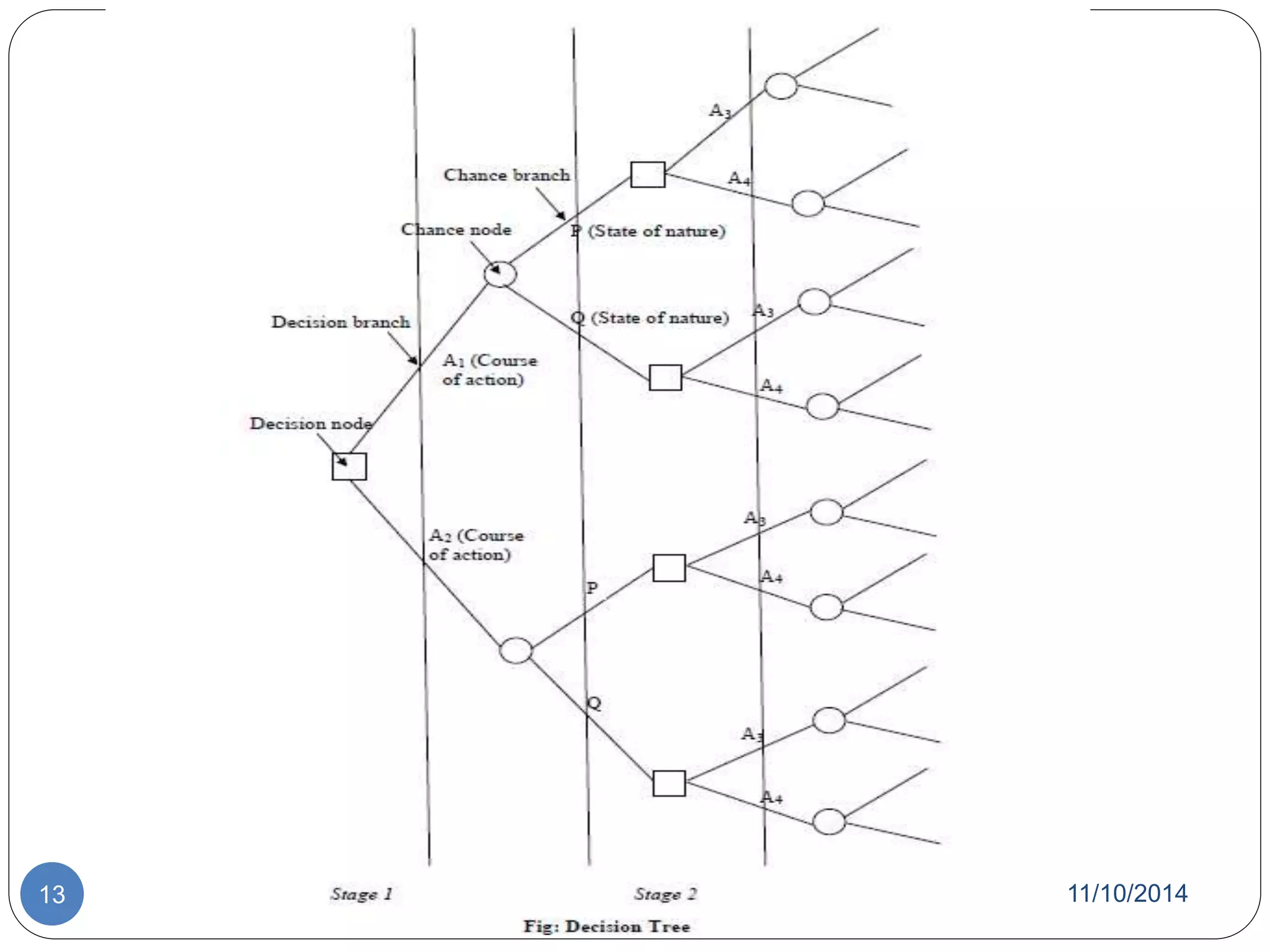
Decision tree 
 A decision tree is a graphic representation of the 
strategy-outcome combinations available to the 
decision maker. 
 A decision tree consists of nodes, branches, 
probability estimates, and payoffs. 
 There are two types of nodes: decision nodes 
and chance nodes. 
 A decision node is usually represented by a 
square and indicates places where a decision-maker 
must make a decision. 
11 11/10/2014
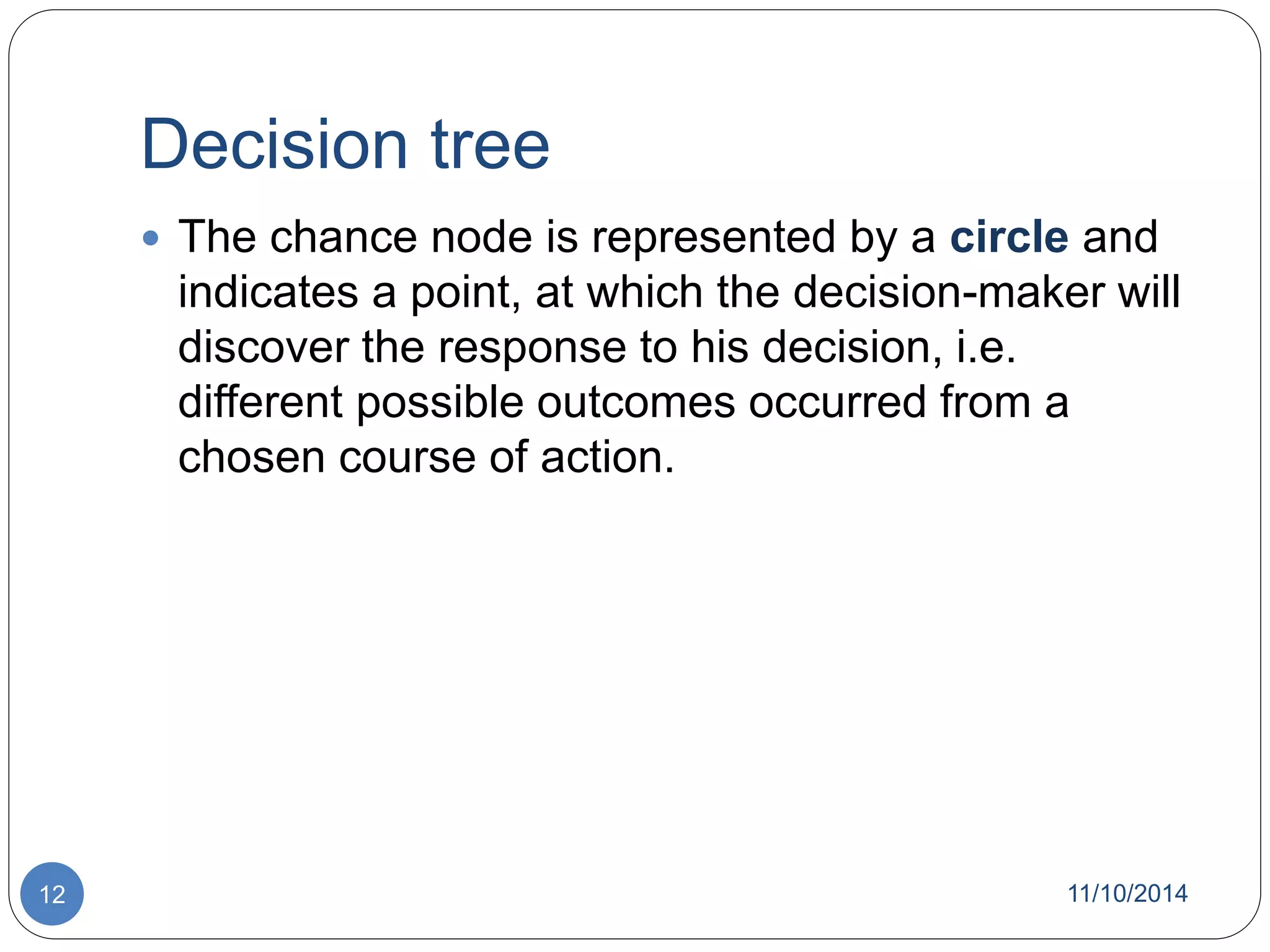
Decision tree 
 The chance node is represented by a circle and 
indicates a point, at which the decision-maker will 
discover the response to his decision, i.e. 
different possible outcomes occurred from a 
chosen course of action. 
12 11/10/2014
13 11/10/2014
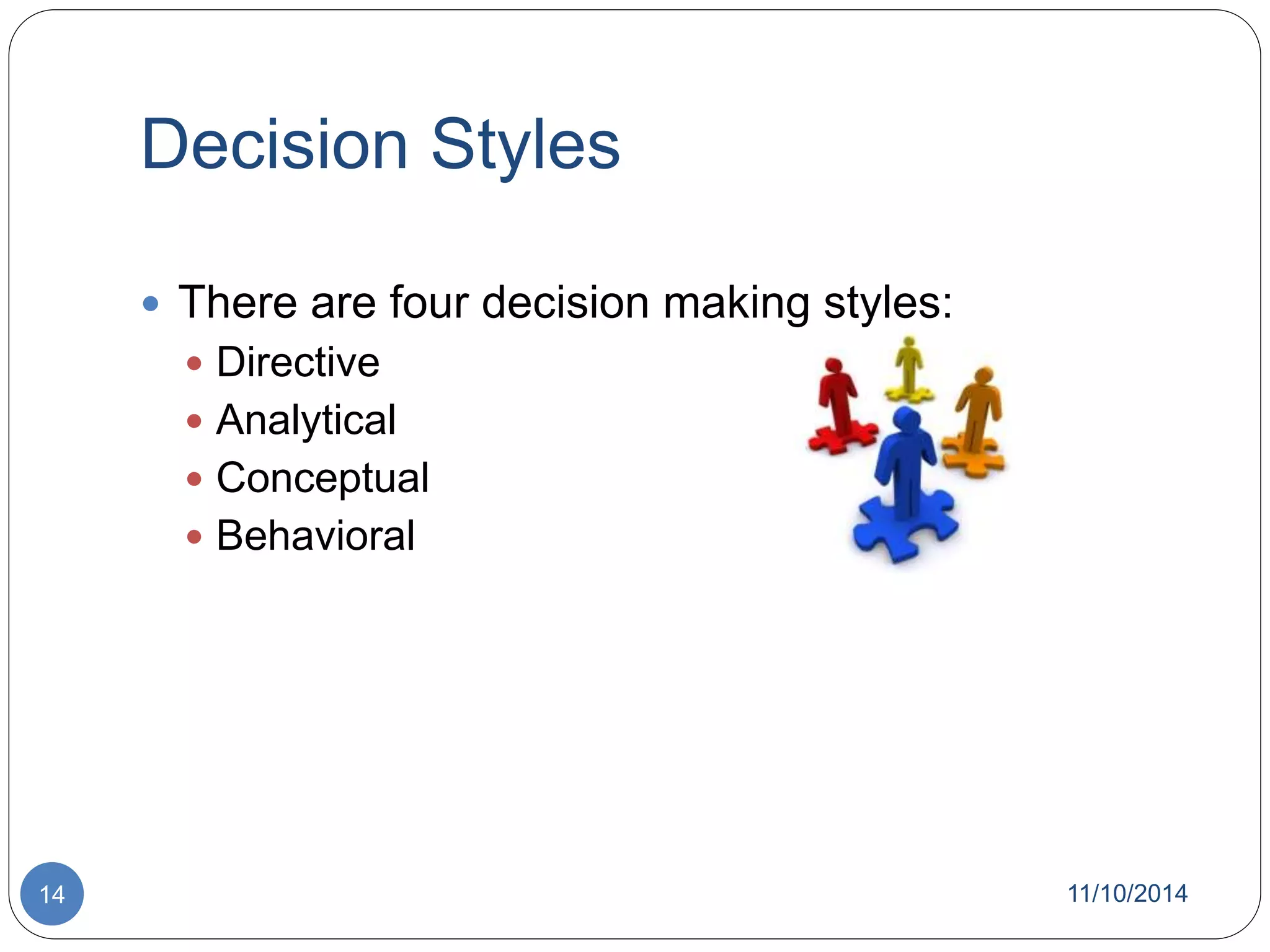
Decision Styles 
 There are four decision making styles: 
 Directive 
 Analytical 
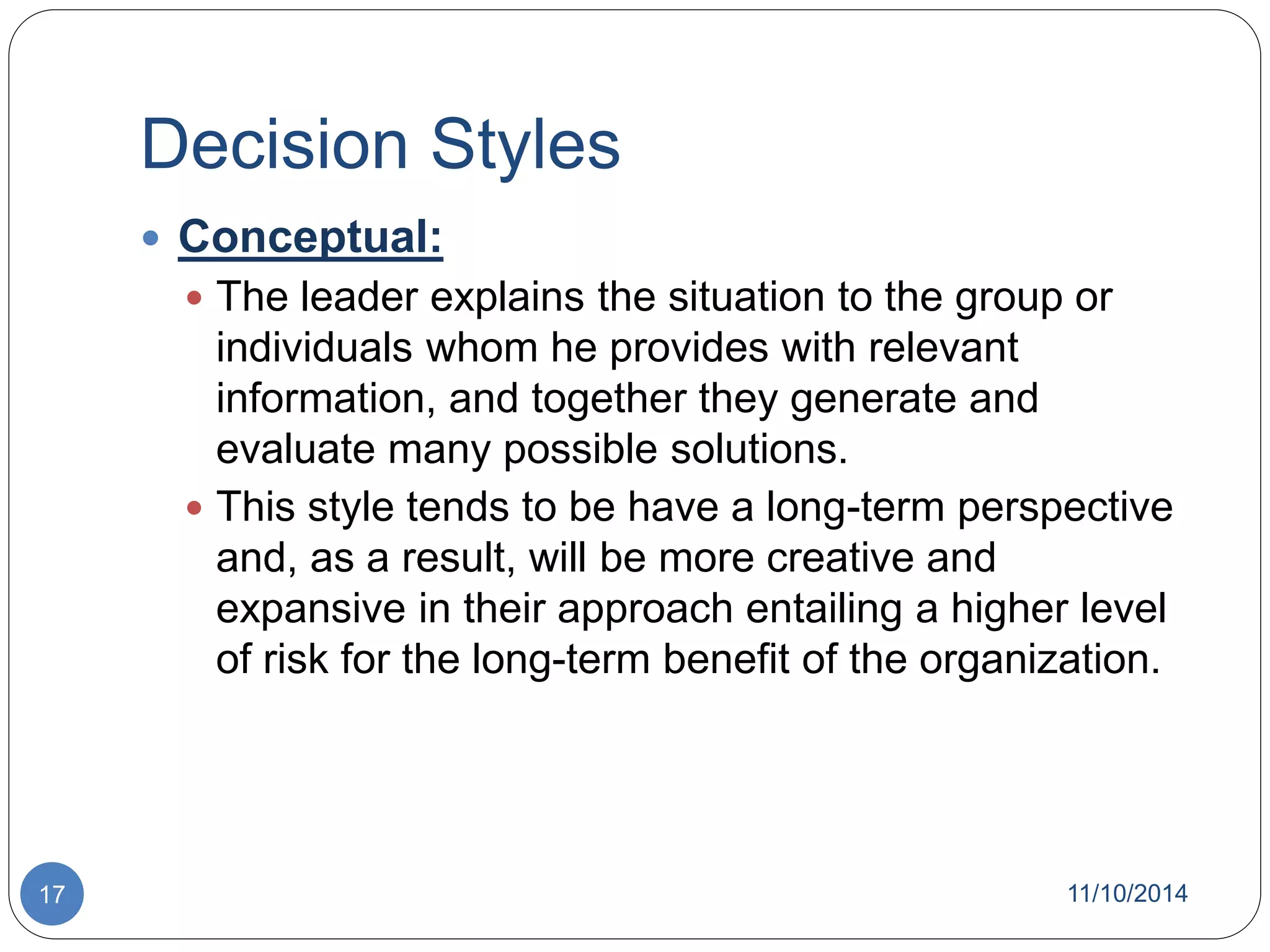
 Conceptual 
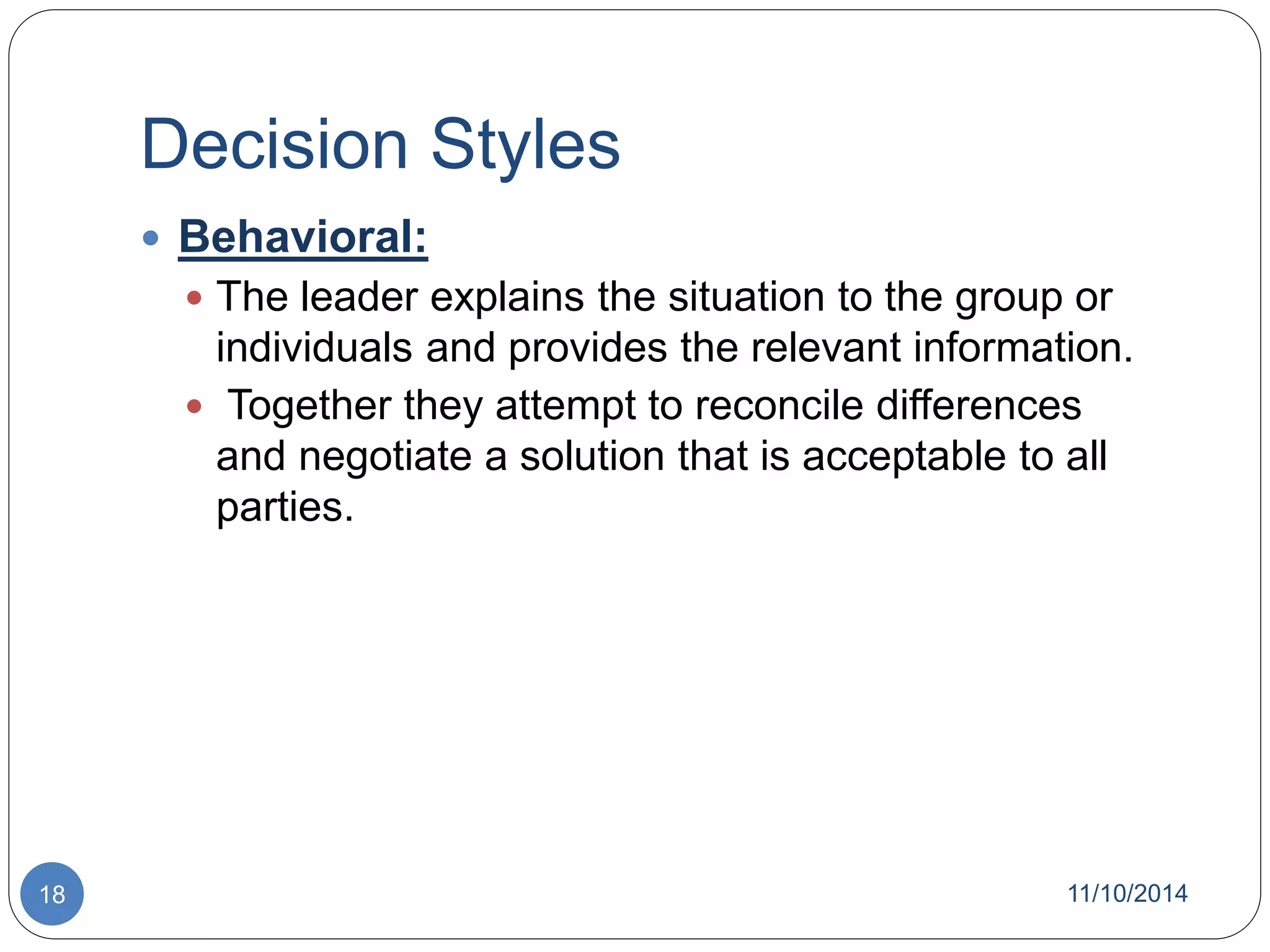
 Behavioral 
14 11/10/2014
Decision Styles 
 Directive: 
 The group leader solves the problem, using the 
information he possesses. 
 He/she does not consult with anyone else nor seek 
information in any form. 
 This style assumes that the leader has sufficient 
information to examine all the relevant options and 
make an effective decision, but that is rarely the 
case. 
15 11/10/2014
Decision Styles 
 Analytical: 
 When the leader does not possess sufficient 
information to make an effective decision, they will 
need to obtain information or skill from others. 
 They may not tell them what the problem is; 
normally, they simply asks for information. 
 The leader then evaluates the information and 
makes the decision. 
16 11/10/2014
Decision Styles 
 Conceptual: 
 The leader explains the situation to the group or 
individuals whom he provides with relevant 
information, and together they generate and 
evaluate many possible solutions. 
 This style tends to be have a long-term perspective 
and, as a result, will be more creative and 
expansive in their approach entailing a higher level 
of risk for the long-term benefit of the organization. 
17 11/10/2014
Decision Styles 
 Behavioral: 
 The leader explains the situation to the group or 
individuals and provides the relevant information. 
 Together they attempt to reconcile differences 
and negotiate a solution that is acceptable to all 
parties. 
18 11/10/2014
Decision Theories 
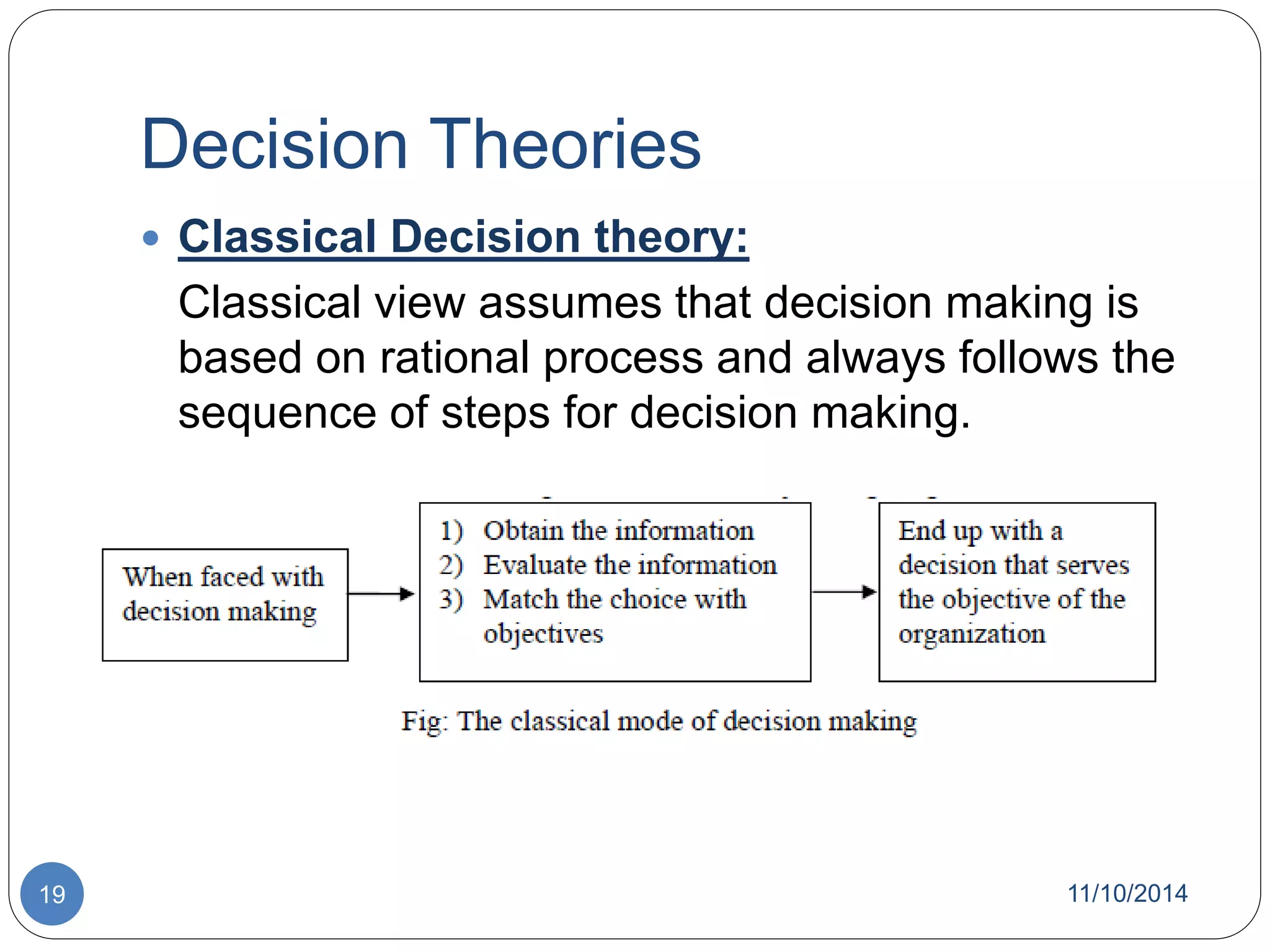
 Classical Decision theory: 
Classical view assumes that decision making is 
based on rational process and always follows the 
sequence of steps for decision making. 
19 11/10/2014
Decision Theories 
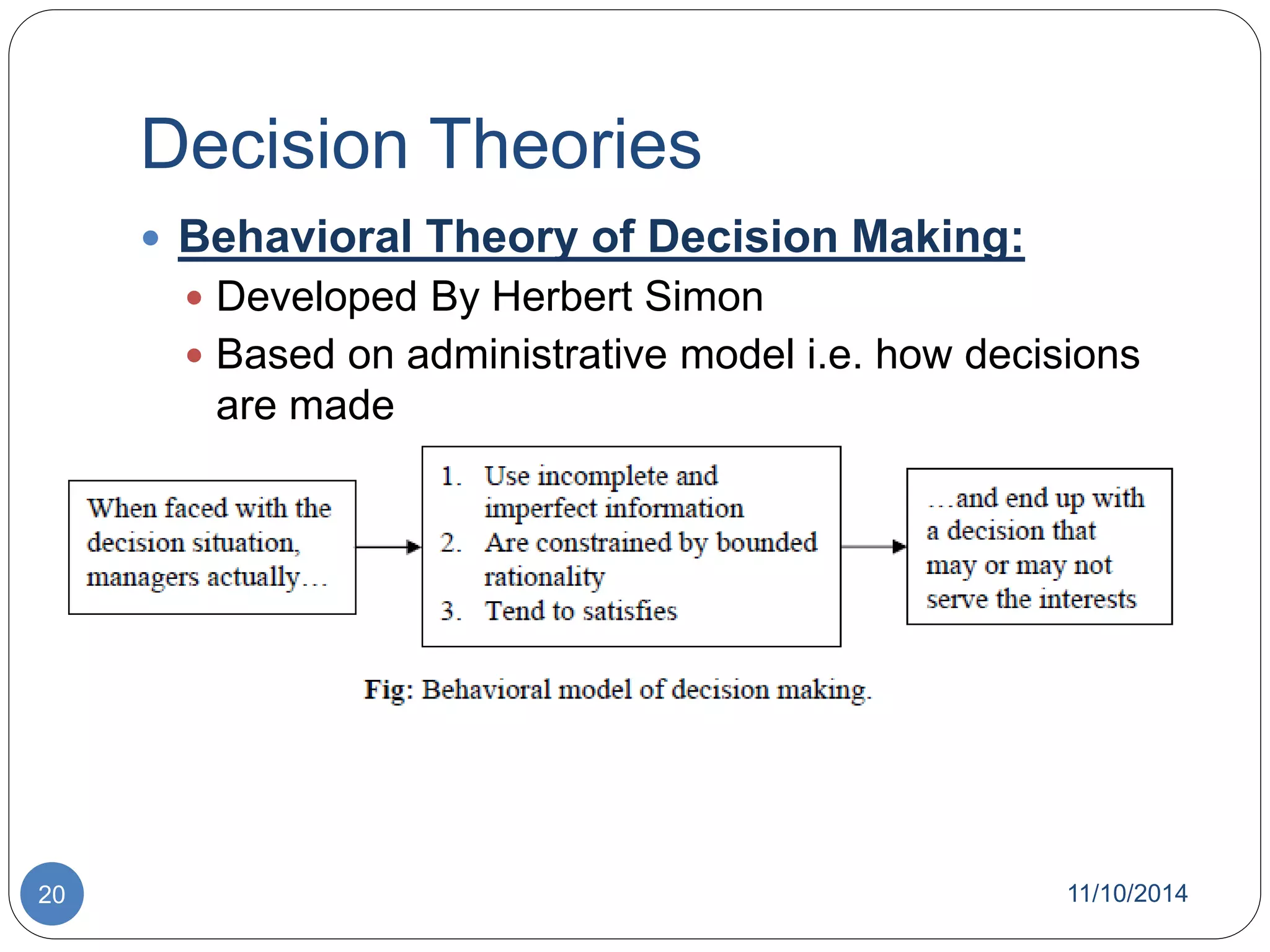
 Behavioral Theory of Decision Making: 
 Developed By Herbert Simon 
 Based on administrative model i.e. how decisions 
are made 
20 11/10/2014
Decision Theories 
 The two main component of this theory are: 
i. Bounded Rationality: 
 Decision maker is limited in their Rationality 
because of different factors such as: 
 Attitude 
 Ability 
 Education 
 Benefits 
 Skills 
 Habits 
21 11/10/2014
Decision Theories 
ii. Satisfying: 
 Decision Maker tries to satisfy organization 
objectives with his best efforts 
 Satisfactory solution is obtained 
22 11/10/2014
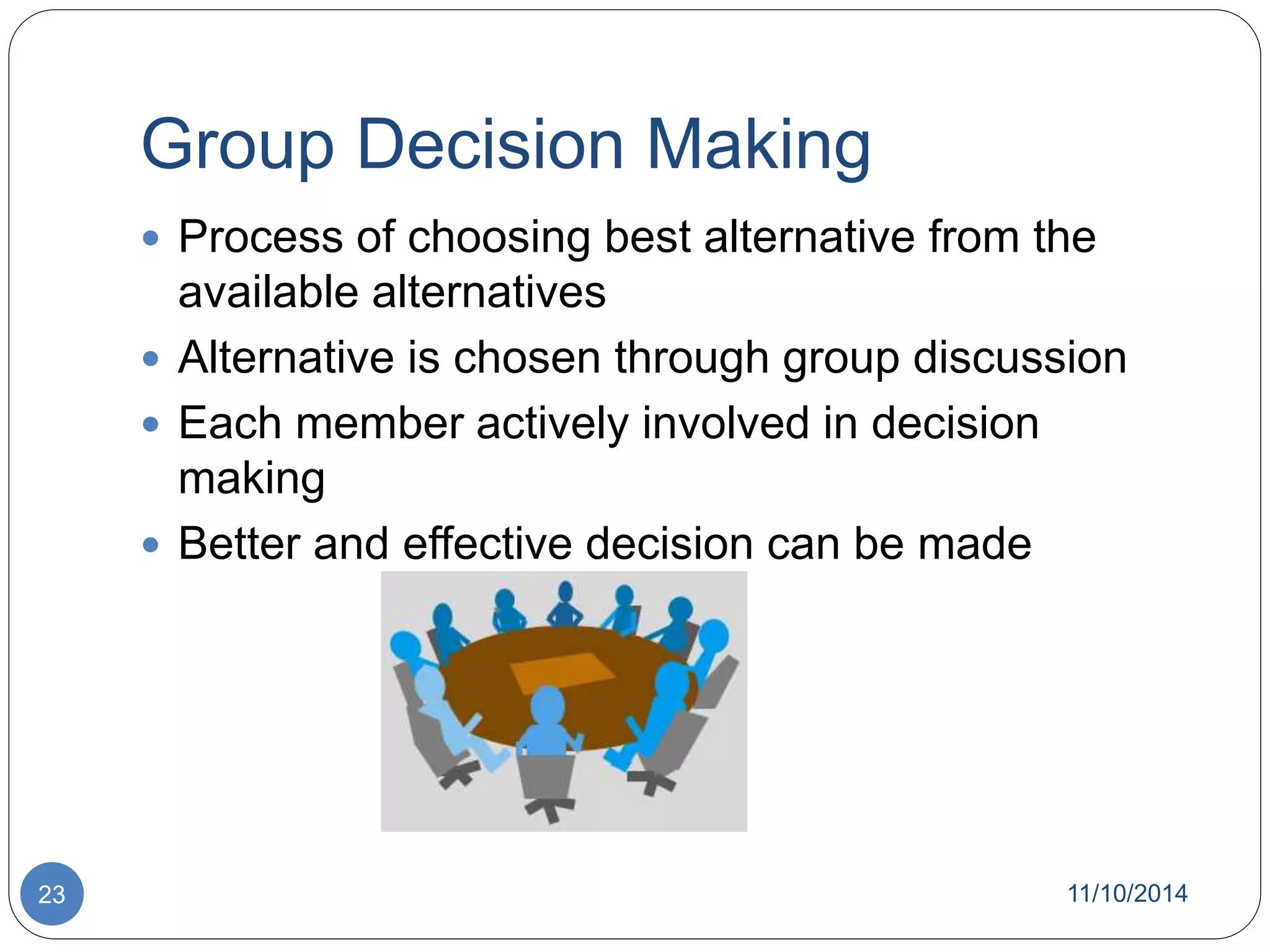
Group Decision Making 
 Process of choosing best alternative from the 
available alternatives 
 Alternative is chosen through group discussion 
 Each member actively involved in decision 
making 
 Better and effective decision can be made 
23 11/10/2014
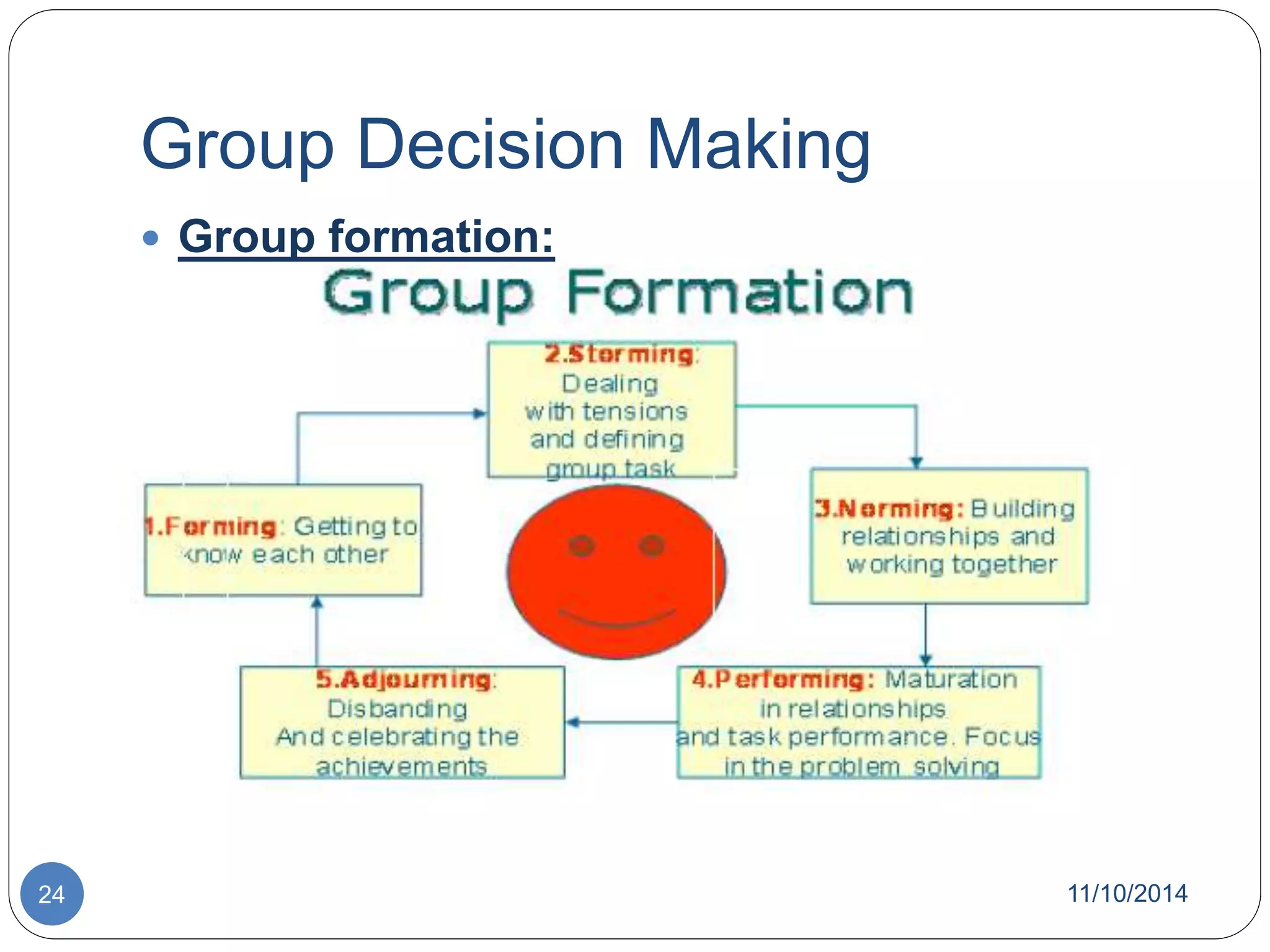
Group Decision Making 
 Group formation: 
24 11/10/2014
Group Decision Making 
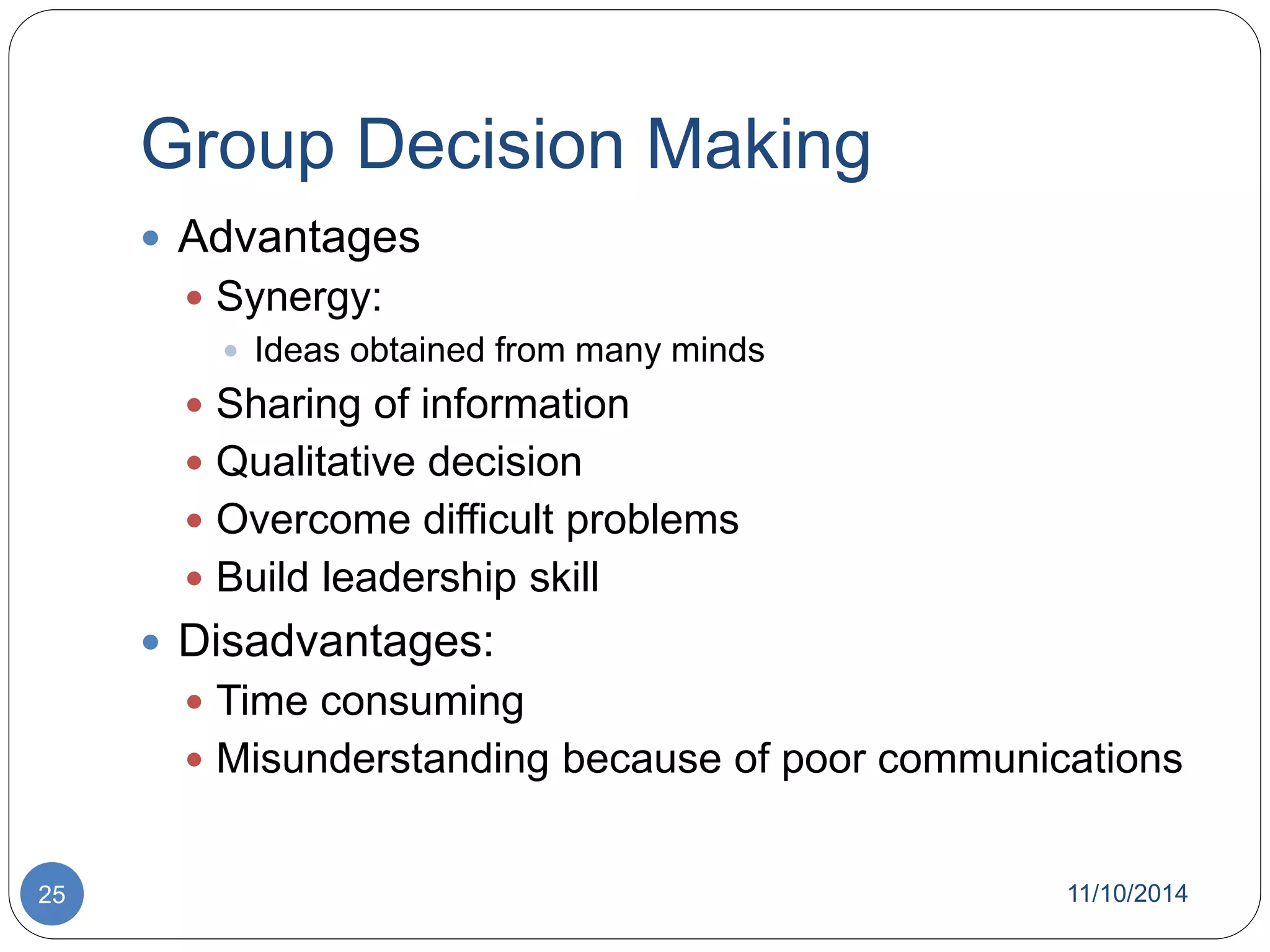
 Advantages 
 Synergy: 
 Ideas obtained from many minds 
 Sharing of information 
 Qualitative decision 
 Overcome difficult problems 
 Build leadership skill 
 Disadvantages: 
 Time consuming 
 Misunderstanding because of poor communications 
25 11/10/2014
Improving the Decision Making 
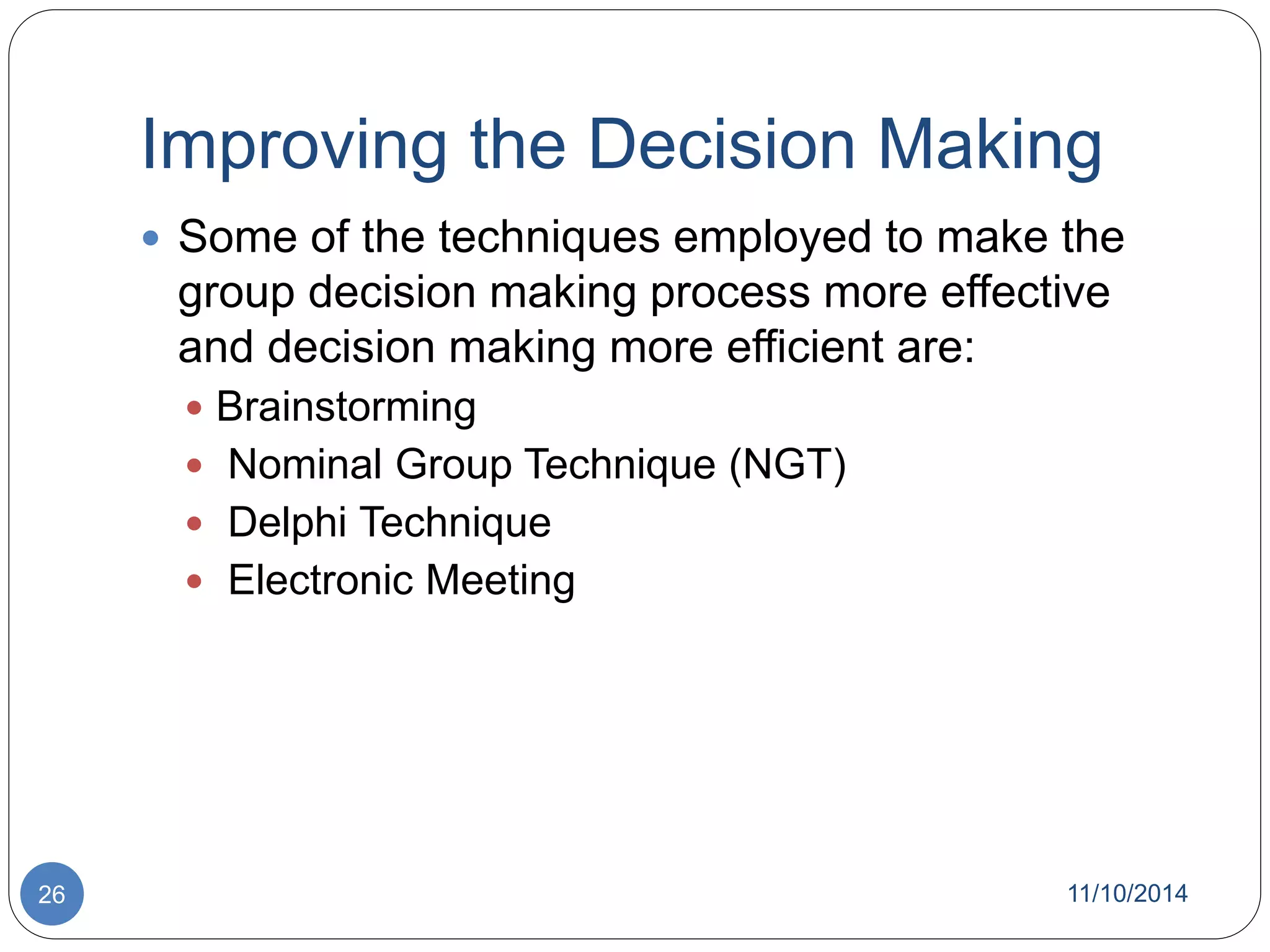
 Some of the techniques employed to make the 
group decision making process more effective 
and decision making more efficient are: 
 Brainstorming 
 Nominal Group Technique (NGT) 
 Delphi Technique 
 Electronic Meeting 
26 11/10/2014
Improving the Decision Making 
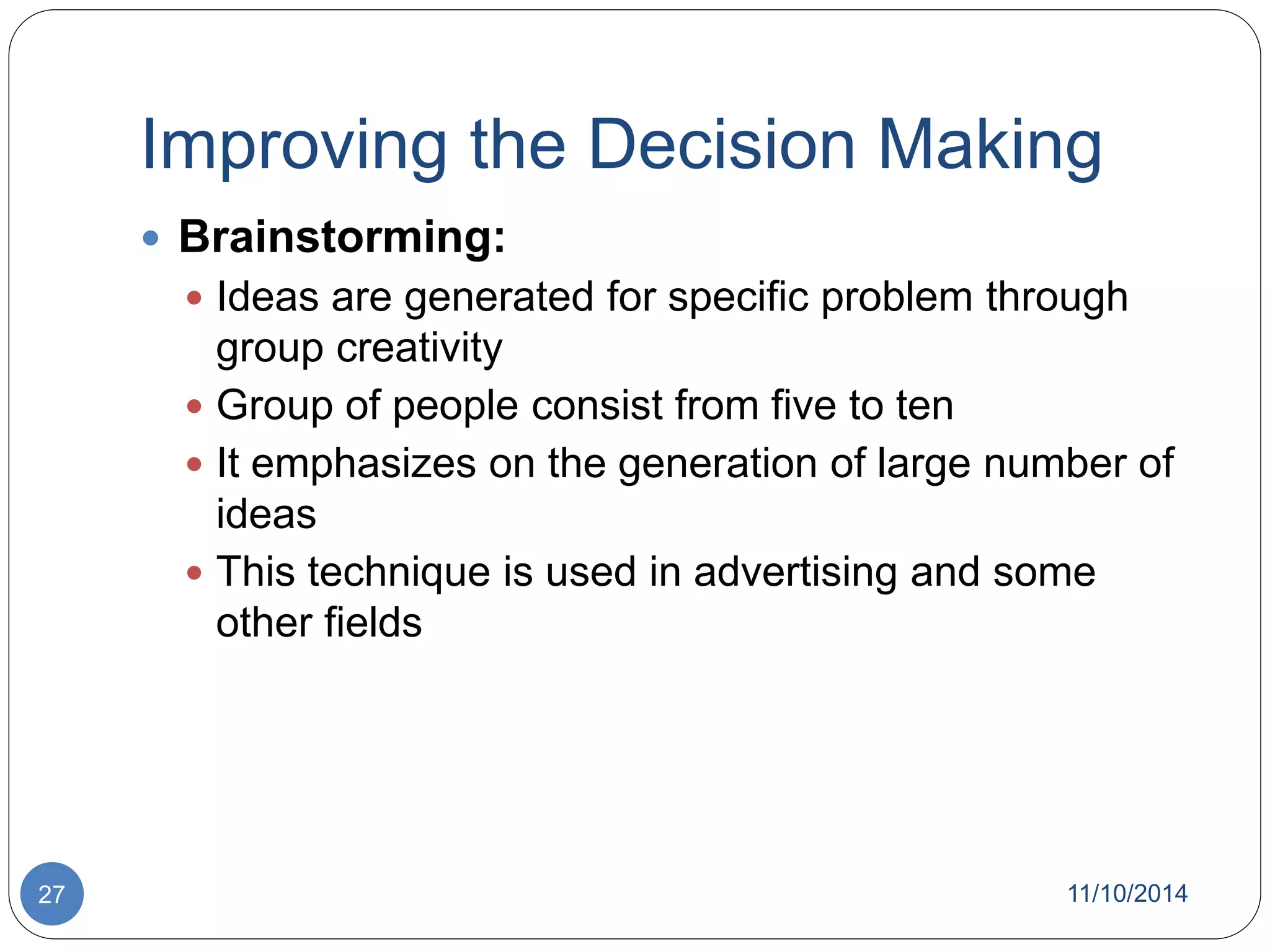
 Brainstorming: 
 Ideas are generated for specific problem through 
group creativity 
 Group of people consist from five to ten 
 It emphasizes on the generation of large number of 
ideas 
 This technique is used in advertising and some 
other fields 
27 11/10/2014
Improving the Decision Making 
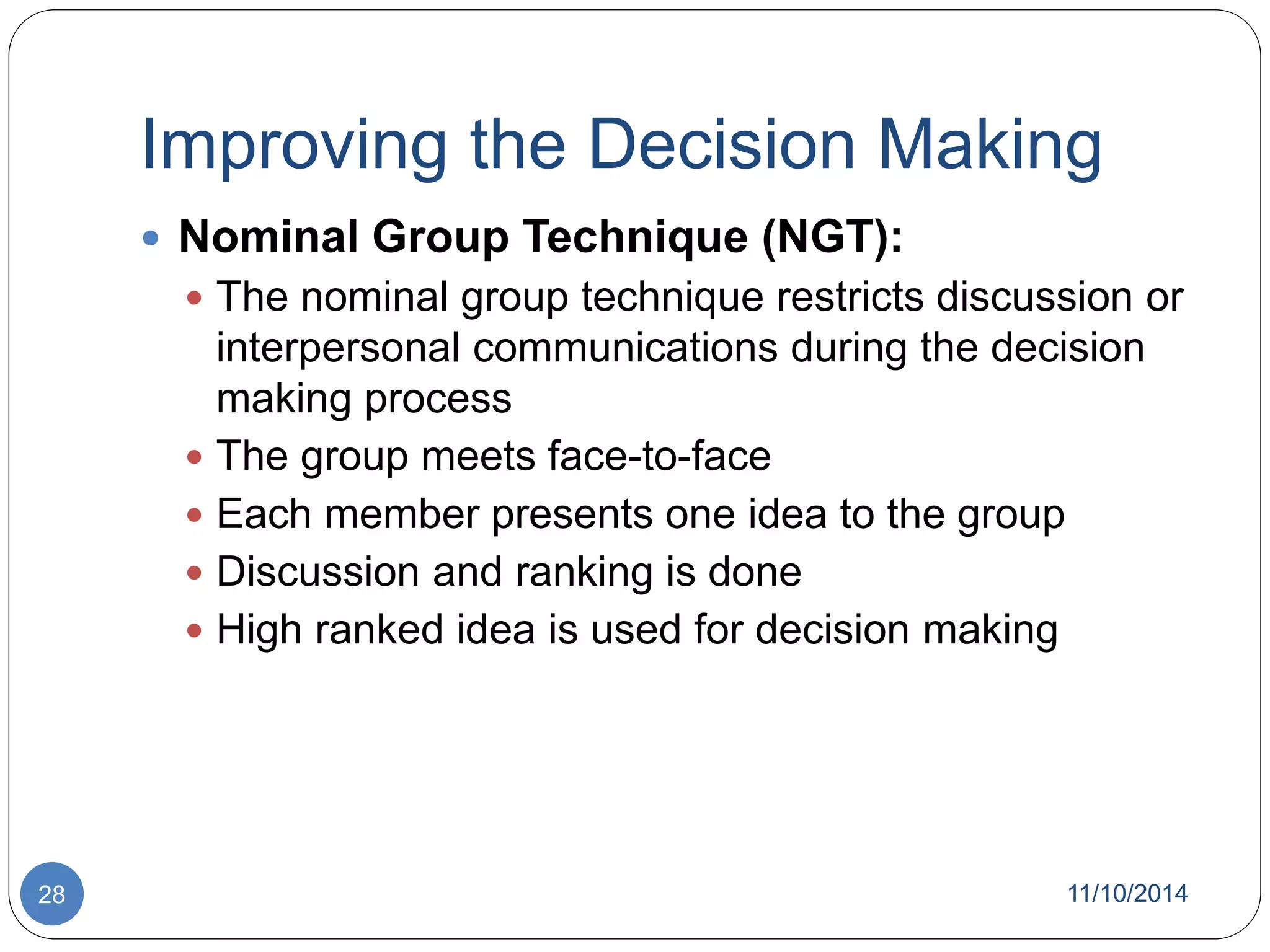
 Nominal Group Technique (NGT): 
 The nominal group technique restricts discussion or 
interpersonal communications during the decision 
making process 
 The group meets face-to-face 
 Each member presents one idea to the group 
 Discussion and ranking is done 
 High ranked idea is used for decision making 
28 11/10/2014
Improving the Decision Making 
Delphi Techniques: 
 A Delphi technique is the modification of NGT 
 Each individual member independently writes down 
comments, suggestions and solution 
 All the comments are sent to a central location, 
where they are compiled 
 Finally decisions are made in written form through 
consensus 
29 11/10/2014
Improving the Decision Making 
 Electronic Meeting 
 Electronic Meeting is one of the techniques that 
combine the NGT with sophisticated computer 
technology. 
 Each member communicate by writing comments 
by using computer terminals 
30 11/10/2014
ANY 
QUESTIONS 
31 11/10/2014
32 11/10/2014

Decision theory

  • 1.
    Decision Theory Presentedby: Bina Gupta Presented to: Shiva Shrestha 1 BIM Department,HSM 11/10/2014
  • 2.
    Contents  Definition  Types of decisions  Decision making conditions  Decision Making Process  Decision Tree  Decision Styles  Decision Theories  Group Decision Making  Improving Decision Making 2 11/10/2014
  • 3.
    Decision Making Decision making is a process of identifying and evaluating choices.  Decision making is the process of choosing the best alternative from the number of available alternative. 3 11/10/2014
  • 4.
    Decision Making Decision making is very important in human life:  In personal life,  Which profession to choose  What to have for dinner  Whether to do home work or watch movie  Whom to marry.  In Business environment,  How much to charge for a product.  Where and how much to invest .  Which candidate to hire for a job.  Which advertising media to adopt 4 11/10/2014
  • 5.
    Types of DecisionMaking Types by frequency  Programmed decisions  decision making that relate to the day to day running of an organization  predetermined rules and procedures  structured type and recurs with some frequency  Decision making is done by low level management 5 11/10/2014
  • 6.
    Types of DecisionMaking  Non-programmed decisions  decisions making with unusual and exceptional problems.  Poorly structured  Decision making is done by top level management 6 11/10/2014
  • 7.
    Types of DecisionMaking Types by nature  Operating decisions  Similar to programmed decision  Day to day decision  Aim at maximizing the efficiency and probability of the organization’s current operations.  Decision making is done by low level management team 7 11/10/2014
  • 8.
    Types of DecisionMaking  Strategic decisions  Focuses on the issues external to the organization.  Concerned with goals and objectives of the organization, selection of product- market mix etc.  Decision making is done by top level management  Administrative decisions  Link between operational and strategic decision  deal with the issues such as rules, procedures, reward system etc.  Decision making is done by middle level management 8 11/10/2014
  • 9.
    Decision Making Conditions/Environment  Conditions of certainty  Problems and alternatives are well known  Outcomes are predetermined  Conditions of uncertainty  Problems are known but alternatives are unknown  Not enough knowledge about solutions  Conditions of risk  Risk is involved in each actions of decision making  Outcomes are associated with risk 9 11/10/2014
  • 10.
  • 11.
    Decision tree A decision tree is a graphic representation of the strategy-outcome combinations available to the decision maker.  A decision tree consists of nodes, branches, probability estimates, and payoffs.  There are two types of nodes: decision nodes and chance nodes.  A decision node is usually represented by a square and indicates places where a decision-maker must make a decision. 11 11/10/2014
  • 12.
    Decision tree The chance node is represented by a circle and indicates a point, at which the decision-maker will discover the response to his decision, i.e. different possible outcomes occurred from a chosen course of action. 12 11/10/2014
  • 13.
  • 14.
    Decision Styles There are four decision making styles:  Directive  Analytical  Conceptual  Behavioral 14 11/10/2014
  • 15.
    Decision Styles Directive:  The group leader solves the problem, using the information he possesses.  He/she does not consult with anyone else nor seek information in any form.  This style assumes that the leader has sufficient information to examine all the relevant options and make an effective decision, but that is rarely the case. 15 11/10/2014
  • 16.
    Decision Styles Analytical:  When the leader does not possess sufficient information to make an effective decision, they will need to obtain information or skill from others.  They may not tell them what the problem is; normally, they simply asks for information.  The leader then evaluates the information and makes the decision. 16 11/10/2014
  • 17.
    Decision Styles Conceptual:  The leader explains the situation to the group or individuals whom he provides with relevant information, and together they generate and evaluate many possible solutions.  This style tends to be have a long-term perspective and, as a result, will be more creative and expansive in their approach entailing a higher level of risk for the long-term benefit of the organization. 17 11/10/2014
  • 18.
    Decision Styles Behavioral:  The leader explains the situation to the group or individuals and provides the relevant information.  Together they attempt to reconcile differences and negotiate a solution that is acceptable to all parties. 18 11/10/2014
  • 19.
    Decision Theories Classical Decision theory: Classical view assumes that decision making is based on rational process and always follows the sequence of steps for decision making. 19 11/10/2014
  • 20.
    Decision Theories Behavioral Theory of Decision Making:  Developed By Herbert Simon  Based on administrative model i.e. how decisions are made 20 11/10/2014
  • 21.
    Decision Theories The two main component of this theory are: i. Bounded Rationality:  Decision maker is limited in their Rationality because of different factors such as:  Attitude  Ability  Education  Benefits  Skills  Habits 21 11/10/2014
  • 22.
    Decision Theories ii.Satisfying:  Decision Maker tries to satisfy organization objectives with his best efforts  Satisfactory solution is obtained 22 11/10/2014
  • 23.
    Group Decision Making  Process of choosing best alternative from the available alternatives  Alternative is chosen through group discussion  Each member actively involved in decision making  Better and effective decision can be made 23 11/10/2014
  • 24.
    Group Decision Making  Group formation: 24 11/10/2014
  • 25.
    Group Decision Making  Advantages  Synergy:  Ideas obtained from many minds  Sharing of information  Qualitative decision  Overcome difficult problems  Build leadership skill  Disadvantages:  Time consuming  Misunderstanding because of poor communications 25 11/10/2014
  • 26.
    Improving the DecisionMaking  Some of the techniques employed to make the group decision making process more effective and decision making more efficient are:  Brainstorming  Nominal Group Technique (NGT)  Delphi Technique  Electronic Meeting 26 11/10/2014
  • 27.
    Improving the DecisionMaking  Brainstorming:  Ideas are generated for specific problem through group creativity  Group of people consist from five to ten  It emphasizes on the generation of large number of ideas  This technique is used in advertising and some other fields 27 11/10/2014
  • 28.
    Improving the DecisionMaking  Nominal Group Technique (NGT):  The nominal group technique restricts discussion or interpersonal communications during the decision making process  The group meets face-to-face  Each member presents one idea to the group  Discussion and ranking is done  High ranked idea is used for decision making 28 11/10/2014
  • 29.
    Improving the DecisionMaking Delphi Techniques:  A Delphi technique is the modification of NGT  Each individual member independently writes down comments, suggestions and solution  All the comments are sent to a central location, where they are compiled  Finally decisions are made in written form through consensus 29 11/10/2014
  • 30.
    Improving the DecisionMaking  Electronic Meeting  Electronic Meeting is one of the techniques that combine the NGT with sophisticated computer technology.  Each member communicate by writing comments by using computer terminals 30 11/10/2014
  • 31.
    ANY QUESTIONS 3111/10/2014
  • 32.