
Presented by:
Bina Gupta
BIM 7th sem
Under the Supervision of
Ravi Bhattrai
BIM Department
12/31/2014 1
Contents
 Concept
 Theories of work design
 Technology and work design
12/31/2014 2
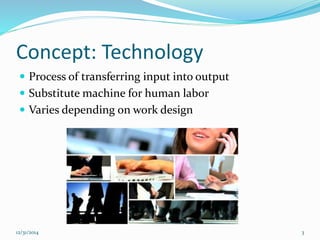
Concept: Technology
 Process of transferring input into output
 Substitute machine for human labor
 Varies depending on work design
12/31/2014 3
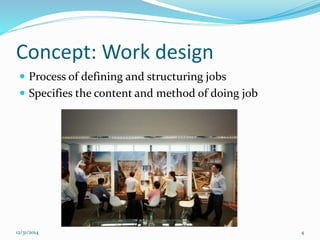
Concept: Work design
 Process of defining and structuring jobs
 Specifies the content and method of doing job
12/31/2014 4
Concept: Work design
 Methods of work design
 Job Specialization
 Job Specification
 Job Rotation
 Job Enlargement
 Job Enrichment
 Autonomous team
12/31/2014 5
Theories of work design
 Job Characteristics Theory
 Social Information processing theory
12/31/2014 6
Theories of work design:
Job Characteristics Theory
 Developed by Hackman and Oldham
 This theory states that critical psychological states
determines the impact of job characteristics on
employee response to the task
12/31/2014 7
Theories of work design:
Job Characteristics Theory
 The various psychological states are:
 Experienced meaningfulness of work
 Experienced responsibility for work outcome
 Knowledge of results
12/31/2014 8
Theories of work design:
Job Characteristics Theory
 Job characteristics that triggers Psychological state are:
 Skills variety
 Task identity
 Task significance
 Autonomy
 Feedback
12/31/2014 9
Theories of work design:
Social Information Processing theory
 States that social information in the workplace
influences how employees perceive and react to job
characteristics.
 Employees adapt attitudes and behaviours in response
to social cues with whom they interact
12/31/2014 10
Theories of work design:
Social Information Processing theory
 Social information and job characteristics reinforce
each other
 Positive social information and well design job produces
positive reaction
 Negative social information and poor design job
produces negative reaction
12/31/2014 11
Technology and Work design
 Team and continuous improvement process
 Reengineering work process
 Flexible manufacturing system
 Worker Obsolesce
12/31/2014 12
Technology and Work design:
Team and continuous improvement process
 Also termed as TQM
 TQM advocates continuous improvement of product
quality through everyone’s commitment and
involvement to satisfy costumer’s need.
12/31/2014 13
Technology and Work design:
Team and continuous improvement process
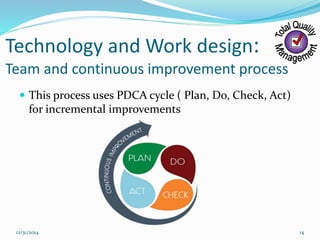
 This process uses PDCA cycle ( Plan, Do, Check, Act)
for incremental improvements
12/31/2014 14
Technology and Work design:
Team and continuous improvement process
 Requirements for continuous improvement Process
(TQM)
 New Technology
 Employee involvement
 Commitment
 Team Effort
 Production methods
 Costumer orientation
 Control
12/31/2014 15
Technology and Work design:
Team and continuous improvement process
 Tools for continuous improvement process
 Quality circle
 Zero defect
 Just in Time
 Quality control
 Quality assurance
 Training
12/31/2014 16
Technology and Work design:
Reengineering Work Process
 Radical redesign of the work process
 Individual processes are combined to gain efficiencies
and productivity
 Workers are allowed to make decisions on the spot to
eliminate process roadblocks and increase speed to
market
12/31/2014 17
Technology and Work design:
Reengineering Work Process
 Key elements of reengineering are:
 Identify distinctive competencies
 Assess core processes
 Horizontal reorganization
12/31/2014 18
Technology and Work design:
Flexible Manufacturing System
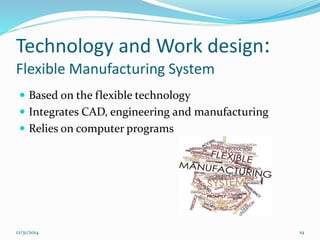
 Based on the flexible technology
 Integrates CAD, engineering and manufacturing
 Relies on computer programs
12/31/2014 19
Technology and Work design:
Flexible Manufacturing System
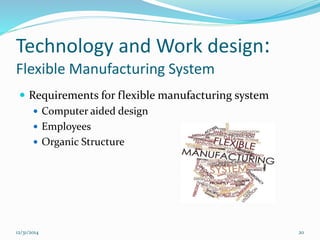
 Requirements for flexible manufacturing system
 Computer aided design
 Employees
 Organic Structure
12/31/2014 20
Technology and Work design:
Worker Obsolescence
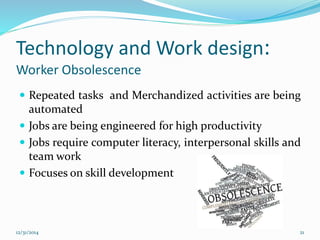
 Repeated tasks and Merchandized activities are being
automated
 Jobs are being engineered for high productivity
 Jobs require computer literacy, interpersonal skills and
team work
 Focuses on skill development
12/31/2014 21
12/31/2014 22

Technology & Work Design

  • 1.
    Presented by: Bina Gupta BIM7th sem Under the Supervision of Ravi Bhattrai BIM Department 12/31/2014 1
  • 2.
    Contents  Concept  Theoriesof work design  Technology and work design 12/31/2014 2
  • 3.
    Concept: Technology  Processof transferring input into output  Substitute machine for human labor  Varies depending on work design 12/31/2014 3
  • 4.
    Concept: Work design Process of defining and structuring jobs  Specifies the content and method of doing job 12/31/2014 4
  • 5.
    Concept: Work design Methods of work design  Job Specialization  Job Specification  Job Rotation  Job Enlargement  Job Enrichment  Autonomous team 12/31/2014 5
  • 6.
    Theories of workdesign  Job Characteristics Theory  Social Information processing theory 12/31/2014 6
  • 7.
    Theories of workdesign: Job Characteristics Theory  Developed by Hackman and Oldham  This theory states that critical psychological states determines the impact of job characteristics on employee response to the task 12/31/2014 7
  • 8.
    Theories of workdesign: Job Characteristics Theory  The various psychological states are:  Experienced meaningfulness of work  Experienced responsibility for work outcome  Knowledge of results 12/31/2014 8
  • 9.
    Theories of workdesign: Job Characteristics Theory  Job characteristics that triggers Psychological state are:  Skills variety  Task identity  Task significance  Autonomy  Feedback 12/31/2014 9
  • 10.
    Theories of workdesign: Social Information Processing theory  States that social information in the workplace influences how employees perceive and react to job characteristics.  Employees adapt attitudes and behaviours in response to social cues with whom they interact 12/31/2014 10
  • 11.
    Theories of workdesign: Social Information Processing theory  Social information and job characteristics reinforce each other  Positive social information and well design job produces positive reaction  Negative social information and poor design job produces negative reaction 12/31/2014 11
  • 12.
    Technology and Workdesign  Team and continuous improvement process  Reengineering work process  Flexible manufacturing system  Worker Obsolesce 12/31/2014 12
  • 13.
    Technology and Workdesign: Team and continuous improvement process  Also termed as TQM  TQM advocates continuous improvement of product quality through everyone’s commitment and involvement to satisfy costumer’s need. 12/31/2014 13
  • 14.
    Technology and Workdesign: Team and continuous improvement process  This process uses PDCA cycle ( Plan, Do, Check, Act) for incremental improvements 12/31/2014 14
  • 15.
    Technology and Workdesign: Team and continuous improvement process  Requirements for continuous improvement Process (TQM)  New Technology  Employee involvement  Commitment  Team Effort  Production methods  Costumer orientation  Control 12/31/2014 15
  • 16.
    Technology and Workdesign: Team and continuous improvement process  Tools for continuous improvement process  Quality circle  Zero defect  Just in Time  Quality control  Quality assurance  Training 12/31/2014 16
  • 17.
    Technology and Workdesign: Reengineering Work Process  Radical redesign of the work process  Individual processes are combined to gain efficiencies and productivity  Workers are allowed to make decisions on the spot to eliminate process roadblocks and increase speed to market 12/31/2014 17
  • 18.
    Technology and Workdesign: Reengineering Work Process  Key elements of reengineering are:  Identify distinctive competencies  Assess core processes  Horizontal reorganization 12/31/2014 18
  • 19.
    Technology and Workdesign: Flexible Manufacturing System  Based on the flexible technology  Integrates CAD, engineering and manufacturing  Relies on computer programs 12/31/2014 19
  • 20.
    Technology and Workdesign: Flexible Manufacturing System  Requirements for flexible manufacturing system  Computer aided design  Employees  Organic Structure 12/31/2014 20
  • 21.
    Technology and Workdesign: Worker Obsolescence  Repeated tasks and Merchandized activities are being automated  Jobs are being engineered for high productivity  Jobs require computer literacy, interpersonal skills and team work  Focuses on skill development 12/31/2014 21
  • 22.