Compiled By: Prof. G B Rathod
EC department-BVM EngineeringCollege,
Email: ghansyam.rathod@bvmengineering.ac.in
INTRODUCTION OF BIOMEDICAL
INSTRUMENTATION
www.gbrathod.co.in
Biomedical Instrumentation
www.gbrathod.co.in
Sphygmomanometer
Biomedical Instrumentation
www.gbrathod.co.in
The average body temperature is 98.6 F (37 C). But normal body
temperature can range between 97 F (36.1 C) and 99 F (37.2 C) or more. Your body
temperature can vary depending on how active you are or the time of day. Generally, older
people have lower body temperatures than younger people have
Biomedical Instrumentation
www.gbrathod.co.in
Oximeter
Small beams of light pass through the blood in the finger,
measuring the amount of oxygen. It does this by
measuring changes of light absorption in oxygenated or
deoxygenated blood. This is a painless process. The
pulse oximeter will thus be able to tell you
your oxygen saturation levels along with your heart
rate.
TOPIC OUTLINES…
 THEAGE OF BIOMEDICAL ENGINEERING
 DEVELOPMENT OF BIOMEDICAL INSTRUMENTATION
 BIOMETRICS
 INTRODUCTIONTO MAN INSTRUMENT SYSTEM
 COMPONENTS OF MAN INSTRUMENT SYSTEM
 PHYSIOLOGICAL SYSTEM OF BODY
 TOPIC OUTCOME
 QUESTIONS
 REFERENCES
www.gbrathod.co.in
THE AGE OF BIOMEDICAL ENGINEERING
 It is a technology of this era. Near to 1970s,was the decade when
this field get rapid progress.
 We can define it such that, Bio means its related to life. There are
many inter disciplines also. E.g. Biochemistry,
Biophysics,Biomechanics,Bioelectronics, Bioinstrumentations
etc…
 committees have been form to define this terms
 The different committees provided various definitions of this
field..
 One of the definition is …..
www.gbrathod.co.in
THE AGE OF BIOMEDICAL ENGINEERING
 “Bioengineering “ be defined as application of the
knowledge gained by a cross fertilization of
engineering and the biological sciences so that both
will be more fully utilized for the benefit of
man(woman or human).
 Association for the Advancement of Medical
Instrumentation ( AAMI).
 Biomedical equipment technician(BMET)
 The other titles have been used, hospital engineer and
medical engineer.
 Biomedical instrumentation is the methods of
measurement within the filed.
 Other problem is communication gape between the
engineers and the doctors.( Appendix are given in the
book)
www.gbrathod.co.in
DEVELOPMENT OF BIOMEDICAL
INSTRUMENTATION
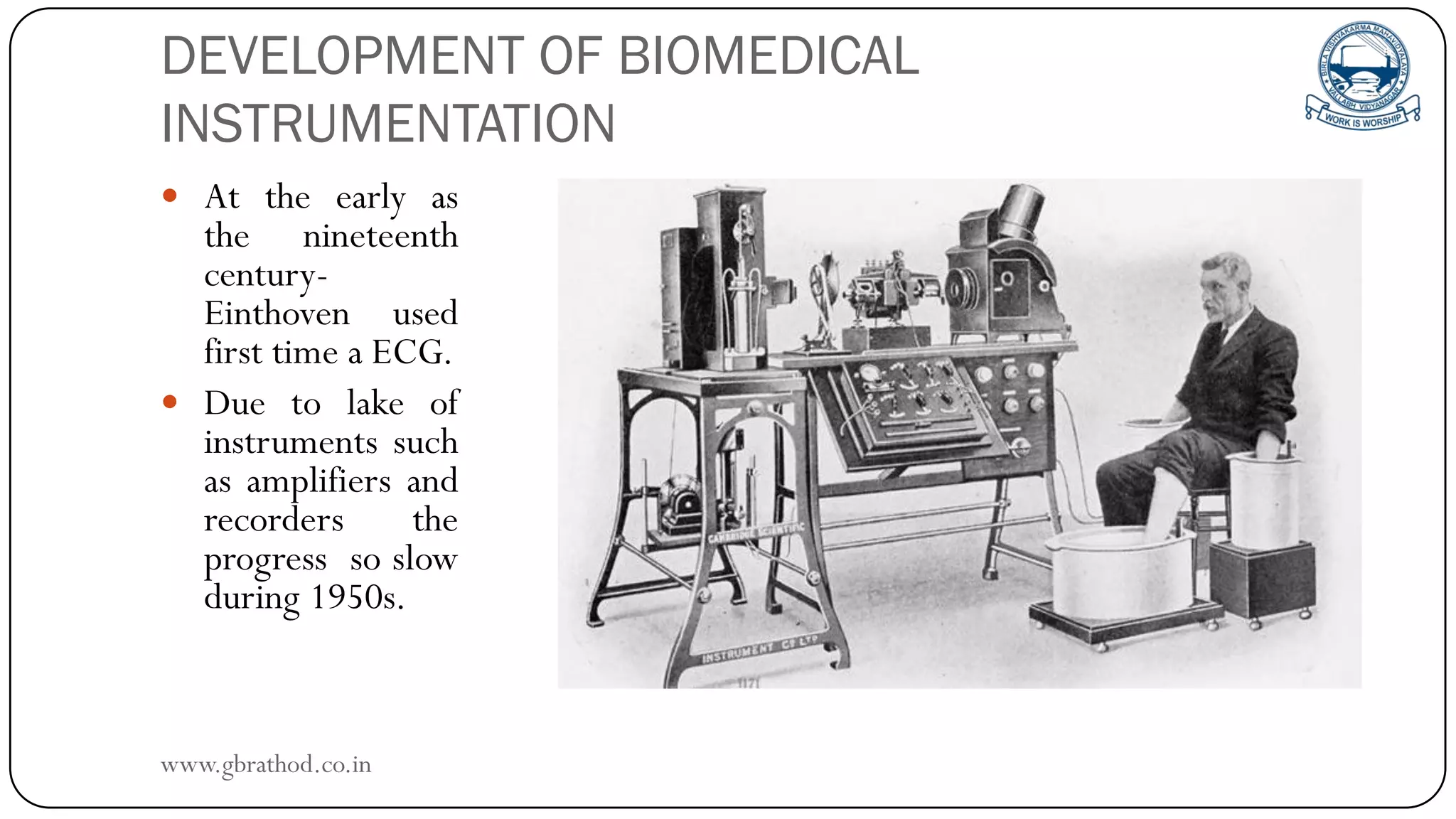
 At the early as
the nineteenth
century-
Einthoven used
first time a ECG.
 Due to lake of
instruments such
as amplifiers and
recorders the
progress so slow
during 1950s.
www.gbrathod.co.in
DEVELOPMENT OF BIOMEDICAL
INSTRUMENTATION
 Physiological parameters can not be measure as physical
parameters.
 During next decade the because of high cost of instruments and
also medical staff were suspicious of the new equipments and
often uncooperative.
 During the Mercury , Gemini and Apollo program of NASA,
Large help was provided to design such medical instruments.
 After that universities, hospitals, colleges and researchers are
started more working in this field.
www.gbrathod.co.in
BIOMETRICS
 The branch of science that includes the measurement of
physiological variables and parameters is known as biometrics.
 Sensors and Transducers are useful for making of measuring
instruments related to body.
 For designing of medical instrumentation systems, few factors are
to be considered.
 (1) Range, (2) Sensitivity, (3) Linearity, (4) Hysteresis,
(5) Frequency Response, (6) Accuracy, (7) Signal to Nosie Ratio,
(8) Stability, (9) Isolation, (10) Simplicity.
www.gbrathod.co.in
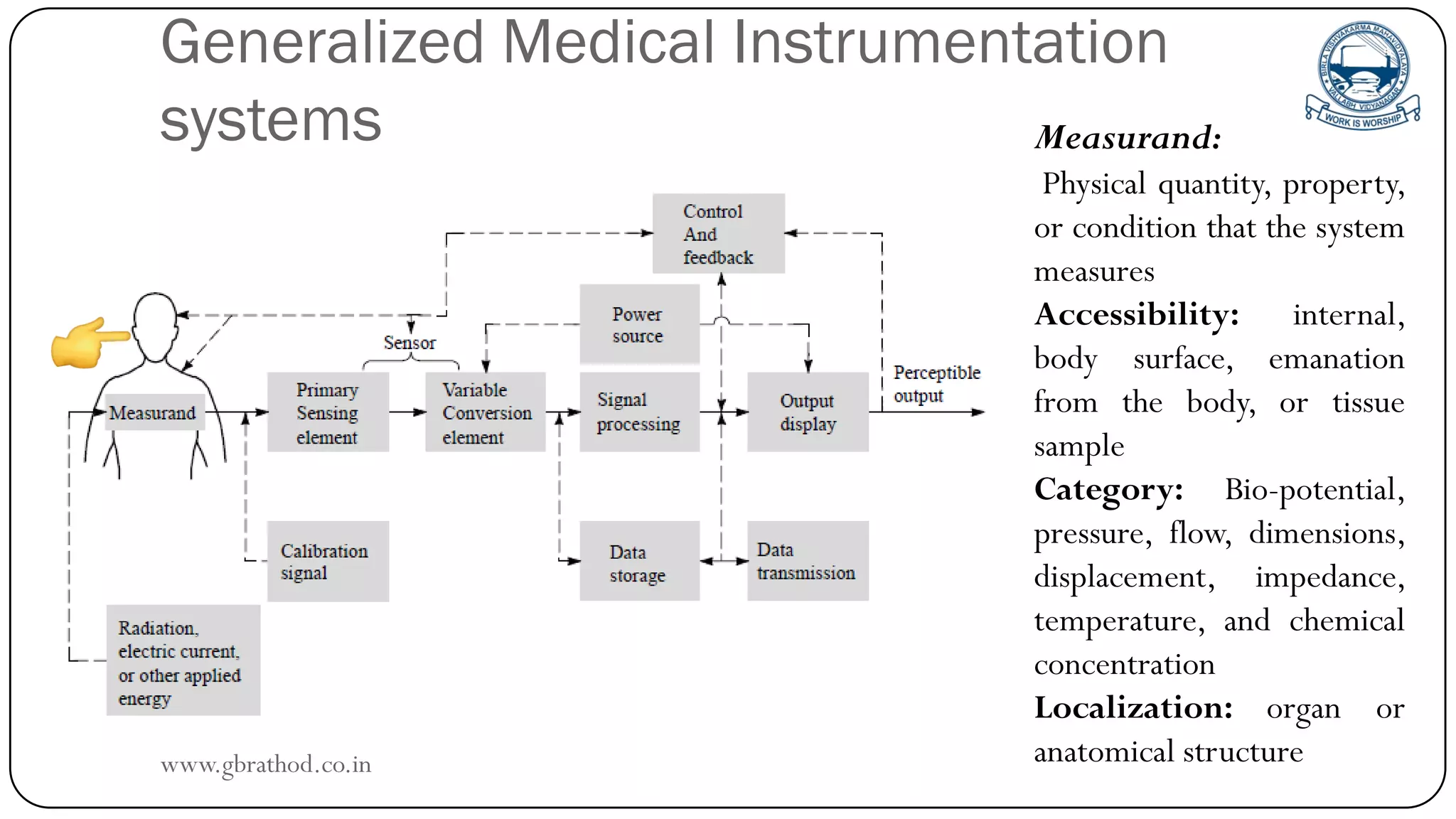
Generalized Medical Instrumentation
systems
www.gbrathod.co.in
Measurand:
Physical quantity, property,
or condition that the system
measures
Accessibility: internal,
body surface, emanation
from the body, or tissue
sample
Category: Bio-potential,
pressure, flow, dimensions,
displacement, impedance,
temperature, and chemical
concentration
Localization: organ or
anatomical structure
Generalized Medical Instrumentation
systems
www.gbrathod.co.in
Sensor
•Transducer (sensor) is a device
that converts one form of
energy to another (electric)
•Specific minimization of the
extracted energy
•Minimally invasive
•Primary sensing element and
variable conversion element
Generalized Medical Instrumentation
systems
www.gbrathod.co.in
Signal Conditioning
Amplification, filtering,
impedance matching,A/C
conversion, DSP, etc.
Output Display
Visual sense
Numerical or graphical
Discrete or continuous
Permanent or temporary
Auditory sense
Tactile sense
Generalized Medical Instrumentation
systems
www.gbrathod.co.in
Auxiliary Elements
Calibration
Control and
feedback
Storage
Transmission
Classifications of Biomedical Instruments
www.gbrathod.co.in
 Quantity that is sensed: pressure, flow, temperature, etc.
 Principle of transduction: resistive, inductive, capacitive,
ultrasonic, electrochemical,etc.
 Organ system: cardiovascular, pulmonary, nervous,
endocrine, etc.
 Clinical medicine specialties: pediatrics, obstetrics,
cardiology, radiology, etc
Interfering and Modifying Inputs
www.gbrathod.co.in
 Desired input: Vecg
 Interfering input: 60-Hz noise
 Modifying input: orientation of
the patient cables
 Two possible interfering inputs
are stray magnetic fields and
capacitive coupled noise.
Orientation of patient cables and
changes in electrode-skin
impedance are two possible
modifying inputs. Z1 and Z2
represent the electrode-skin
interface impedances.
Compensation Techniques
www.gbrathod.co.in
 Inherent Insensitivity
 Make all components inherently sensitive only to desired
inputs
 Twisting the lead wires in last Figure.
 UseAg/AgCl electrode to reduce motion artifact
PHYSIOLOGICAL SYSTEMS OF THE BODY
Communication of
Man with his
environment
www.gbrathod.co.in
PHYSIOLOGICAL SYSTEMS OF THE BODY
 The biochemical system: The human body has within it an
integrated conglomerate of chemical systems that produce
energy for the activity of the body, messenger agents for
communication, materials for body repair and growth, and
substances required to carry out the various body functions.
 The cardiovascular system: Heart( Hydraulic system)
 The respiratory system: Pneumatic system
 The nervous system
www.gbrathod.co.in
Overview Cell Structure
 All mammals, including humans, are made up of basic building blocks
called cells.
 The different types of cells perform different jobs and so have different
gross structures.
 The size of cells also varies, ranging from 200 nm to several centimeters
in length. Most cells, however, fall within the range of 0.5 to 20
micrometer.
 The cell is surrounded by semipermeable membrane.
 The structure of most cells includes a nucleus inside of the cell,
separated from the surrounding cytoplasm by its own membrane. The
nucleus contains the genetic coding of reproducible cells.
www.gbrathod.co.in
Overview Cell Structure
Fig.1.1: Diverse forms
Of mammalian cells
(Not to the same scale)
www.gbrathod.co.in
Overview Cell Structure
 Cells in the human body are quite numerous. It has been
estimated that there are approximately 75 trillion cells in the
body, of which one third (25 trillion) are red blood cells.
 All cells in a many celled animal retain certain powers or
characteristics, such as organization, irritability (i.e.,
response to external stimuli), nutrition, metabolism,
respiration and excretion.
www.gbrathod.co.in
Body Fluids
 The body is almost two thirds fluid ( Actually, approximately
56%).
 Intracellular fluids contains large concentration of potassium,
magnesium and phosphate ions;
 Extracellular fluids contains significant concentrations of
sodium, chloride, bicarbonate ions, oxygen, amino acids,
fatty acids, glucose, and carbon dioxide.
 Lets see different types of tissues of human body: Click Here
www.gbrathod.co.in
Major Systems of the body
 Musculoskeletal system
 The muscles and bones of the body provide locomotion.( i.e. the ability
to move around and manipulate our surroundings).
 If it were not for locomotion, human would be more dependent on the
local environment.
 Human would not be able to move to avoid danger, find food and water,
or erect shelter from the elements.
 Fig. 1.2 shows the principal structure of the musculoskeletal system.
 The bones are joined together to form articulations and joints and so are
able to move with respect to each other.
www.gbrathod.co.in
Major Systems of the body
Fig.1.3: Musculoskeletal system
www.gbrathod.co.in
Let’sTake a look at the system:
Click here
Major Systems of the body
 Respiration System
 The respiratory system takes oxygen into the body
and gives off carbon dioxide waste products from the
cells.
 The respiratory system includes the mouth; nose;
trachea, or windpipe; bronchi; and lungs.
 Deoxygenated blood from the right side of the heart
passes trough the lungs: only 0.4 to 2.0 micrometer
of membrane separate the air carrying alveoli from
the pulmonary capillaries.
 Gaseous oxygen diffuses across this membrane into
the blood stream, while carbon dioxide comes out of
the blood, into the alveoli, to be exhaled into the
atmosphere.
 Lets see how the system is working: Click here
www.gbrathod.co.in
Major Systems of the body
 Gastrointestinal system
 The GI system takes in raw materials in the
form of food and liquids and process them
so that they are absorbed into the body.
 The system includes the mouth, esophagus,
stomach, small intestine, and large
intestine.
 Digestion of food is the process of breaking
down, liquefying and chemically processing
food stuffs so that they cab be used by the
body.
 Both mechanical mixing and chemical
breakdown occurs in the stomach. See the
figure
 Lets see how the system works: Click here
www.gbrathod.co.in
Major Systems of the body
 Nervous system
 The nervous system is essential to the functioning of the human organism.
 It regulates our automatic control systems, integrates and assimilates data
from the outside world and our internal organs, and regulates and controls
the locomotors system.
 The automatic nervous system is responsible for regulating the automatic
function of the body- heartbeat, glad secretions, GI system, and so forth.
 The automatic nervous system operates at a subconscious level- you are not
aware of its functioning.
www.gbrathod.co.in
Major Systems of the body
 The sensory nervous system receives data from the
outside world and certain internal organs through cells
that function as sensory receptors.(i.e.., transduces, in
electrical terminology).
 The eyes and ears are sensory receptors for light and
sound, respectively. But there are also other sensory
structures that are sensitive to pain, heat and pressure.
 The central nervous system (CNS) gathers, as similates,
and integrates data from the outside world, information
on the state of internal organs, etc.
 The brain is the principal organ of the CNS, and , like
computer, it can store, process, and generate information
and react to stimuli. The CNS also includes the spinal
cord.
 Lets take a look: Click here
www.gbrathod.co.in
Major Systems of the body
 Endocrine System
 Central Nervous system is an electrical communications and
control system within the body, the endocrine system is a
chemical communication/control system and aids in the
regulation of internal body states.
 Chemicals called hormones are secreted by the eight major
endocrine glades into the bloodstream, in which they act as
control agents to regulate various organic functions.
www.gbrathod.co.in
Major Systems of the body
 The Circulatory system
 The circulatory system transports body fluids around the body from one organ
to another.
 Figure1.4 shows a schematic representation of the blood circulatory system.
 The transport of blood is caused by a pressure built up when the heart, a pump,
contracts.
 Oxygenated blood from the left ventricle is pumped throughout the body
delivering oxygen to the various organs and tissues.
 It is claimed that the human blood circulatory system is so extensive that no cell
in the body is farther than one cell’s diameter from a small vessel, or capillary.
www.gbrathod.co.in
Major Systems of the body
 The oxygenated blood flows in arteries to the organs. The blood flowing
into the vessels of the GI tract picks up nutrients and water.
 The portion of the blood flows into the kidneys is cleaned of impurities
and waste products, which are excreted through the bladder urethra.
The kidney act as blood filter.
 The blood gives up much of its oxygen to the tissues, and the
deoxygenated blood returns to the heart in the veins.
 Deoxygenated blood enters the right side of the heart at the right
atrium. It is then pumped into the right ventricle and out of the heart to
the lungs. In the lungs the blood gives up its carbon dioxide and takes on
a fresh supply of oxygen.
www.gbrathod.co.in
Major Systems of the body
Fig.1.4: Circulatory system.
www.gbrathod.co.in
Lets take a look at the system:
Click here
Click here for 3d animated video
Click here to see how ECG Generated
TOPIC OUTCOMES
 We come to know the necessity of this technology. The field
with great research opportunity.
 The benefits of the biomedical engineering and in that the
understanding of the various instrument’s parameters.
 The basic understanding of human body and the various
parameters that can be measure using this technology.
www.gbrathod.co.in
REFERENCE
 Book:“Biomedical instrumentation and measurements “ ,by
L. Cromwell, F .Weibell, and E. Pfeiffer. PHI publication 2nd
Edition.
www.gbrathod.co.in
List of reference books:
1. Leslie Cromwell, Fred J.Weibell, ErichA. Pfeiffer,“Biomedical
Instrumentation and Measurements”,PHI Private Limited,2nd
Edi, 2012.
2. John G.Webster,“Medical InstrumentationApplication and
Design”,WSEWiley India Private Limited, 3rd Edition, 2012.
3. Joseph J. Carr, John M. Brown,“Introduction to Biomedical
EquipmentTechnology”, Pearson Education, 4th Edition, 2012.
4. R S. Khandpur,“Handbook of Biomedical Instrumentation”,Tata
McGraw Hill, 2nd Edition, 2002
www.gbrathod.co.in
THANK YOU
www.gbrathod.co.in
www.gbrathod.co.in

Topic 1 introduction of biomedical instrumentation

  • 1.
    Compiled By: Prof.G B Rathod EC department-BVM EngineeringCollege, Email: ghansyam.rathod@bvmengineering.ac.in INTRODUCTION OF BIOMEDICAL INSTRUMENTATION www.gbrathod.co.in
  • 2.
  • 3.
    Biomedical Instrumentation www.gbrathod.co.in The averagebody temperature is 98.6 F (37 C). But normal body temperature can range between 97 F (36.1 C) and 99 F (37.2 C) or more. Your body temperature can vary depending on how active you are or the time of day. Generally, older people have lower body temperatures than younger people have
  • 4.
    Biomedical Instrumentation www.gbrathod.co.in Oximeter Small beamsof light pass through the blood in the finger, measuring the amount of oxygen. It does this by measuring changes of light absorption in oxygenated or deoxygenated blood. This is a painless process. The pulse oximeter will thus be able to tell you your oxygen saturation levels along with your heart rate.
  • 5.
    TOPIC OUTLINES…  THEAGEOF BIOMEDICAL ENGINEERING  DEVELOPMENT OF BIOMEDICAL INSTRUMENTATION  BIOMETRICS  INTRODUCTIONTO MAN INSTRUMENT SYSTEM  COMPONENTS OF MAN INSTRUMENT SYSTEM  PHYSIOLOGICAL SYSTEM OF BODY  TOPIC OUTCOME  QUESTIONS  REFERENCES www.gbrathod.co.in
  • 6.
    THE AGE OFBIOMEDICAL ENGINEERING  It is a technology of this era. Near to 1970s,was the decade when this field get rapid progress.  We can define it such that, Bio means its related to life. There are many inter disciplines also. E.g. Biochemistry, Biophysics,Biomechanics,Bioelectronics, Bioinstrumentations etc…  committees have been form to define this terms  The different committees provided various definitions of this field..  One of the definition is ….. www.gbrathod.co.in
  • 7.
    THE AGE OFBIOMEDICAL ENGINEERING  “Bioengineering “ be defined as application of the knowledge gained by a cross fertilization of engineering and the biological sciences so that both will be more fully utilized for the benefit of man(woman or human).  Association for the Advancement of Medical Instrumentation ( AAMI).  Biomedical equipment technician(BMET)  The other titles have been used, hospital engineer and medical engineer.  Biomedical instrumentation is the methods of measurement within the filed.  Other problem is communication gape between the engineers and the doctors.( Appendix are given in the book) www.gbrathod.co.in
  • 8.
    DEVELOPMENT OF BIOMEDICAL INSTRUMENTATION At the early as the nineteenth century- Einthoven used first time a ECG.  Due to lake of instruments such as amplifiers and recorders the progress so slow during 1950s. www.gbrathod.co.in
  • 9.
    DEVELOPMENT OF BIOMEDICAL INSTRUMENTATION Physiological parameters can not be measure as physical parameters.  During next decade the because of high cost of instruments and also medical staff were suspicious of the new equipments and often uncooperative.  During the Mercury , Gemini and Apollo program of NASA, Large help was provided to design such medical instruments.  After that universities, hospitals, colleges and researchers are started more working in this field. www.gbrathod.co.in
  • 10.
    BIOMETRICS  The branchof science that includes the measurement of physiological variables and parameters is known as biometrics.  Sensors and Transducers are useful for making of measuring instruments related to body.  For designing of medical instrumentation systems, few factors are to be considered.  (1) Range, (2) Sensitivity, (3) Linearity, (4) Hysteresis, (5) Frequency Response, (6) Accuracy, (7) Signal to Nosie Ratio, (8) Stability, (9) Isolation, (10) Simplicity. www.gbrathod.co.in
  • 11.
    Generalized Medical Instrumentation systems www.gbrathod.co.in Measurand: Physicalquantity, property, or condition that the system measures Accessibility: internal, body surface, emanation from the body, or tissue sample Category: Bio-potential, pressure, flow, dimensions, displacement, impedance, temperature, and chemical concentration Localization: organ or anatomical structure
  • 12.
    Generalized Medical Instrumentation systems www.gbrathod.co.in Sensor •Transducer(sensor) is a device that converts one form of energy to another (electric) •Specific minimization of the extracted energy •Minimally invasive •Primary sensing element and variable conversion element
  • 13.
    Generalized Medical Instrumentation systems www.gbrathod.co.in SignalConditioning Amplification, filtering, impedance matching,A/C conversion, DSP, etc. Output Display Visual sense Numerical or graphical Discrete or continuous Permanent or temporary Auditory sense Tactile sense
  • 14.
    Generalized Medical Instrumentation systems www.gbrathod.co.in AuxiliaryElements Calibration Control and feedback Storage Transmission
  • 15.
    Classifications of BiomedicalInstruments www.gbrathod.co.in  Quantity that is sensed: pressure, flow, temperature, etc.  Principle of transduction: resistive, inductive, capacitive, ultrasonic, electrochemical,etc.  Organ system: cardiovascular, pulmonary, nervous, endocrine, etc.  Clinical medicine specialties: pediatrics, obstetrics, cardiology, radiology, etc
  • 16.
    Interfering and ModifyingInputs www.gbrathod.co.in  Desired input: Vecg  Interfering input: 60-Hz noise  Modifying input: orientation of the patient cables  Two possible interfering inputs are stray magnetic fields and capacitive coupled noise. Orientation of patient cables and changes in electrode-skin impedance are two possible modifying inputs. Z1 and Z2 represent the electrode-skin interface impedances.
  • 17.
    Compensation Techniques www.gbrathod.co.in  InherentInsensitivity  Make all components inherently sensitive only to desired inputs  Twisting the lead wires in last Figure.  UseAg/AgCl electrode to reduce motion artifact
  • 18.
    PHYSIOLOGICAL SYSTEMS OFTHE BODY Communication of Man with his environment www.gbrathod.co.in
  • 19.
    PHYSIOLOGICAL SYSTEMS OFTHE BODY  The biochemical system: The human body has within it an integrated conglomerate of chemical systems that produce energy for the activity of the body, messenger agents for communication, materials for body repair and growth, and substances required to carry out the various body functions.  The cardiovascular system: Heart( Hydraulic system)  The respiratory system: Pneumatic system  The nervous system www.gbrathod.co.in
  • 20.
    Overview Cell Structure All mammals, including humans, are made up of basic building blocks called cells.  The different types of cells perform different jobs and so have different gross structures.  The size of cells also varies, ranging from 200 nm to several centimeters in length. Most cells, however, fall within the range of 0.5 to 20 micrometer.  The cell is surrounded by semipermeable membrane.  The structure of most cells includes a nucleus inside of the cell, separated from the surrounding cytoplasm by its own membrane. The nucleus contains the genetic coding of reproducible cells. www.gbrathod.co.in
  • 21.
    Overview Cell Structure Fig.1.1:Diverse forms Of mammalian cells (Not to the same scale) www.gbrathod.co.in
  • 22.
    Overview Cell Structure Cells in the human body are quite numerous. It has been estimated that there are approximately 75 trillion cells in the body, of which one third (25 trillion) are red blood cells.  All cells in a many celled animal retain certain powers or characteristics, such as organization, irritability (i.e., response to external stimuli), nutrition, metabolism, respiration and excretion. www.gbrathod.co.in
  • 23.
    Body Fluids  Thebody is almost two thirds fluid ( Actually, approximately 56%).  Intracellular fluids contains large concentration of potassium, magnesium and phosphate ions;  Extracellular fluids contains significant concentrations of sodium, chloride, bicarbonate ions, oxygen, amino acids, fatty acids, glucose, and carbon dioxide.  Lets see different types of tissues of human body: Click Here www.gbrathod.co.in
  • 24.
    Major Systems ofthe body  Musculoskeletal system  The muscles and bones of the body provide locomotion.( i.e. the ability to move around and manipulate our surroundings).  If it were not for locomotion, human would be more dependent on the local environment.  Human would not be able to move to avoid danger, find food and water, or erect shelter from the elements.  Fig. 1.2 shows the principal structure of the musculoskeletal system.  The bones are joined together to form articulations and joints and so are able to move with respect to each other. www.gbrathod.co.in
  • 25.
    Major Systems ofthe body Fig.1.3: Musculoskeletal system www.gbrathod.co.in Let’sTake a look at the system: Click here
  • 26.
    Major Systems ofthe body  Respiration System  The respiratory system takes oxygen into the body and gives off carbon dioxide waste products from the cells.  The respiratory system includes the mouth; nose; trachea, or windpipe; bronchi; and lungs.  Deoxygenated blood from the right side of the heart passes trough the lungs: only 0.4 to 2.0 micrometer of membrane separate the air carrying alveoli from the pulmonary capillaries.  Gaseous oxygen diffuses across this membrane into the blood stream, while carbon dioxide comes out of the blood, into the alveoli, to be exhaled into the atmosphere.  Lets see how the system is working: Click here www.gbrathod.co.in
  • 27.
    Major Systems ofthe body  Gastrointestinal system  The GI system takes in raw materials in the form of food and liquids and process them so that they are absorbed into the body.  The system includes the mouth, esophagus, stomach, small intestine, and large intestine.  Digestion of food is the process of breaking down, liquefying and chemically processing food stuffs so that they cab be used by the body.  Both mechanical mixing and chemical breakdown occurs in the stomach. See the figure  Lets see how the system works: Click here www.gbrathod.co.in
  • 28.
    Major Systems ofthe body  Nervous system  The nervous system is essential to the functioning of the human organism.  It regulates our automatic control systems, integrates and assimilates data from the outside world and our internal organs, and regulates and controls the locomotors system.  The automatic nervous system is responsible for regulating the automatic function of the body- heartbeat, glad secretions, GI system, and so forth.  The automatic nervous system operates at a subconscious level- you are not aware of its functioning. www.gbrathod.co.in
  • 29.
    Major Systems ofthe body  The sensory nervous system receives data from the outside world and certain internal organs through cells that function as sensory receptors.(i.e.., transduces, in electrical terminology).  The eyes and ears are sensory receptors for light and sound, respectively. But there are also other sensory structures that are sensitive to pain, heat and pressure.  The central nervous system (CNS) gathers, as similates, and integrates data from the outside world, information on the state of internal organs, etc.  The brain is the principal organ of the CNS, and , like computer, it can store, process, and generate information and react to stimuli. The CNS also includes the spinal cord.  Lets take a look: Click here www.gbrathod.co.in
  • 30.
    Major Systems ofthe body  Endocrine System  Central Nervous system is an electrical communications and control system within the body, the endocrine system is a chemical communication/control system and aids in the regulation of internal body states.  Chemicals called hormones are secreted by the eight major endocrine glades into the bloodstream, in which they act as control agents to regulate various organic functions. www.gbrathod.co.in
  • 31.
    Major Systems ofthe body  The Circulatory system  The circulatory system transports body fluids around the body from one organ to another.  Figure1.4 shows a schematic representation of the blood circulatory system.  The transport of blood is caused by a pressure built up when the heart, a pump, contracts.  Oxygenated blood from the left ventricle is pumped throughout the body delivering oxygen to the various organs and tissues.  It is claimed that the human blood circulatory system is so extensive that no cell in the body is farther than one cell’s diameter from a small vessel, or capillary. www.gbrathod.co.in
  • 32.
    Major Systems ofthe body  The oxygenated blood flows in arteries to the organs. The blood flowing into the vessels of the GI tract picks up nutrients and water.  The portion of the blood flows into the kidneys is cleaned of impurities and waste products, which are excreted through the bladder urethra. The kidney act as blood filter.  The blood gives up much of its oxygen to the tissues, and the deoxygenated blood returns to the heart in the veins.  Deoxygenated blood enters the right side of the heart at the right atrium. It is then pumped into the right ventricle and out of the heart to the lungs. In the lungs the blood gives up its carbon dioxide and takes on a fresh supply of oxygen. www.gbrathod.co.in
  • 33.
    Major Systems ofthe body Fig.1.4: Circulatory system. www.gbrathod.co.in Lets take a look at the system: Click here Click here for 3d animated video Click here to see how ECG Generated
  • 34.
    TOPIC OUTCOMES  Wecome to know the necessity of this technology. The field with great research opportunity.  The benefits of the biomedical engineering and in that the understanding of the various instrument’s parameters.  The basic understanding of human body and the various parameters that can be measure using this technology. www.gbrathod.co.in
  • 35.
    REFERENCE  Book:“Biomedical instrumentationand measurements “ ,by L. Cromwell, F .Weibell, and E. Pfeiffer. PHI publication 2nd Edition. www.gbrathod.co.in
  • 36.
    List of referencebooks: 1. Leslie Cromwell, Fred J.Weibell, ErichA. Pfeiffer,“Biomedical Instrumentation and Measurements”,PHI Private Limited,2nd Edi, 2012. 2. John G.Webster,“Medical InstrumentationApplication and Design”,WSEWiley India Private Limited, 3rd Edition, 2012. 3. Joseph J. Carr, John M. Brown,“Introduction to Biomedical EquipmentTechnology”, Pearson Education, 4th Edition, 2012. 4. R S. Khandpur,“Handbook of Biomedical Instrumentation”,Tata McGraw Hill, 2nd Edition, 2002 www.gbrathod.co.in
  • 37.