1
Prof. Dr. Nizamettin AYDIN
naydin@yildiz.edu.tr
naydin@ieee.org
http://www.yildiz.edu.tr/~naydin
Biomedical Instrumentation
2
Course Details
• Course Code : GBE 302
• Course Name: Biomedical Instrumentation
• Instructor : Nizamettin AYDIN
3
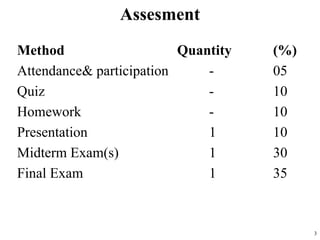
Assesment
Method Quantity (%)
Attendance& participation - 05
Quiz - 10
Homework - 10
Presentation 1 10
Midterm Exam(s) 1 30
Final Exam 1 35
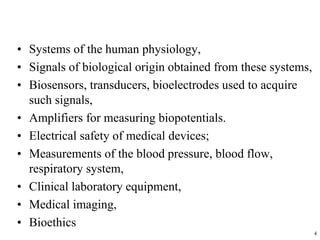
• Systems of the human physiology,
• Signals of biological origin obtained from these systems,
• Biosensors, transducers, bioelectrodes used to acquire
such signals,
• Amplifiers for measuring biopotentials.
• Electrical safety of medical devices;
• Measurements of the blood pressure, blood flow,
respiratory system,
• Clinical laboratory equipment,
• Medical imaging,
• Bioethics
4
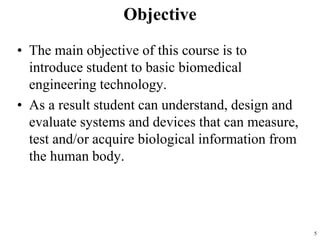
Objective
• The main objective of this course is to
introduce student to basic biomedical
engineering technology.
• As a result student can understand, design and
evaluate systems and devices that can measure,
test and/or acquire biological information from
the human body.
5
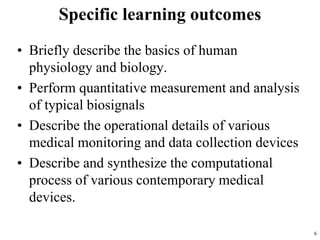
Specific learning outcomes
• Briefly describe the basics of human
physiology and biology.
• Perform quantitative measurement and analysis
of typical biosignals
• Describe the operational details of various
medical monitoring and data collection devices
• Describe and synthesize the computational
process of various contemporary medical
devices.
6
7
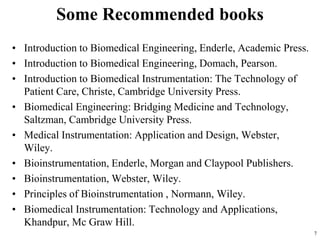
Some Recommended books
• Introduction to Biomedical Engineering, Enderle, Academic Press.
• Introduction to Biomedical Engineering, Domach, Pearson.
• Introduction to Biomedical Instrumentation: The Technology of
Patient Care, Christe, Cambridge University Press.
• Biomedical Engineering: Bridging Medicine and Technology,
Saltzman, Cambridge University Press.
• Medical Instrumentation: Application and Design, Webster,
Wiley.
• Bioinstrumentation, Enderle, Morgan and Claypool Publishers.
• Bioinstrumentation, Webster, Wiley.
• Principles of Bioinstrumentation , Normann, Wiley.
• Biomedical Instrumentation: Technology and Applications,
Khandpur, Mc Graw Hill.
8
Some Recommended books
• Introduction to Biomedical Equipment Tech., Carr and Brown,
Prentice Hall.
• Std. Handbook of Biomedical Engineering & Design, Kutz, Mc
Graw Hill.
• Design of Medical Electronic Devices, Perez, Academic Press.
• Introduction to Bioengineering, Goldsmith and Lewis, Oxford.
• Principles of Anatomy and Physiology, Tortora and Grabowski,
Wiley.
• Engineering Physiology, Kroemer, Springer
• Design and development of medical electronic instrumentation: a
practical perspective of the design, construction, and test of
material devices, Prutchi and Norris, Wiley.
9
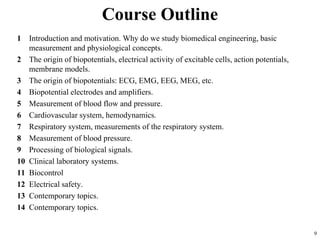
Course Outline
1 Introduction and motivation. Why do we study biomedical engineering, basic
measurement and physiological concepts.
2 The origin of biopotentials, electrical activity of excitable cells, action potentials,
membrane models.
3 The origin of biopotentials: ECG, EMG, EEG, MEG, etc.
4 Biopotential electrodes and amplifiers.
5 Measurement of blood flow and pressure.
6 Cardiovascular system, hemodynamics.
7 Respiratory system, measurements of the respiratory system.
8 Measurement of blood pressure.
9 Processing of biological signals.
10 Clinical laboratory systems.
11 Biocontrol
12 Electrical safety.
13 Contemporary topics.
14 Contemporary topics.
Rules of the Conduct
• No eating /drinking in class
– except water
• Cell phones must be kept outside of class or
switched-off during class
– If your cell-phone rings during class or you use it
in any way, you will be asked to leave and counted
as unexcused absent.
• No web surfing and/or unrelated use of
computers,
– when computers are used in class or lab.
10
Rules of the Conduct
• You are responsible for checking the class web
page often for announcements.
• Academic dishonesty and cheating will not be
tolerated and will be dealt with according to
university rules and regulations
– Presenting any work, or a portion thereof, that
does not belong to you is considered academic
dishonesty.
11
Attendance Policy
• The requirement for attendance is 70%.
– Hospital reports are not accepted to fulfill the
requirement for attendance.
– The students, who fail to fulfill the attendance
requirement, will be excluded from the final exams
and the grade of NA will be given.
12

Introduction to Biomedical Engineering and Instruments

  • 1.
    1 Prof. Dr. NizamettinAYDIN naydin@yildiz.edu.tr naydin@ieee.org http://www.yildiz.edu.tr/~naydin Biomedical Instrumentation
  • 2.
    2 Course Details • CourseCode : GBE 302 • Course Name: Biomedical Instrumentation • Instructor : Nizamettin AYDIN
  • 3.
    3 Assesment Method Quantity (%) Attendance&participation - 05 Quiz - 10 Homework - 10 Presentation 1 10 Midterm Exam(s) 1 30 Final Exam 1 35
  • 4.
    • Systems ofthe human physiology, • Signals of biological origin obtained from these systems, • Biosensors, transducers, bioelectrodes used to acquire such signals, • Amplifiers for measuring biopotentials. • Electrical safety of medical devices; • Measurements of the blood pressure, blood flow, respiratory system, • Clinical laboratory equipment, • Medical imaging, • Bioethics 4
  • 5.
    Objective • The mainobjective of this course is to introduce student to basic biomedical engineering technology. • As a result student can understand, design and evaluate systems and devices that can measure, test and/or acquire biological information from the human body. 5
  • 6.
    Specific learning outcomes •Briefly describe the basics of human physiology and biology. • Perform quantitative measurement and analysis of typical biosignals • Describe the operational details of various medical monitoring and data collection devices • Describe and synthesize the computational process of various contemporary medical devices. 6
  • 7.
    7 Some Recommended books •Introduction to Biomedical Engineering, Enderle, Academic Press. • Introduction to Biomedical Engineering, Domach, Pearson. • Introduction to Biomedical Instrumentation: The Technology of Patient Care, Christe, Cambridge University Press. • Biomedical Engineering: Bridging Medicine and Technology, Saltzman, Cambridge University Press. • Medical Instrumentation: Application and Design, Webster, Wiley. • Bioinstrumentation, Enderle, Morgan and Claypool Publishers. • Bioinstrumentation, Webster, Wiley. • Principles of Bioinstrumentation , Normann, Wiley. • Biomedical Instrumentation: Technology and Applications, Khandpur, Mc Graw Hill.
  • 8.
    8 Some Recommended books •Introduction to Biomedical Equipment Tech., Carr and Brown, Prentice Hall. • Std. Handbook of Biomedical Engineering & Design, Kutz, Mc Graw Hill. • Design of Medical Electronic Devices, Perez, Academic Press. • Introduction to Bioengineering, Goldsmith and Lewis, Oxford. • Principles of Anatomy and Physiology, Tortora and Grabowski, Wiley. • Engineering Physiology, Kroemer, Springer • Design and development of medical electronic instrumentation: a practical perspective of the design, construction, and test of material devices, Prutchi and Norris, Wiley.
  • 9.
    9 Course Outline 1 Introductionand motivation. Why do we study biomedical engineering, basic measurement and physiological concepts. 2 The origin of biopotentials, electrical activity of excitable cells, action potentials, membrane models. 3 The origin of biopotentials: ECG, EMG, EEG, MEG, etc. 4 Biopotential electrodes and amplifiers. 5 Measurement of blood flow and pressure. 6 Cardiovascular system, hemodynamics. 7 Respiratory system, measurements of the respiratory system. 8 Measurement of blood pressure. 9 Processing of biological signals. 10 Clinical laboratory systems. 11 Biocontrol 12 Electrical safety. 13 Contemporary topics. 14 Contemporary topics.
  • 10.
    Rules of theConduct • No eating /drinking in class – except water • Cell phones must be kept outside of class or switched-off during class – If your cell-phone rings during class or you use it in any way, you will be asked to leave and counted as unexcused absent. • No web surfing and/or unrelated use of computers, – when computers are used in class or lab. 10
  • 11.
    Rules of theConduct • You are responsible for checking the class web page often for announcements. • Academic dishonesty and cheating will not be tolerated and will be dealt with according to university rules and regulations – Presenting any work, or a portion thereof, that does not belong to you is considered academic dishonesty. 11
  • 12.
    Attendance Policy • Therequirement for attendance is 70%. – Hospital reports are not accepted to fulfill the requirement for attendance. – The students, who fail to fulfill the attendance requirement, will be excluded from the final exams and the grade of NA will be given. 12

Editor's Notes