PRESENTATION ON
GSM ARCHITECTURE
CONTENTS
• GSM-introduction
• GSM Services

• Architecture

• Security in GSM

• Characteristics of GSM standard

• Advantages of GSM

• Future of GSM
What is GSM ?

Global System for Mobile (GSM) is a
second generation cellular standard
developed to cater voice services and data
delivery using digital modulation .
GSM: HISTORY
• Developed by Group Spéciale Mobile (founded 1982) which was
  an initiative of CEPT ( Conference of European Post and
  Telecommunication )
• Under ETSI, GSM is named as “ Global System for Mobile
  communication “ in 1989
• Full set of specifications phase-I became available in 1990
• Phase 2 of the GSM specifications occurs in 1995. Coverage is
  extended to rural areas
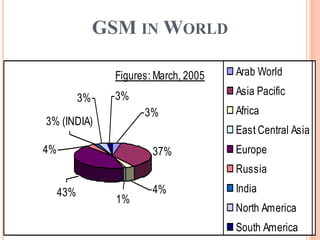
GSM IN WORLD

                  Figures: March, 2005   Arab World

                  3%                     Asia Pacific
           3%
                        3%               Africa
3% (INDIA)
                                         East Central Asia
4%                        37%            Europe
                                         Russia
     43%                  4%             India
                  1%
                                         North America
                                         South America
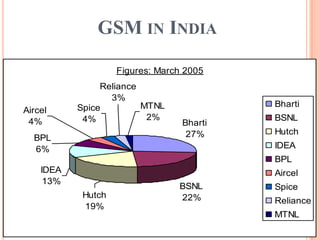
GSM IN INDIA

                    Figures: March 2005
                Reliance
                  3%
           Spice         MTNL              Bharti
Aircel
            4%            2%               BSNL
 4%                               Bharti
                                   27%     Hutch
  BPL
  6%                                       IDEA
                                           BPL
    IDEA                                   Aircel
     13%
                                 BSNL      Spice
            Hutch                22%       Reliance
            19%
                                           MTNL
GSM SERVICES

• Tele-services
• Bearer or Data Services
• Supplementary services
TELE SERVICES

• Telecommunication services that enable voice communication via
mobile phones
• Offered services
 - Mobile telephony
 - Emergency calling
BEARER SERVICES

• Include various data services for information transfer
  between GSM and other networks like PSTN, ISDN etc
  at rates from 300 to 9600 bps
• Short Message Service (SMS)
   - up to 160 character alphanumeric data transmission
     to/from the mobile terminal
• Voice mailbox
SUPPLEMENTARY SERVICES
 Call related services :
• Call Waiting- Notification of an incoming call while on the handset
• Call Hold- Put a caller on hold to take another call
• Call Barring- All calls, outgoing calls, or incoming calls
• Call Forwarding- Calls can be sent to various numbers defined by
  the user
• Multi Party Call Conferencing - Link multiple calls together
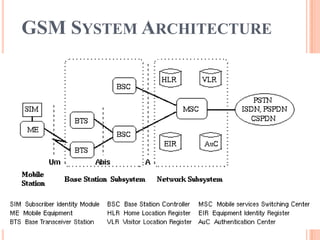
GSM SYSTEM ARCHITECTURE
GSM SYSTEM ARCHITECTURE-I
 Mobile Station (MS)
       Mobile Equipment (ME)
       Subscriber Identity Module (SIM)
 Base Station Subsystem (BSS)
       Base Transceiver Station (BTS)
       Base Station Controller (BSC)
 Network Switching Subsystem(NSS)
       Mobile Switching Center (MSC)
       Home Location Register (HLR)
       Visitor Location Register (VLR)
       Authentication Center (AUC)
       Equipment Identity Register (EIR)
SYSTEM ARCHITECTURE
      MOBILE STATION (MS)

The Mobile Station is made up of two entities:

1. Mobile Equipment (ME)
2. Subscriber Identity Module (SIM)
MOBILE EQUIPMENT

   Portable, vehicle mounted, hand held device
   Uniquely identified by an IMEI (International Mobile
    Equipment Identity)
   Voice and data transmission
   Monitoring power and signal quality of surrounding cells
    for optimum handover
   Power level : 0.8W – 20 W
   160 character long SMS.
SUBSCRIBER IDENTITY MODULE(SIM)
   Smart card contains the International Mobile Subscriber
    Identity (IMSI)
   Allows user to send and receive calls and receive other
    subscribed services
   Protected by a password or PIN
   Can be moved from phone to phone – contains key
    information to activate the phone
SYSTEM ARCHITECTURE
        BASE STATION SUBSYSTEM (BSS)

     Base Station Subsystem is composed of two parts that
     communicate across the standardized Abis interface allowing
     operation between components made by different suppliers

1.   Base Transceiver Station (BTS)
2.   Base Station Controller (BSC)
BASE TRANSCEIVER STATION (BTS):

   Encodes, encrypts, multiplexes, modulates and feeds
    the RF signals to the antenna.
   Communicates with Mobile station and BSC
   Consists of Transceivers (TRX) units
BASE STATION CONTROLLER (BSC)

   Manages Radio resources for BTS
   Assigns Frequency and time slots for all MS’s in its area
   Handles call set up
   Handover for each MS
   It communicates with MSC and BTS
SYSTEM ARCHITECTURE
               NETWORK SWITCHING
                 SUBSYSTEM(NSS)
   The system contains the following functional units

    Mobile Switching Center (MSC)
    Home Location Register (HLR)
    Visitor Location Register (VLR)
    Authentication Center (AUC)
    Equipment Identity Register (EIR)
MOBILE SWITCHING CENTER (MSC)

•   Heart of the network
•   Manages communication between GSM and other networks
•   Billing information and collection
•   Mobility management
    - Registration
    - Location Updating
    - Inter BSS and inter MSC call handoff
HOME LOCATION REGISTERS (HLR)

 Stores information about each subscriber that belongs to it MSC in
 permanent and temporary fashion.
 As soon as mobile subscriber leaves its current local area, the
 information in the HLR is updated.
 database contains IMSI, MSISDN, prepaid/ postpaid, roaming
 restrictions, supplementary services.
VISITOR LOCATION REGISTERS (VLR)
 Temporary database which updates whenever new MS enters its
 area, by HLR database
 Assigns a TMSI to each MS entering the VLR area which keeps on
 changing.
 Controls those mobiles roaming in its area

 Database contains IMSI, MSISDN, Location Area, authentication
 key
AUTHENTICATION CENTER (AUC)

 Contains the algorithms for authentication as well as the keys for
  encryption.
 Protects network operators from fraud.

 Situated in special protected part of the HLR.
EQUIPMENT IDENTITY REGISTER (EIR)

 Stores all devices identifications registered for this network.
 Database that is used to track handsets using the IMEI
  (International Mobile Equipment Identity)
 Prevents calls from stolen, unauthorised or defective mobile
  devices
OPERATION AND MAINTENANCE CENTRE
                 (OMC)

 The centralized operation of the various units in the system and
  functions needed to maintain the subsystems.
 Dynamic monitoring and controlling of the network.

 Functions :

   - configuration management
   - fault report and alarm handling
   - performance supervision/management
   - storage of system software and data
SECURITY IN GSM
 On air interface, GSM uses encryption and TMSI instead
  of IMSI.
 SIM is provided 4-8 digit PIN to validate the ownership
  of SIM
 3 algorithms are specified :

  - A3 algorithm for authentication
  - A5 algorithm for encryption
  - A8 algorithm for key generation
CHARACTERISTICS OF GSM STANDARD

 Fully digital system using 900,1800 MHz frequency band.
 User/terminal authentication for fraud control.

 Full international roaming capability.

 Low speed data services (upto 9.6 Kb/s).

 Compatibility with ISDN.

 Support of Short Message Service (SMS).
ADVANTAGES OF GSM OVER ANALOG
                        SYSTEM

 Reduced RF transmission power and longer battery life.
 International roaming capability.

 Better security against fraud (through terminal validation and
  user authentication).
 Encryption capability for information security and privacy.
GSM APPLICATIONS

 Mobile telephony
 GSM-R

 Telemetry System

 - Fleet management
 - Automatic meter reading
 - Toll Collection
 - Remote control and fault reporting of DG sets
 Value Added Services
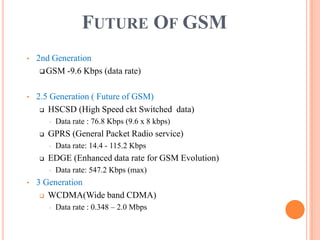
FUTURE OF GSM
•   2nd Generation
      GSM -9.6 Kbps (data rate)


•   2.5 Generation ( Future of GSM)
      HSCSD (High Speed ckt Switched data)

           Data rate : 76.8 Kbps (9.6 x 8 kbps)
       GPRS (General Packet Radio service)
           Data rate: 14.4 - 115.2 Kbps
       EDGE (Enhanced data rate for GSM Evolution)
           Data rate: 547.2 Kbps (max)
•   3 Generation
      WCDMA(Wide band CDMA)

           Data rate : 0.348 – 2.0 Mbps
?

Gsm architecture

  • 1.
  • 2.
    CONTENTS • GSM-introduction • GSMServices • Architecture • Security in GSM • Characteristics of GSM standard • Advantages of GSM • Future of GSM
  • 3.
    What is GSM? Global System for Mobile (GSM) is a second generation cellular standard developed to cater voice services and data delivery using digital modulation .
  • 4.
    GSM: HISTORY • Developedby Group Spéciale Mobile (founded 1982) which was an initiative of CEPT ( Conference of European Post and Telecommunication ) • Under ETSI, GSM is named as “ Global System for Mobile communication “ in 1989 • Full set of specifications phase-I became available in 1990 • Phase 2 of the GSM specifications occurs in 1995. Coverage is extended to rural areas
  • 5.
    GSM IN WORLD Figures: March, 2005 Arab World 3% Asia Pacific 3% 3% Africa 3% (INDIA) East Central Asia 4% 37% Europe Russia 43% 4% India 1% North America South America
  • 6.
    GSM IN INDIA Figures: March 2005 Reliance 3% Spice MTNL Bharti Aircel 4% 2% BSNL 4% Bharti 27% Hutch BPL 6% IDEA BPL IDEA Aircel 13% BSNL Spice Hutch 22% Reliance 19% MTNL
  • 7.
    GSM SERVICES • Tele-services •Bearer or Data Services • Supplementary services
  • 8.
    TELE SERVICES • Telecommunicationservices that enable voice communication via mobile phones • Offered services - Mobile telephony - Emergency calling
  • 9.
    BEARER SERVICES • Includevarious data services for information transfer between GSM and other networks like PSTN, ISDN etc at rates from 300 to 9600 bps • Short Message Service (SMS) - up to 160 character alphanumeric data transmission to/from the mobile terminal • Voice mailbox
  • 10.
    SUPPLEMENTARY SERVICES Callrelated services : • Call Waiting- Notification of an incoming call while on the handset • Call Hold- Put a caller on hold to take another call • Call Barring- All calls, outgoing calls, or incoming calls • Call Forwarding- Calls can be sent to various numbers defined by the user • Multi Party Call Conferencing - Link multiple calls together
  • 11.
  • 12.
    GSM SYSTEM ARCHITECTURE-I Mobile Station (MS) Mobile Equipment (ME) Subscriber Identity Module (SIM)  Base Station Subsystem (BSS) Base Transceiver Station (BTS) Base Station Controller (BSC)  Network Switching Subsystem(NSS) Mobile Switching Center (MSC) Home Location Register (HLR) Visitor Location Register (VLR) Authentication Center (AUC) Equipment Identity Register (EIR)
  • 13.
    SYSTEM ARCHITECTURE MOBILE STATION (MS) The Mobile Station is made up of two entities: 1. Mobile Equipment (ME) 2. Subscriber Identity Module (SIM)
  • 14.
    MOBILE EQUIPMENT  Portable, vehicle mounted, hand held device  Uniquely identified by an IMEI (International Mobile Equipment Identity)  Voice and data transmission  Monitoring power and signal quality of surrounding cells for optimum handover  Power level : 0.8W – 20 W  160 character long SMS.
  • 15.
    SUBSCRIBER IDENTITY MODULE(SIM)  Smart card contains the International Mobile Subscriber Identity (IMSI)  Allows user to send and receive calls and receive other subscribed services  Protected by a password or PIN  Can be moved from phone to phone – contains key information to activate the phone
  • 16.
    SYSTEM ARCHITECTURE BASE STATION SUBSYSTEM (BSS) Base Station Subsystem is composed of two parts that communicate across the standardized Abis interface allowing operation between components made by different suppliers 1. Base Transceiver Station (BTS) 2. Base Station Controller (BSC)
  • 17.
    BASE TRANSCEIVER STATION(BTS):  Encodes, encrypts, multiplexes, modulates and feeds the RF signals to the antenna.  Communicates with Mobile station and BSC  Consists of Transceivers (TRX) units
  • 18.
    BASE STATION CONTROLLER(BSC)  Manages Radio resources for BTS  Assigns Frequency and time slots for all MS’s in its area  Handles call set up  Handover for each MS  It communicates with MSC and BTS
  • 19.
    SYSTEM ARCHITECTURE NETWORK SWITCHING SUBSYSTEM(NSS)  The system contains the following functional units Mobile Switching Center (MSC) Home Location Register (HLR) Visitor Location Register (VLR) Authentication Center (AUC) Equipment Identity Register (EIR)
  • 20.
    MOBILE SWITCHING CENTER(MSC) • Heart of the network • Manages communication between GSM and other networks • Billing information and collection • Mobility management - Registration - Location Updating - Inter BSS and inter MSC call handoff
  • 21.
    HOME LOCATION REGISTERS(HLR)  Stores information about each subscriber that belongs to it MSC in permanent and temporary fashion.  As soon as mobile subscriber leaves its current local area, the information in the HLR is updated.  database contains IMSI, MSISDN, prepaid/ postpaid, roaming restrictions, supplementary services.
  • 22.
    VISITOR LOCATION REGISTERS(VLR)  Temporary database which updates whenever new MS enters its area, by HLR database  Assigns a TMSI to each MS entering the VLR area which keeps on changing.  Controls those mobiles roaming in its area  Database contains IMSI, MSISDN, Location Area, authentication key
  • 23.
    AUTHENTICATION CENTER (AUC) Contains the algorithms for authentication as well as the keys for encryption.  Protects network operators from fraud.  Situated in special protected part of the HLR.
  • 24.
    EQUIPMENT IDENTITY REGISTER(EIR)  Stores all devices identifications registered for this network.  Database that is used to track handsets using the IMEI (International Mobile Equipment Identity)  Prevents calls from stolen, unauthorised or defective mobile devices
  • 25.
    OPERATION AND MAINTENANCECENTRE (OMC)  The centralized operation of the various units in the system and functions needed to maintain the subsystems.  Dynamic monitoring and controlling of the network.  Functions : - configuration management - fault report and alarm handling - performance supervision/management - storage of system software and data
  • 26.
    SECURITY IN GSM On air interface, GSM uses encryption and TMSI instead of IMSI.  SIM is provided 4-8 digit PIN to validate the ownership of SIM  3 algorithms are specified : - A3 algorithm for authentication - A5 algorithm for encryption - A8 algorithm for key generation
  • 27.
    CHARACTERISTICS OF GSMSTANDARD  Fully digital system using 900,1800 MHz frequency band.  User/terminal authentication for fraud control.  Full international roaming capability.  Low speed data services (upto 9.6 Kb/s).  Compatibility with ISDN.  Support of Short Message Service (SMS).
  • 28.
    ADVANTAGES OF GSMOVER ANALOG SYSTEM  Reduced RF transmission power and longer battery life.  International roaming capability.  Better security against fraud (through terminal validation and user authentication).  Encryption capability for information security and privacy.
  • 29.
    GSM APPLICATIONS  Mobiletelephony  GSM-R  Telemetry System - Fleet management - Automatic meter reading - Toll Collection - Remote control and fault reporting of DG sets  Value Added Services
  • 30.
    FUTURE OF GSM • 2nd Generation  GSM -9.6 Kbps (data rate) • 2.5 Generation ( Future of GSM)  HSCSD (High Speed ckt Switched data)  Data rate : 76.8 Kbps (9.6 x 8 kbps)  GPRS (General Packet Radio service)  Data rate: 14.4 - 115.2 Kbps  EDGE (Enhanced data rate for GSM Evolution)  Data rate: 547.2 Kbps (max) • 3 Generation  WCDMA(Wide band CDMA)  Data rate : 0.348 – 2.0 Mbps
  • 31.