6         Mobile Station

    Objectives
    After this chapter the student will:
    • be able to describe the role of the ME in the Mobile Network.
    • be able to describe the characteristics and security aspects of the SIM
      card.


       6.1     INTRODUCTION ........................................................................ 2

       6.2 MOBILE EQUIPMENT - ME....................................................... 3
         Types of Mobile Stations .............................................................. 3
         Output Power ............................................................................... 3
         Frequency bands .......................................................................... 4
         Full Rate/Half Rate Services ........................................................ 4
         SMS Capabilities .......................................................................... 4
         Mobile Termination - MT ............................................................. 4

       6.3 SUBSCRIBER IDENTITY MODULE - SIM ................................... 5
         SIM characteristics....................................................................... 6
         SIM information storage .............................................................. 6
         Security attributes......................................................................... 8

       6.4 MOBILE STATION FEATURES .................................................... 9
         Basic MS features......................................................................... 9
         Supplementary MS features........................................................ 11
         Additional MS features............................................................... 11


Michael Quek                                                                                              1
6.1 Introduction
          The Mobile Station represents the only part the user will probably ever see
          of the whole system. It is the phone that is carried by the subscriber and
          used for making and receiving calls. There are different types of Mobile
          Stations but they all consist of two logical units, the Mobile Equipment
          and the Subscriber Identity Module.

          Mobile stations today offer not only an interface to the user (i.e.
          microphone, loudspeaker, a display and keyboard for the management of
          calls and services) but also an interface to personal computer and fax
          machine (which can be installed in the PC). The range of services and
          interfaces is left up to the manufacturer of the MS and can thus vary
          between MSs. This is due to that only a few MS features are mandatory
          whilst many of them are optional.


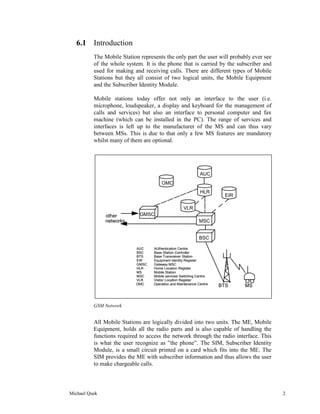
                                                              AUC
                                       OMC
                                                              HLR
                                                                       EIR

                                                    VLR
               other         GMSC
               networks                                      MSC


                                                             BSC

                           AUC     AUthentication Centre
                           BSC     Base Station Controller
                           BTS     Base Transceiver Station
                           EIR     Equipment Identity Register
                           GMSC    Gateway MSC
                           HLR     Home Location Register
                           MS      Mobile Station
                           MSC     Mobile services Switching Centre
                           VLR     Visitor Location Register
                           OMC     Operation and Maintenance Centre
                                                                      BTS    MS


          GSM Network


          All Mobile Stations are logically divided into two units. The ME, Mobile
          Equipment, holds all the radio parts and is also capable of handling the
          functions required to access the network through the radio interface. This
          is what the user recognize as ”the phone”. The SIM, Subscriber Identity
          Module, is a small circuit printed on a card which fits into the ME. The
          SIM provides the ME with subscriber information and thus allows the user
          to make chargeable calls.


Michael Quek                                                                            2
6.2 Mobile Equipment - ME
          The Mobile Equipment is characterised by its radio and service functions.
          The ME holds all the necessary functions to access the system, but without
          the SIM the ME is only allowed to place emergency calls. Some of the
          radio functions are the output power and the frequency bands that can be
          handled. The service functions could be e.g. support of full rate and half
          rate coding and the terminal capabilities. The Mobile Termination (MT)
          could, apart from the man-machine interface, have different interfaces
          towards the user such as ISDN or non-ISDN (e.g. for X and V-series)
          interfaces.


          Types of Mobile Stations
          The different types of Mobile Stations can be divided into vehicle-mounted
          and hand-held stations.

          • Vehicle-mounted stations are mounted in a vehicle and have
            the antenna physically mounted on the outside of the vehicle.

          • Handheld stations are small and light enough to be carried by
            hand and typically has the antenna directly attached to it.


          Output Power
          GSM mobile stations are separated into classes according to their
          maximum output power.

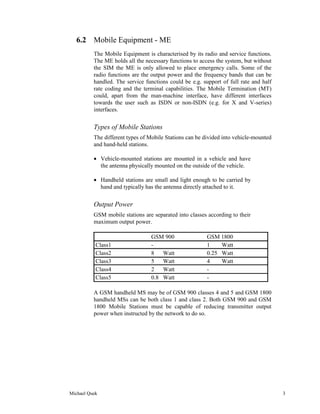
                                 GSM 900                 GSM 1800
           Class1                -                       1    Watt
           Class2                8   Watt                0.25 Watt
           Class3                5   Watt                4    Watt
           Class4                2   Watt                -
           Class5                0.8 Watt                -

          A GSM handheld MS may be of GSM 900 classes 4 and 5 and GSM 1800
          handheld MSs can be both class 1 and class 2. Both GSM 900 and GSM
          1800 Mobile Stations must be capable of reducing transmitter output
          power when instructed by the network to do so.


Michael Quek                                                                           3
Frequency bands
          For the GSM Mobile Stations, three frequency bands are defined:

          • Standard GSM Band: 890-915 MHz Uplink and 935-960 MHz
            downlink
          • Extended GSM Band: 880-915 MHz Uplink and 925-960 MHz
            downlink
          • GSM 1800 Band: 1710-1785 MHz Uplink and 1805-1880 MHz
            downlink

          The Mobile Station may be capable of supporting one or more of these
          bands. However, a procedure to select GSM 1800 operation must be
          provided internally in the MS if it is capable of handling both.
          Simultaneous use of GSM 1800 modes is not supported.


          Full Rate/Half Rate Services
          Both full and half rate services are specified. An MS may support one of
          these or both, depending on the basic service to be used and the MS
          capabilities.


          SMS Capabilities
          The ME may be able to handle the point-to-point Short Messages Services
          both mobile originated and mobile terminated.


          Mobile Termination - MT
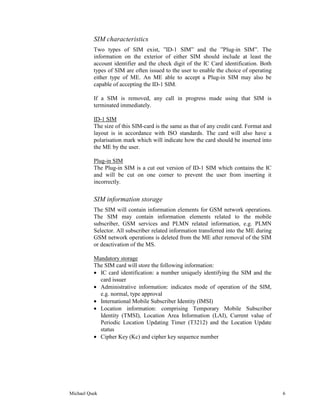
          There are three types of MT:
          • MT0 consists of the functions belonging to the functional group MT,
            with support of no terminal interfaces.
          • MT1 consists of the functions belonging to the functional group MT,
            and an interface with the GSM recommended subset of the ISDN user-
            network interface recommendations.
          • MT2 consists of the functions belonging to the functional group MT,
            and with an interface that complies with the GSM recommended subset
            of the CCITT X or V series interface recommendations.


Michael Quek                                                                         4
Mobile Station

                                                         MT0


                                      2B+D               MT1
                             R                     S                  Um
                     X+V              TA                 MT1


                    X+V                                  MT2

                                 ISDN Interfaces

          Connection points for MTs


          MT plus any TE (Terminal Equipment) or TE+TA (Terminal Adapter) will
          constitute the mobile station.


   6.3 Subscriber Identity Module - SIM
          In order for the ME to operate in a GSM network for services other than
          emergency services, a valid SIM-card with a valid IMSI stored on it must
          be present. With the insertion of the SIM card the ME will become a fully
          functional Mobile Station.

          Certain subscriber parameters together with personal data used by the
          subscriber, e.g. frequently called numbers will be stored on the SIM. Since
          only the SIM is required to personalise a phone it is therefore possible to
          rent a phone and personalise its operation with the insertion of the SIM
          card. This way all calls will be diverted to the new location of the SIM card
          wherever it is in the global GSM network. Every call placed from this
          phone will be billed to the subscriber’s home account.

          There are three types of subscriber related information that is stored on the
          SIM:
          • Data fixed before the personalisation of the SIM, e.g. IMSI, subscriber
            authentication key (Ki), access control class.
          • Temporary network data, e.g. TMSI, LAI, Kc, forbidden PLMNs.
          • Service related data, e.g. language preference, advice of charge.
          The GSM application may be one of several applications on a multi-
          application IC card.


Michael Quek                                                                              5
SIM characteristics
          Two types of SIM exist, ”ID-1 SIM” and the ”Plug-in SIM”. The
          information on the exterior of either SIM should include at least the
          account identifier and the check digit of the IC Card identification. Both
          types of SIM are often issued to the user to enable the choice of operating
          either type of ME. An ME able to accept a Plug-in SIM may also be
          capable of accepting the ID-1 SIM.

          If a SIM is removed, any call in progress made using that SIM is
          terminated immediately.

          ID-1 SIM
          The size of this SIM-card is the same as that of any credit card. Format and
          layout is in accordance with ISO standards. The card will also have a
          polarisation mark which will indicate how the card should be inserted into
          the ME by the user.

          Plug-in SIM
          The Plug-in SIM is a cut out version of ID-1 SIM which contains the IC
          and will be cut on one corner to prevent the user from inserting it
          incorrectly.


          SIM information storage
          The SIM will contain information elements for GSM network operations.
          The SIM may contain information elements related to the mobile
          subscriber, GSM services and PLMN related information, e.g. PLMN
          Selector. All subscriber related information transferred into the ME during
          GSM network operations is deleted from the ME after removal of the SIM
          or deactivation of the MS.

          Mandatory storage
          The SIM card will store the following information:
          • IC card identification: a number uniquely identifying the SIM and the
            card issuer
          • Administrative information: indicates mode of operation of the SIM,
            e.g. normal, type approval
          • International Mobile Subscriber Identity (IMSI)
          • Location information: comprising Temporary Mobile Subscriber
            Identity (TMSI), Location Area Information (LAI), Current value of
            Periodic Location Updating Timer (T3212) and the Location Update
            status
          • Cipher Key (Kc) and cipher key sequence number


Michael Quek                                                                             6
Location Information, Cipher key and Cipher Key Sequence Number are
          updated on the SIM after each call termination and when the MS is
          correctly deactivated in accordance with the manufacturers instructions.

          In addition the SIM will manage and provide storage for the following
          information in accordance with the security requirements:
          • PIN
          • PIN enable/disable indicator
          • PIN error counter
          • PUK
          • PUK error counter
          • Subscriber authentication key

          Other mandatory features stored on the SIM card are:
          • BCCH information: list of carrier frequencies to be used for cell
            selection
          • HPLMN search period: used to control the time interval between
            HPLMN searches
          • Forbidden PLMNs
          • Language preference: subscriber preferred language(s) of MMI
          • Phase identification
          • Access control class(es)
          • SIM service table: indicates which optional services are provided by the
            SIM

          Optional storage
          In addition to the above the SIM may provide storage capabilities for the
          following:
          • Abbreviated Dialling Numbers
          • Fixed Dialling Numbers
          • Last number(s) dialled
          • Short messages and associated parameters
          • Capability configuration parameters: Provides the parameters of
             required bearer capabilities associated with dialling numbers
          • Cell Broadcast Message Identifier Selection
          • Accumulated call meter, Accumulated call meter maximum value and
             Price per unit & currency table
          • PLMN selector: for automatic PLMN selection
          • Called party sub address

          In addition, if the SIM supports PIN2, the following information will be
          managed and stored by the SIM:
          • PIN2 and PIN2 error counter
          • PUK2 and PUK2 error counter


Michael Quek                                                                           7
Security attributes
          The GSM security attributes to be supported by the SIM are:
          • authentication algorithm (A3)
          • subscriber authentication key (Ki)
          • cipher key generation algorithm (A8)
          • cipher key (Kc)
          • control of access to data stored (PIN and PUK), and functions
            performed, in the SIM

          (An algorithm A38 may perform the combined functions of A3 and A8.)

          All reasonable steps are taken to ensure that the algorithms (A3 and A8)
          and subscriber authentication key (Ki) cannot be read, altered, manipulated
          or bypassed in such a way as to reveal secret information.
          Every MS process which require the use of the subscriber authentication
          key are performed internally by the SIM.

          Authentication
          A security function for authenticating the SIM, which is mandatory for any
          MS, is based on a cryptographic algorithm A3, and the secret subscriber
          authentication key Ki. Both A3 and Ki are located on the SIM.

          Ciphering
          The security function that ciphers the information sent and received by the
          MS, requires a cipher key Kc. The generation of the Kc is based on a
          cryptographic algorithm A8, and the Ki. Also A8 is located on the SIM.

          SIM-control
          To provide protection against the use of stolen cards PIN and PUK codes
          are issued.

          The SIM contains a PIN number (Personal Identification Number) which
          will provide protection against unauthorised use as the PIN number is
          requested each time the MS is switched on. The PIN could be disabled by
          the subscriber or by the operator at start of subscription. For the use of
          some optional features a second PIN number (PIN2) will be requested.

          The PIN numbers are stored and verified in the SIM card. Both PINs take
          the form of a numeric value of 4 to 8 decimal digits.

          If an incorrect PIN or PIN2 is entered, that will be indicated to the user.
          The relevant PIN will be blocked after the three consecutive incorrect
          entries, i.e. functions and actions on data protected by the PIN access
          condition are no longer possible. Removing/inserting the SIM or switching
          the MS off/on has no effect.
          Unblocking of a PIN is performed using the relevant PIN Unblocking Key
          (PUK/PUK2). The PUKs consist of 8 decimals and are not changeable by


Michael Quek                                                                            8
the user. If an incorrect PUK is entered, that will be indicated to the user.
          After 10 consecutive incorrect entries, the PUK is itself blocked, even if
          between attempts the SIM has been removed or the MS has been switched
          off. It is not possible to read the PINs or PUKs from the ME.


   6.4 Mobile Station features
          Three categories of features can be distinguished:
          1. Basic MS features are directly related to the operation of basic
             telecommunication services (e.g. key-pad functions).
          2. Supplementary MS features are directly related to the operation of
             supplementary services (e.g. display of calling line number).
          3. Additional MS features are features which are neither a basic nor a
             supplementary feature (e.g. abbreviated dialling).


          Basic MS features
          Function                             (M - Mandatory, O - Optional)
          Display of Called Number                                M
          Indication of Call Progress Signals                     M
          Country / PLMN Indication                               M
          Country / PLMN Selection                                M
          Keypad                                                  O
          IMEI                                                    M
          Short Message                                           M
          Short Message Overflow Indication                       M
          DTE / DCE Interface                                     O
          ISDN ”S” Interface                                      O
          International Access Function (”+” Key)                 O
          Service Indicator                                       M
          Autocalling restriction capabilities                    --
          Emergency Calls capabilities                            M
          Dual Tone Multi Frequency function (DTMF)               M
          Subscription Identity Management                        M
          On / Off switch                                         O
          Subaddress                                              O
          Support of Encryption A5/1 and A5/2                     M
          Short Message Service Cell Broadcast DRX                M
          Service provider Indication                             M
          Table of Basic MS features
          Display of Called Number
          This feature allows the user to check if the number is correct before call
          set-up.
          Indication of Call Progress Signals


Michael Quek                                                                              9
Theses indications are based on signalling information returned from the
          PLMN. They can be shown on visual display or as recorded message or
          simply as tones.

          Country / PLMN Indication
          The Country / PLMN indicator simply indicates in which GSM PLMN that
          the MS is roaming. It is necessary that this information is displayed so that
          the user is aware that ”roaming” is taking place.

          Country / PLMN selection
          If more than one GSM PLMN exists in a given area the user will have the
          ability to select which operator to be connected.

          IMEI
          Each MS has a unique ME identity and will transmit this when requested
          to do so by the PLMN. The IMEI is stored on a module which is physically
          secured in the MS and not accessible to the user.

          Short message indication and acknowledgement
          Messages submitted to the service centre by a telecommunications network
          user will be delivered to the MS shortly after the MS accesses the system.
          The MS will provide an indication to the user that a message has been
          received from the service centre and must also send an acknowledgement
          signal to the PLMN to show that this indication has been activated. The
          PLMN will then return this acknowledgement to the service centre.

          Short message overflow indication
          When an incoming message cannot be received due to insufficient
          available memory it will be indicated to the MS user.

          DTE / DCE
          This is a standard interface for attachment of a DTE (Data Terminal
          Equipment) to the MS and used in conjunction with data services, DCE
          (Data Communication Equipment).

          ISDN ”S” terminal Interface
          This is a standard interface for attachment of equipment to ISDN.

          International access function
          For the purpose of gaining international access from an MS a key with a
          function ”+” is used. When this is signalled over the air interface it has the
          function of generating the international access code in the network.

          Service Indicator (SI)
          When there is adequate signal strength to allow a call to be made and the
          MS has successfully registered on the selected PLMN it will be indicated
          to the user.
          Dual Tone Multi Frequency (DTMF)


Michael Quek                                                                               10
The MS is capable of initiating DTMF in accordance with GSM
          specifications.

          Subscription identity management
          The SIM (Subscriber Identity Module) contains the IMSI. The result of the
          SIM card being removed is that a call in progress will be terminated and no
          further calls should be allowed to be initiated. Emergency calls may still be
          made by dialling 112.

          Support of Encryption A5/1 and A5/2
          Support of A5/1, A5/2 and non encrypted mode is mandatory. The
          specification allows the use of 7 different algorithms and the non encrypted
          case.

          Service provider Indication
          Whilst in idle mode the Service providers name along with the current
          PLMN can be displayed. The SIM should support two options in parallel
          and alternatively.


          Supplementary MS features

          Function                       (M - Mandatory, O - Optional)
          Control of Supplementary Services                 --
           Call Barring and Call Forwarding                 M
           Others                                           O
          Table of Supplementary MS features


          Control of Supplementary Services
          The support of Call Barring and Call Forwarding Supplementary Services
          is mandatory. The support of other Supplementary Services is up to the
          manufacturer.


          Additional MS features

          Function                        (M - Mandatory, O - Optional)
          Abbreviated Dialling                                 O
          Fixed Number Dialling                                O
          Barring of Outgoing Calls                            O
          DTMF Control Digits Separator                        O
          Selection of Directory No in Short Messages          O
          Last Numbers Dialled                                 O
          Table of Additional MS features


          Abbreviated Dialling


Michael Quek                                                                              11
The directory number or part thereof is stored in the MS together with the
          abbreviated address. After retrieval the number may appear on the display.
          Abbreviated numbers stored in the ME or SIM may contain wild
          characters. The completed number is transmitted on the radio path.

          Fixed Number Dialling
          Utilising this feature in conjunction with an electronic lock makes it
          possible to place a bar on calling any numbers other than those pre-
          programmed in the SIM. ”Fixed Dialling Mode” under control of PIN 2,
          may be enabled or disabled, the mode selected will then be stored in the
          SIM.

          Barring of outgoing calls
          This feature allows outgoing calls to be blocked. The barring condition can
          be activated/deactivated by using a key, keyword etc. The barring may be
          selective and applied to individual services or individual call types. This is
          set in the ME only.

          DTMF control digits separator
          Provision has been made to enter DTMF digits with a telephone number,
          and upon the called party answering the ME will send the DTMF digits
          automatically to the network.

          Selection of directory number in short messages
          The Short Message may be used to convey a Directory Number which the
          user may wish to call. This can be indicated by enclosing the directory
          number in a pair of inverted commas (” ”). If the displayed message
          contains these characters enclosing a directory number, a call can be set up
          by user action. Normal (unspecified) or International format (+) may be
          used.

          Last numbers dialled
          The MS may store the Last ”N” Numbers dialled in the SIM and/or the
          ME. ”N” may take the value up to 10 in the SIM. It may be any value in
          the ME. If these numbers are stored in both the SIM and the ME, those
          from the SIM will take precedence.


Michael Quek                                                                               12

Mobile Station

  • 1.
    6 Mobile Station Objectives After this chapter the student will: • be able to describe the role of the ME in the Mobile Network. • be able to describe the characteristics and security aspects of the SIM card. 6.1 INTRODUCTION ........................................................................ 2 6.2 MOBILE EQUIPMENT - ME....................................................... 3 Types of Mobile Stations .............................................................. 3 Output Power ............................................................................... 3 Frequency bands .......................................................................... 4 Full Rate/Half Rate Services ........................................................ 4 SMS Capabilities .......................................................................... 4 Mobile Termination - MT ............................................................. 4 6.3 SUBSCRIBER IDENTITY MODULE - SIM ................................... 5 SIM characteristics....................................................................... 6 SIM information storage .............................................................. 6 Security attributes......................................................................... 8 6.4 MOBILE STATION FEATURES .................................................... 9 Basic MS features......................................................................... 9 Supplementary MS features........................................................ 11 Additional MS features............................................................... 11 Michael Quek 1
  • 2.
    6.1 Introduction The Mobile Station represents the only part the user will probably ever see of the whole system. It is the phone that is carried by the subscriber and used for making and receiving calls. There are different types of Mobile Stations but they all consist of two logical units, the Mobile Equipment and the Subscriber Identity Module. Mobile stations today offer not only an interface to the user (i.e. microphone, loudspeaker, a display and keyboard for the management of calls and services) but also an interface to personal computer and fax machine (which can be installed in the PC). The range of services and interfaces is left up to the manufacturer of the MS and can thus vary between MSs. This is due to that only a few MS features are mandatory whilst many of them are optional. AUC OMC HLR EIR VLR other GMSC networks MSC BSC AUC AUthentication Centre BSC Base Station Controller BTS Base Transceiver Station EIR Equipment Identity Register GMSC Gateway MSC HLR Home Location Register MS Mobile Station MSC Mobile services Switching Centre VLR Visitor Location Register OMC Operation and Maintenance Centre BTS MS GSM Network All Mobile Stations are logically divided into two units. The ME, Mobile Equipment, holds all the radio parts and is also capable of handling the functions required to access the network through the radio interface. This is what the user recognize as ”the phone”. The SIM, Subscriber Identity Module, is a small circuit printed on a card which fits into the ME. The SIM provides the ME with subscriber information and thus allows the user to make chargeable calls. Michael Quek 2
  • 3.
    6.2 Mobile Equipment- ME The Mobile Equipment is characterised by its radio and service functions. The ME holds all the necessary functions to access the system, but without the SIM the ME is only allowed to place emergency calls. Some of the radio functions are the output power and the frequency bands that can be handled. The service functions could be e.g. support of full rate and half rate coding and the terminal capabilities. The Mobile Termination (MT) could, apart from the man-machine interface, have different interfaces towards the user such as ISDN or non-ISDN (e.g. for X and V-series) interfaces. Types of Mobile Stations The different types of Mobile Stations can be divided into vehicle-mounted and hand-held stations. • Vehicle-mounted stations are mounted in a vehicle and have the antenna physically mounted on the outside of the vehicle. • Handheld stations are small and light enough to be carried by hand and typically has the antenna directly attached to it. Output Power GSM mobile stations are separated into classes according to their maximum output power. GSM 900 GSM 1800 Class1 - 1 Watt Class2 8 Watt 0.25 Watt Class3 5 Watt 4 Watt Class4 2 Watt - Class5 0.8 Watt - A GSM handheld MS may be of GSM 900 classes 4 and 5 and GSM 1800 handheld MSs can be both class 1 and class 2. Both GSM 900 and GSM 1800 Mobile Stations must be capable of reducing transmitter output power when instructed by the network to do so. Michael Quek 3
  • 4.
    Frequency bands For the GSM Mobile Stations, three frequency bands are defined: • Standard GSM Band: 890-915 MHz Uplink and 935-960 MHz downlink • Extended GSM Band: 880-915 MHz Uplink and 925-960 MHz downlink • GSM 1800 Band: 1710-1785 MHz Uplink and 1805-1880 MHz downlink The Mobile Station may be capable of supporting one or more of these bands. However, a procedure to select GSM 1800 operation must be provided internally in the MS if it is capable of handling both. Simultaneous use of GSM 1800 modes is not supported. Full Rate/Half Rate Services Both full and half rate services are specified. An MS may support one of these or both, depending on the basic service to be used and the MS capabilities. SMS Capabilities The ME may be able to handle the point-to-point Short Messages Services both mobile originated and mobile terminated. Mobile Termination - MT There are three types of MT: • MT0 consists of the functions belonging to the functional group MT, with support of no terminal interfaces. • MT1 consists of the functions belonging to the functional group MT, and an interface with the GSM recommended subset of the ISDN user- network interface recommendations. • MT2 consists of the functions belonging to the functional group MT, and with an interface that complies with the GSM recommended subset of the CCITT X or V series interface recommendations. Michael Quek 4
  • 5.
    Mobile Station MT0 2B+D MT1 R S Um X+V TA MT1 X+V MT2 ISDN Interfaces Connection points for MTs MT plus any TE (Terminal Equipment) or TE+TA (Terminal Adapter) will constitute the mobile station. 6.3 Subscriber Identity Module - SIM In order for the ME to operate in a GSM network for services other than emergency services, a valid SIM-card with a valid IMSI stored on it must be present. With the insertion of the SIM card the ME will become a fully functional Mobile Station. Certain subscriber parameters together with personal data used by the subscriber, e.g. frequently called numbers will be stored on the SIM. Since only the SIM is required to personalise a phone it is therefore possible to rent a phone and personalise its operation with the insertion of the SIM card. This way all calls will be diverted to the new location of the SIM card wherever it is in the global GSM network. Every call placed from this phone will be billed to the subscriber’s home account. There are three types of subscriber related information that is stored on the SIM: • Data fixed before the personalisation of the SIM, e.g. IMSI, subscriber authentication key (Ki), access control class. • Temporary network data, e.g. TMSI, LAI, Kc, forbidden PLMNs. • Service related data, e.g. language preference, advice of charge. The GSM application may be one of several applications on a multi- application IC card. Michael Quek 5
  • 6.
    SIM characteristics Two types of SIM exist, ”ID-1 SIM” and the ”Plug-in SIM”. The information on the exterior of either SIM should include at least the account identifier and the check digit of the IC Card identification. Both types of SIM are often issued to the user to enable the choice of operating either type of ME. An ME able to accept a Plug-in SIM may also be capable of accepting the ID-1 SIM. If a SIM is removed, any call in progress made using that SIM is terminated immediately. ID-1 SIM The size of this SIM-card is the same as that of any credit card. Format and layout is in accordance with ISO standards. The card will also have a polarisation mark which will indicate how the card should be inserted into the ME by the user. Plug-in SIM The Plug-in SIM is a cut out version of ID-1 SIM which contains the IC and will be cut on one corner to prevent the user from inserting it incorrectly. SIM information storage The SIM will contain information elements for GSM network operations. The SIM may contain information elements related to the mobile subscriber, GSM services and PLMN related information, e.g. PLMN Selector. All subscriber related information transferred into the ME during GSM network operations is deleted from the ME after removal of the SIM or deactivation of the MS. Mandatory storage The SIM card will store the following information: • IC card identification: a number uniquely identifying the SIM and the card issuer • Administrative information: indicates mode of operation of the SIM, e.g. normal, type approval • International Mobile Subscriber Identity (IMSI) • Location information: comprising Temporary Mobile Subscriber Identity (TMSI), Location Area Information (LAI), Current value of Periodic Location Updating Timer (T3212) and the Location Update status • Cipher Key (Kc) and cipher key sequence number Michael Quek 6
  • 7.
    Location Information, Cipherkey and Cipher Key Sequence Number are updated on the SIM after each call termination and when the MS is correctly deactivated in accordance with the manufacturers instructions. In addition the SIM will manage and provide storage for the following information in accordance with the security requirements: • PIN • PIN enable/disable indicator • PIN error counter • PUK • PUK error counter • Subscriber authentication key Other mandatory features stored on the SIM card are: • BCCH information: list of carrier frequencies to be used for cell selection • HPLMN search period: used to control the time interval between HPLMN searches • Forbidden PLMNs • Language preference: subscriber preferred language(s) of MMI • Phase identification • Access control class(es) • SIM service table: indicates which optional services are provided by the SIM Optional storage In addition to the above the SIM may provide storage capabilities for the following: • Abbreviated Dialling Numbers • Fixed Dialling Numbers • Last number(s) dialled • Short messages and associated parameters • Capability configuration parameters: Provides the parameters of required bearer capabilities associated with dialling numbers • Cell Broadcast Message Identifier Selection • Accumulated call meter, Accumulated call meter maximum value and Price per unit & currency table • PLMN selector: for automatic PLMN selection • Called party sub address In addition, if the SIM supports PIN2, the following information will be managed and stored by the SIM: • PIN2 and PIN2 error counter • PUK2 and PUK2 error counter Michael Quek 7
  • 8.
    Security attributes The GSM security attributes to be supported by the SIM are: • authentication algorithm (A3) • subscriber authentication key (Ki) • cipher key generation algorithm (A8) • cipher key (Kc) • control of access to data stored (PIN and PUK), and functions performed, in the SIM (An algorithm A38 may perform the combined functions of A3 and A8.) All reasonable steps are taken to ensure that the algorithms (A3 and A8) and subscriber authentication key (Ki) cannot be read, altered, manipulated or bypassed in such a way as to reveal secret information. Every MS process which require the use of the subscriber authentication key are performed internally by the SIM. Authentication A security function for authenticating the SIM, which is mandatory for any MS, is based on a cryptographic algorithm A3, and the secret subscriber authentication key Ki. Both A3 and Ki are located on the SIM. Ciphering The security function that ciphers the information sent and received by the MS, requires a cipher key Kc. The generation of the Kc is based on a cryptographic algorithm A8, and the Ki. Also A8 is located on the SIM. SIM-control To provide protection against the use of stolen cards PIN and PUK codes are issued. The SIM contains a PIN number (Personal Identification Number) which will provide protection against unauthorised use as the PIN number is requested each time the MS is switched on. The PIN could be disabled by the subscriber or by the operator at start of subscription. For the use of some optional features a second PIN number (PIN2) will be requested. The PIN numbers are stored and verified in the SIM card. Both PINs take the form of a numeric value of 4 to 8 decimal digits. If an incorrect PIN or PIN2 is entered, that will be indicated to the user. The relevant PIN will be blocked after the three consecutive incorrect entries, i.e. functions and actions on data protected by the PIN access condition are no longer possible. Removing/inserting the SIM or switching the MS off/on has no effect. Unblocking of a PIN is performed using the relevant PIN Unblocking Key (PUK/PUK2). The PUKs consist of 8 decimals and are not changeable by Michael Quek 8
  • 9.
    the user. Ifan incorrect PUK is entered, that will be indicated to the user. After 10 consecutive incorrect entries, the PUK is itself blocked, even if between attempts the SIM has been removed or the MS has been switched off. It is not possible to read the PINs or PUKs from the ME. 6.4 Mobile Station features Three categories of features can be distinguished: 1. Basic MS features are directly related to the operation of basic telecommunication services (e.g. key-pad functions). 2. Supplementary MS features are directly related to the operation of supplementary services (e.g. display of calling line number). 3. Additional MS features are features which are neither a basic nor a supplementary feature (e.g. abbreviated dialling). Basic MS features Function (M - Mandatory, O - Optional) Display of Called Number M Indication of Call Progress Signals M Country / PLMN Indication M Country / PLMN Selection M Keypad O IMEI M Short Message M Short Message Overflow Indication M DTE / DCE Interface O ISDN ”S” Interface O International Access Function (”+” Key) O Service Indicator M Autocalling restriction capabilities -- Emergency Calls capabilities M Dual Tone Multi Frequency function (DTMF) M Subscription Identity Management M On / Off switch O Subaddress O Support of Encryption A5/1 and A5/2 M Short Message Service Cell Broadcast DRX M Service provider Indication M Table of Basic MS features Display of Called Number This feature allows the user to check if the number is correct before call set-up. Indication of Call Progress Signals Michael Quek 9
  • 10.
    Theses indications arebased on signalling information returned from the PLMN. They can be shown on visual display or as recorded message or simply as tones. Country / PLMN Indication The Country / PLMN indicator simply indicates in which GSM PLMN that the MS is roaming. It is necessary that this information is displayed so that the user is aware that ”roaming” is taking place. Country / PLMN selection If more than one GSM PLMN exists in a given area the user will have the ability to select which operator to be connected. IMEI Each MS has a unique ME identity and will transmit this when requested to do so by the PLMN. The IMEI is stored on a module which is physically secured in the MS and not accessible to the user. Short message indication and acknowledgement Messages submitted to the service centre by a telecommunications network user will be delivered to the MS shortly after the MS accesses the system. The MS will provide an indication to the user that a message has been received from the service centre and must also send an acknowledgement signal to the PLMN to show that this indication has been activated. The PLMN will then return this acknowledgement to the service centre. Short message overflow indication When an incoming message cannot be received due to insufficient available memory it will be indicated to the MS user. DTE / DCE This is a standard interface for attachment of a DTE (Data Terminal Equipment) to the MS and used in conjunction with data services, DCE (Data Communication Equipment). ISDN ”S” terminal Interface This is a standard interface for attachment of equipment to ISDN. International access function For the purpose of gaining international access from an MS a key with a function ”+” is used. When this is signalled over the air interface it has the function of generating the international access code in the network. Service Indicator (SI) When there is adequate signal strength to allow a call to be made and the MS has successfully registered on the selected PLMN it will be indicated to the user. Dual Tone Multi Frequency (DTMF) Michael Quek 10
  • 11.
    The MS iscapable of initiating DTMF in accordance with GSM specifications. Subscription identity management The SIM (Subscriber Identity Module) contains the IMSI. The result of the SIM card being removed is that a call in progress will be terminated and no further calls should be allowed to be initiated. Emergency calls may still be made by dialling 112. Support of Encryption A5/1 and A5/2 Support of A5/1, A5/2 and non encrypted mode is mandatory. The specification allows the use of 7 different algorithms and the non encrypted case. Service provider Indication Whilst in idle mode the Service providers name along with the current PLMN can be displayed. The SIM should support two options in parallel and alternatively. Supplementary MS features Function (M - Mandatory, O - Optional) Control of Supplementary Services -- Call Barring and Call Forwarding M Others O Table of Supplementary MS features Control of Supplementary Services The support of Call Barring and Call Forwarding Supplementary Services is mandatory. The support of other Supplementary Services is up to the manufacturer. Additional MS features Function (M - Mandatory, O - Optional) Abbreviated Dialling O Fixed Number Dialling O Barring of Outgoing Calls O DTMF Control Digits Separator O Selection of Directory No in Short Messages O Last Numbers Dialled O Table of Additional MS features Abbreviated Dialling Michael Quek 11
  • 12.
    The directory numberor part thereof is stored in the MS together with the abbreviated address. After retrieval the number may appear on the display. Abbreviated numbers stored in the ME or SIM may contain wild characters. The completed number is transmitted on the radio path. Fixed Number Dialling Utilising this feature in conjunction with an electronic lock makes it possible to place a bar on calling any numbers other than those pre- programmed in the SIM. ”Fixed Dialling Mode” under control of PIN 2, may be enabled or disabled, the mode selected will then be stored in the SIM. Barring of outgoing calls This feature allows outgoing calls to be blocked. The barring condition can be activated/deactivated by using a key, keyword etc. The barring may be selective and applied to individual services or individual call types. This is set in the ME only. DTMF control digits separator Provision has been made to enter DTMF digits with a telephone number, and upon the called party answering the ME will send the DTMF digits automatically to the network. Selection of directory number in short messages The Short Message may be used to convey a Directory Number which the user may wish to call. This can be indicated by enclosing the directory number in a pair of inverted commas (” ”). If the displayed message contains these characters enclosing a directory number, a call can be set up by user action. Normal (unspecified) or International format (+) may be used. Last numbers dialled The MS may store the Last ”N” Numbers dialled in the SIM and/or the ME. ”N” may take the value up to 10 in the SIM. It may be any value in the ME. If these numbers are stored in both the SIM and the ME, those from the SIM will take precedence. Michael Quek 12