PRESENTATION ON


         NAME : BHANU PRATAP SINGH
         BRANCH : E.I.
         ROLL NO . : 090105012
CONTENTS

 INTRODUCTION
 ARCHITECTURE

 SPECIFICATIONS

 SECURITY

 CHARACTERISTICS

 APPLICATIONS

 FUTURE
INTRODUCTION


   Global System for Mobile (GSM) is a second generation cellular
    standard developed to cater voice services and data delivery using
    digital modulation.
   Aim Of GSM is to replace the incompatible analog system .

   Today many providers all over the world use GSM (more than 135
    countries in Asia, Africa, Europe, Australia, America)
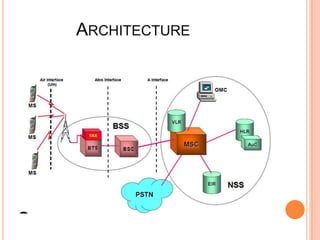
ARCHITECTURE
ARCHITECTURE

   Mobile Station
       Mobile Equipment (ME)
       Subscriber Identity Module (SIM)
       Base Station Subsystem (BSS):
       Base Transceiver Station
       Base Station Controller
       Network Subsystem:

         Mobile Switching Center (MSC)
         Home Location Register (HLR)
         Visitor Location Register (VLR)
         Authentication Center (AUC)
         Equipment Identity Register (EIR)
MOBILE STATION (MS)

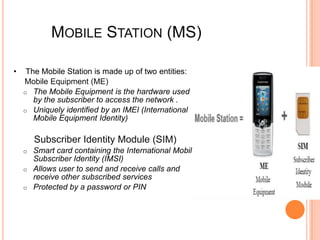
•    The Mobile Station is made up of two entities:
    Mobile Equipment (ME)
    o The Mobile Equipment is the hardware used
       by the subscriber to access the network .
    o Uniquely identified by an IMEI (International
       Mobile Equipment Identity)

        Subscriber Identity Module (SIM)
    o Smart card containing the International Mobile
      Subscriber Identity (IMSI)
    o Allows user to send and receive calls and
      receive other subscribed services
    o Protected by a password or PIN
BASE STATION SUBSYSTEM

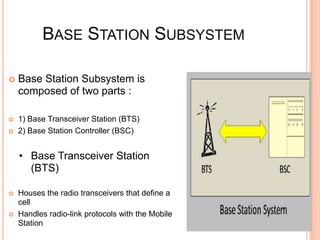
   Base Station Subsystem is
    composed of two parts :

   1) Base Transceiver Station (BTS)
   2) Base Station Controller (BSC)


    • Base Transceiver Station
      (BTS)

   Houses the radio transceivers that define a
    cell
   Handles radio-link protocols with the Mobile
    Station
Base Station Controller (BSC)


 Manages Resources for BTS ,
 Handles call set up,
 Location update,
 Handover for each MS.
NETWORK SUBSYSTEM
   Mobile Services Switching Center (MSC)
     MSC performs following functions :

   Switching and call routing
   Charging
   Service provisioning
   Communication with HLR
   Communication with the VLR
   Communication with other MSCs
   Control of connected BSCs
   Direct access to Internet services

   Home Location Registers (HLR) :

   Contains administrative information of each subscriber
   Most important database
NETWORK SUBSYSTEM
 Visitor Location Registers (VLR)
    o tracks which customers have the phone on and ready to
       receive a call
    o periodically updates the database on which phones are
       turned on and ready to receive calls
 Authentication         Center (AUC)
    o   mainly used for security
    o   data storage location and functional part of the network


 Equipment        Identity Register (EIR)
        - Database that is used to track handsets using the IMEI ,Made up
        of three sub-classes: The White List, The Black List and the Gray
        List
    o   Optional database
GSM SPECIFICATIONS


•   GSM systems use radio frequencies between 890-915 MHz for
    receive and between 935-960 MHz for transmit.
•   RF carriers are spaced every 200 kHz, allowing a total of 124
    carriers for use.
•   An RF carrier is a pair of radio frequencies, one used in each
    direction.
•   Transmit and receive frequencies are always separated by 45
    MHz .
SECURITY IN GSM

   On air interface, GSM uses encryption and TMSI instead of
    IMSI.
   SIM is provided 4-8 digit PIN to validate the ownership of SIM
   3 algorithms are specified :
     - A3 algorithm for authentication
    - A5 algorithm for encryption
    - A8 algorithm for key generation
CHARACTERISTICS OF GSM STANDARD

   Fully digital system using 900,1800 MHz frequency band.
   TDMA over radio carriers(200 KHz carrier spacing.
   User/terminal authentication for fraud control.
   Encryption of speech and data transmission over the radio
    path.
   Full international roaming capability.
   Low speed data services (up to 9.6 Kb/s).
   Compatibility with ISDN.
   Support of Short Message Service (SMS).
ADVANTAGES OF GSM OVER ANALOG
       SYSTEM


   Capacity increases
   Reduced RF transmission power and longer battery life.
   International roaming capability.
   Better security against fraud (through terminal validation and user
    authentication.
GSM APPLICATIONS

 Telemetry System
- Fleet management
- Automatic meter reading
- Toll Collection

   Value Added Services
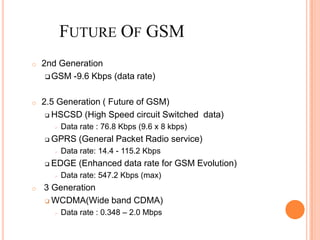
FUTURE OF GSM
o   2nd Generation
      GSM -9.6 Kbps (data rate)


o   2.5 Generation ( Future of GSM)
      HSCSD (High Speed circuit Switched data)

           Data rate : 76.8 Kbps (9.6 x 8 kbps)
       GPRS (General Packet Radio service)
           Data rate: 14.4 - 115.2 Kbps
       EDGE (Enhanced data rate for GSM Evolution)
           Data rate: 547.2 Kbps (max)
o   3 Generation
     WCDMA(Wide band CDMA)

           Data rate : 0.348 – 2.0 Mbps
THANK
YOU

Mob. comp . prst

  • 1.
    PRESENTATION ON NAME : BHANU PRATAP SINGH BRANCH : E.I. ROLL NO . : 090105012
  • 2.
    CONTENTS  INTRODUCTION  ARCHITECTURE SPECIFICATIONS  SECURITY  CHARACTERISTICS  APPLICATIONS  FUTURE
  • 3.
    INTRODUCTION  Global System for Mobile (GSM) is a second generation cellular standard developed to cater voice services and data delivery using digital modulation.  Aim Of GSM is to replace the incompatible analog system .  Today many providers all over the world use GSM (more than 135 countries in Asia, Africa, Europe, Australia, America)
  • 4.
  • 5.
    ARCHITECTURE  Mobile Station  Mobile Equipment (ME)  Subscriber Identity Module (SIM)  Base Station Subsystem (BSS):  Base Transceiver Station  Base Station Controller  Network Subsystem:  Mobile Switching Center (MSC)  Home Location Register (HLR)  Visitor Location Register (VLR)  Authentication Center (AUC)  Equipment Identity Register (EIR)
  • 6.
    MOBILE STATION (MS) • The Mobile Station is made up of two entities: Mobile Equipment (ME) o The Mobile Equipment is the hardware used by the subscriber to access the network . o Uniquely identified by an IMEI (International Mobile Equipment Identity) Subscriber Identity Module (SIM) o Smart card containing the International Mobile Subscriber Identity (IMSI) o Allows user to send and receive calls and receive other subscribed services o Protected by a password or PIN
  • 7.
    BASE STATION SUBSYSTEM  Base Station Subsystem is composed of two parts :  1) Base Transceiver Station (BTS)  2) Base Station Controller (BSC) • Base Transceiver Station (BTS)  Houses the radio transceivers that define a cell  Handles radio-link protocols with the Mobile Station
  • 8.
    Base Station Controller(BSC)  Manages Resources for BTS ,  Handles call set up,  Location update,  Handover for each MS.
  • 9.
    NETWORK SUBSYSTEM  Mobile Services Switching Center (MSC) MSC performs following functions :  Switching and call routing  Charging  Service provisioning  Communication with HLR  Communication with the VLR  Communication with other MSCs  Control of connected BSCs  Direct access to Internet services  Home Location Registers (HLR) :  Contains administrative information of each subscriber  Most important database
  • 10.
    NETWORK SUBSYSTEM  VisitorLocation Registers (VLR) o tracks which customers have the phone on and ready to receive a call o periodically updates the database on which phones are turned on and ready to receive calls  Authentication Center (AUC) o mainly used for security o data storage location and functional part of the network  Equipment Identity Register (EIR) - Database that is used to track handsets using the IMEI ,Made up of three sub-classes: The White List, The Black List and the Gray List o Optional database
  • 11.
    GSM SPECIFICATIONS • GSM systems use radio frequencies between 890-915 MHz for receive and between 935-960 MHz for transmit. • RF carriers are spaced every 200 kHz, allowing a total of 124 carriers for use. • An RF carrier is a pair of radio frequencies, one used in each direction. • Transmit and receive frequencies are always separated by 45 MHz .
  • 12.
    SECURITY IN GSM  On air interface, GSM uses encryption and TMSI instead of IMSI.  SIM is provided 4-8 digit PIN to validate the ownership of SIM  3 algorithms are specified : - A3 algorithm for authentication - A5 algorithm for encryption - A8 algorithm for key generation
  • 13.
    CHARACTERISTICS OF GSMSTANDARD  Fully digital system using 900,1800 MHz frequency band.  TDMA over radio carriers(200 KHz carrier spacing.  User/terminal authentication for fraud control.  Encryption of speech and data transmission over the radio path.  Full international roaming capability.  Low speed data services (up to 9.6 Kb/s).  Compatibility with ISDN.  Support of Short Message Service (SMS).
  • 14.
    ADVANTAGES OF GSMOVER ANALOG SYSTEM  Capacity increases  Reduced RF transmission power and longer battery life.  International roaming capability.  Better security against fraud (through terminal validation and user authentication.
  • 15.
    GSM APPLICATIONS  TelemetrySystem - Fleet management - Automatic meter reading - Toll Collection  Value Added Services
  • 16.
    FUTURE OF GSM o 2nd Generation  GSM -9.6 Kbps (data rate) o 2.5 Generation ( Future of GSM)  HSCSD (High Speed circuit Switched data)  Data rate : 76.8 Kbps (9.6 x 8 kbps)  GPRS (General Packet Radio service)  Data rate: 14.4 - 115.2 Kbps  EDGE (Enhanced data rate for GSM Evolution)  Data rate: 547.2 Kbps (max) o 3 Generation  WCDMA(Wide band CDMA)  Data rate : 0.348 – 2.0 Mbps
  • 17.