GSM – GLOBAL SYSTEM FOR
MOBILE COMMUNICATION

PRESENTED BY:-

KRISHNA BALLABH GUPTA
B.TECH 4th SEM [CSE]
SCE DEHRADUN
DISCUSSION TOPICS
• History
• Building Blocks
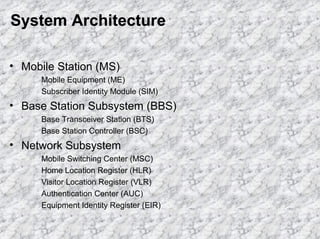
• System Architecture
• Features (Basic and Advanced)
• Advantages of GSM
• Future – what’s next
HISTORY
contd.
• GSM criteria –
–
–
–
–
–
–
–
–
–

Good subjective speech quality
Low terminal and service cost
Support for international roaming – one system for all of Europe
Ability to support handheld terminals
Support for range of new services and facilities
Enhanced Features
ISDN compatibility
Enhance privacy
Security against fraud
HISTORY
contd.

• Late 1980’s GSM work was transferred to the
European Telecommunication Standards Institute
(ETSI) and SGM (Special Mobile Group) was
created
• Document the functionality and interaction of every
aspect of the GSM network
• 1987 ETSI oversees the creation of GSM MoU
(Memorandum of Understanding) Association
HISTORY
contd.
• Formal objective of the GSM MoU Association is the
promotion and evolution of the GSM systems and GSM
platforms
• Concepts of a published international standard and a
constantly evolving common standard are unique to GSM
• Work groups throughout the world specifically designed to
allow interested parties to meet and work on finding
solutions to systems enhancements that will fit into
existing programs of GSM operators
HISTORY
contd.
• Phase I of GSM specifications was published in 1990
• International demand was so great that the system name
was changed from Groupe Special Mobile to Global
Systems for Mobile Communications (still GSM)
• Commercial service started in mid-1991
• 1992 first paying customers were signed up for service
• By 1993 there were 36 GSM networks in 22 countries
• Early 1994 there were 1.3 million subscribers worldwide
• By 1996 there were more than 25 million subscribers
worldwide
• By October 1997 it had grown to more than 55 million
subscribers worldwide
Building Blocks
• AMPS – Advanced Mobile Phone System
• TACS – Total Access Communication System
• NMT – Nordic Mobile Telephone System
Building Blocks
contd.

AMPS – Advanced Mobile Phone System
• analog technology
• used in North and South America and
approximately 35 other countries
• operates in the 800 MHz band using FDMA
technology
Building Blocks
contd.

TACS – Total Access Communication System
• variant of AMPS
• deployed in a number of countries
• primarily in the UK
Building Blocks
contd.
NMT – Nordic Mobile Telephone System
• analog technology
• deployed in the Benelux countries and Russia
• operates in the 450 and 900 MHz band
• first technology to offer international roaming – only within
the Nordic countries
System Architecture
• Mobile Station (MS)
Mobile Equipment (ME)
Subscriber Identity Module (SIM)

• Base Station Subsystem (BBS)
Base Transceiver Station (BTS)
Base Station Controller (BSC)

• Network Subsystem
Mobile Switching Center (MSC)
Home Location Register (HLR)
Visitor Location Register (VLR)
Authentication Center (AUC)
Equipment Identity Register (EIR)
System Architecture
Mobile Station (MS)
The Mobile Station is made up of two entities:
1. Mobile Equipment (ME)
2. Subscriber Identity Module (SIM)
System Architecture
Mobile Station (MS) contd.
Mobile Equipment
•
•
•

Produced by many different manufacturers
Must obtain approval from the standardization
body
Uniquely identified by an IMEI (International
Mobile Equipment Identity)
System Architecture
Mobile Station (MS) contd.
Subscriber Identity Module (SIM)
•
•
•
•
•

Smart card containing the International Mobile
Subscriber Identity (IMSI)
Allows user to send and receive calls and receive other
subscribed services
Encoded network identification details
Protected by a password or PIN
Can be moved from phone to phone – contains key
information to activate the phone
System Architecture
Base Station Subsystem (BSS)
Base Station Subsystem is composed of two parts
that communicate across the standardized Abis
interface allowing operation between
components made by different suppliers
1. Base Transceiver Station (BTS)
2. Base Station Controller (BSC)
System Architecture
Base Station Subsystem (BSS) contd.
Base Transceiver Station (BTS)
•
•
•
•

Houses the radio transceivers that define a cell
Handles radio-link protocols with the Mobile Station
Speech and data transmissions from the MS are
recoded
Requirements for BTS:
ruggedness
reliability
portability
minimum costs
System Architecture
Base Station Subsystem (BSS) contd.
Base Station Controller (BSC)
•
•
•
•

Manages Resources for BTS
Handles call set up
Location update
Handover for each MS
System Architecture
Network Subsystem
Mobile Switching Center (MSC)
• Switch speech and data connections between:
Base Station Controllers
Mobile Switching Centers
GSM-networks
Other external networks

• Heart of the network
• Three main jobs:
1) connects calls from sender to receiver
2) collects details of the calls made and received
3) supervises operation of the rest of the network components
System Architecture
Network Subsystem contd.
• Home Location Registers (HLR)
- contains administrative information of each subscriber
- current location of the mobile

• Visitor Location Registers (VLR)
- contains selected administrative information from the HLR
- authenticates the user
- tracks which customers have the phone on and ready to
receive a call
- periodically updates the database on which phones are
turned on and ready to receive calls
System Architecture
Network Subsystem contd.
• Authentication Center (AUC)
- mainly used for security
- data storage location and functional part of the network
- Ki is the primary element

• Equipment Identity Register (EIR)
- Database that is used to track handsets using the IMEI
(International Mobile Equipment Identity)
- Made up of three sub-classes: The White List, The Black List
and the Gray List
- Optional database
System Architecture
Basic Features Provided by GSM
• Call Waiting
- Notification of an incoming call while on the handset

• Call Hold
- Put a caller on hold to take another call

• Call Barring
- All calls, outgoing calls, or incoming calls

• Call Forwarding
- Calls can be sent to various numbers defined by the user

• Multi Party Call Conferencing
- Link multiple calls together
Advanced Features Provided by
GSM
• Calling Line ID
- incoming telephone number displayed

• Alternate Line Service
- one for personal calls
- one for business calls

• Closed User Group
- call by dialing last for numbers

• Advice of Charge
- tally of actual costs of phone calls

• Fax & Data
- Virtual Office / Professional Office

• Roaming
- services and features can follow customer from market to market
Future -- UMTS (Universal Mobile
Telephone System
• Reasons for innovations
- new service requirements
- availability of new radio bands

• User demands
-

seamless Internet-Intranet access
wide range of available services
compact, lightweight and affordable terminals
simple terminal operation
open, understandable pricing structures for the whole spectrum of
available services
Advantages of GSM
•
•
•
•
•
•
•
•
•
•

Crisper, cleaner quieter calls
Security against fraud and eavesdropping
International roaming capability in over 100 countries
Improved battery life
Efficient network design for less expensive system expansion
Efficient use of spectrum
Advanced features such as short messaging and caller ID
A wide variety of handsets and accessories
High stability mobile fax and data at up to 9600 baud
Ease of use with over the air activation, and all account information
is held in a smart card which can be moved from handset to
handset

Gsm an introduction....

  • 1.
    GSM – GLOBALSYSTEM FOR MOBILE COMMUNICATION PRESENTED BY:- KRISHNA BALLABH GUPTA B.TECH 4th SEM [CSE] SCE DEHRADUN
  • 2.
    DISCUSSION TOPICS • History •Building Blocks • System Architecture • Features (Basic and Advanced) • Advantages of GSM • Future – what’s next
  • 3.
    HISTORY contd. • GSM criteria– – – – – – – – – – Good subjective speech quality Low terminal and service cost Support for international roaming – one system for all of Europe Ability to support handheld terminals Support for range of new services and facilities Enhanced Features ISDN compatibility Enhance privacy Security against fraud
  • 4.
    HISTORY contd. • Late 1980’sGSM work was transferred to the European Telecommunication Standards Institute (ETSI) and SGM (Special Mobile Group) was created • Document the functionality and interaction of every aspect of the GSM network • 1987 ETSI oversees the creation of GSM MoU (Memorandum of Understanding) Association
  • 5.
    HISTORY contd. • Formal objectiveof the GSM MoU Association is the promotion and evolution of the GSM systems and GSM platforms • Concepts of a published international standard and a constantly evolving common standard are unique to GSM • Work groups throughout the world specifically designed to allow interested parties to meet and work on finding solutions to systems enhancements that will fit into existing programs of GSM operators
  • 6.
    HISTORY contd. • Phase Iof GSM specifications was published in 1990 • International demand was so great that the system name was changed from Groupe Special Mobile to Global Systems for Mobile Communications (still GSM) • Commercial service started in mid-1991 • 1992 first paying customers were signed up for service • By 1993 there were 36 GSM networks in 22 countries • Early 1994 there were 1.3 million subscribers worldwide • By 1996 there were more than 25 million subscribers worldwide • By October 1997 it had grown to more than 55 million subscribers worldwide
  • 7.
    Building Blocks • AMPS– Advanced Mobile Phone System • TACS – Total Access Communication System • NMT – Nordic Mobile Telephone System
  • 8.
    Building Blocks contd. AMPS –Advanced Mobile Phone System • analog technology • used in North and South America and approximately 35 other countries • operates in the 800 MHz band using FDMA technology
  • 9.
    Building Blocks contd. TACS –Total Access Communication System • variant of AMPS • deployed in a number of countries • primarily in the UK
  • 10.
    Building Blocks contd. NMT –Nordic Mobile Telephone System • analog technology • deployed in the Benelux countries and Russia • operates in the 450 and 900 MHz band • first technology to offer international roaming – only within the Nordic countries
  • 11.
    System Architecture • MobileStation (MS) Mobile Equipment (ME) Subscriber Identity Module (SIM) • Base Station Subsystem (BBS) Base Transceiver Station (BTS) Base Station Controller (BSC) • Network Subsystem Mobile Switching Center (MSC) Home Location Register (HLR) Visitor Location Register (VLR) Authentication Center (AUC) Equipment Identity Register (EIR)
  • 12.
    System Architecture Mobile Station(MS) The Mobile Station is made up of two entities: 1. Mobile Equipment (ME) 2. Subscriber Identity Module (SIM)
  • 13.
    System Architecture Mobile Station(MS) contd. Mobile Equipment • • • Produced by many different manufacturers Must obtain approval from the standardization body Uniquely identified by an IMEI (International Mobile Equipment Identity)
  • 14.
    System Architecture Mobile Station(MS) contd. Subscriber Identity Module (SIM) • • • • • Smart card containing the International Mobile Subscriber Identity (IMSI) Allows user to send and receive calls and receive other subscribed services Encoded network identification details Protected by a password or PIN Can be moved from phone to phone – contains key information to activate the phone
  • 15.
    System Architecture Base StationSubsystem (BSS) Base Station Subsystem is composed of two parts that communicate across the standardized Abis interface allowing operation between components made by different suppliers 1. Base Transceiver Station (BTS) 2. Base Station Controller (BSC)
  • 16.
    System Architecture Base StationSubsystem (BSS) contd. Base Transceiver Station (BTS) • • • • Houses the radio transceivers that define a cell Handles radio-link protocols with the Mobile Station Speech and data transmissions from the MS are recoded Requirements for BTS: ruggedness reliability portability minimum costs
  • 17.
    System Architecture Base StationSubsystem (BSS) contd. Base Station Controller (BSC) • • • • Manages Resources for BTS Handles call set up Location update Handover for each MS
  • 18.
    System Architecture Network Subsystem MobileSwitching Center (MSC) • Switch speech and data connections between: Base Station Controllers Mobile Switching Centers GSM-networks Other external networks • Heart of the network • Three main jobs: 1) connects calls from sender to receiver 2) collects details of the calls made and received 3) supervises operation of the rest of the network components
  • 19.
    System Architecture Network Subsystemcontd. • Home Location Registers (HLR) - contains administrative information of each subscriber - current location of the mobile • Visitor Location Registers (VLR) - contains selected administrative information from the HLR - authenticates the user - tracks which customers have the phone on and ready to receive a call - periodically updates the database on which phones are turned on and ready to receive calls
  • 20.
    System Architecture Network Subsystemcontd. • Authentication Center (AUC) - mainly used for security - data storage location and functional part of the network - Ki is the primary element • Equipment Identity Register (EIR) - Database that is used to track handsets using the IMEI (International Mobile Equipment Identity) - Made up of three sub-classes: The White List, The Black List and the Gray List - Optional database
  • 21.
  • 22.
    Basic Features Providedby GSM • Call Waiting - Notification of an incoming call while on the handset • Call Hold - Put a caller on hold to take another call • Call Barring - All calls, outgoing calls, or incoming calls • Call Forwarding - Calls can be sent to various numbers defined by the user • Multi Party Call Conferencing - Link multiple calls together
  • 23.
    Advanced Features Providedby GSM • Calling Line ID - incoming telephone number displayed • Alternate Line Service - one for personal calls - one for business calls • Closed User Group - call by dialing last for numbers • Advice of Charge - tally of actual costs of phone calls • Fax & Data - Virtual Office / Professional Office • Roaming - services and features can follow customer from market to market
  • 24.
    Future -- UMTS(Universal Mobile Telephone System • Reasons for innovations - new service requirements - availability of new radio bands • User demands - seamless Internet-Intranet access wide range of available services compact, lightweight and affordable terminals simple terminal operation open, understandable pricing structures for the whole spectrum of available services
  • 25.
    Advantages of GSM • • • • • • • • • • Crisper,cleaner quieter calls Security against fraud and eavesdropping International roaming capability in over 100 countries Improved battery life Efficient network design for less expensive system expansion Efficient use of spectrum Advanced features such as short messaging and caller ID A wide variety of handsets and accessories High stability mobile fax and data at up to 9600 baud Ease of use with over the air activation, and all account information is held in a smart card which can be moved from handset to handset