CONTENTS
ď‚— WHAT IS ANTENNA
ď‚— TRANSMITTER ANTENNA
ď‚— RECEIVER ANTENNA
ď‚— YAGI-UDA ANTENNA
 LOG – PERIODIC ANTENNA
ď‚— HELIX ANTENNA
ď‚— PARABOLIC ANTENNA
ď‚— LOOP ANTENNA
ď‚— ANTENNA ARRARY
ANTENNA
ď‚— An antenna is an electrical device which converts
  electric energy into radio waves, and vice versa. It is
  usually used with a radio transmitter or radio receiver.

ď‚— An antenna is a device for sending or receiving
  electromagnetic waves.
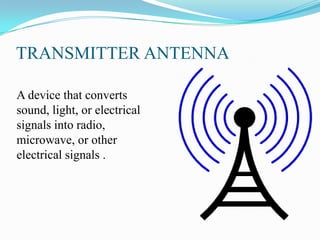
TRANSMITTER ANTENNA

A device that converts
sound, light, or electrical
signals into radio,
microwave, or other
electrical signals .
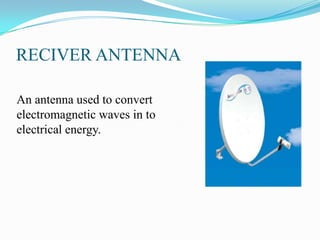
RECIVER ANTENNA

An antenna used to convert
electromagnetic waves in to
electrical energy.
TYPES OF ANTENNA
 YAGI – UDA ANTENNA
 LOG – PERIODIC ANTENNA
ď‚— HELIX ANTENNA
ď‚— PARABOLIC ANTENNA
ď‚— LOOP ANTENNA
YAGI – UDA ANTENNA
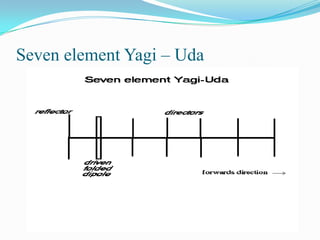
ď‚— Yagi-Uda antenna consist of reflector, director and
  driven element.
ď‚— It is unidirectional antenna.
 Frequency range – 300MHz-3GHz
Seven element Yagi – Uda
Yagi – Uda advantage
ď‚— High gain and good front to back ratio.
ď‚— It has narrow bandwidth.
ď‚— It is fixed frequency device.
ď‚— Grater directivity due to director and reflector.
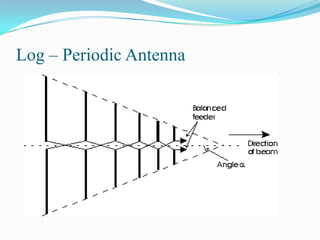
Log - periodic antenna
ď‚— A unidirectional antenna in which the length and
  spacing of the elements increase logarithmically from
  one end to the other.
ď‚— It is frequency-independent antenna.
 Frequency range – VHF and UHF band.
Log – Periodic Antenna
Advantages
ď‚— It is broadband antenna.
ď‚— It is unidirectional antenna.
ď‚— It is frequency independent antenna.
HELIX ANTENNA
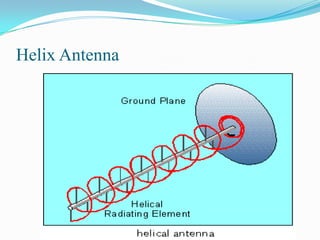
ď‚— A conducting wire in the form of screw thread fed by
  power source.
ď‚— The feed line is connected between the bottom of the
  helix and the ground plane.
ď‚— Helix antenna is Omni directional.
 Frequency range – VHF and UHF band.
Helix Antenna
Application
ď‚— Satellite communication.
ď‚— Space communication & space probes.
ď‚— For telemetry applications.
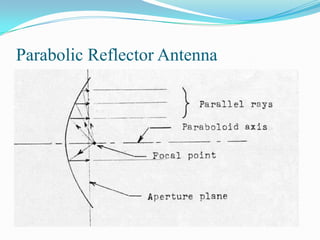
PARABOLIC REFLECTOR
ANTENNA
ď‚— This is used to convert spherical wave into plane wave
ď‚— The feed antenna is called primary antenna and
  reflector is secondary antenna.
ď‚— Frequency range - 3GHz-30GHz
Parabolic Reflector Antenna
Application
ď‚— Radar communication.
ď‚— Satellite communication.
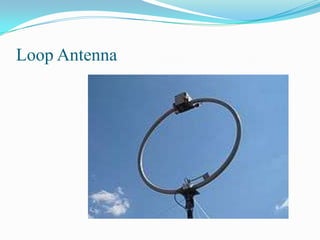
LOOP ANTENNA
ď‚— A directional-type antenna consisting of one or more
  complete turns of a conductor.
ď‚— It determine the direction of arrival of radio signals.
 Frequency range – 500-1600KHz.
Loop Antenna
Application
ď‚— Direction finding of signal propagation.
ď‚— Radio(AM/FM)reception.
ď‚— Long distance point to point communication.
Antenna Arrays
ď‚— Arrays are used to increase diretivity and gain in
  desired direction.

ď‚— Eliminate the radiation in undesired direction.
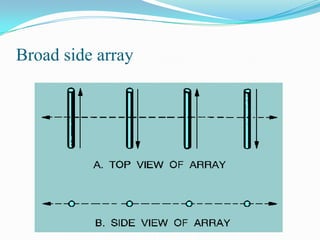
Broadside Array
ď‚— If the direction of maximum radiation is generated is
  perpendicular is called broadside array.

ď‚— Each antenna is fed by the current of same magnitude
  and phase.

ď‚— Radiation pattern is bidirectional.
Broad side array
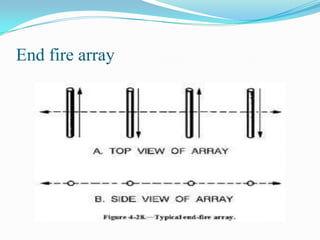
End Fire Array
ď‚— If the maximum radiation is generated parallel to the
  antenna array axis is called end fire array.

ď‚— Each antenna is fed by the current same magnitude
  and opposite phase.

ď‚— Radiation pattern is bidirectional.
End fire array
CONCLUSION
ď‚— All the antenna are very useful in all the application
  such as transmitter and receiver.
ď‚— Antenna are used to convert electrical energy to
  electromagnetic energy.

Antenna

  • 2.
    CONTENTS  WHAT ISANTENNA  TRANSMITTER ANTENNA  RECEIVER ANTENNA  YAGI-UDA ANTENNA  LOG – PERIODIC ANTENNA  HELIX ANTENNA  PARABOLIC ANTENNA  LOOP ANTENNA  ANTENNA ARRARY
  • 3.
    ANTENNA ď‚— An antennais an electrical device which converts electric energy into radio waves, and vice versa. It is usually used with a radio transmitter or radio receiver. ď‚— An antenna is a device for sending or receiving electromagnetic waves.
  • 4.
    TRANSMITTER ANTENNA A devicethat converts sound, light, or electrical signals into radio, microwave, or other electrical signals .
  • 5.
    RECIVER ANTENNA An antennaused to convert electromagnetic waves in to electrical energy.
  • 6.
    TYPES OF ANTENNA YAGI – UDA ANTENNA  LOG – PERIODIC ANTENNA  HELIX ANTENNA  PARABOLIC ANTENNA  LOOP ANTENNA
  • 7.
    YAGI – UDAANTENNA  Yagi-Uda antenna consist of reflector, director and driven element.  It is unidirectional antenna.  Frequency range – 300MHz-3GHz
  • 8.
    Seven element Yagi– Uda
  • 9.
    Yagi – Udaadvantage  High gain and good front to back ratio.  It has narrow bandwidth.  It is fixed frequency device.  Grater directivity due to director and reflector.
  • 10.
    Log - periodicantenna  A unidirectional antenna in which the length and spacing of the elements increase logarithmically from one end to the other.  It is frequency-independent antenna.  Frequency range – VHF and UHF band.
  • 11.
  • 12.
    Advantages ď‚— It isbroadband antenna. ď‚— It is unidirectional antenna. ď‚— It is frequency independent antenna.
  • 13.
    HELIX ANTENNA  Aconducting wire in the form of screw thread fed by power source.  The feed line is connected between the bottom of the helix and the ground plane.  Helix antenna is Omni directional.  Frequency range – VHF and UHF band.
  • 14.
  • 15.
    Application ď‚— Satellite communication. ď‚—Space communication & space probes. ď‚— For telemetry applications.
  • 16.
    PARABOLIC REFLECTOR ANTENNA ď‚— Thisis used to convert spherical wave into plane wave ď‚— The feed antenna is called primary antenna and reflector is secondary antenna. ď‚— Frequency range - 3GHz-30GHz
  • 17.
  • 18.
  • 19.
    LOOP ANTENNA  Adirectional-type antenna consisting of one or more complete turns of a conductor.  It determine the direction of arrival of radio signals.  Frequency range – 500-1600KHz.
  • 20.
  • 21.
    Application ď‚— Direction findingof signal propagation. ď‚— Radio(AM/FM)reception. ď‚— Long distance point to point communication.
  • 22.
    Antenna Arrays ď‚— Arraysare used to increase diretivity and gain in desired direction. ď‚— Eliminate the radiation in undesired direction.
  • 23.
    Broadside Array ď‚— Ifthe direction of maximum radiation is generated is perpendicular is called broadside array. ď‚— Each antenna is fed by the current of same magnitude and phase. ď‚— Radiation pattern is bidirectional.
  • 24.
  • 25.
    End Fire Array ď‚—If the maximum radiation is generated parallel to the antenna array axis is called end fire array. ď‚— Each antenna is fed by the current same magnitude and opposite phase. ď‚— Radiation pattern is bidirectional.
  • 26.
  • 27.
    CONCLUSION ď‚— All theantenna are very useful in all the application such as transmitter and receiver. ď‚— Antenna are used to convert electrical energy to electromagnetic energy.