By - ARIJIT SARKAR
ANTENNA
INTRODUCTIO
N
2
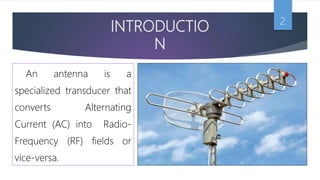
An antenna is a
specialized transducer that
converts Alternating
Current (AC) into Radio-
Frequency (RF) fields or
vice-versa.
WORKING OF AN
ANTENNA
3
WAVE RADIATION
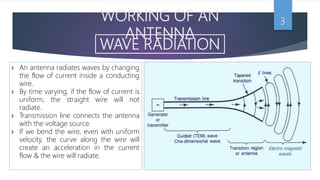
 An antenna radiates waves by changing
the flow of current inside a conducting
wire.
 By time varying, if the flow of current is
uniform, the straight wire will not
radiate.
 Transmission line connects the antenna
with the voltage source.
 If we bend the wire, even with uniform
velocity, the curve along the wire will
create an acceleration in the current
flow & the wire will radiate.
ANTENNA
PARAMETERS
4
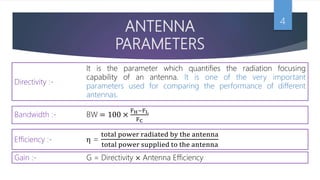
Efficiency :- η =
total power radiated by the antenna
total power supplied to the antenna
Gain :- G = Directivity × Antenna Efficiency
It is the parameter which quantifies the radiation focusing
capability of an antenna. It is one of the very important
parameters used for comparing the performance of different
antennas.
Directivity :-
Bandwidth :- BW = 100 ×
FH−FL
FC
TYPES OF
ANTENNAS
5
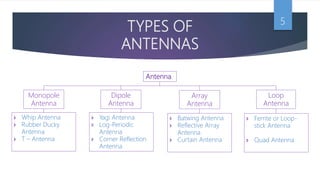
Antenna
Dipole
Antenna
Loop
Antenna
Monopole
Antenna
Array
Antenna
 Yagi Antenna
 Log-Periodic
Antenna
 Corner Reflection
Antenna
 Whip Antenna
 Rubber Ducky
Antenna
 T – Antenna
 Batwing Antenna
 Reflective Array
Antenna
 Curtain Antenna
 Ferrite or Loop-
stick Antenna
 Quad Antenna
MONOPOLE
ANTENNA
6
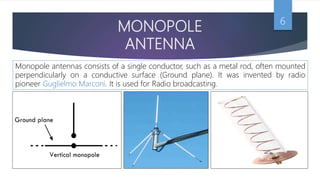
Monopole antennas consists of a single conductor, such as a metal rod, often mounted
perpendicularly on a conductive surface (Ground plane). It was invented by radio
pioneer Guglielmo Marconi. It is used for Radio broadcasting.
7
DIPOLE
ANTENNA
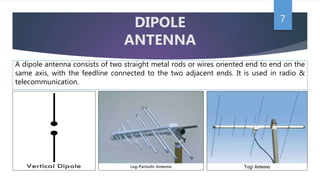
A dipole antenna consists of two straight metal rods or wires oriented end to end on the
same axis, with the feedline connected to the two adjacent ends. It is used in radio &
telecommunication.
ARRAY ANTENNA
8
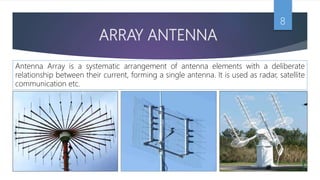
Antenna Array is a systematic arrangement of antenna elements with a deliberate
relationship between their current, forming a single antenna. It is used as radar, satellite
communication etc.
LOOP
ANTENNA
9
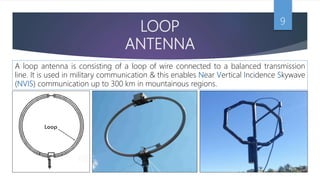
A loop antenna is consisting of a loop of wire connected to a balanced transmission
line. It is used in military communication & this enables Near Vertical Incidence Skywave
(NVIS) communication up to 300 km in mountainous regions.
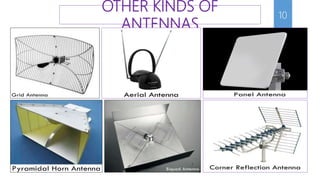
OTHER KINDS OF
ANTENNAS
10
11
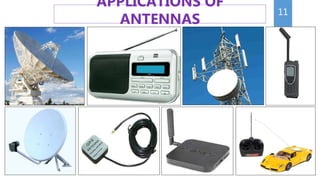
APPLICATIONS OF
ANTENNAS
ADVANTAGES OF USING ANTENNAS
12
 Antenna is a device that transmits & receives signals in a free space.
 Mechanically strong when mounted on a rigid surface.
 Antennas have high performance.
 Low fabrication cost, hence can be manufactured in a large quantities.
CONCLUSION
Antennas are very curious devices. From cell phones
and televisions to automobiles and the tops of buildings, we
see a variety of antennas all around us. They transmit and
receive information by invisible electromagnetic waves in a
free space. Antennas are very important part of
communication systems.
13
Antenna

Antenna

  • 1.
    By - ARIJITSARKAR ANTENNA
  • 2.
    INTRODUCTIO N 2 An antenna isa specialized transducer that converts Alternating Current (AC) into Radio- Frequency (RF) fields or vice-versa.
  • 3.
    WORKING OF AN ANTENNA 3 WAVERADIATION  An antenna radiates waves by changing the flow of current inside a conducting wire.  By time varying, if the flow of current is uniform, the straight wire will not radiate.  Transmission line connects the antenna with the voltage source.  If we bend the wire, even with uniform velocity, the curve along the wire will create an acceleration in the current flow & the wire will radiate.
  • 4.
    ANTENNA PARAMETERS 4 Efficiency :- η= total power radiated by the antenna total power supplied to the antenna Gain :- G = Directivity × Antenna Efficiency It is the parameter which quantifies the radiation focusing capability of an antenna. It is one of the very important parameters used for comparing the performance of different antennas. Directivity :- Bandwidth :- BW = 100 × FH−FL FC
  • 5.
    TYPES OF ANTENNAS 5 Antenna Dipole Antenna Loop Antenna Monopole Antenna Array Antenna  YagiAntenna  Log-Periodic Antenna  Corner Reflection Antenna  Whip Antenna  Rubber Ducky Antenna  T – Antenna  Batwing Antenna  Reflective Array Antenna  Curtain Antenna  Ferrite or Loop- stick Antenna  Quad Antenna
  • 6.
    MONOPOLE ANTENNA 6 Monopole antennas consistsof a single conductor, such as a metal rod, often mounted perpendicularly on a conductive surface (Ground plane). It was invented by radio pioneer Guglielmo Marconi. It is used for Radio broadcasting.
  • 7.
    7 DIPOLE ANTENNA A dipole antennaconsists of two straight metal rods or wires oriented end to end on the same axis, with the feedline connected to the two adjacent ends. It is used in radio & telecommunication.
  • 8.
    ARRAY ANTENNA 8 Antenna Arrayis a systematic arrangement of antenna elements with a deliberate relationship between their current, forming a single antenna. It is used as radar, satellite communication etc.
  • 9.
    LOOP ANTENNA 9 A loop antennais consisting of a loop of wire connected to a balanced transmission line. It is used in military communication & this enables Near Vertical Incidence Skywave (NVIS) communication up to 300 km in mountainous regions.
  • 10.
  • 11.
  • 12.
    ADVANTAGES OF USINGANTENNAS 12  Antenna is a device that transmits & receives signals in a free space.  Mechanically strong when mounted on a rigid surface.  Antennas have high performance.  Low fabrication cost, hence can be manufactured in a large quantities.
  • 13.
    CONCLUSION Antennas are verycurious devices. From cell phones and televisions to automobiles and the tops of buildings, we see a variety of antennas all around us. They transmit and receive information by invisible electromagnetic waves in a free space. Antennas are very important part of communication systems. 13