Nader Jarmooz 2012
Projects are planned and implemented in terms of
  their Goals and Objectives set by the Project
  Champion and Stakeholders

Goals and Objectives must be clearly defined and
  established at the outset.

Goals are outcomes whilst Objectives are activities
  that will result in the desired outcome
Goal and Objectives can be seen as a contract
between the project manager and sponsors
(Watson, 1998).

not set in stone and can be changed with the
agreement of those involved should the project
requirements change during the process

all changes must be agreed upon between the
project manager and sponsors, and
communicated to project team.
what are Project Goals and Objective?
To answer this question three interrelated
queries need to be identified:

• What are the project objectives?
• What are the outputs from project?
• What are the criteria for assessing project success?

Bee and Bee (1997) argue that the answer to above
queries provide the vital foundation for successful
completion of all subsequent project stages
Project Objectives need to be aligned with organisational,
team, and individual Objectives to ensure that common
focus is set on common goals (Bee and Bee, 1997).
    To ensure successful alignment following
    issues need to be considered:
         •Organisational objectives
         •Team Objectives
         •Individual Objectives
Organisational Objectives are outcomes that the Firm want
to achieve. Project Objectives are the activities involved in
achieving the Firm’s goals (Field and Keller, 1998).
Objectives are the underlying basis for the project
activities and express goals in SMART terms
They specify what the outcome will be and what
activities are required for agreed gaols
They state final outcomes in terms of improved
percentages/ratios, or new products/processes
Objectives help define the project in terms of its
purpose and perceived benefits, therefore it need to
contain both quantitative and qualitative information
(Turner, 1997).
Objectives need to be SMART:

  •Specific: clearly stated with specific outcomes.
  •Measureable: so the end of each objective can be
  identified and measured against success criteria
  •Achievable: attainable given the available
  resources, time, and technology, in accordance with
  required quality.
  •Realistic: sensible, pragmatic, and prioritised
  activities for achieving set goals.
  •Timely: planned and attained tasks according to
  base line and prioritisation of hierarchy of needs.
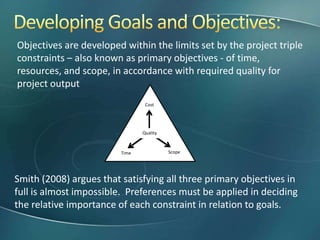
Objectives are developed within the limits set by the project triple
constraints – also known as primary objectives - of time,
resources, and scope, in accordance with required quality for
project output
                                 Cost


                                Quality


                         Time             Scope


Smith (2008) argues that satisfying all three primary objectives in
full is almost impossible. Preferences must be applied in deciding
the relative importance of each constraint in relation to goals.
Goals are desired outcomes whilst Objectives are a set of activities
for achieving goals.
They need to be developed and established at the outset and
communicated to everyone involved.
Project goals and objectives must be aligned with organisational
goals and objectives in order to gain approval and contribute to
overall organisational strategy.

Objectives should be SMART and set within the limits of triple
constraint.

Goals are broad long term outcomes and objectives are specific
measurable short term activities that will articulate project goals.
Defining Project Objectives:
http://www.projectsmart.co.uk/defining-project-goals-and-
objectives.html
http://www.projectsmart.co.uk/use-smart-objectives-to-focus-
goals-plans-and-performance.html
http://www.ehow.com/how_8689923_write-project-objectives.html

Open learn information for Objectives:
http://openlearn.open.ac.uk/mod/oucontent/view.php?id=403254&secti
on=2.5

Using aims and objectives to create a business strategy
http://businesscasestudies.co.uk/kelloggs/using-aims-and-objectives-
to-create-a-business-strategy/introduction.html#ixzz25ai9PacI

Video Tutorials for Setting SMART Goals:
http://www.youtube.com/watch?v=uThBb3kGf4k&feature=related
References
Bee, R, and Bee, F, 1997, Project Management The People Challenge,
London, Cromwell Press

Field, M, and Keller L, 1998, Project Management, London,
International Thomson Business Press

Meredith, J. R., and Mantel, S. J., 1995, Project Management A
Managerial Approach, 3rd Ed, USA, Wiley and Sons. Inc.

Smith, N. J., 2008, Engineering Project Management, Oxford, 3rd Ed,
Blackwell Publishing Ltd

Turner, J. R., 1997, The Handbook of Project-Based Management,
Maidenhead, McGraw-Hill Publishing Company

Watson, M, 1998, Managing Small Projects, Wokingham, Project
Manager Today Publications

project goals and objectives

  • 1.
  • 2.
    Projects are plannedand implemented in terms of their Goals and Objectives set by the Project Champion and Stakeholders Goals and Objectives must be clearly defined and established at the outset. Goals are outcomes whilst Objectives are activities that will result in the desired outcome
  • 3.
    Goal and Objectivescan be seen as a contract between the project manager and sponsors (Watson, 1998). not set in stone and can be changed with the agreement of those involved should the project requirements change during the process all changes must be agreed upon between the project manager and sponsors, and communicated to project team.
  • 4.
    what are ProjectGoals and Objective? To answer this question three interrelated queries need to be identified: • What are the project objectives? • What are the outputs from project? • What are the criteria for assessing project success? Bee and Bee (1997) argue that the answer to above queries provide the vital foundation for successful completion of all subsequent project stages
  • 5.
    Project Objectives needto be aligned with organisational, team, and individual Objectives to ensure that common focus is set on common goals (Bee and Bee, 1997). To ensure successful alignment following issues need to be considered: •Organisational objectives •Team Objectives •Individual Objectives Organisational Objectives are outcomes that the Firm want to achieve. Project Objectives are the activities involved in achieving the Firm’s goals (Field and Keller, 1998).
  • 6.
    Objectives are theunderlying basis for the project activities and express goals in SMART terms They specify what the outcome will be and what activities are required for agreed gaols They state final outcomes in terms of improved percentages/ratios, or new products/processes Objectives help define the project in terms of its purpose and perceived benefits, therefore it need to contain both quantitative and qualitative information (Turner, 1997).
  • 7.
    Objectives need tobe SMART: •Specific: clearly stated with specific outcomes. •Measureable: so the end of each objective can be identified and measured against success criteria •Achievable: attainable given the available resources, time, and technology, in accordance with required quality. •Realistic: sensible, pragmatic, and prioritised activities for achieving set goals. •Timely: planned and attained tasks according to base line and prioritisation of hierarchy of needs.
  • 8.
    Objectives are developedwithin the limits set by the project triple constraints – also known as primary objectives - of time, resources, and scope, in accordance with required quality for project output Cost Quality Time Scope Smith (2008) argues that satisfying all three primary objectives in full is almost impossible. Preferences must be applied in deciding the relative importance of each constraint in relation to goals.
  • 9.
    Goals are desiredoutcomes whilst Objectives are a set of activities for achieving goals. They need to be developed and established at the outset and communicated to everyone involved. Project goals and objectives must be aligned with organisational goals and objectives in order to gain approval and contribute to overall organisational strategy. Objectives should be SMART and set within the limits of triple constraint. Goals are broad long term outcomes and objectives are specific measurable short term activities that will articulate project goals.
  • 10.
    Defining Project Objectives: http://www.projectsmart.co.uk/defining-project-goals-and- objectives.html http://www.projectsmart.co.uk/use-smart-objectives-to-focus- goals-plans-and-performance.html http://www.ehow.com/how_8689923_write-project-objectives.html Openlearn information for Objectives: http://openlearn.open.ac.uk/mod/oucontent/view.php?id=403254&secti on=2.5 Using aims and objectives to create a business strategy http://businesscasestudies.co.uk/kelloggs/using-aims-and-objectives- to-create-a-business-strategy/introduction.html#ixzz25ai9PacI Video Tutorials for Setting SMART Goals: http://www.youtube.com/watch?v=uThBb3kGf4k&feature=related
  • 11.
    References Bee, R, andBee, F, 1997, Project Management The People Challenge, London, Cromwell Press Field, M, and Keller L, 1998, Project Management, London, International Thomson Business Press Meredith, J. R., and Mantel, S. J., 1995, Project Management A Managerial Approach, 3rd Ed, USA, Wiley and Sons. Inc. Smith, N. J., 2008, Engineering Project Management, Oxford, 3rd Ed, Blackwell Publishing Ltd Turner, J. R., 1997, The Handbook of Project-Based Management, Maidenhead, McGraw-Hill Publishing Company Watson, M, 1998, Managing Small Projects, Wokingham, Project Manager Today Publications