Project Management
Fundamentals
BRENT C. HECTOR PMP, PSM, PSOP,EMB-PAL
Introduction to Project Management
The (What, Why & How)
Project Characteristics Unique in nature
► Deliver a new or an improved product or service that will either solve a
problem or take advantage of an opportunity
► Have definite & Explicit Goal (WHY)
► Have S.M.A.R.T (ER) objectives to achieve the GOAL
► Requires set of resources(money, equipment etc.)
► Have a specific time frame for completion with a definite start and finish.
► Involves risk and uncertainty.
► Requires cross-functional teams and interdisciplinary approach.
Introduction to Project Management
► A project is a temporary undertaking performed to produce a
unique product, service, or result. ~ Brings about a change
► What is Project Management?
► “is the use of specific knowledge, processes, skills (people), experience,
tools, and techniques to deliver something of value to people, according
to the acceptance criteria (Quality) within agreed parameters. It has final
deliverables that are constrained to a finite time and budget.”
PM vs General Management
► Each project is unique and differs from routine
operations—the ongoing activities and processes of an
organization—because projects reach a conclusion
once the goal is achieved.
► "At its most fundamental, project management is about
people getting things done.“ ~ Dr Martin Barnes, APM
President 2003-2012
PM Processes & Activities (1)
► Initiating:
► Clarifying the business need, defining high-level expectations and
resource budgets, and beginning to identify audiences that may play a
role in your project
► Planning:
► Detailing the project scope (Outputs & Outcomes), time frames,
resources, and risks, as well as intended approaches to project
communications, quality, and management of external purchases of
goods and services
PM Processes & Activities (1)
► Executing:
► implementing the project plans to produce the desired results (product, service
or outcome) and communicating with and managing project audiences and
stakeholders
► Monitoring and controlling :
► Tracking performance, Inspecting the quality of the deliverable and taking
actions necessary to help ensure the desired results are achieved
► Closing:
► Ending all project activity. E.g. creating a final report/documentation, settling all
invoices, releasing project teams, returning resources etc.
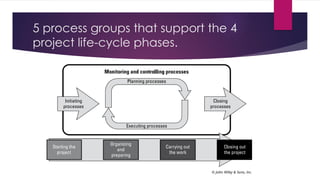
5 process groups that support the 4
project life-cycle phases.
Why Project Management
►…Because the undertaking of any endeavour to
tackle complex or complicated problems with
many unknowns, broad assumptions and a mix of
people that most likely had never worked together,
presents a high level of uncertainty (risks), and
therefore requires an agreed approach or
framework or methodologies, guide the process.
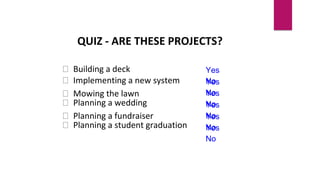
QUIZ - ARE THESE PROJECTS?
Building a deck
Implementing a new system
Mowing the lawn
Planning a wedding
Planning a fundraiser
Planning a student graduation
Yes
No
Yes
No
Yes
No
Yes
No
Yes
No
Yes
No
Planning
► Identify, Analyze, Define, document
► Project Goal (Vision/Narrative),
► Stakeholders – Target audience and any person, community or org
► Objectives, outputs and outcome (Scope)
► Inputs – Resources, funds, project team’s roles and skills
► Activities Milestones, Tasks and sub-tasks, estimation/forecasting,
assigning, scheduling
► Dependencies, Risks Assumptions
► Indicators, acceptance criteria
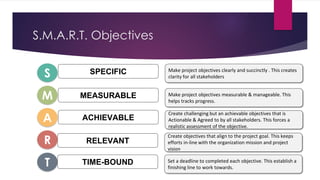
S.M.A.R.T. Objectives
T
S SPECIFIC Make project objectives clearly and succinctly . This creates
clarity for all stakeholders
A ACHIEVABLE
Create challenging but an achievable objectives that is
Actionable & Agreed to by all stakeholders. This forces a
realistic assessment of the objective.
R RELEVANT
Create objectives that align to the project goal. This keeps
efforts in-line with the organization mission and project
vision
TIME-BOUND
M MEASURABLE Make project objectives measurable & manageable. This
helps tracks progress.
Set a deadline to completed each objective. This establish a
finishing line to work towards.
E.g. Smart Objectives
► NOT SMART Example: Help youth gain income.
► SMART Example: Increase by 15% the income level of 100 youths (18-25) in
[Specific] districts over one year.
► NOT SMART Example: Provide mental health care service to women and
Children.
► SMART Example: By the end of the project, increase the number of women
and children with access to a mental healthcare worker from 15% to 45%.
Quotes
► “everyone has a plan until they get punched in the mouth”. ~ Mike
Tyson
► No Plan Survives First contact or no plan of operations can with any
certainty reach beyond the first encounter with the enemy.’ ~ Prussian
Field Marshal Helmuth von Moltke
► Plans Are Worthless but Planning Is Everything ~ Dwight D. Eisenhower
► The map is not the territory.
► Responding to Change as opposed to following a plan. Planning is
continuous
► Planning should always a group activity – Collective intelligence
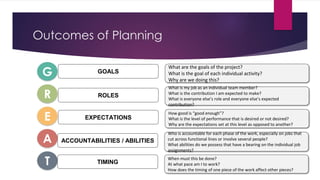
Outcomes of Planning
T
G GOALS
What are the goals of the project?
What is the goal of each individual activity?
Why are we doing this?
E EXPECTATIONS
How good is “good enough”?
What is the level of performance that is desired or not desired?
Why are the expectations set at this level as opposed to another?
A ACCOUNTABILITIES / ABILITIES
Who is accountable for each phase of the work, especially on jobs that
cut across functional lines or involve several people?
What abilities do we possess that have a bearing on the individual job
assignments?
TIMING
R ROLES
What is my job as an individual team member?
What is the contribution I am expected to make?
What is everyone else’s role and everyone else’s expected
contribution?
When must this be done?
At what pace am I to work?
How does the timing of one piece of the work affect other pieces?
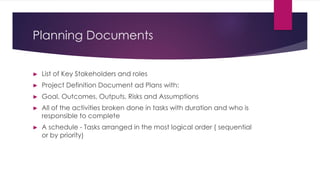
Planning Documents
► List of Key Stakeholders and roles
► Project Definition Document ad Plans with:
► Goal, Outcomes, Outputs, Risks and Assumptions
► All of the activities broken done in tasks with duration and who is
responsible to complete
► A schedule - Tasks arranged in the most logical order ( sequential
or by priority)
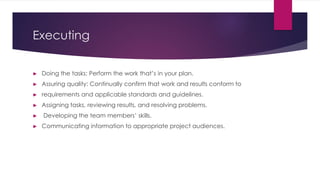
Executing
► Doing the tasks: Perform the work that’s in your plan.
► Assuring quality: Continually confirm that work and results conform to
► requirements and applicable standards and guidelines.
► Assigning tasks, reviewing results, and resolving problems.
► Developing the team members’ skills.
► Communicating information to appropriate project audiences.
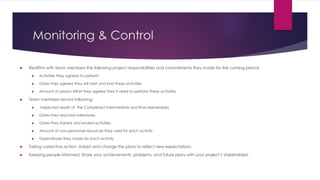
Monitoring & Control
► Reaffirm with team members the following project responsibilities and commitments they made for the coming period:
► Activities they agreed to perform
► Dates they agreed they will start and end these activities
► Amount of person effort they agreed they’ll need to perform these activities
► Team members record following:
► Inspected results of the Completed intermediate and final deliverables
► Dates they reached milestones
► Dates they started and ended activities
► Amount of non-personnel resources they used for each activity
► Expenditures they made for each activity
► Taking corrective action: Adapt and change the plans to reflect new expectations.
► Keeping people informed: Share your achievements, problems, and future plans with your project’s stakeholders.
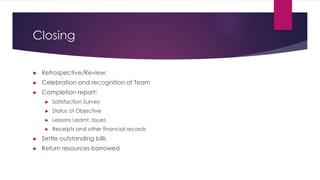
Closing
► Retrospective/Review:
► Celebration and recognition of Team
► Completion report:
► Satisfaction Survey
► Status of Objective
► Lessons Learnt, Issues
► Receipts and other financial records
► Settle outstanding bills
► Return resources borrowed
-.
MEASURING PROJECT SUCCESS
► Project success has been primarily measure using 3 major
project constraints, Scope, Cost Schedule. These focus on
the PM Process and the output.
► A better way is to also focus on Value:
► Outcome – Objectives achieved
► Target audience satisfaction (quality and
performance).
► - Investor/ Funding Agency Satisfaction (ROI)
Barriers, Risks and Issues That Affect
Project Success
► Poor communication
► Disagreement
► Misunderstandings
► Inclement weather
► Union strikes
► Personality conflicts
► Poor management
► Poorly defined goals and objectives
Role of the Project Manager
► Project managers bear ultimate responsibility for making things happen.
Traditionally, they have carried out this role as mere implementers. To do their jobs,
they needed to have the necessary administrative and technical competencies.
► Today they play a far broader role. In addition to the traditional skills, they need to
have business skills, customer relations skills, and political skills.
► Psychologically, they must be results-oriented self-starters with a high tolerance for
ambiguity because little is clear-cut in today's tumultuous business environment.
Shortcomings in any of these areas can lead to project failure.
J. Davidson Frame, Academic Dean at The University of Management and
Technology
Project Manager's Skill Set
► Leadership
► People management (customers, suppliers, functional managers and project team)
► Effective communication (verbal and written)
► Influencing
► Negotiation
► Conflict management
► Planning
► Contract management
► Estimating
► Budget management
► Problem-solving
► Creative thinking
► Time management
Videos
► Big Bang – Project Management
► Good teamwork and bad teamwork
► Minions – Team Work

Project Management Fundamentals

  • 1.
    Project Management Fundamentals BRENT C.HECTOR PMP, PSM, PSOP,EMB-PAL
  • 2.
    Introduction to ProjectManagement The (What, Why & How) Project Characteristics Unique in nature ► Deliver a new or an improved product or service that will either solve a problem or take advantage of an opportunity ► Have definite & Explicit Goal (WHY) ► Have S.M.A.R.T (ER) objectives to achieve the GOAL ► Requires set of resources(money, equipment etc.) ► Have a specific time frame for completion with a definite start and finish. ► Involves risk and uncertainty. ► Requires cross-functional teams and interdisciplinary approach.
  • 3.
    Introduction to ProjectManagement ► A project is a temporary undertaking performed to produce a unique product, service, or result. ~ Brings about a change ► What is Project Management? ► “is the use of specific knowledge, processes, skills (people), experience, tools, and techniques to deliver something of value to people, according to the acceptance criteria (Quality) within agreed parameters. It has final deliverables that are constrained to a finite time and budget.”
  • 4.
    PM vs GeneralManagement ► Each project is unique and differs from routine operations—the ongoing activities and processes of an organization—because projects reach a conclusion once the goal is achieved. ► "At its most fundamental, project management is about people getting things done.“ ~ Dr Martin Barnes, APM President 2003-2012
  • 5.
    PM Processes &Activities (1) ► Initiating: ► Clarifying the business need, defining high-level expectations and resource budgets, and beginning to identify audiences that may play a role in your project ► Planning: ► Detailing the project scope (Outputs & Outcomes), time frames, resources, and risks, as well as intended approaches to project communications, quality, and management of external purchases of goods and services
  • 6.
    PM Processes &Activities (1) ► Executing: ► implementing the project plans to produce the desired results (product, service or outcome) and communicating with and managing project audiences and stakeholders ► Monitoring and controlling : ► Tracking performance, Inspecting the quality of the deliverable and taking actions necessary to help ensure the desired results are achieved ► Closing: ► Ending all project activity. E.g. creating a final report/documentation, settling all invoices, releasing project teams, returning resources etc.
  • 7.
    5 process groupsthat support the 4 project life-cycle phases.
  • 8.
    Why Project Management ►…Becausethe undertaking of any endeavour to tackle complex or complicated problems with many unknowns, broad assumptions and a mix of people that most likely had never worked together, presents a high level of uncertainty (risks), and therefore requires an agreed approach or framework or methodologies, guide the process.
  • 9.
    QUIZ - ARETHESE PROJECTS? Building a deck Implementing a new system Mowing the lawn Planning a wedding Planning a fundraiser Planning a student graduation Yes No Yes No Yes No Yes No Yes No Yes No
  • 10.
    Planning ► Identify, Analyze,Define, document ► Project Goal (Vision/Narrative), ► Stakeholders – Target audience and any person, community or org ► Objectives, outputs and outcome (Scope) ► Inputs – Resources, funds, project team’s roles and skills ► Activities Milestones, Tasks and sub-tasks, estimation/forecasting, assigning, scheduling ► Dependencies, Risks Assumptions ► Indicators, acceptance criteria
  • 11.
    S.M.A.R.T. Objectives T S SPECIFICMake project objectives clearly and succinctly . This creates clarity for all stakeholders A ACHIEVABLE Create challenging but an achievable objectives that is Actionable & Agreed to by all stakeholders. This forces a realistic assessment of the objective. R RELEVANT Create objectives that align to the project goal. This keeps efforts in-line with the organization mission and project vision TIME-BOUND M MEASURABLE Make project objectives measurable & manageable. This helps tracks progress. Set a deadline to completed each objective. This establish a finishing line to work towards.
  • 12.
    E.g. Smart Objectives ►NOT SMART Example: Help youth gain income. ► SMART Example: Increase by 15% the income level of 100 youths (18-25) in [Specific] districts over one year. ► NOT SMART Example: Provide mental health care service to women and Children. ► SMART Example: By the end of the project, increase the number of women and children with access to a mental healthcare worker from 15% to 45%.
  • 13.
    Quotes ► “everyone hasa plan until they get punched in the mouth”. ~ Mike Tyson ► No Plan Survives First contact or no plan of operations can with any certainty reach beyond the first encounter with the enemy.’ ~ Prussian Field Marshal Helmuth von Moltke ► Plans Are Worthless but Planning Is Everything ~ Dwight D. Eisenhower ► The map is not the territory. ► Responding to Change as opposed to following a plan. Planning is continuous ► Planning should always a group activity – Collective intelligence
  • 14.
    Outcomes of Planning T GGOALS What are the goals of the project? What is the goal of each individual activity? Why are we doing this? E EXPECTATIONS How good is “good enough”? What is the level of performance that is desired or not desired? Why are the expectations set at this level as opposed to another? A ACCOUNTABILITIES / ABILITIES Who is accountable for each phase of the work, especially on jobs that cut across functional lines or involve several people? What abilities do we possess that have a bearing on the individual job assignments? TIMING R ROLES What is my job as an individual team member? What is the contribution I am expected to make? What is everyone else’s role and everyone else’s expected contribution? When must this be done? At what pace am I to work? How does the timing of one piece of the work affect other pieces?
  • 15.
    Planning Documents ► Listof Key Stakeholders and roles ► Project Definition Document ad Plans with: ► Goal, Outcomes, Outputs, Risks and Assumptions ► All of the activities broken done in tasks with duration and who is responsible to complete ► A schedule - Tasks arranged in the most logical order ( sequential or by priority)
  • 16.
    Executing ► Doing thetasks: Perform the work that’s in your plan. ► Assuring quality: Continually confirm that work and results conform to ► requirements and applicable standards and guidelines. ► Assigning tasks, reviewing results, and resolving problems. ► Developing the team members’ skills. ► Communicating information to appropriate project audiences.
  • 17.
    Monitoring & Control ►Reaffirm with team members the following project responsibilities and commitments they made for the coming period: ► Activities they agreed to perform ► Dates they agreed they will start and end these activities ► Amount of person effort they agreed they’ll need to perform these activities ► Team members record following: ► Inspected results of the Completed intermediate and final deliverables ► Dates they reached milestones ► Dates they started and ended activities ► Amount of non-personnel resources they used for each activity ► Expenditures they made for each activity ► Taking corrective action: Adapt and change the plans to reflect new expectations. ► Keeping people informed: Share your achievements, problems, and future plans with your project’s stakeholders.
  • 18.
    Closing ► Retrospective/Review: ► Celebrationand recognition of Team ► Completion report: ► Satisfaction Survey ► Status of Objective ► Lessons Learnt, Issues ► Receipts and other financial records ► Settle outstanding bills ► Return resources borrowed
  • 19.
    -. MEASURING PROJECT SUCCESS ►Project success has been primarily measure using 3 major project constraints, Scope, Cost Schedule. These focus on the PM Process and the output. ► A better way is to also focus on Value: ► Outcome – Objectives achieved ► Target audience satisfaction (quality and performance). ► - Investor/ Funding Agency Satisfaction (ROI)
  • 20.
    Barriers, Risks andIssues That Affect Project Success ► Poor communication ► Disagreement ► Misunderstandings ► Inclement weather ► Union strikes ► Personality conflicts ► Poor management ► Poorly defined goals and objectives
  • 21.
    Role of theProject Manager ► Project managers bear ultimate responsibility for making things happen. Traditionally, they have carried out this role as mere implementers. To do their jobs, they needed to have the necessary administrative and technical competencies. ► Today they play a far broader role. In addition to the traditional skills, they need to have business skills, customer relations skills, and political skills. ► Psychologically, they must be results-oriented self-starters with a high tolerance for ambiguity because little is clear-cut in today's tumultuous business environment. Shortcomings in any of these areas can lead to project failure. J. Davidson Frame, Academic Dean at The University of Management and Technology
  • 22.
    Project Manager's SkillSet ► Leadership ► People management (customers, suppliers, functional managers and project team) ► Effective communication (verbal and written) ► Influencing ► Negotiation ► Conflict management ► Planning ► Contract management ► Estimating ► Budget management ► Problem-solving ► Creative thinking ► Time management
  • 23.
    Videos ► Big Bang– Project Management ► Good teamwork and bad teamwork ► Minions – Team Work