Narration, slides and
graphics by:
J. Banzon
What is a project?

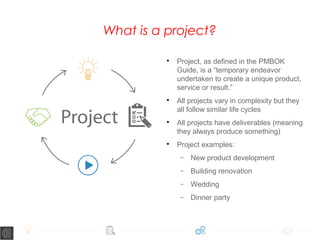
Project, as defined in the PMBOK
Guide, is a “temporary endeavor
undertaken to create a unique product,
service or result.”

All projects vary in complexity but they
all follow similar life cycles

All projects have deliverables (meaning
they always produce something)

Project examples:
− New product development
− Building renovation
− Wedding
− Dinner party
What is a project life cycle?

Project life cycle is a series of phases of a project from initiation
to completion.

The life cycle gives a practical approach to problem solving
applied to all aspects of a project.

Phases in a project life cycle encompasses sequential and
overlapping phases.

A project life cycle typically has 4 major phases:
− Initiation Phase
− Planning Phase
− Implementation/ Execution Phase
− Closure Phase
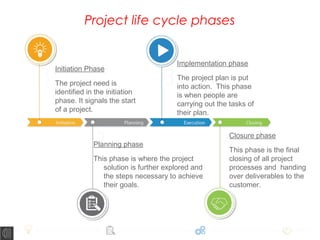
Project life cycle phases
Initiation Phase
The project need is
identified in the initiation
phase. It signals the start
of a project.
Planning phase
This phase is where the project
solution is further explored and
the steps necessary to achieve
their goals.
Closure phase
This phase is the final
closing of all project
processes and handing
over deliverables to the
customer.
Implementation phase
The project plan is put
into action. This phase
is when people are
carrying out the tasks of
their plan.
Initiation phase

The first phase explores the project concept.

Scope is defined during this phase.

Feasibility studies are made in order to identify if there
is a business need and justification to pursue the
project. Project charter is developed for approval.

This is the phase that the project team is assembled
and the project manager is identified.
Planning phase

This phase further details the scope of the project.

Tasks and resources are identified and assigned during
this phase

Project manager coordinates the preparation of the
schedule and project budget

Risks are identified ahead to anticipate any project threats

Quality plan is developed to maintain proper standards
throughout project

Communications plan is created in order to ensure
everyone is constantly informed of project status
Implementation phase

This phase is where the work outlined in the project
plan is performed.

This phase consumes the most resources and
energy.

Constant and close monitoring of the work should be
done to ensure efficiency of the project execution.

Status reports are important for all stakeholders
involved.

Deliverables are measured against the set metrics to
ensure quality is acceptable
Closure phase

This is the last phase of the project life cycle and
involves handing over final deliverable to the
customer.

Contracts are properly terminated for equipment,
vendors and staff.

All stakeholders are to be informed of project
closure.

This phase is when the team reviews the overall
project and identify lessons learned for future
projects.
Processes

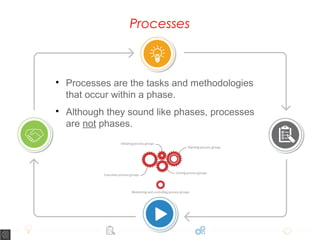
Processes are the tasks and methodologies
that occur within a phase.

Although they sound like phases, processes
are not phases.

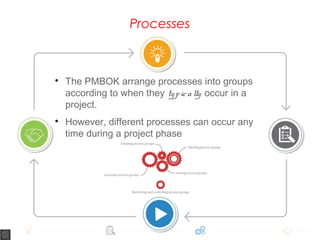
The PMBOK arrange processes into groups
according to when they typically occur in a
project.

However, different processes can occur any
time during a project phase
Processes

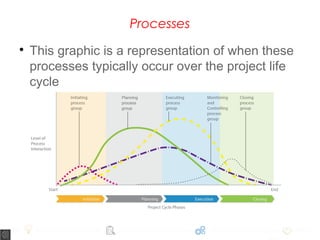
This graphic is a representation of when these
processes typically occur over the project life
cycle
Processes
Initiating process group

Typically occurring during the
initiation phase of a project.

These process groups define
the new project or phase
objectives and what is needed
to achieve it.

Involves obtaining
authorization for the project or
phase.

Process group main output is
the project charter and
stakeholder register.
Initiation processes:
4.1 Develop Project Charter
13.1 Identify Stakeholders
From PMBOK, 5th
edition
Planning process group

Typically occurring during the
planning phase of a project.

Planning process group does not
just apply to the planning phase.
Planning is an activity that continues
to almost the end of a project, as
projects tend to change as it
progresses.

A skilled project manager knows
how much time and effort to put into
each stage of planning as the project
changes
Planning processes:
4.2 Develop Project Management Plan
5.1 Plan Scope Management
5.2 Collect Requirements
5.3 Define Scope
5.4 Create WBS
6.1 Plan Schedule Management
6.2 Define Activities
6.3 Sequence Activities
6.4 Estimate Activity Resources
6.5 Estimate Activity Duration
6.6 Develop Schedule
7.1 Plan Cost Management
7.2 Estimate Costs
7.3 Determine Budget
8.1 Plan Quality Management
9.1 Plan Human Resource Management
10.1 Plan Communications Management
11.1 Plan Risk Management
11.2 Identify Risks
11.3 Perform Qualitative Risk Analysis
11.4 Perform Quantitative Risk Analysis
11.5 Plan Risk Responses
12.1 Plan Procurement Management
13.2 Plan Stakeholder Management
From PMBOK, 5th
edition
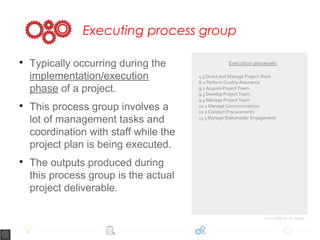
Executing process group

Typically occurring during the
implementation/execution
phase of a project.

This process group involves a
lot of management tasks and
coordination with staff while the
project plan is being executed.

The outputs produced during
this process group is the actual
project deliverable.
Execution processes:
4.3 Direct and Manage Project Work
8.2 Perform Quality Assurance
9.2 Acquire Project Team
9.3 Develop Project Team
9.4 Manage Project Team
10.2 Manage Communications
12.2 Conduct Procurements
13.3 Manage Stakeholder Engagement
From PMBOK, 5th
edition
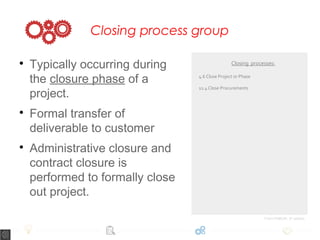
Closing process group

Typically occurring during
the closure phase of a
project.

Formal transfer of
deliverable to customer

Administrative closure and
contract closure is
performed to formally close
out project.
Closing processes:
4.6 Close Project or Phase
12.4 Close Procurements
From PMBOK, 5th
edition
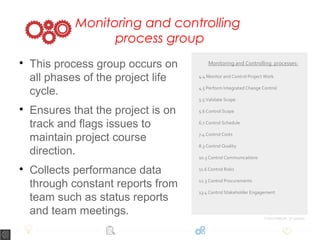
Monitoring and controlling
process group

This process group occurs on
all phases of the project life
cycle.

Ensures that the project is on
track and flags issues to
maintain project course
direction.

Collects performance data
through constant reports from
team such as status reports
and team meetings.
Monitoring and Controlling processes:
4.4 Monitor and Control Project Work
4.5 Perform Integrated Change Control
5.5 Validate Scope
5.6 Control Scope
6.7 Control Schedule
7.4 Control Costs
8.3 Control Quality
10.3 Control Communications
11.6 Control Risks
12.3 Control Procurements
13.4 Control Stakeholder Engagement
From PMBOK, 5th
edition
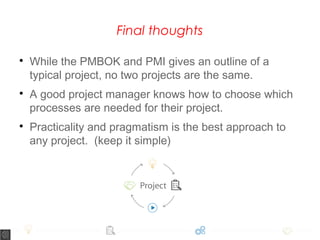
Final thoughts

While the PMBOK and PMI gives an outline of a
typical project, no two projects are the same.

A good project manager knows how to choose which
processes are needed for their project.

Practicality and pragmatism is the best approach to
any project. (keep it simple)
References

https://opentextbc.ca/projectmanagement/chapter/chapter-3-the-project-life-cycle-phases-p

http://www.method123.com/project-lifecycle.php

http://www.free-management-ebooks.com/faqpm/processes-01.htm

Duncan, William ( 1996 ). AGuide to the Pro je ct Manag e m e nt Bo dy o f
Kno wle dg e . Newtown Square, Pennsylvania: PMI Publishing Division.

Project life cycle

  • 1.
  • 2.
    What is aproject?  Project, as defined in the PMBOK Guide, is a “temporary endeavor undertaken to create a unique product, service or result.”  All projects vary in complexity but they all follow similar life cycles  All projects have deliverables (meaning they always produce something)  Project examples: − New product development − Building renovation − Wedding − Dinner party
  • 3.
    What is aproject life cycle?  Project life cycle is a series of phases of a project from initiation to completion.  The life cycle gives a practical approach to problem solving applied to all aspects of a project.  Phases in a project life cycle encompasses sequential and overlapping phases.  A project life cycle typically has 4 major phases: − Initiation Phase − Planning Phase − Implementation/ Execution Phase − Closure Phase
  • 4.
    Project life cyclephases Initiation Phase The project need is identified in the initiation phase. It signals the start of a project. Planning phase This phase is where the project solution is further explored and the steps necessary to achieve their goals. Closure phase This phase is the final closing of all project processes and handing over deliverables to the customer. Implementation phase The project plan is put into action. This phase is when people are carrying out the tasks of their plan.
  • 5.
    Initiation phase  The firstphase explores the project concept.  Scope is defined during this phase.  Feasibility studies are made in order to identify if there is a business need and justification to pursue the project. Project charter is developed for approval.  This is the phase that the project team is assembled and the project manager is identified.
  • 6.
    Planning phase  This phasefurther details the scope of the project.  Tasks and resources are identified and assigned during this phase  Project manager coordinates the preparation of the schedule and project budget  Risks are identified ahead to anticipate any project threats  Quality plan is developed to maintain proper standards throughout project  Communications plan is created in order to ensure everyone is constantly informed of project status
  • 7.
    Implementation phase  This phaseis where the work outlined in the project plan is performed.  This phase consumes the most resources and energy.  Constant and close monitoring of the work should be done to ensure efficiency of the project execution.  Status reports are important for all stakeholders involved.  Deliverables are measured against the set metrics to ensure quality is acceptable
  • 8.
    Closure phase  This isthe last phase of the project life cycle and involves handing over final deliverable to the customer.  Contracts are properly terminated for equipment, vendors and staff.  All stakeholders are to be informed of project closure.  This phase is when the team reviews the overall project and identify lessons learned for future projects.
  • 9.
    Processes  Processes are thetasks and methodologies that occur within a phase.  Although they sound like phases, processes are not phases.
  • 10.
     The PMBOK arrangeprocesses into groups according to when they typically occur in a project.  However, different processes can occur any time during a project phase Processes
  • 11.
     This graphic isa representation of when these processes typically occur over the project life cycle Processes
  • 12.
    Initiating process group  Typicallyoccurring during the initiation phase of a project.  These process groups define the new project or phase objectives and what is needed to achieve it.  Involves obtaining authorization for the project or phase.  Process group main output is the project charter and stakeholder register. Initiation processes: 4.1 Develop Project Charter 13.1 Identify Stakeholders From PMBOK, 5th edition
  • 13.
    Planning process group  Typicallyoccurring during the planning phase of a project.  Planning process group does not just apply to the planning phase. Planning is an activity that continues to almost the end of a project, as projects tend to change as it progresses.  A skilled project manager knows how much time and effort to put into each stage of planning as the project changes Planning processes: 4.2 Develop Project Management Plan 5.1 Plan Scope Management 5.2 Collect Requirements 5.3 Define Scope 5.4 Create WBS 6.1 Plan Schedule Management 6.2 Define Activities 6.3 Sequence Activities 6.4 Estimate Activity Resources 6.5 Estimate Activity Duration 6.6 Develop Schedule 7.1 Plan Cost Management 7.2 Estimate Costs 7.3 Determine Budget 8.1 Plan Quality Management 9.1 Plan Human Resource Management 10.1 Plan Communications Management 11.1 Plan Risk Management 11.2 Identify Risks 11.3 Perform Qualitative Risk Analysis 11.4 Perform Quantitative Risk Analysis 11.5 Plan Risk Responses 12.1 Plan Procurement Management 13.2 Plan Stakeholder Management From PMBOK, 5th edition
  • 14.
    Executing process group  Typicallyoccurring during the implementation/execution phase of a project.  This process group involves a lot of management tasks and coordination with staff while the project plan is being executed.  The outputs produced during this process group is the actual project deliverable. Execution processes: 4.3 Direct and Manage Project Work 8.2 Perform Quality Assurance 9.2 Acquire Project Team 9.3 Develop Project Team 9.4 Manage Project Team 10.2 Manage Communications 12.2 Conduct Procurements 13.3 Manage Stakeholder Engagement From PMBOK, 5th edition
  • 15.
    Closing process group  Typicallyoccurring during the closure phase of a project.  Formal transfer of deliverable to customer  Administrative closure and contract closure is performed to formally close out project. Closing processes: 4.6 Close Project or Phase 12.4 Close Procurements From PMBOK, 5th edition
  • 16.
    Monitoring and controlling processgroup  This process group occurs on all phases of the project life cycle.  Ensures that the project is on track and flags issues to maintain project course direction.  Collects performance data through constant reports from team such as status reports and team meetings. Monitoring and Controlling processes: 4.4 Monitor and Control Project Work 4.5 Perform Integrated Change Control 5.5 Validate Scope 5.6 Control Scope 6.7 Control Schedule 7.4 Control Costs 8.3 Control Quality 10.3 Control Communications 11.6 Control Risks 12.3 Control Procurements 13.4 Control Stakeholder Engagement From PMBOK, 5th edition
  • 17.
    Final thoughts  While thePMBOK and PMI gives an outline of a typical project, no two projects are the same.  A good project manager knows how to choose which processes are needed for their project.  Practicality and pragmatism is the best approach to any project. (keep it simple)
  • 18.