Project Scope Management
Waleed El-Naggar, MBA, PMP
Agenda
   Introduction to Project Scope

   Collect Requirements

   Define Scope

   Create WBS

   Control Scope

   Verify Scope
     10/06/2009              Prepared by: Waleed El-Naggar   2
What is Project Scope?
   Scope refers to all the work involved in creating
    the products of the project and the processes
    used to create them.

   Project scope management includes the
    processes required to ensure that the project
    includes all the work required, and only the work
    required, to complete the project successfully.
     10/06/2009                 Prepared by: Waleed El-Naggar   3
Product Scope vs. Project Scope
   Product scope: The futures & functions that
    characterize the product, service, or result.

   Project Scope: The work that needs to be
    accomplished to deliver a product, service, or
    result with the specified features and
    functions.

     10/06/2009                Prepared by: Waleed El-Naggar   4
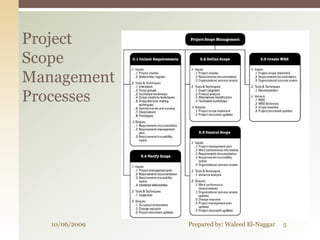
Project
Scope
Management
Processes


   10/06/2009   Prepared by: Waleed El-Naggar   5
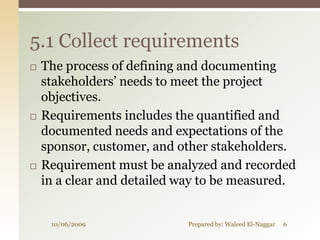
5.1 Collect requirements
   The process of defining and documenting
    stakeholders’ needs to meet the project
    objectives.
   Requirements includes the quantified and
    documented needs and expectations of the
    sponsor, customer, and other stakeholders.
   Requirement must be analyzed and recorded
    in a clear and detailed way to be measured.


     10/06/2009             Prepared by: Waleed El-Naggar   6
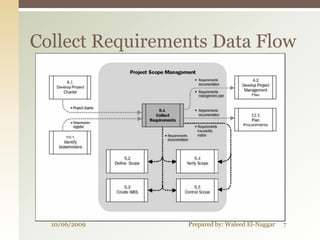
Collect Requirements Data Flow


  10/06/2009     Prepared by: Waleed El-Naggar   7
Collect Requirements: Inputs
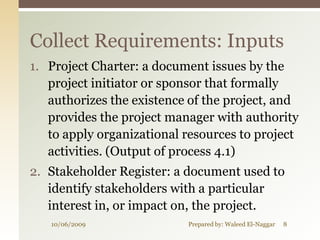
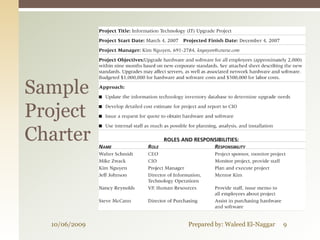
1. Project Charter: a document issues by the
   project initiator or sponsor that formally
   authorizes the existence of the project, and
   provides the project manager with authority
   to apply organizational resources to project
   activities. (Output of process 4.1)
2. Stakeholder Register: a document used to
   identify stakeholders with a particular
   interest in, or impact on, the project.
   10/06/2009              Prepared by: Waleed El-Naggar   8
Sample
Project
Charter


  10/06/2009   Prepared by: Waleed El-Naggar   9
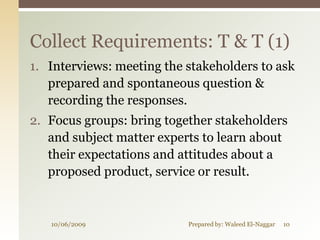
Collect Requirements: T & T (1)
1. Interviews: meeting the stakeholders to ask
   prepared and spontaneous question &
   recording the responses.
2. Focus groups: bring together stakeholders
   and subject matter experts to learn about
   their expectations and attitudes about a
   proposed product, service or result.


   10/06/2009              Prepared by: Waleed El-Naggar   10
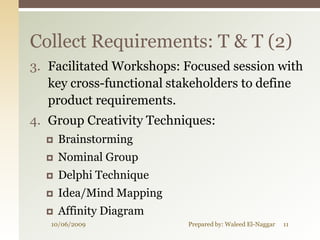
Collect Requirements: T & T (2)
3. Facilitated Workshops: Focused session with
   key cross-functional stakeholders to define
   product requirements.
4. Group Creativity Techniques:
     Brainstorming
     Nominal Group
     Delphi Technique
     Idea/Mind Mapping
     Affinity Diagram
   10/06/2009             Prepared by: Waleed El-Naggar   11
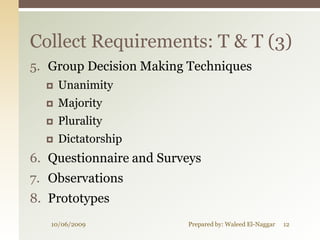
Collect Requirements: T & T (3)
5. Group Decision Making Techniques
     Unanimity
     Majority
     Plurality
     Dictatorship
6. Questionnaire and Surveys
7. Observations
8. Prototypes
   10/06/2009            Prepared by: Waleed El-Naggar   12
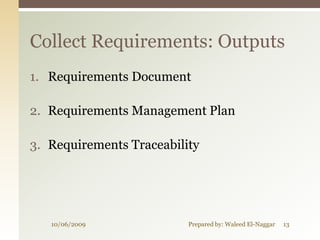
Collect Requirements: Outputs
1. Requirements Document

2. Requirements Management Plan

3. Requirements Traceability


   10/06/2009             Prepared by: Waleed El-Naggar   13
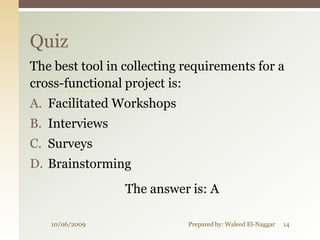
Quiz
The best tool in collecting requirements for a
cross-functional project is:
A. Facilitated Workshops
B. Interviews
C. Surveys
D. Brainstorming
                 The answer is: A

   10/06/2009               Prepared by: Waleed El-Naggar   14
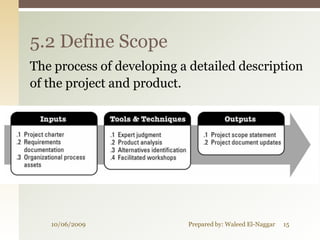
5.2 Define Scope
The process of developing a detailed description
of the project and product.


   10/06/2009              Prepared by: Waleed El-Naggar   15
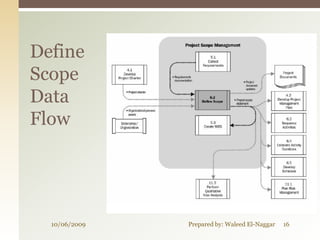
Define
Scope
Data
Flow


  10/06/2009   Prepared by: Waleed El-Naggar   16
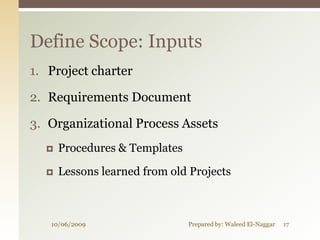
Define Scope: Inputs
1. Project charter

2. Requirements Document

3. Organizational Process Assets
     Procedures & Templates

     Lessons learned from old Projects


   10/06/2009                  Prepared by: Waleed El-Naggar   17
Define Scope: T & T
1. Expert Judgment

2. Product Analysis

3. Alternatives Identification

4. Facilitated workshops


   10/06/2009               Prepared by: Waleed El-Naggar   18
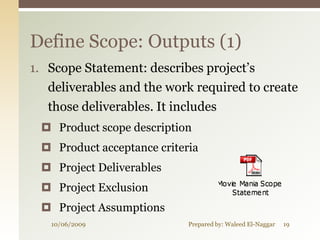
Define Scope: Outputs (1)
1. Scope Statement: describes project’s
   deliverables and the work required to create
   those deliverables. It includes
  Product scope description
  Product acceptance criteria
  Project Deliverables
  Project Exclusion
  Project Assumptions
   10/06/2009               Prepared by: Waleed El-Naggar   19
Define Scope: Outputs (2)
2. Project Documents Updates: may include,
  but not limited to:
  Stakeholder register

  Requirements Documents

  Requirements Traceability Matrix


   10/06/2009              Prepared by: Waleed El-Naggar   20
Quiz
Why would you consider the scope statement so important
in your project management methodology?
A. Mandatory to consult the plan before accepting change.
B. Project managers must document any changes before
   approving or declining them.
C. The project scope serves as a reference for all future
   project decisions.
D. The project plan and EVM work together to assess the
   risk involved with proposed changes
                     The answer is: C
      10/06/2009                    Prepared by: Waleed El-Naggar   21
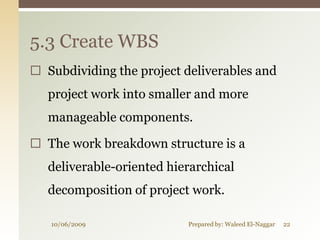
5.3 Create WBS
 Subdividing the project deliverables and
   project work into smaller and more
   manageable components.

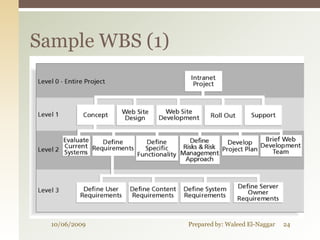
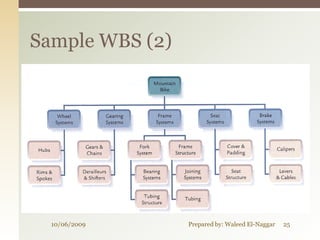
 The work breakdown structure is a
   deliverable-oriented hierarchical
   decomposition of project work.

   10/06/2009              Prepared by: Waleed El-Naggar   22
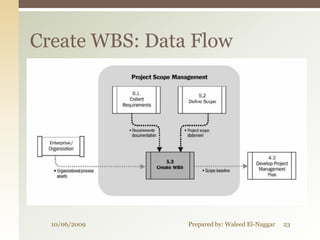
Create WBS: Data Flow


  10/06/2009    Prepared by: Waleed El-Naggar   23
Sample WBS (1)


  10/06/2009     Prepared by: Waleed El-Naggar   24
Sample WBS (2)


  10/06/2009     Prepared by: Waleed El-Naggar   25
Create WBS: Inputs
1. Project Scope Statement

2. Requirements Document

3. Organizational Process Assets


   10/06/2009                Prepared by: Waleed El-Naggar   26
Create WBS: T & T
1. Decomposition
  The subdivision of project deliverables into
  smaller, more manageable components. The
  work package level is the lowest level in the
  WBS, and is the point at which the cost an
  activity durations can be reliably estimated and
  managed. The level of detail for work packages
  will vary with the size and complexity of the
  project.
   10/06/2009               Prepared by: Waleed El-Naggar   27
Create WBS: Outputs
1. WBS

2. WBS Dictionary
  A number Identifier

  Who is responsible for what

  A description of each work package

  Any related codes

   10/06/2009              Prepared by: Waleed El-Naggar   28
Create WBS: Outputs
3. Scope baseline

4. Project Documents updates


   10/06/2009            Prepared by: Waleed El-Naggar   29
Quiz
A work breakdown structure numbering system allows
project staff to:
A. Systematically estimate costs of work breakdown
   structure elements.
B. Provide project justification
C. Identify the level at which individual elements are found
D. Use it in project management software


                     The answer is: C
      10/06/2009                   Prepared by: Waleed El-Naggar   30
Quiz
Which of the following documents contain detailed
descriptions of work packages?
A. Work breakdown structure (WBS) dictionary
B. Activity list
C. Preliminary project scope statement
D. Project scope management plan


                    The answer is: A
      10/06/2009                   Prepared by: Waleed El-Naggar   31
Quiz
The work breakdown structure can best be thought of as an
effective aid for ___________ communication
A. Team
B. Project manager
C. Customer
D. stakeholders


                     The answer is: D
     10/06/2009                  Prepared by: Waleed El-Naggar   32
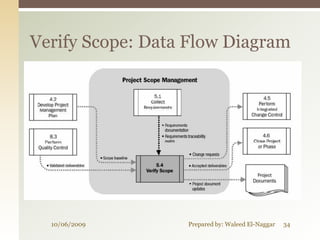
5.4 Verify Scope
 Formalizing acceptance of the completed
   project deliverables.
 Includes reviewing deliverables with the client
   and obtaining formal acceptance of deliverables.
 Scope verification is concerned with acceptance
  of deliverables while quality control is
   concerned with correctness of the deliverables
   and meeting quality requirements.
   10/06/2009                Prepared by: Waleed El-Naggar   33
Verify Scope: Data Flow Diagram


  10/06/2009      Prepared by: Waleed El-Naggar   34
Verify Scope: Inputs
1. Project Management Plan
   Scope statement

   WBS

   WBS Dictionary.

2. Requirements Documentation

3. Requirements Traceability Matrix

4. Validated Deliverables
   10/06/2009                Prepared by: Waleed El-Naggar   35
Verify Scope: T & T
1. Inspection: measuring, and verifying to
   determine whether work and deliverables meet
   requirements and product acceptance criteria.

   Inspections are sometimes called reviews,
   audits, and walkthroughs.


   10/06/2009                  Prepared by: Waleed El-Naggar   36
Verify Scope: Outputs
1. Accepted Deliverables

2. Change Requests

3. Project Document Updates


   10/06/2009              Prepared by: Waleed El-Naggar   37
Quiz
Which of the following is an output of scope
verification?
A. WBS template
B. Rework
C. Formal acceptance
D. SOW acceptance

                  The answer is: C
     10/06/2009               Prepared by: Waleed El-Naggar   38
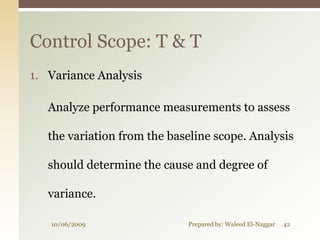
5.5 Control Scope
 Monitoring the status of the project and
  products scope
 Managing changes to scope baseline
 Ensure all requested changes and
  recommended corrective or preventive actions
  are processed through the “Perform Integrated
  Change Control” process (4.5)
 Uncontrolled changes are often referred to as
  project scope creep.
   10/06/2009                Prepared by: Waleed El-Naggar   39
Control Scope: Inputs (1)
1. Project Management Plan
  Scope baseline

  Scope management plan

  Change management plan

  Configuration management plan

  Requirements management plan

2. Work Performance Indicators
   10/06/2009                Prepared by: Waleed El-Naggar   40
Control Scope: Inputs (2)
3. Requirements Documentation

4. Requirements Traceability Matrix

5. Organizational Process Assets


   10/06/2009               Prepared by: Waleed El-Naggar   41
Control Scope: T & T
1. Variance Analysis

   Analyze performance measurements to assess

   the variation from the baseline scope. Analysis

   should determine the cause and degree of

   variance.

   10/06/2009                Prepared by: Waleed El-Naggar   42
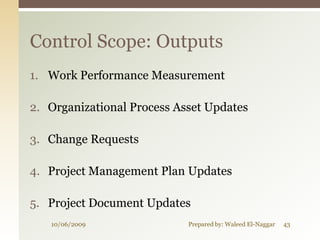
Control Scope: Outputs
1. Work Performance Measurement

2. Organizational Process Asset Updates

3. Change Requests

4. Project Management Plan Updates

5. Project Document Updates
   10/06/2009               Prepared by: Waleed El-Naggar   43
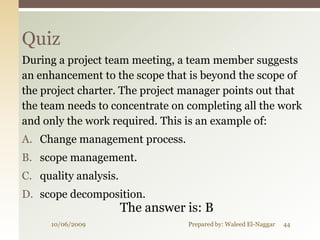
Quiz
During a project team meeting, a team member suggests
an enhancement to the scope that is beyond the scope of
the project charter. The project manager points out that
the team needs to concentrate on completing all the work
and only the work required. This is an example of:
A. Change management process.
B. scope management.
C. quality analysis.
D. scope decomposition.
                       The answer is: B
      10/06/2009                  Prepared by: Waleed El-Naggar   44
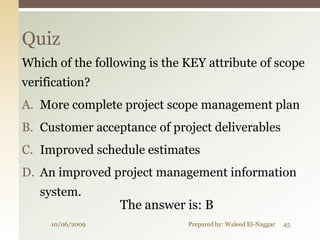
Quiz
Which of the following is the KEY attribute of scope
verification?
A. More complete project scope management plan
B. Customer acceptance of project deliverables
C. Improved schedule estimates
D. An improved project management information
   system.
                  The answer is: B
     10/06/2009               Prepared by: Waleed El-Naggar   45
Thank you


       waleed_k@aucegypt.edu


10/06/2009          Prepared by: Waleed El-Naggar   46

02 project scope management

  • 1.
  • 2.
    Agenda  Introduction to Project Scope  Collect Requirements  Define Scope  Create WBS  Control Scope  Verify Scope 10/06/2009 Prepared by: Waleed El-Naggar 2
  • 3.
    What is ProjectScope?  Scope refers to all the work involved in creating the products of the project and the processes used to create them.  Project scope management includes the processes required to ensure that the project includes all the work required, and only the work required, to complete the project successfully. 10/06/2009 Prepared by: Waleed El-Naggar 3
  • 4.
    Product Scope vs.Project Scope  Product scope: The futures & functions that characterize the product, service, or result.  Project Scope: The work that needs to be accomplished to deliver a product, service, or result with the specified features and functions. 10/06/2009 Prepared by: Waleed El-Naggar 4
  • 5.
    Project Scope Management Processes 10/06/2009 Prepared by: Waleed El-Naggar 5
  • 6.
    5.1 Collect requirements  The process of defining and documenting stakeholders’ needs to meet the project objectives.  Requirements includes the quantified and documented needs and expectations of the sponsor, customer, and other stakeholders.  Requirement must be analyzed and recorded in a clear and detailed way to be measured. 10/06/2009 Prepared by: Waleed El-Naggar 6
  • 7.
    Collect Requirements DataFlow 10/06/2009 Prepared by: Waleed El-Naggar 7
  • 8.
    Collect Requirements: Inputs 1.Project Charter: a document issues by the project initiator or sponsor that formally authorizes the existence of the project, and provides the project manager with authority to apply organizational resources to project activities. (Output of process 4.1) 2. Stakeholder Register: a document used to identify stakeholders with a particular interest in, or impact on, the project. 10/06/2009 Prepared by: Waleed El-Naggar 8
  • 9.
    Sample Project Charter 10/06/2009 Prepared by: Waleed El-Naggar 9
  • 10.
    Collect Requirements: T& T (1) 1. Interviews: meeting the stakeholders to ask prepared and spontaneous question & recording the responses. 2. Focus groups: bring together stakeholders and subject matter experts to learn about their expectations and attitudes about a proposed product, service or result. 10/06/2009 Prepared by: Waleed El-Naggar 10
  • 11.
    Collect Requirements: T& T (2) 3. Facilitated Workshops: Focused session with key cross-functional stakeholders to define product requirements. 4. Group Creativity Techniques:  Brainstorming  Nominal Group  Delphi Technique  Idea/Mind Mapping  Affinity Diagram 10/06/2009 Prepared by: Waleed El-Naggar 11
  • 12.
    Collect Requirements: T& T (3) 5. Group Decision Making Techniques  Unanimity  Majority  Plurality  Dictatorship 6. Questionnaire and Surveys 7. Observations 8. Prototypes 10/06/2009 Prepared by: Waleed El-Naggar 12
  • 13.
    Collect Requirements: Outputs 1.Requirements Document 2. Requirements Management Plan 3. Requirements Traceability 10/06/2009 Prepared by: Waleed El-Naggar 13
  • 14.
    Quiz The best toolin collecting requirements for a cross-functional project is: A. Facilitated Workshops B. Interviews C. Surveys D. Brainstorming The answer is: A 10/06/2009 Prepared by: Waleed El-Naggar 14
  • 15.
    5.2 Define Scope Theprocess of developing a detailed description of the project and product. 10/06/2009 Prepared by: Waleed El-Naggar 15
  • 16.
    Define Scope Data Flow 10/06/2009 Prepared by: Waleed El-Naggar 16
  • 17.
    Define Scope: Inputs 1.Project charter 2. Requirements Document 3. Organizational Process Assets  Procedures & Templates  Lessons learned from old Projects 10/06/2009 Prepared by: Waleed El-Naggar 17
  • 18.
    Define Scope: T& T 1. Expert Judgment 2. Product Analysis 3. Alternatives Identification 4. Facilitated workshops 10/06/2009 Prepared by: Waleed El-Naggar 18
  • 19.
    Define Scope: Outputs(1) 1. Scope Statement: describes project’s deliverables and the work required to create those deliverables. It includes  Product scope description  Product acceptance criteria  Project Deliverables  Project Exclusion  Project Assumptions 10/06/2009 Prepared by: Waleed El-Naggar 19
  • 20.
    Define Scope: Outputs(2) 2. Project Documents Updates: may include, but not limited to:  Stakeholder register  Requirements Documents  Requirements Traceability Matrix 10/06/2009 Prepared by: Waleed El-Naggar 20
  • 21.
    Quiz Why would youconsider the scope statement so important in your project management methodology? A. Mandatory to consult the plan before accepting change. B. Project managers must document any changes before approving or declining them. C. The project scope serves as a reference for all future project decisions. D. The project plan and EVM work together to assess the risk involved with proposed changes The answer is: C 10/06/2009 Prepared by: Waleed El-Naggar 21
  • 22.
    5.3 Create WBS Subdividing the project deliverables and project work into smaller and more manageable components.  The work breakdown structure is a deliverable-oriented hierarchical decomposition of project work. 10/06/2009 Prepared by: Waleed El-Naggar 22
  • 23.
    Create WBS: DataFlow 10/06/2009 Prepared by: Waleed El-Naggar 23
  • 24.
    Sample WBS (1) 10/06/2009 Prepared by: Waleed El-Naggar 24
  • 25.
    Sample WBS (2) 10/06/2009 Prepared by: Waleed El-Naggar 25
  • 26.
    Create WBS: Inputs 1.Project Scope Statement 2. Requirements Document 3. Organizational Process Assets 10/06/2009 Prepared by: Waleed El-Naggar 26
  • 27.
    Create WBS: T& T 1. Decomposition The subdivision of project deliverables into smaller, more manageable components. The work package level is the lowest level in the WBS, and is the point at which the cost an activity durations can be reliably estimated and managed. The level of detail for work packages will vary with the size and complexity of the project. 10/06/2009 Prepared by: Waleed El-Naggar 27
  • 28.
    Create WBS: Outputs 1.WBS 2. WBS Dictionary  A number Identifier  Who is responsible for what  A description of each work package  Any related codes 10/06/2009 Prepared by: Waleed El-Naggar 28
  • 29.
    Create WBS: Outputs 3.Scope baseline 4. Project Documents updates 10/06/2009 Prepared by: Waleed El-Naggar 29
  • 30.
    Quiz A work breakdownstructure numbering system allows project staff to: A. Systematically estimate costs of work breakdown structure elements. B. Provide project justification C. Identify the level at which individual elements are found D. Use it in project management software The answer is: C 10/06/2009 Prepared by: Waleed El-Naggar 30
  • 31.
    Quiz Which of thefollowing documents contain detailed descriptions of work packages? A. Work breakdown structure (WBS) dictionary B. Activity list C. Preliminary project scope statement D. Project scope management plan The answer is: A 10/06/2009 Prepared by: Waleed El-Naggar 31
  • 32.
    Quiz The work breakdownstructure can best be thought of as an effective aid for ___________ communication A. Team B. Project manager C. Customer D. stakeholders The answer is: D 10/06/2009 Prepared by: Waleed El-Naggar 32
  • 33.
    5.4 Verify Scope Formalizing acceptance of the completed project deliverables.  Includes reviewing deliverables with the client and obtaining formal acceptance of deliverables.  Scope verification is concerned with acceptance of deliverables while quality control is concerned with correctness of the deliverables and meeting quality requirements. 10/06/2009 Prepared by: Waleed El-Naggar 33
  • 34.
    Verify Scope: DataFlow Diagram 10/06/2009 Prepared by: Waleed El-Naggar 34
  • 35.
    Verify Scope: Inputs 1.Project Management Plan  Scope statement  WBS  WBS Dictionary. 2. Requirements Documentation 3. Requirements Traceability Matrix 4. Validated Deliverables 10/06/2009 Prepared by: Waleed El-Naggar 35
  • 36.
    Verify Scope: T& T 1. Inspection: measuring, and verifying to determine whether work and deliverables meet requirements and product acceptance criteria. Inspections are sometimes called reviews, audits, and walkthroughs. 10/06/2009 Prepared by: Waleed El-Naggar 36
  • 37.
    Verify Scope: Outputs 1.Accepted Deliverables 2. Change Requests 3. Project Document Updates 10/06/2009 Prepared by: Waleed El-Naggar 37
  • 38.
    Quiz Which of thefollowing is an output of scope verification? A. WBS template B. Rework C. Formal acceptance D. SOW acceptance The answer is: C 10/06/2009 Prepared by: Waleed El-Naggar 38
  • 39.
    5.5 Control Scope Monitoring the status of the project and products scope  Managing changes to scope baseline  Ensure all requested changes and recommended corrective or preventive actions are processed through the “Perform Integrated Change Control” process (4.5)  Uncontrolled changes are often referred to as project scope creep. 10/06/2009 Prepared by: Waleed El-Naggar 39
  • 40.
    Control Scope: Inputs(1) 1. Project Management Plan  Scope baseline  Scope management plan  Change management plan  Configuration management plan  Requirements management plan 2. Work Performance Indicators 10/06/2009 Prepared by: Waleed El-Naggar 40
  • 41.
    Control Scope: Inputs(2) 3. Requirements Documentation 4. Requirements Traceability Matrix 5. Organizational Process Assets 10/06/2009 Prepared by: Waleed El-Naggar 41
  • 42.
    Control Scope: T& T 1. Variance Analysis Analyze performance measurements to assess the variation from the baseline scope. Analysis should determine the cause and degree of variance. 10/06/2009 Prepared by: Waleed El-Naggar 42
  • 43.
    Control Scope: Outputs 1.Work Performance Measurement 2. Organizational Process Asset Updates 3. Change Requests 4. Project Management Plan Updates 5. Project Document Updates 10/06/2009 Prepared by: Waleed El-Naggar 43
  • 44.
    Quiz During a projectteam meeting, a team member suggests an enhancement to the scope that is beyond the scope of the project charter. The project manager points out that the team needs to concentrate on completing all the work and only the work required. This is an example of: A. Change management process. B. scope management. C. quality analysis. D. scope decomposition. The answer is: B 10/06/2009 Prepared by: Waleed El-Naggar 44
  • 45.
    Quiz Which of thefollowing is the KEY attribute of scope verification? A. More complete project scope management plan B. Customer acceptance of project deliverables C. Improved schedule estimates D. An improved project management information system. The answer is: B 10/06/2009 Prepared by: Waleed El-Naggar 45
  • 46.
    Thank you waleed_k@aucegypt.edu 10/06/2009 Prepared by: Waleed El-Naggar 46